battery OPEL VIVARO C 2020.25 Manual user
[x] Cancel search | Manufacturer: OPEL, Model Year: 2020.25, Model line: VIVARO C, Model: OPEL VIVARO C 2020.25Pages: 287, PDF Size: 28.79 MB
Page 220 of 287
218Vehicle careDischarge protection
Battery voltage
When the vehicle battery voltage is
running low, a warning message will
appear in the Driver Information
Centre.
When the vehicle is being driven, the
load reduction function temporarily
deactivates certain functions, such as
the air conditioning, the heated rear
window, heated steering wheel, etc.
The deactivated functions are
reactivated automatically as soon as
conditions permit.
Idle boost
If charging of the vehicle battery is
required due to battery condition, the
power output of the generator must be increased. This will be achieved by
an idle boost which may be audible.
A message appears in the Driver
Information Centre.
Power outlet
The power outlets are deactivated in
the event of low vehicle battery
voltage.Warning label
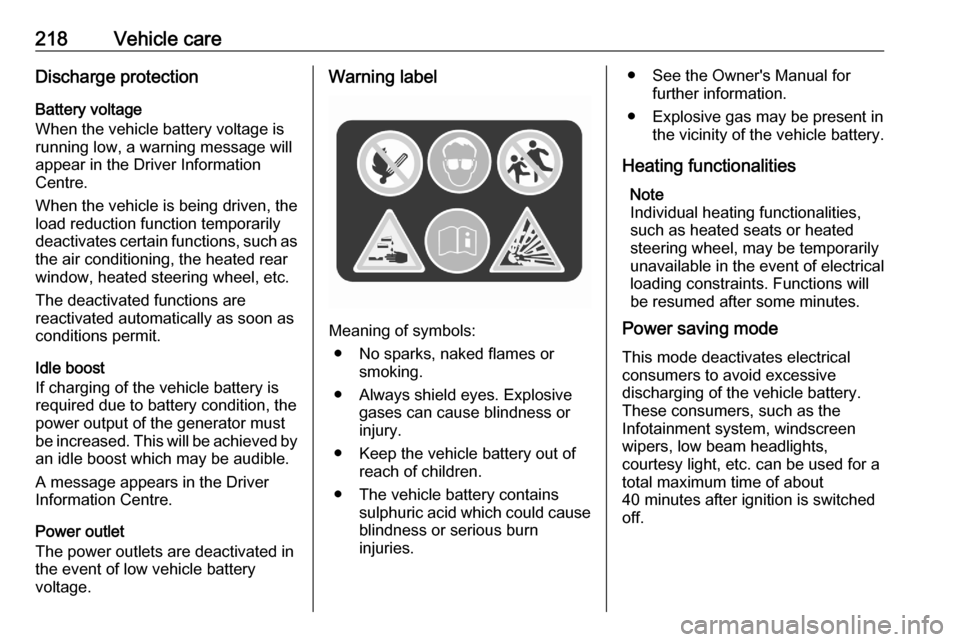
Meaning of symbols:
● No sparks, naked flames or smoking.
● Always shield eyes. Explosive gases can cause blindness or
injury.
● Keep the vehicle battery out of reach of children.
● The vehicle battery contains sulphuric acid which could cause
blindness or serious burn
injuries.
● See the Owner's Manual for further information.
● Explosive gas may be present in the vicinity of the vehicle battery.
Heating functionalities Note
Individual heating functionalities,
such as heated seats or heated
steering wheel, may be temporarily
unavailable in the event of electrical
loading constraints. Functions will
be resumed after some minutes.
Power saving mode
This mode deactivates electrical
consumers to avoid excessive
discharging of the vehicle battery.
These consumers, such as the
Infotainment system, windscreen
wipers, low beam headlights,
courtesy light, etc. can be used for a
total maximum time of about
40 minutes after ignition is switched
off.
Page 235 of 287
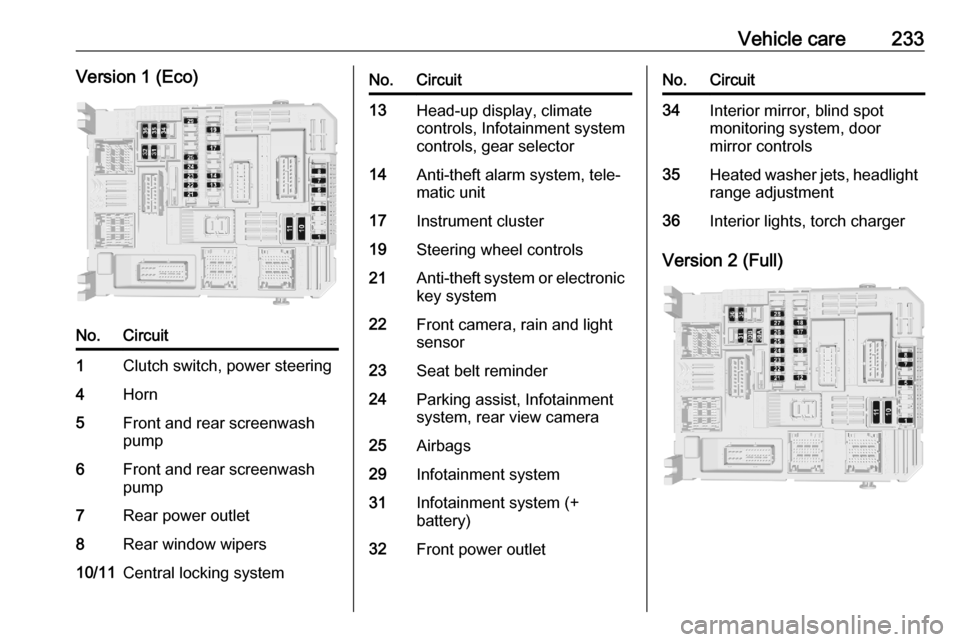
Vehicle care233Version 1 (Eco)No.Circuit1Clutch switch, power steering4Horn5Front and rear screenwash
pump6Front and rear screenwash
pump7Rear power outlet8Rear window wipers10/11Central locking systemNo.Circuit13Head-up display, climate
controls, Infotainment system
controls, gear selector14Anti-theft alarm system, tele‐
matic unit17Instrument cluster19Steering wheel controls21Anti-theft system or electronic key system22Front camera, rain and light
sensor23Seat belt reminder24Parking assist, Infotainment
system, rear view camera25Airbags29Infotainment system31Infotainment system (+
battery)32Front power outletNo.Circuit34Interior mirror, blind spot
monitoring system, door
mirror controls35Heated washer jets, headlight
range adjustment36Interior lights, torch charger
Version 2 (Full)
Page 236 of 287

234Vehicle careNo.Circuit1Anti-theft system or
electronic key system5Parking assist, Infotain‐
ment system, rear view
camera7Rear climate controls,
audio system amplifier8Rear window wipers10/11Central locking system12Anti-theft alarm system17Rear power outlet18Telematic unit21Interior lights, torch
charger22Interior lights, glovebox
light23Blind spot monitoring
system, door mirror
controls24Steering wheel controlsNo.Circuit25Headlight range adjust‐
ment26Seat belt reminder27Front camera, rain and
light sensor28Head-up display, front
climate controls, Info‐
tainment system
controls, gear selector30A or 30BAudio system (+
battery)31Airbag33Front power outlet35Instrument cluster36Infotainment systemVehicle tools
Tools
The tools are located in the box
underneath the left front seat.
Page 244 of 287
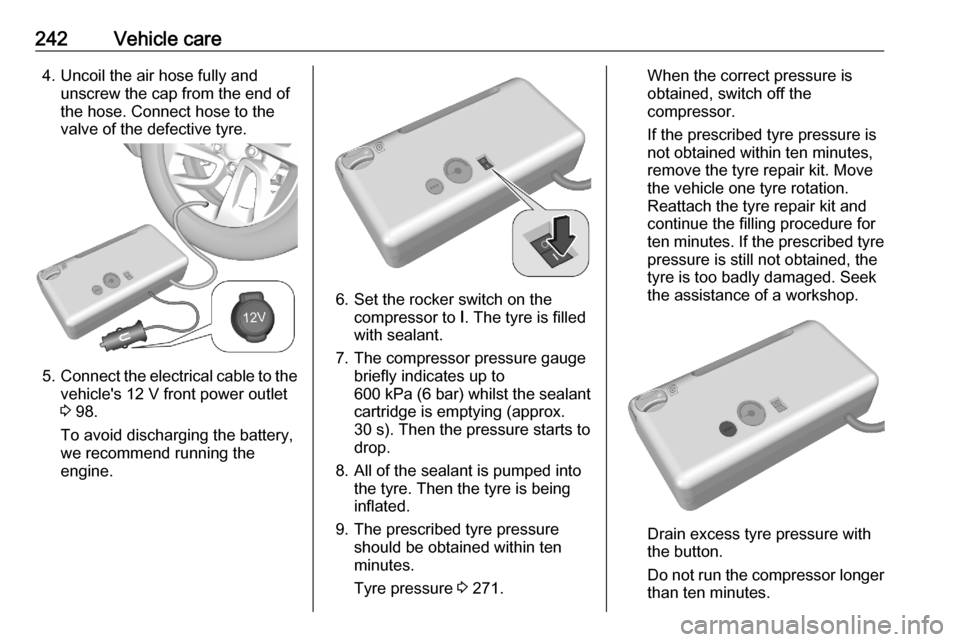
242Vehicle care4. Uncoil the air hose fully andunscrew the cap from the end of
the hose. Connect hose to the valve of the defective tyre.
5. Connect the electrical cable to the
vehicle's 12 V front power outlet
3 98.
To avoid discharging the battery, we recommend running the
engine.
6. Set the rocker switch on the compressor to I. The tyre is filled
with sealant.
7. The compressor pressure gauge briefly indicates up to
600 kPa (6 bar) whilst the sealant
cartridge is emptying (approx.
30 s). Then the pressure starts to
drop.
8. All of the sealant is pumped into the tyre. Then the tyre is being
inflated.
9. The prescribed tyre pressure should be obtained within ten
minutes.
Tyre pressure 3 271.
When the correct pressure is
obtained, switch off the
compressor.
If the prescribed tyre pressure is
not obtained within ten minutes,
remove the tyre repair kit. Move
the vehicle one tyre rotation.
Reattach the tyre repair kit and
continue the filling procedure for ten minutes. If the prescribed tyre pressure is still not obtained, the
tyre is too badly damaged. Seek
the assistance of a workshop.
Drain excess tyre pressure with
the button.
Do not run the compressor longer
than ten minutes.
Page 252 of 287

250Vehicle careJump startingDo not start with quick charger.
A vehicle with a discharged vehicle
battery can be started using jump
leads and the vehicle battery of
another vehicle.9 Warning
Be extremely careful when starting
with jump leads. Any deviation
from the following instructions can
lead to injuries or damage caused
by battery explosion or damage to the electrical systems of both
vehicles.
9 Warning
Avoid contact of the battery with
eyes, skin, fabrics and painted
surfaces. The fluid contains
sulphuric acid which can cause
injuries and damage in the event
of direct contact.
● Never expose the vehicle battery
to naked flames or sparks.
● A discharged vehicle battery can already freeze at a temperature
of 0 °C. Defrost the frozen battery before connecting jump leads.
● Wear eye protection and protective clothing when
handling a battery.
● Use a booster battery with the same voltage (12 V). Its capacity
(Ah) must not be much less than
that of the discharged vehicle battery.
● Use jump leads with insulated terminals and a cross section of
at least 16 mm 2
(25 mm 2
for
diesel engines).
● Do not disconnect the discharged
vehicle battery from the vehicle.
● Switch off all unnecessary electrical consumers.
● Do not lean over the vehicle battery during jump starting.
● Do not allow the terminals of one
lead to touch those of the other
lead.● The vehicles must not come into contact with each other during
the jump starting process.
● Apply the parking brake, transmission in neutral,
automatic transmission in P.
Open the positive terminal protection
caps of both vehicle batteries.
Lead connection order: 1. Connect the red lead to the positive terminal of the booster
battery.
2. Connect the other end of the red lead to the positive terminal of the
discharged battery.
Page 253 of 287

Vehicle care2513. Connect the black lead to thenegative terminal of the booster
battery.
4. Connect the other end of the black
lead to a vehicle grounding point
of your vehicle in the engine
compartment.
Route the leads so that they cannot
catch on rotating parts in the engine
compartment.
To start the engine: 1. Start the engine of the vehicle providing the jump.
2. After 5 minutes, start the other engine. Start attempts should be
made for no longer than 15
seconds at an interval of 1 minute.
3. Allow both engines to idle for approx. three minutes with the
leads connected.
4. Switch on electrical consumers e.g. headlights, heated rear
window of the vehicle receiving
the jump start.
5. Reverse above sequence exactly when removing leads.Towing
Towing the vehicle
Press in the middle of the cover plate
and slide to the upper left corner to
unclip it.
The towing eye is stowed with the vehicle tools 3 234.
Screw in the towing eye clockwise as
far as it will go until it stops in a
horizontal position.
Attach a tow rope – or better a tow rod
– to the towing eye.
The towing eye must only be used for
towing and not for recovering the
vehicle.
Switch on ignition to release steering
wheel lock and to permit operation of
brake lights, horn and windscreen
wiper.
Page 278 of 287

276Customer informationDepending on technical equipment
level, the data stored is as follows:
● system component operating states (e.g. fill level, tyre
pressure, battery status)
● faults and defects in important system components (e.g. lights,
brakes)
● system reactions in special driving situations (e.g. triggering
of an airbag, actuation of the
stability control systems)
● information on events damaging the vehicle
● for electric vehicles the amount of
charge in the high-voltage
battery, estimated range
In special cases (e.g. if the vehicle
has detected a malfunction), it may be
necessary to save data that would
otherwise just be volatile.
When you use services (e.g. repairs,
maintenance), the operating data
saved can be read together with the
vehicle identification number and
used when necessary. Staff working
for the service network ( e.g. garages,
manufacturers) or third parties (e.g.breakdown services) can read the
data from the vehicle. The same
applies to warranty work and quality
assurance measures.
Data is generally read via the OBD
(On-Board Diagnostics) port
prescribed by law in the vehicle. The operating data which is read out,
documents the technical condition of
the vehicle or individual components
and assists with fault diagnosis,
compliance with warranty obligations
and quality improvement. This data,
in particular information on
component stress, technical events,
operator errors and other faults, is
transmitted to the manufacturer
where appropriate, together with the
vehicle identification number. The
manufacturer is also subject to
product liability. The manufacturer
potentially also uses operating data
from vehicles for product recalls. This
data can also be used to check
customer warranty and guarantee
claims.
Fault memories in the vehicle can be
reset by a service company when
carrying out servicing or repairs or at
your request.Comfort and Infotainment
functions
Comfort settings and custom settingscan be stored in the vehicle and
changed or reset at any time.
Depending on the equipment level in
question, these include
● seat and steering wheel position settings
● chassis and air conditioning settings
● custom settings such as interior lighting
You can input your own data in the
Infotainment functions for your
vehicle as part of the selected
features.
Depending on the equipment level in
question, these include
● multimedia data such as music, videos or photos for playback in
an integrated multimedia system
● address book data for use with an
integrated hands-free system or an integrated navigation system
Page 282 of 287

280IndexAAccessories and vehicle modifications .......................... 212
Active emergency braking ..116, 188
Adaptive cruise control .......115, 180
AdBlue ................................ 114, 162
Adjustable air vents ...................149
Airbag and belt tensioners .........111
Airbag deactivation ..............65, 111
Airbag label................................... 61 Airbag system .............................. 61
Air conditioning regular operation ................................ 151
Air conditioning system .............. 141
Air intake .................................... 150
Air vents...................................... 149
Antilock brake system ................ 169
Antilock brake system (ABS) .....112
Anti-theft alarm system ................37
Anti-theft locking system .............. 36 Appearance care ........................253
Armrest ......................................... 52
Automatic anti-dazzle ..................41
Automatic crash notification (ACN) ...................................... 128
Automatic light control ...............131
Automatic locking ........................29
Automatic transmission .............165
Autostop ............................. 115, 157B
Battery discharge protection ......138
BlueInjection ............................... 162
Bonnet ....................................... 214
Brake and clutch fluid .................262
Brake assist ............................... 171
Brake fluid .................................. 216 Brakes ............................... 169, 216
Brake system ............................. 112
Breakdown.................................. 251
Bulb replacement ....................... 220
C Camera display........................... 199
Capacities .................................. 270
Cargo management system ........82
Catalytic converter .....................161
Central locking system ................25
Centre console lighting ..............137
Centre high-mounted brake light 229
Changing tyre and wheel size ...240
Charging system ........................ 111
child lock ....................................... 43
Child locks ................................... 29
Child restraint installation locations ................................... 70
Child restraints.............................. 67
Child restraint systems ................67
Child surveillance mirror ...............41
Climate control ............................. 16
Page 286 of 287

284torch............................................ 135
Tow bar....................................... 205
Towing ................................ 205, 251
Towing another vehicle .............252
Towing equipment .....................207
Towing the vehicle .....................251
Trailer coupling ........................... 205
Trailer stability assist .................210
Trailer towing ............................. 206
Transmission ............................... 18
Transmission display .................166
Tread depth ............................... 239
Trip odometer ............................ 106
Turn lights .......................... 110, 134
Tyre chains ................................ 240
Tyre deflation detection system . 238
Tyre designations ......................237
Tyre pressure ............................ 237
Tyre pressures ........................... 271
Tyre repair kit ............................. 241
U Ultrasonic parking assist............. 192
Underseat storage .......................80
Upholstery .................................. 255
USB port ....................................... 98
Using this manual ..........................3
V
Valet mode ................................. 120
Vehicle battery ........................... 217Vehicle checks............................ 213
Vehicle data ................................ 266
Vehicle data recording and privacy ..................................... 275
Vehicle detected ahead ..............115
Vehicle dimensions .................... 270
Vehicle Identification Number ....264
Vehicle jack ................................ 234
Vehicle locator lighting ...............138
Vehicle messages .....................123
Vehicle personalisation .............124
Vehicle security ............................ 36
Vehicle specific data ......................3
Vehicle storage ........................... 212
Vehicle tools ............................... 234
Vehicle unlocking ........................... 6 Ventilation ................................... 147
W
Warning chimes .........................123
Warning lights ............................. 105
Washer and wiper systems .........14
Washer fluid ............................... 216
Wheel changing .........................244
Wheel covers ............................. 240
Wheels and tyres .......................237
Windows ....................................... 42
Windscreen................................... 42
Windscreen wiper and washer ....95Winter tyres ............................... 237
Wiper blade replacement ..........219
X
Xenon headlights .......................223