ESP OPEL ZAFIRA 2009 User Guide
[x] Cancel search | Manufacturer: OPEL, Model Year: 2009, Model line: ZAFIRA, Model: OPEL ZAFIRA 2009Pages: 228, PDF Size: 7.3 MB
Page 141 of 228
Driving and operating
141
ABS starts to regulate brake pressure
as soon as a wheel shows a tendency
to lock. The vehicle remains
steerable, even during hard braking.
ABS control is made apparent though
a pulse in the brake pedal and the
noise of the regulation process.
For optimum braking, keep the brake
pedal fully depressed throughout the
braking process, despite the fact that
the pedal is pulsating. Do not reduce
the pressure on the pedal.
Control indicator u 3 89.
Adaptive brake lamp
During full braking, all three brake
lamps flash for the duration of ABS
control. Fault
9
Warning If there is a fault in the ABS, the
wheels may be liable to lock due
to braking that is heavier than
normal. The advantages of ABS
are no longer available. During
hard braking, the vehicle can no
longer be steered and may
swerve.
Have the cause of the fault remedied
by a workshop. Parking brake
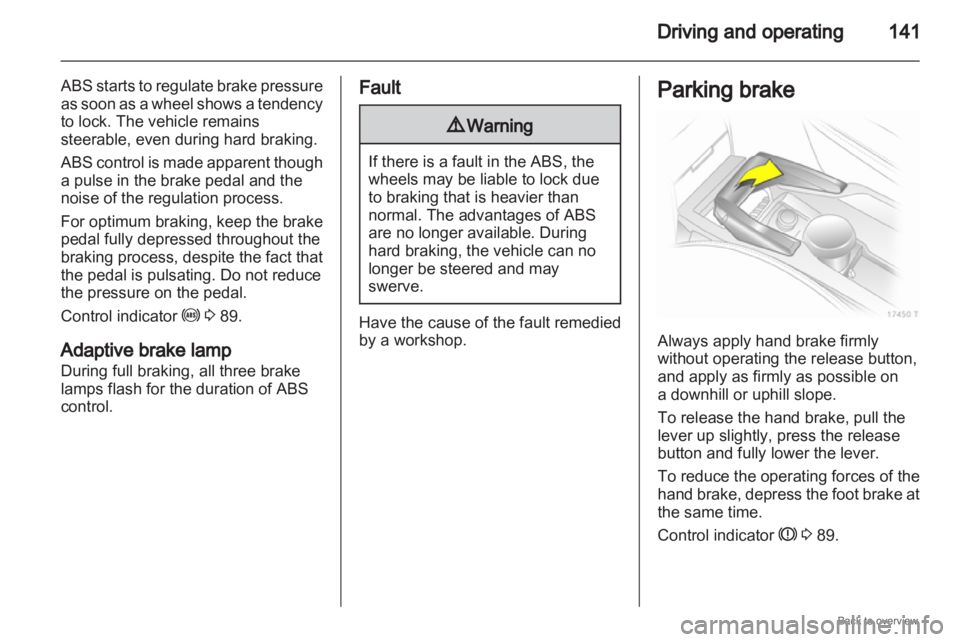
Always apply hand brake firmly
without operating the release button,
and apply as firmly as possible on
a downhill or uphill slope.
To release the hand brake, pull the
lever up slightly, press the release
button and fully lower the lever.
To
reduce the operating forces of the
hand brake, depress the foot brake at
the same time.
Control indicator R 3 89.
Page 142 of 228

142
Driving and operating
Brake assist
If the brake pedal is depressed
quickly and forcefully, maximum
brake force is automatically applied
(full braking).
Maintain steady pressure on the
brake
pedal for as long as full braking
is required. Maximum brake force is
automatically reduced when the
brake pedal is released.
Hill start assist
The system helps pull away on
inclines. After releasing the brake
pedal, if the hand brake is not applied
the brakes are released after a 2-
second delay. Ride control systems
Electronic stability
program
Electronic stability program
(ESP®
Plus
) improves driving stability
when necessary, regardless of the
type
of road surface or tyre grip. It also
prevents the drive wheels from
spinning.
As soon as the vehicle starts to
swerve (understeer/oversteer),
engine output is reduced and the
wheels are braked individually. This
considerably improves the driving
stability of the vehicle on slippery road
surfaces.
ESP® Plus
is operational as soon as
control indicator v extinguishes.
When ESP® Plus
comes into action v
flashes. 9
Warning Do not let this special safety
feature tempt you into taking risks
when driving.
Adapt speed to the road
conditions.
Control indicator
v 3 89.
Deactivation ESP®
Plus
can be deactivated when
Sport mode is engaged for high-
performance driving:
Page 143 of 228

Driving and operating
143
Hold the SPORT button depressed
for about 4 seconds. Control indicator
v illuminates. ESPoff also appears in
the service display. 9
Warning Do not deactivate ESP®
Plus
if
a
run-flat tyre 3 has lost pressure.ESP®
Plus
is reactivated by pressing
the SPORT
button. ESPon appears in
the service display. ESP® Plus
is also
reactivated the next time the ignition
is switched on.
Sport mode 3 143.
Interactive driving system
Interactive driving system (IDS Plus
)
combines the electronic stability
program (ESP® Plus
) with the antilock
brake system (ABS) and continuous
damping control (CDC) to improve
driving dynamics and vehicle safety. Sport mode
Suspension and steering become
more direct and provide better
contact with the road surface. The
engine reacts more quickly to
accelerator pedal movements.
Automatic
gear changing is also more
responsive.
Control indicator IDSPlus
3 91.
Activation Press SPORT button.
Control indicator
1 3 89. Winter programme activation not
possible.
Deactivation
Briefly press the SPORT button.
Sport mode is deactivated the next
time the ignition is switched on or if
the Winter programme is activated.
Continuous damping
control
Continuous damping control (CDC)
changes suspension with damping
adaptation
of each shock absorber to
the current driving situation and road
conditions.
When Sport mode is engaged, the
damping control is adapted to
a sportier driving style.
Control indicator IDS+ 3 91.
Page 145 of 228
Driving and operating
145
Reduction
With cruise control active, hold down
button g
or briefly press it repeatedly:
speed is reduced continuously or in
small increments.
When button g is released the current
speed is stored and maintained.
Deactivation
Briefly press the § button: cruise
control is deactivated.
Automatic deactivation:
■ Vehicle speed below approx. 30 km/h
■ The brake pedal is depressed
■ The clutch pedal is depressed
■ Selector lever in N. Object detection
systems
Parking assist Parking assist makes parking easier
by measuring the distance between
the vehicle and obstacles. It is the
driver, however, who maintains full
responsibility for parking.
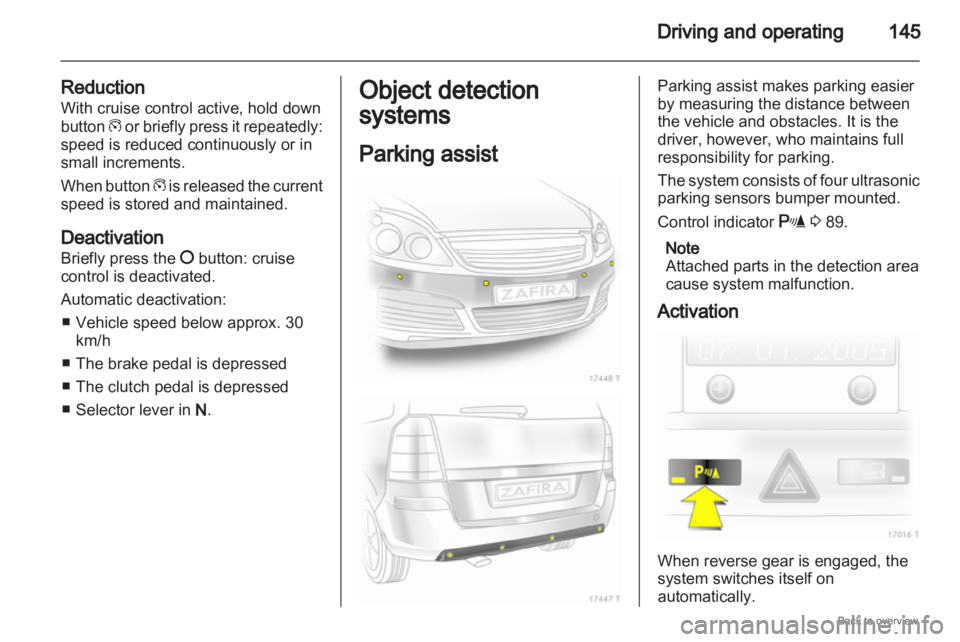
The
system consists of four ultrasonic
parking sensors bumper mounted.
Control indicator r 3 89.
Note
Attached parts in the detection area
cause system malfunction.
Activation When reverse gear is engaged, the
system switches itself on
automatically.
Page 150 of 228
150
Driving and operating
If the trailer starts snaking, drive more
slowly, do not attempt to correct the
steering and brake sharply if
necessary.
When driving downhill, drive in the
same gear as if driving uphill and
drive at a similar speed.
Adjust tyre pressure to the value
specified for full load 3 220.
Trailer towing
Trailer loads
The permissible trailer loads are
vehicle and engine-dependent
maximum values which must not be
exceeded. The actual trailer load is
the difference between the actual
gross weight of the trailer and the
actual coupling socket load with the
trailer coupled.
The permissible trailer loads are
specified
in the vehicle documents. In
general, they are valid for gradients
up to max. 12 % The permitted trailer load applies up
to the specified incline and up to an
altitude of 1000 metres above sea
level. Since engine power decreases
as altitude increases because of the
air becoming thinner, therefore
reducing climbing ability, the
permissible gross train weight also
decreases by 10 % for every 1000
metres of additional altitude. The
gross
train weight does not have to be
reduced when driving on roads with
slight inclines (less than 8 %, e. g.
motorways).
The permissible gross train weight
must not be exceeded. This weight is
specified on the identification plate
3 208.
Vertical coupling load
The vertical coupling load is the load
exerted by the trailer on the coupling
ball. It can be varied by changing the
weight distribution when loading the
trailer.
The maximum permissible vertical
coupling load (75 kg) is specified on
the towing equipment identification
plate and in the vehicle documents. Always aim for the maximum load,
especially in the case of heavy
trailers. The vertical coupling load
should never fall below 25 kg.
Rear axle load
When the trailer is coupled and the
towing vehicle fully loaded, the
permissible rear axle load (see
identification plate or vehicle
documents) may be exceeded by 90
kg
and the gross vehicle weight rating
by 75 kg. If the permissible rear axle
load is exceeded, a maximum speed
of 100 km/h applies.
Towing equipment Caution
When operating without a trailer,
remove the coupling ball bar.
Page 153 of 228
Driving and operating
153
Dismounting the coupling ball
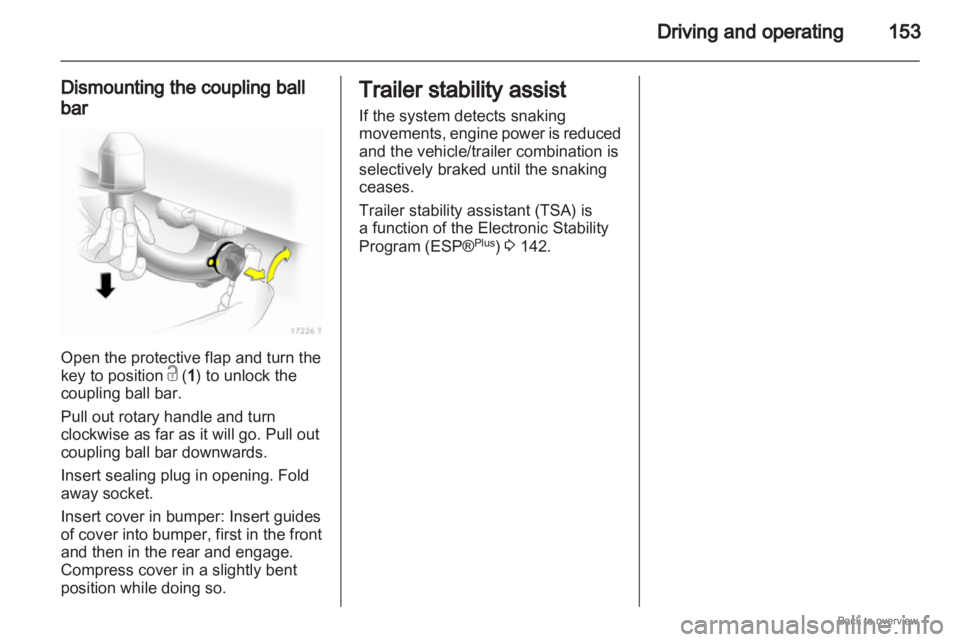
bar Open the protective flap and turn the
key to position c (1
) to unlock the
coupling ball bar.
Pull out rotary handle and turn
clockwise as far as it will go. Pull out
coupling ball bar downwards.
Insert sealing plug in opening. Fold
away socket.
Insert cover in bumper: Insert guides
of cover into bumper, first in the front
and then in the rear and engage.
Compress cover in a slightly bent
position while doing so. Trailer stability assist
If the system detects snaking
movements,
engine power is reduced
and the vehicle/trailer combination is
selectively braked until the snaking
ceases.
Trailer stability assistant (TSA) is
a function of the Electronic Stability
Program (ESP® Plus
) 3 142.
Page 167 of 228
Vehicle care
167
2. Press bulb slightly towards spring clip and remove.
3. Insert new bulb.
4. Install lamp.
Instrument panel
illumination
Have bulbs replaced by a workshop. Electrical system
Fuses
Data on the replacement fuse must
match
the data on the defective fuse.
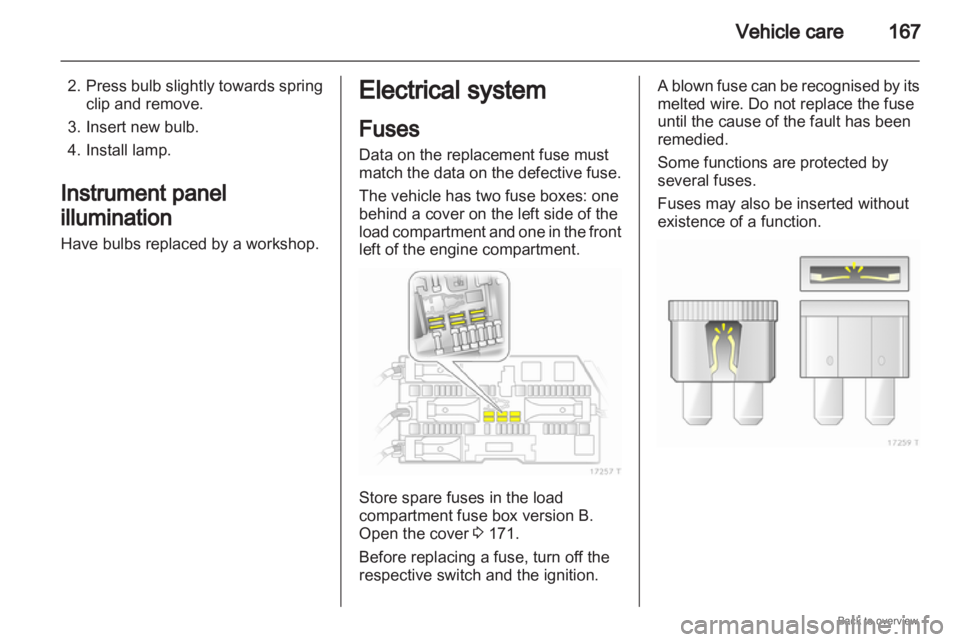
The vehicle has two fuse boxes: one
behind a cover on the left side of the
load compartment and one in the front
left of the engine compartment. Store spare fuses in the load
compartment fuse box version B.
Open the cover 3 171.
Before replacing a fuse, turn off the
respective switch and the ignition. A blown fuse can be recognised by its
melted wire. Do not replace the fuse
until the cause of the fault has been
remedied.
Some functions are protected by
several fuses.
Fuses may also be inserted without
existence of a function.
Page 178 of 228
178
Vehicle care
If there is more wear at the front than
the rear, swap round front wheels and
rear wheels.
Tyres age, even if they are not used.
We recommend tyre replacement
every 6 years.
Changing tyre and wheel
size
If tyres of a different size than those
fitted at the factory are used, it may be
necessary to reprogram the
speedometer and make other vehicle
modifications.
After converting to a different tyre
size, have the label with tyre
pressures replaced. 9
Warning Use of unsuitable tyres or wheels
may lead to accidents and will
invalidate the vehicle type
approval. Wheel covers
Wheel covers and tyres that are
factory approved for the respective
vehicle and comply with all of the
relevant wheel and tyre combination
requirements must be used.
If
the wheel covers and tyres used are
not factory approved, the tyres must
not have a beaded edge.
Wheel covers must not impair brake
cooling.
Remove the wheel covers if tyre
chains are to be installed. 9
Warning Use of unsuitable tyres or wheel
covers could lead to sudden
pressure loss and thereby
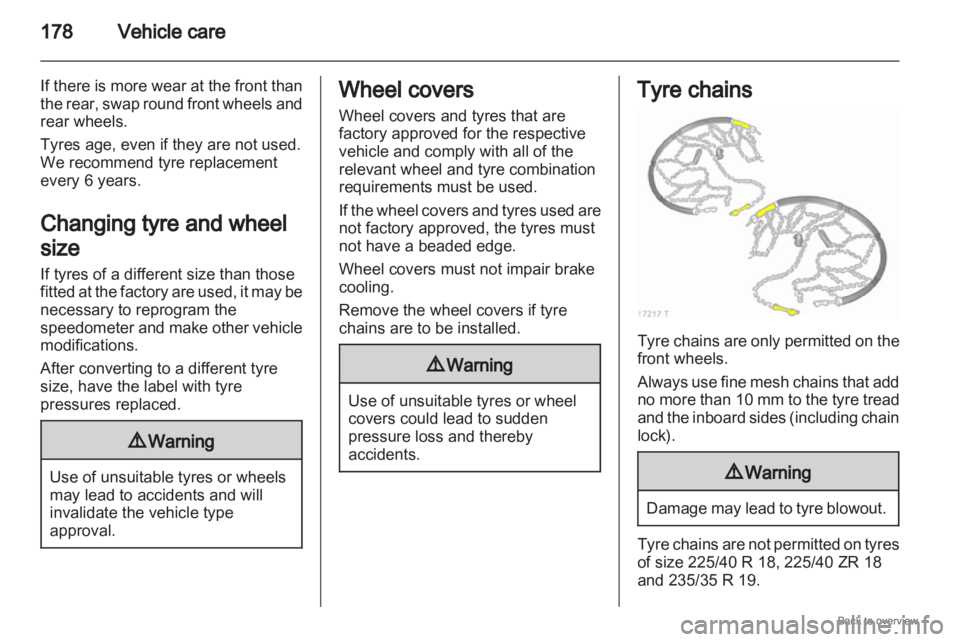
accidents. Tyre chains
Tyre chains are only permitted on the
front wheels.
Always
use fine mesh chains that add
no more than 10 mm to the tyre tread
and the inboard sides (including chain
lock). 9
Warning Damage may lead to tyre blowout.
Tyre chains are not permitted on tyres
of size 225/40 R 18, 225/40 ZR 18
and 235/35 R 19.