battery OPEL ZAFIRA 2009 User Guide
[x] Cancel search | Manufacturer: OPEL, Model Year: 2009, Model line: ZAFIRA, Model: OPEL ZAFIRA 2009Pages: 228, PDF Size: 7.3 MB
Page 135 of 228
Driving and operating
135
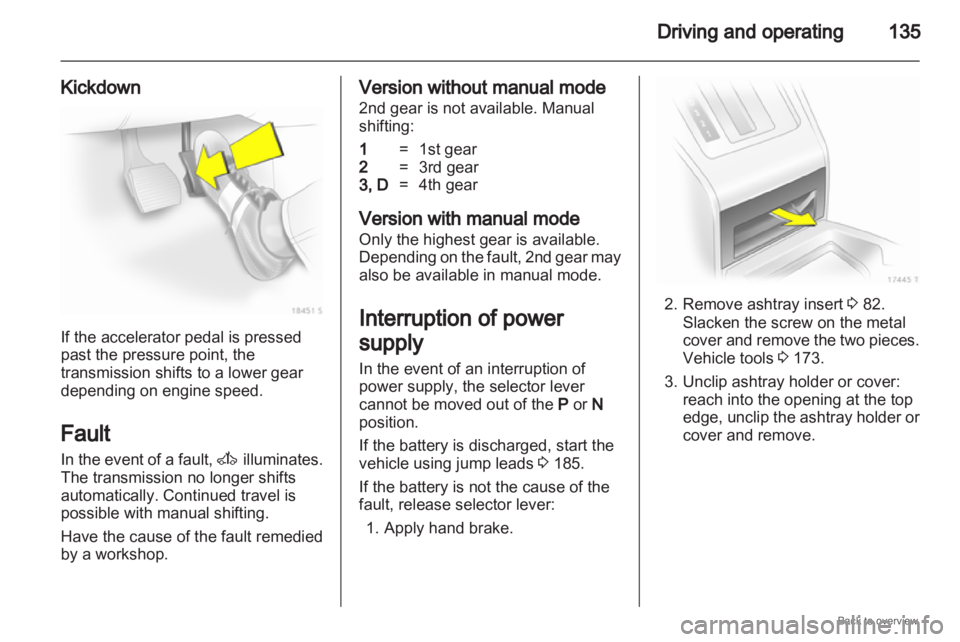
Kickdown If the accelerator pedal is pressed
past the pressure point, the
transmission shifts to a lower gear
depending on engine speed.
Fault
In
the event of a fault, A illuminates.
The transmission no longer shifts
automatically. Continued travel is
possible with manual shifting.
Have the cause of the fault remedied
by a workshop. Version without manual mode
2nd gear is not available. Manual
shifting:
1
= 1st gear
2 = 3rd gear
3, D =4th gear
Version with manual mode
Only the highest gear is available.
Depending
on the fault, 2nd gear may
also be available in manual mode.
Interruption of power
supply
In the event of an interruption of
power supply, the selector lever
cannot be moved out of the P or N
position.
If the battery is discharged, start the
vehicle using jump leads 3 185.
If the battery is not the cause of the
fault, release selector lever: 1. Apply hand brake. 2. Remove ashtray insert
3 82.
Slacken the screw on the metal
cover
and remove the two pieces.
Vehicle tools 3 173.
3. Unclip ashtray holder or cover: reach into the opening at the top
edge, unclip the ashtray holder or
cover and remove.
Page 139 of 228

Driving and operating
139
Activation
Press the T button. The transmission
switches to automatic mode. The
vehicle starts off in 2nd gear. Sport
mode is deactivated.
Deactivation
The Winter programme is switched off
by:
■ pressing the T button again
■ turning off the ignition,
■ switching to manual mode (when switched back to automatic mode,
the Winter programme is again
active)
■ when clutch temperature is too high Kickdown
If the accelerator pedal is pressed
past the pressure point, the
transmission shifts to a lower gear
depending on engine speed.
Fault
To prevent damage to the manual
transmission
automated, the clutch is
engaged automatically at high clutch
temperatures.
A illuminates in the event of a fault.
Continued driving is possible. Manual
mode cannot be used for shifting. If F appears in the transmission
display, continued driving is not
possible.
Have the cause of the fault remedied
by a workshop.
Interruption of power
supply
The clutch is not disengaged if there
is an interruption of the power supply
when a gear is engaged. The vehicle
cannot move.
If the battery is discharged, start the
vehicle using jump leads 3 185.
If the cause of the fault is not
a discharged battery, seek the
assistance of a workshop.
Page 154 of 228
154
Vehicle care
Vehicle care
General Information ...................154
Vehicle checks ........................... 155
Bulb replacement .......................160
Electrical system ........................167
Vehicle tools .............................. 173
Wheels and tyres .......................174
Jump starting ............................. 185
Towing ....................................... 187
Appearance care .......................189 General Information
Accessories and vehicle
modifications
We
recommend to use Genuine Parts
and Accessories and factory
approved parts specific for your
vehicle type. We cannot assess or
guarantee for other products - even if
they have a regulatory or otherwise
granted approval.
Do not make any modifications to the
electrical system, e. g. changes of
electronic control units (chip tuning).
Vehicle storage
Storage for a long period of time
Following must be done if the vehicle
should be stored for several months:
■ Wash and wax the vehicle.
■ Have the wax in the engine compartment and underbody
checked.
■ Clean and preserve rubber seals.
■ Change engine oil. ■ Drain washer fluid reservoir.
■
Check coolant anti-freeze andcorrosion protection.
■ Adjust tyre pressure to the value specified for full load.
■ Park vehicle in dry, well ventilated place. Engage first or reverse gear
or set selector lever to P. Prevent
the vehicle from rolling.
■ Do not apply hand brake.
■ Open bonnet, close all doors and lock the vehicle.
■ Disconnect the clamp from the negative terminal of the vehicle
battery. Beware that all systems are
not functional, e.g. anti-theft alarm
system.
Putting back into operation
Following must be done if the vehicle
is putting back into operation: ■ Connect the clamp to the negative terminal of the vehicle battery.
Activate the electronic of the power
windows.
■ Check tyre pressure.
■ Fill up the washer fluid reservoir.
Page 158 of 228
158
Vehicle care
concentration checked and have the
cause of the coolant loss remedied by
a workshop.
Washer fluid Fill with clean water mixed with
a suitable quantity of windscreen
wash solution which contains anti-
freeze. Brakes
A squealing noise indicates that the
brake lining is at its minimum
thickness. Continued driving is
possible but have the brake lining
replaced as soon as possible.
Once new brake linings are installed,
do not brake unnecessarily hard for
the first few journeys.
Brake fluid
9
Warning Brake fluid is poisonous and
corrosive.
Avoid contact with eyes,
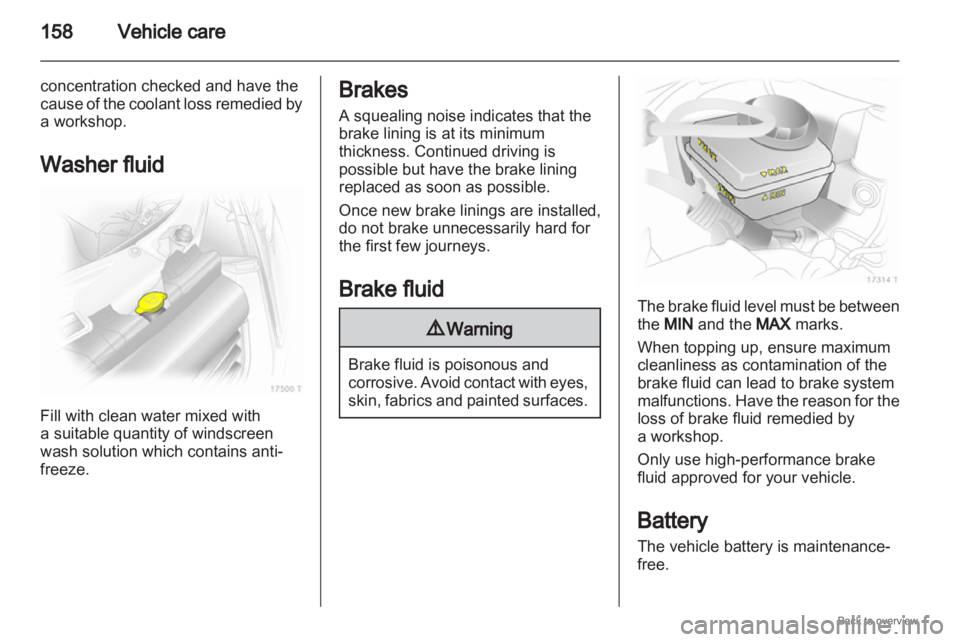
skin, fabrics and painted surfaces. The brake fluid level must be between
the MIN and the MAX marks.
When topping up, ensure maximum
cleanliness as contamination of the
brake fluid can lead to brake system
malfunctions.
Have the reason for the
loss of brake fluid remedied by
a workshop.
Only use high-performance brake
fluid approved for your vehicle.
Battery
The vehicle battery is maintenance-
free.
Page 159 of 228
Vehicle care
159
Batteries do not belong in household
waste. They must be disposed of at
an appropriate recycling collection
point.
Laying up the vehicle for more than
4 weeks can lead to battery
discharge.
Disconnect the clamp from
the negative terminal of the vehicle
battery.
Ensure the ignition is switched off
before connecting or disconnecting
the vehicle battery.
Diesel fuel system
bleeding
If the tank has been run dry, the diesel
fuel system must be bled. Switch on
the ignition three times for 15 seconds
at a time. Then start the engine for
a maximum of 40 seconds. Repeat
this process after no less than
5 seconds. If the engine fails to start,
seek the assistance of a workshop. Wiper blade replacement
Service setting for front
windscreen wipers
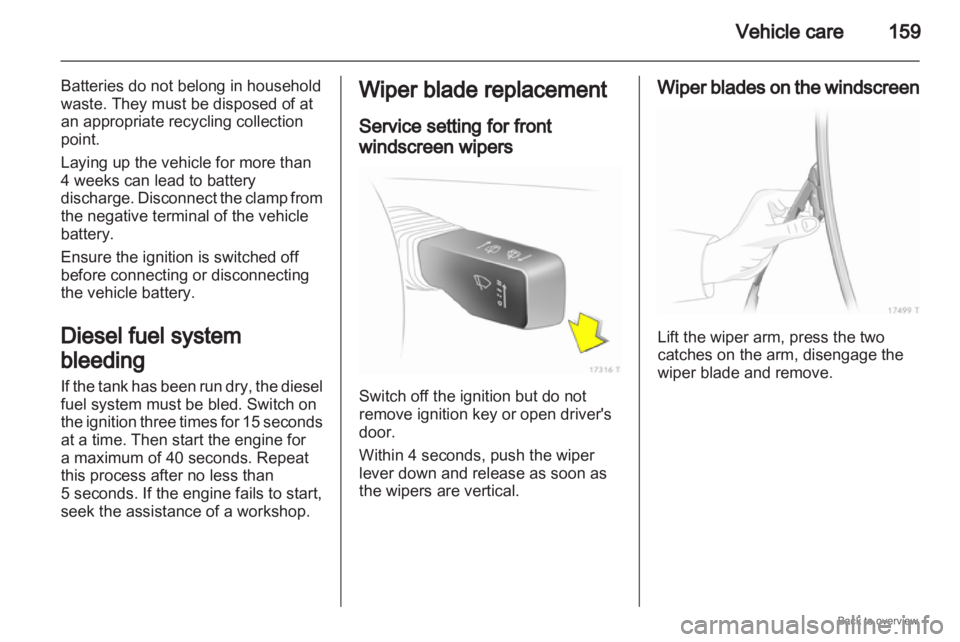
Switch off the ignition but do not
remove ignition key or open driver's
door.
Within 4 seconds, push the wiper
lever down and release as soon as
the wipers are vertical. Wiper blades on the windscreen
Lift the wiper arm, press the two
catches on the arm, disengage the
wiper blade and remove.
Page 180 of 228
180
Vehicle care
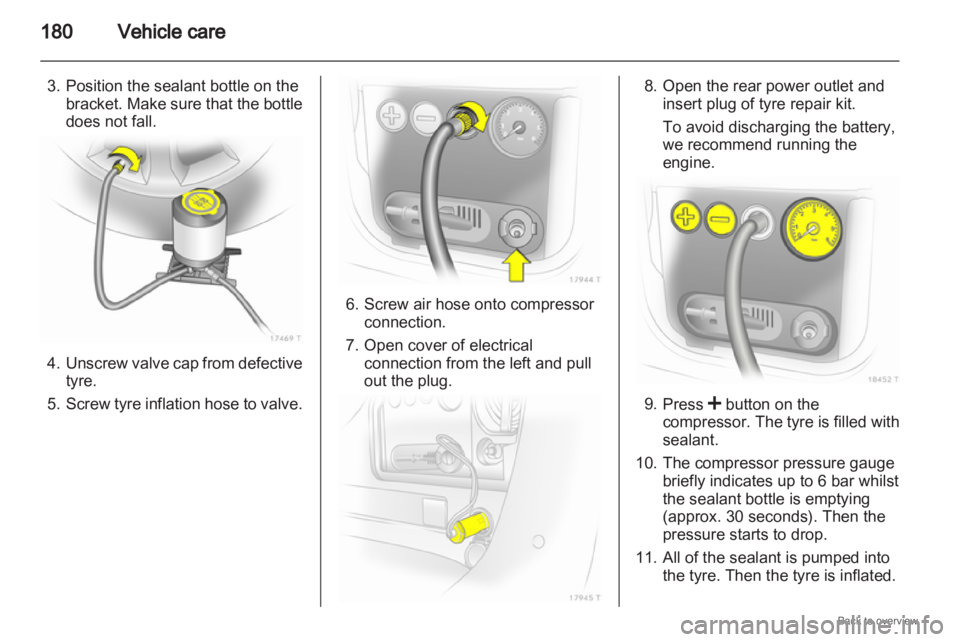
3. Position the sealant bottle on the bracket. Make sure that the bottle
does not fall. 4. Unscrew
valve cap from defective
tyre.
5. Screw tyre inflation hose to valve. 6. Screw air hose onto compressor
connection.
7.
Open cover of electricalconnection from the left and pull
out the plug. 8. Open the rear power outlet and
insert plug of tyre repair kit.
To avoid discharging the battery,
we recommend running the
engine. 9.
Press < button on the
compressor.
The tyre is filled with
sealant.
10. The compressor pressure gauge briefly indicates up to 6 bar whilst
the sealant bottle is emptying
(approx. 30 seconds). Then the
pressure starts to drop.
11. All of the sealant is pumped into the tyre. Then the tyre is inflated.
Page 185 of 228
Vehicle care
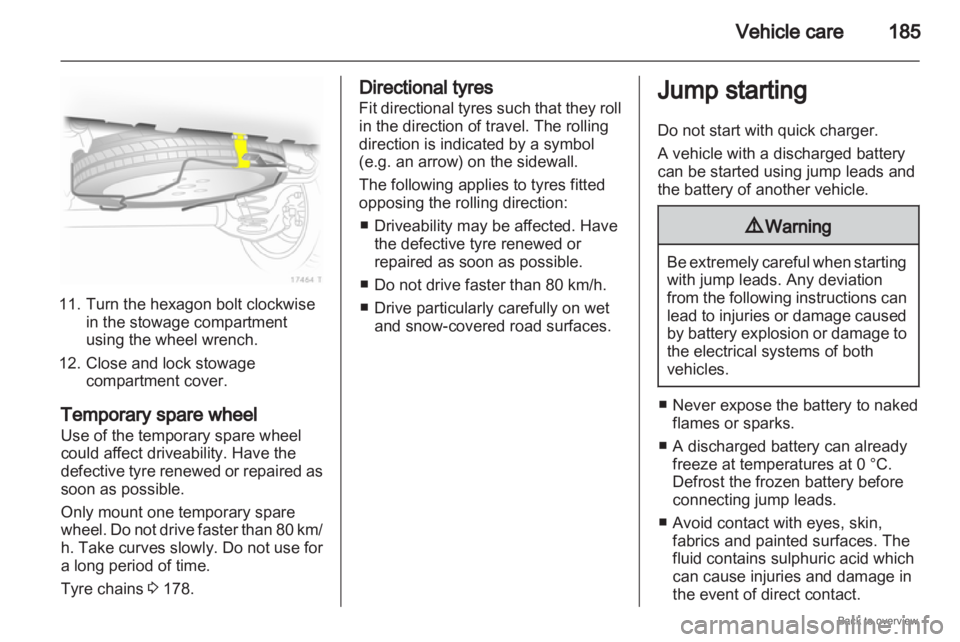
18511. Turn the hexagon bolt clockwise
in the stowage compartment
using the wheel wrench.
12.
Close and lock stowagecompartment cover.
Temporary spare wheel
Use of the temporary spare wheel
could affect driveability. Have the
defective tyre renewed or repaired as
soon as possible.
Only mount one temporary spare
wheel. Do not drive faster than 80 km/
h. Take curves slowly. Do not use for
a long period of time.
Tyre chains 3 178. Directional tyres
Fit
directional tyres such that they roll
in the direction of travel. The rolling
direction is indicated by a symbol
(e.g. an arrow) on the sidewall.
The following applies to tyres fitted
opposing the rolling direction:
■ Driveability may be affected. Have the defective tyre renewed or
repaired as soon as possible.
■ Do not drive faster than 80 km/h.
■ Drive particularly carefully on wet and snow-covered road surfaces. Jump starting
Do not start with quick charger.
A vehicle with a discharged battery
can be started using jump leads and
the battery of another vehicle.
9
Warning Be extremely careful when starting
with jump leads. Any deviation
from
the following instructions can
lead to injuries or damage caused
by battery explosion or damage to
the electrical systems of both
vehicles. ■ Never expose the battery to naked
flames or sparks.
■
A discharged battery can alreadyfreeze at temperatures at 0 °C.
Defrost the frozen battery before
connecting jump leads.
■ Avoid contact with eyes, skin, fabrics and painted surfaces. The
fluid contains sulphuric acid which
can cause injuries and damage in
the event of direct contact.
Page 186 of 228
186
Vehicle care
■ Wear eye protection and protective
clothing when handling a battery.
■ Use a booster battery with the same voltage (12 volts). Its capacity
(Ah) must not be much less than
that of the discharged battery.
■ Use jump leads with insulated terminals and a cross section of at
least 16 mm 2
(25 mm 2
for diesel
engines).
■ Do not disconnect the discharged battery from the vehicle.
■ Switch off all unnecessary electrical consumers.
■ Do not lean over the battery during jump starting.
■ Do not allow the terminals of one lead to touch those of the other
lead.
■ The vehicles must not come into contact with each other during the
jump starting process.
■ Apply the handbrake, transmission in neutral, automatic transmission
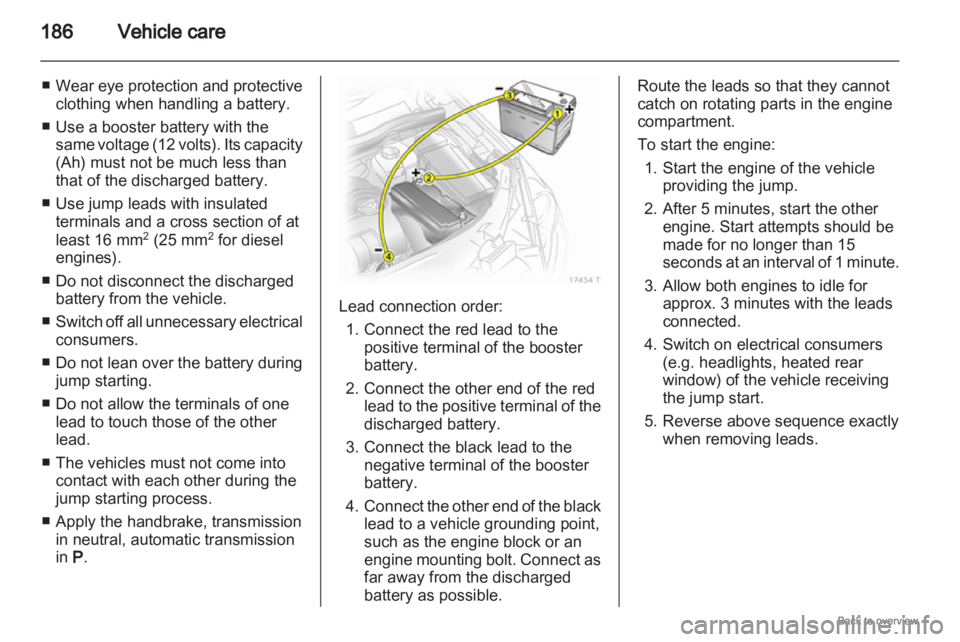
in P. Lead connection order:
1.
Connect the red lead to thepositive terminal of the booster
battery.
2. Connect the other end of the red lead to the positive terminal of the
discharged battery.
3. Connect the black lead to the negative terminal of the booster
battery.
4. Connect the other end of the black lead to a vehicle grounding point,
such as the engine block or an
engine mounting bolt. Connect as
far away from the discharged
battery as possible. Route the leads so that they cannot
catch on rotating parts in the engine
compartment.
To start the engine:
1.
Start the engine of the vehicleproviding the jump.
2. After 5 minutes, start the other engine. Start attempts should be
made for no longer than 15
seconds at an interval of 1 minute.
3. Allow both engines to idle for approx. 3 minutes with the leads
connected.
4. Switch on electrical consumers (e.g. headlights, heated rear
window) of the vehicle receiving
the jump start.
5. Reverse above sequence exactly when removing leads.
Page 195 of 228
Service and maintenance
195Service operations by year
1)
km ( x 1000) 1) 1
30 2
60 3
90 4
120 5
150
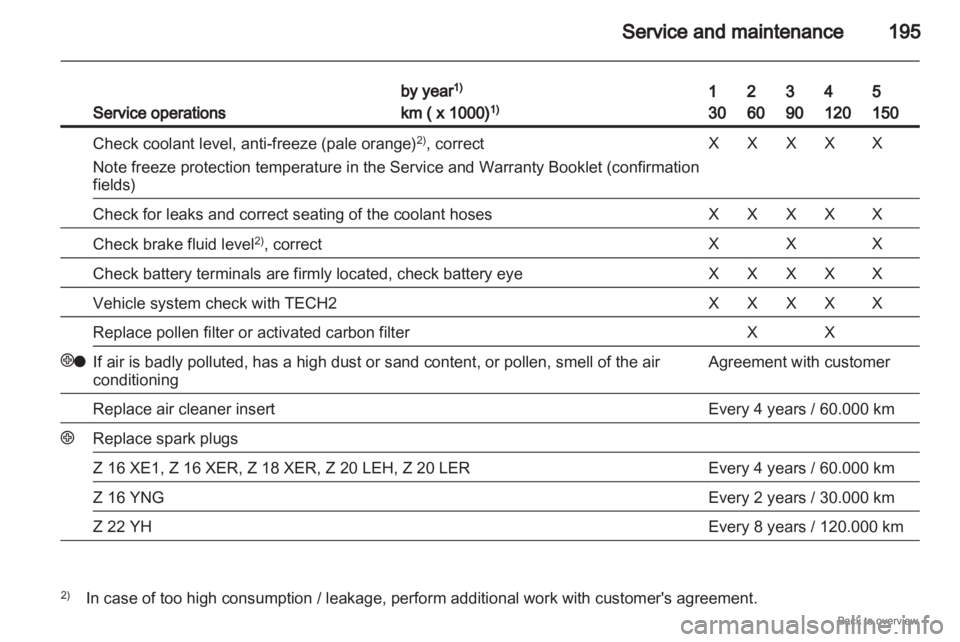
Check coolant level, anti-freeze (pale orange)
2)
, correct
Note freeze protection temperature in the Service and Warranty Booklet (confirmation
fields) X X X X X
Check for leaks and correct seating of the coolant hoses X X X X X
Check brake fluid level
2)
, correct X X X
Check battery terminals are firmly located, check battery eye X X X X X
Vehicle system check with TECH2 X X X X X
Replace pollen filter or activated carbon filter X X
+o
If air is badly polluted, has a high dust or sand content, or pollen, smell of the air
conditioning Agreement with customer
Replace air cleaner insert Every 4 years / 60.000 km
+ Replace spark plugs Z 16 XE1, Z 16 XER, Z 18 XER, Z 20 LEH, Z 20 LER Every 4 years / 60.000 km
Z 16 YNG Every 2 years / 30.000 km
Z 22 YH Every 8 years / 120.000 km
2)
In case of too high consumption / leakage, perform additional work with customer's agreement.
Page 199 of 228
Service and maintenance
199
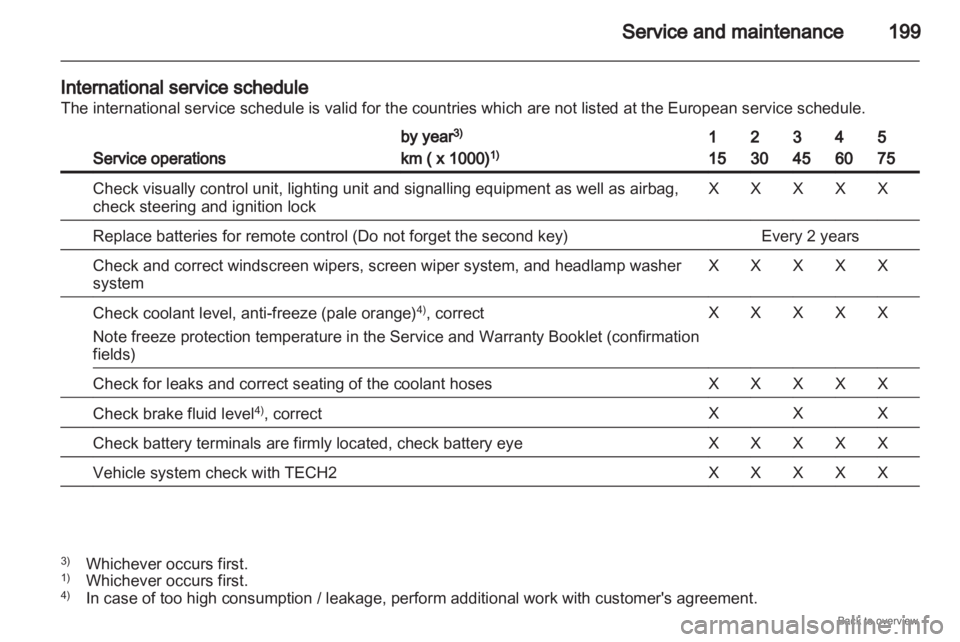
International service schedule
The international service schedule is valid for the countries which are not listed at the European service schedule. Service operations by year
3)
km ( x 1000) 1) 1
15 2
30 3
45 4
60 5
75
Check visually control unit, lighting unit and signalling equipment as well as airbag,
check steering and ignition lock X X X X X
Replace batteries for remote control (Do not forget the second key) Every 2 years
Check and correct windscreen wipers, screen wiper system, and headlamp washer
system X X X X X
Check coolant level, anti-freeze (pale orange)
4)
, correct
Note freeze protection temperature in the Service and Warranty Booklet (confirmation
fields) X X X X X
Check for leaks and correct seating of the coolant hoses X X X X X
Check brake fluid level
4)
, correct X X X
Check battery terminals are firmly located, check battery eye X X X X X
Vehicle system check with TECH2 X X X X X
3)
Whichever occurs first.
1) Whichever occurs first.
4) In case of too high consumption / leakage, perform additional work with customer's agreement.