lights OPEL ZAFIRA 2009 User Guide
[x] Cancel search | Manufacturer: OPEL, Model Year: 2009, Model line: ZAFIRA, Model: OPEL ZAFIRA 2009Pages: 228, PDF Size: 7.3 MB
Page 109 of 228

Lighting
109
High beam To switch from dipped to high beam,
push lever.
To
switch to dipped beam, push lever
again or pull.
Headlight flash
To activate the headlight flash, pull
lever. Headlight range
adjustment
Manual headlight range
adjustment
To adapt headlight range to the
vehicle load to prevent dazzling:
Press knob to disengage and turn to
required position.
Vehicles without automatic level
control system
0 =
Front seats occupied
1 = All seats occupied 2 = All seats occupied and luggage
compartment load
3 = Driver's seat occupied and luggage compartment load
Vehicles with automatic level control
system
0 = Front seats occupied
1 = All seats occupied
1 = All seats occupied and luggage compartment load
2 = Driver's seat occupied and luggage compartment load
Automatic headlight range
adjustment
Headlight range is automatically
adjusted based on vehicle load.
Headlights when driving
abroad
The assymetrical headlight beam
extends visibility at the edge of the
road at the passenger side.
However, when driving in countries
where traffic drives on the opposite
side
of the road, adjust the headlights
to prevent dazzling.
Page 110 of 228
110
Lighting
Vehicles with halogen headlight
system
Have the headlights adjusted by
a workshop.
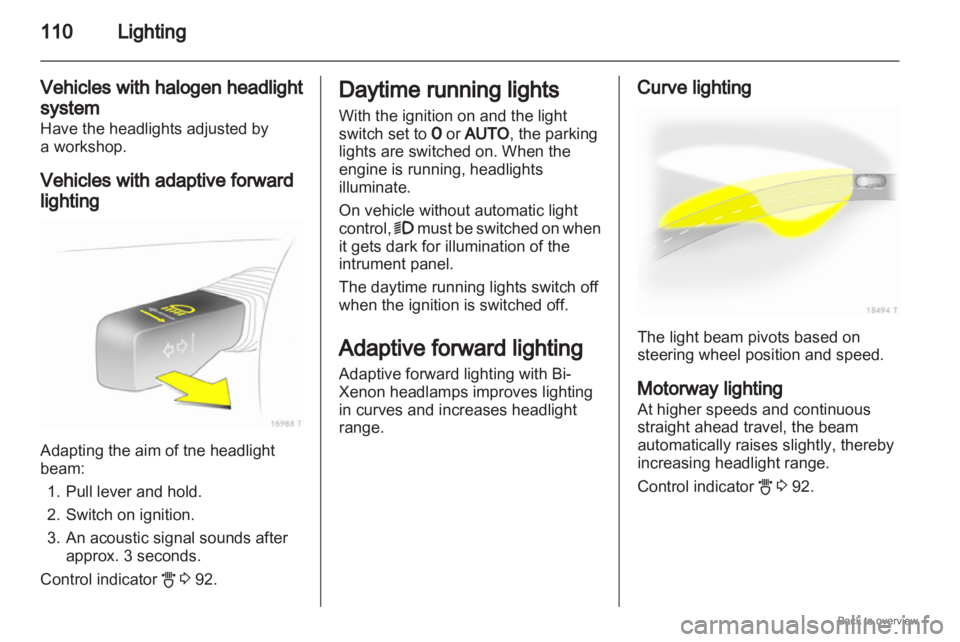
Vehicles with adaptive forward
lighting Adapting the aim of tne headlight
beam:
1.
Pull lever and hold.
2. Switch on ignition.
3. An acoustic signal sounds after approx. 3 seconds.
Control indicator B 3 92. Daytime running lights
With the ignition on and the light
switch set to 7 or AUTO, the parking
lights are switched on. When the
engine is running, headlights
illuminate.
On vehicle without automatic light
control, 9
must be switched on when
it gets dark for illumination of the
intrument panel.
The daytime running lights switch off
when the ignition is switched off.
Adaptive forward lighting
Adaptive forward lighting with Bi-
Xenon headlamps improves lighting
in curves and increases headlight
range. Curve lighting
The light beam pivots based on
steering wheel position and speed.
Motorway lighting
At higher speeds and continuous
straight ahead travel, the beam
automatically raises slightly, thereby
increasing headlight range.
Control indicator
B 3 92.
Page 111 of 228

Lighting
111
Hazard warning flashers Operated with the ¨ button.
The hazard warning flashers activate
automatically if the airbags deploy. Turn and lane-change
signals
Lever up = Right indicator
Lever down = Left indicator
The lever always springs back to its
original position.
If the lever is moved past the
resistance point, the indicator is
switched on constantly. When the
steering wheel moves back, the
indicator
is automatically deactivated.
For three flashes, e. g. when
changing lanes, press the lever until
resistance is felt and then release. Move the lever to the resistance point
and hold for longer indication.
Switch the indicator off manually by
moving the lever slightly.
Front fog lights
The front fog lights can only be
switched on when both the ignition
and headlights or parking lights are
on.
Operated with the > button.
Page 112 of 228

112
Lighting
Rear fog lights The rear fog light can only be
switched on when both the ignition
and headlights or parking lights (with
front fog lights) are on.
Operated with the r button.
The vehicle rear fog light is
deactivated when towing. Parking lights
When parked, the parking lights on
one side can be activated:
1. Set light switch to 7 or AUTO .
2.
Ignition off.
3. Move turn signal lever all the way up (right parking lights) or down
(left parking lights).
Confirmed by a signal and the
corresponding turn signal control
indicator.
To switch it off, switch on the ignition
or move the turn signal lever in the
opposite direction. Reversing lights
The reversing lights come on when
the ignition is on and reverse gear is
selected.
Misted light covers
The
inside of the light covers may mist
up briefly in poor, wet and cold
weather conditions, in heavy rain or
after washing. The mist disappears
quickly by itself; to help, switch on the
headlights.
Page 113 of 228
Lighting
113
Interior lighting
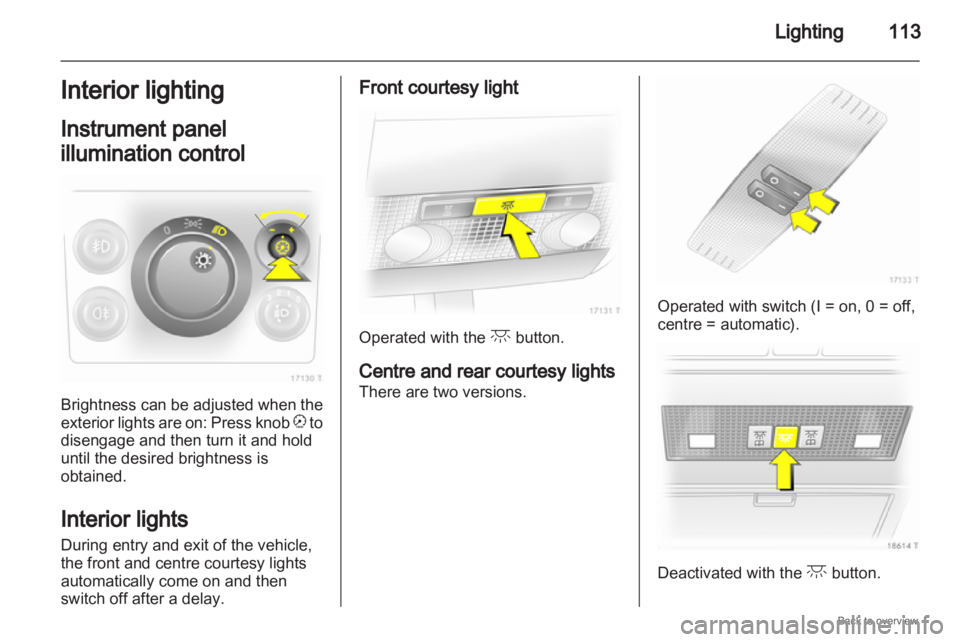
Instrument panel
illumination control Brightness can be adjusted when the
exterior
lights are on: Press knob k to
disengage and then turn it and hold
until the desired brightness is
obtained.
Interior lights
During entry and exit of the vehicle,
the front and centre courtesy lights
automatically come on and then
switch off after a delay. Front courtesy light
Operated with the c button.
Centre and rear courtesy lights
There are two versions. Operated with switch (I = on, 0 = off,
centre = automatic).
Deactivated with the
c button.
Page 114 of 228
114
Lighting
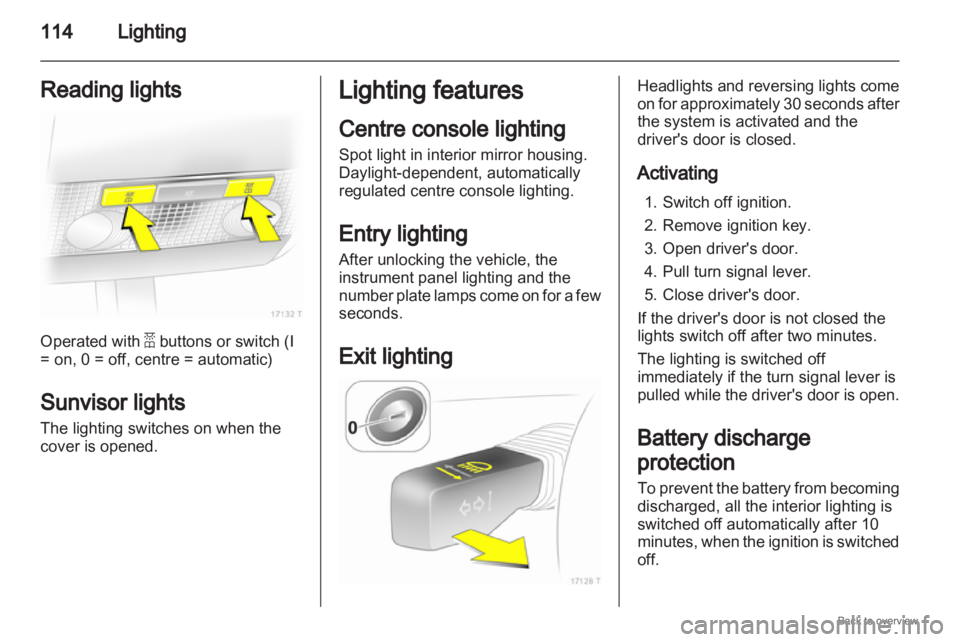
Reading lights Operated with a buttons or switch (I
= on, 0 = off, centre = automatic)
Sunvisor lights
The lighting switches on when the
cover is opened. Lighting features
Centre console lighting
Spot light in interior mirror housing.
Daylight-dependent, automatically
regulated centre console lighting.
Entry lighting
After unlocking the vehicle, the
instrument panel lighting and the
number
plate lamps come on for a few
seconds.
Exit lighting Headlights and reversing lights come
on
for approximately 30 seconds after
the system is activated and the
driver's door is closed.
Activating
1. Switch off ignition.
2. Remove ignition key.
3. Open driver's door.
4. Pull turn signal lever.
5. Close driver's door.
If the driver's door is not closed the
lights switch off after two minutes.
The lighting is switched off
immediately if the turn signal lever is
pulled while the driver's door is open.
Battery discharge
protection
To prevent the battery from becoming
discharged, all the interior lighting is
switched off automatically after 10
minutes, when the ignition is switched
off.
Page 137 of 228
Driving and operating
137
If the Winter programme is activated,
T is illuminated.
Starting the engine
Depress the foot brake when starting
the engine. If the foot brake is not
depressed, j illuminates in the
instrument, "N" flashes in the
transmission display and the engine
cannot be started.
Starting is not possible if all brake
lights fail.
When
the foot brake is depressed, the
transmission automatically shifts to
N upon start. There may be a slight
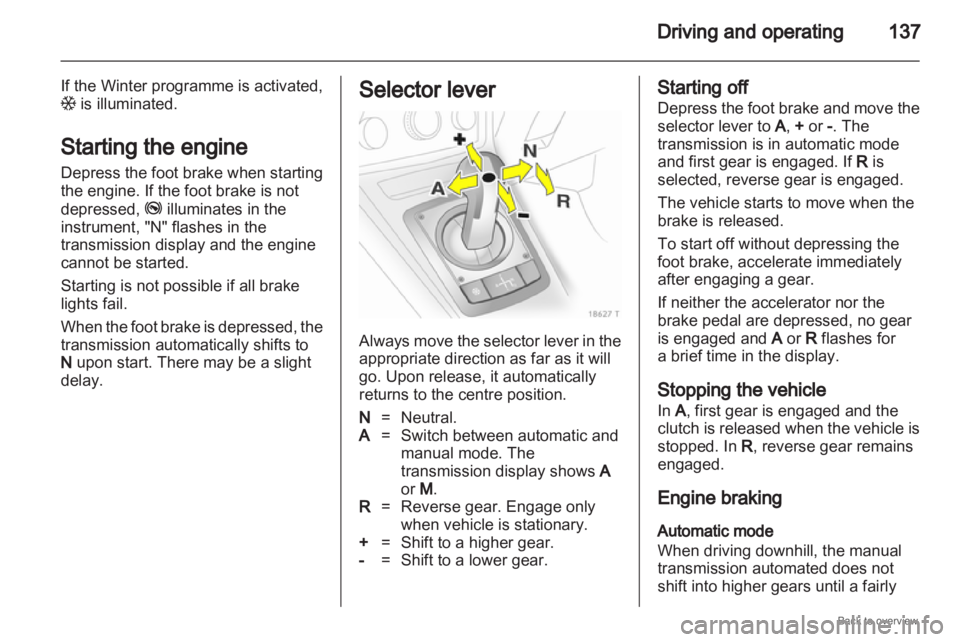
delay. Selector lever
Always move the selector lever in the
appropriate direction as far as it will
go. Upon release, it automatically
returns to the centre position.
N
= Neutral.
A = Switch between automatic and
manual mode. The
transmission display shows A
or M.
R = Reverse gear. Engage only
when vehicle is stationary.
+ = Shift to a higher gear.
- = Shift to a lower gear. Starting off
Depress
the foot brake and move the
selector lever to A, + or -. The
transmission is in automatic mode
and first gear is engaged. If R is
selected, reverse gear is engaged.
The vehicle starts to move when the
brake is released.
To start off without depressing the
foot brake, accelerate immediately
after engaging a gear.
If neither the accelerator nor the
brake pedal are depressed, no gear
is engaged and A or R flashes for
a brief time in the display.
Stopping the vehicle
In A, first gear is engaged and the
clutch is released when the vehicle is
stopped. In R , reverse gear remains
engaged.
Engine braking
Automatic mode
When driving downhill, the manual
transmission automated does not
shift into higher gears until a fairly
Page 160 of 228
160
Vehicle care
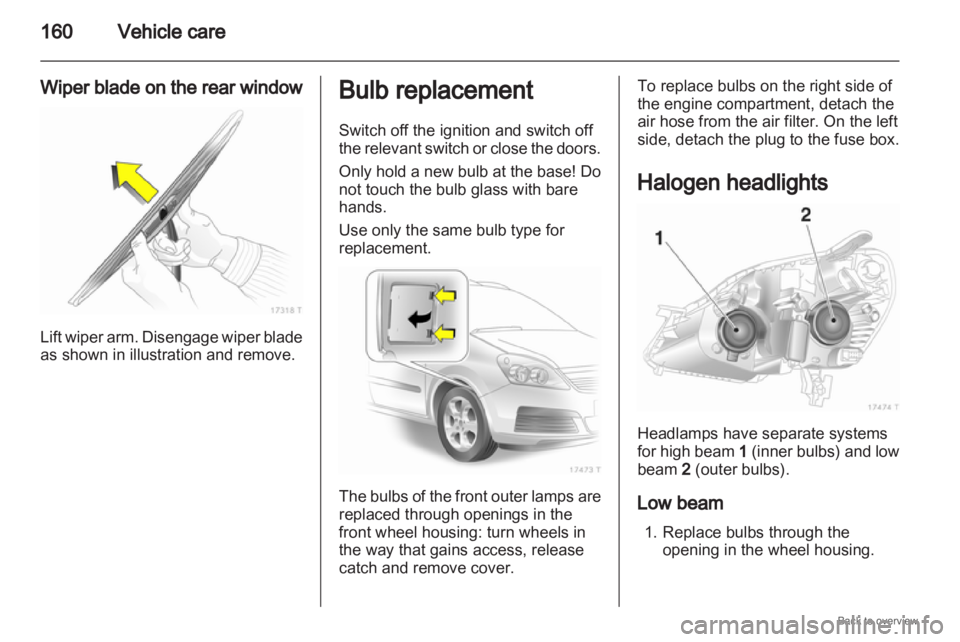
Wiper blade on the rear window Lift wiper arm. Disengage wiper blade
as shown in illustration and remove. Bulb replacement
Switch off the ignition and switch off
the
relevant switch or close the doors.
Only hold a new bulb at the base! Do
not touch the bulb glass with bare
hands.
Use only the same bulb type for
replacement. The bulbs of the front outer lamps are
replaced through openings in the
front wheel housing: turn wheels in
the way that gains access, release
catch and remove cover. To replace bulbs on the right side of
the engine compartment, detach the
air hose from the air filter. On the left
side, detach the plug to the fuse box.
Halogen headlights
Headlamps have separate systems
for
high beam 1 (inner bulbs) and low
beam 2 (outer bulbs).
Low beam 1. Replace bulbs through the opening in the wheel housing.
Page 162 of 228
162
Vehicle care
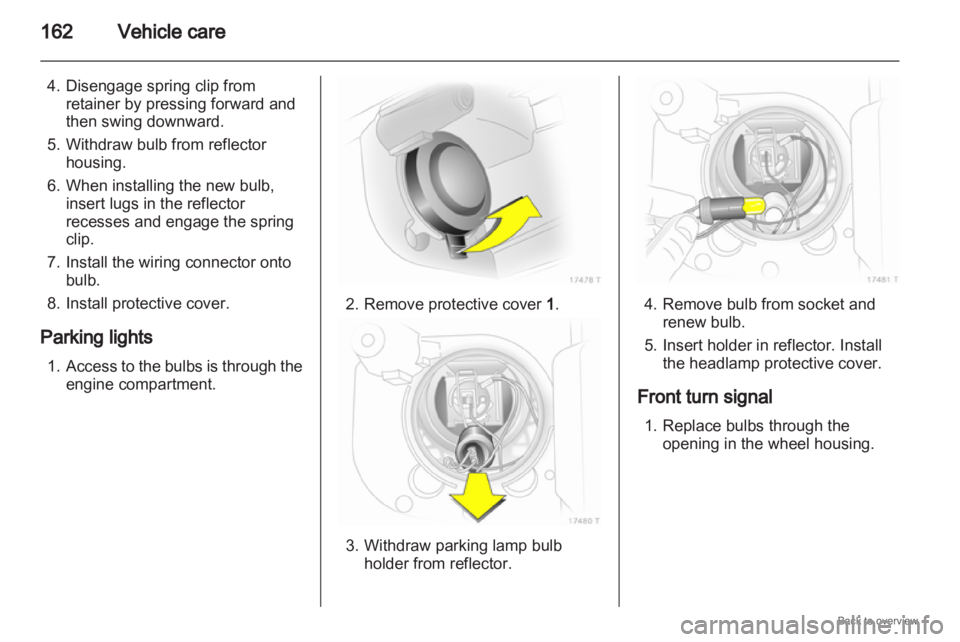
4. Disengage spring clip from retainer by pressing forward and
then swing downward.
5.
Withdraw bulb from reflectorhousing.
6. When installing the new bulb, insert lugs in the reflector
recesses and engage the spring
clip.
7. Install the wiring connector onto bulb.
8. Install protective cover.
Parking lights 1. Access to the bulbs is through the engine compartment. 2. Remove protective cover
1. 3. Withdraw parking lamp bulb
holder from reflector. 4. Remove bulb from socket and
renew bulb.
5.
Insert holder in reflector. Installthe headlamp protective cover.
Front turn signal 1. Replace bulbs through the opening in the wheel housing.
Page 163 of 228
Vehicle care
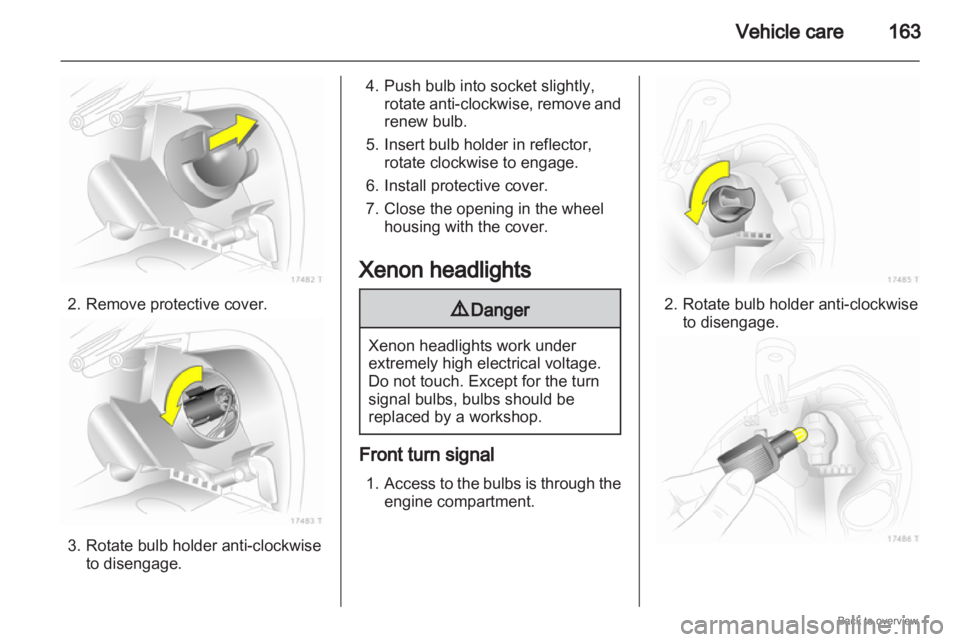
1632. Remove protective cover.
3. Rotate bulb holder anti-clockwise
to disengage. 4. Push bulb into socket slightly,
rotate anti-clockwise, remove and
renew bulb.
5. Insert bulb holder in reflector, rotate clockwise to engage.
6. Install protective cover.
7. Close the opening in the wheel housing with the cover.
Xenon headlights 9
Danger Xenon headlights work under
extremely high electrical voltage.
Do not touch. Except for the turn
signal bulbs, bulbs should be
replaced by a workshop.
Front turn signal
1. Access
to the bulbs is through the
engine compartment. 2. Rotate bulb holder anti-clockwise
to disengage.