towing OPEL ZAFIRA 2009 User Guide
[x] Cancel search | Manufacturer: OPEL, Model Year: 2009, Model line: ZAFIRA, Model: OPEL ZAFIRA 2009Pages: 228, PDF Size: 7.3 MB
Page 152 of 228
152
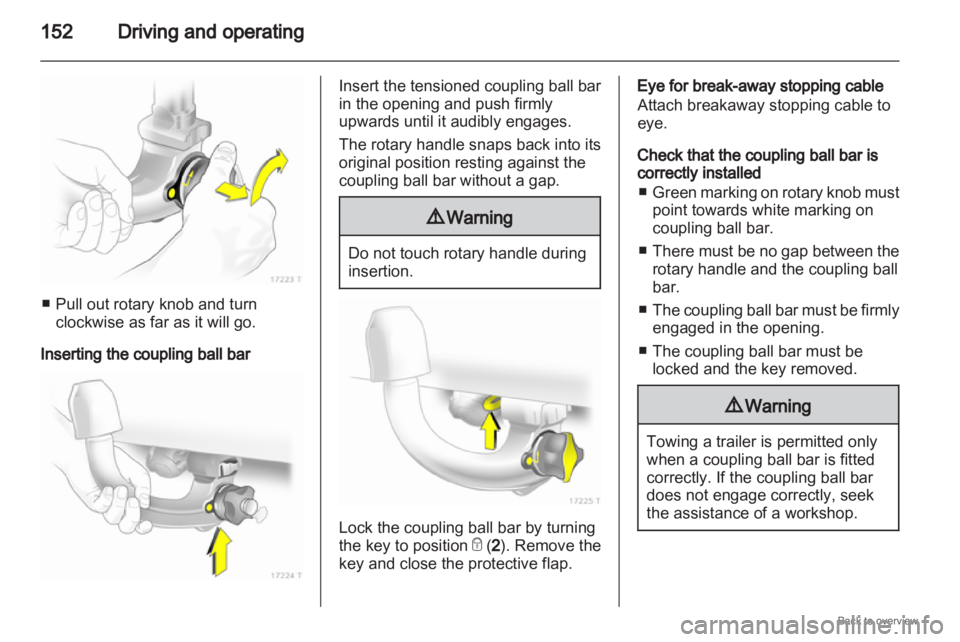
Driving and operating■ Pull out rotary knob and turn
clockwise as far as it will go.
Inserting the coupling ball bar Insert the tensioned coupling ball bar
in the opening and push firmly
upwards until it audibly engages.
The rotary handle snaps back into its
original position resting against the
coupling ball bar without a gap.
9
Warning Do not touch rotary handle during
insertion.
Lock the coupling ball bar by turning
the key to position
e (2). Remove the
key and close the protective flap. Eye for break-away stopping cable
Attach breakaway stopping cable to
eye.
Check that the coupling ball bar is
correctly installed
■ Green
marking on rotary knob must
point towards white marking on
coupling ball bar.
■ There must be no gap between the rotary handle and the coupling ball
bar.
■ The coupling ball bar must be firmly engaged in the opening.
■ The coupling ball bar must be locked and the key removed. 9
Warning Towing a trailer is permitted only
when a coupling ball bar is fitted
correctly. If the coupling ball bar
does not engage correctly, seek
the assistance of a workshop.
Page 154 of 228
154
Vehicle care
Vehicle care
General Information ...................154
Vehicle checks ........................... 155
Bulb replacement .......................160
Electrical system ........................167
Vehicle tools .............................. 173
Wheels and tyres .......................174
Jump starting ............................. 185
Towing ....................................... 187
Appearance care .......................189 General Information
Accessories and vehicle
modifications
We
recommend to use Genuine Parts
and Accessories and factory
approved parts specific for your
vehicle type. We cannot assess or
guarantee for other products - even if
they have a regulatory or otherwise
granted approval.
Do not make any modifications to the
electrical system, e. g. changes of
electronic control units (chip tuning).
Vehicle storage
Storage for a long period of time
Following must be done if the vehicle
should be stored for several months:
■ Wash and wax the vehicle.
■ Have the wax in the engine compartment and underbody
checked.
■ Clean and preserve rubber seals.
■ Change engine oil. ■ Drain washer fluid reservoir.
■
Check coolant anti-freeze andcorrosion protection.
■ Adjust tyre pressure to the value specified for full load.
■ Park vehicle in dry, well ventilated place. Engage first or reverse gear
or set selector lever to P. Prevent
the vehicle from rolling.
■ Do not apply hand brake.
■ Open bonnet, close all doors and lock the vehicle.
■ Disconnect the clamp from the negative terminal of the vehicle
battery. Beware that all systems are
not functional, e.g. anti-theft alarm
system.
Putting back into operation
Following must be done if the vehicle
is putting back into operation: ■ Connect the clamp to the negative terminal of the vehicle battery.
Activate the electronic of the power
windows.
■ Check tyre pressure.
■ Fill up the washer fluid reservoir.
Page 173 of 228
Vehicle care
173
No. Circuit
29
Cigarette lighter, front power
outlet
30 Rear power outlet
31 –
32 –
33 Open&Start system
34 –
35 Rear power outlet
36 Socket for towing equipment
37 –
38 Central locking system, terminal
30
39 Left seat heating
40 Right seat heating
41 –
42 – No. Circuit
43
–
44 – Vehicle tools
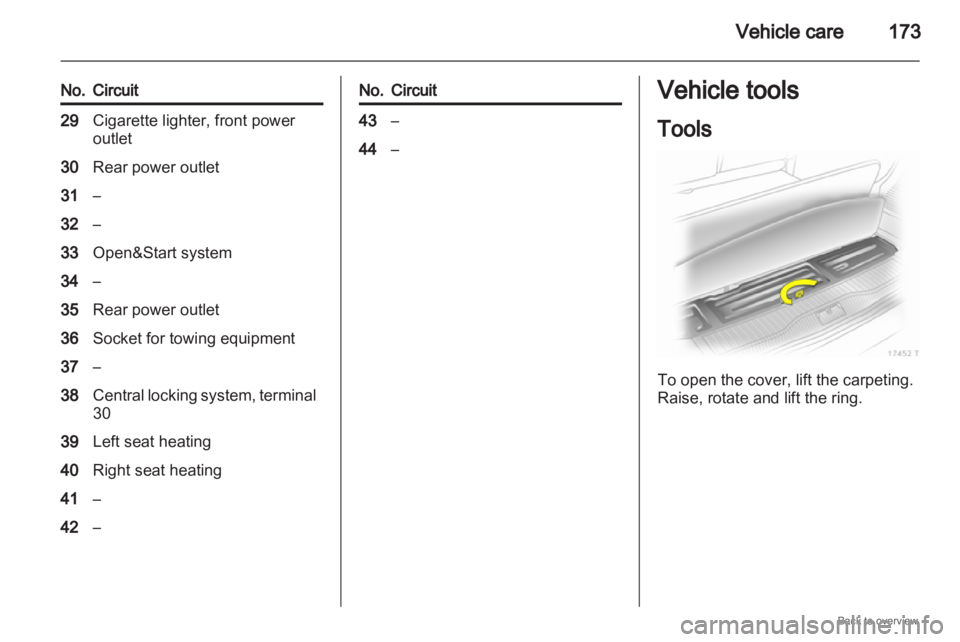
Tools
To open the cover, lift the carpeting.
Raise, rotate and lift the ring.
Page 187 of 228
Vehicle care
187
Towing
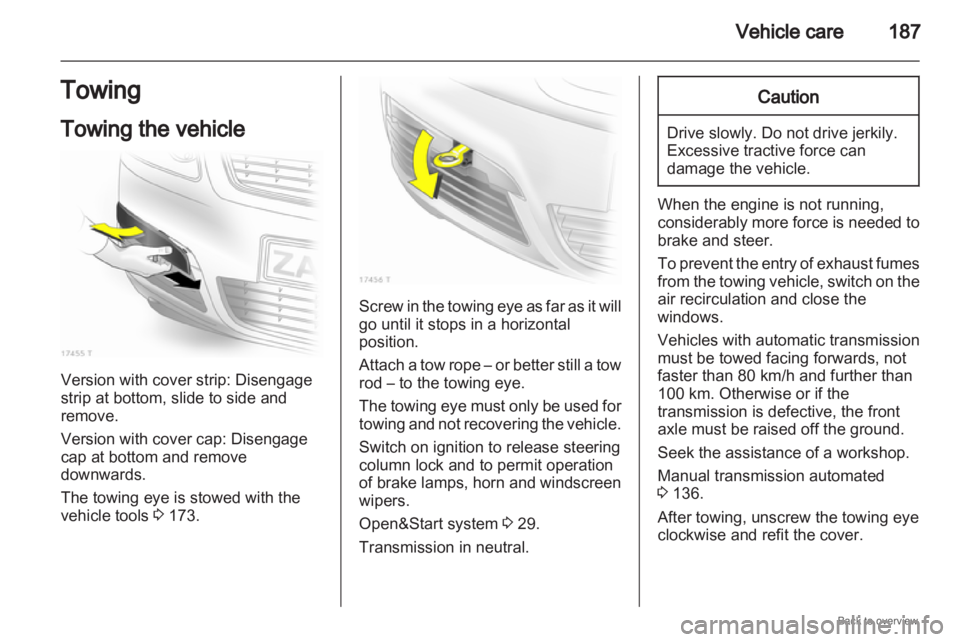
Towing the vehicle Version with cover strip: Disengage
strip at bottom, slide to side and
remove.
Version with cover cap: Disengage
cap at bottom and remove
downwards.
The towing eye is stowed with the
vehicle tools
3 173. Screw in the towing eye as far as it will
go until it stops in a horizontal
position.
Attach
a tow rope – or better still a tow
rod – to the towing eye.
The towing eye must only be used for
towing and not recovering the vehicle.
Switch on ignition to release steering
column lock and to permit operation
of brake lamps, horn and windscreen
wipers.
Open&Start system 3 29.
Transmission in neutral. Caution
Drive slowly. Do not drive jerkily.
Excessive tractive force can
damage the vehicle.
When the engine is not running,
considerably
more force is needed to
brake and steer.
To prevent the entry of exhaust fumes
from the towing vehicle, switch on the
air recirculation and close the
windows.
Vehicles with automatic transmission
must be towed facing forwards, not
faster than 80 km/h and further than
100 km. Otherwise or if the
transmission is defective, the front
axle must be raised off the ground.
Seek the assistance of a workshop.
Manual transmission automated
3 136.
After towing, unscrew the towing eye
clockwise and refit the cover.
Page 188 of 228
188
Vehicle care
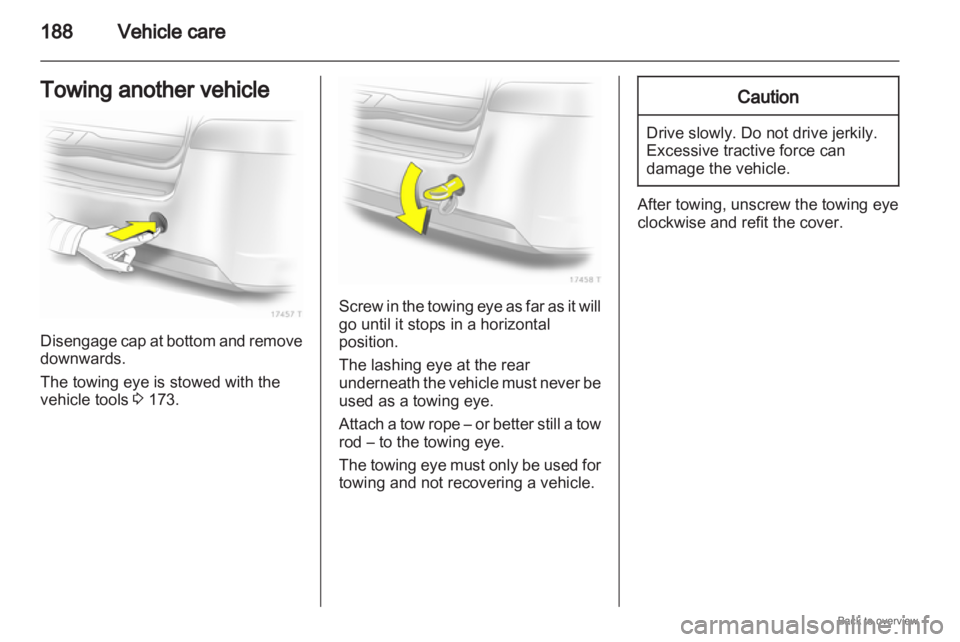
Towing another vehicle Disengage cap at bottom and remove
downwards.
The towing eye is stowed with the
vehicle tools
3 173. Screw in the towing eye as far as it will
go until it stops in a horizontal
position.
The lashing eye at the rear
underneath
the vehicle must never be
used as a towing eye.
Attach a tow rope – or better still a tow
rod – to the towing eye.
The towing eye must only be used for
towing and not recovering a vehicle. Caution
Drive slowly. Do not drive jerkily.
Excessive tractive force can
damage the vehicle.
After towing, unscrew the towing eye
clockwise and refit the cover.
Page 191 of 228
Vehicle care
191
Towing equipment
Do not clean the coupling ball bar with
a steam-jet or high-pressure jet
cleaner.
Interior care
Interior and upholstery
Only clean the vehicle interior,
including the instrument panel fascia
and panelling, with a dry cloth or
interior cleaner.
The instrument panel should only be
cleaned using a soft damp cloth.
Clean fabric upholstery with
a vacuum cleaner and brush.
Remove stains with an upholstery
cleaner.
Clean seat belts with lukewarm water
or interior cleaner. Caution
Close Velcro fasteners as open
Velcro
fasteners on clothing could
damage seat upholstery. Plastic and rubber parts
Plastic and rubber parts can be
cleaned with the same cleaner as
used to clean the body. Use interior
cleaner if necessary. Do not use any
other
agent. Avoid solvents and petrol
in particular. Do not use high-
pressure jet cleaners.
Page 204 of 228
204
Service and maintenance
Additional servicing
Additional operations +
Additional operations are not required
every service but can be performed in
conjunction with a regular service.
Time allowances for such work are
not included in the scope of regular
services and will be charged for
additionally. It is more economic if
these operations are performed as
part of a scheduled service than
having them performed separately.
Extreme operating conditions o
Extreme operating conditions are
given when at least one of the
following occurs frequently:
■ cold starts,
■ stop and go,
■ trailer towing,
■ gradients and/or high altitudes,
■ poor road surfaces,
■ sand and dust,
■ extreme temperature fluctuations. Police vehicles, taxis and driving
school vehicles are also classified as
operating under extreme conditions.
Under extreme operating conditions,
it may be necessary to have certain
scheduled service work done more
frequently than the scheduled
intervals.
Seek technical advice on the
servicing
requirements dependent on
the specific operating conditions. Recommended fluids,
lubricants and parts
Recommended fluids and
lubricants
Only use products that have been
tested and approved. Damage
resulting from the use of non-
approved materials will not be
covered by the warranty.
9
Warning Operating materials are
hazardous and could be
poisonous. Handle with care. Pay
attention to information given on
the containers.
Engine oil
Engine oil is identified by its quality
and also its viscosity. Quality is more
important than viscosity when
selecting which engine oil to use.
Page 217 of 228
![OPEL ZAFIRA 2009 User Guide Technical data
217
Additional weight
Engine Z16XEP Z16XER Z16XE1 Z16YNG Z18XER Z20LER Z20LEH
Edition/Enjoy [kg] 10 10 10 10 10 5 –
Cosmo [kg] 23 23 23 23 23 16 –
Sport [kg] 20 20 20 – 20 13 –](/img/37/58241/w960_58241-216.png "OPEL ZAFIRA 2009 User Guide Technical data
217
Additional weight
Engine Z16XEP Z16XER Z16XE1 Z16YNG Z18XER Z20LER Z20LEH
Edition/Enjoy [kg] 10 10 10 10 10 5 –
Cosmo [kg] 23 23 23 23 23 16 –
Sport [kg] 20 20 20 – 20 13 –")
Technical data
217
Additional weight
Engine Z16XEP Z16XER Z16XE1 Z16YNG Z18XER Z20LER Z20LEH
Edition/Enjoy [kg] 10 10 10 10 10 5 –
Cosmo [kg] 23 23 23 23 23 16 –
Sport [kg] 20 20 20 – 20 13 –
Engine Z22YH A17DTJ A17DTR Z19DTL Z19DT Z19DTH
Edition/Enjoy [kg] 5 5 5 5 5 5
Cosmo [kg] 16 16 16 16 16 16
Sport [kg] 13 13 13 13 13 13
Heavy accessories
Accessories
Moon roof Towing equipment Headlamp washer system Adaptive forward lighting
Weight [kg] 35 17 3 4
Page 223 of 228
Technical data
223
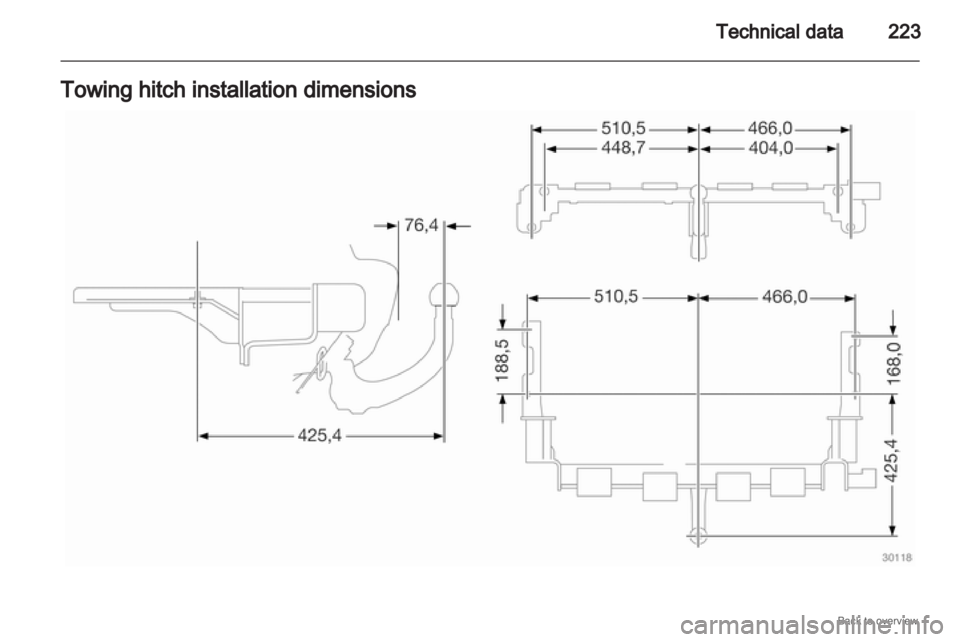
Towing hitch installation dimensions
Page 225 of 228

225
Child restraints with transponders ............................ 65
Child restraint systems ................62
Cigarette lighter ........................... 81
Climate control .............................
15
Clock ............................................ 80
Continuous damping control ......143
Control indicators.......................... 85
Control of the vehicle .................127
Convex shape .............................. 39
Cruise control ...................... 93, 144
Cupholders .................................. 67
Curtain airbag system .................. 60
D
Danger, Warnings and Cautions ... 4
Daytime running lights ...............110
Deflation detection system and tyre pressure monitoring
system....................................... 90
Diesel fuel system bleeding .......159
Diesel particle filter ..............26, 129
Door open .................................... 93
Drain diesel fuel filter .................101
Driving characteristics and towing tips .............................. 149
E
Easytronic................................... 136
Electric adjustment ......................39 Electronic climate control
system .................................... 121
Electronic driving programmes
.
........................................ 134, 138
Electronic Stability Program 89, 142
End-of-life vehicle recovery .......155
Engine compartment fuse box ...168
Engine coolant ........................... 157
Engine coolant temperature ........90
Engine cooling level ..................101
Engine data ............................... 209
Engine exhaust .......................... 129
Engine oil ................................... 156
Engine oil pressure ......................91
Entry lighting .............................. 114
Exit lighting ................................ 114
Exterior care .............................. 189
Exterior light ................................. 92
Exterior lighting ............................ 13
F
Fault ................................... 135, 139
First aid kit ................................... 74
Fixed air vents ........................... 125
FlexOrganizer .............................. 24
Fog light ....................................... 92
Fog lights ................................... 164
Folding ......................................... 39
Folding tray .................................. 74
Front airbag system ..................... 58 Front fog lights ...........................
111
Fuel consumption - CO 2-
Emissions ....................... 148, 213
Fuel for diesel engines ..............146
Fuel for natural gas operation ...147
Fuel for petrol engines ...............146
Fuel gauge ...................................
84
Fuel selector ................................ 84
Fuses ......................................... 167
G
General information ...................149
Glovebox ..................................... 67
Graphic-Info-Display, Colour- Info-Display .............................. 96
H
Halogen headlights ....................160
Hand brake ................................. 141
Hazard warning flashers ............111
Headlight flash ........................... 109
Headlight range adjustment ......109
Headlights when driving abroad 109
Head restraint adjustment ............. 8
Head restraints ............................ 44
Heated ......................................... 40
Heated rear window ..................... 42
Heating ........................................ 49
Heating and ventilation system . 118
High beam ........................... 92, 109