belt OPEL ZAFIRA 2009 Owner's Manual
[x] Cancel search | Manufacturer: OPEL, Model Year: 2009, Model line: ZAFIRA, Model: OPEL ZAFIRA 2009Pages: 228, PDF Size: 7.3 MB
Page 73 of 228
Storage
73
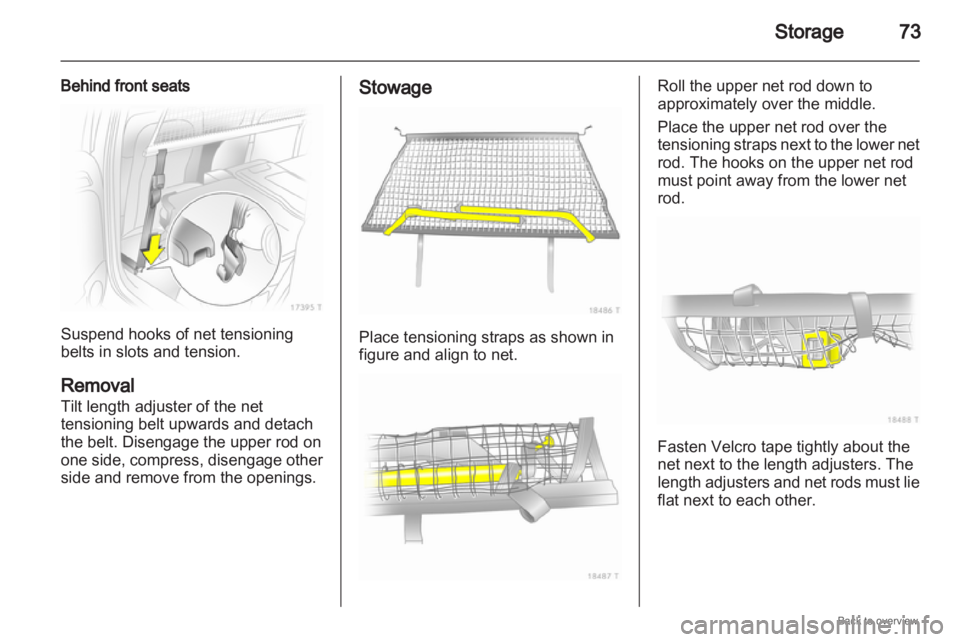
Behind front seats Suspend hooks of net tensioning
belts in slots and tension.
Removal
Tilt length adjuster of the net
tensioning belt upwards and detach
the belt. Disengage the upper rod on
one
side, compress, disengage other
side and remove from the openings. Stowage
Place tensioning straps as shown in
figure and align to net. Roll the upper net rod down to
approximately over the middle.
Place the upper net rod over the
tensioning
straps next to the lower net
rod. The hooks on the upper net rod
must point away from the lower net
rod. Fasten Velcro tape tightly about the
net next to the length adjusters. The
length
adjusters and net rods must lie
flat next to each other.
Page 87 of 228
Instruments and controls
87
Turn signal
O illuminates or flashes green.
Illuminated
The control indicator illuminates
briefly when the parking lamps are
switched on.
Flashes
The control indicator flashes if a turn
signal or the hazard warning flashers
are activated.
Fast flashing: failure of a direction
indicator lamp or associated fuse,
failure of direction indicator lamp on
trailer.
Bulb replacement 3 160. Fuses
3 167.
Turn signals 3 111.
Seat belt reminder
X illuminates or flashes red.
Illuminated
After the ignition is switched on until
the seat belt is fastened. Flashes
After starting off until the seat belt is
fastened.
Fastening the seat belt
3 55.
Airbag and belt tensioners
v illuminates red.
When the ignition is switched on, the
control indicator illuminates for about
4 seconds. If it does not illuminate,
does not go out after 4 seconds or
illuminates whilst driving, there is
a fault in the belt tensioner, the
airbags or the seat occupancy
recognition
system. The systems may
fail to trigger in the event of an
accident.
Deployment of the belt tensioners or
airbags is indicated by continuous
illumination of v. 9
Warning Have the cause of the fault
eliminated immediately by
a workshop. Airbag system, belt tensioners
3 57,
3 54.
Seat occupancy
recognition
y illuminates or flashes yellow.
Illuminated
If the vehicle is equipped with seat
occupancy
recognition, y illuminates
for about 4 seconds after the ignition
is switched on.
If a child restraint system with
transponders is detected, y remains
illuminated. Only then may a child
restraint system with transponders be
used on the front passenger seat as
the front passenger airbag systems
are deactivated 3 61.
Page 100 of 228
100
Instruments and controls
Always day design: black or coloured
text on light background.
Always night design: white or
coloured text on dark background.
Selection is indicated by a o in front
of the menu item.
Ignition logic
See infotainment system manual. Vehicle messages
Messages are given via the
instrument panel display or as
warning and signal buzzers. Check
control messages appear on the
Info-Display. Some appear in an
abbreviated form. Confirm warning
messages 3 93, 3 96.
Warning chimes
When starting the engine or
whilst driving
■
If the electronic key is not presentor is not recognised.
■ If seat belt is not fastened.
■ If a door or the tailgate is not fully closed when starting off.
■ If a certain speed is exceeded with the hand brake applied.
■ If the speed programmed at the factory is exceeded.
■ If the vehicle has automated manual transmission and the
driver's door is opened when the engine is running, a gear is
engaged and the foot brake is not
depressed.
When the vehicle is parked and
the driver's door is opened ■
When the key is in the ignition switch.
■ With exterior lights on.
■ With Open&Start system and automatic transmission, if the
selector lever is not in P.
■ For automated manual transmission, if the hand brake is
not applied and no gear is engaged
when the engine is switched off.
Battery voltage
Low battery voltage in remote control
or electronic key. On vehicles without
check control, the message InSP3
appears in the instrument panel
display. Replace the battery 3 28,
3 29.
Page 126 of 228
126
Climate control
Air conditioning regular
operation
In order to ensure continuously
efficient performance, cooling must
be operated for a few minutes once
a month, irrespective of the weather
and time of year. Operation with
cooling is not possible when outside
temperature is low.
Service
For
optimal cooling performance, it is
recommended that the climate control
system be checked annually, starting
three years after initial vehicle
registration.
■ Functionality and pressure test
■ Heating functionality
■ Leakage check
■ Check of drive belts
■ Cleaning of condenser and evaporator drainage
■ Performance check
Page 175 of 228
Vehicle care
175
Depending on tyre manufacturer, run-
flat tyres can be identified from
a marking on the tyre wall. E.g. ROF
= RunonFlat for Goodyear or SSR
= Self Supporting Runflat Tyre for
Continental.
Use of run-flat tyres is only permitted
in combination with factory approved
alloy wheels.
Do not use a tyre repair kit.
The ECO tyre pressure must not be
used.
Run-flat tyres must not be combined
with standard tyres.
If converting to standard tyres, note
that the vehicle is not equipped with
a spare wheel or tyre repair kit.
Driving with a damaged tyre
A
loss in tyre pressure is indicated by
the tyre pressure monitoring system
or the deflation detection system.
If a tyre has no pressure, continued
driving is possible
■ at a speed of max. 80 km/h
■ up to a distance of 80 km 9
Warning The vehicle will be more difficult to
steer and handle. Braking
distance will be longer.
Adapt driving style and speed to
the changed conditions.
Tyre designations
E.g. 195/65 R 15 91 H
195
=Tyre width, mm
65 =Cross-section ratio (tyre
height to tyre width), %
R = Belt type: Radial
RF =Type: RunFlat
15 =Wheel diameter, inches
91 =Load index e.g. 91 is
equivalent to 618 kg
H = Speed code letter
Speed code letter:
Q = up to 160 km/h
S = up to 180 km/h
T = up to 190 km/h
H = up to 210 km/h
V = up to 240 km/h
W = up to 270 km/h Tyre pressure
Check the pressure of cold tyres at
least every 14 days and before any
long journey. Do not forget the spare
wheel. This also applies to vehicles
with tyre pressure monitoring.
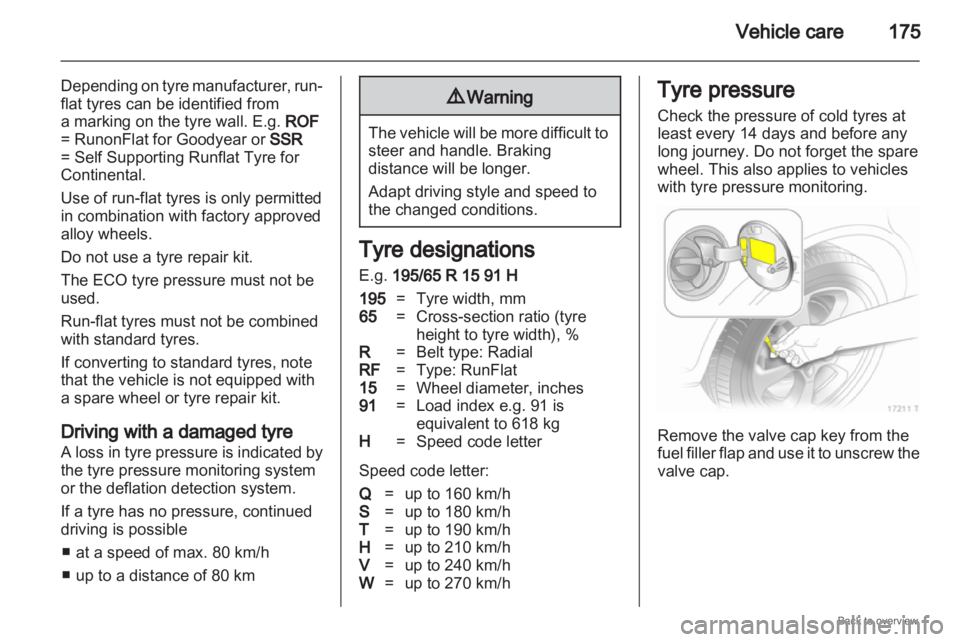
Remove the valve cap key from the
fuel
filler flap and use it to unscrew the
valve cap.
Page 190 of 228
190
Vehicle care
Clean smearing wiper blades with
a soft cloth and window cleaner.
Moonroof
Never
clean with solvents or abrasive
agents, fuels, aggressive media (e.g.
paint cleaner, acetone-containing
solutions etc.), acidic or highly
alkaline media or abrasive pads. Do
not apply wax or polishing agents to
the middle part of the moonroof.
Wheels and tyres
Do not use high-pressure jet
cleaners.
Clean rims with a pH-neutral wheel
cleaner.
Rims are painted and can be treated
with the same agents as the body.
Paintwork damage
Rectify minor paintwork damage with
a touch-up pen before rust forms.
Have more extensive damage or rust
areas repaired by a workshop. Underbody
Some
areas of the vehicle underbody
have a PVC undercoating while other
critical areas have a durable
protective wax coating.
After the underbody is washed, check
the underbody and have it waxed if
necessary.
Bitumen/rubber materials could
damage the PVC coating. Have
underbody work carried out by
a workshop.
Before and after winter, wash the
underbody and have the protective
wax coating checked.
Engine compartment
Areas of the engine compartment that
are painted in the same colour as the
vehicle must be looked after like any
other painted surface.
It is advisable to wash the engine
compartment before and after winter
and preserve it with wax. Protect the
alternator and brake fluid reservoir
with plastic sheets before washing
the engine. When washing the engine with
a steam-jet cleaner, do not direct the
steam jet towards components of the
antilock brake system, air
conditioning system or the belt drive
and its components.
After
an engine wash, have all engine
room components preserved
thoroughly by a workshop using
protective wax.
Do not use high-pressure jet
cleaners.
Natural gas system
Do not direct the steam jet or high-
pressure jet towards natural gas
system components. It is particularly
important to protect the natural gas
tank and the pressure valves on the
vehicle underbody and the bulkhead
in the engine compartment.
These components must not be
treated using chemical cleaners or
preservatives.
Have components of the natural gas
system cleaned by a workshop
authorised to carry out maintenance
of natural gas vehicles.
Page 191 of 228
Vehicle care
191
Towing equipment
Do not clean the coupling ball bar with
a steam-jet or high-pressure jet
cleaner.
Interior care
Interior and upholstery
Only clean the vehicle interior,
including the instrument panel fascia
and panelling, with a dry cloth or
interior cleaner.
The instrument panel should only be
cleaned using a soft damp cloth.
Clean fabric upholstery with
a vacuum cleaner and brush.
Remove stains with an upholstery
cleaner.
Clean seat belts with lukewarm water
or interior cleaner. Caution
Close Velcro fasteners as open
Velcro
fasteners on clothing could
damage seat upholstery. Plastic and rubber parts
Plastic and rubber parts can be
cleaned with the same cleaner as
used to clean the body. Use interior
cleaner if necessary. Do not use any
other
agent. Avoid solvents and petrol
in particular. Do not use high-
pressure jet cleaners.
Page 196 of 228
196
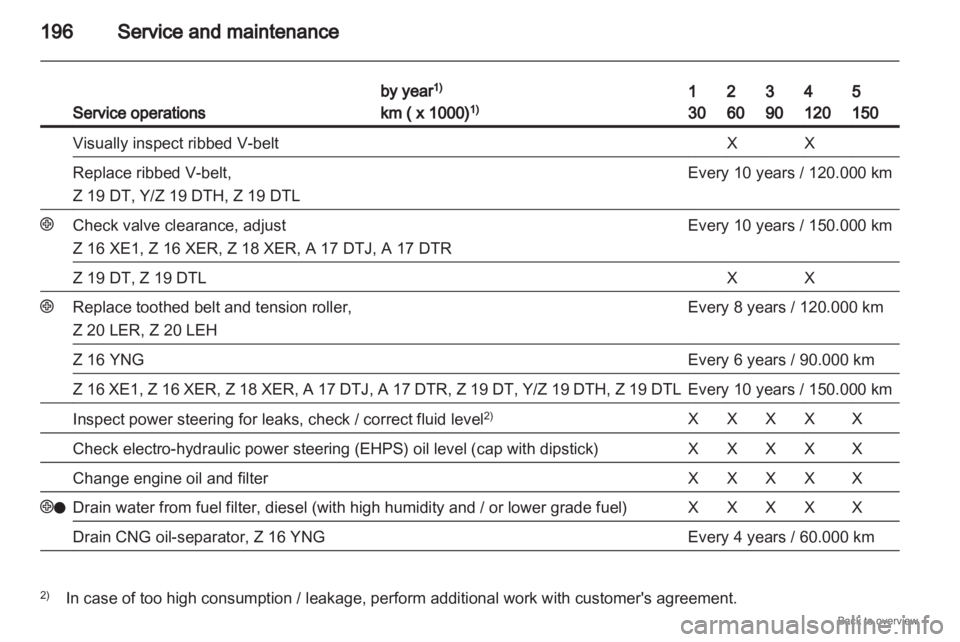
Service and maintenanceService operations by year
1)
km ( x 1000) 1) 1
30 2
60 3
90 4
120 5
150
Visually inspect ribbed V-belt X X
Replace ribbed V-belt,
Z 19 DT, Y/Z 19 DTH, Z 19 DTL Every 10 years / 120.000 km
+ Check valve clearance, adjust
Z 16 XE1, Z 16 XER, Z 18 XER, A 17 DTJ, A 17 DTR Every 10 years / 150.000 km
Z 19 DT, Z 19 DTL X X
+ Replace toothed belt and tension roller,
Z 20 LER, Z 20 LEH Every 8 years / 120.000 km
Z 16 YNG Every 6 years / 90.000 km
Z 16 XE1, Z 16 XER, Z 18 XER, A 17 DTJ, A 17 DTR, Z 19 DT, Y/Z 19 DTH, Z 19 DTL Every 10 years / 150.000 km
Inspect power steering for leaks, check / correct fluid level
2) X X X X X
Check electro-hydraulic power steering (EHPS) oil level (cap with dipstick) X X X X X
Change engine oil and filter X X X X X
+o Drain water from fuel filter, diesel (with high humidity and / or lower grade fuel) X X X X X
Drain CNG oil-separator, Z 16 YNG Every 4 years / 60.000 km
2)
In case of too high consumption / leakage, perform additional work with customer's agreement.
Page 200 of 228
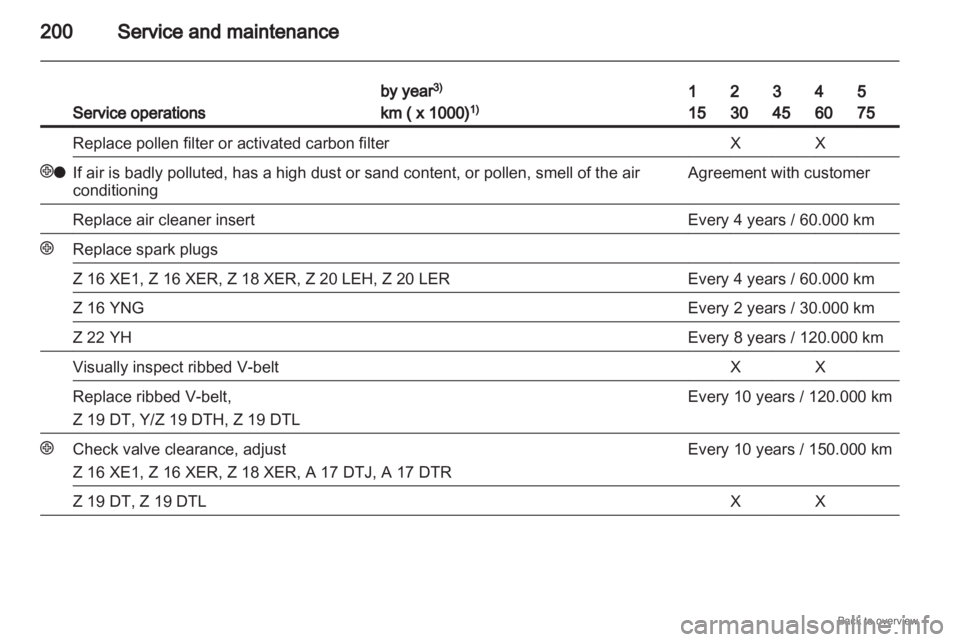
200
Service and maintenanceService operations by year
3)
km ( x 1000) 1) 1
15 2
30 3
45 4
60 5
75
Replace pollen filter or activated carbon filter X X
+o
If air is badly polluted, has a high dust or sand content, or pollen, smell of the air
conditioning Agreement with customer
Replace air cleaner insert Every 4 years / 60.000 km
+ Replace spark plugs Z 16 XE1, Z 16 XER, Z 18 XER, Z 20 LEH, Z 20 LER Every 4 years / 60.000 km
Z 16 YNG Every 2 years / 30.000 km
Z 22 YH Every 8 years / 120.000 km
Visually inspect ribbed V-belt X X
Replace ribbed V-belt,
Z 19 DT, Y/Z 19 DTH, Z 19 DTL Every 10 years / 120.000 km
+ Check valve clearance, adjust
Z 16 XE1, Z 16 XER, Z 18 XER, A 17 DTJ, A 17 DTR Every 10 years / 150.000 km
Z 19 DT, Z 19 DTL X X
Page 201 of 228
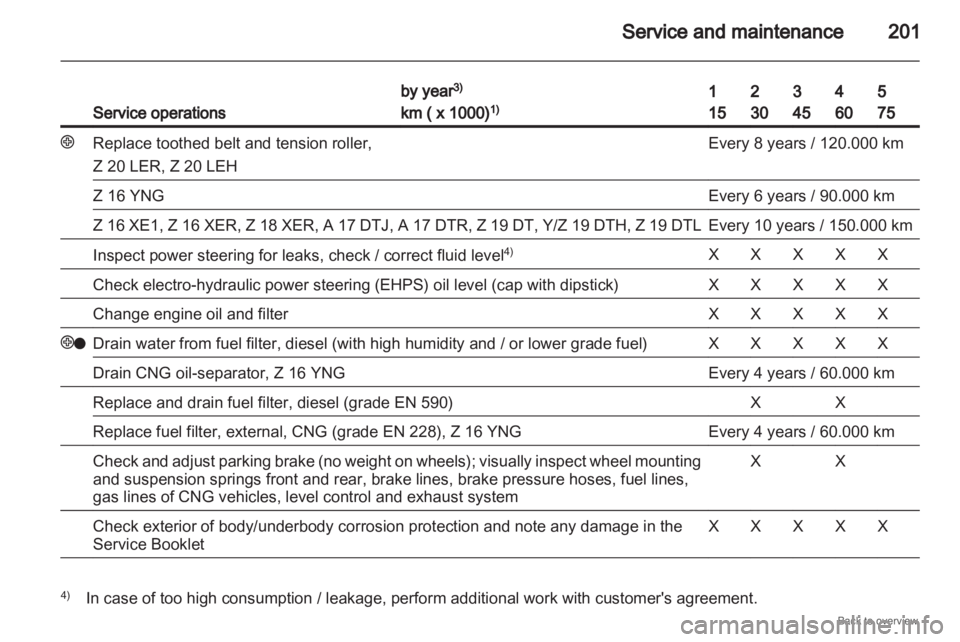
Service and maintenance
201Service operations by year
3)
km ( x 1000) 1) 1
15 2
30 3
45 4
60 5
75
+ Replace toothed belt and tension roller,
Z 20 LER, Z 20 LEH Every 8 years / 120.000 km
Z 16 YNG Every 6 years / 90.000 km
Z 16 XE1, Z 16 XER, Z 18 XER, A 17 DTJ, A 17 DTR, Z 19 DT, Y/Z 19 DTH, Z 19 DTL Every 10 years / 150.000 km
Inspect power steering for leaks, check / correct fluid level
4) X X X X X
Check electro-hydraulic power steering (EHPS) oil level (cap with dipstick) X X X X X
Change engine oil and filter X X X X X
+o Drain water from fuel filter, diesel (with high humidity and / or lower grade fuel) X X X X X
Drain CNG oil-separator, Z 16 YNG Every 4 years / 60.000 km
Replace and drain fuel filter, diesel (grade EN 590) X X
Replace fuel filter, external, CNG (grade EN 228), Z 16 YNG Every 4 years / 60.000 km
Check and adjust parking brake (no weight on wheels); visually inspect wheel mounting
and suspension springs front and rear, brake lines, brake pressure hoses, fuel lines,
gas lines of CNG vehicles, level control and exhaust system X X
Check exterior of body/underbody corrosion protection and note any damage in the
Service Booklet X X X X X
4)
In case of too high consumption / leakage, perform additional work with customer's agreement.