tow OPEL ZAFIRA 2009 Owner's Guide
[x] Cancel search | Manufacturer: OPEL, Model Year: 2009, Model line: ZAFIRA, Model: OPEL ZAFIRA 2009Pages: 228, PDF Size: 7.3 MB
Page 184 of 228
184
Vehicle careThe spare wheel is kept beneath the
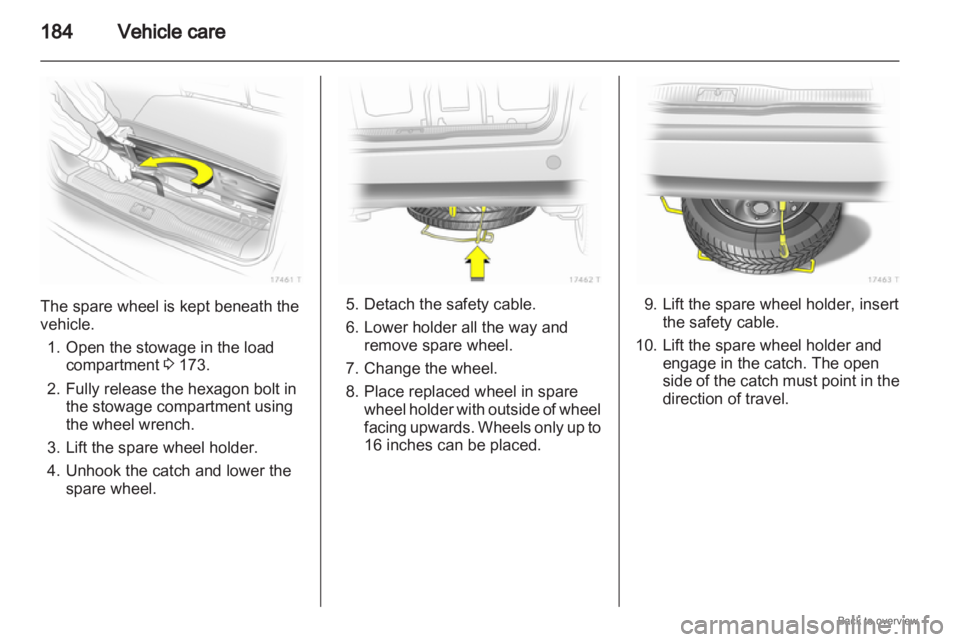
vehicle.
1.
Open the stowage in the loadcompartment 3 173.
2. Fully release the hexagon bolt in the stowage compartment using
the wheel wrench.
3. Lift the spare wheel holder.
4. Unhook the catch and lower the spare wheel. 5. Detach the safety cable.
6.
Lower holder all the way andremove spare wheel.
7. Change the wheel.
8. Place replaced wheel in spare wheel holder with outside of wheel
facing upwards. Wheels only up to
16 inches can be placed. 9. Lift the spare wheel holder, insert
the safety cable.
10.
Lift the spare wheel holder andengage in the catch. The open
side of the catch must point in the
direction of travel.
Page 185 of 228
Vehicle care
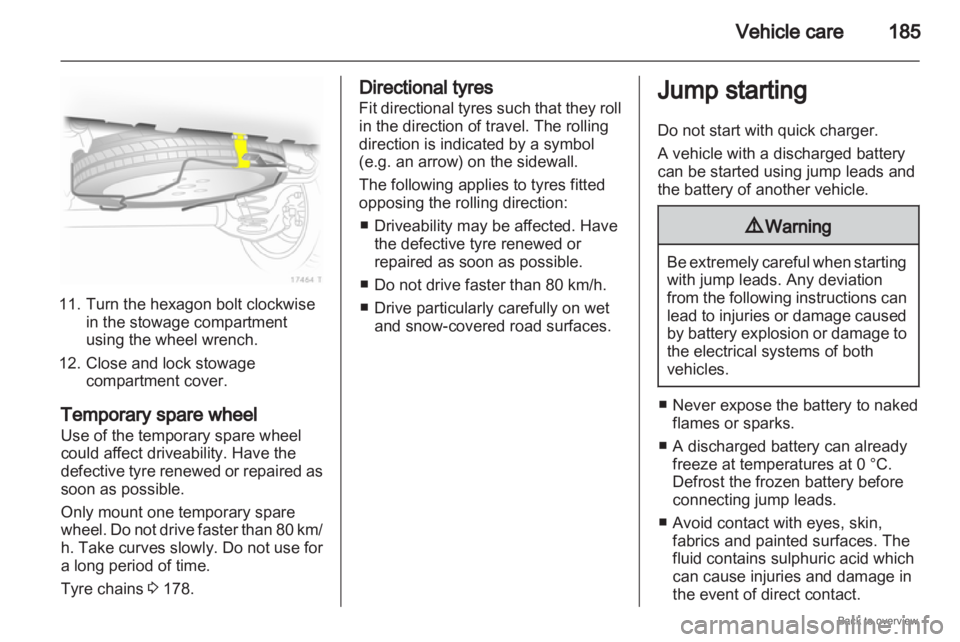
18511. Turn the hexagon bolt clockwise
in the stowage compartment
using the wheel wrench.
12.
Close and lock stowagecompartment cover.
Temporary spare wheel
Use of the temporary spare wheel
could affect driveability. Have the
defective tyre renewed or repaired as
soon as possible.
Only mount one temporary spare
wheel. Do not drive faster than 80 km/
h. Take curves slowly. Do not use for
a long period of time.
Tyre chains 3 178. Directional tyres
Fit
directional tyres such that they roll
in the direction of travel. The rolling
direction is indicated by a symbol
(e.g. an arrow) on the sidewall.
The following applies to tyres fitted
opposing the rolling direction:
■ Driveability may be affected. Have the defective tyre renewed or
repaired as soon as possible.
■ Do not drive faster than 80 km/h.
■ Drive particularly carefully on wet and snow-covered road surfaces. Jump starting
Do not start with quick charger.
A vehicle with a discharged battery
can be started using jump leads and
the battery of another vehicle.
9
Warning Be extremely careful when starting
with jump leads. Any deviation
from
the following instructions can
lead to injuries or damage caused
by battery explosion or damage to
the electrical systems of both
vehicles. ■ Never expose the battery to naked
flames or sparks.
■
A discharged battery can alreadyfreeze at temperatures at 0 °C.
Defrost the frozen battery before
connecting jump leads.
■ Avoid contact with eyes, skin, fabrics and painted surfaces. The
fluid contains sulphuric acid which
can cause injuries and damage in
the event of direct contact.
Page 187 of 228
Vehicle care
187
Towing
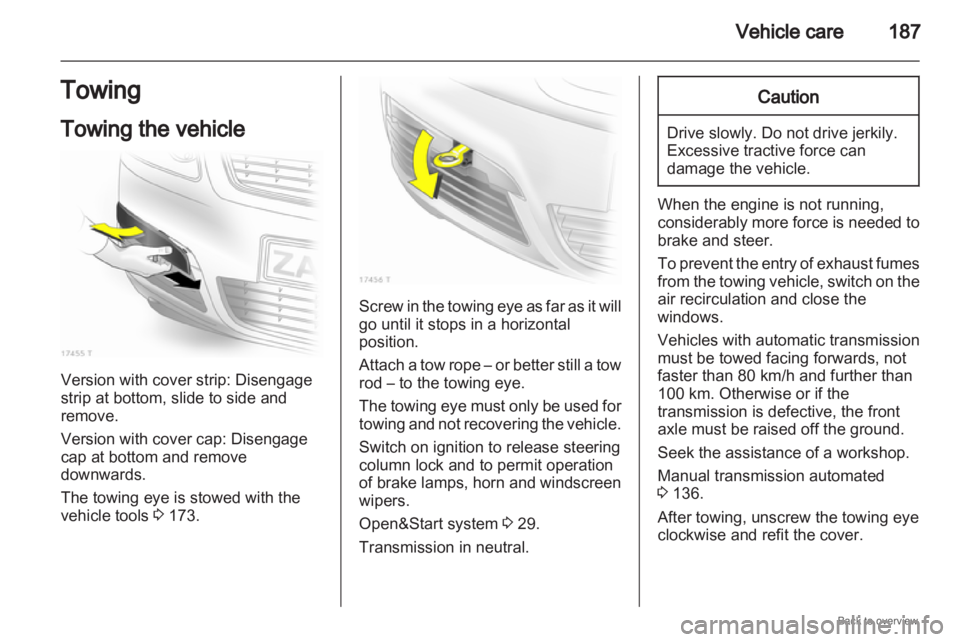
Towing the vehicle Version with cover strip: Disengage
strip at bottom, slide to side and
remove.
Version with cover cap: Disengage
cap at bottom and remove
downwards.
The towing eye is stowed with the
vehicle tools
3 173. Screw in the towing eye as far as it will
go until it stops in a horizontal
position.
Attach
a tow rope – or better still a tow
rod – to the towing eye.
The towing eye must only be used for
towing and not recovering the vehicle.
Switch on ignition to release steering
column lock and to permit operation
of brake lamps, horn and windscreen
wipers.
Open&Start system 3 29.
Transmission in neutral. Caution
Drive slowly. Do not drive jerkily.
Excessive tractive force can
damage the vehicle.
When the engine is not running,
considerably
more force is needed to
brake and steer.
To prevent the entry of exhaust fumes
from the towing vehicle, switch on the
air recirculation and close the
windows.
Vehicles with automatic transmission
must be towed facing forwards, not
faster than 80 km/h and further than
100 km. Otherwise or if the
transmission is defective, the front
axle must be raised off the ground.
Seek the assistance of a workshop.
Manual transmission automated
3 136.
After towing, unscrew the towing eye
clockwise and refit the cover.
Page 188 of 228
188
Vehicle care
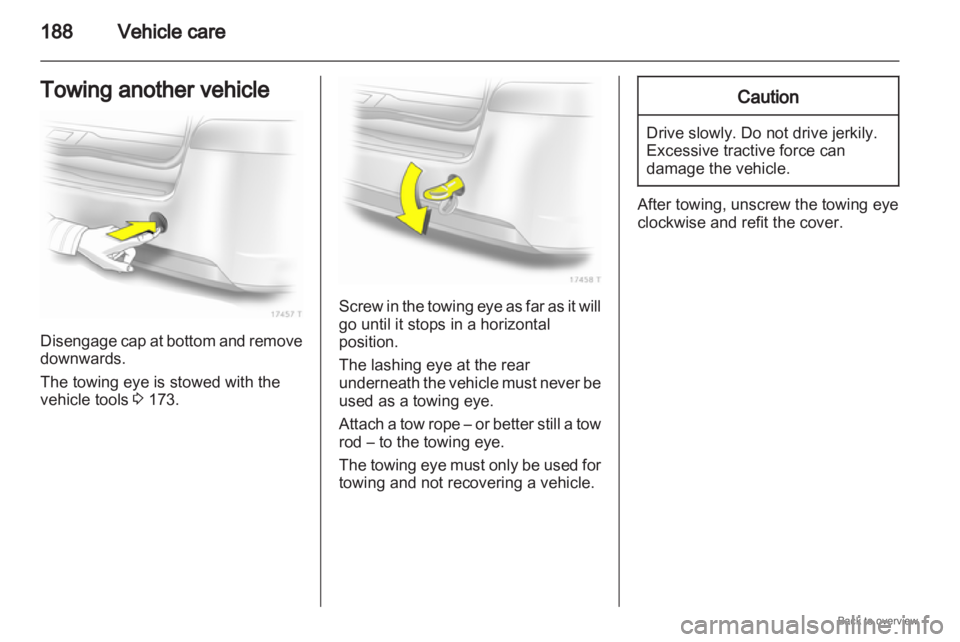
Towing another vehicle Disengage cap at bottom and remove
downwards.
The towing eye is stowed with the
vehicle tools
3 173. Screw in the towing eye as far as it will
go until it stops in a horizontal
position.
The lashing eye at the rear
underneath
the vehicle must never be
used as a towing eye.
Attach a tow rope – or better still a tow
rod – to the towing eye.
The towing eye must only be used for
towing and not recovering a vehicle. Caution
Drive slowly. Do not drive jerkily.
Excessive tractive force can
damage the vehicle.
After towing, unscrew the towing eye
clockwise and refit the cover.
Page 190 of 228
190
Vehicle care
Clean smearing wiper blades with
a soft cloth and window cleaner.
Moonroof
Never
clean with solvents or abrasive
agents, fuels, aggressive media (e.g.
paint cleaner, acetone-containing
solutions etc.), acidic or highly
alkaline media or abrasive pads. Do
not apply wax or polishing agents to
the middle part of the moonroof.
Wheels and tyres
Do not use high-pressure jet
cleaners.
Clean rims with a pH-neutral wheel
cleaner.
Rims are painted and can be treated
with the same agents as the body.
Paintwork damage
Rectify minor paintwork damage with
a touch-up pen before rust forms.
Have more extensive damage or rust
areas repaired by a workshop. Underbody
Some
areas of the vehicle underbody
have a PVC undercoating while other
critical areas have a durable
protective wax coating.
After the underbody is washed, check
the underbody and have it waxed if
necessary.
Bitumen/rubber materials could
damage the PVC coating. Have
underbody work carried out by
a workshop.
Before and after winter, wash the
underbody and have the protective
wax coating checked.
Engine compartment
Areas of the engine compartment that
are painted in the same colour as the
vehicle must be looked after like any
other painted surface.
It is advisable to wash the engine
compartment before and after winter
and preserve it with wax. Protect the
alternator and brake fluid reservoir
with plastic sheets before washing
the engine. When washing the engine with
a steam-jet cleaner, do not direct the
steam jet towards components of the
antilock brake system, air
conditioning system or the belt drive
and its components.
After
an engine wash, have all engine
room components preserved
thoroughly by a workshop using
protective wax.
Do not use high-pressure jet
cleaners.
Natural gas system
Do not direct the steam jet or high-
pressure jet towards natural gas
system components. It is particularly
important to protect the natural gas
tank and the pressure valves on the
vehicle underbody and the bulkhead
in the engine compartment.
These components must not be
treated using chemical cleaners or
preservatives.
Have components of the natural gas
system cleaned by a workshop
authorised to carry out maintenance
of natural gas vehicles.
Page 191 of 228
Vehicle care
191
Towing equipment
Do not clean the coupling ball bar with
a steam-jet or high-pressure jet
cleaner.
Interior care
Interior and upholstery
Only clean the vehicle interior,
including the instrument panel fascia
and panelling, with a dry cloth or
interior cleaner.
The instrument panel should only be
cleaned using a soft damp cloth.
Clean fabric upholstery with
a vacuum cleaner and brush.
Remove stains with an upholstery
cleaner.
Clean seat belts with lukewarm water
or interior cleaner. Caution
Close Velcro fasteners as open
Velcro
fasteners on clothing could
damage seat upholstery. Plastic and rubber parts
Plastic and rubber parts can be
cleaned with the same cleaner as
used to clean the body. Use interior
cleaner if necessary. Do not use any
other
agent. Avoid solvents and petrol
in particular. Do not use high-
pressure jet cleaners.
Page 198 of 228

198
Service and maintenanceService operations by year
1)
km ( x 1000) 1) 1
30 2
60 3
90 4
120 5
150
Undo wheel fastening (take care if tyre pressure monitoring system is present) and
tighten to torque: 110 Nm.
The wheel bolt taper should be greased or oiled lightly during assembly.
Check tyre condition. Check/correct tyre pressure (including spare wheel)
With tyre repair system - check completeness and expiry date of kit. Replace sealant
bottle every 4 years. X X
+
Annual service check if annual mileage exceeds 20 000 km
Visually inspect first-aid kit, (presence in designated stowage compartment,
completeness and expiry date), lashing eyes and warning triangle Every 2 years
Check/correct headlamp adjustment (including auxiliary headlamps) X X
Grease door hinges, door stop, lock cylinder, striker plate, bonnet lock, tailgate hinges,
wipe door stop check strap clean before greasing X X
Test drive, final inspection (check steering and ignition locks, instruments and indicator
lamps,
entire brake system, steering, air conditioning, engine, body and running gear),
reset service interval display with TECH 2) X X X X X
+: Additional operations.
o: Under extreme operating conditions and if required by country-specific conditions, the intervals are reduced.
Page 202 of 228

202
Service and maintenanceService operations by year
3)
km ( x 1000) 1) 1
15 2
30 3
45 4
60 5
75
+o
Visually inspect front and rear wheel brakes
4)
, if a tyre pressure monitoring system is
fitted, do not swap wheels over X X
Annual service check if annual mileage exceeds 20 000 km
Engine, transmission (AT, MT), inspect air-conditioning compressor for leaks
4) X X X X X
Visually inspect folding covers on steering, tie rods and axle drive X X X X X
Tie rod and supporting joint checking X X X X X
+ Change brake and clutch fluid automated manual transmission (MTA) Every 2 years
Undo wheel fastening (take care if tyre pressure monitoring system is present) and
tighten to torque: 110 Nm.
The wheel bolt taper should be greased or oiled lightly during assembly.
Check tyre condition. Check/correct tyre pressure (including spare wheel)
With tyre repair system - check completeness and expiry date of kit. Replace sealant
bottle every 4 years. X X
+
Annual service check if annual mileage exceeds 20 000 km
Visually inspect first-aid kit, (presence in designated stowage compartment,
completeness and expiry date), lashing eyes and warning triangle Every 2 years
Check/correct headlamp adjustment (including auxiliary headlamps) X X
4)
In case of too high consumption / leakage, perform additional work with customer's agreement.
Page 204 of 228
204
Service and maintenance
Additional servicing
Additional operations +
Additional operations are not required
every service but can be performed in
conjunction with a regular service.
Time allowances for such work are
not included in the scope of regular
services and will be charged for
additionally. It is more economic if
these operations are performed as
part of a scheduled service than
having them performed separately.
Extreme operating conditions o
Extreme operating conditions are
given when at least one of the
following occurs frequently:
■ cold starts,
■ stop and go,
■ trailer towing,
■ gradients and/or high altitudes,
■ poor road surfaces,
■ sand and dust,
■ extreme temperature fluctuations. Police vehicles, taxis and driving
school vehicles are also classified as
operating under extreme conditions.
Under extreme operating conditions,
it may be necessary to have certain
scheduled service work done more
frequently than the scheduled
intervals.
Seek technical advice on the
servicing
requirements dependent on
the specific operating conditions. Recommended fluids,
lubricants and parts
Recommended fluids and
lubricants
Only use products that have been
tested and approved. Damage
resulting from the use of non-
approved materials will not be
covered by the warranty.
9
Warning Operating materials are
hazardous and could be
poisonous. Handle with care. Pay
attention to information given on
the containers.
Engine oil
Engine oil is identified by its quality
and also its viscosity. Quality is more
important than viscosity when
selecting which engine oil to use.
Page 217 of 228
![OPEL ZAFIRA 2009 Owners Guide Technical data
217
Additional weight
Engine Z16XEP Z16XER Z16XE1 Z16YNG Z18XER Z20LER Z20LEH
Edition/Enjoy [kg] 10 10 10 10 10 5 –
Cosmo [kg] 23 23 23 23 23 16 –
Sport [kg] 20 20 20 – 20 13 –](/img/37/58241/w960_58241-216.png "OPEL ZAFIRA 2009 Owners Guide Technical data
217
Additional weight
Engine Z16XEP Z16XER Z16XE1 Z16YNG Z18XER Z20LER Z20LEH
Edition/Enjoy [kg] 10 10 10 10 10 5 –
Cosmo [kg] 23 23 23 23 23 16 –
Sport [kg] 20 20 20 – 20 13 –")
Technical data
217
Additional weight
Engine Z16XEP Z16XER Z16XE1 Z16YNG Z18XER Z20LER Z20LEH
Edition/Enjoy [kg] 10 10 10 10 10 5 –
Cosmo [kg] 23 23 23 23 23 16 –
Sport [kg] 20 20 20 – 20 13 –
Engine Z22YH A17DTJ A17DTR Z19DTL Z19DT Z19DTH
Edition/Enjoy [kg] 5 5 5 5 5 5
Cosmo [kg] 16 16 16 16 16 16
Sport [kg] 13 13 13 13 13 13
Heavy accessories
Accessories
Moon roof Towing equipment Headlamp washer system Adaptive forward lighting
Weight [kg] 35 17 3 4