brake fluid OPEL ZAFIRA 2009 Owners Manual
[x] Cancel search | Manufacturer: OPEL, Model Year: 2009, Model line: ZAFIRA, Model: OPEL ZAFIRA 2009Pages: 228, PDF Size: 7.3 MB
Page 17 of 228
In brief
17
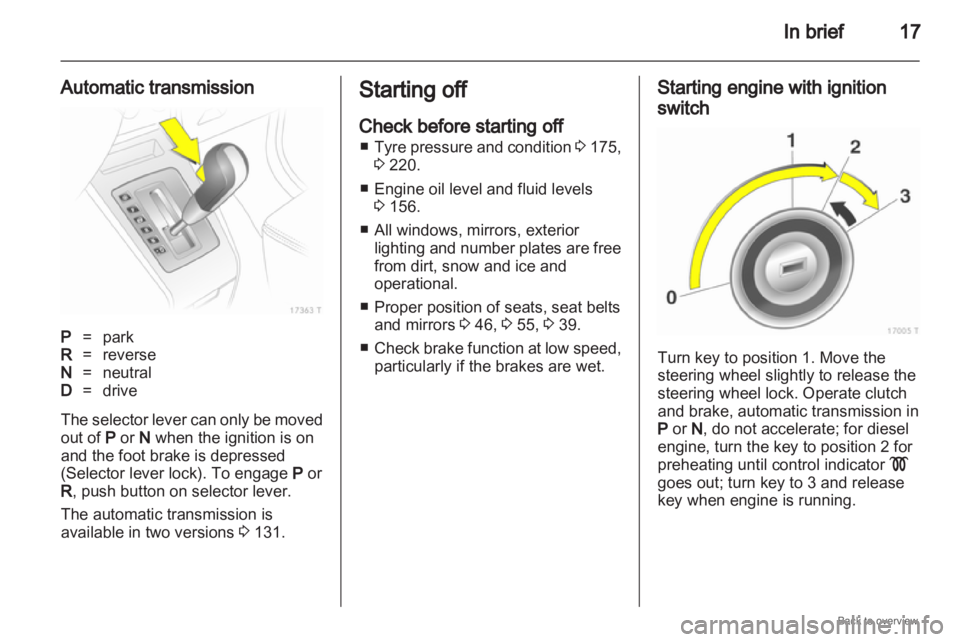
Automatic transmission P
=park
R = reverse
N = neutral
D = drive
The selector lever can only be moved
out of P or N when the ignition is on
and the foot brake is depressed
(Selector lever lock). To engage P or
R , push button on selector lever.
The automatic transmission is
available in two versions 3 131. Starting off
Check before starting off
■ Tyre
pressure and condition 3 175,
3 220.
■ Engine oil level and fluid levels 3 156.
■ All windows, mirrors, exterior lighting and number plates are free
from dirt, snow and ice and
operational.
■ Proper position of seats, seat belts and mirrors 3 46, 3 55, 3 39.
■ Check brake function at low speed, particularly if the brakes are wet. Starting engine with ignition
switch
Turn key to position 1. Move the
steering wheel slightly to release the
steering wheel lock. Operate clutch
and brake, automatic transmission in
P or N
, do not accelerate; for diesel
engine, turn the key to position 2 for
preheating until control indicator !
goes out; turn key to 3 and release
key when engine is running.
Page 89 of 228

Instruments and controls
89
Flashes with switched on
ignition
Fault in the electronic immobiliser
system.
The engine cannot be started
3 38.
Brake and clutch system
R illuminates or flashes red.
Illuminated
Illuminates when the hand brake is
released if the brake/clutch fluid level
is too low 3 158. 9
Warning Stop. Do not continue your
journey. Consult a workshop.
Illuminates after the ignition is
switched on if the hand brake is
applied
3 141.
Flashes
On vehicle with automated manual
transmission, flashes for a few
seconds
when the ignition is switched
off if the hand brake is not applied. On vehicles with automated manual
transmission, flashes when the
driver's door is opened if no gear is
engaged and the hand brake is not
applied.
Antilock brake system
(ABS)
u
illuminates red.
Illuminates
for a few seconds after the
ignition is turned on. The system is
ready for operation when the control
indicator goes out.
If the control indicator does not go out
after a few seconds, or if it illuminates
while driving, there is a fault in the
ABS. The brake system remains
operational but without ABS
regulation.
Anti-lock Braking System 3 140.
Sport mode
1 illuminates yellow.
The symbol is illuminated when Sport
mode is on 3 134, 3 138. Winter mode
T
illuminates yellow.
The symbol is illuminated when
Winter mode is on 3 134, 3 138.
Ultrasonic parking assist
r illuminates or flashes yellow.
Illuminated
Fault
in system. Have the cause of the
fault remedied by a workshop.
Flashes
Fault due to sensors that are dirty or
covered by ice or snow.
or
Interference due to external sources
of ultra sound. Once the source of
interference is removed, the system
will operate normally.
Ultrasonic parking sensors 3 145.
Electronic Stability
Program
v flashes or illuminates yellow.
Page 101 of 228
Instruments and controls
101
Brake light switch
Brake light does not come on during
braking. Have the cause of the fault
remedied immediately by
a workshop.
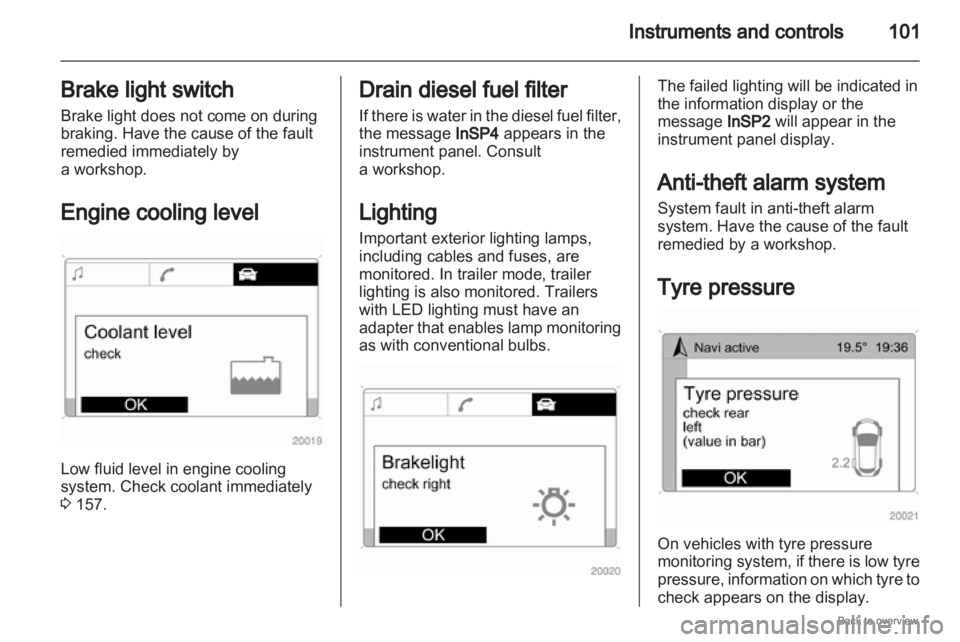
Engine cooling level Low fluid level in engine cooling
system. Check coolant immediately
3 157. Drain diesel fuel filter
If
there is water in the diesel fuel filter,
the message InSP4 appears in the
instrument panel. Consult
a workshop.
Lighting
Important exterior lighting lamps,
including cables and fuses, are
monitored. In trailer mode, trailer
lighting is also monitored. Trailers
with LED lighting must have an
adapter that enables lamp monitoring
as with conventional bulbs. The failed lighting will be indicated in
the information display or the
message InSP2 will appear in the
instrument panel display.
Anti-theft alarm system
System fault in anti-theft alarm
system. Have the cause of the fault
remedied by a workshop.
Tyre pressure On vehicles with tyre pressure
monitoring
system, if there is low tyre
pressure, information on which tyre to
check appears on the display.
Page 154 of 228
154
Vehicle care
Vehicle care
General Information ...................154
Vehicle checks ........................... 155
Bulb replacement .......................160
Electrical system ........................167
Vehicle tools .............................. 173
Wheels and tyres .......................174
Jump starting ............................. 185
Towing ....................................... 187
Appearance care .......................189 General Information
Accessories and vehicle
modifications
We
recommend to use Genuine Parts
and Accessories and factory
approved parts specific for your
vehicle type. We cannot assess or
guarantee for other products - even if
they have a regulatory or otherwise
granted approval.
Do not make any modifications to the
electrical system, e. g. changes of
electronic control units (chip tuning).
Vehicle storage
Storage for a long period of time
Following must be done if the vehicle
should be stored for several months:
■ Wash and wax the vehicle.
■ Have the wax in the engine compartment and underbody
checked.
■ Clean and preserve rubber seals.
■ Change engine oil. ■ Drain washer fluid reservoir.
■
Check coolant anti-freeze andcorrosion protection.
■ Adjust tyre pressure to the value specified for full load.
■ Park vehicle in dry, well ventilated place. Engage first or reverse gear
or set selector lever to P. Prevent
the vehicle from rolling.
■ Do not apply hand brake.
■ Open bonnet, close all doors and lock the vehicle.
■ Disconnect the clamp from the negative terminal of the vehicle
battery. Beware that all systems are
not functional, e.g. anti-theft alarm
system.
Putting back into operation
Following must be done if the vehicle
is putting back into operation: ■ Connect the clamp to the negative terminal of the vehicle battery.
Activate the electronic of the power
windows.
■ Check tyre pressure.
■ Fill up the washer fluid reservoir.
Page 158 of 228
158
Vehicle care
concentration checked and have the
cause of the coolant loss remedied by
a workshop.
Washer fluid Fill with clean water mixed with
a suitable quantity of windscreen
wash solution which contains anti-
freeze. Brakes
A squealing noise indicates that the
brake lining is at its minimum
thickness. Continued driving is
possible but have the brake lining
replaced as soon as possible.
Once new brake linings are installed,
do not brake unnecessarily hard for
the first few journeys.
Brake fluid
9
Warning Brake fluid is poisonous and
corrosive.
Avoid contact with eyes,
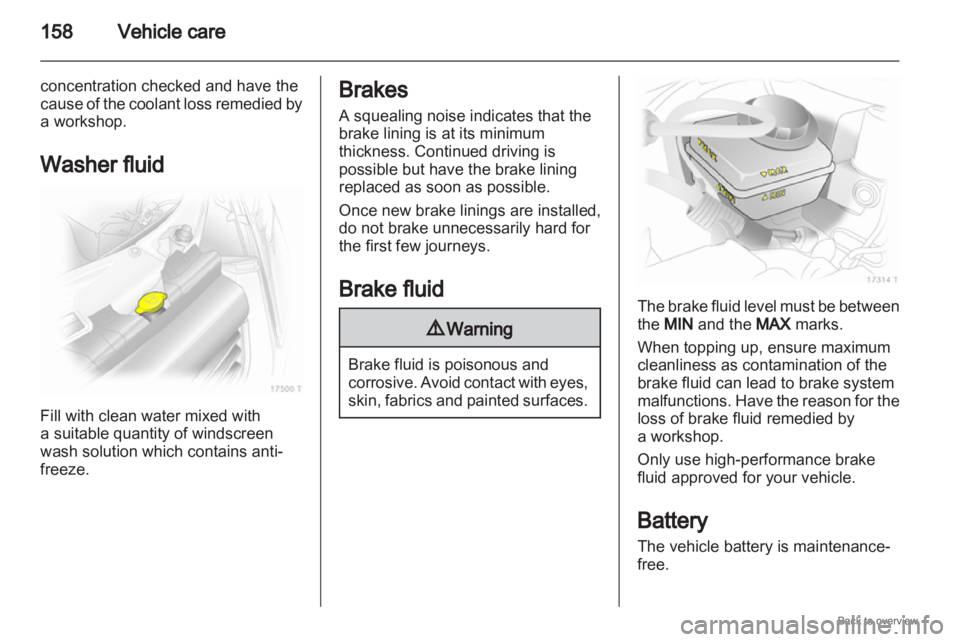
skin, fabrics and painted surfaces. The brake fluid level must be between
the MIN and the MAX marks.
When topping up, ensure maximum
cleanliness as contamination of the
brake fluid can lead to brake system
malfunctions.
Have the reason for the
loss of brake fluid remedied by
a workshop.
Only use high-performance brake
fluid approved for your vehicle.
Battery
The vehicle battery is maintenance-
free.
Page 190 of 228
190
Vehicle care
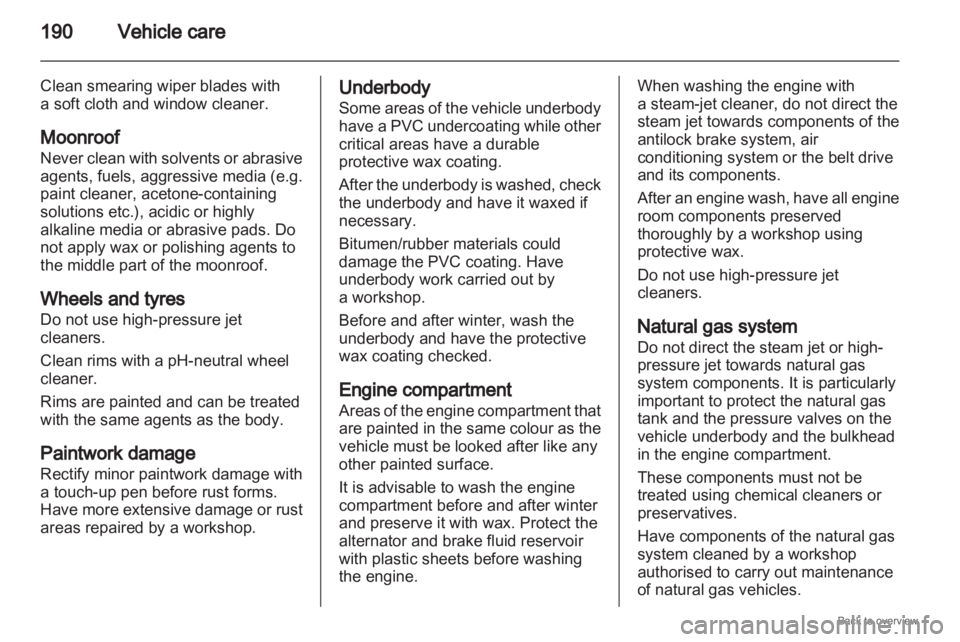
Clean smearing wiper blades with
a soft cloth and window cleaner.
Moonroof
Never
clean with solvents or abrasive
agents, fuels, aggressive media (e.g.
paint cleaner, acetone-containing
solutions etc.), acidic or highly
alkaline media or abrasive pads. Do
not apply wax or polishing agents to
the middle part of the moonroof.
Wheels and tyres
Do not use high-pressure jet
cleaners.
Clean rims with a pH-neutral wheel
cleaner.
Rims are painted and can be treated
with the same agents as the body.
Paintwork damage
Rectify minor paintwork damage with
a touch-up pen before rust forms.
Have more extensive damage or rust
areas repaired by a workshop. Underbody
Some
areas of the vehicle underbody
have a PVC undercoating while other
critical areas have a durable
protective wax coating.
After the underbody is washed, check
the underbody and have it waxed if
necessary.
Bitumen/rubber materials could
damage the PVC coating. Have
underbody work carried out by
a workshop.
Before and after winter, wash the
underbody and have the protective
wax coating checked.
Engine compartment
Areas of the engine compartment that
are painted in the same colour as the
vehicle must be looked after like any
other painted surface.
It is advisable to wash the engine
compartment before and after winter
and preserve it with wax. Protect the
alternator and brake fluid reservoir
with plastic sheets before washing
the engine. When washing the engine with
a steam-jet cleaner, do not direct the
steam jet towards components of the
antilock brake system, air
conditioning system or the belt drive
and its components.
After
an engine wash, have all engine
room components preserved
thoroughly by a workshop using
protective wax.
Do not use high-pressure jet
cleaners.
Natural gas system
Do not direct the steam jet or high-
pressure jet towards natural gas
system components. It is particularly
important to protect the natural gas
tank and the pressure valves on the
vehicle underbody and the bulkhead
in the engine compartment.
These components must not be
treated using chemical cleaners or
preservatives.
Have components of the natural gas
system cleaned by a workshop
authorised to carry out maintenance
of natural gas vehicles.
Page 195 of 228
Service and maintenance
195Service operations by year
1)
km ( x 1000) 1) 1
30 2
60 3
90 4
120 5
150
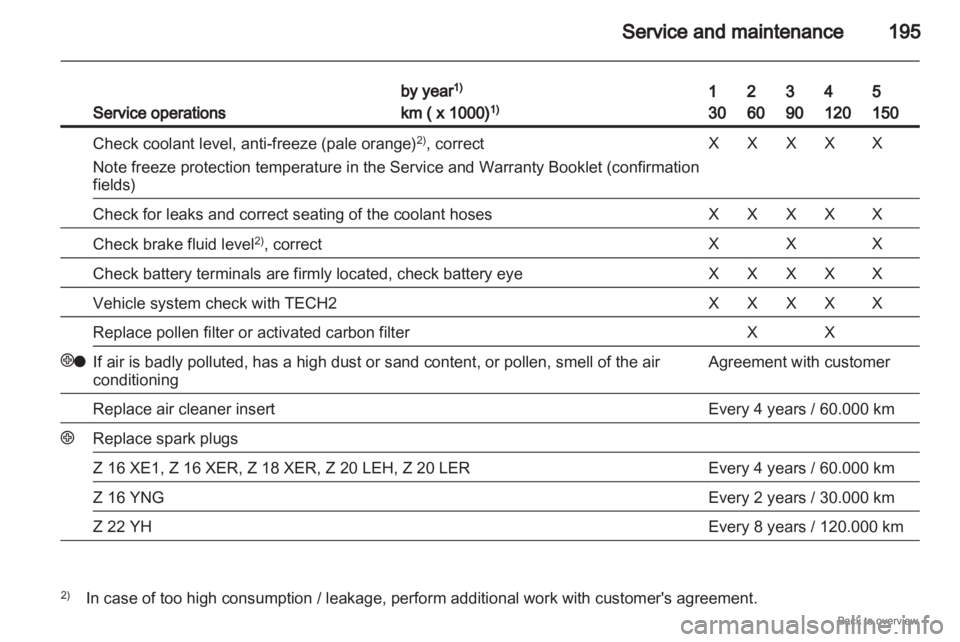
Check coolant level, anti-freeze (pale orange)
2)
, correct
Note freeze protection temperature in the Service and Warranty Booklet (confirmation
fields) X X X X X
Check for leaks and correct seating of the coolant hoses X X X X X
Check brake fluid level
2)
, correct X X X
Check battery terminals are firmly located, check battery eye X X X X X
Vehicle system check with TECH2 X X X X X
Replace pollen filter or activated carbon filter X X
+o
If air is badly polluted, has a high dust or sand content, or pollen, smell of the air
conditioning Agreement with customer
Replace air cleaner insert Every 4 years / 60.000 km
+ Replace spark plugs Z 16 XE1, Z 16 XER, Z 18 XER, Z 20 LEH, Z 20 LER Every 4 years / 60.000 km
Z 16 YNG Every 2 years / 30.000 km
Z 22 YH Every 8 years / 120.000 km
2)
In case of too high consumption / leakage, perform additional work with customer's agreement.
Page 197 of 228
Service and maintenance
197Service operations by year
1)
km ( x 1000) 1) 1
30 2
60 3
90 4
120 5
150
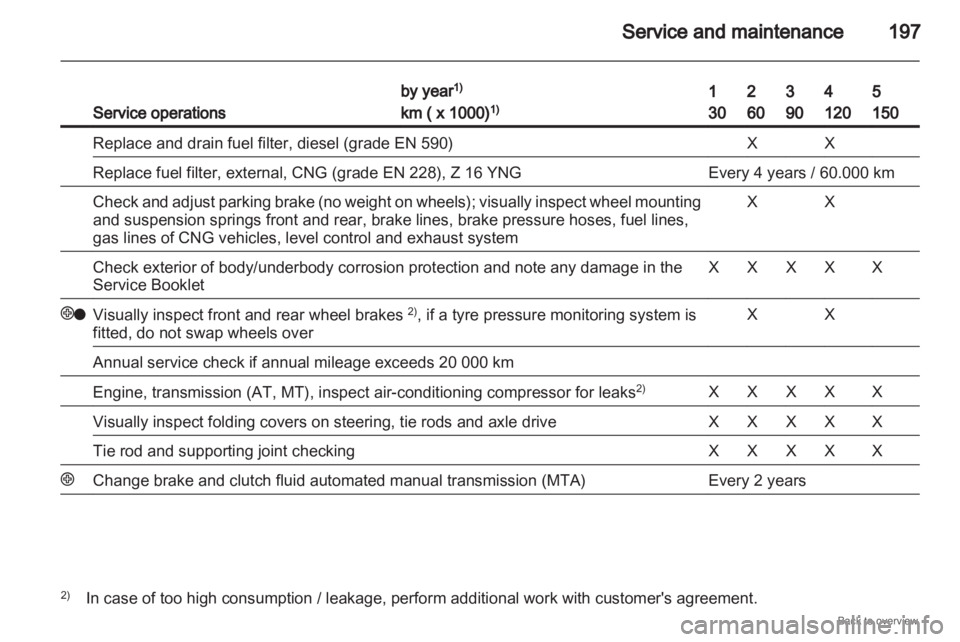
Replace and drain fuel filter, diesel (grade EN 590) X X
Replace fuel filter, external, CNG (grade EN 228), Z 16 YNG Every 4 years / 60.000 km
Check and adjust parking brake (no weight on wheels); visually inspect wheel mounting
and suspension springs front and rear, brake lines, brake pressure hoses, fuel lines,
gas lines of CNG vehicles, level control and exhaust system X X
Check exterior of body/underbody corrosion protection and note any damage in the
Service Booklet X X X X X
+o
Visually inspect front and rear wheel brakes
2)
, if a tyre pressure monitoring system is
fitted, do not swap wheels over X X
Annual service check if annual mileage exceeds 20 000 km
Engine, transmission (AT, MT), inspect air-conditioning compressor for leaks
2) X X X X X
Visually inspect folding covers on steering, tie rods and axle drive X X X X X
Tie rod and supporting joint checking X X X X X
+ Change brake and clutch fluid automated manual transmission (MTA) Every 2 years
2)
In case of too high consumption / leakage, perform additional work with customer's agreement.
Page 199 of 228
Service and maintenance
199
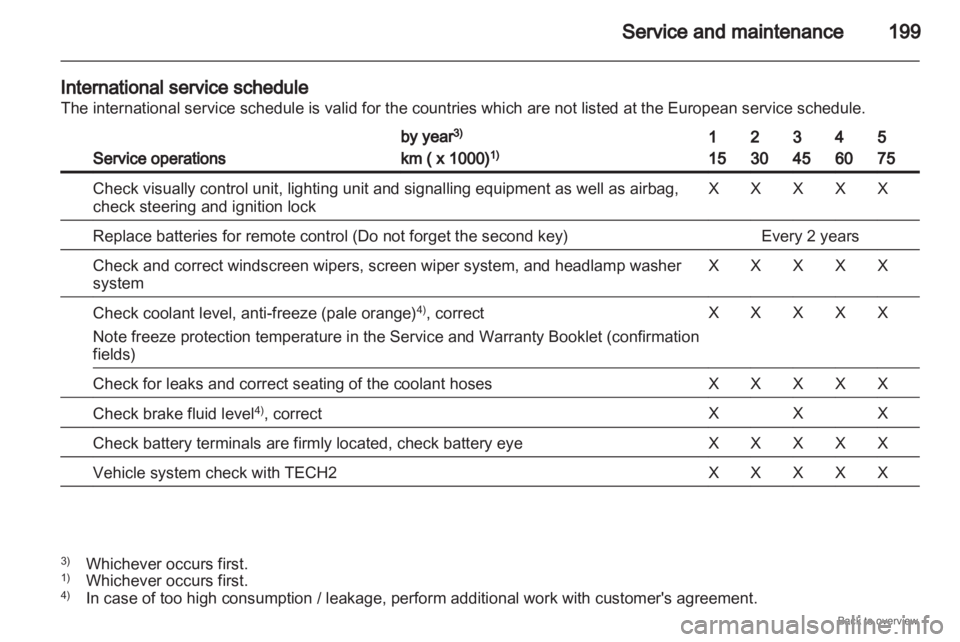
International service schedule
The international service schedule is valid for the countries which are not listed at the European service schedule. Service operations by year
3)
km ( x 1000) 1) 1
15 2
30 3
45 4
60 5
75
Check visually control unit, lighting unit and signalling equipment as well as airbag,
check steering and ignition lock X X X X X
Replace batteries for remote control (Do not forget the second key) Every 2 years
Check and correct windscreen wipers, screen wiper system, and headlamp washer
system X X X X X
Check coolant level, anti-freeze (pale orange)
4)
, correct
Note freeze protection temperature in the Service and Warranty Booklet (confirmation
fields) X X X X X
Check for leaks and correct seating of the coolant hoses X X X X X
Check brake fluid level
4)
, correct X X X
Check battery terminals are firmly located, check battery eye X X X X X
Vehicle system check with TECH2 X X X X X
3)
Whichever occurs first.
1) Whichever occurs first.
4) In case of too high consumption / leakage, perform additional work with customer's agreement.
Page 201 of 228
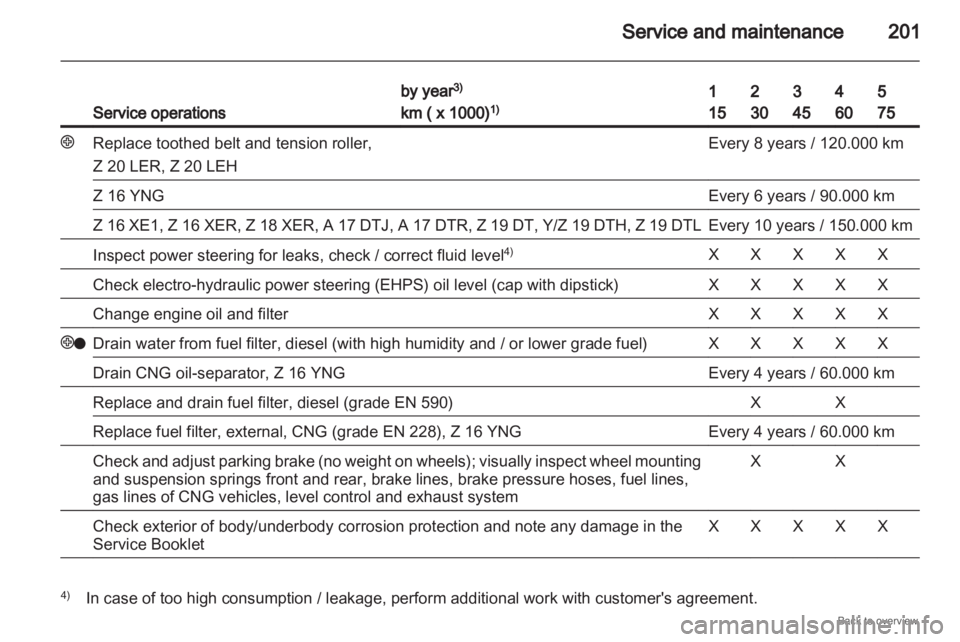
Service and maintenance
201Service operations by year
3)
km ( x 1000) 1) 1
15 2
30 3
45 4
60 5
75
+ Replace toothed belt and tension roller,
Z 20 LER, Z 20 LEH Every 8 years / 120.000 km
Z 16 YNG Every 6 years / 90.000 km
Z 16 XE1, Z 16 XER, Z 18 XER, A 17 DTJ, A 17 DTR, Z 19 DT, Y/Z 19 DTH, Z 19 DTL Every 10 years / 150.000 km
Inspect power steering for leaks, check / correct fluid level
4) X X X X X
Check electro-hydraulic power steering (EHPS) oil level (cap with dipstick) X X X X X
Change engine oil and filter X X X X X
+o Drain water from fuel filter, diesel (with high humidity and / or lower grade fuel) X X X X X
Drain CNG oil-separator, Z 16 YNG Every 4 years / 60.000 km
Replace and drain fuel filter, diesel (grade EN 590) X X
Replace fuel filter, external, CNG (grade EN 228), Z 16 YNG Every 4 years / 60.000 km
Check and adjust parking brake (no weight on wheels); visually inspect wheel mounting
and suspension springs front and rear, brake lines, brake pressure hoses, fuel lines,
gas lines of CNG vehicles, level control and exhaust system X X
Check exterior of body/underbody corrosion protection and note any damage in the
Service Booklet X X X X X
4)
In case of too high consumption / leakage, perform additional work with customer's agreement.