child restraint OPEL ZAFIRA 2009 Owners Manual
[x] Cancel search | Manufacturer: OPEL, Model Year: 2009, Model line: ZAFIRA, Model: OPEL ZAFIRA 2009Pages: 228, PDF Size: 7.3 MB
Page 44 of 228

44
Seats, restraints
Seats, restraints
Head restraints ............................ 44
Front seats ................................... 46
Rear seats ................................... 49
Seat belts ..................................... 54
Airbag system .............................. 57
Child restraints ............................. 62 Head restraints
Position
9
Warning Only drive with the head restraint
set to the proper position.
The middle of the head restraint
should be at eye level. If this is not
possible for extremely tall persons,
set to highest position, and set to
lowest position for small persons. Adjustment
Head restraints with release button
Press the button, adjust height and
engage.
Page 59 of 228
Seats, restraints
59
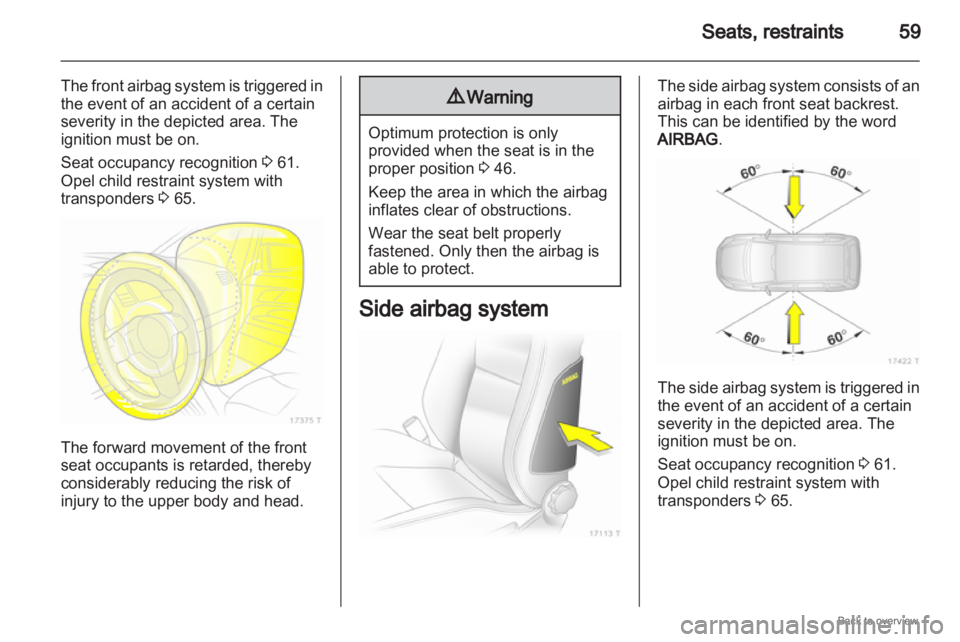
The front airbag system is triggered in
the event of an accident of a certain
severity in the depicted area. The
ignition must be on.
Seat occupancy recognition 3 61.
Opel child restraint system with
transponders 3 65.The forward movement of the front
seat occupants is retarded, thereby
considerably reducing the risk of
injury to the upper body and head. 9
Warning Optimum protection is only
provided when the seat is in the
proper position
3 46.
Keep the area in which the airbag
inflates clear of obstructions.
Wear the seat belt properly
fastened. Only then the airbag is
able to protect. Side airbag system The side airbag system consists of an
airbag in each front seat backrest.
This can be identified by the word
AIRBAG.
The side airbag system is triggered in
the event of an accident of a certain
severity in the depicted area. The
ignition must be on.
Seat occupancy recognition
3 61.
Opel child restraint system with
transponders 3 65.
Page 61 of 228
Seats, restraints
61
The risk of injury to the head in the
event of a side impact is considerably
reduced.
The curtain airbag system does not
protect the third row of seats. 9
Warning Keep the area in which the airbag
inflates clear of obstructions.
The hooks on the handles in the
roof frame are only suitable for
hanging up light articles of
clothing,
without coat hangers. Do
not keep any items in these
clothes. Seat occupancy
recognition
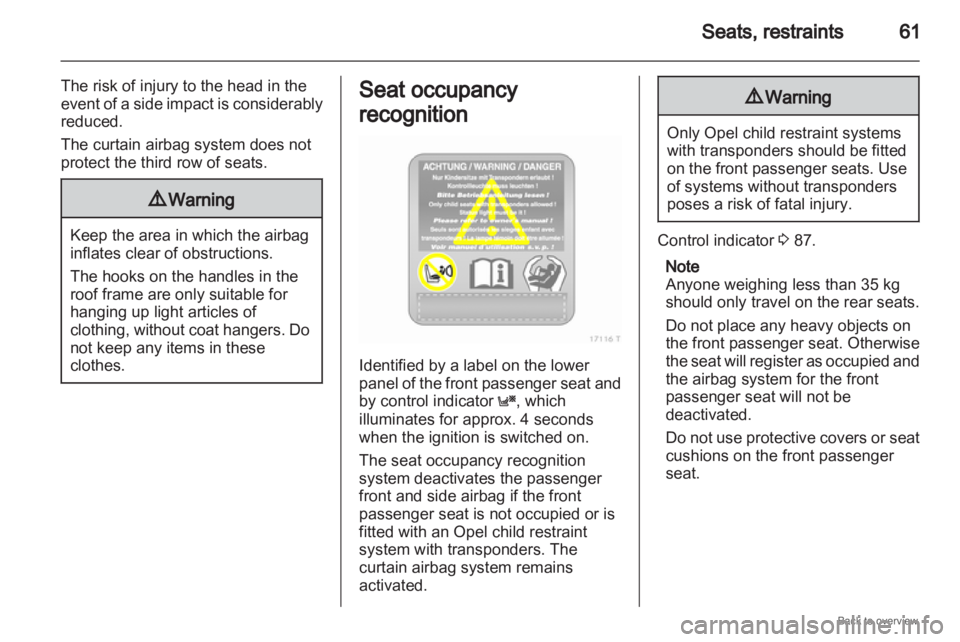
Identified by a label on the lower
panel
of the front passenger seat and
by control indicator y, which
illuminates for approx. 4 seconds
when the ignition is switched on.
The seat occupancy recognition
system deactivates the passenger
front and side airbag if the front
passenger seat is not occupied or is
fitted with an Opel child restraint
system with transponders. The
curtain airbag system remains
activated. 9
Warning Only Opel child restraint systems
with transponders should be fitted
on
the front passenger seats. Use
of systems without transponders
poses a risk of fatal injury. Control indicator
3 87.
Note
Anyone weighing less than 35 kg
should only travel on the rear seats.
Do not place any heavy objects on
the front passenger seat. Otherwise
the
seat will register as occupied and
the airbag system for the front
passenger seat will not be
deactivated.
Do not use protective covers or seat
cushions on the front passenger
seat.
Page 62 of 228
62
Seats, restraints
Child restraints
Child restraint systems
Follow the usage instructions for the
child restraint system.
Always comply with local or national
regulations. In some countries, the
use of child restraint systems is
forbidden on certain seats.
Selecting the right system
Your child should travel facing
backwards in the vehicle, until as old
as possible. A child has a very weak
cervical spinal column and in the
event of an accident is less likely to
suffer injury in a rearward-facing,
semi-lying position than if seated
upright.
Children
under 12 years or under 150
cm tall should only travel in an
appropriate child safety seat.
When transporting children, use the
child restraint systems suitable for the
child's weight. Note
Do not stick anything on the child
restraint systems and do not cover
them with any other materials.
A child restraint system which has
been subjected to stress in an
accident must be replaced.
Page 63 of 228

Seats, restraints
63
Child restraint installation locations
Permissible options for fitting a child safety seat
Weight and age class 1) On front passenger
seat On outboard
seats in the
second row On centre seat
in the second
row On the seats
in the third
row
Group 0: up to 10 kg or approx. 10 months
Group 0+: up to 13 kg or approx. 2 years
B
1
, + U, + U X
Group I: 9 to 18 kg or approx. 8 months to 4 years
B
2
, + U, +, ++ U UF
Group II: 15 to 25 kg or approx. 3 to 7 years
Group III: 22 to 36 kg or approx. 6 to 12 years
X U U UF
B
1
= Limited, only with seat occupancy recognition and Opel child restraint system with transponders.
If the child restraint system is being secured using a three-point seat belt, move seat height adjustment to uppermost
position. Move front passenger seat as far back as possible and move front passenger seat belt anchorage point to
lowest position.
B 2
= Limited, only with seat occupancy recognition and Opel child restraint system with transponders.
If
the child restraint system is being secured using a three-point seat belt, move seat height adjustment to uppermost
position. Move front passenger seat as far back as possible so that vehicle safety belt runs from anchorage point
towards the front.
U = Universal suitability in conjunction with three-point seat belt.
UF = Can be used universally for child restraint systems facing the front in combination with a three-point seat belt.
+ = Vehicle seat available with ISOFIX attachments. When attaching using ISOFIX, only the ISOFIX child restraint systems permitted for the vehicle may be used.
1) We recommend the use of each system until the child reaches the upper weight limit.
Page 64 of 228
64
Seats, restraints
++ = Vehicle seat available with ISOFIX attachments. When attaching using ISOFIX and Top-tether, universally permitted
ISOFIX child restraint systems may be used.
X = No child restraint system permitted in this weight class.
Page 65 of 228
Seats, restraints
65
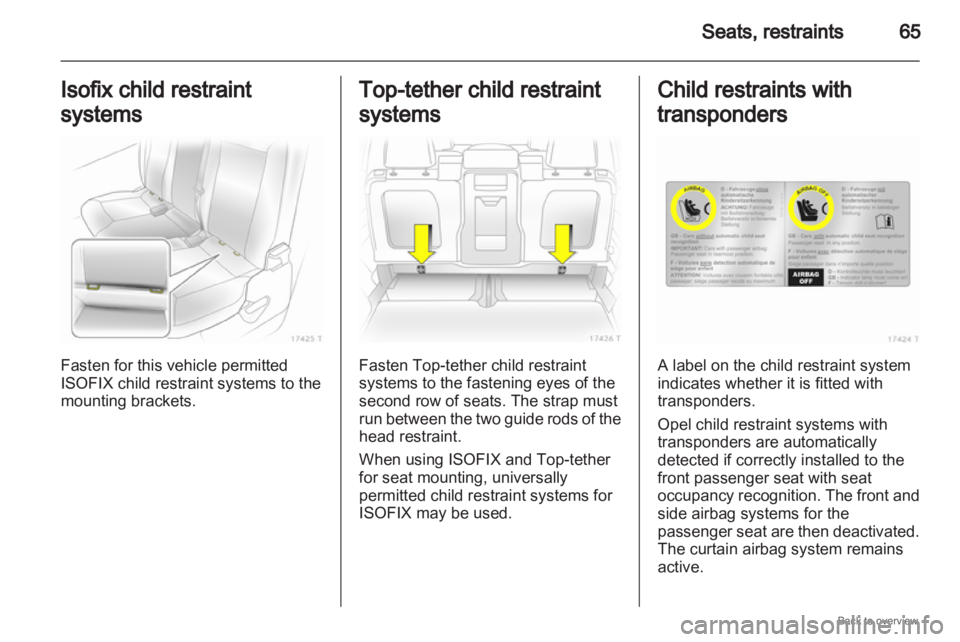
Isofix child restraint
systems Fasten for this vehicle permitted
ISOFIX child restraint systems to the
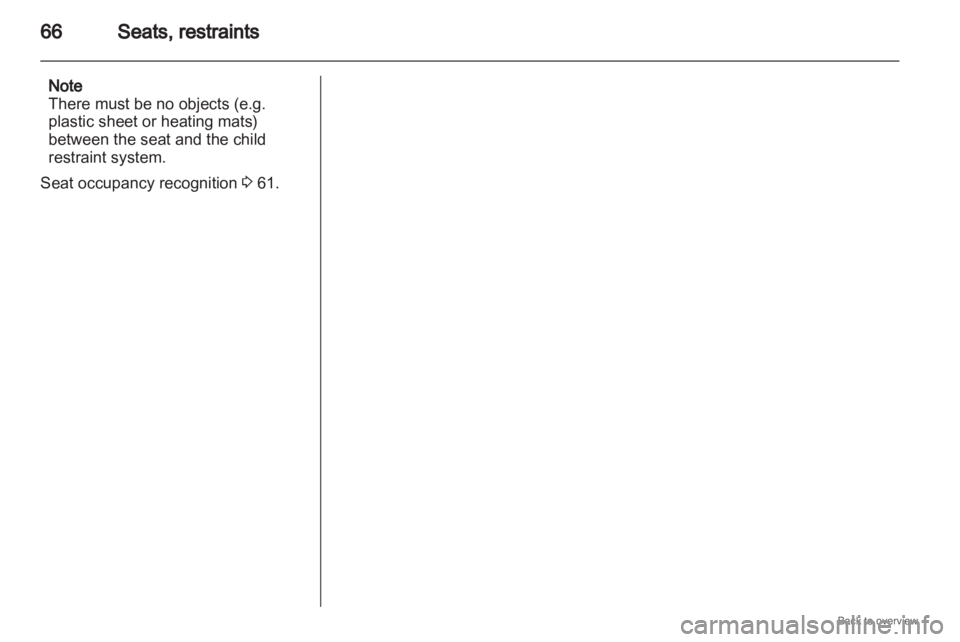
mounting brackets. Top-tether child restraint
systems
Fasten Top-tether child restraint
systems to the fastening eyes of the
second row of seats. The strap must
run
between the two guide rods of the
head restraint.
When using ISOFIX and Top-tether
for seat mounting, universally
permitted child restraint systems for
ISOFIX may be used. Child restraints with
transponders
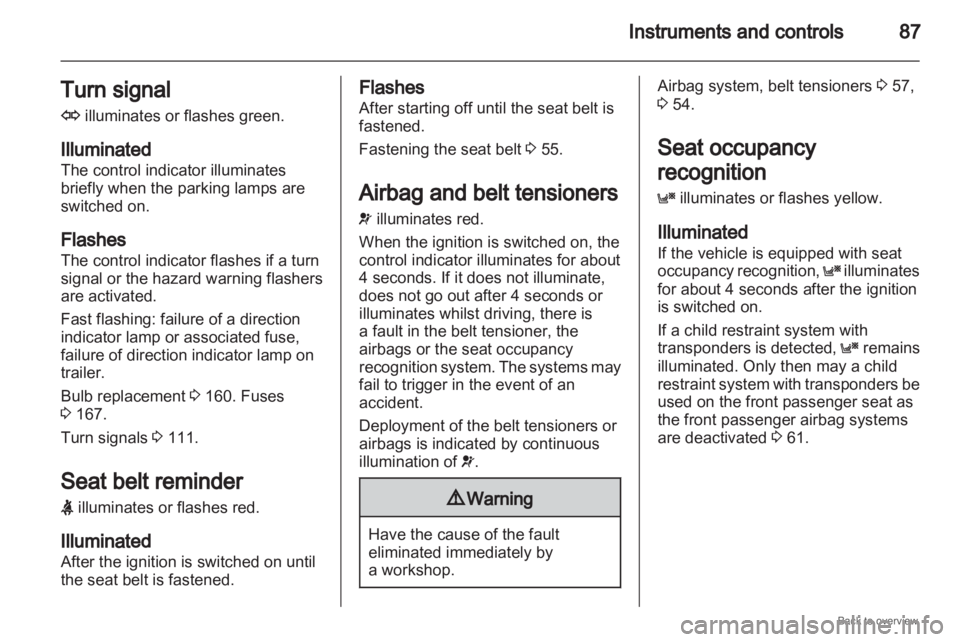
A label on the child restraint system
indicates whether it is fitted with
transponders.
Opel child restraint systems with
transponders are automatically
detected if correctly installed to the
front passenger seat with seat
occupancy
recognition. The front and
side airbag systems for the
passenger seat are then deactivated.
The curtain airbag system remains
active.
Page 66 of 228
66
Seats, restraints
Note
There must be no objects (e.g.
plastic sheet or heating mats)
between the seat and the child
restraint system.
Seat occupancy recognition 3 61.
Page 87 of 228
Instruments and controls
87
Turn signal
O illuminates or flashes green.
Illuminated
The control indicator illuminates
briefly when the parking lamps are
switched on.
Flashes
The control indicator flashes if a turn
signal or the hazard warning flashers
are activated.
Fast flashing: failure of a direction
indicator lamp or associated fuse,
failure of direction indicator lamp on
trailer.
Bulb replacement 3 160. Fuses
3 167.
Turn signals 3 111.
Seat belt reminder
X illuminates or flashes red.
Illuminated
After the ignition is switched on until
the seat belt is fastened. Flashes
After starting off until the seat belt is
fastened.
Fastening the seat belt
3 55.
Airbag and belt tensioners
v illuminates red.
When the ignition is switched on, the
control indicator illuminates for about
4 seconds. If it does not illuminate,
does not go out after 4 seconds or
illuminates whilst driving, there is
a fault in the belt tensioner, the
airbags or the seat occupancy
recognition
system. The systems may
fail to trigger in the event of an
accident.
Deployment of the belt tensioners or
airbags is indicated by continuous
illumination of v. 9
Warning Have the cause of the fault
eliminated immediately by
a workshop. Airbag system, belt tensioners
3 57,
3 54.
Seat occupancy
recognition
y illuminates or flashes yellow.
Illuminated
If the vehicle is equipped with seat
occupancy
recognition, y illuminates
for about 4 seconds after the ignition
is switched on.
If a child restraint system with
transponders is detected, y remains
illuminated. Only then may a child
restraint system with transponders be
used on the front passenger seat as
the front passenger airbag systems
are deactivated 3 61.
Page 88 of 228
88
Instruments and controls 9
Danger If a child restraint system is fitted
and the control indicator is not
illuminated while driving, the front
and side airbag for the front
passenger seat are not
deactivated.
Flashes
Fault in system or child restraint
system with transponders defective
or improperly fitted
3 61.9
Danger Flashing of the control indicator
while driving indicates a fault.
Have the cause of the fault
remedied by a workshop
immediately.
Child restraint system with
transponders
3 65.
Charging system
p illuminates red. It illuminates when the ignition is
switched
on and goes out shortly after
the engine starts.
Illuminates when the engine is
running
Stop, switch off engine. Battery is not
charging. Engine cooling may be
interrupted. In diesel engines, power
to the brake servo unit may be cut.
Seek the assistance of a workshop.
Malfunction indicator light
Z illuminates or flashes yellow.
It illuminates when the ignition is
switched on and goes out shortly after
the engine starts.
Illuminates when the engine is
running
Fault in the emission control system.
The permitted emission limits may be
exceeded. Immediately seek the
assistance of a workshop. Flashes when the engine is
running
Fault that could lead to catalytic
converter damage. Ease up on the
throttle until the flashing stops. Seek
the immediate assistance of
a workshop.
Service vehicle soon
A
illuminates or flashes yellow.
Illuminates when the engine is
running
Fault in engine or transmission
electronics. The electronics switch to
an emergency running programme.
Fuel consumption may be increased
and the vehicle handling may be
impaired.
If
the fault persists after restarting the
vehicle, consult a workshop.
Illuminates together with InSP4
in the service display
Seek the assistance of a workshop for
draining the diesel fuel filter.