maintenance OPEL ZAFIRA 2009 Owners Manual
[x] Cancel search | Manufacturer: OPEL, Model Year: 2009, Model line: ZAFIRA, Model: OPEL ZAFIRA 2009Pages: 228, PDF Size: 7.3 MB
Page 1 of 228
Introduction
.................................... 2
In brief ............................................ 6
Keys, doors and windows ............27
Seats, restraints ........................... 44
Storage ........................................ 67
Instruments and controls .............77
Lighting ...................................... 108
Infotainment system ...................115
Climate control ........................... 118
Driving and operating .................127
Vehicle care ............................... 154
Service and maintenance ..........192
Technical data ........................... 207
Index .......................................... 224
Contents
Page 3 of 228
Introduction 3
Vehicle specific data
Please enter your vehicle’s data on
the previous page to keep it easily
accessible. This information is
available under the sections "Service
and Maintenance" and "Technical
data" as well as on the identification
plate.
Introduction
Your vehicle is a designed
combination
of advanced technology,
safety, environmental friendliness
and economy.
This Owner’s Manual provides you
with all the necessary information to
enable you to drive your vehicle
safely and efficiently.
Make sure your passengers are
aware of the possible risk of accident
and injury which may result from
improper use of the vehicle.
You must always comply with the
specific laws and regulations of the
country that you are in. These laws
may differ from the information in this
Owner’s Manual. When this Owner’s Manual refers to
a
workshop visit, we recommend your
Opel Service Partner.
All Opel Service Partners provide
first-class service at reasonable
prices. Experienced mechanics
trained by Opel work according to
specific Opel instructions.
The customer literature pack should
always be kept ready to hand in the
vehicle glovebox.
Using this manual
■ The "In brief" section will give you an initial overview.
■ The table of contents at the beginning of this manual and within
each chapter shows where the
information is located.
■ The index will enable you to search for specific information.
■ Yellow arrows in the illustrations serve as points of reference or
indicate some action to be
performed. ■ Black arrows in the illustrations
indicate a reaction or a second
action to be performed.
■
This Owner’s Manual depicts left-hand drive vehicles. Operation is
similar for right-hand drive vehicles.
■ The Owner’s Manual uses the factory engine designations. The
corresponding sales designations
can be found in the chapter
"Technical data".
■ Directional data, e.g. left or right, or front or back, always relate to the
direction of travel.
■ Depending on the model variant, country variant, integrated special
equipment and accessories, the
scope of equipment of your vehicle
can differ from the descriptions in
these Owner’s Manual.
Page 118 of 228
118
Climate control
Climate control
Climate control systems ............. 118
Air vents ..................................... 124
Maintenance .............................. 125 Climate control systems
Heating and ventilation
system
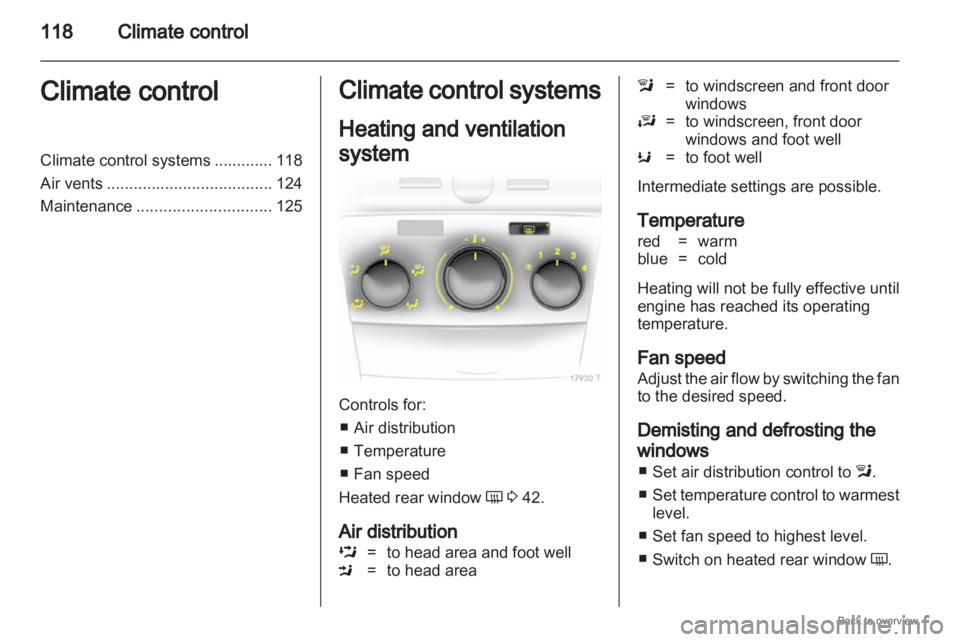
Controls for:
■ Air distribution
■ Temperature
■ Fan speed
Heated rear window Ü 3 42.
Air distribution
L =
to head area and foot well
M = to head area l
= to windscreen and front door
windows
J = to windscreen, front door
windows and foot well
K = to foot well
Intermediate settings are possible.
Temperature
red = warm
blue = cold
Heating will not be fully effective until
engine has reached its operating
temperature.
Fan speed
Adjust
the air flow by switching the fan
to the desired speed.
Demisting and defrosting the
windows
■ Set air distribution control to l.
■ Set temperature control to warmest level.
■ Set fan speed to highest level.
■ Switch on heated rear window Ü.
Page 125 of 228
Climate control
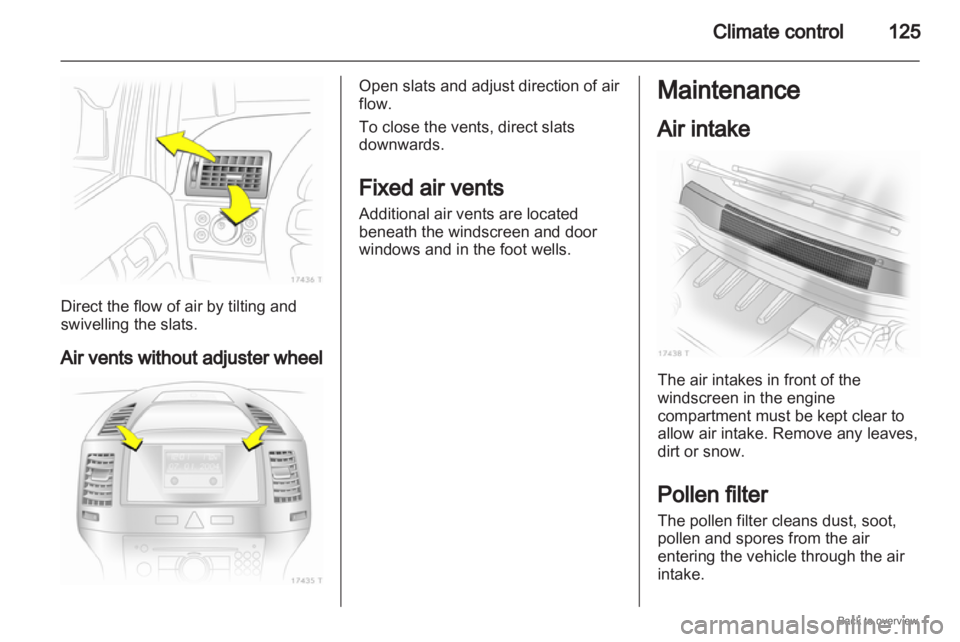
125Direct the flow of air by tilting and
swivelling the slats.
Air
vents without adjuster wheel Open slats and adjust direction of air
flow.
To close the vents, direct slats
downwards.
Fixed air vents
Additional air vents are located
beneath the windscreen and door
windows and in the foot wells.
Maintenance
Air intake
The air intakes in front of the
windscreen in the engine
compartment must be kept clear to
allow air intake. Remove any leaves,
dirt or snow.
Pollen filter
The pollen filter cleans dust, soot,
pollen and spores from the air
entering the vehicle through the air
intake.
Page 158 of 228
158
Vehicle care
concentration checked and have the
cause of the coolant loss remedied by
a workshop.
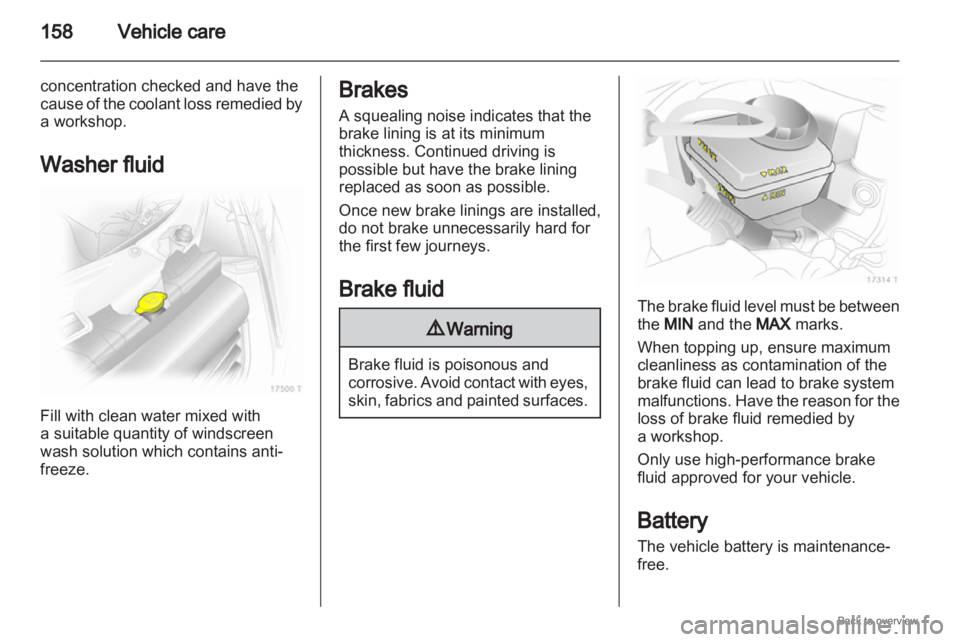
Washer fluid Fill with clean water mixed with
a suitable quantity of windscreen
wash solution which contains anti-
freeze. Brakes
A squealing noise indicates that the
brake lining is at its minimum
thickness. Continued driving is
possible but have the brake lining
replaced as soon as possible.
Once new brake linings are installed,
do not brake unnecessarily hard for
the first few journeys.
Brake fluid
9
Warning Brake fluid is poisonous and
corrosive.
Avoid contact with eyes,
skin, fabrics and painted surfaces. The brake fluid level must be between
the MIN and the MAX marks.
When topping up, ensure maximum
cleanliness as contamination of the
brake fluid can lead to brake system
malfunctions.
Have the reason for the
loss of brake fluid remedied by
a workshop.
Only use high-performance brake
fluid approved for your vehicle.
Battery
The vehicle battery is maintenance-
free.
Page 190 of 228
190
Vehicle care
Clean smearing wiper blades with
a soft cloth and window cleaner.
Moonroof
Never
clean with solvents or abrasive
agents, fuels, aggressive media (e.g.
paint cleaner, acetone-containing
solutions etc.), acidic or highly
alkaline media or abrasive pads. Do
not apply wax or polishing agents to
the middle part of the moonroof.
Wheels and tyres
Do not use high-pressure jet
cleaners.
Clean rims with a pH-neutral wheel
cleaner.
Rims are painted and can be treated
with the same agents as the body.
Paintwork damage
Rectify minor paintwork damage with
a touch-up pen before rust forms.
Have more extensive damage or rust
areas repaired by a workshop. Underbody
Some
areas of the vehicle underbody
have a PVC undercoating while other
critical areas have a durable
protective wax coating.
After the underbody is washed, check
the underbody and have it waxed if
necessary.
Bitumen/rubber materials could
damage the PVC coating. Have
underbody work carried out by
a workshop.
Before and after winter, wash the
underbody and have the protective
wax coating checked.
Engine compartment
Areas of the engine compartment that
are painted in the same colour as the
vehicle must be looked after like any
other painted surface.
It is advisable to wash the engine
compartment before and after winter
and preserve it with wax. Protect the
alternator and brake fluid reservoir
with plastic sheets before washing
the engine. When washing the engine with
a steam-jet cleaner, do not direct the
steam jet towards components of the
antilock brake system, air
conditioning system or the belt drive
and its components.
After
an engine wash, have all engine
room components preserved
thoroughly by a workshop using
protective wax.
Do not use high-pressure jet
cleaners.
Natural gas system
Do not direct the steam jet or high-
pressure jet towards natural gas
system components. It is particularly
important to protect the natural gas
tank and the pressure valves on the
vehicle underbody and the bulkhead
in the engine compartment.
These components must not be
treated using chemical cleaners or
preservatives.
Have components of the natural gas
system cleaned by a workshop
authorised to carry out maintenance
of natural gas vehicles.
Page 192 of 228

192
Service and maintenance
Service and
maintenance
General information ...................192
Scheduled maintenance ............194
Recommended
fluids, lubricants
and parts .................................... 204 General information
Service information
In order to ensure economical and
safe vehicle operation and to
maintain the value of your vehicle, it
is of vital importance that all
maintenance
work is carried out at the
proper intervals as specified.
European service intervals
Due every 30,000 km or 1 year,
whichever occurs first.
International service intervals
Due every 15,000 km or 1 year,
whichever occurs first.
Confirmations
Confirmation of service is recorded in
the Service and Warranty Booklet.
The date and mileage is completed
with the stamp and signature of the
servicing workshop.
Make sure that the Service and
Warranty Booklet is completed
correctly as continuous proof of
service is essential if any warranty or goodwill claims are to be met, and is
also a benefit when selling the
vehicle.
Fixed service interval
When
service is due, InSP appears in
the odometer display for
approximately 10 seconds when the
ignition is switched on. Have the next
service performed by a workshop
within one week or 500 km
(whichever occurs first).
Flexible service interval
The length of the service intervals is
based on several parameters
stemming from usage. For this
reason, various engine-specific data
is continually gathered and is used to
calculate the remaining distance until
the next service.
If the remaining distance is less than
1500 km, InSP is displayed with
a remaining distance of 1000 km
when the ignition is switched on and
off. If less than 1000 km remains,
InSP is displayed for several
seconds. Have the next service
Page 193 of 228
Service and maintenance
193
performed by a workshop within one
week or 500 km (whichever occurs
first).
Display of remaining distance: 1.
Switch off ignition.
2. Briefly press the trip odometer reset button. The odometer
reading is shown.
3. Press and hold the reset button for about 2 seconds. InSP and the
remaining distance are displayed.
Page 194 of 228
194
Service and maintenance
Scheduled
maintenance Service schedules
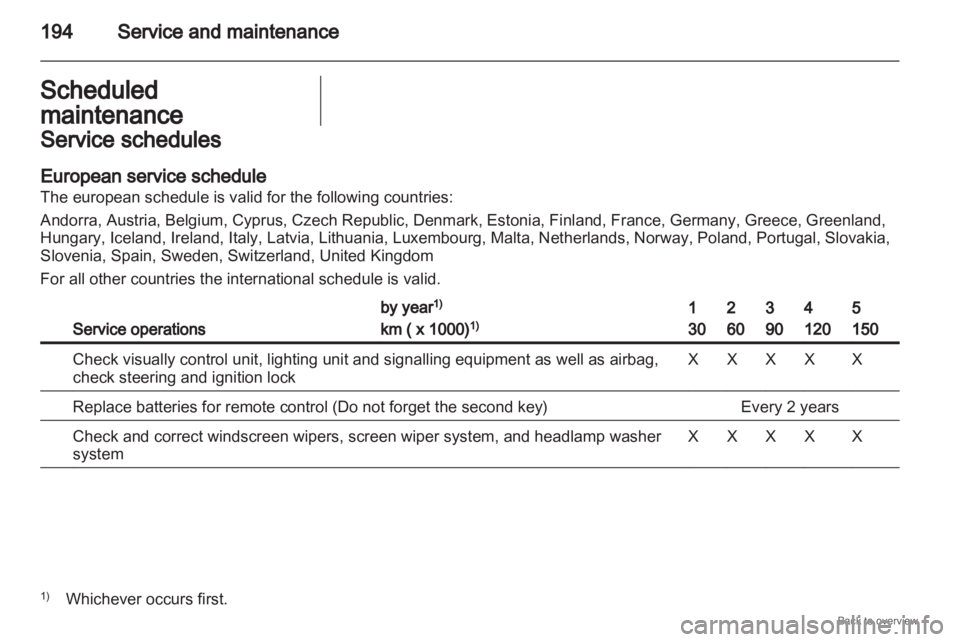
European service schedule
The european schedule is valid for the following countries:
Andorra, Austria, Belgium, Cyprus, Czech Republic, Denmark, Estonia, Finland, France, Germany, Greece, Greenland,
Hungary, Iceland, Ireland, Italy, Latvia, Lithuania, Luxembourg, Malta, Netherlands, Norway, Poland, Portugal, Slovakia,
Slovenia, Spain, Sweden, Switzerland, United Kingdom
For all other countries the international schedule is valid.
Service operations by year
1)
km ( x 1000) 1) 1
30 2
60 3
90 4
120 5
150
Check visually control unit, lighting unit and signalling equipment as well as airbag,
check steering and ignition lock X X X X X
Replace batteries for remote control (Do not forget the second key) Every 2 years
Check and correct windscreen wipers, screen wiper system, and headlamp washer
system X X X X X
1)
Whichever occurs first.
Page 195 of 228
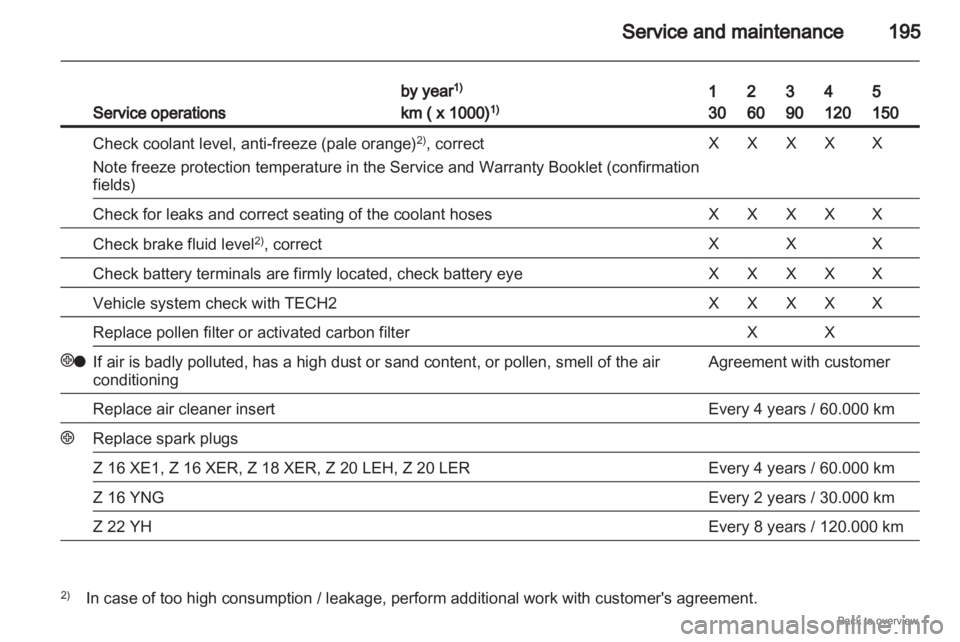
Service and maintenance
195Service operations by year
1)
km ( x 1000) 1) 1
30 2
60 3
90 4
120 5
150
Check coolant level, anti-freeze (pale orange)
2)
, correct
Note freeze protection temperature in the Service and Warranty Booklet (confirmation
fields) X X X X X
Check for leaks and correct seating of the coolant hoses X X X X X
Check brake fluid level
2)
, correct X X X
Check battery terminals are firmly located, check battery eye X X X X X
Vehicle system check with TECH2 X X X X X
Replace pollen filter or activated carbon filter X X
+o
If air is badly polluted, has a high dust or sand content, or pollen, smell of the air
conditioning Agreement with customer
Replace air cleaner insert Every 4 years / 60.000 km
+ Replace spark plugs Z 16 XE1, Z 16 XER, Z 18 XER, Z 20 LEH, Z 20 LER Every 4 years / 60.000 km
Z 16 YNG Every 2 years / 30.000 km
Z 22 YH Every 8 years / 120.000 km
2)
In case of too high consumption / leakage, perform additional work with customer's agreement.