battery OPEL ZAFIRA C 2017.25 Manual user
[x] Cancel search | Manufacturer: OPEL, Model Year: 2017.25, Model line: ZAFIRA C, Model: OPEL ZAFIRA C 2017.25Pages: 291, PDF Size: 9.02 MB
Page 223 of 291
Vehicle care221Charging the vehicle battery9Warning
On vehicles with stop-start
system, ensure that the charging potential does not exceed
14.6 volts when using a battery
charger. Otherwise the vehicle
battery might be damaged.
Jump starting 3 251.
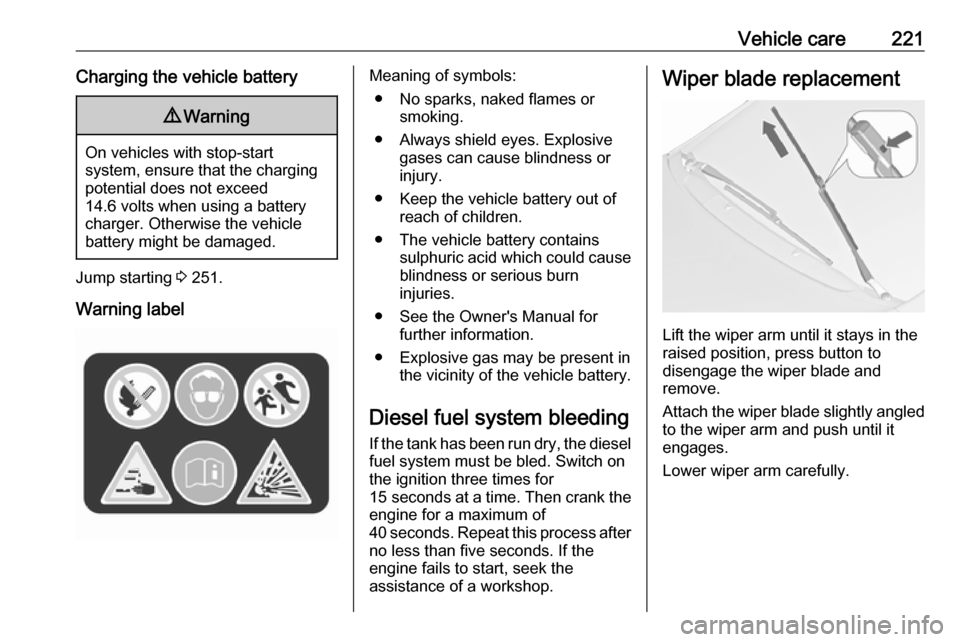
Warning label
Meaning of symbols: ● No sparks, naked flames or smoking.
● Always shield eyes. Explosive gases can cause blindness or
injury.
● Keep the vehicle battery out of reach of children.
● The vehicle battery contains sulphuric acid which could cause
blindness or serious burn
injuries.
● See the Owner's Manual for further information.
● Explosive gas may be present in the vicinity of the vehicle battery.
Diesel fuel system bleeding If the tank has been run dry, the diesel
fuel system must be bled. Switch on
the ignition three times for
15 seconds at a time. Then crank the
engine for a maximum of 40 seconds. Repeat this process after
no less than five seconds. If the
engine fails to start, seek the
assistance of a workshop.Wiper blade replacement
Lift the wiper arm until it stays in the
raised position, press button to
disengage the wiper blade and
remove.
Attach the wiper blade slightly angled
to the wiper arm and push until it
engages.
Lower wiper arm carefully.
Page 233 of 291
Vehicle care231Engine compartment fusebox
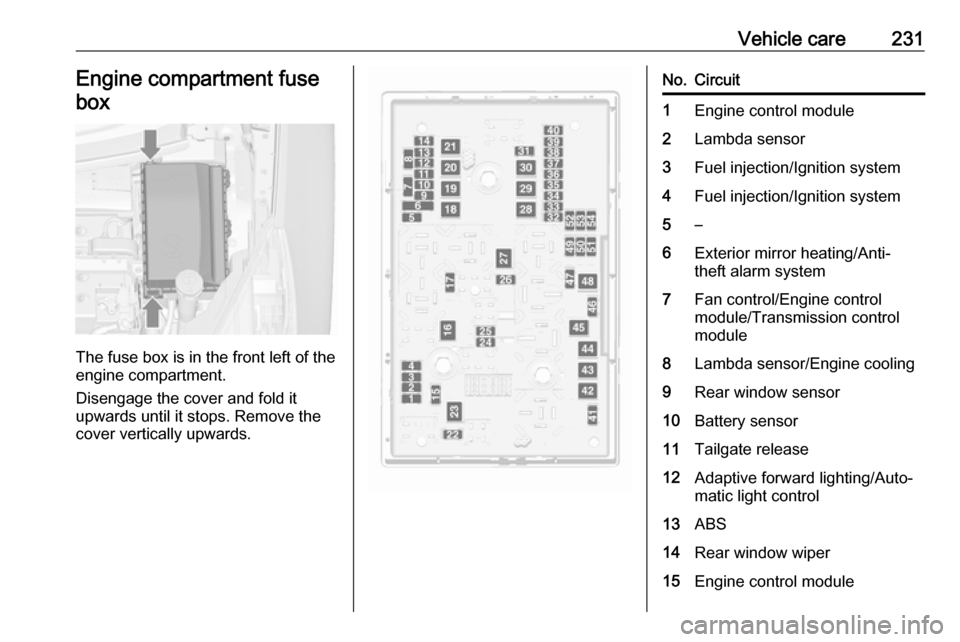
The fuse box is in the front left of the
engine compartment.
Disengage the cover and fold it
upwards until it stops. Remove the
cover vertically upwards.
No.Circuit1Engine control module2Lambda sensor3Fuel injection/Ignition system4Fuel injection/Ignition system5–6Exterior mirror heating/Anti-
theft alarm system7Fan control/Engine control
module/Transmission control
module8Lambda sensor/Engine cooling9Rear window sensor10Battery sensor11Tailgate release12Adaptive forward lighting/Auto‐
matic light control13ABS14Rear window wiper15Engine control module
Page 246 of 291
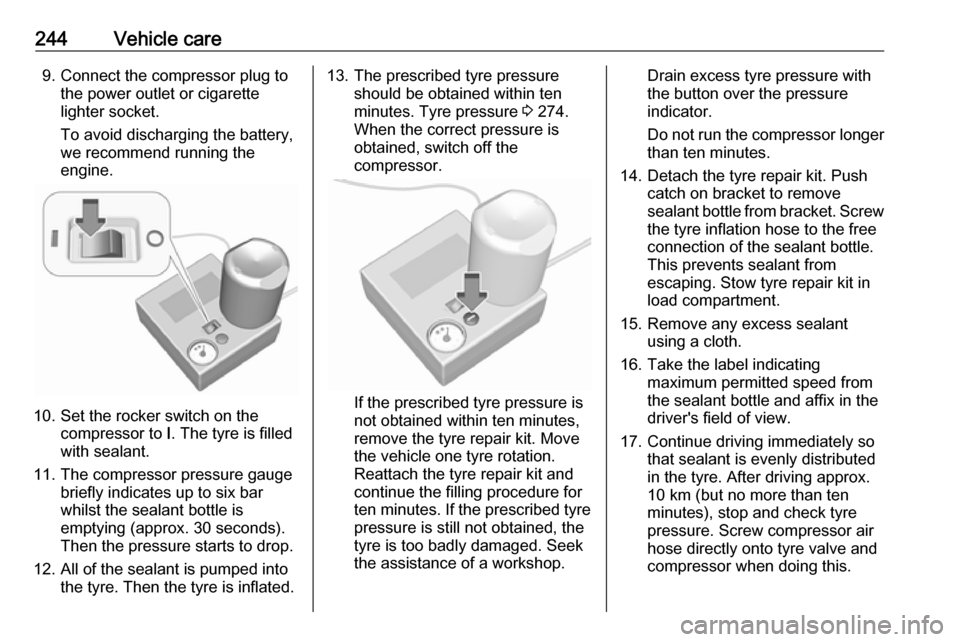
244Vehicle care9. Connect the compressor plug tothe power outlet or cigarette
lighter socket.
To avoid discharging the battery,
we recommend running the
engine.
10. Set the rocker switch on the compressor to I. The tyre is filled
with sealant.
11. The compressor pressure gauge briefly indicates up to six bar
whilst the sealant bottle is
emptying (approx. 30 seconds).
Then the pressure starts to drop.
12. All of the sealant is pumped into the tyre. Then the tyre is inflated.
13. The prescribed tyre pressureshould be obtained within ten
minutes. Tyre pressure 3 274.
When the correct pressure is
obtained, switch off the
compressor.
If the prescribed tyre pressure is
not obtained within ten minutes,
remove the tyre repair kit. Move
the vehicle one tyre rotation.
Reattach the tyre repair kit and
continue the filling procedure for
ten minutes. If the prescribed tyre
pressure is still not obtained, the
tyre is too badly damaged. Seek
the assistance of a workshop.
Drain excess tyre pressure with
the button over the pressure indicator.
Do not run the compressor longer
than ten minutes.
14. Detach the tyre repair kit. Push catch on bracket to remove
sealant bottle from bracket. Screw the tyre inflation hose to the free
connection of the sealant bottle.
This prevents sealant from
escaping. Stow tyre repair kit in
load compartment.
15. Remove any excess sealant using a cloth.
16. Take the label indicating maximum permitted speed from
the sealant bottle and affix in the
driver's field of view.
17. Continue driving immediately so that sealant is evenly distributed
in the tyre. After driving approx.
10 km (but no more than ten
minutes), stop and check tyre
pressure. Screw compressor air
hose directly onto tyre valve and
compressor when doing this.
Page 253 of 291

Vehicle care251Jump starting
Do not start with quick charger.
A vehicle with a discharged battery
can be started using jump leads and
the battery of another vehicle.
Do not start with quick charger.9 Warning
Be extremely careful when starting
with jump leads. Any deviation
from the following instructions can
lead to injuries or damage caused
by battery explosion or damage to the electrical systems of both
vehicles.
9 Warning
Avoid contact of the battery with
eyes, skin, fabrics and painted
surfaces. The fluid contains
sulphuric acid which can cause
injuries and damage in the event
of direct contact.
● Never expose the vehicle battery
to naked flames or sparks.
● A discharged vehicle battery can already freeze at a temperature
of 0 °C. Defrost the frozen vehicle
battery before connecting jump leads.
● Wear eye protection and protective clothing when
handling a battery.
● Use a booster vehicle battery with the same voltage (12 Volt).
Its capacity (Ah) must not be
much less than that of the
discharged vehicle battery.
● Use jump leads with insulated terminals and a cross section of
at least 16 mm 2
(25 mm 2
for
diesel engines).
● Do not disconnect the discharged
vehicle battery from the vehicle.
● Switch off all unnecessary electrical consumers.
● Do not lean over the battery during jump starting.
● Do not allow the terminals of one
lead to touch those of the other
lead.● The vehicles must not come into contact with each other during
the jump starting process.
● Apply the parking brake, transmission in neutral,
automatic transmission in P.
● Open the positive terminal protection cap of your vehicle in
the engine compartment and of
the booster vehicle battery.
Page 254 of 291

252Vehicle careLead connection order:1. Connect the red lead to the positive terminal of the booster
battery.
2. Connect the other end of the red lead to the positive terminal of the
discharged battery.
3. Connect the black lead to the negative terminal of the boosterbattery.
4. Connect the other end of the black
lead to a vehicle grounding point
of your vehicle in the engine
compartment.
Route the leads so that they cannot
catch on rotating parts in the engine
compartment.
To start the engine: 1. Start the engine of the vehicle providing the jump.
2. After five minutes, start the other engine. Start attempts should be
made for no longer than
15 seconds at an interval of one
minute.3. Allow both engines to idle for approx. three minutes with the
leads connected.
4. Switch on electrical consumers (e.g. headlights, heated rear
window) of the vehicle receiving
the jump start.
5. Reverse above sequence exactly when removing leads.Towing
Towing the vehicle
Disengage cap at bottom and removedownwards.
The towing eye is stowed with the
vehicle tools 3 236.
Page 286 of 291

284IndexAAccessories and vehicle modifications .......................... 214
Active Emergency Braking .........186
Active head restraints ...................37
Adaptive cruise control .......117, 176
AdBlue ........................ 115, 159, 259
Adjustable air vents ...................148
Airbag and belt tensioners .........111
Airbag deactivation ..............58, 112
Airbag label................................... 54
Airbag system .............................. 54
Air conditioning regular operation ................................ 149
Air conditioning system .............. 143
Air intake .................................... 149
Air vents...................................... 148
Antilock brake system ................ 166
Antilock brake system (ABS) .....113
Anti-theft alarm system ................26
Anti-theft locking system .............. 26
Appearance care ........................254
Armrest ......................................... 42
Armrest storage ........................... 69
Ashtrays ..................................... 103
Automatic anti-dazzle ..................30
Automatic light control ...............133
Automatic locking ........................24
Automatic transmission .............162Autostop..................................... 154
Auxiliary heater ........................... 148
B Battery discharge protection ......141
Battery voltage ........................... 124
Bicycle rack .................................. 70
BlueInjection ............................... 159
Bonnet ....................................... 215
Brake and clutch fluid .................259
Brake and clutch system ...........112
Brake assist ............................... 168
Brake fluid .................................. 219 Brakes ............................... 166, 219
Breakdown.................................. 252
Bulb replacement ....................... 222
C Capacities .................................. 272
Cargo management system ........88
Car Pass ...................................... 21
Catalytic converter .....................158
Central locking system ................22
Centre console lighting ..............140
Centre console storage ...............69
Changing tyre and wheel size ...242
Charging system ........................ 112
Child locks ................................... 25
Child restraint installation locations ................................... 63
Child restraints.............................. 60
Page 290 of 291

288Traction Control system off......... 114
Traffic sign assistant ...........117, 194
Trailer coupling ........................... 208
Trailer stability assist .................212
Trailer towing ............................. 209
Transmission ............................... 16
Transmission display .................162
Tread depth ............................... 241
Trip odometer ............................ 104
Turn and lane-change signals ...137
Turn signal ................................. 110
Tyre chains ................................ 242
Tyre designations ......................236
Tyre pressure ............................ 237
Tyre pressure monitoring system ............................. 115, 238
Tyre pressures ........................... 274
Tyre repair kit ............................. 242
U
Ultrasonic parking assist............. 188
Underseat storage .......................68
Upholstery .................................. 256
Using this manual ..........................3
V Vehicle battery ........................... 219
Vehicle checks............................ 215
Vehicle data ................................ 264
Vehicle data recording and privacy ..................................... 282Vehicle detected ahead..............117
Vehicle dimensions .................... 271
Vehicle Identification Number ....262
Vehicle jack ................................ 236
Vehicle messages .....................123
Vehicle personalisation .............125
Vehicle security ............................ 26
Vehicle specific data ......................3
Vehicle storage ........................... 214
Vehicle tools ............................... 236
Vehicle unlocking ........................... 6
Vehicle weight ........................... 270
Ventilation ................................... 142
W
Warning chimes .........................124
Warning lights ............................. 104
Warning triangle .......................... 92
Washer and wiper systems .........14
Washer fluid ............................... 219
Wheel changing .........................245
Wheel covers ............................. 242
Wheels and tyres .......................236
Windows ....................................... 31
Windscreen................................... 31
Windscreen wiper/washer ...........98
Winter tyres ............................... 236
Wiper blade replacement ..........221