trailer OPEL ZAFIRA C 2018.5 Manual user
[x] Cancel search | Manufacturer: OPEL, Model Year: 2018.5, Model line: ZAFIRA C, Model: OPEL ZAFIRA C 2018.5Pages: 341, PDF Size: 10.22 MB
Page 255 of 341

Driving and operating253Trailer hitch
General information
Only use towing equipment that has
been approved for your vehicle.
Vehicles with natural gas engines
require special towing equipment.
Entrust retrofitting of towing
equipment to a workshop. It may be
necessary to make changes that
affect the cooling system, heat
shields or other equipment.
The bulb outage detection function for trailer brake light cannot detect a
partial bulb outage. E.g. in case of
4x 5 Watt bulbs, the function only
detects lamp outage when only a
single 5 Watt lamp remains or none
remain.
Fitting of towing equipment could
cover the opening of the towing eye.
If this is the case use the coupling ball
bar for towing. Always keep the
coupling ball bar in the vehicle.Driving characteristics and
towing tips
Before attaching a trailer, lubricate
the coupling ball. However, do not do
so if a stabiliser, which acts on the
coupling ball, is being used to reduce snaking movements.
For trailers with low driving stability
and caravan trailers with a permitted
gross vehicle weight of more than
1300 kg the use of a stabiliser is
strongly recommended when driving
above 80 km/h.
If the trailer starts snaking, drive more
slowly, do not attempt to correct the
steering and brake sharply if
necessary.
When driving downhill, drive in the
same gear as if driving uphill and
drive at a similar speed.
Adjust tyre pressure to the value
specified for full load 3 319.Trailer towing
Trailer loads
The permissible trailer loads are
vehicle and engine-dependent
maximum values which must not be
exceeded. The actual trailer load is
the difference between the actual
gross weight of the trailer and the
actual coupling socket load with the
trailer coupled.
The permissible trailer loads are
specified in the vehicle documents. In general, they are valid for gradients
up to 12%.
The permissible trailer load applies
up to the specified incline and at sea
level. Since engine power decreases
as altitude increases due to the air
becoming thinner, therefore reducing
climbing ability, the permissible gross
train weight also decreases by 10%
for every 1000 metres of altitude. The gross train weight does not have to be reduced when driving on roads with
slight inclines (less than 8%, e.g.
motorways).
Page 256 of 341
254Driving and operatingThe permissible gross train weight
must not be exceeded. This weight is
specified on the identification plate
3 306.
Vertical coupling load The vertical coupling load is the load
exerted by the trailer on the coupling
ball. It can be varied by changing the
weight distribution when loading the
trailer.
The maximum permissible vertical
coupling load (75 kg) is specified on
the towing equipment identification
plate and in the vehicle documents.
Note
Engines B16DTH, B16DTJ,
B20DTH and B20DTJ: Depending
on the equipment the maximum
permissible vertical coupling load
can be 75 kg or 60 kg.
Always aim for the maximum load,
especially in the case of heavy
trailers. The vertical coupling load
should never fall below 25 kg.Rear axle load
When the trailer is coupled and the
towing vehicle fully loaded, the
permissible rear axle load (see
identification plate or vehicle
documents) may be exceeded by
60 kg , the gross vehicle weight rating
may be exceeded by 60 kg. If the
permissible rear axle load is
exceeded, a maximum speed of
100 km/h applies.
Towing equipmentCaution
When operating without a trailer,
remove the coupling ball bar.
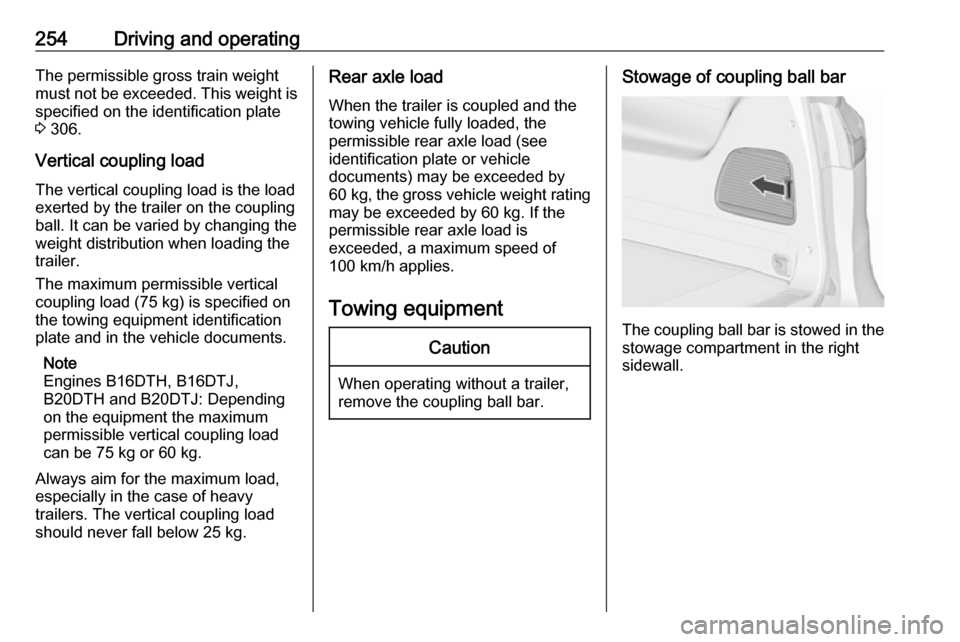
Stowage of coupling ball bar
The coupling ball bar is stowed in the
stowage compartment in the right
sidewall.
Page 258 of 341
256Driving and operatingInsert the tensioned coupling ball bar
in the opening and push firmly
upwards until it audibly engages.
The rotary handle snaps back into its
original position, resting against the
coupling ball bar without a gap.9 Warning
Do not touch rotary handle during
insertion.
Lock the coupling ball bar by turning
the key to position e. Remove the key
and close the protective flap.
Eye for break-away stopping cable
Attach breakaway stopping cable to
eye.
Check that the coupling ball bar is correctly installed
● Green marking on rotary knob must point towards green
marking on coupling ball bar.
● There must be no gap between the rotary handle and the
coupling ball bar.
● The coupling ball bar must be firmly engaged in the opening.
● The coupling ball bar must be locked and the key removed.9Warning
Towing a trailer is permitted only
when a coupling ball bar is fitted correctly. If the coupling ball bardoes not engage correctly, seekthe assistance of a workshop.
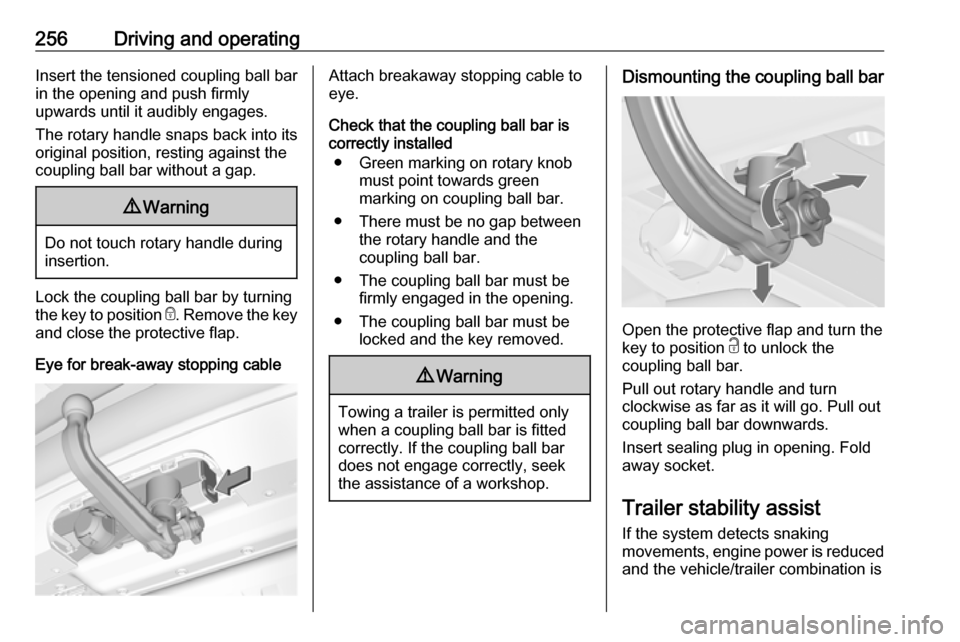
Dismounting the coupling ball bar
Open the protective flap and turn the
key to position c to unlock the
coupling ball bar.
Pull out rotary handle and turn
clockwise as far as it will go. Pull out coupling ball bar downwards.
Insert sealing plug in opening. Fold away socket.
Trailer stability assist
If the system detects snaking
movements, engine power is reduced
and the vehicle/trailer combination is
Page 259 of 341

Driving and operating257selectively braked until the snaking
ceases. While system is working keep
steering wheel as still as possible.
Trailer stability assist (TSA) is a
function of the Electronic Stability
Control 3 217.
Page 282 of 341

280Vehicle careNo.Circuit1–2Trailer outlet3Parking assist4Selective catalytic reduction
system5–6–7Power seat8–9Selective catalytic reduction
system10Nitrogen oxide sensor11Trailer module/Trailer socket12Trailer module13Trailer outlet14–15–No.Circuit16Interior mirror/Rear view
camera17Power outlet18–19–20–21Heated front seats22–23–24Selective catalytic reduction
system25–26–27–28–29–30–No.Circuit31–32Active damping system/Lane
departure warning
Page 305 of 341

Service and maintenance303Service and
maintenanceGeneral information ...................303
Service information ..................303
Recommended fluids, lubricants and parts .................................... 304
Recommended fluids and lubricants ................................ 304General information
Service information In order to ensure economical and
safe vehicle operation and to
maintain the value of your vehicle, it
is of vital importance that all
maintenance work is carried out at the proper intervals as specified.
The detailed, up-to-date service
schedule for your vehicle is available
at the workshop.
European service intervals Maintenance of your vehicle is
required every 30,000 km or after one year, whichever occurs first.
Additional engine oil and filter change
is indicated by the engine oil life
system, when required earlier than
maintenance.
A shorter service interval can be valid for severe driving behaviour, e.g. for
taxis and police vehicles.
The European service intervals are
valid for the following countries:Andorra, Austria, Belgium, Bosnia-
Herzegovina, Bulgaria, Croatia,
Cyprus, Czech Republic, Denmark,
Estonia, Finland, France, Germany,
Greece, Greenland, Hungary,
Iceland, Ireland, Italy, Latvia,
Liechtenstein, Lithuania,
Luxembourg, Macedonia, Malta,
Monaco, Montenegro, Netherlands,
Norway, Poland, Portugal, Romania,
San Marino, Serbia, Slovakia,
Slovenia, Spain, Sweden,
Switzerland, United Kingdom.
Service display 3 107.
International service intervals
Maintenance of your vehicle is
required every 15,000 km or after one year, whichever occurs first.
Additional engine oil and filter change
is indicated by the engine oil life
system, when required earlier than
maintenance.
Severe operating conditions exist if
one or more of the following
circumstances occur frequently: Cold starting, stop and go operation, trailer
operation, mountain driving, driving
on poor and sandy road surfaces,
Page 339 of 341

337Seat belts ..................................... 50
Seat heating ................................. 43
Seat position ................................ 38
Second row seats ........................44
Selective catalytic reduction .......206
Selector lever ............................. 209
Service ............................... 196, 303
Service display .......................... 107
Service information ....................303
Side airbag system ......................58
Side blind spot alert ....................237
Sidelights .................................... 130
Side turn lights ........................... 273
Smartphone ................................ 159
Phone projection .....................164
Software acknowledgement .......326
Spare wheel ............................... 293
Speech recognition .....................179
Speed dial numbers ...................184
Speed limiter....................... 117, 221
Speedometer ............................. 103
Starting and operating ................198
Starting off ................................... 17
Starting the engine ....................199
Station search............................. 154
Steering ...................................... 198
Steering wheel adjustment ......9, 97
Steering wheel audio controls ....142
Steering wheel controls ...............97
Stop-start system........................ 201Storage ......................................... 66
Storage compartments .................66
Storing stations ........................... 155
Sunvisor lights ........................... 138
Sun visors .................................... 33
Switching the Infotainment system on ................................ 145
Symbols ......................................... 4
System settings .......................... 151
T Tachometer ............................... 104
Tail lights ................................... 270
Theft-deterrent feature ..............141
Third row seats ............................ 48
Three-point seat belt .................... 51
TMC stations .............................. 165
Tone settings .............................. 149
Tools .......................................... 281
Touch beep volume ....................150
Tow bar....................................... 253
Towing ................................ 253, 298
Towing another vehicle .............299
Towing equipment .....................254
Towing the vehicle .....................298
TP volume .................................. 150
Traction Control system ............. 216
Traction Control system off......... 114
Traffic incidents .......................... 176
Traffic sign assistant ...........117, 240Trailer coupling ........................... 253
Trailer stability assist .................256
Trailer towing ............................. 253
Transmission ............................... 16
Transmission display .................209
Tread depth ............................... 286
Trip odometer ............................ 103
Turn lights .......................... 110, 135
Turn list ....................................... 176
Tyre chains ................................ 287
Tyre designations ......................281
Tyre pressure ............................ 282
Tyre pressure monitoring system ............................. 115, 283
Tyre pressures ........................... 319
Tyre repair kit ............................. 287
U Ultrasonic parking assist............. 234
Underseat storage .......................68
Upholstery .................................. 302
Usage ................. 145, 153, 167, 179
Bluetooth ................................. 159
Menu ....................................... 147
Navigation system ...................167
Phone ...................................... 184
Radio ....................................... 153
USB ......................................... 159