brake PEUGEOT 106 2001 User Guide
[x] Cancel search | Manufacturer: PEUGEOT, Model Year: 2001, Model line: 106, Model: PEUGEOT 106 2001Pages: 107, PDF Size: 2.92 MB
Page 54 of 107
YOUR 106 IN DETAIL55
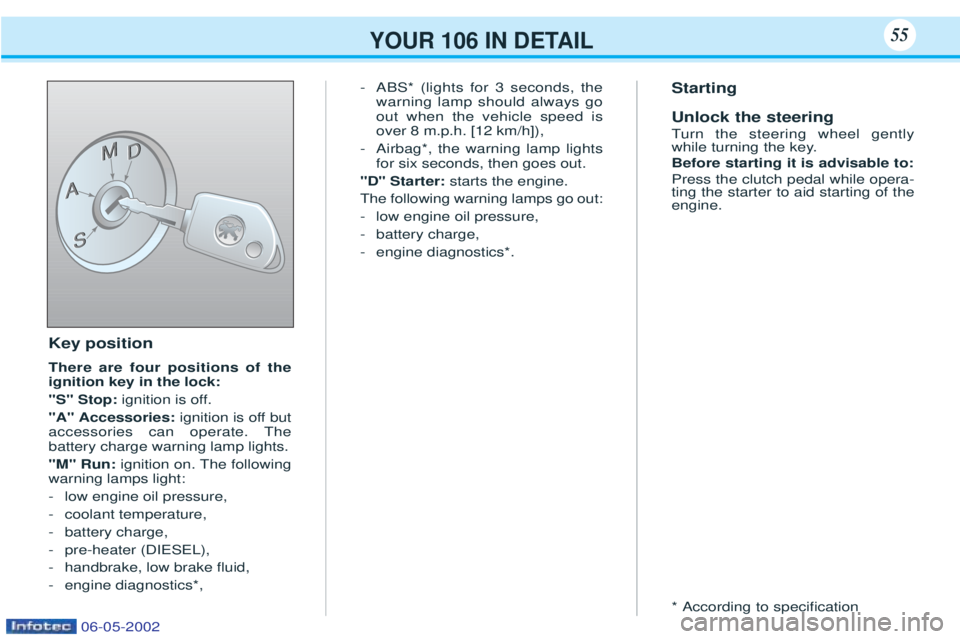
Key position There are four positions of the ignition key in the lock: "S" Stop: ignition is off.
"A" Accessories: ignition is off but
accessories can operate. The battery charge warning lamp lights. "M" Run: ignition on. The following
warning lamps light:- low engine oil pressure,
- coolant temperature,
- battery charge,
- pre-heater (DIESEL),
- handbrake, low brake ßuid,
- engine diagnostics*, -
ABS* (lights for 3 seconds, the warning lamp should always goout when the vehicle speed isover 8 m.p.h. [12 km/h]),
- Airbag*, the warning lamp lightsfor six seconds, then goes out.
"D" Starter: starts the engine.
The following warning lamps go out: - low engine oil pressure,
- battery charge,
- engine diagnostics*. Starting Unlock the steering T
urn the steering wheel gently
while turning the key. Before starting it is advisable to: Press the clutch pedal while opera- ting the starter to aid starting of theengine. * According to speciÞcation
06-05-2002
Page 55 of 107
YOUR 106 IN DETAIL55
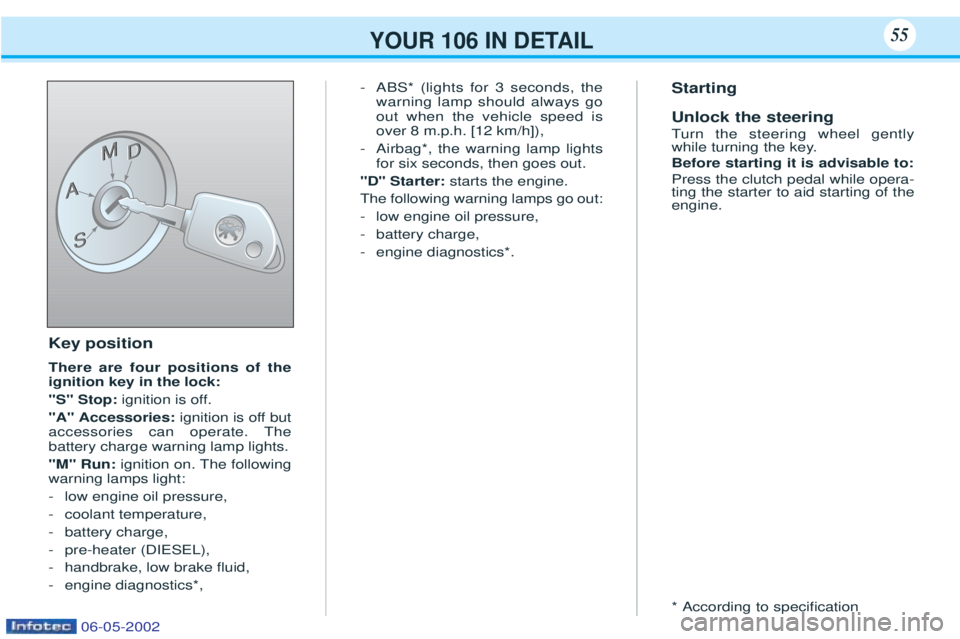
Key position There are four positions of the ignition key in the lock: "S" Stop: ignition is off.
"A" Accessories: ignition is off but
accessories can operate. The battery charge warning lamp lights. "M" Run: ignition on. The following
warning lamps light:- low engine oil pressure,
- coolant temperature,
- battery charge,
- pre-heater (DIESEL),
- handbrake, low brake ßuid,
- engine diagnostics*, -
ABS* (lights for 3 seconds, the warning lamp should always goout when the vehicle speed isover 8 m.p.h. [12 km/h]),
- Airbag*, the warning lamp lightsfor six seconds, then goes out.
"D" Starter: starts the engine.
The following warning lamps go out: - low engine oil pressure,
- battery charge,
- engine diagnostics*. Starting Unlock the steering T
urn the steering wheel gently
while turning the key. Before starting it is advisable to: Press the clutch pedal while opera- ting the starter to aid starting of theengine. * According to speciÞcation
06-05-2002
Page 56 of 107
YOUR 106 IN DETAIL56
Starting a petrol engine* Do not press the accelerator pedal. Operate the starter without relea- sing the key until the engine starts. * According to speciÞcationStarting a diesel engine Engine cold: Do not press the accelerator pedal. T
urn the key to position “M”, the
pre-heat warning lamp lights.W ait until the warning lamp goes
out, then operate the starter in posi- tion “D” until the engine runs
smoothly.
Engine hot: Do not press the accelerator pedal.
Operate the starter.If the engine stops or does not start
immediately, always wait a fewseconds before trying again using
the pre-heater.Never race a cold engi- ne.
Never run the engine inan enclosed space. If the engine cannot be
stopped using the ignition key, press the brake pedal, engage agear and release the clutch inorder to stall the engine. Do not modify the steering
lock in any way.
NOTE: according to speci fica-
tion, the pre-heat warning lamp does not light if the engi-ne is suf ficiently hot.
06-05-2002
Page 72 of 107
YOUR 106 IN DETAIL70
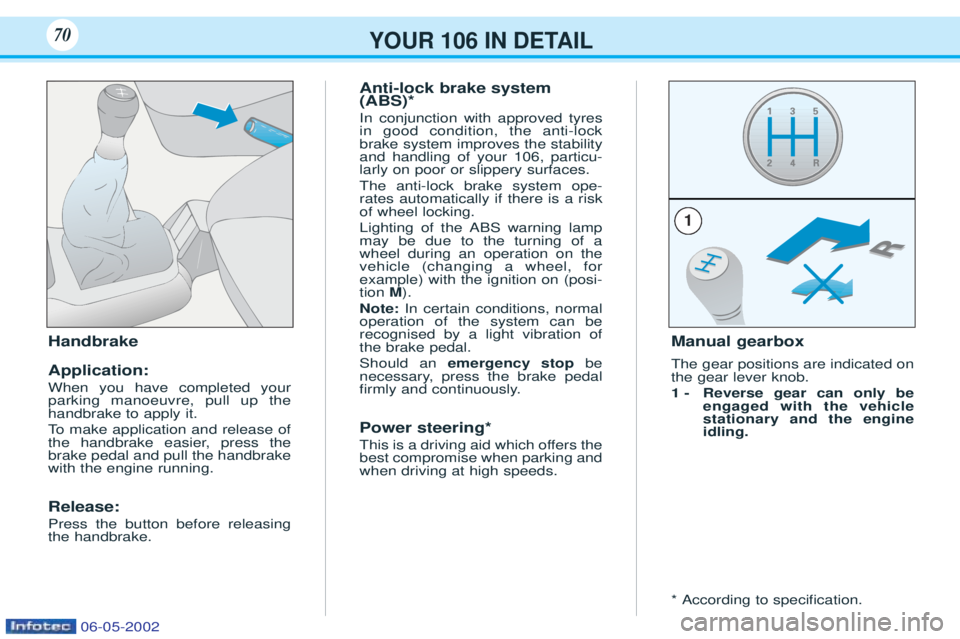
Handbrake Application: When you have completed your parking manoeuvre, pull up thehandbrake to apply it.
To make application and release of
the handbrake easier, press the brake pedal and pull the handbrakewith the engine running. Release: Press the button before releasing the handbrake. Anti-lock brake system(ABS)* In conjunction with approved tyres in good condition, the anti-lockbrake system improves the stabilityand handling of your 106, particu-larly on poor or slippery surfaces. The anti-lock brake system ope- rates automatically if there is a riskof wheel locking. Lighting of the ABS warning lamp may be due to the turning of awheel during an operation on thevehicle (changing a wheel, forexample) with the ignition on (posi-tion
M).
Note: In certain conditions, normal
operation of the system can berecognised by a light vibration ofthe brake pedal. Should an emergency stop be
necessary, press the brake pedal
Þrmly and continuously. Power steering*
This is a driving aid which offers the best compromise when parking andwhen driving at high speeds. Manual gearbox The gear positions are indicated on the gear lever knob.
1- R
everse gear can only be
engaged with the vehicle stationary and the engineidling.
* According to speciÞcation.
1
06-05-2002
Page 78 of 107
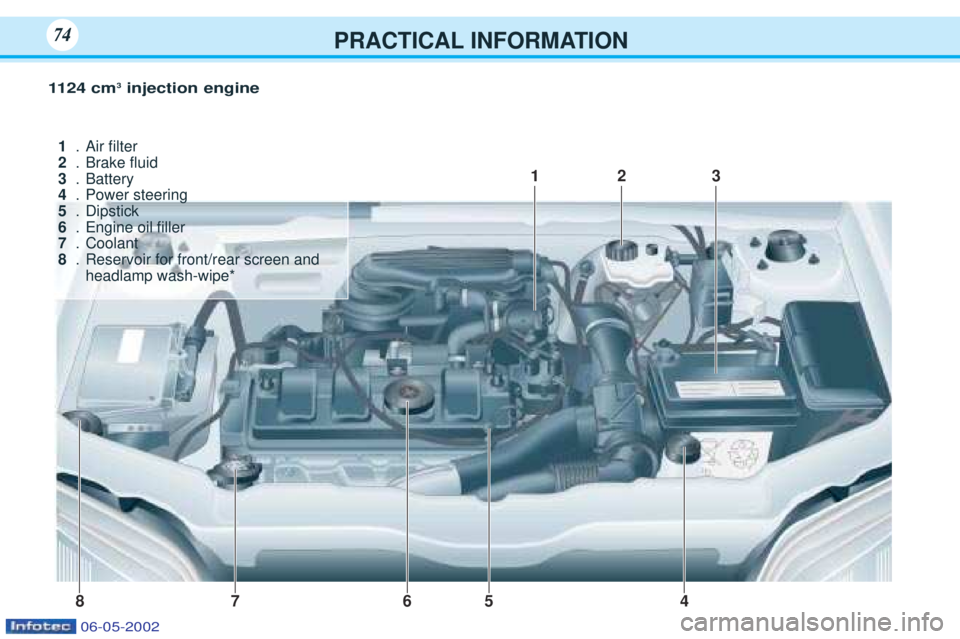
PRACTICAL INFORMATION7474
1124 cm 3
injection engine
4
1
3
5
6
87 2
1
.Air Þlter
2 .Brake ßuid
3 .Battery
4 .Power steering
5 .Dipstick
6 .Engine oil Þller
7 .Coolant
8 .Reservoir for front/rear screen and headlamp wash-wipe*
06-05-2002
Page 79 of 107
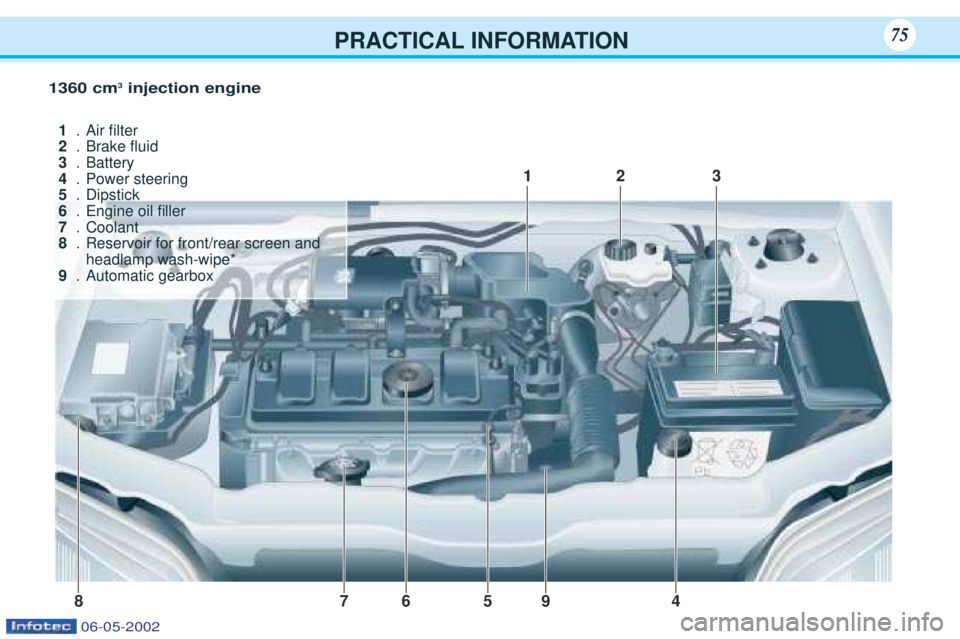
PRACTICAL INFORMATION75
1360 cm3
injection engine
4
1
3
5
6
87 2
9
1
.Air Þlter
2 .Brake ßuid
3 .Battery
4 .Power steering
5 .Dipstick
6 .Engine oil Þller
7 .Coolant
8 .Reservoir for front/rear screen and headlamp wash-wipe*
9 .Automatic gearbox
75
06-05-2002
Page 80 of 107
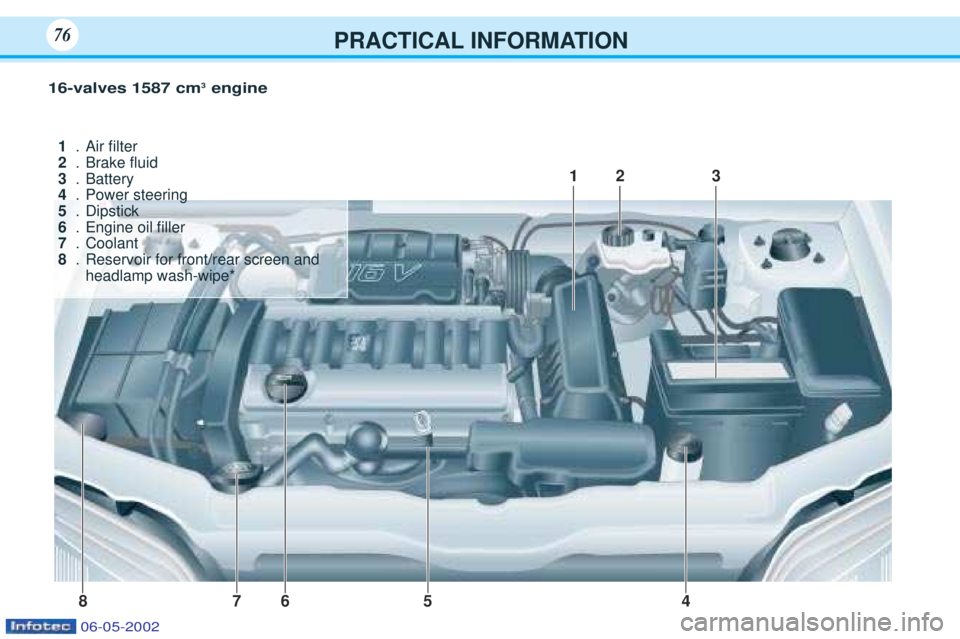
PRACTICAL INFORMATION7676
16-valves 1587 cm3
engine
4
1
3
6
87 2
5
1
.Air Þlter
2 .Brake ßuid
3 .Battery
4 .Power steering
5 .Dipstick
6 .Engine oil Þller
7 .Coolant
8 .Reservoir for front/rear screen and headlamp wash-wipe*
06-05-2002
Page 81 of 107
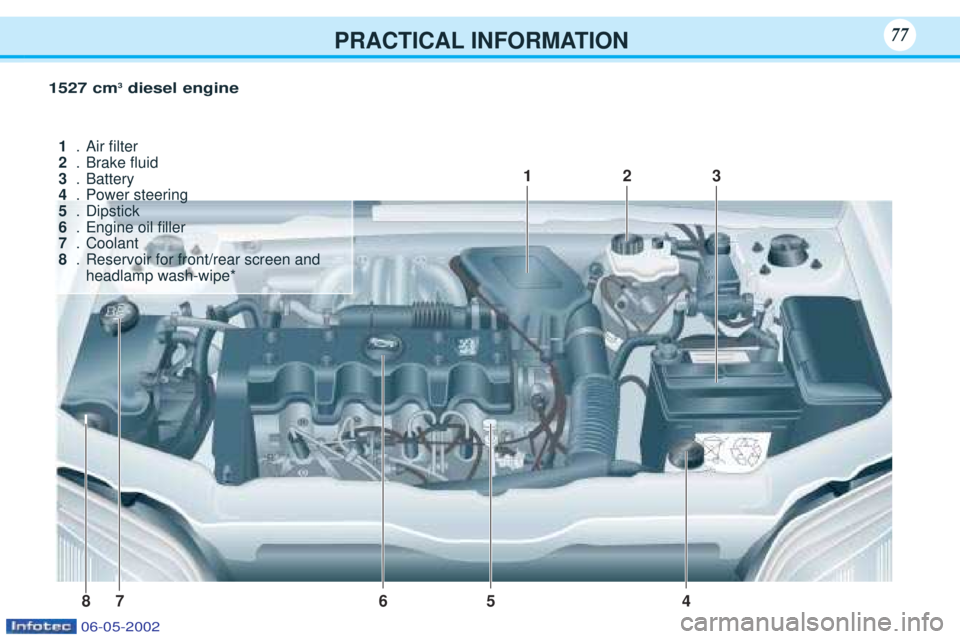
PRACTICAL INFORMATION7777
1527 cm3
diesel engine
4
1
3
5
6
87 2
1
.Air Þlter
2 .Brake ßuid
3 .Battery
4 .Power steering
5 .Dipstick
6 .Engine oil Þller
7 .Coolant
8 .Reservoir for front/rear screen and headlamp wash-wipe*
06-05-2002
Page 82 of 107
CHECKING THE LEVELS 1. Air filter
The air filter element must be changed at the recommendedintervals. If you drive in a dustyatmosphere, change it twice asoften. Follow the recommendations given in the maintenance schedule. 2. Brake fluid
The level must always be above the
DANGER mark on the reservoir. Inthe event of a signiÞcant drop in theßuid level, consult a PEUGEOT
dealer immediately. Use fluids
approved by the manufacturer,which conform to DOT 3 or DOT 4standards. 3. Battery
At the beginning of winter, have the battery checked by a PEUGEOT
dealer. In summer (30¡C and above) or if the battery is in heavy use, checkthe level of electrolyte; it must coverthe separator plates at all times. If
necessary, top up with distilled
water. 4. Power steering* When the engine is cold, the level must always be above the MINmark, close to the MAX mark. 5. Dipstick Check the oil level on ßat ground, with the engine cold and preferably
before the Þrst journey of the day. Never exceed the maximum level.
Check the level regularly.
6. T
opping up with oil
Y our oil must be changed in accor-
dance with the maintenance sche- dule. The oil must be topped up between oil changes. Regularly check and top-up the oil level. Maximum oil consumption is 0.5 litres per 600 miles (1000 km). 7. Coolant Engine cold: the coolant level must be between the min and max marksin the expansion chamber with the
cap removed. To close, turn the capto the second notch*. Cooling circuit Always use the coolant which is approved by the manufacturer
(PROCOR TM108 / GLYSANTING33 or REVKOGEL 2000). If this isnot possible, top up with distilledwater and have the protection level
checked by a PEUGEOT dealer. When the engine is hot, the coolant temperature is regulated by the fan.As the fan can operate with theignition key removed, and as thecooling circuit is pressurised,
do
not carry out any work for atleast an hour after switching offthe engine .
Note: the coolant does not need tobe renewed.
8. Front/rear screen and headlamp wash reservoir*
For optimum cleaning quality and
for your safety, it is best to use cleaning products approved byPEUGEOT (capacity 4.5 litreswithout headlamp wash, 5.5 litreswith headlamp wash). * According to speciÞcation
PRACTICAL INFORMATION7878
06-05-2002
Page 83 of 107
PRACTICAL INFORMATION79
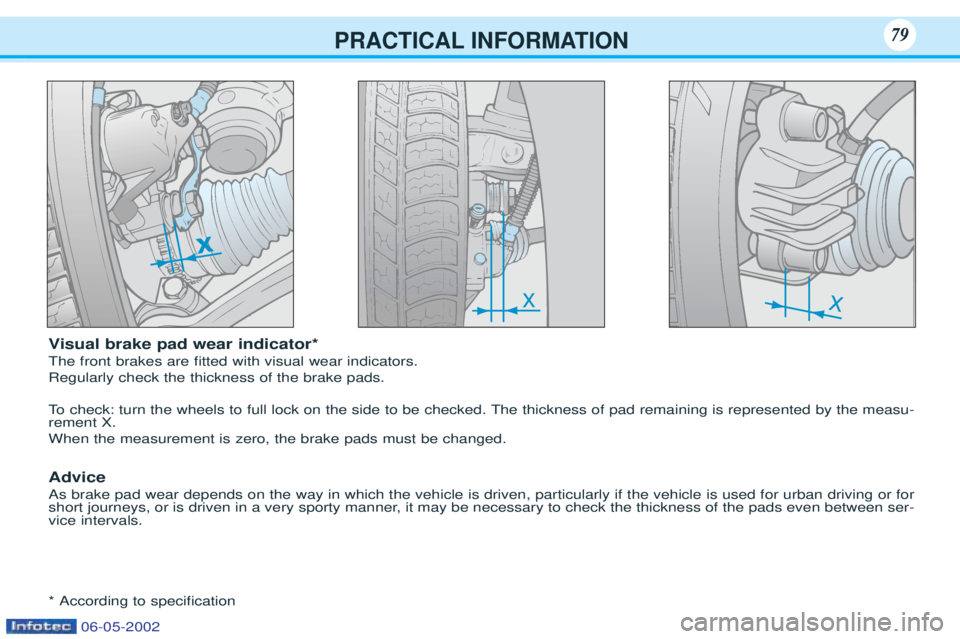
Visual brake pad wear indicator*
The front brakes are Þtted with visual wear indicators. Regularly check the thickness of the brake pads.
To check: turn the wheels to full lock on the side to be checked. The thickness of pad remaining is represented by the measu-
rement X. When the measurement is zero, the brake pads must be changed. Advice As brake pad wear depends on the way in which the vehicle is driven, particularly if the vehicle is used for urban driving or f or
short journeys, or is driven in a very sporty manner, it may be necessary to check the thickness of the pads even between ser- vice intervals. * According to speciÞcation
79
06-05-2002