key PEUGEOT 106 2001 User Guide
[x] Cancel search | Manufacturer: PEUGEOT, Model Year: 2001, Model line: 106, Model: PEUGEOT 106 2001Pages: 107, PDF Size: 2.92 MB
Page 57 of 107
YOUR 106 IN DETAIL58
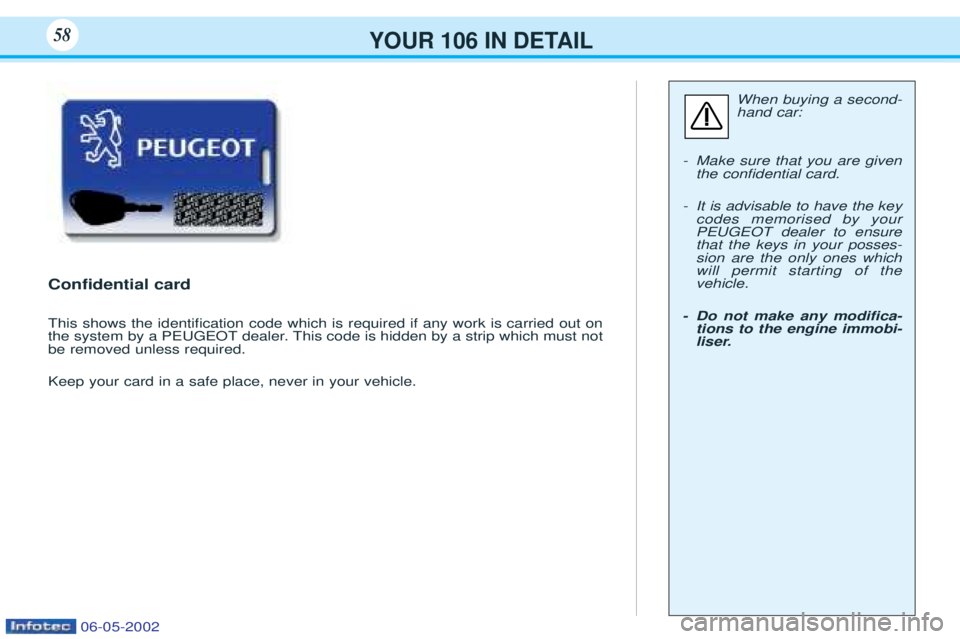
Confidential card
This shows the identiÞcation code which is required if any work is carried out on
the system by a PEUGEOT dealer. This code is hidden by a strip which must notbe removed unless required. Keep your card in a safe place, never in your vehicle.
When buying a second- hand car:
- Make sure that you are giventhe conÞdential card.
- It is advisable to have the keycodes memorised by yourPEUGEOT dealer to ensurethat the keys in your posses-sion are the only ones whichwill permit starting of thevehicle.
- Do not make any modiÞca-tions to the engine immobi-
liser.
06-05-2002
Page 58 of 107
YOUR 106 IN DETAIL59
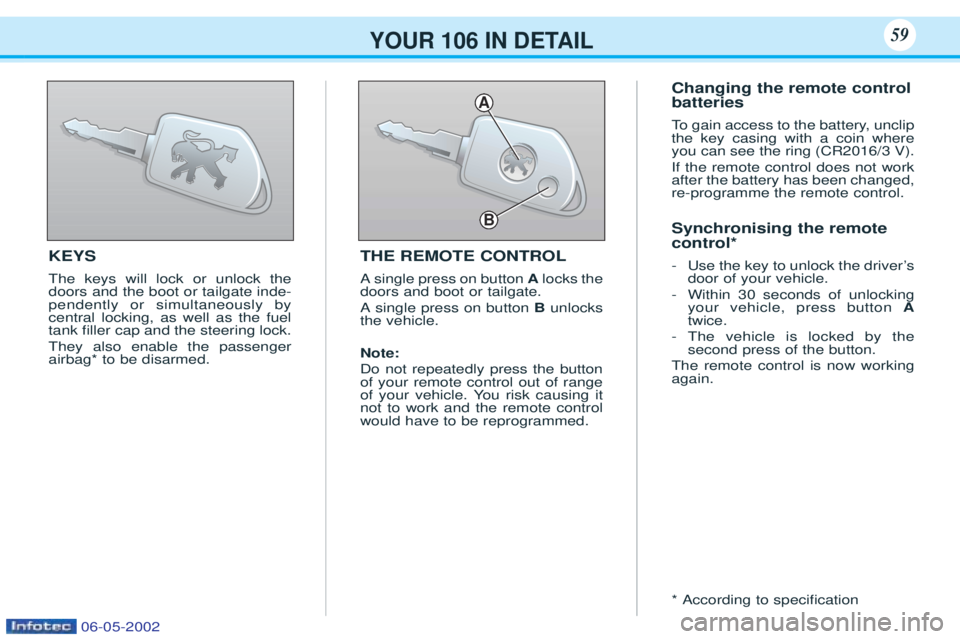
KEYS The keys will lock or unlock the doors and the boot or tailgate inde-pendently or simultaneously bycentral locking, as well as the fueltank Þller cap and the steering lock. They also enable the passenger airbag* to be disarmed.THE REMOTE CONTROL A single press on button
Alocks the
doors and boot or tailgate. A single press on button Bunlocks
the vehicle. Note: Do not repeatedly press the button of your remote control out of range
of your vehicle. You risk causing itnot to work and the remote controlwould have to be reprogrammed. Changing the remote control batteries
To
gain access to the battery, unclip
the key casing with a coin where you can see the ring (CR2016/3 V). If the remote control does not work after the battery has been changed,re-programme the remote control. Synchronising the remote control* - Use the key to unlock the driverÕs door of your vehicle.
-W ithin 30 seconds of unlocking
your vehicle, press button A
twice.
- The vehicle is locked by thesecond press of the button.
The remote control is now workingagain. * According to speciÞcation
A
B
06-05-2002
Page 59 of 107
YOUR 106 IN DETAIL57
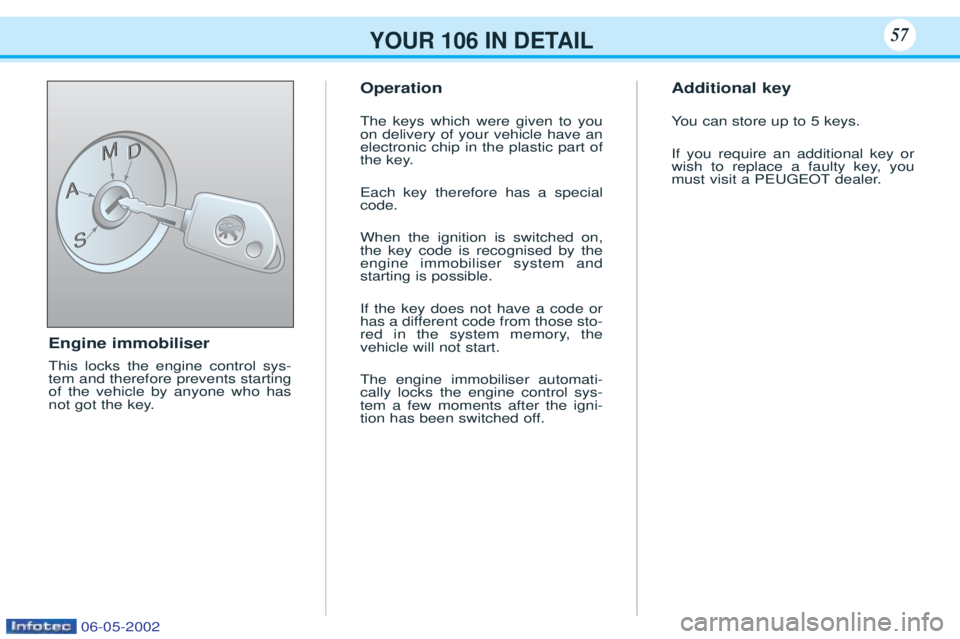
Engine immobiliser This locks the engine control sys- tem and therefore prevents startingof the vehicle by anyone who has
not got the key.Operation The keys which were given to you on delivery of your vehicle have anelectronic chip in the plastic part of
the key. Each key therefore has a special code. When the ignition is switched on, the key code is recognised by theengine immobiliser system andstarting is possible. If the key does not have a code or
has a different code from those sto-
red in the system memory, thevehicle will not start. The engine immobiliser automati- cally locks the engine control sys-tem a few moments after the igni-
tion has been switched off.Additional key Y
ou can store up to 5 keys.
If you require an additional key or
wish to replace a faulty key, you
must visit a PEUGEOT dealer.
06-05-2002
Page 60 of 107
DOORS Opening the doors from the inside
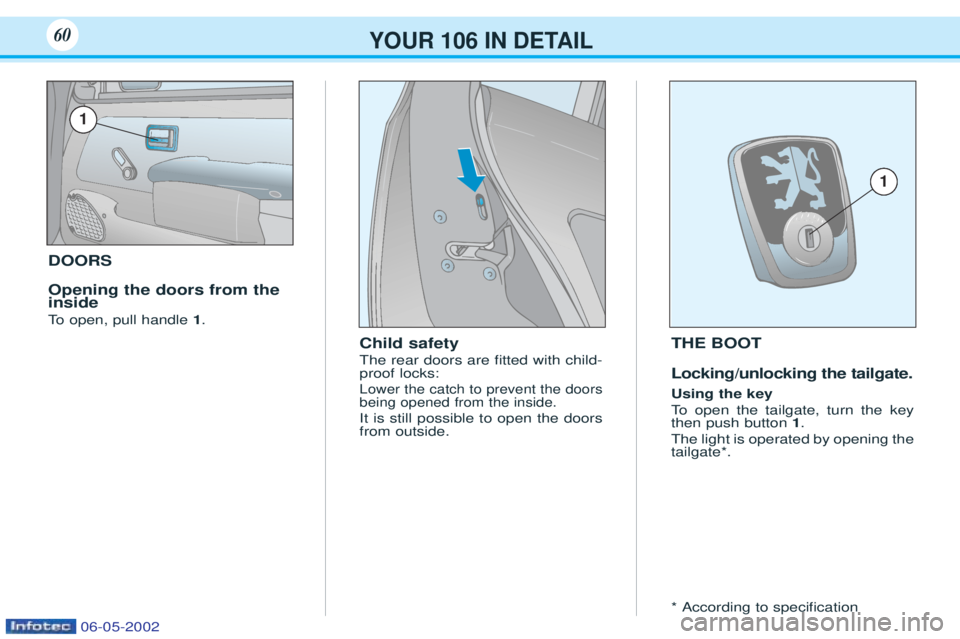
To open, pull handle 1.
Child safety The rear doors are Þtted with child- proof locks:
Lower the catch to prevent the doorsbeing opened from the inside.
It is still possible to open the doorsfrom outside. THE BOOT Locking/unlocking the tailgate. Using the key
To
open the tailgate, turn the key
then push button 1.
The light is operated by opening the tailgate*. * According to speciÞcation
YOUR 106 IN DETAIL60
1
1
06-05-2002
Page 61 of 107
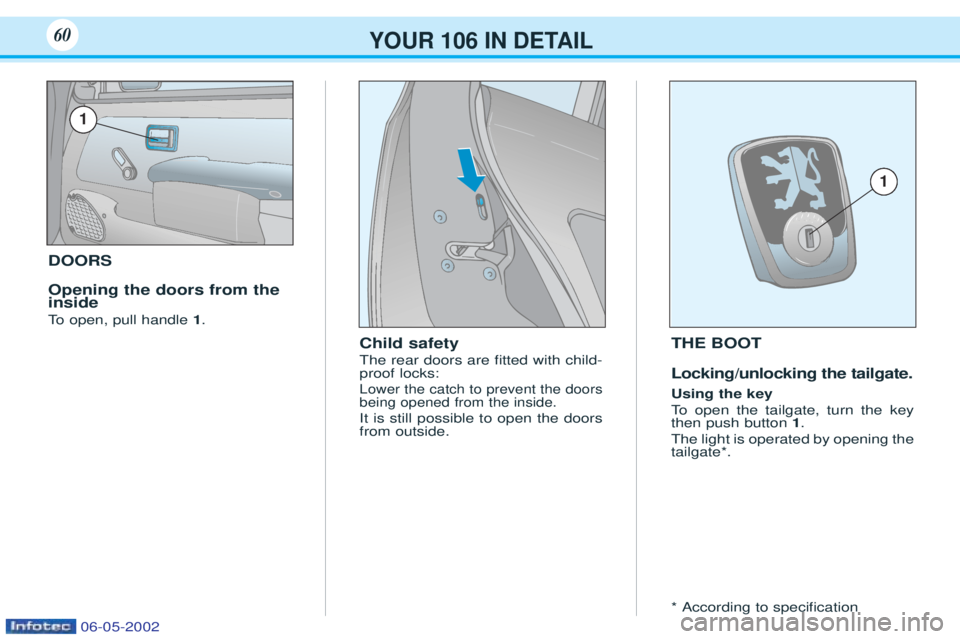
DOORS Opening the doors from the inside
To open, pull handle 1.
Child safety The rear doors are Þtted with child- proof locks:
Lower the catch to prevent the doorsbeing opened from the inside.
It is still possible to open the doorsfrom outside. THE BOOT Locking/unlocking the tailgate. Using the key
To
open the tailgate, turn the key
then push button 1.
The light is operated by opening the tailgate*. * According to speciÞcation
YOUR 106 IN DETAIL60
1
1
06-05-2002
Page 62 of 107
YOUR 106 IN DETAIL61
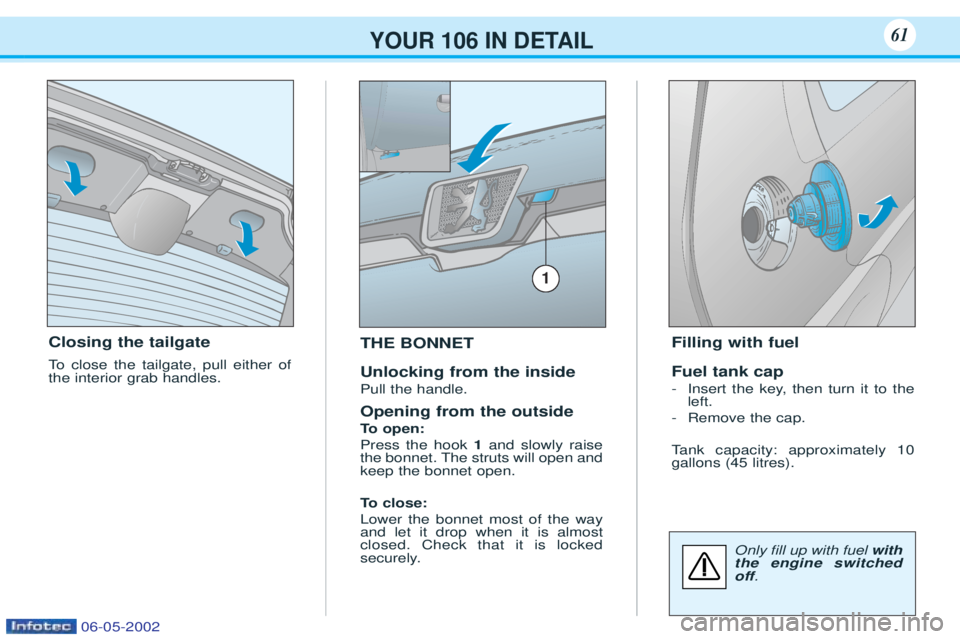
Closing the tailgate
To close the tailgate, pull either of
the interior grab handles. THE BONNET Unlocking from the inside Pull the handle. Opening from the outside
To
open:
Press the hook 1and slowly raise
the bonnet. The struts will open and keep the bonnet open.
To close:
Lower the bonnet most of the way and let it drop when it is almostclosed. Check that it is locked
securely. Filling with fuel Fuel tank cap -
Insert the key, then turn it to the left.
- Remove the cap.
T ank capacity: approximately 10
gallons (45 litres).
1
Only Þll up with fuel with
the engine switched
off .
06-05-2002
Page 64 of 107
YOUR 106 IN DETAIL61
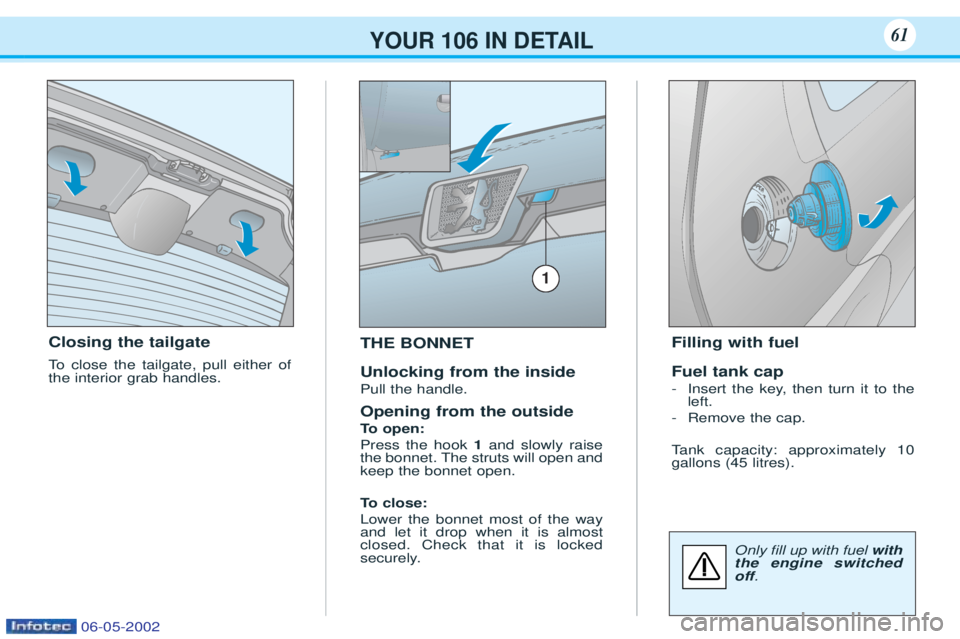
Closing the tailgate
To close the tailgate, pull either of
the interior grab handles. THE BONNET Unlocking from the inside Pull the handle. Opening from the outside
To
open:
Press the hook 1and slowly raise
the bonnet. The struts will open and keep the bonnet open.
To close:
Lower the bonnet most of the way and let it drop when it is almostclosed. Check that it is locked
securely. Filling with fuel Fuel tank cap -
Insert the key, then turn it to the left.
- Remove the cap.
T ank capacity: approximately 10
gallons (45 litres).
1
Only Þll up with fuel with
the engine switched
off .
06-05-2002
Page 67 of 107
YOUR 106 IN DETAIL64
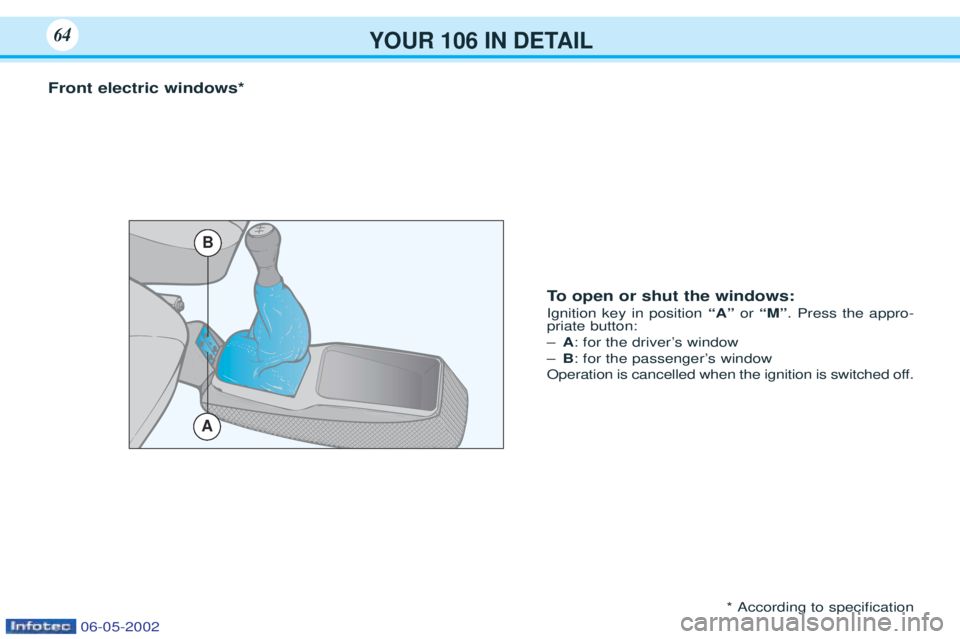
Front electric windows*To open or shut the windows:
Ignition key in position “A”or “M” . Press the appro-
priate button: Ð A: for the driverÕs window
Ð B: for the passengerÕs window
Operation is cancelled when the ignition is switched off.
* According to speciÞcation
B
A
06-05-2002
Page 73 of 107
YOUR 106 IN DETAIL71
AIR BAGS* The airbag system has been desi- gned to maximise the safety of theoccupants in the event of seriouscollisions. It works in conjunctionwith the seat belts. The electronic detectors register and analyse any abrupt deceleration ofthe vehicle; if the triggering thresholdis reached the airbags inßate instant-ly and come between the occupantsand the vehicle. Immediately after the impact, the air-
bags deßate rapidly, so that they donot hinder the visibility of the occu-pants and their exit if necessary fromthe vehicle. The airbags are not deployed in the case of collisions which are notserious, for which the seat belt is suf-Þcient to ensure maximum protec-tion. The seriousness of a collisiondepends on the nature of the obs-tacle and the speed of the vehicle atthe moment of the collision. Airbags only operate when the ignition is switched on. Note: the gas escaping from the
cushion can be a minor irritant. FRONT AIR BAGS* These are folded in the centre of the steering wheel for the driver and in
the fascia for the front passenger.They are deployed simultaneously(except in cases where the airbag isdisarmed), for frontal impacts wherethere is a risk of injury to the head orchest.
-
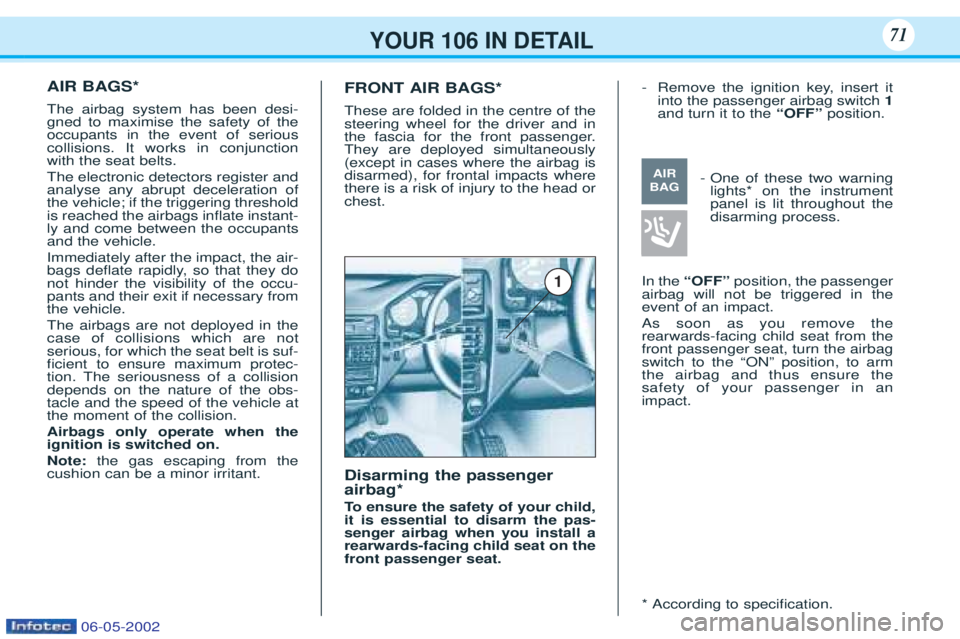
Remove the ignition key, insert itinto the passenger airbag switch 1
and turn it to the “OFF”position.
- One of these two warning lights* on the instrumentpanel is lit throughout thedisarming process.
In the “OFF” position, the passenger
airbag will not be triggered in theevent of an impact. As soon as you remove the rearwards-facing child seat from thefront passenger seat, turn the airbagswitch to the ÒONÓ position, to armthe airbag and thus ensure thesafety of your passenger in animpact. * According to speciÞcation.
Disarming the passenger airbag*
To ensure the safety of your child,
it is essential to disarm the pas- senger airbag when you install arearwards-facing child seat on thefront passenger seat.
1
AIR
BAG
06-05-2002
Page 82 of 107
CHECKING THE LEVELS 1. Air filter
The air filter element must be changed at the recommendedintervals. If you drive in a dustyatmosphere, change it twice asoften. Follow the recommendations given in the maintenance schedule. 2. Brake fluid
The level must always be above the
DANGER mark on the reservoir. Inthe event of a signiÞcant drop in theßuid level, consult a PEUGEOT
dealer immediately. Use fluids
approved by the manufacturer,which conform to DOT 3 or DOT 4standards. 3. Battery
At the beginning of winter, have the battery checked by a PEUGEOT
dealer. In summer (30¡C and above) or if the battery is in heavy use, checkthe level of electrolyte; it must coverthe separator plates at all times. If
necessary, top up with distilled
water. 4. Power steering* When the engine is cold, the level must always be above the MINmark, close to the MAX mark. 5. Dipstick Check the oil level on ßat ground, with the engine cold and preferably
before the Þrst journey of the day. Never exceed the maximum level.
Check the level regularly.
6. T
opping up with oil
Y our oil must be changed in accor-
dance with the maintenance sche- dule. The oil must be topped up between oil changes. Regularly check and top-up the oil level. Maximum oil consumption is 0.5 litres per 600 miles (1000 km). 7. Coolant Engine cold: the coolant level must be between the min and max marksin the expansion chamber with the
cap removed. To close, turn the capto the second notch*. Cooling circuit Always use the coolant which is approved by the manufacturer
(PROCOR TM108 / GLYSANTING33 or REVKOGEL 2000). If this isnot possible, top up with distilledwater and have the protection level
checked by a PEUGEOT dealer. When the engine is hot, the coolant temperature is regulated by the fan.As the fan can operate with theignition key removed, and as thecooling circuit is pressurised,
do
not carry out any work for atleast an hour after switching offthe engine .
Note: the coolant does not need tobe renewed.
8. Front/rear screen and headlamp wash reservoir*
For optimum cleaning quality and
for your safety, it is best to use cleaning products approved byPEUGEOT (capacity 4.5 litreswithout headlamp wash, 5.5 litreswith headlamp wash). * According to speciÞcation
PRACTICAL INFORMATION7878
06-05-2002