belt PEUGEOT 108 2018 User Guide
[x] Cancel search | Manufacturer: PEUGEOT, Model Year: 2018, Model line: 108, Model: PEUGEOT 108 2018Pages: 180, PDF Size: 7.14 MB
Page 63 of 180
61
Deactivating the
passenger's front airbag
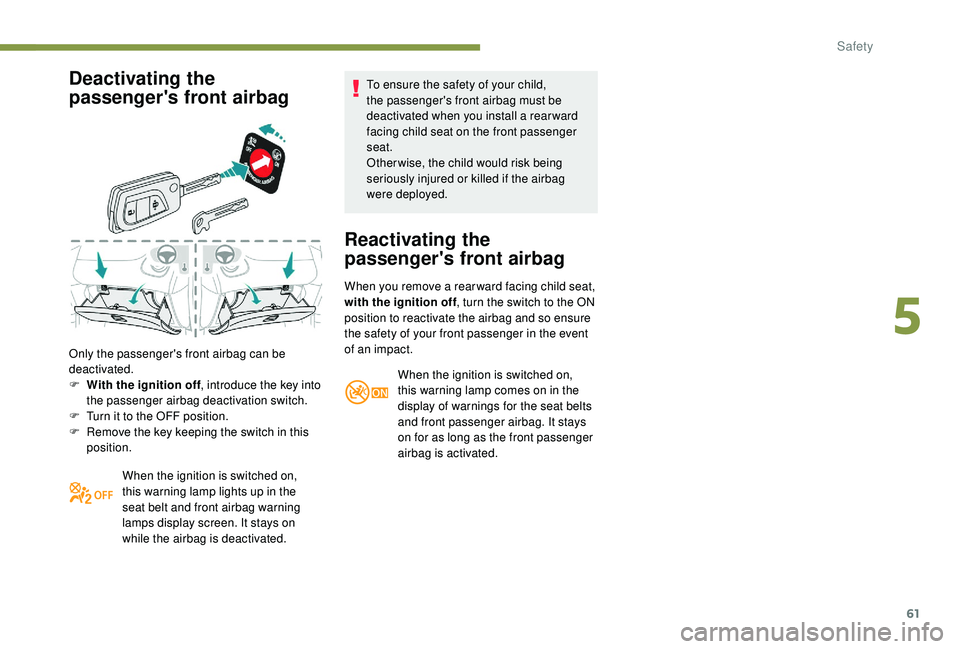
Only the passenger's front airbag can be
deactivated.
F
W
ith the ignition off , introduce the key into
the passenger airbag deactivation switch.
F
T
urn it to the OFF position.
F
R
emove the key keeping the switch in this
position.
When the ignition is switched on,
this warning lamp lights up in the
seat belt and front airbag warning
lamps display screen. It stays on
while the airbag is deactivated. To ensure the safety of your child,
the passenger's front airbag must be
deactivated when you install a
rear ward
facing child seat on the front passenger
seat.
Otherwise, the child would risk being
seriously injured or killed if the airbag
were deployed.
Reactivating the
passenger's front airbag
When you remove a rear ward facing child seat,
w ith the ignition off , turn the switch to the ON
position to reactivate the airbag and so ensure
the safety of your front passenger in the event
of an impact.
When the ignition is switched on,
this warning lamp comes on in the
display of warnings for the seat belts
and front passenger airbag. It stays
on for as long as the front passenger
airbag is activated.
5
Safety
Page 66 of 180
64
Child seat at the rear
"Rearward facing "
When a "rear ward facing" child seat is installed
on a
rear passenger seat , move the vehicle's
front seat for ward and straighten the backrest
so that the "rear ward facing" child seat does
not touch the vehicle's front seat.
" Forward facing "
When a "for ward facing" child seat is installed
on a
rear passenger seat , move the vehicle's
front seat for ward and straighten the backrest
so that the legs of the child in the "for ward
facing" child seat do not touch the vehicle's
front seat.
Recommended child
seats
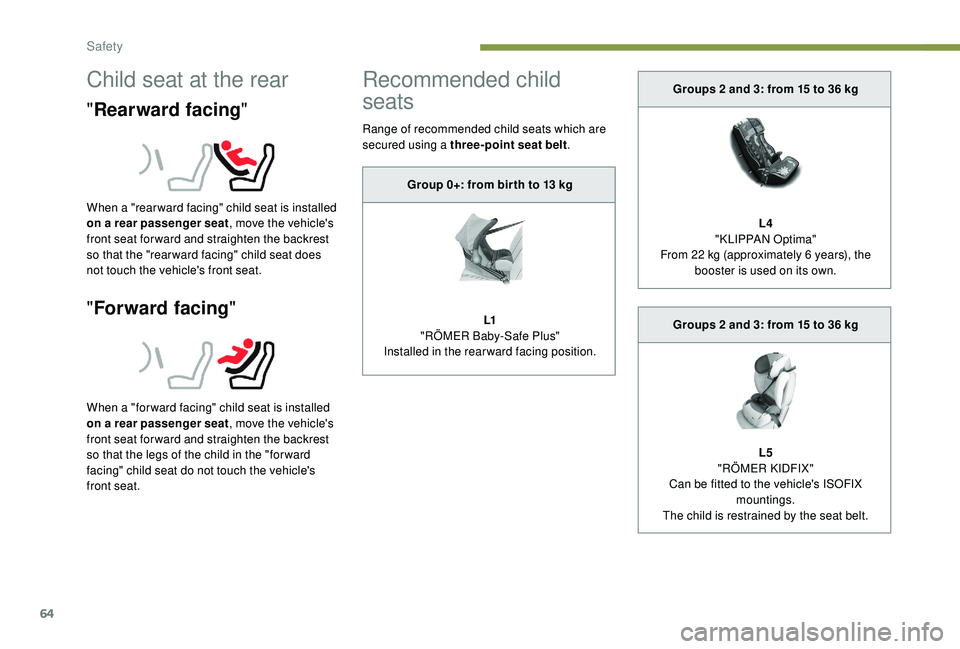
Range of recommended child seats which are
secured using a three-point seat belt .
Group 0+: from bir th to 13
kg
L1
"RÖMER Baby-Safe Plus"
Installed in the rearward facing position. Groups 2
and 3: from 15 to 36 kg
L4
"KLIPPAN Optima"
From 22
kg (approximately 6 years), the
booster is used on its own.
Groups 2
and 3: from 15 to 36 kg
L5
"RÖMER KIDFIX"
Can be fitted to the vehicle's ISOFIX mountings.
The child is restrained by the seat belt.
Safety
Page 67 of 180
65
Locations for child seats secured using the seat belt
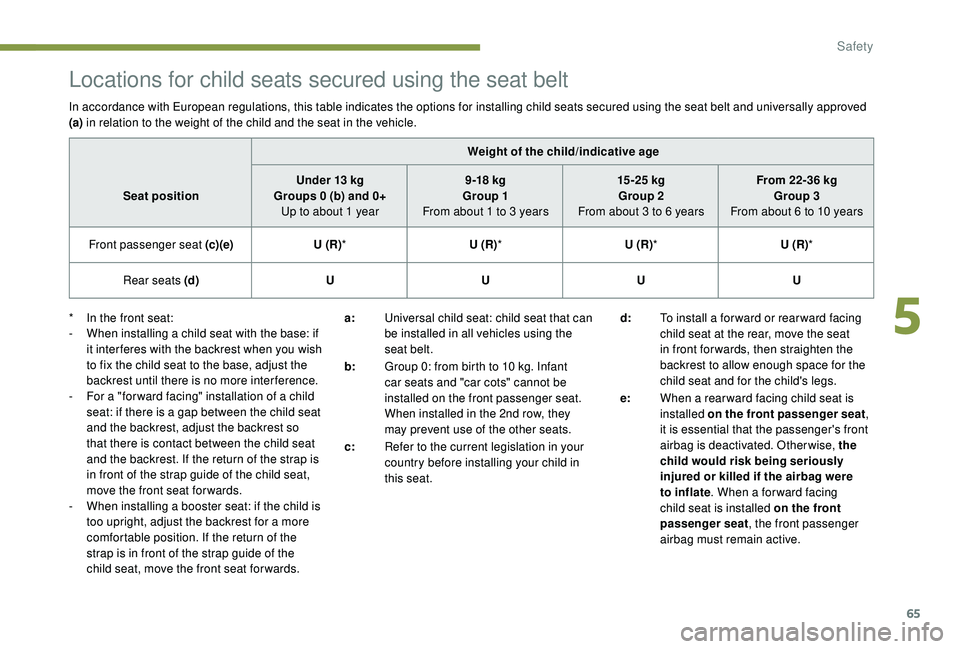
In accordance with European regulations, this table indicates the options for installing child seats secured using the seat belt and universally approved
(a) in relation to the weight of the child and the seat in the vehicle.
Weight of the child/indicative age
Seat position Under 13
kg
Groups 0 (b) and 0+ Up to about 1
year9 -18
kg
Group 1
From about 1
to 3 years15 -25
kg
Group 2
From about 3
to 6 yearsFrom 22-36
kg
Group 3
From about 6
to 10 years
Front passenger seat (c) (e)U (R)* U (R)* U (R)* U (R)*
Rear seats (d) UUUU
d: To install a
forward or rearward facing
child seat at the rear, move the seat
in front for wards, then straighten the
backrest to allow enough space for the
child seat and for the child's legs.
e: When a
rear ward facing child seat is
installed on the front passenger seat ,
it is essential that the passenger's front
airbag is deactivated. Otherwise, the
child would risk being seriously
injured or killed if the airbag were
to inflate . When a
for ward facing
child seat is installed on the front
passenger seat , the front passenger
airbag must remain active.
*
I
n the front seat:
-
W
hen installing a child seat with the base: if
it inter feres with the backrest when you wish
to fix the child seat to the base, adjust the
backrest until there is no more inter ference.
-
F
or a "for ward facing" installation of a child
seat: if there is a
gap between the child seat
and the backrest, adjust the backrest so
that there is contact between the child seat
and the backrest. If the return of the strap is
in front of the strap guide of the child seat,
move the front seat for wards.
-
W
hen installing a booster seat: if the child is
too upright, adjust the backrest for a
more
comfortable position. If the return of the
strap is in front of the strap guide of the
child seat, move the front seat for wards. a:
Universal child seat: child seat that can
be installed in all vehicles using the
seat belt.
b: Group 0: from birth to 10
kg. Infant
car seats and "car cots" cannot be
installed on the front passenger seat.
When installed in the 2nd row, they
may prevent use of the other seats.
c: Refer to the current legislation in your
country before installing your child in
this seat.
5
Safety
Page 68 of 180
66
U:Seat suitable for the installation of
a
child seat secured using a seat belt
and universally approved, rearward
and/or for ward facing, with the front
seat adjusted in the middle longitudinal
position.
U (R): same as U , with the vehicle seat which
must be adjusted in the rearmost
longitudinal position, backrest
straightened.
ISOFIX mountings
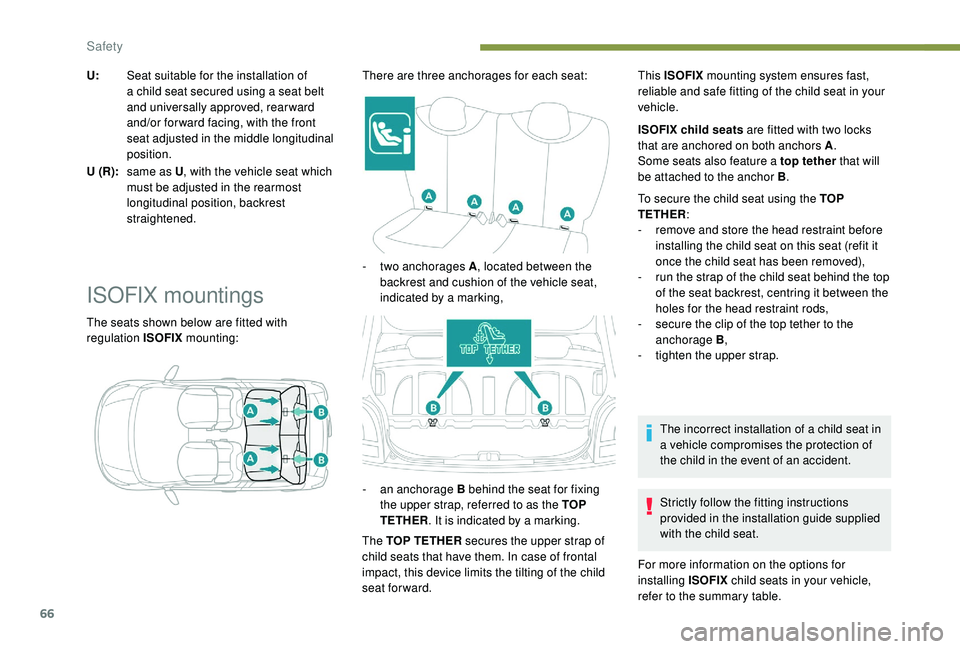
The seats shown below are fitted with
regulation ISOFIX mounting: There are three anchorages for each seat:
-
t
wo anchorages A
, located between the
backrest and cushion of the vehicle seat,
indicated by a marking,
-
an
anchorage B behind the seat for fixing
the upper strap, referred to as the TOP
TETHER . It is indicated by a
marking.
The TOP TETHER secures the upper strap of
child seats that have them. In case of frontal
impact, this device limits the tilting of the child
seat forward. This ISOFIX
mounting system ensures fast,
reliable and safe fitting of the child seat in your
vehicle.
ISOFIX child seats are fitted with two locks
that are anchored on both anchors A .
Some seats also feature a top tether
that will
be attached to the anchor B .
To secure the child seat using the TOP
TETHER :
-
r
emove and store the head restraint before
installing the child seat on this seat (refit it
once the child seat has been removed),
-
r
un the strap of the child seat behind the top
of the seat backrest, centring it between the
holes for the head restraint rods,
- s ecure the clip of the top tether to the
anchorage B ,
-
t
ighten the upper strap.
The incorrect installation of a
child seat in
a
vehicle compromises the protection of
the child in the event of an accident.
Strictly follow the fitting instructions
provided in the installation guide supplied
with the child seat.
For more information on the options for
installing ISOFIX child seats in your vehicle,
refer to the summary table.
Safety
Page 69 of 180
67
Recommended ISOFIX
child seats
Also consult the user guides from the child
seat's manufacturer to find out how to
install and remove the seat.
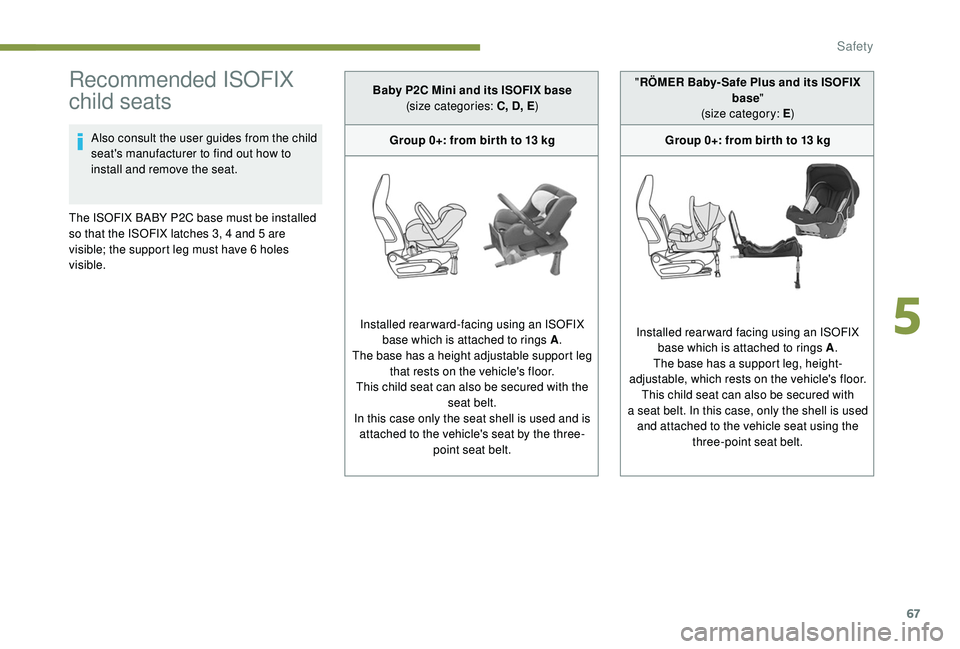
The ISOFIX BABY P2C base must be installed
so that the ISOFIX latches 3, 4
and 5 are
visible; the support leg must have 6
holes
visible. Baby P2C Mini and its ISOFIX base
(size categories: C, D, E )
Group 0+: from bir th to 13 kg
Installed rearward-facing using an ISOFIX base which is attached to rings A .
The base has a
height adjustable support leg
that rests on the vehicle's floor.
This child seat can also be secured with the seat belt.
In this case only the seat shell is used and is attached to the vehicle's seat by the three- point seat belt. "
RÖMER Baby- Safe Plus and its ISOFIX
base"
(size category: E )
Group 0+: from bir th to 13 kg
Installed rearward facing using an ISOFIX base which is attached to rings A .
The base has a
support leg, height-
adjustable, which rests on the vehicle's floor. This child seat can also be secured with
a
seat belt. In this case, only the shell is used
and attached to the vehicle seat using the three-point seat belt.
5
Safety
Page 70 of 180
68
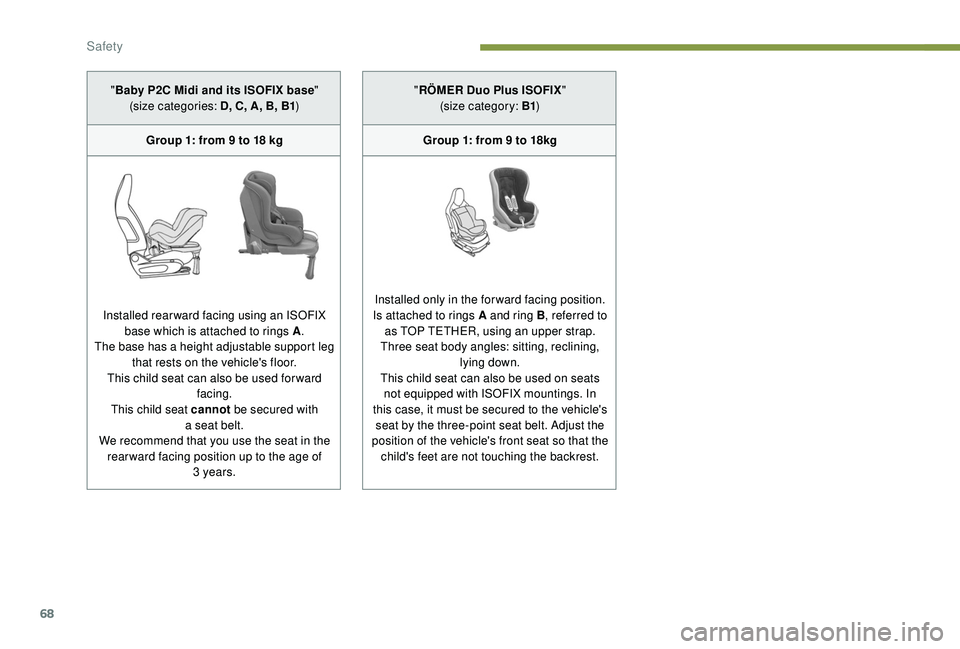
"Baby P2C Midi and its ISOFIX base "
(size categories: D, C, A, B, B1 )
Group 1: from 9
to 18 kg
Installed rearward facing using an ISOFIX base which is attached to rings A .
The base has a
height adjustable support leg
that rests on the vehicle's floor.
This child seat can also be used for ward facing.
This child seat cannot be secured with
a
seat belt.
We recommend that you use the seat in the rear ward facing position up to the age of 3
years. "
RÖMER Duo Plus ISOFIX "
(size category: B1 )
Group 1: from 9
to 18kg
Installed only in the forward facing position.
Is attached to rings A and ring B , referred to
as TOP TETHER, using an upper strap.
Three seat body angles: sitting, reclining, lying down.
This child seat can also be used on seats not equipped with ISOFIX mountings. In
this case, it must be secured to the vehicle's seat by the three-point seat belt. Adjust the
position of the vehicle's front seat so that the child's feet are not touching the backrest.
Safety
Page 72 of 180
70
Locations for i-Size child
seats
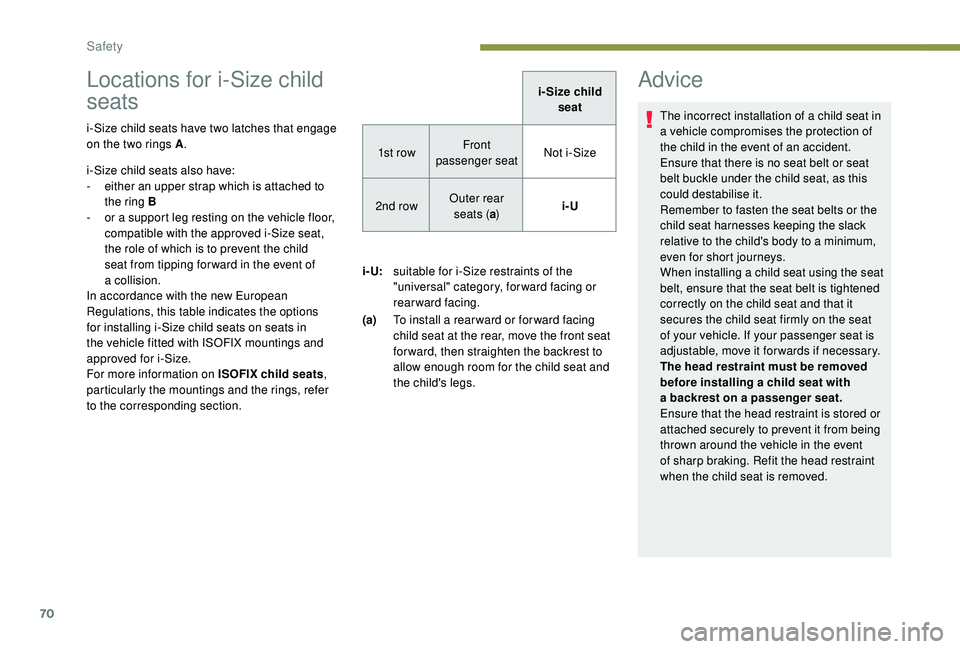
i-Size child seats have two latches that engage
on the two rings A.
i-Size child seats also have:
-
e
ither an upper strap which is attached to
the ring B
-
o
r a support leg resting on the vehicle floor,
compatible with the approved i-Size seat,
the role of which is to prevent the child
seat from tipping for ward in the event of
a
collision.
In accordance with the new European
Regulations, this table indicates the options
for installing i-Size child seats on seats in
the vehicle fitted with ISOFIX mountings and
approved for i-Size.
For more information on ISOFIX child seats ,
particularly the mountings and the rings, refer
to the corresponding section. i-Size child
seat
1st row Front
passenger seat Not i-Size
2nd row Outer rear
seats ( a) i-U
i- U: suitable for i-Size restraints of the
"universal" category, forward facing or
rearward facing.
(a) To install a
rearward or forward facing
child seat at the rear, move the front seat
for ward, then straighten the backrest to
allow enough room for the child seat and
the child's legs.
Advice
The incorrect installation of a child seat in
a vehicle compromises the protection of
the child in the event of an accident.
Ensure that there is no seat belt or seat
belt buckle under the child seat, as this
could destabilise it.
Remember to fasten the seat belts or the
child seat harnesses keeping the slack
relative to the child's body to a
minimum,
even for short journeys.
When installing a
child seat using the seat
belt, ensure that the seat belt is tightened
correctly on the child seat and that it
secures the child seat firmly on the seat
of your vehicle. If your passenger seat is
adjustable, move it forwards if necessary.
The head restraint must be removed
before installing a
child seat with
a
backrest on a passenger seat.
Ensure that the head restraint is stored or
attached securely to prevent it from being
thrown around the vehicle in the event
of sharp braking. Refit the head restraint
when the child seat is removed.
Safety
Page 73 of 180
71
Children at the rear
At rear seating positions, always leave
sufficient space between the front seat
and:
-
a "
rear ward facing" child seat,
-
t
he child's feet for a child seat fitted
forward facing.
To do this, move the front seat for wards
and, if necessary, move its backrest into
the upright position.
For optimal installation of the forward
facing child seat, verify that its backrest is
as close as possible to the backrest of the
vehicle seat, if possible in contact with it.
Children at the front
The legislation on carrying children on the
front passenger seat is specific to each
country. Refer to the legislation in force in
the country in which you are driving.
Deactivate the front passenger airbag
when a "rear ward facing" child seat is
installed on the front passenger seats.
Other wise, there is a
risk of serious or
fatal injury to the child if the airbag is
deployed. Installing a
booster seat
The chest part of the seat belt must be
positioned on the child's shoulder without
touching the neck.
Ensure that the lap part of the seat belt
passes correctly over the child's thighs.
We recommend using a
booster seat with
a
backrest, equipped with a belt guide at
shoulder level.
Additional protections
To prevent accidental opening of the doors
and rear windows, use the child lock.
Take care not to open the rear windows by
more than one third.
To protect young children from the rays
of the sun, fit side blinds on the rear
windows.
As a
safety precaution, do not leave:
-
a c
hild or children alone and
unattended in a
vehicle,
-
a c
hild or an animal in a vehicle
which is exposed to the sun, with the
windows closed,
-
t
he keys within reach of children inside
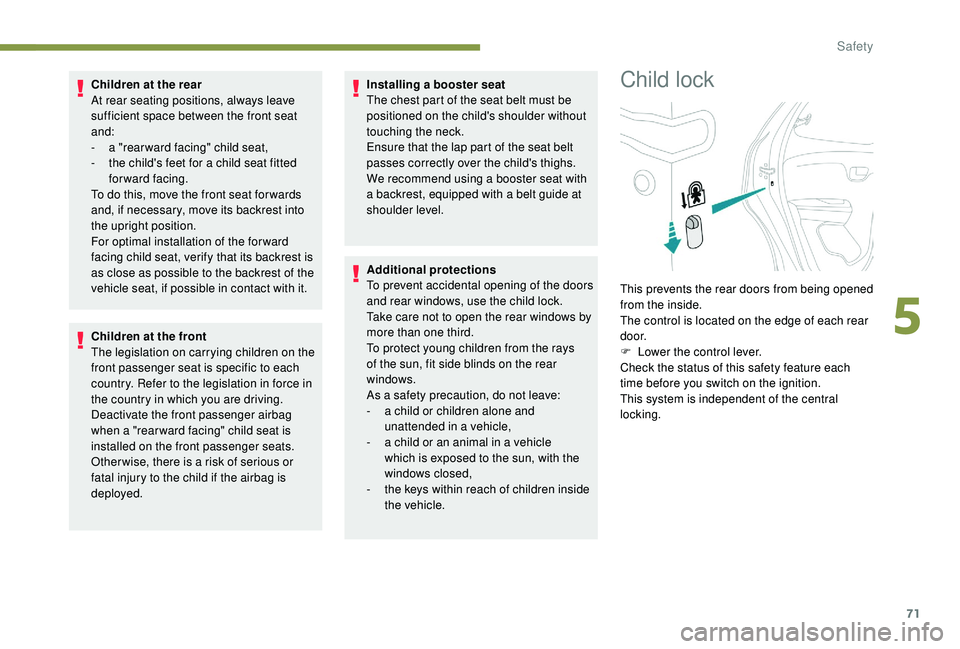
the vehicle.Child lock
This prevents the rear doors from being opened
from the inside.
The control is located on the edge of each rear
d o o r.
F
L
ower the control lever.
Check the status of this safety feature each
time before you switch on the ignition.
This system is independent of the central
locking.
5
Safety
Page 83 of 180
81
Operation
Going into engine STOP mode
This indicator lamp comes on in the
instrument panel and the engine
goes into standby automatically:
-
w
hen the vehicle is stationary, you put the
gearbox into neutral and release the clutch
pedal.
Stop & Starttime counters
A partial time counter counts the periods in
STOP mode during a journey. For your convenience during parking
manoeuvres, STOP mode is not available
for a
few seconds after coming out of
reverse gear.
Stop & Start does not change features
of the vehicle such as braking, power
steering…
Never refuel with the engine in STOP
mode; you must switch off the ignition.
Special cases: STOP mode not
available
Stop & Start
The Stop & Start system puts the engine
temporarily into standby – STOP mode – during
traffic stops (red lights, traffic jams, etc.). The
engine restarts automatically – START mode
– as soon as you want to move off. Restarting
occurs instantly, quickly and silently.
Per fect for urban use, the Stop & Start system
reduces fuel consumption and exhaust
emissions as well as the noise level when
stationary. -
t
he engine is needed to maintain
a comfortable temperature in the passenger
compartment,
-
d
emisting is active,
-
s
ome special conditions (battery charge,
engine temperature, braking assistance,
vehicle stopped on a
steep slope, high
altitude…) where the engine is needed to
assure control of a
system.
Going into engine START mode
This indicator lamp goes off and the
engine restarts automatically:
-
w
hen you fully depress the clutch pedal.
Special case: START invoked
automatically
START mode is invoked automatically if:
- y
ou open the driver's door,
-
y
ou open the bonnet,
-
y
ou unfasten the driver's seat belt,
-
s
ome temporary conditions apply (battery
charge, engine temperature, braking
assistance, vehicle on a
steep slope,
adjustment of the air conditioning, …) where
it is necessary for control of a
system or of
the vehicle.
It is displayed in the trip computer as soon as
the Stop & Start acts.
Press one of the "
DISP" buttons to return to the
previous display.
A global time counter counts the periods in
STOP mode since the last reset to zero.
When it is displayed, press for more than two
seconds on one of the " DISP" buttons to reset
to zero.
STOP mode does not activate, mainly when:
-
t
he driver's door is open,
-
t
he driver's seat belt is not fastened,
6
Driving
Page 124 of 180
122
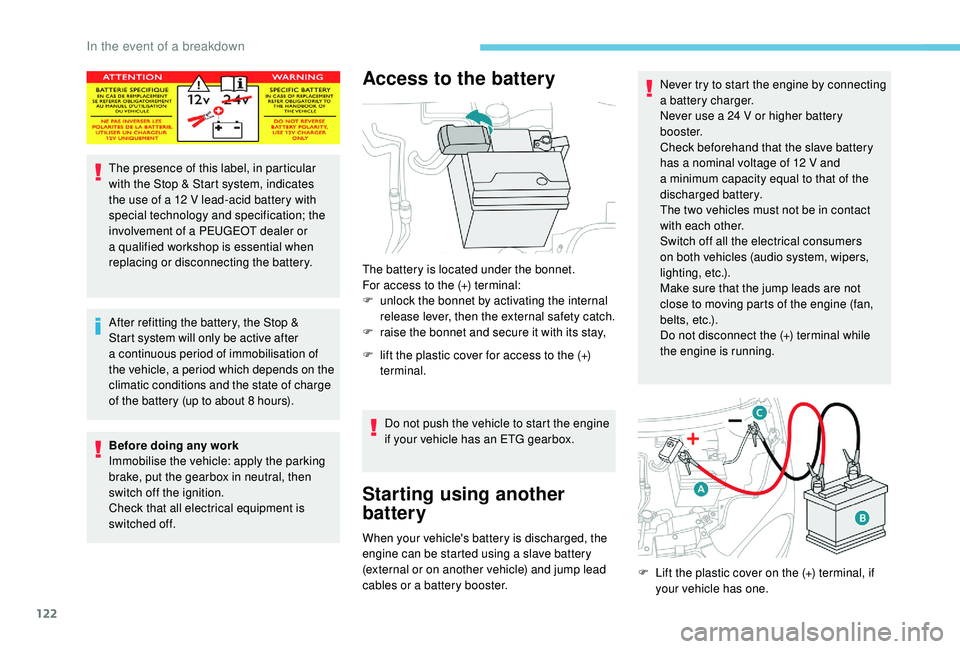
The presence of this label, in particular
with the Stop & Start system, indicates
the use of a 12 V lead-acid battery with
special technology and specification; the
involvement of a
PEUGEOT dealer or
a
qualified workshop is essential when
replacing or disconnecting the battery.
After refitting the battery, the Stop &
Start system will only be active after
a
continuous period of immobilisation of
the vehicle, a period which depends on the
climatic conditions and the state of charge
of the battery (up to about 8
hours).
Before doing any work
Immobilise the vehicle: apply the parking
brake, put the gearbox in neutral, then
switch off the ignition.
Check that all electrical equipment is
switched off.
Access to the battery
The battery is located under the bonnet.
For access to the (+) terminal:
F
u
nlock the bonnet by activating the internal
release lever, then the external safety catch.
F
r
aise the bonnet and secure it with its stay,
F
l
ift the plastic cover for access to the (+)
terminal.
Do not push the vehicle to start the engine
if your vehicle has an ETG gearbox.
Starting using another
battery
When your vehicle's battery is discharged, the
engine can be started using a slave battery
(external or on another vehicle) and jump lead
cables or a
battery booster. Never try to start the engine by connecting
a
battery charger.
Never use a 24 V or higher battery
b o o s t e r.
Check beforehand that the slave battery
has a nominal voltage of 12 V and
a
minimum capacity equal to that of the
discharged battery.
The two vehicles must not be in contact
with each other.
Switch off all the electrical consumers
on both vehicles (audio system, wipers,
lighting, etc.).
Make sure that the jump leads are not
close to moving parts of the engine (fan,
belts, etc.).
Do not disconnect the (+) terminal while
the engine is running.
F
L
ift the plastic cover on the (+) terminal, if
your vehicle has one.
In the event of a breakdown