check engine PEUGEOT 2008 2013.5 User Guide
[x] Cancel search | Manufacturer: PEUGEOT, Model Year: 2013.5, Model line: 2008, Model: PEUGEOT 2008 2013.5Pages: 336, PDF Size: 9.23 MB
Page 97 of 336
95
4
Driving
The system is reactivated automatically at every new start using the key.
Reactivation
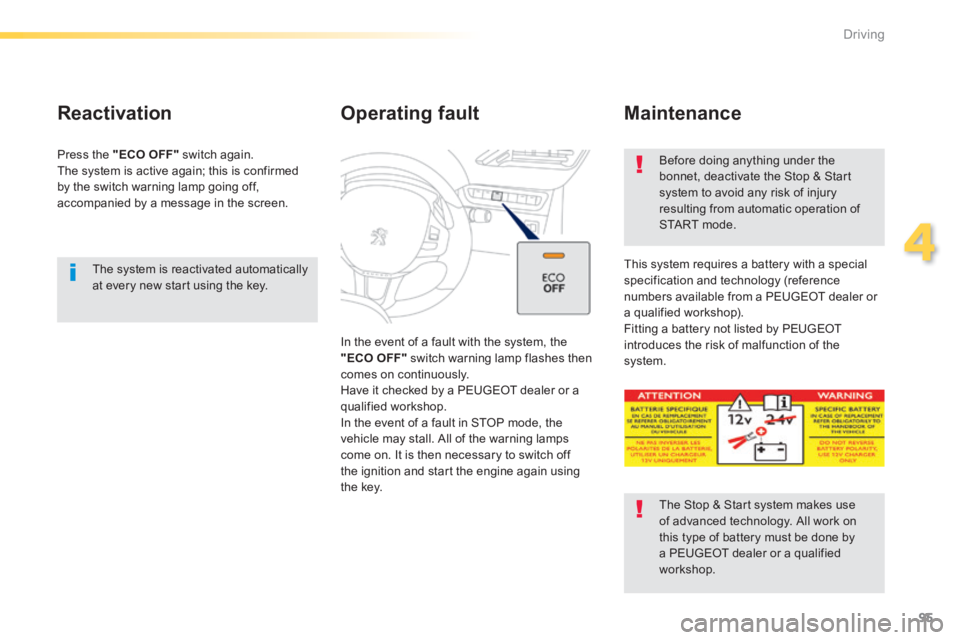
Press the "ECO OFF" switch again. The system is active again; this is confirmed by the switch warning lamp going off, accompanied by a message in the screen.
Operating fault
In the event of a fault with the system, the "ECO OFF" switch warning lamp flashes then comes on continuously. Have it checked by a PEUGEOT dealer or a qualified workshop. In the event of a fault in STOP mode, the
vehicle may stall. All of the warning lamps come on. It is then necessary to switch off the ignition and start the engine again using the key.
Before doing anything under the bonnet, deactivate the Stop & Start system to avoid any risk of injury resulting from automatic operation of START mode.
This system requires a battery with a special specification and technology (reference numbers available from a PEUGEOT dealer or a qualified workshop). Fitting a battery not listed by PEUGEOT introduces the risk of malfunction of the system.
Maintenance
The Stop & Start system makes use of advanced technology. All work on this type of battery must be done by a PEUGEOT dealer or a qualified workshop.
Page 98 of 336
96
Driving
Hill start assist
System which keeps your vehicle immobilised temporarily (approximately 2 seconds) when starting on a gradient, the time it takes to move your foot from the brake pedal to the accelerator pedal. This function is only active when: - the vehicle is completely stationary, with your foot on the brake pedal, - when certain conditions of gradient are met, - with the driver’s door closed. The hill start assist function cannot be deactivated.
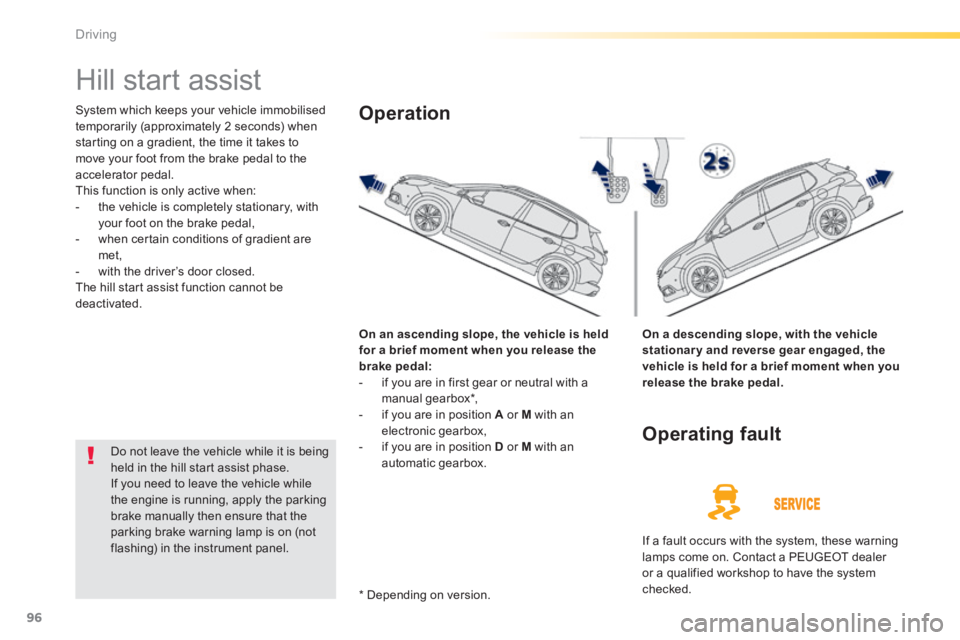
On an ascending slope, the vehicle is held for a brief moment when you release the brake pedal: - if you are in first gear or neutral with a manual gearbox * , - if you are in position A or M with an electronic gearbox, - if you are in position D or M with an automatic gearbox.
Operation
On a descending slope, with the vehicle stationary and reverse gear engaged, the vehicle is held for a brief moment when you release the brake pedal.
Do not leave the vehicle while it is being held in the hill start assist phase. If you need to leave the vehicle while the engine is running, apply the parking brake manually then ensure that the parking brake warning lamp is on (not flashing) in the instrument panel.
Operating fault
If a fault occurs with the system, these warning lamps come on. Contact a PEUGEOT dealer or a qualified workshop to have the system checked. * Depending on version.
Page 109 of 336
107
4
Driving
In bad weather and in winter, ensure that the sensors are not covered by road dirt, ice or snow.
In the event of a fault, have the system checked by a PEUGEOT dealer or a qualified workshop.
If the system is deactivated during a manoeuvre, the drive should reactivate it manually to repeat the measurement.
If the lateral distance between your vehicle and the space is too great, the system may not be able to measure the space. Anything projecting beyond the envelope of the vehicle (long or wide load) is not taken into account by the Park Assist system during a manoeuvre.
Deactivation
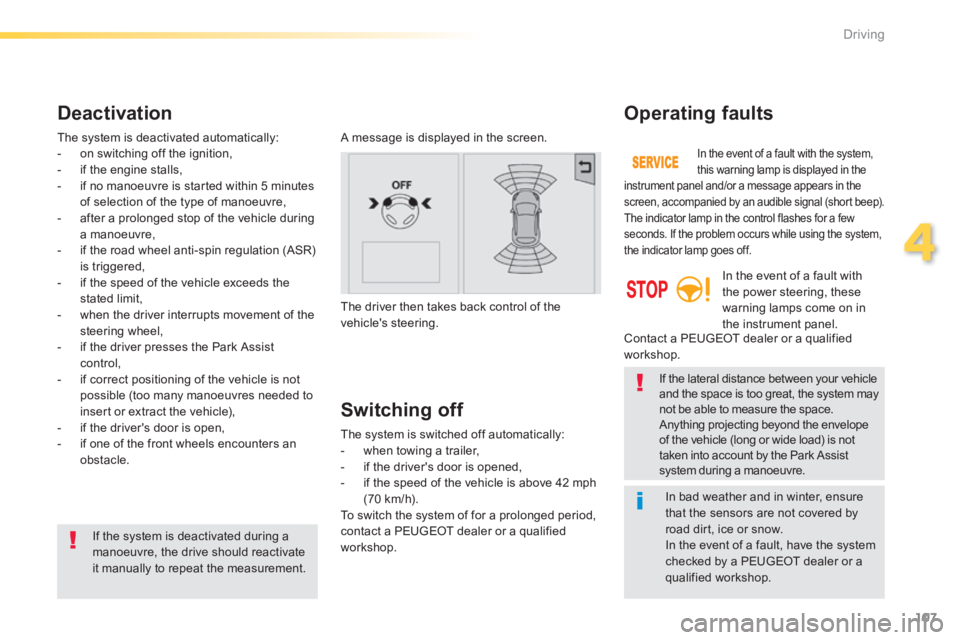
A message is displayed in the screen.
The driver then takes back control of the vehicle's steering.
The system is deactivated automatically: - on switching off the ignition, - if the engine stalls, - if no manoeuvre is started within 5 minutes of selection of the type of manoeuvre, - after a prolonged stop of the vehicle during a manoeuvre, - if the road wheel anti-spin regulation (ASR) is triggered, - if the speed of the vehicle exceeds the stated limit, - when the driver interrupts movement of the steering wheel, - if the driver presses the Park Assist control, - if correct positioning of the vehicle is not possible (too many manoeuvres needed to insert or extract the vehicle), - if the driver's door is open, - if one of the front wheels encounters an obstacle.
Switching off
The system is switched off automatically: - when towing a trailer, - if the driver's door is opened, - if the speed of the vehicle is above 42 mph (70 km/h). To switch the system of for a prolonged period, contact a PEUGEOT dealer or a qualified workshop.
Operating faults
In the event of a fault with the system, this warning lamp is displayed in the instrument panel and/or a message appears in the screen, accompanied by an audible signal (short beep). The indicator lamp in the control flashes for a few
seconds. If the problem occurs while using the system, the indicator lamp goes off.
In the event of a fault with the power steering, these warning lamps come on in the instrument panel. Contact a PEUGEOT dealer or a qualified workshop.
Page 129 of 336
127
6
Safety
Dynamic stability control (DSC) and anti-slip regulation (ASR)
Activation
These systems are activated automatically each time the vehicle is started. As soon as they detect a problem of grip or trajectory, these systems act on the operation if the engine and brakes.
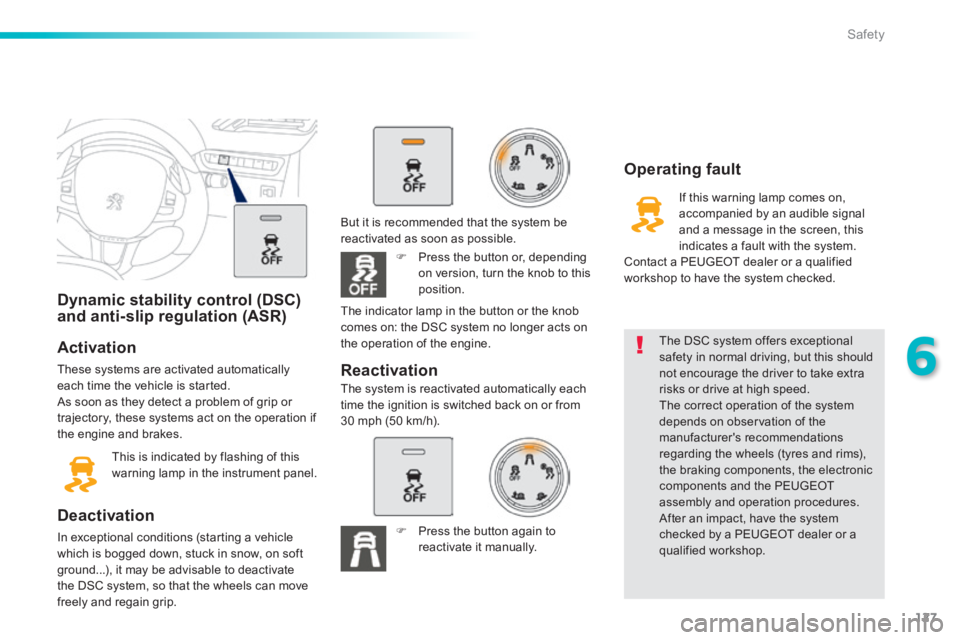
This is indicated by flashing of this warning lamp in the instrument panel.
Deactivation
In exceptional conditions (starting a vehicle which is bogged down, stuck in snow, on soft ground...), it may be advisable to deactivate the DSC system, so that the wheels can move freely and regain grip.
The DSC system offers exceptional safety in normal driving, but this should not encourage the driver to take extra risks or drive at high speed. The correct operation of the system depends on observation of the manufacturer's recommendations regarding the wheels (tyres and rims), the braking components, the electronic components and the PEUGEOT assembly and operation procedures. After an impact, have the system checked by a PEUGEOT dealer or a qualified workshop.
Operating fault
If this warning lamp comes on, accompanied by an audible signal and a message in the screen, this indicates a fault with the system. Contact a PEUGEOT dealer or a qualified workshop to have the system checked.
Reactivation
But it is recommended that the system be reactivated as soon as possible.
Press the button or, depending on version, turn the knob to this position.
The system is reactivated automatically each time the ignition is switched back on or from30 mph (50 km/h).
The indicator lamp in the button or the knob comes on: the DSC system no longer acts on the operation of the engine.
Press the button again to reactivate it manually.
Page 155 of 336
153
7
Practical information
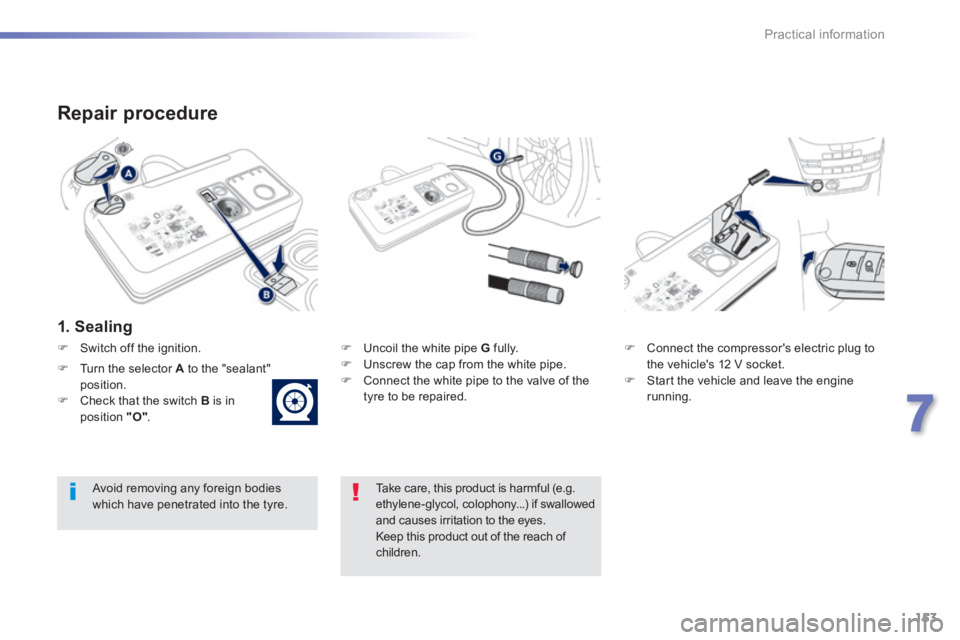
Repair procedure
1. Sealing
Uncoil the white pipe G fully. Unscrew the cap from the white pipe. Connect the white pipe to the valve of the tyre to be repaired.
Connect the compressor's electric plug to the vehicle's 12 V socket. Start the vehicle and leave the engine running.
Take care, this product is harmful (e.g. ethylene-glycol, colophony...) if swallowed and causes irritation to the eyes. Keep this product out of the reach of children.
Avoid removing any foreign bodies which have penetrated into the tyre.
Switch off the ignition.
Turn the selector A to the "sealant" position. Check that the switch B is in position "O" .
Page 158 of 336
156
Practical information
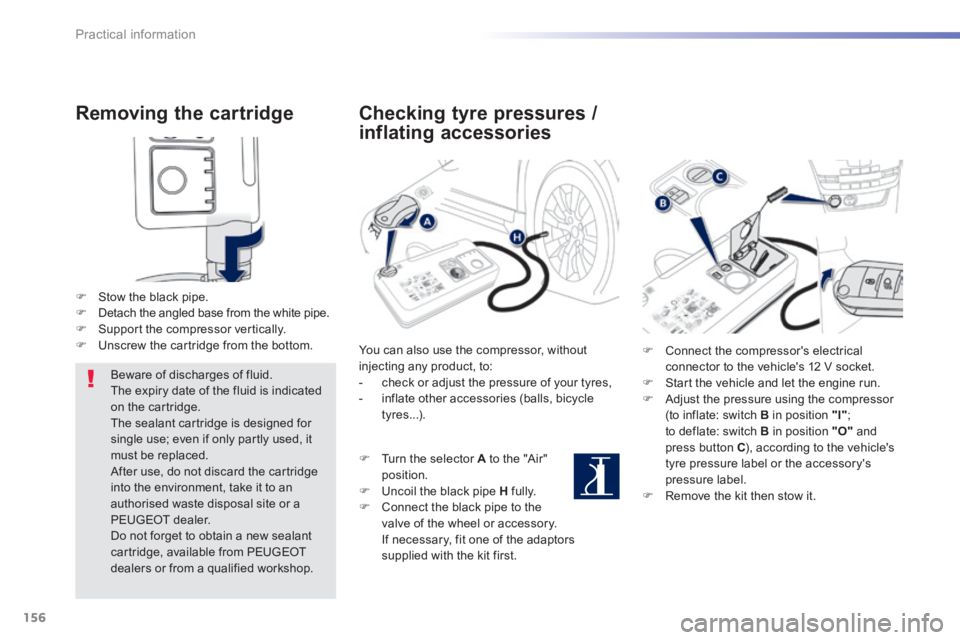
Removing the cartridge
Stow the black pipe. Detach the angled base from the white pipe. Support the compressor vertically. Unscrew the cartridge from the bottom.
Beware of discharges of fluid. The expiry date of the fluid is indicated on the cartridge. The sealant cartridge is designed for single use; even if only partly used, it must be replaced. After use, do not discard the cartridge into the environment, take it to an authorised waste disposal site or a PEUGEOT dealer.
Do not forget to obtain a new sealant cartridge, available from PEUGEOT dealers or from a qualified workshop.
Checking tyre pressures /
inflating accessories
You can also use the compressor, without injecting any product, to: - check or adjust the pressure of your tyres, - inflate other accessories (balls, bicycle tyres...).
Turn the selector A to the "Air" position. Uncoil the black pipe H fully. Connect the black pipe to the valve of the wheel or accessory. If necessary, fit one of the adaptors supplied with the kit first.
Connect the compressor's electrical connector to the vehicle's 12 V socket. Start the vehicle and let the engine run. Adjust the pressure using the compressor (to inflate: switch B in position "I" ; to deflate: switch B in position "O" and press button C ), according to the vehicle's tyre pressure label or the accessory's pressure label. Remove the kit then stow it.
Page 181 of 336
179
7
Practical information
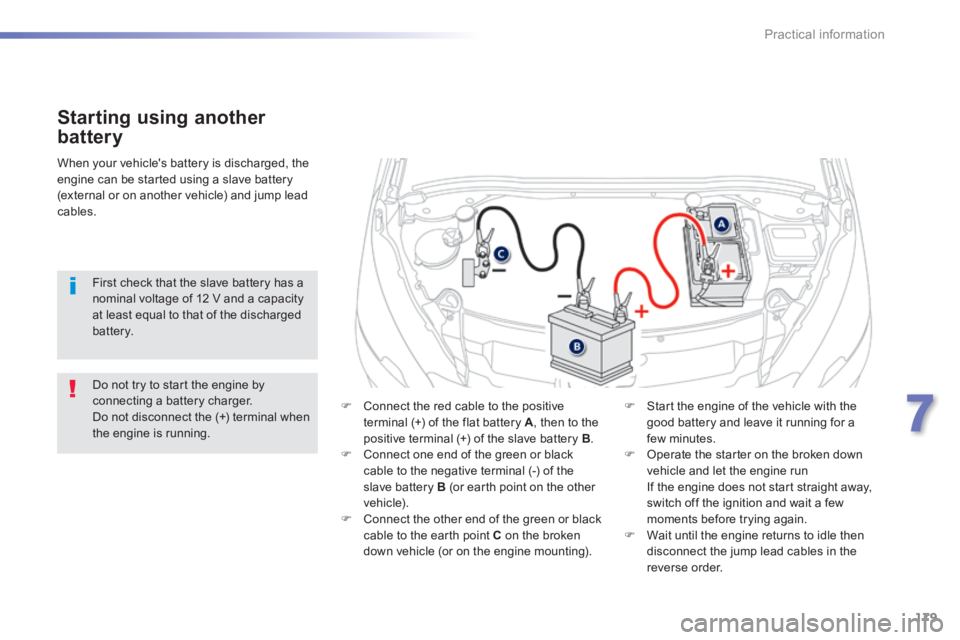
Starting using another
battery
Connect the red cable to the positive terminal (+) of the flat battery A , then to the
positive terminal (+) of the slave battery B . Connect one end of the green or black cable to the negative terminal (-) of the slave battery B (or earth point on the other vehicle). Connect the other end of the green or black cable to the earth point C on the broken down vehicle (or on the engine mounting).
Start the engine of the vehicle with the good battery and leave it running for a
few minutes. Operate the starter on the broken down vehicle and let the engine run If the engine does not start straight away, switch off the ignition and wait a few moments before trying again. Wait until the engine returns to idle then disconnect the jump lead cables in the reverse order.
When your vehicle's battery is discharged, the engine can be started using a slave battery (external or on another vehicle) and jump lead cables.
Do not try to start the engine by connecting a battery charger. Do not disconnect the (+) terminal when the engine is running.
First check that the slave battery has a nominal voltage of 12 V and a capacity at least equal to that of the discharged battery.
Page 182 of 336
180
Practical information
It is advisable to disconnect the battery if the vehicle is to be left unused for more than one month.
The batteries contain harmful substances such as sulphuric acid and lead. They must be disposed of in accordance with regulations and must not, in any circumstances, be discarded with household waste. Take used remote control batteries and vehicle batteries to a special collection point.
Protect your eyes and face before handling the battery. All operations on the battery must be carried out in a well ventilated area and away from naked flames and sources of sparks, so as to avoid the risk of
explosion or fire. Do not try to charge a frozen battery; the battery must first be thawed out to avoid the risk of explosion. If the battery has been frozen, before charging have it checked by a PEUGEOT dealer or a qualified workshop who will check that the internal components have not been damaged and the casing is not cracked, which could cause a leak of toxic and corrosive acid. Do not reverse the polarity and use only a 12 V charger. Do not disconnect the terminals while the engine is running. Do not charge the batteries without disconnecting the terminals first. Wash your hands after wards.
Do not push the vehicle to start the engine if you have an electronic or automatic gearbox.
Before disconnecting the battery
Wait 2 minutes after switching off the ignition before disconnecting the battery. Close the windows and the doors before disconnecting the battery.
Following reconnection of the battery
Following reconnection of the battery, switch on the ignition and wait 1 minute before starting to permit initialisation of the electronic systems. However, if problems remain following this operation, contact a PEUGEOT dealer or a qualified workshop. Referring to the corresponding section, you must yourself reinitialise: - the remote control key, - the on-board satellite navigation system.
The Stop & Start battery does not have to be disconnected for charging.
Charging the battery using
a battery charger
Disconnect the battery from the vehicle. Follow the instructions for use provided by the manufacturer of the charger. Connect the battery starting with the negative terminal (-). Check that the terminals and connectors are clean. If they are covered with sulphate (whitish or greenish deposit), remove them and clean them.
Page 188 of 336
186
Practical information
Driving advice
Distribution of loads
Distribute the load in the trailer so that the heaviest items are as close as possible to the axle and the nose weight approaches the maximum permitted without exceeding it.
Air density decreases with altitude, thus reducing engine performance. Above1 000 metres, the maximum towed load must be reduced by 10 % for every 1 000 metres of altitude.
Side wind
Take into account the increased sensitivity to side wind.
Cooling
Towing a trailer on a slope increases the temperature of the coolant. As the fan is electrically controlled, its cooling capacity is not dependent on the engine speed.
To lower the engine speed, reduce your speed. The maximum towed load on a long incline depends on the gradient and the ambient temperature. In all cases, keep a check on the coolant temperature.
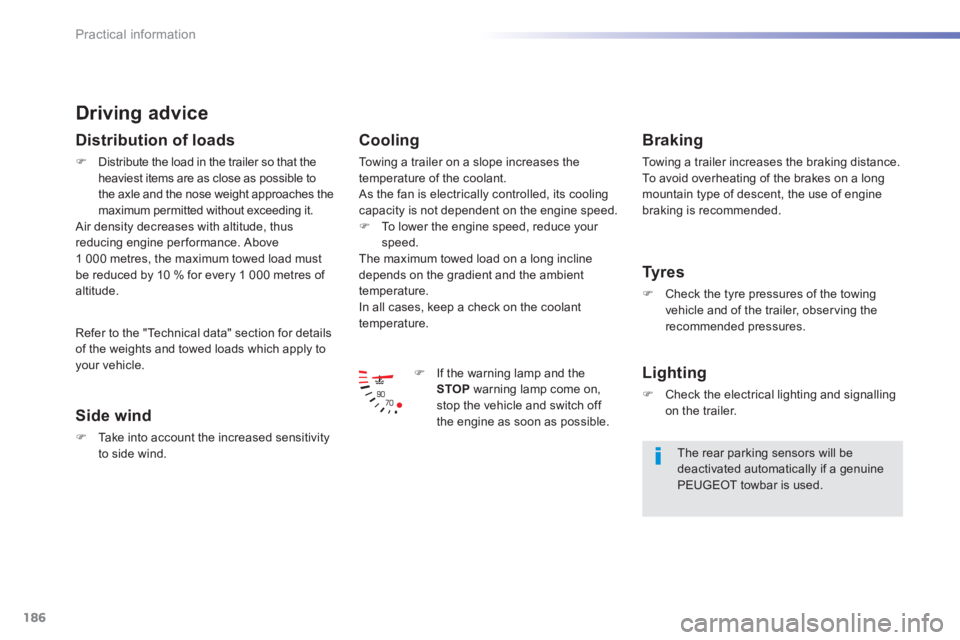
If the warning lamp and the STOP warning lamp come on, stop the vehicle and switch off the engine as soon as possible.
Braking
Towing a trailer increases the braking distance. To avoid overheating of the brakes on a long mountain type of descent, the use of engine braking is recommended.
Ty r e s
Check the tyre pressures of the towing vehicle and of the trailer, observing the recommended pressures.
Lighting
Check the electrical lighting and signalling on the trailer.
The rear parking sensors will be deactivated automatically if a genuine PEUGEOT towbar is used.
Refer to the "Technical data" section for details of the weights and towed loads which apply to your vehicle.
Page 192 of 336
190
Checks
PEUGEOT & TOTAL
Partners in performance and
protection of the environment
Innovation at the service of performance
The TOTAL Research and Development teams develop lubricants for PEUGEOT which satisfy the requirements of the latest technical innovations incorporated in PEUGEOT vehicles. This ensures that you obtain the best per formance and the maximum engine life.
RECOMMENDS
Reduced exhaust emissions
TOTAL lubricants are formulated to optimise the efficiency of engines and the protection of the emissions post-treatment systems. It is crucial to observe the servicing recommendations made by PEUGEOT to ensure correct operation.