ECO mode PEUGEOT 2008 2013.5 Owners Manual
[x] Cancel search | Manufacturer: PEUGEOT, Model Year: 2013.5, Model line: 2008, Model: PEUGEOT 2008 2013.5Pages: 336, PDF Size: 9.23 MB
Page 5 of 336
.
.
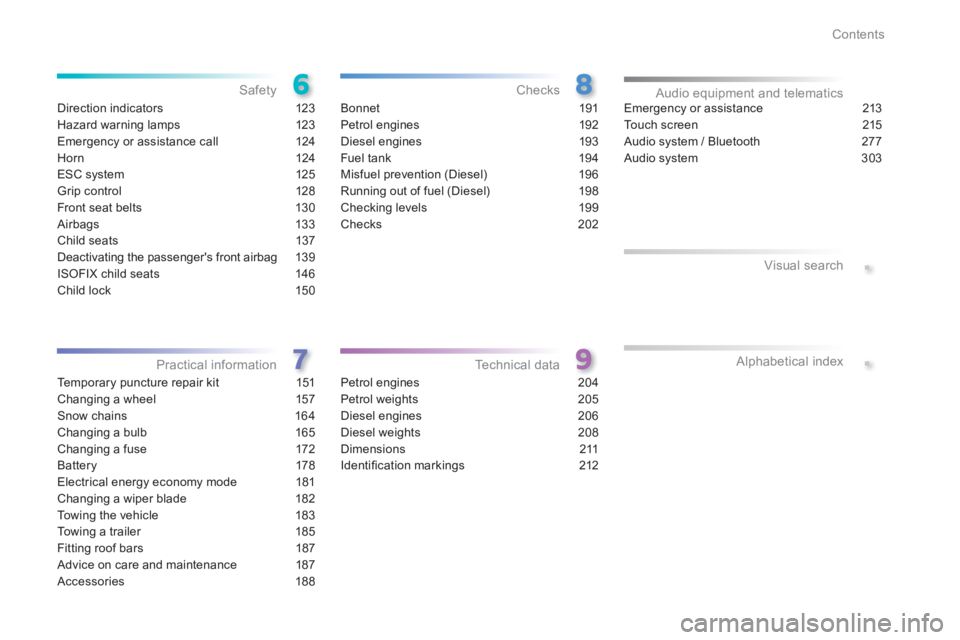
Contents
Direction indicators 123
Hazard warning lamps 123
Emergency or assistance call 124
H or n 124
ESC system 125
Grip control 128
Front seat belts 130
Airbags 133
Child seats 137
Deactivating the passenger's front airbag 139
ISOFIX child seats 146
Child lock 150
Safety
Temporary puncture repair kit 151
Changing a wheel 157
Snow chains 164
Changing a bulb 165
Changing a fuse 172
Battery 178
Electrical energy economy mode 181
Changing a wiper blade 182
Towing the vehicle 183
Towing a trailer 185
Fitting roof bars 187
Advice on care and maintenance 187
Accessories 188
Practical information
Bonnet 191
Petrol engines 192
Diesel engines 193
Fuel tank 194
Misfuel prevention (Diesel) 196
Running out of fuel (Diesel) 198
Checking levels 199
Checks 202
Checks
Petrol engines 204
Petrol weights 205
Diesel engines 206
Diesel weights 208
Dimensions 211
Identifi cation markings 212
Technical data
Emergency or assistance 213
Touch screen 215
Audio system / Bluetooth 277
Audio system 303
Audio equipment and telematics
Visual search
Alphabetical index
Page 16 of 336
14
Familiarisation
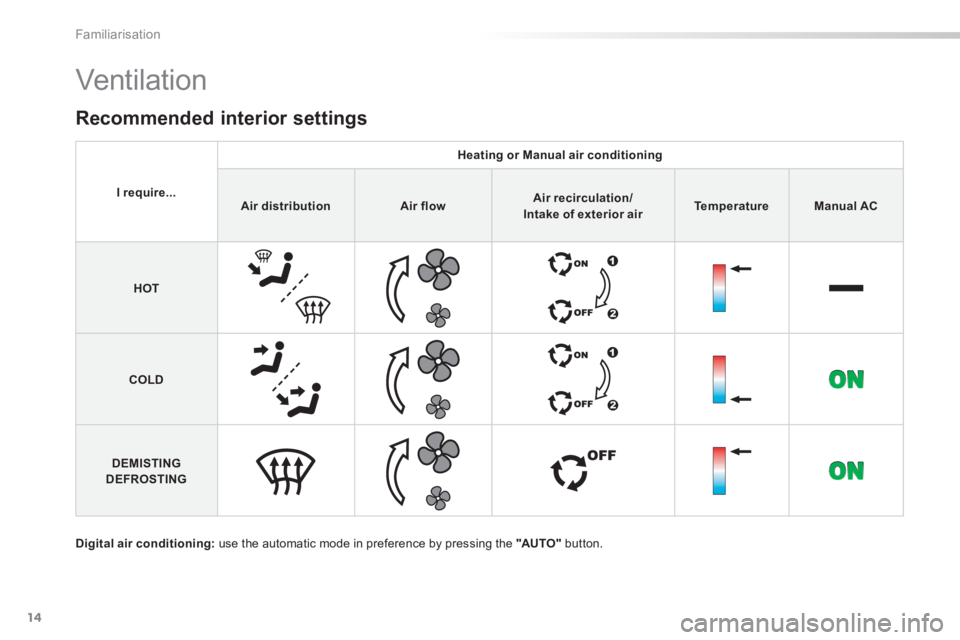
I require...
Heating or Manual air conditioning
Air distributionAir flowAir recirculation/Intake of exterior airTemperatureManual AC
HOT
COLD
DEMISTING DEFROSTING
Ventilation
Recommended interior settings
Digital air conditioning: use the automatic mode in preference by pressing the "AUTO" button.
Page 19 of 336
.
17
9394
94
Familiarisation
Driving safely
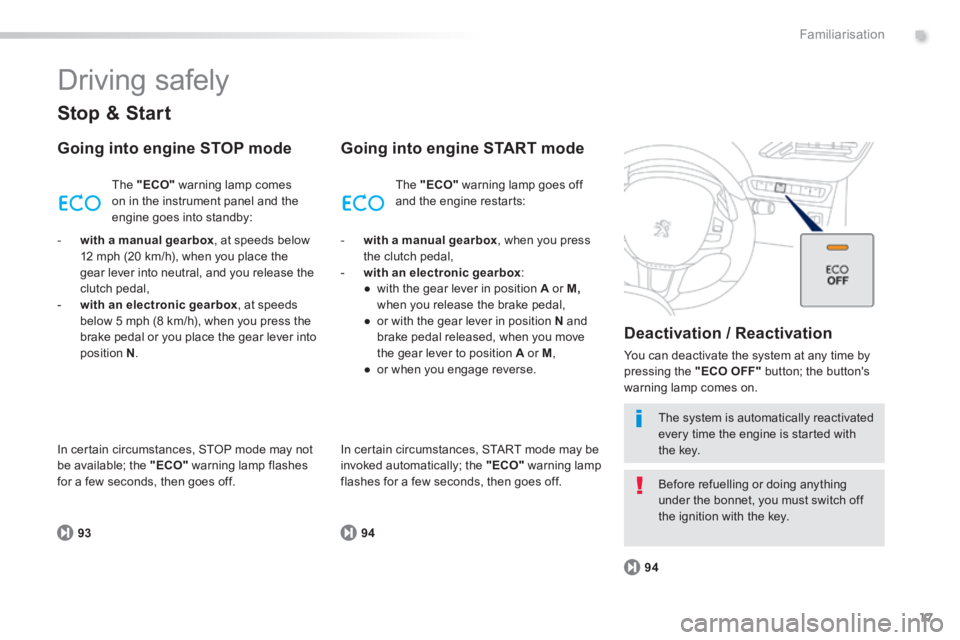
Stop & Start
Going into engine STOP mode
The "ECO" warning lamp comes on in the instrument panel and the engine goes into standby:
Going into engine START mode
Deactivation / Reactivation
You can deactivate the system at any time by pressing the "ECO OFF" button; the button's warning lamp comes on.
The system is automatically reactivated every time the engine is started with the key.
Before refuelling or doing anything under the bonnet, you must switch off the ignition with the key.
The "ECO" warning lamp goes off and the engine restarts:
- with a manual gearbox , when you press the clutch pedal, - with an electronic gearbox : ● with the gear lever in position A or M,when you release the brake pedal, ● or with the gear lever in position N and brake pedal released, when you move the gear lever to position A or M , ● or when you engage reverse.
- with a manual gearbox , at speeds below 12 mph (20 km/h), when you place the gear lever into neutral, and you release the clutch pedal, - with an electronic gearbox , at speeds below 5 mph (8 km/h), when you press the brake pedal or you place the gear lever into position N .
In certain circumstances, START mode may be invoked automatically; the "ECO" warning lamp flashes for a few seconds, then goes off.
In certain circumstances, STOP mode may not be available; the "ECO" warning lamp flashes for a few seconds, then goes off.
Page 21 of 336
19
Eco-driving Eco-driving is a range of everyday practices that allow the motorist to optimise their fuel consumption and CO2 emissions.
Optimise the use of your gearbox
With a manual gearbox, move off gently and change up without waiting. During acceleration change up early.
With an automatic or electronic gearbox, give preference to automatic mode and avoid pressing the accelerator pedal heavily or suddenly.
The gear shift indicator invites you engage the most suitable gear: as soon as the indication is displayed in the instrument panel, follow it straight away. For vehicles fitted with an electronic or automatic gearbox, this indicator appears only in manual mode.
Drive smoothly
Maintain a safe distance between vehicles, use engine braking rather than the brake pedal, and press the accelerator progressively. These practices contribute towards a reduction in fuel consumption and CO2emissions and also helps reduce the background traffic noise.
If your vehicle has cruise control, make use of the system at speeds above 25 mph (40 km/h) when the traffic is flowing well.
Control the use of your electrical
equipment
Before moving off, if the passenger compartment is too warm, ventilate it by opening the windows and air vents before using the air conditioning. Above 30 mph (50 km/h), close the windows and leave the air vents open. Remember to make use of equipment that can help keep the temperature in the passenger compartment down (sunroof and window blinds...). Switch off the air conditioning, unless it has automatic regulation, as soon as the desired temperature is attained. Switch off the demisting and defrosting controls, if not automatic. Switch off the heated seat as soon as possible.
Switch off the headlamps and front foglamps when the level of light does not require their use.
Avoid running the engine before moving off, particularly in winter; your vehicle will warm up much faster while driving.
As a passenger, if you avoid connecting your multimedia devices (film, music, video game...), you will contribute towards limiting the
consumption of electrical energy, and so of fuel. Disconnect your portable devices before leaving the vehicle.
Page 25 of 336
1
23
Monitoring
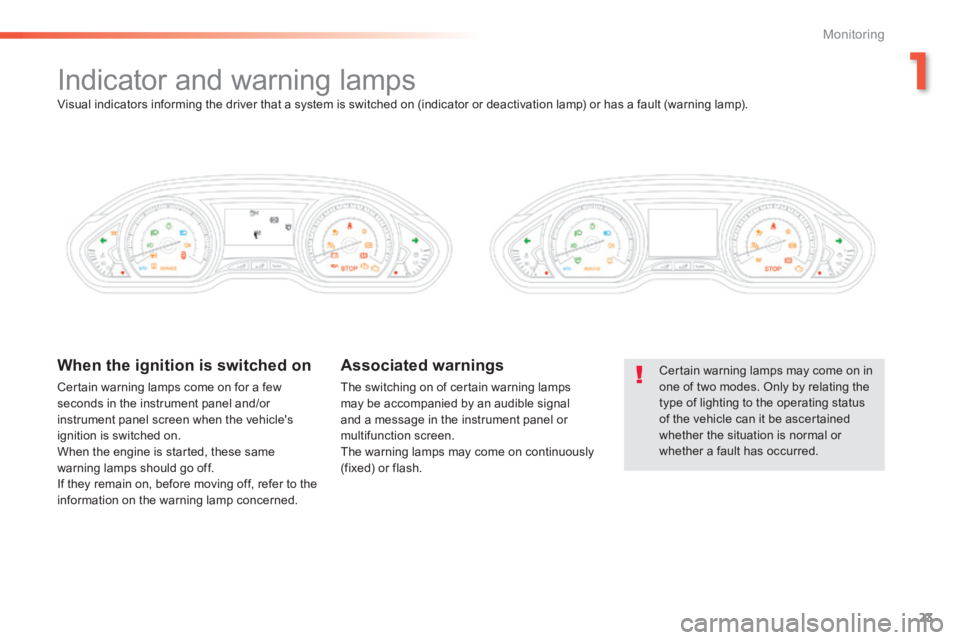
Indicator and warning lamps
Certain warning lamps may come on in one of two modes. Only by relating the type of lighting to the operating status of the vehicle can it be ascertained
whether the situation is normal or whether a fault has occurred.
When the ignition is switched on
Certain warning lamps come on for a few seconds in the instrument panel and/or instrument panel screen when the vehicle's ignition is switched on. When the engine is started, these same warning lamps should go off. If they remain on, before moving off, refer to the information on the warning lamp concerned.
Associated warnings
The switching on of certain warning lamps may be accompanied by an audible signal and a message in the instrument panel or multifunction screen. The warning lamps may come on continuously (fixed) or flash.
Visual indicators informing the driver that a system is switched on (indicator or deactivation lamp) or has a fault (warning lamp).
Page 28 of 336
26
Monitoring
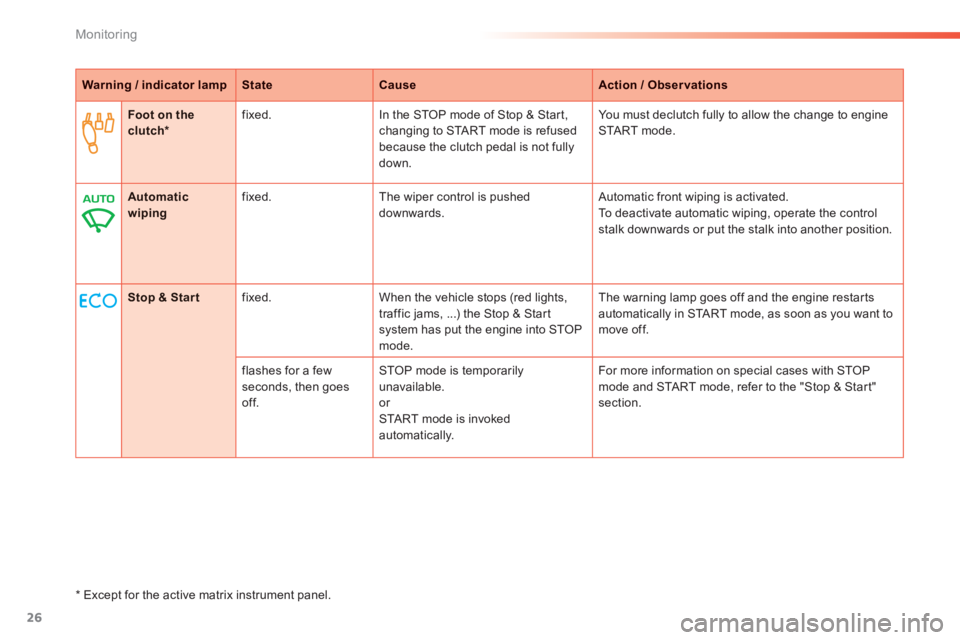
Warning / indicator lampStateCauseAction / Observations
Foot on the clutch * fixed. In the STOP mode of Stop & Start, changing to START mode is refused because the clutch pedal is not fully down.
You must declutch fully to allow the change to engine START mode.
Stop & Star t fixed. When the vehicle stops (red lights, traffic jams, ...) the Stop & Start system has put the engine into STOP mode.
The warning lamp goes off and the engine restarts automatically in START mode, as soon as you want to move off.
flashes for a few seconds, then goes of f.
STOP mode is temporarily unavailable. or START mode is invoked automatically.
For more information on special cases with STOP mode and START mode, refer to the "Stop & Start" section.
Automatic wiping fixed. The wiper control is pushed downwards. Automatic front wiping is activated. To deactivate automatic wiping, operate the control stalk downwards or put the stalk into another position.
* Except for the active matrix instrument panel.
Page 42 of 336
40
Monitoring
System which provides current information concerning the trip (range, fuel consumption…).
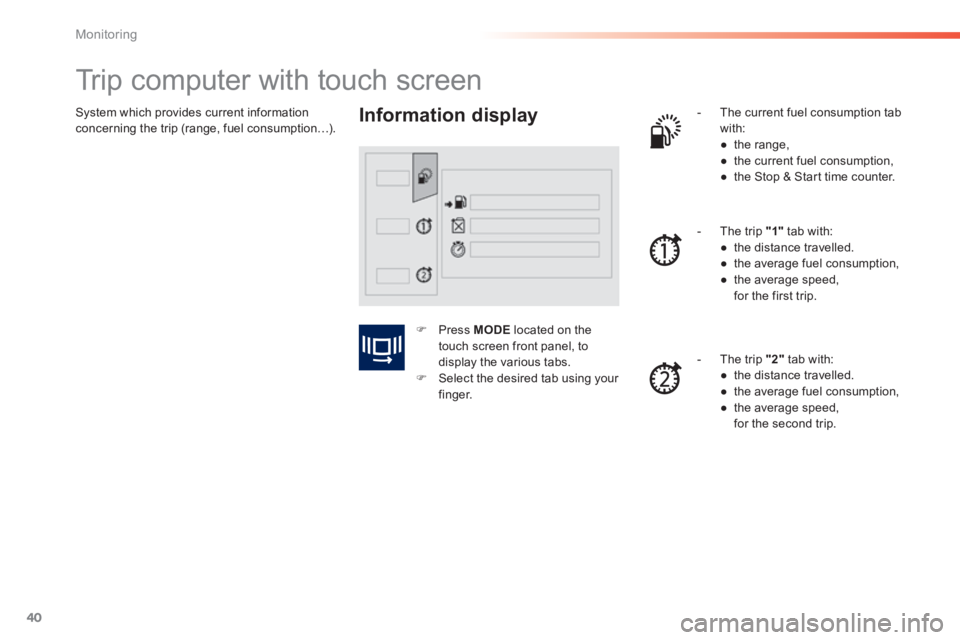
Trip computer with touch screen
Information display - The current fuel consumption tab with: ● t h e r a n g e , ● the current fuel consumption, ● the Stop & Start time counter.
- The trip "1" tab with: ● the distance travelled. ● the average fuel consumption, ● the average speed, for the first trip.
- The trip "2" tab with: ● the distance travelled. ● the average fuel consumption, ● the average speed, for the second trip.
Press MODE located on the touch screen front panel, to display the various tabs. Select the desired tab using your finger.
Page 44 of 336
42
Monitoring
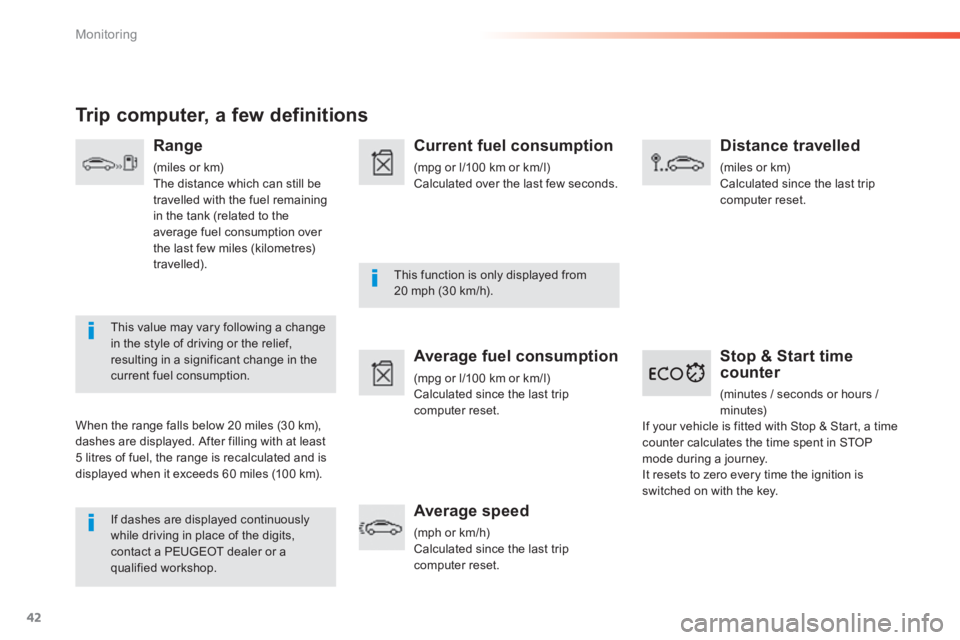
Stop & Start time counter
(minutes / seconds or hours / minutes)
If dashes are displayed continuously
while driving in place of the digits, contact a PEUGEOT dealer or a qualified workshop.
This function is only displayed from 20 mph (30 km/h).
This value may vary following a change in the style of driving or the relief, resulting in a significant change in the current fuel consumption.
Trip computer, a few definitions
Range
(miles or km) The distance which can still be travelled with the fuel remaining in the tank (related to the average fuel consumption over the last few miles (kilometres) travelled).
When the range falls below 20 miles (30 km), dashes are displayed. After filling with at least 5 litres of fuel, the range is recalculated and is displayed when it exceeds 60 miles (100 km).
Current fuel consumption
(mpg or l/100 km or km/l) Calculated over the last few seconds.
Average fuel consumption
(mpg or l/100 km or km/l) Calculated since the last trip computer reset.
Average speed
(mph or km/h) Calculated since the last trip computer reset.
Distance travelled
(miles or km) Calculated since the last trip computer reset.
If your vehicle is fitted with Stop & Start, a time counter calculates the time spent in STOP mode during a journey. It resets to zero every time the ignition is switched on with the key.
Page 86 of 336
84
Driving
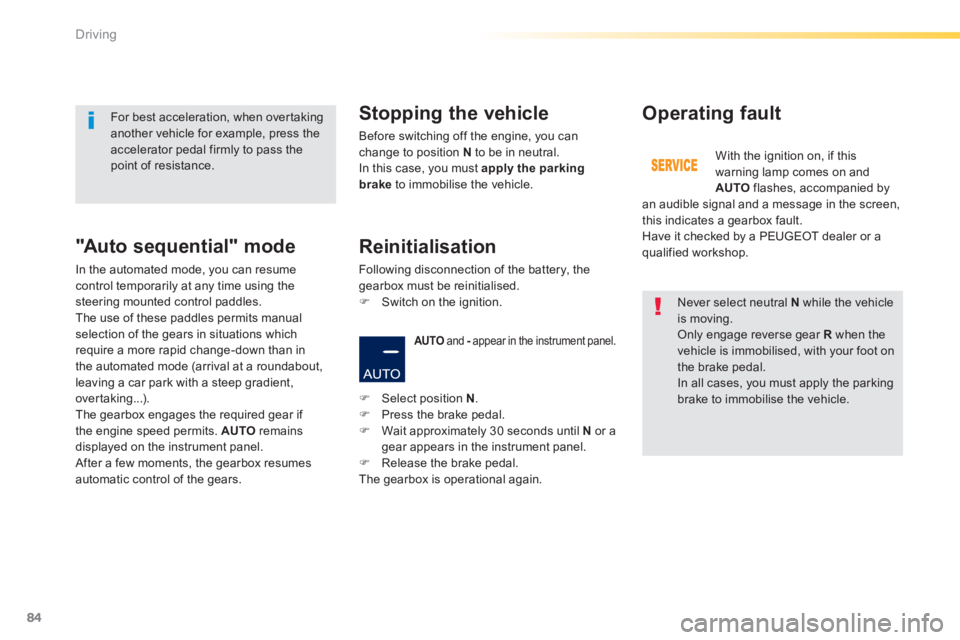
Never select neutral N while the vehicle is moving. Only engage reverse gear R when the vehicle is immobilised, with your foot on the brake pedal. In all cases, you must apply the parking brake to immobilise the vehicle.
"Auto sequential" mode
In the automated mode, you can resume control temporarily at any time using the steering mounted control paddles. The use of these paddles permits manual selection of the gears in situations which require a more rapid change-down than in the automated mode (arrival at a roundabout, leaving a car park with a steep gradient, over taking...). The gearbox engages the required gear if the engine speed permits. AUTO remains displayed on the instrument panel. After a few moments, the gearbox resumes automatic control of the gears.
Stopping the vehicle
Before switching off the engine, you can change to position N to be in neutral. In this case, you must apply the parking brake to immobilise the vehicle.
AUTO and - appear in the instrument panel. - appear in the instrument panel. -
Operating fault
With the ignition on, if this warning lamp comes on and AUTO flashes, accompanied by an audible signal and a message in the screen, this indicates a gearbox fault. Have it checked by a PEUGEOT dealer or a qualified workshop.
For best acceleration, when overtaking another vehicle for example, press the accelerator pedal firmly to pass the point of resistance.
Select position N . Press the brake pedal. Wait approximately 30 seconds until N or a gear appears in the instrument panel. Release the brake pedal. The gearbox is operational again.
Reinitialisation
Following disconnection of the battery, the gearbox must be reinitialised. Switch on the ignition.
Page 93 of 336
91
4
Driving
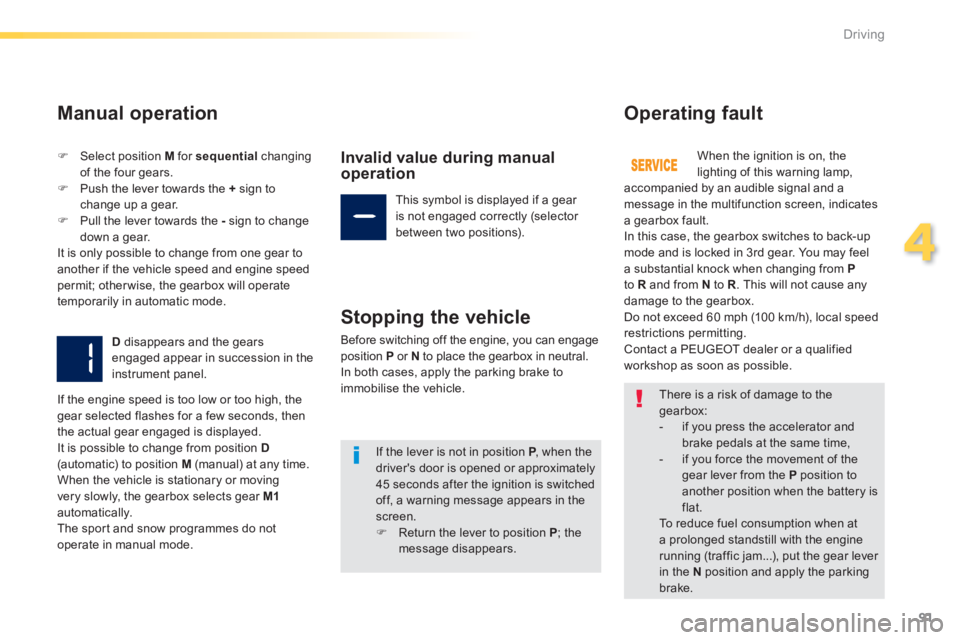
Manual operation
Select position M for sequential changing of the four gears. Push the lever towards the + sign to change up a gear. Pull the lever towards the - sign to change
down a gear. It is only possible to change from one gear to another if the vehicle speed and engine speed permit; otherwise, the gearbox will operate temporarily in automatic mode.
D disappears and the gears engaged appear in succession in the instrument panel.
Invalid value during manual operation
This symbol is displayed if a gear is not engaged correctly (selector between two positions).
Stopping the vehicle
Before switching off the engine, you can engage position P or N to place the gearbox in neutral. In both cases, apply the parking brake to immobilise the vehicle.
Operating fault
When the ignition is on, the lighting of this warning lamp, accompanied by an audible signal and a message in the multifunction screen, indicates a gearbox fault. In this case, the gearbox switches to back-up mode and is locked in 3rd gear. You may feel a substantial knock when changing from Pto R and from N to R . This will not cause any damage to the gearbox. Do not exceed 60 mph (100 km/h), local speed restrictions permitting. Contact a PEUGEOT dealer or a qualified workshop as soon as possible.
If the engine speed is too low or too high, the gear selected flashes for a few seconds, then the actual gear engaged is displayed. It is possible to change from position D(automatic) to position M (manual) at any time. When the vehicle is stationary or moving very slowly, the gearbox selects gear M1automatically. The sport and snow programmes do not
operate in manual mode.
There is a risk of damage to the gearbox: - if you press the accelerator and
brake pedals at the same time, - if you force the movement of the gear lever from the P position to another position when the battery is flat. To reduce fuel consumption when at a prolonged standstill with the engine running (traffic jam...), put the gear lever in the N position and apply the parking
brake.
If the lever is not in position P , when the P , when the Pdriver's door is opened or approximately 45 seconds after the ignition is switched off, a warning message appears in the screen. Return the lever to position P ; the message disappears.