ESP PEUGEOT 2008 2013 User Guide
[x] Cancel search | Manufacturer: PEUGEOT, Model Year: 2013, Model line: 2008, Model: PEUGEOT 2008 2013Pages: 324, PDF Size: 8.39 MB
Page 69 of 324
67
3
Comfort
Dual-zone digital air conditioning
The air conditioning can only operate with the engine running.
Automatic operation
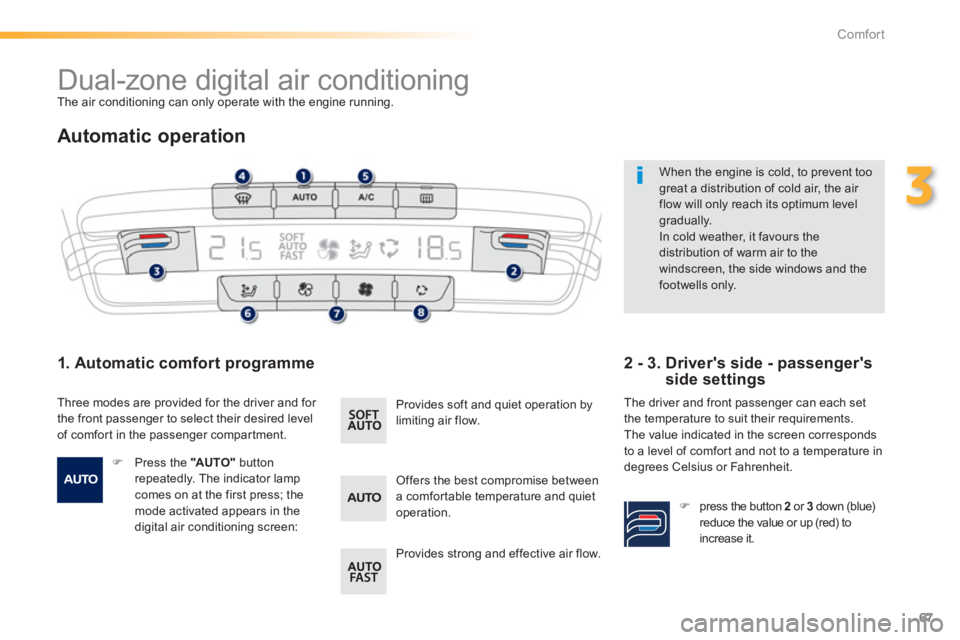
1. Automatic comfort programme
Three modes are provided for the driver and for
the front passenger to select their desired level
o
f comfor t in the passenger compartment.
When the engine is cold, to prevent too great a distribution of cold air, the air flow will only reach its optimum levelgradually.
In cold weather, it favours thedistribution of warm air to the windscreen, the side windows and the footwells only.
2 - 3. Driver's side - passenger's
side settings
The driver and front passenger can each set
the temperature to suit their requirements.
The value indicated in the screen corresponds
to a level of comfor t and not to a temperature in
degrees Celsius or Fahrenheit.
) press the button 2 or 3
down (blue)
reduce the value or up (red) toincrease it.
Offers the best compromise between a comfor table temperature and quiet
operation. Provides so
ft and quiet operation by limiting air flow.
Provides stron
g and effective air flow.
)
Press the "AUTO"
button
repeatedly. The indicator lamp comes on at the first press; the
mode activated appears in the
di
gital air conditioning screen:
Page 90 of 324
88
Driving
Four-speed automatic gearbox which offers a choice between the comfor t of fully automatic operation, enhanced by spor t and snow
programmes, or manual gear changing.
There are therefore four driving modes:-automatic
operation for electronic management of the gears by the gearbox,
-
sportprogramme for a more dynamic style
of driving,
- snowprogramme to improve driving when
traction is poor,
-
sequentialoperation for manual changing
of the gears by the driver.
Automatic gearbox
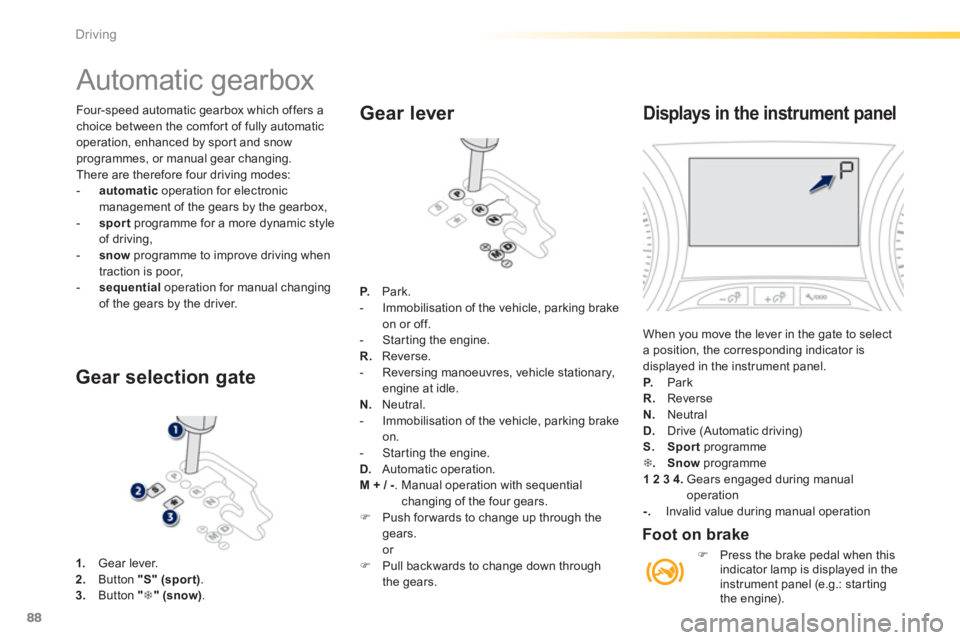
1.
Gear lever.2.
Button "S"(sport)
.
3.Button "7"(snow).
Gear selection gateGear lever
P.Park.
- Immobilisation of the vehicle, parking brakeon or off.
- Starting the engine.
R. Reverse.
- Reversing manoeuvres, vehicle stationary, engine at idle.N.Neutral.
- Immobilisation of the vehicle, parking brakeon.
- Star ting the engine.D.
Automatic operation. M + / -. Manual operation with sequential changing of the four gears.)Push for wards to change up through the
gears.or )Pull backwards to change down through
the gears.
Displays in the instrument panel
When you move the lever in the gate to select
a position, the corresponding indicator is
displayed in the instrument panel. P. Park R.ReverseN.
NeutralD.Drive (Automatic driving) S.Sport
programme 7.Snowprogramme
1 2 3 4. Gears engaged during manual
operation
-. Invalid value during manual operation
Foot on brake
)
Press the brake pedal when this
indicator lamp is displayed in the
instrument panel
(e.g.: starting
the engine).
Page 93 of 324
91
4
Driving
Gear shift indicator *
Operation
*
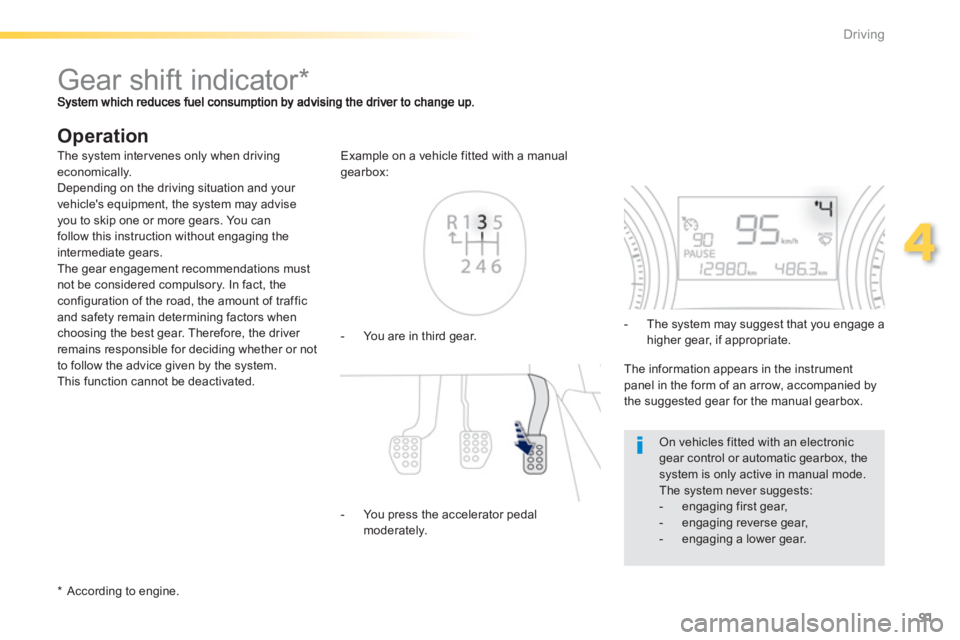
According to engine. - You are in third gear. Example on a vehicle
fitted with a manualgearbox:
-
You press the accelerator pedalmoderately.
- The s
ystem may suggest that you engage a higher gear, if appropriate.
The in
formation appears in the instrument
panel in the form of an arrow, accompanied bythe suggested gear for the manual gearbox.
On vehicles fitted with an electronicgear control or automatic gearbox, thesystem is only active in manual mode.
The system never suggests:
- engaging first gear,
- engaging reverse gear,
- engaging a lower gear.
The system intervenes only when driving economically.
Depending on the driving situation and your
vehicle's equipment, the system may advise you to skip one or more gears. You can
follow this instruction without engaging the
intermediate gears.
The gear engagement recommendations mustnot be considered compulsory. In fact, the configuration of the road, the amount of traffic
and safety remain determining factors whenchoosing the best gear. Therefore, the driver
remains responsible for deciding whether or not
to follow the advice given by the system.
This function cannot be deactivated.
Page 98 of 324
96
Driving
Speed limiter
System which prevents the vehicle fromexceeding the speed programmed by the driver.
When the programmed speed limit is reached,
pressing the accelerator pedal in the normalmanner no longer has any effect.
The speed limiter is switched onmanually: the programmed speed must be at least 20 mph (30 km/h).
The speed limiter is switched off
by manual foperation of the control.
The programmed speed can be exceeded
temporarily by pressing the accelerator firmly.
To return to the programmed speed, simply slow down to a speed below the programmed speed.
The speed limiter cannot, in any circumstances,replace the need to respect speed limits, nor can it replace the need for vigilance and responsibility on the par t of the driver.
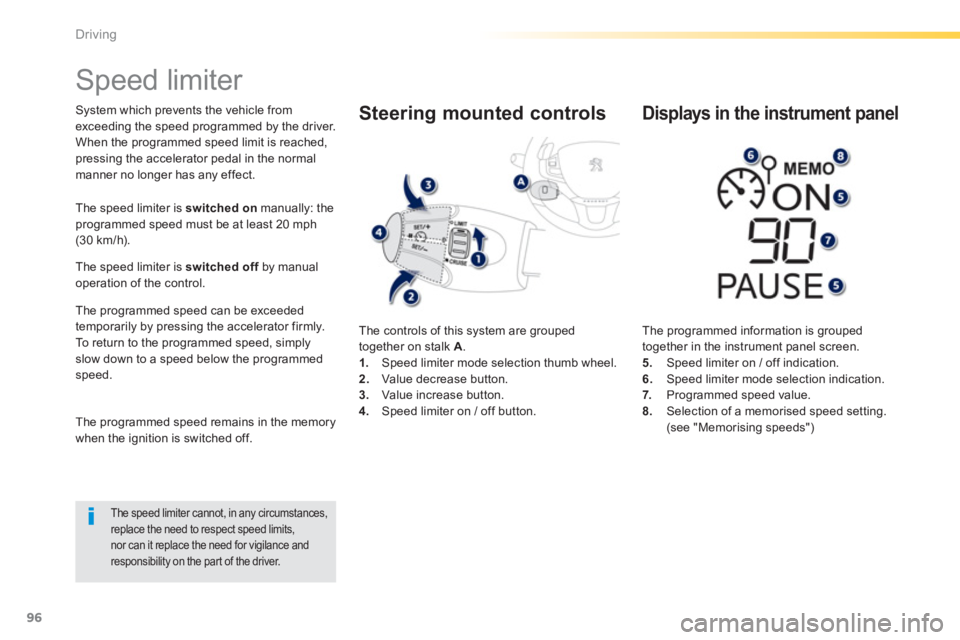
The controls of this system are grouped
together on stalk A.1.Speed limiter mode selection thumb wheel.2. Value decrease button. 3.
Value increase button. 4.Speed limiter on / off button.
Steering mounted controls
The programmed information is grouped
together in the instrument panel screen.
5. Speed limiter on / off indication.
6.Speed limiter mode selection indication. 7. Programmed speed value. 8.Selection of a memorised speed setting.
(see "Memorising speeds")
Displays in the instrument panel
The programmed speed remains in the memorywhen the ignition is switched off.
Page 100 of 324
98
Driving
Cruise control
System which automatically maintains thespeed of the vehicle at the value programmed
by the driver, without any action on the accelerator pedal.
The cruise control is switched on
manually: itrequires a minimum vehicle speed of 25 mph(40 km/h), as well as the engagement of:
-
fourth gear on a manual gearbox,
- second gear on an electronic or automaticgearbox, in sequential mode,
- position A
on an electronic gearbox or position D
on an automatic gearbox.
Th
e cruise control is switched offmanuallyfor by pressing the brake or clutch pedal or on
triggering of the electronic stability system for safety reasons.
It is possible to exceed the programmed speed
temporarily by pressing the accelerator pedal. To return to the programmed speed, simply release the accelerator pedal. Switching off the ignition cancels any programmed speed value. The controls of this s
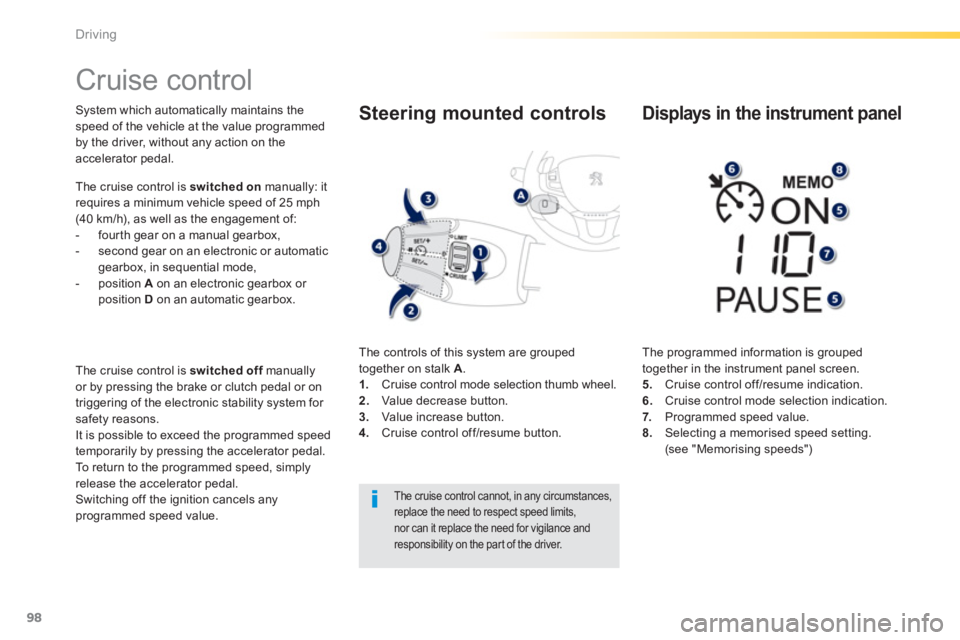
ystem are grouped
together on stalk A .
1.Cruise control mode selection thumb wheel.2. Value decrease button. 3.
Value increase button. 4.Cruise control off/resume button.
Steering mounted controls
The cruise control cannot, in any circumstances, replace the need to respect speed limits,nor can it replace the need for vigilance andresponsibility on the par t of the driver.
The programmed information is grouped
together in the instrument panel screen.
5. Cruise control off/resume indication.
6.Cruise control mode selection indication.7. Programmed speed value. 8.Selecting a memorised speed setting.
(see "Memorising speeds")
Displays in the instrument panel
Page 103 of 324
101
4
Driving
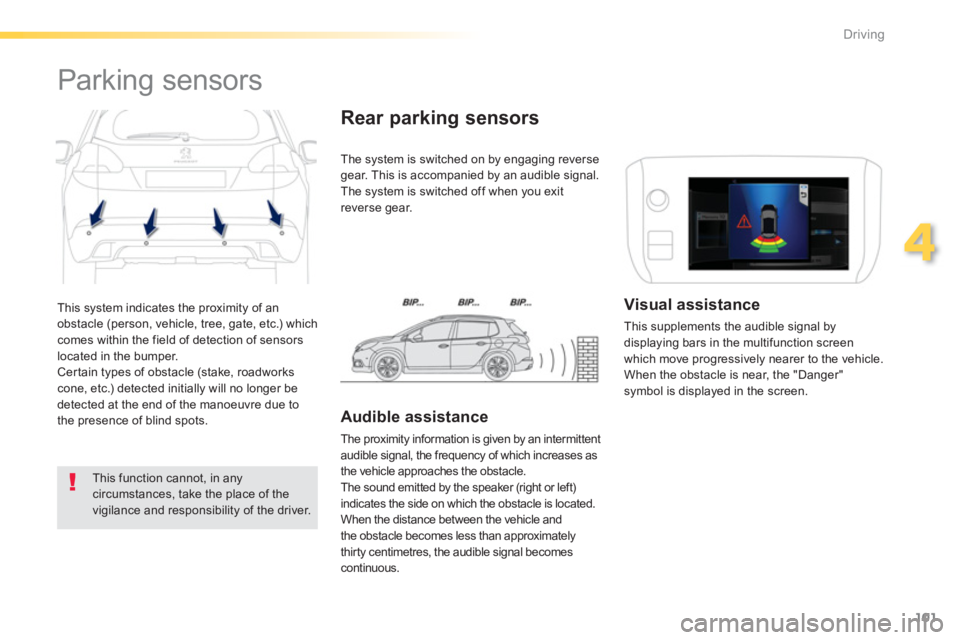
This system indicates the proximity of an
obstacle (person, vehicle, tree, gate, etc.) which comes within the field of detection of sensorslocated in the bumper.
Certain types of obstacle (stake, roadworkscone, etc.) detected initially will no longer bedetected at the end of the manoeuvre due to
the presence of blind spots.
Parking sensors
This function cannot, in any circumstances, take the place of the vigilance and responsibility of the driver.The system is switched on by engaging reverse
gear. This is accompanied by an audible signal.
The system is switched off when you exit reverse gear.
Rear parking sensors
Audible assistance
The proximity information is given by an intermittent audible signal, the frequency of which increases as
the vehicle approaches the obstacle.
The sound emitted b
y the speaker (right or left)indicates the side on which the obstacle is located.
When the distance between the vehicle and
t
he obstacle becomes less than approximatelythirty centimetres, the audible signal becomes continuous.
Visual assistance
This supplements the audible signal bydisplaying bars in the multifunction screen
which move progressively nearer to the vehicle.
When the obstacle is near, the "Danger" symbol is displayed in the screen.
Page 105 of 324
103
4
Driving
Park Assist
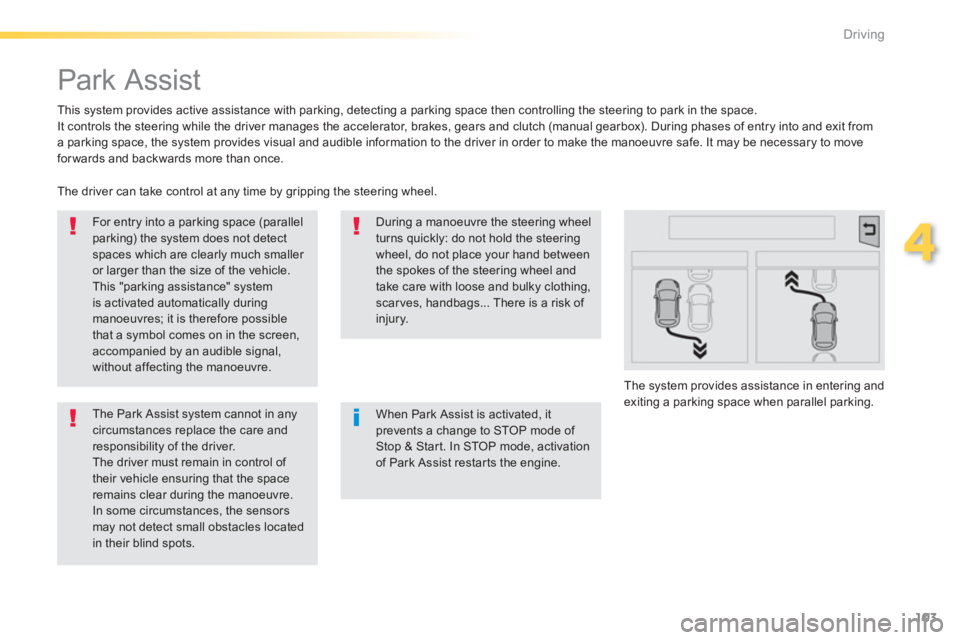
This system provides active assistance with parking, detecting a parking space then controlling the steering to park in the space.
It controls the steering while the driver manages the accelerator, brakes, gears and clutch (manual gearbox). During phases of entry into and exit from
a parking space, the system provides visual and audible information to the driver in order to make the manoeuvre safe. It may be necessary to move
forwards and backwards more than once.
For entry into a parking space (parallel
parking) the system does not detect spaces which are clearly much smaller or larger than the size of the vehicle.
This "parking assistance" system is activated automatically duringmanoeuvres; it is therefore possible that a symbol comes on in the screen,accompanied by an audible signal,without affecting the manoeuvre.
When Park Assist is activated, it prevents a change to STOP mode of Stop & Star t. In STOP mode, activationof Park Assist restarts the engine.
The Park Assist system cannot in anycircumstances replace the care and responsibility of the driver.
The driver must remain in control of their vehicle ensuring that the space remains clear during the manoeuvre. In some circumstances, the sensors may not detect small obstacles located in their blind spots.
During a manoeuvre the steering wheel
turns quickly: do not hold the steering wheel, do not place your hand betweenthe spokes of the steering wheel andtake care with loose and bulky clothing,scarves, handbags... There is a risk of injury.
The s
ystem provides assistance in entering and exiting a parking space when parallel parking.
The driver can take control at any time by gripping the steering wheel.
Page 110 of 324
108
Visibility
Model without AUTO lighting
Model with AUTO lighting
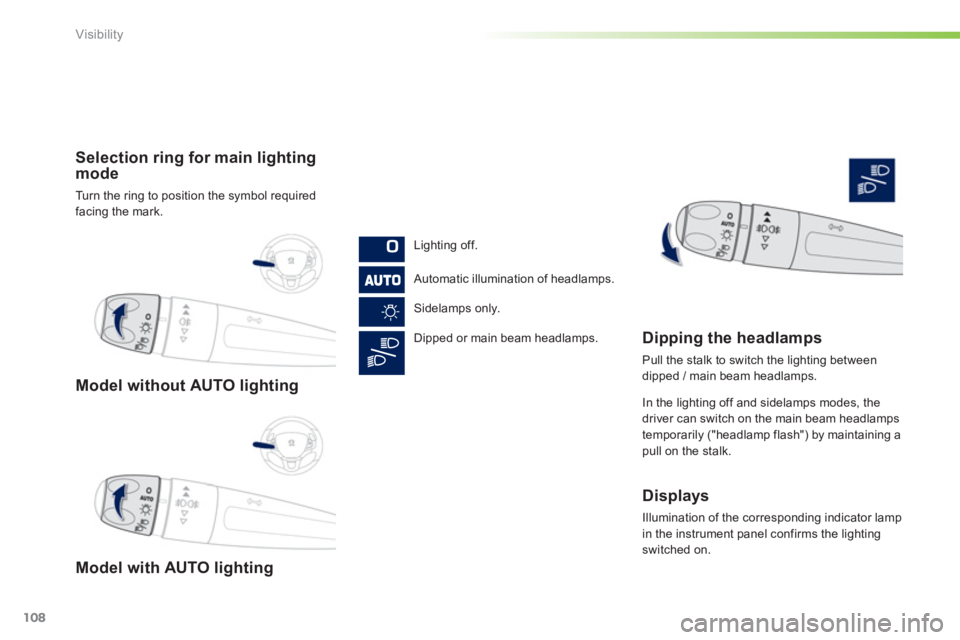
Selection ring for main lighting mode
Turn the ring to position the symbol required
facing the mark.
Li
ghting off.
Automatic illumination of headlamps.
Sidelamps onl
y.
Di
pped or main beam headlamps.
Dipping the headlamps
Pull the stalk to switch the lighting between
dipped / main beam headlamps.
In the li
ghting off and sidelamps modes, the driver can switch on the main beam headlamps
temporaril
y ("headlamp flash") by maintaining apull on the stalk.
Displays
Illumination of the corresponding indicator lamp
in the instrument panel confirms the lightingswitched on.
Page 112 of 324
110
Visibility
In good or rainy weather, both day and night, the front foglamps and the rear foglamp are prohibited. In thesesituations, the power of their beams may dazzle other drivers. They shouldonly be used in fog or snow. In these weather conditions, it is your responsibility to switch on the foglamps and dipped beam headlamps manuallyas the sunshine sensor may detect sufficient light.
Do not forget to switch off the frontfoglamps and the rear foglamp when they are no longer necessary.
Switching on the lampsafter the ignition isswitched off
To reactivate the lighting control, rotate the ring to the "0"position - lamps off, then to the desired position. On opening the driver's door atemporary audible signal warns thedriver that the lighting is on.
The lamps, with the exception of thesidelamps, switch off automatically after a maximum duration of thir ty minutes to prevent discharging of the battery.
Switching off the lampswhen the ignition is switched off
On switching off the ignition, all of thelamps turn off immediately, except for dipped beam if guide-me-home lighting is activated.
Page 114 of 324
112
Visibility
Temporarily keeping the dipped beam
headlamps on after the vehicle's ignition has been switched off makes the driver's exit easier
when the light is poor.
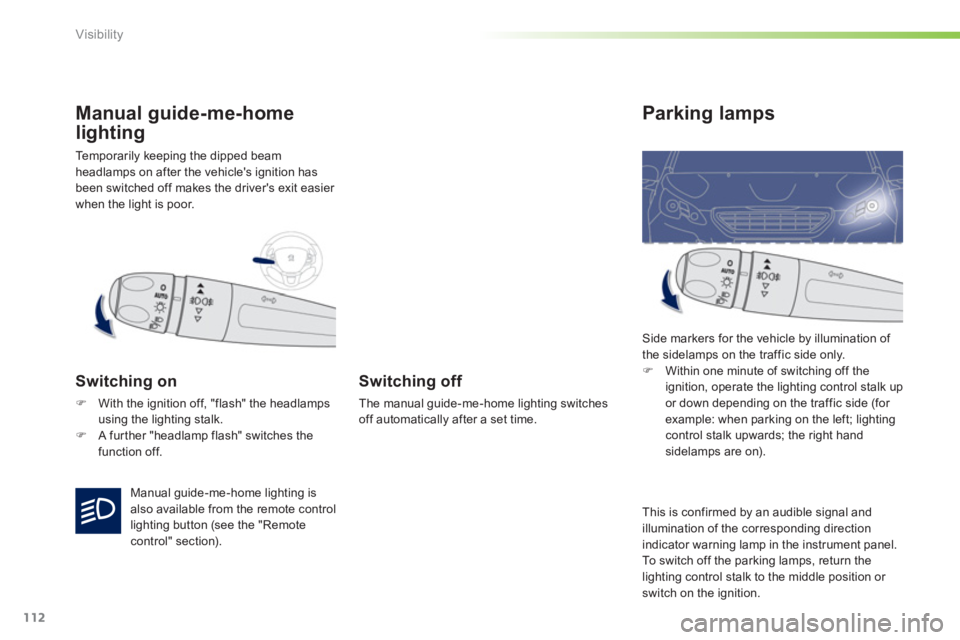
Manual guide-me-home
lighting
Switching on
)With the ignition off, "flash" the headlampsusing the lighting stalk.
)A fur ther "headlamp flash" switches the
function off.
Switching off
The manual guide-me-home lighting switches
off automatically after a set time.
Parking lamps
Side markers for the vehicle by illumination of
the sidelamps on the traffic side only.)Within one minute of switching off the
ignition, operate the lighting control stalk up
or down depending on the traffic side (for example: when parking on the left; lighting
control stalk upwards; the right handsidelamps are on).
Manual
guide-me-home lighting isalso available from the remote controllighting button (see the "Remotecontrol" section). This is con
firmed by an audible signal and
illumination of the corresponding direction
indicator warning lamp in the instrument panel.
To switch o
ff the parking lamps, return the
lighting control stalk to the middle position or switch on the ignition.