brake PEUGEOT 2008 2013 Owner's Manual
[x] Cancel search | Manufacturer: PEUGEOT, Model Year: 2013, Model line: 2008, Model: PEUGEOT 2008 2013Pages: 324, PDF Size: 8.39 MB
Page 100 of 324
98
Driving
Cruise control
System which automatically maintains thespeed of the vehicle at the value programmed
by the driver, without any action on the accelerator pedal.
The cruise control is switched on
manually: itrequires a minimum vehicle speed of 25 mph(40 km/h), as well as the engagement of:
-
fourth gear on a manual gearbox,
- second gear on an electronic or automaticgearbox, in sequential mode,
- position A
on an electronic gearbox or position D
on an automatic gearbox.
Th
e cruise control is switched offmanuallyfor by pressing the brake or clutch pedal or on
triggering of the electronic stability system for safety reasons.
It is possible to exceed the programmed speed
temporarily by pressing the accelerator pedal. To return to the programmed speed, simply release the accelerator pedal. Switching off the ignition cancels any programmed speed value. The controls of this s
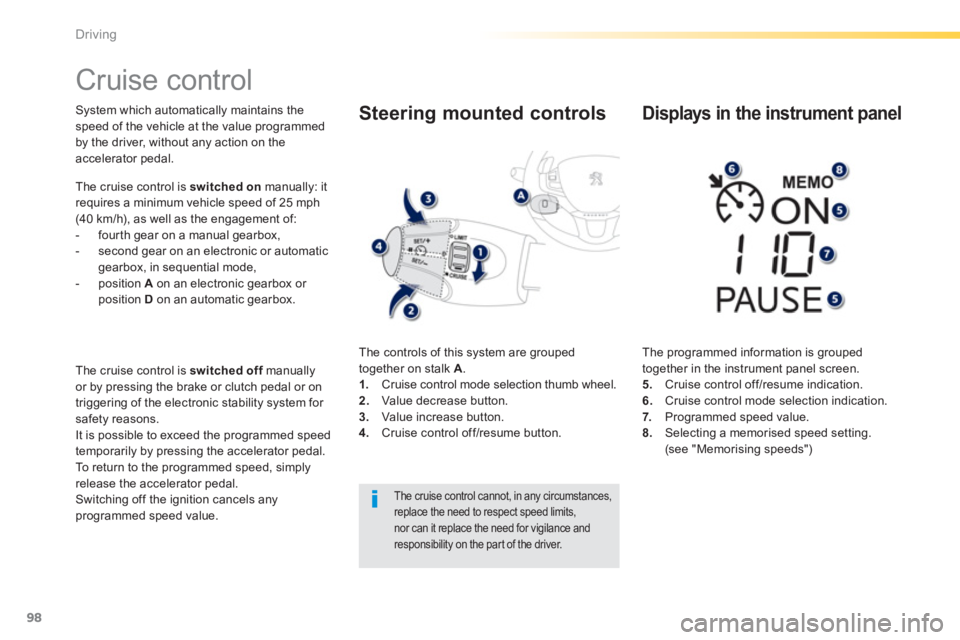
ystem are grouped
together on stalk A .
1.Cruise control mode selection thumb wheel.2. Value decrease button. 3.
Value increase button. 4.Cruise control off/resume button.
Steering mounted controls
The cruise control cannot, in any circumstances, replace the need to respect speed limits,nor can it replace the need for vigilance andresponsibility on the par t of the driver.
The programmed information is grouped
together in the instrument panel screen.
5. Cruise control off/resume indication.
6.Cruise control mode selection indication.7. Programmed speed value. 8.Selecting a memorised speed setting.
(see "Memorising speeds")
Displays in the instrument panel
Page 105 of 324
103
4
Driving
Park Assist
This system provides active assistance with parking, detecting a parking space then controlling the steering to park in the space.
It controls the steering while the driver manages the accelerator, brakes, gears and clutch (manual gearbox). During phases of entry into and exit from
a parking space, the system provides visual and audible information to the driver in order to make the manoeuvre safe. It may be necessary to move
forwards and backwards more than once.
For entry into a parking space (parallel
parking) the system does not detect spaces which are clearly much smaller or larger than the size of the vehicle.
This "parking assistance" system is activated automatically duringmanoeuvres; it is therefore possible that a symbol comes on in the screen,accompanied by an audible signal,without affecting the manoeuvre.
When Park Assist is activated, it prevents a change to STOP mode of Stop & Star t. In STOP mode, activationof Park Assist restarts the engine.
The Park Assist system cannot in anycircumstances replace the care and responsibility of the driver.
The driver must remain in control of their vehicle ensuring that the space remains clear during the manoeuvre. In some circumstances, the sensors may not detect small obstacles located in their blind spots.
During a manoeuvre the steering wheel
turns quickly: do not hold the steering wheel, do not place your hand betweenthe spokes of the steering wheel andtake care with loose and bulky clothing,scarves, handbags... There is a risk of injury.
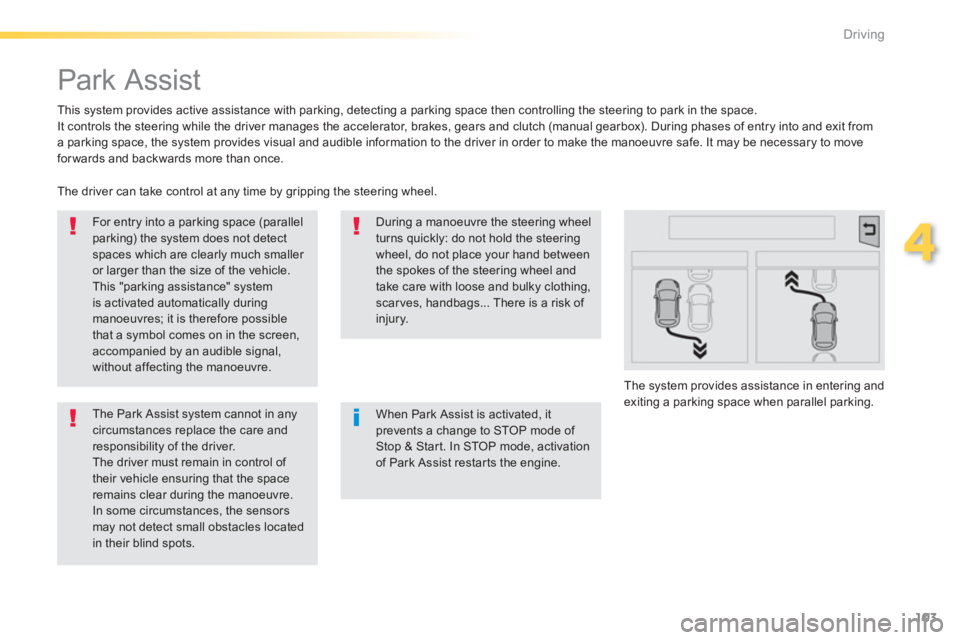
The s
ystem provides assistance in entering and exiting a parking space when parallel parking.
The driver can take control at any time by gripping the steering wheel.
Page 126 of 324
124
Safety
Electronic Stability Programme incorporatingthe following systems:
- the anti-lock braking system (ABS) and the
electronic brake force distribution (EBFD),
- the emergency braking assistance,
- the anti-slip regulation (ASR) or traction control,
- the d
ynamic stability control (DSC).
Electronic stability programme (ESP)
Definitions
Anti-lock braking system (ABS)
and electronic brake force
distribution
(EBFD)
This system improves the stability and
manoeuvrability of your vehicle when braking
and provides improved control in corners, in
par ticular on poor or slippery road surfaces.
The ABS prevents wheel lock in the event of emergency braking.
The electronic brake force distribution system
manages the braking pressure wheel by wheel.
Emergency braking assistance
In an emergency, this system enables you to reach the optimum braking pressure more
quickly and therefore reduce the stoppingdistance.
It is triggered in relation to the speed at which
the brake pedal is pressed. This is felt by areduction in the resistance of the pedal and an
increase in the effectiveness of the braking.
Anti-slip regulation (ASR)
The ASR system (also known as Traction Control) optimises traction in order to avoid
wheel slip by acting on the brakes of the drivingwheels and on the engine. It also improves
the directional stability of the vehicle onacceleration.
Dynamic stability control (DSC)
If there is a difference between the path
followed by the vehicle and that required by
the driver, the DSC monitors each wheel and
automatically acts on the brake of one or more
wheels and on the engine to return the vehicle
to the required path, within the limits of the laws
of physics.
Page 127 of 324
125
6
Safety
Operation
Anti-lock braking system (ABS) and electronic brake force distribution (EBFD)
In emergency braking, pressvery firmly without releasing thepressure.
When changing wheels (tyres and rims), make sure that these are approved for your vehicle. Normal operation of the ABS may makeitself felt by slight vibrations of the brakepedal. When this warnin
g lamp comes on, accompanied by an audible signal and a message, it indicates that
there is a fault with the ABS, whichcould cause loss of control of the vehicle when braking.
When this warnin
g lamp comes on, coupled with the STOP
warning lamp, accompanied by an audible signal and a message, it indicates that
there is a fault with the electronic brake force
distribution (EBFD), which could cause loss of control of the vehicle when braking.You must stop as soon as it is safe to do so. In both cases, contact a PEUGEOT dealer or aqualified workshop.
Page 156 of 324
154
Practical information
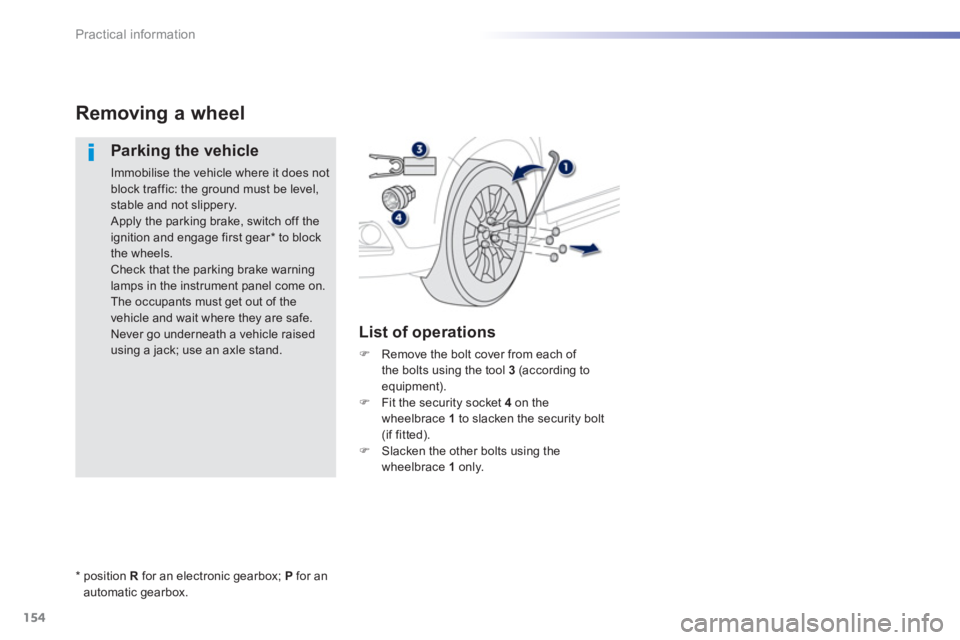
Removing a wheel
Parking the vehicle
Immobilise the vehicle where it does notblock traffic: the ground must be level,stable and not slippery. Apply the parking brake, switch off the
ignition and engage first gear *
to blockthe wheels. Check that the parking brake warninglamps in the instrument panel come on.
The occupants must get out of the vehicle and wait where they are safe.
Never go underneath a vehicle raised using a jack; use an axle stand.
List of operations
)
Remove the bolt cover from each of
the bolts using the tool 3(according toequipment). ) Fit the security socket 4
on thewheelbrace 1
to slacken the security bolt (if fitted).)
Slacken the other bolts using the
wheelbrace 1 only.
*
position R
for an electronic
gearbox; P
for an automatic gearbox.
Page 160 of 324
158
Practical information
Snow chains
In wintry conditions, snow chains improve
traction as well as the behaviour of the vehiclewhen braking.
The snow chains must be fitted only to the front wheels. They must never be fitted to "space-saver" type sparewheels.
Take account of the legislation in forcein your country on the use of snow chains and the maximum running speed authorised.
Use onl
y the chains designed to be fitted to the
type of wheel fitted to your vehicle:
For more information on snow chains
, contact aPEUGEOT dealer or a qualified workshop.
Advice on installation
)If you have to fit the chains during ajourney, stop the vehicle on a flat surface
on the side of the road.)Apply the parking brake and position anywheel chocks to prevent movement of your
vehicle.)Fit the chains following the instructionsprovided by the manufacturer. )Move off gently and drive for a fewmoments, without exceeding 30 mph (50 km/h). )Stop your vehicle and check that the snow chains are correctly tightened.
Avoid driving on roads that have beencleared of snow, to avoid damaging your
vehicle's tyres and the road sur face. It is recommended that before you leave,you practise fitting the snow chains ona level and dry surface. If your vehicleis fitted with alloy wheels, check that no par t of the chain or its fixings is incontact with the wheel rim.
Original tyre size
Maximum link size.
1
95/65 R15
9 mm 1
95/60 R16
205
/55 R16
2
05/50 R17
Page 165 of 324
163
7
Practical information
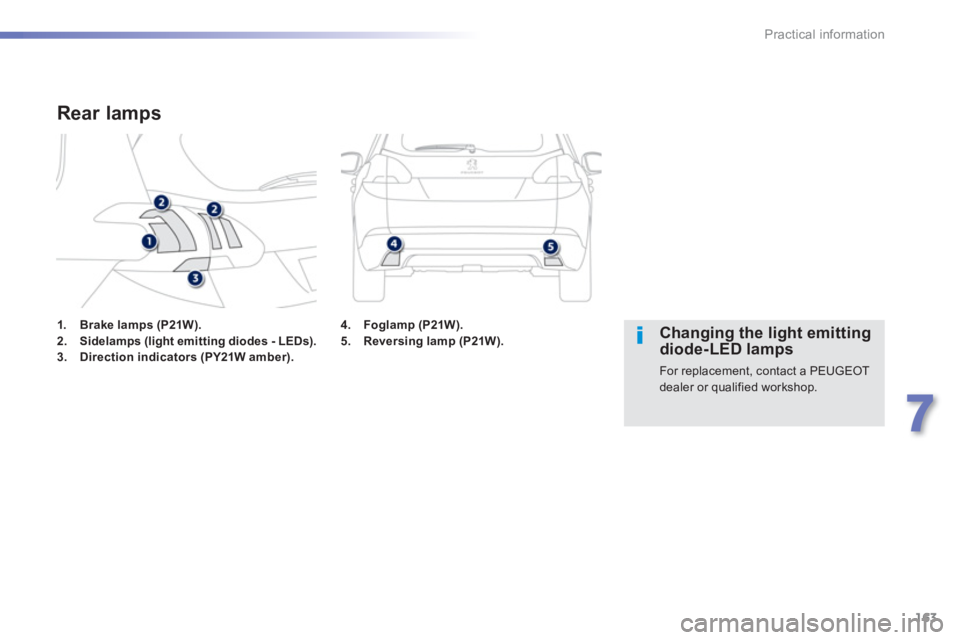
1.Brake lamps (P21W).2. Sidelamps (light emitting diodes - LEDs).3.Direction indicators (PY21W amber).
Rear lamps
Changing the light emittingdiode-LED lamps
For replacement, contact a PEUGEOT dealer or qualified workshop.
4.Foglamp (P21W).5.
Reversing lamp (P21W).
Page 167 of 324
165
7
Practical information
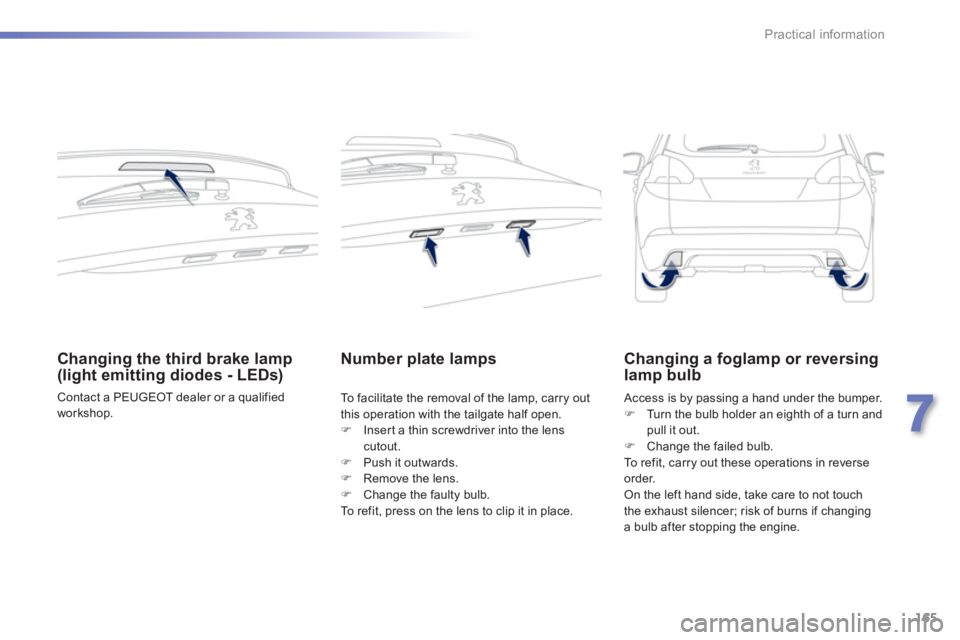
Changing the third brake lamp (light emitting diodes - LEDs)
Contact a PEUGEOT dealer or a qualified
workshop.
Number plate lamps
To facilitate the removal of the lamp, carry out
this operation with the tailgate half open.
) Insert a thin screwdriver into the lenscutout. )
Push it outwards. )
Remove the lens.)
Change the faulty bulb.
To refit, press on the lens to clip it in place.
Access is by passing a hand under the bumper. ) Turn the bulb holder an eighth of a turn and
pull it out.)
Change the failed bulb.
To r e f i t , c a r ry out these operations in reverseorder.
On the left hand side, take care to not touch
the exhaust silencer; risk of burns if changing
a bulb after stopping the engine.
Changing a foglamp or reversing lamp bulb
Page 179 of 324
177
7
Practical information
Towing the vehicle
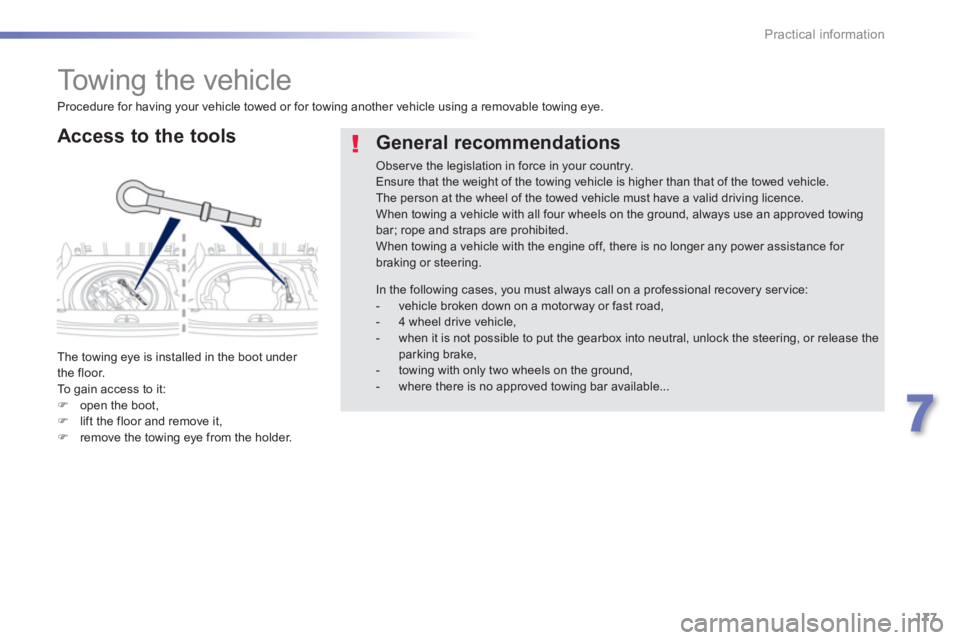
Access to the tools
The towing eye is installed in the boot under
the floor.
To gain access to it: )open the boot, )lift the floor and remove it,
)remove the towing eye from the holder.
General recommendations
Obser ve the legislation in force in your country. Ensure that the weight of the towing vehicle is higher than that of the towed vehicle. The person at the wheel of the towed vehicle must have a valid driving licence.When towing a vehicle with all four wheels on the ground, always use an approved towingbar; rope and straps are prohibited. When towing a vehicle with the engine off, there is no longer any power assistance for braking or steering.
In the following cases, you must always call on a professional recovery service: - vehicle broken down on a motor way or fast road, - 4 wheel drive vehicle, - when it is not possible to put the gearbox into neutral, unlock the steering, or release theparking brake, - towing with only two wheels on the ground, - where there is no approved towing bar available...
Procedure for havin
g your vehicle towed or for towing another vehicle using a removable towing eye.
Page 180 of 324
178
Practical information
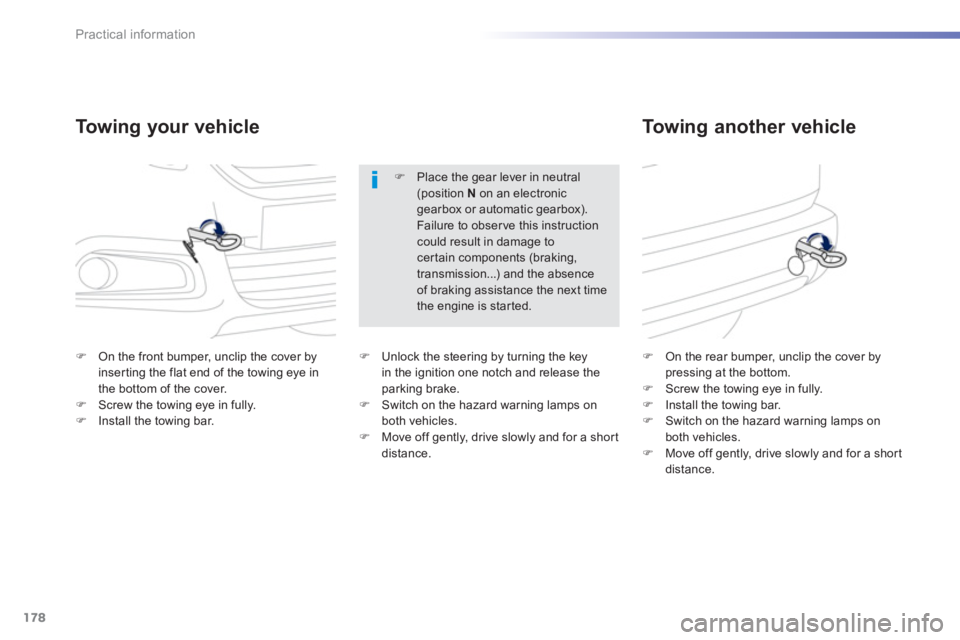
To w i ng your vehicle
To w i ng another vehicle
)On the front bumper, unclip the cover by inserting the flat end of the towing eye in
the bottom of the cover.)Screw the towing eye in fully. )Install the towing bar.
)On the rear bumper, unclip the cover by pressing at the bottom. )Screw the towing eye in fully. )Install the towing bar. )Switch on the hazard warning lamps on
both vehicles.)Move off gently, drive slowly and for a shor t distance.
)Place the gear lever in neutral (position Non an electronicgearbox or automatic gearbox).Failure to observe this instruction could result in damage to certain components (braking, transmission...) and the absenceof braking assistance the next timethe engine is star ted.
) Unlock the steering by turning the key
in the ignition one notch and release the
parking brake.) Switch on the hazard warning lamps onboth vehicles.
)
Move off gently, drive slowly and for a shor tdistance.