weight PEUGEOT 2008 2013 Owners Manual
[x] Cancel search | Manufacturer: PEUGEOT, Model Year: 2013, Model line: 2008, Model: PEUGEOT 2008 2013Pages: 324, PDF Size: 8.39 MB
Page 5 of 324
.
.
Contents
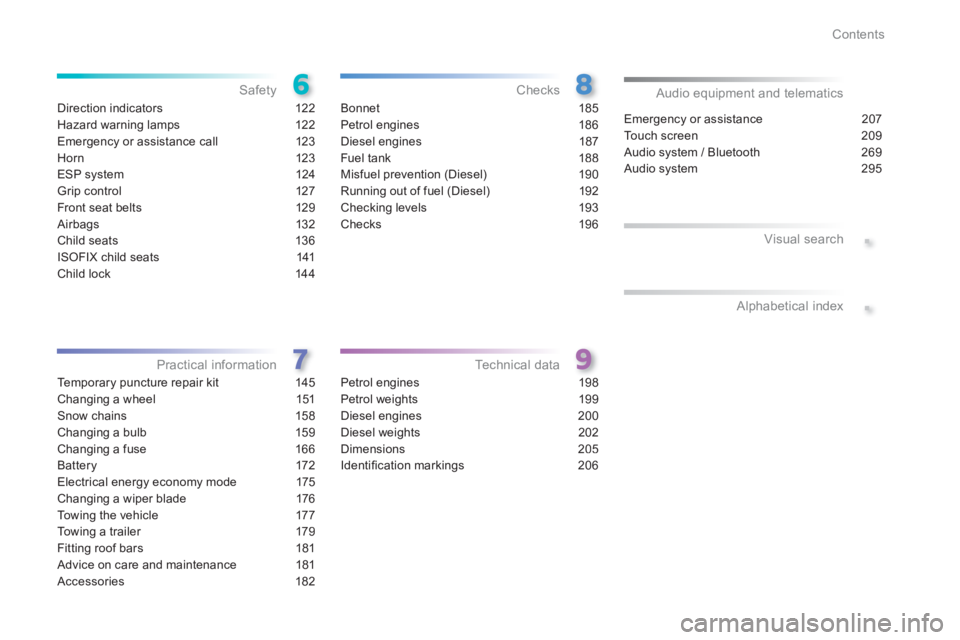
Direction indicators 122
Hazard warning lamps 122
Emergency or assistance call 123
Horn 123
ESP system 124
Grip control 127
Front seat belts 129
Airbags 132
Child seats 136
ISOFIX child seats 141
Child lock 144
Safety
Te m p o r a ry puncture repair kit 145
Changing a wheel 151
Snow chains 158
Changing a bulb 159
Changing a fuse 166
Battery 172
Electrical energy economy mode 175
Changing a wiper blade 176
To w i ng the vehicle 177
To w i ng a trailer 179
Fitting roof bars 181
Advice on care and maintenance 181
Accessories 182
Practical information
Bonnet 185
Petrol engines 186
Diesel engines 187
Fuel tank 188
Misfuel prevention (Diesel) 190
Running out of fuel (Diesel) 192
Checking levels 193
Checks 196
Checks
Petrol engines 198
Petrol weights 199
Diesel engines 200
Diesel weights 202
Dimensions 205
Identifi cation markings 206
Technical data
Emergency or assistance 207
Touch screen 209
Audio system / Bluetooth 269
Audio system 295
Audio equipment and telematics
Visual search
Alphabetical index
Page 38 of 324
36
Instruments and controls
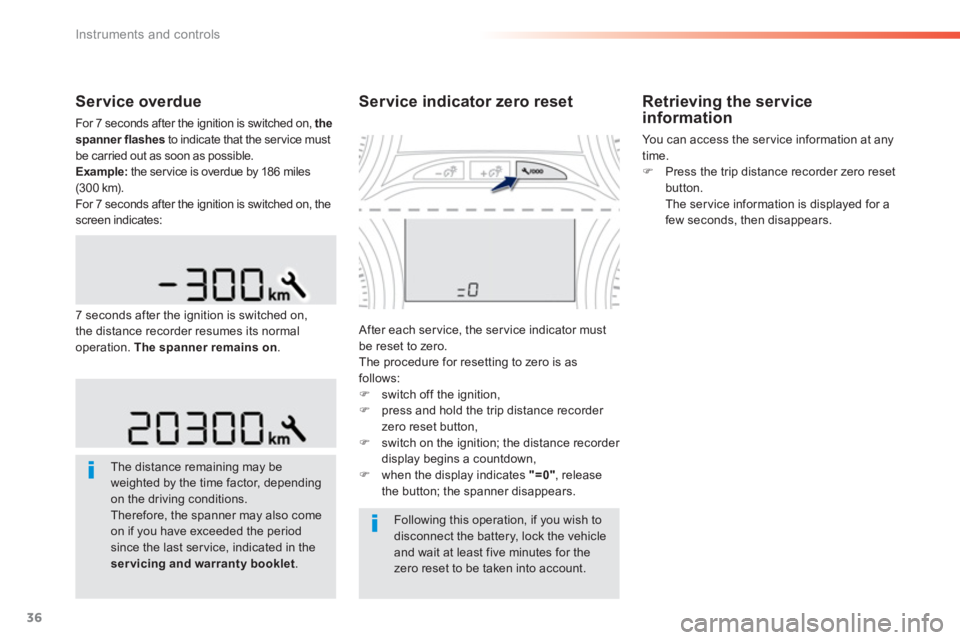
Service overdue
For 7 seconds after the ignition is switched on, the
spanner flashesto indicate that the service must
be carried out as soon as possible.
Example: the ser vice is overdue by 18 6 miles(300 km).
For 7 seconds after the ignition is switched on, thescreen indicates:
The distance remaining may be weighted by the time factor, dependingon the driving conditions.
Therefore, the spanner may also comeon if you have exceeded the period since the last service, indicated in the servicing and warranty booklet.
Following this operation, if you wish to disconnect the battery, lock the vehicle and wait at least five minutes for the zero reset to be taken into account.
Service indicator zero reset
After each ser vice, the ser vice indicator mustbe reset to zero.
The procedure for resetting to zero is as
follows: ) switch off the ignition,)
press and hold the trip distance recorder
zero reset button,
) switch on the ignition; the distance recorder
display begins a countdown,
) when the display indicates "=0", release
the button; the spanner disappears.
Retrieving the serviceinformation
You can access the ser vice information at any
time.
)Press the trip distance recorder zero reset button.
The ser vice information is displayed for a
few seconds, then disappears.
7 seconds after the i
gnition is switched on,
the distance recorder resumes its normal
operation. The spanner remains on.
Page 138 of 324
136
Safety
General points
relating to child seats
For maximum safety, please obser ve the following recommendations:
- in accordance with European regulations,
all children under the age of 12 or less
than one and a half metres tall must
travel in a
pproved child seats suited to
their weight , on seats fitted with a seat
belt or ISOFIX mountings * ,-statistically, the safest seats in your
vehicle for carrying children are the rear seats,- a child weighing less than 9 kg must
travel in the "rearwards-facing" position both in the front and in the rear.
PEUGEOT recommends that childrenshould travel in the outer rrear seats
of your vehicle: -"rearwards-facing"
up to the age of 2,-"forwards-facing"over the age of 2.
Although one of PEUGEOT main criteria when
designing your vehicle, the safety of your children also depends on you.
*
The rules for carr
ying children are specific to
each country. Refer to the legislation in force
in your country.
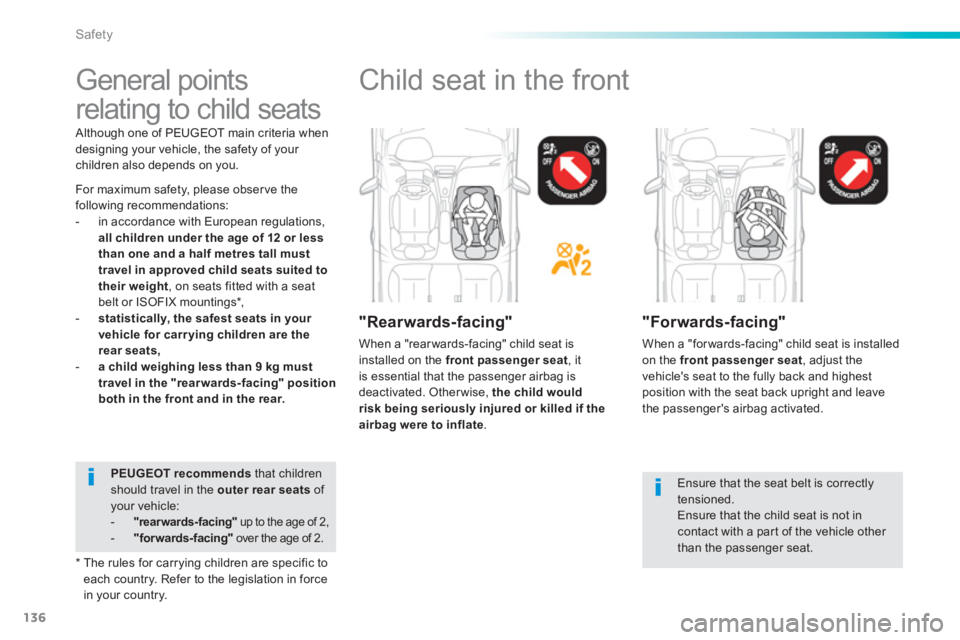
Child seat in the front
"Rearwards-facing"
When a "rear wards-facing" child seat isinstalled on the front passenger seat, it is essential that the passenger airbag is
deactivated. Other wise, the child would
risk being seriously injured or killed if the
airbag were to inflate .
"Forwards-facing"
When a "forwards-facing" child seat is installed on the front passenger seat
, adjust the
vehicle's seat to the fully back and highestposition with the seat back upright and leave
the passenger's airbag activated.
Ensure that the seat belt is correctly tensioned. Ensure that the child seat is not in contact with a par t of the vehicle other than the passenger seat.
Page 141 of 324
139
6
Safety
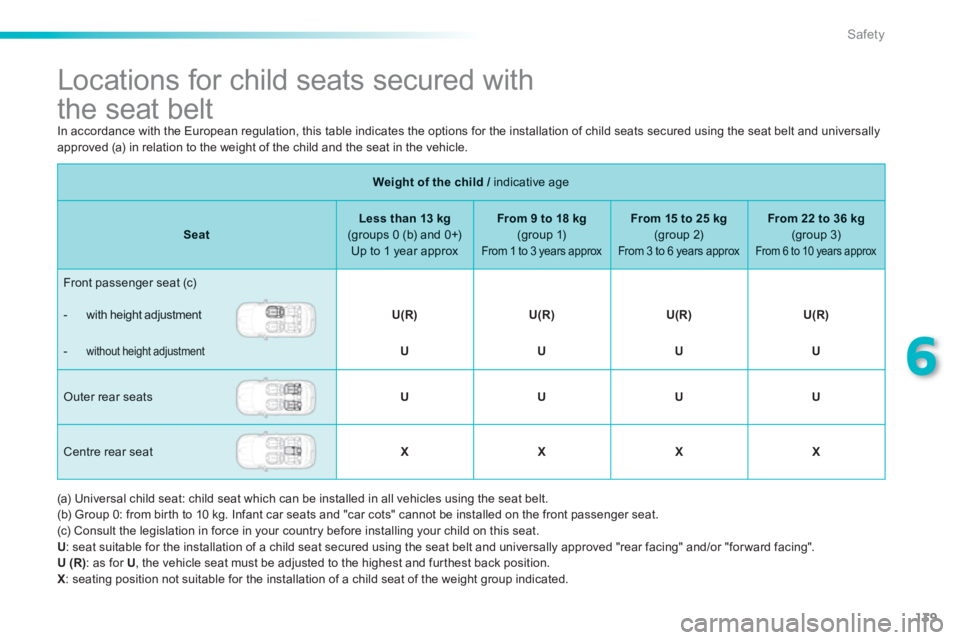
Locations for child seats secured with
the seat belt
In accordance with the European regulation, this table indicates the options for the installation of child seats secured using the seat belt and universally
approved (a) in relation to the weight of the child and the seat in the vehicle.
Weight of the child /indicative age /
SeatLess than 13 kg (groups 0 (b) and 0+) Up to 1 year approx
From 9 to 18 kg(group 1)From 1 to 3 years approx
From 15 to 25 kg
(group 2)From 3 to 6 years approx
From 22 to 36 kg(group 3) From 6 to 10 years approx
Front passenger seat (c)
- with height adjustment U(R)U(R)U(R)U(R)
-
without height adjustmenttUUUU
Outer rear seats UUUU
Centre rear seat XXXX
(a) Universal child seat: child seat which can be installed in all vehicles using the seat belt.
(b) Group 0: from bir th to 10 kg. Infant car seats and "car cots" cannot be installed on the front passenger seat.
(c) Consult the legislation in force in your country before installing your child on this seat.
U: seat suitable for the installation of a child seat secured using the seat belt and universally approved "rear facing" and/or "for ward facing". U (R): as for U, the vehicle seat must be adjusted to the highest and furthest back position.
X
: seating position not suitable for the installation of a child seat of the weight group indicated.
Page 145 of 324
143
6
Safety
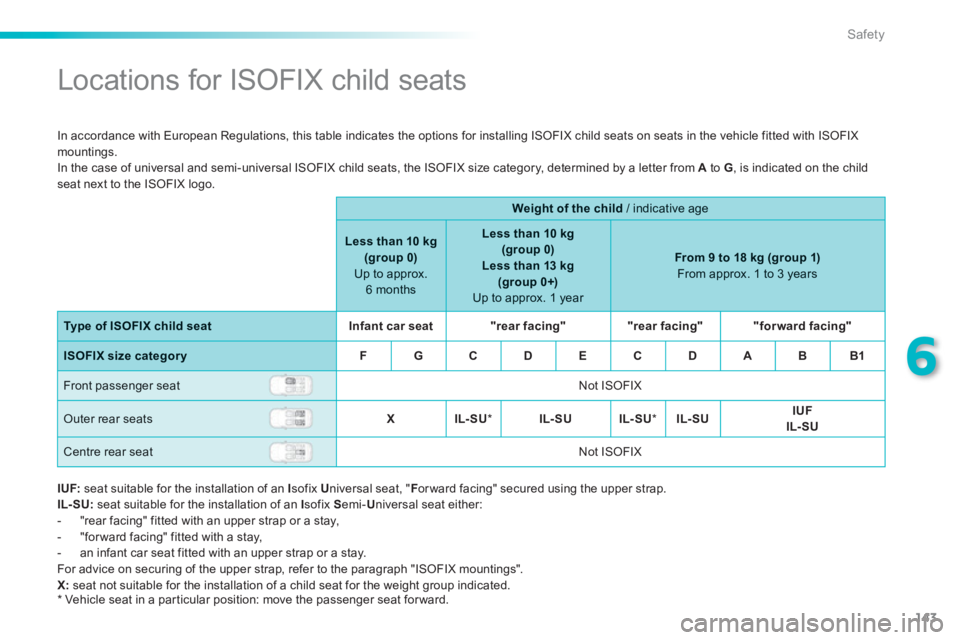
Locations for ISOFIX child seats
In accordance with European Regulations, this table indicates the options for installing ISOFIX child seats on seats in the vehicle fitted with ISOFIX mountings.
In the case of universal and semi-universal ISOFIX child seats, the ISOFIX size category, determined by a letter from A
to G
, is indicated on the childseat next to the ISOFIX logo.
Weight of the child
/ indicative age
Less than 10 kg
(group 0)Up to approx.6 months
Less than 10 kg(group 0)
Less than 13 kg(group 0+)Up to approx. 1 year
From 9 to 18 kg (group 1)From approx. 1 to 3 years
Type of ISOFIX child seatInfant car seat"rear facing""rear facing" "for ward facing"
ISOFIX size categoryFGCDECDABB1
Front passenger seatNot ISOFIX
Outer rear seats XIL-SU*IL-SUIL-SU*IL-SUIUF
IL-SU
Centre rear seat
Not ISOFIX
IUF:seat suitable for the installation of an Isofix U
niversal seat, "F
orward facing" secured using the upper strap. IL-SU:seat suitable for the installation of an I sofix S emi-U
niversal seat either:
- "rear facing" fitted with an upper strap or a stay,
- "forward facing" fitted with a stay,
- an infant car seat fitted with an upper strap or a stay.
For advice on securing of the upper strap, refer to the paragraph "ISOFIX mountings". X:seat not suitable for the installation of a child seat for the weight group indicated.
*
Vehicle seat in a par ticular position: move the passenger seat forward.
Page 179 of 324
177
7
Practical information
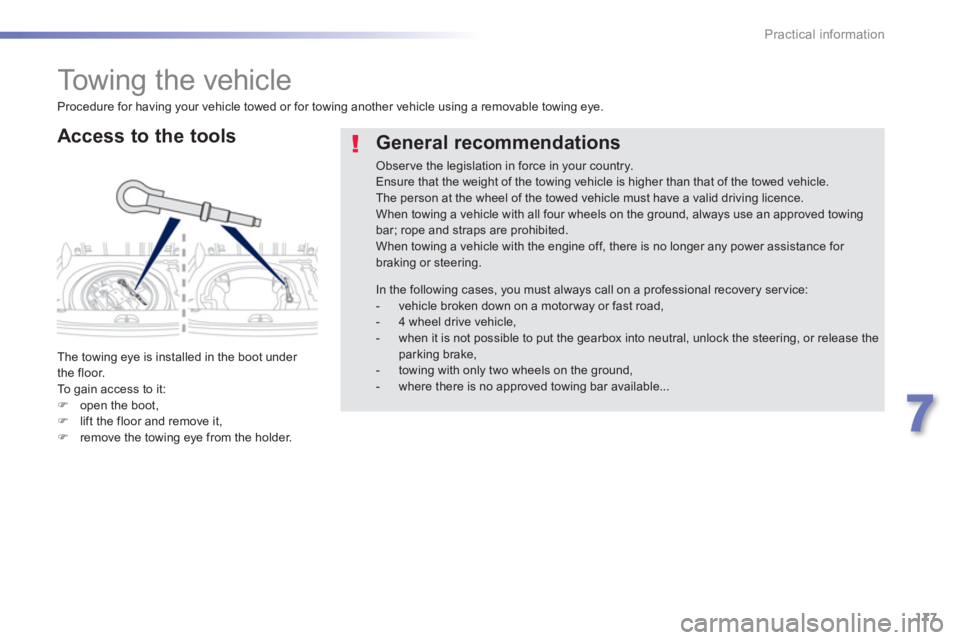
Towing the vehicle
Access to the tools
The towing eye is installed in the boot under
the floor.
To gain access to it: )open the boot, )lift the floor and remove it,
)remove the towing eye from the holder.
General recommendations
Obser ve the legislation in force in your country. Ensure that the weight of the towing vehicle is higher than that of the towed vehicle. The person at the wheel of the towed vehicle must have a valid driving licence.When towing a vehicle with all four wheels on the ground, always use an approved towingbar; rope and straps are prohibited. When towing a vehicle with the engine off, there is no longer any power assistance for braking or steering.
In the following cases, you must always call on a professional recovery service: - vehicle broken down on a motor way or fast road, - 4 wheel drive vehicle, - when it is not possible to put the gearbox into neutral, unlock the steering, or release theparking brake, - towing with only two wheels on the ground, - where there is no approved towing bar available...
Procedure for havin
g your vehicle towed or for towing another vehicle using a removable towing eye.
Page 182 of 324
180
Practical information
Driving advice
Distribution of loads
)Distribute the load in the trailer so that theheaviest items are as close as possible to
the axle and the nose weight approaches the maximum permitted without exceeding it.
Air density decreases with altitude, thus reducing engine performance. Above1 000 metres, the maximum towed load must
be reduced by 10 % for every 1 000 metres of altitude.
Side wind
)Take into account the increased sensitivity
to side wind.
Cooling
To w i ng a trailer on a slope increases the
temperature of the coolant.
As the fan is electricall
y controlled, its cooling capacity is not dependent on the engine speed.)
To lower the engine speed, reduce your speed.
The maximum towed load on a long incline
depends on the gradient and the ambient
tem
perature.
In all cases, keep a check on the coolant
temperature.
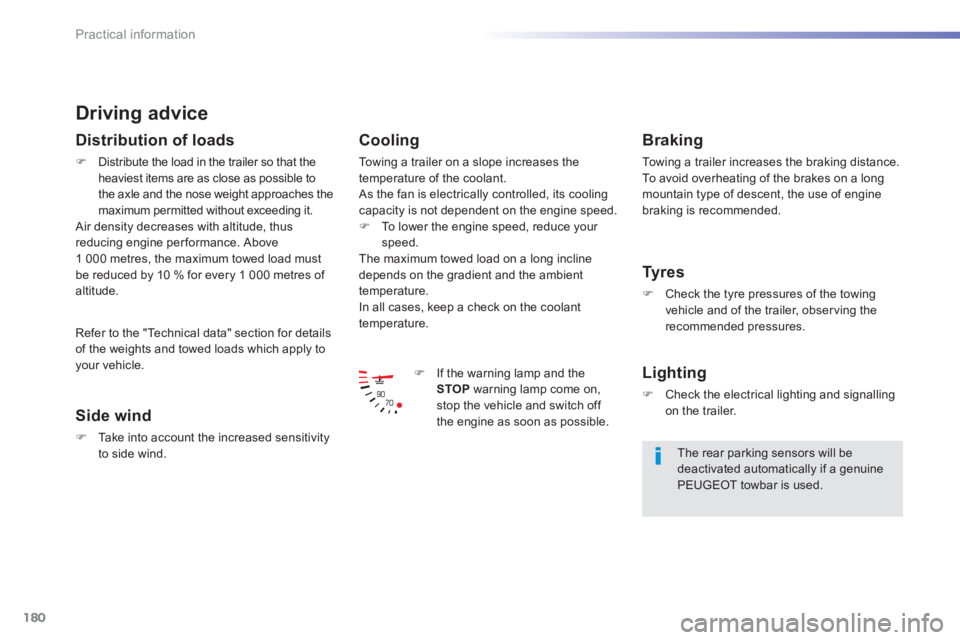
)If the warning lamp and the
STOP warning lamp come on, stop the vehicle and switch off
the engine as soon as possible.
Braking
To w i ng a trailer increases the braking distance.
To avoid overheating of the brakes on a longmountain type of descent, the use of engine braking is recommended.
Tyres
)Check the tyre pressures of the towingvehicle and of the trailer, obser ving the recommended pressures.
Lighting
)Check the electrical lighting and signalling on the trailer.
The rear parking sensors will be deactivated automatically if a genuine PEUGEOT towbar is used.
R
efer to the "Technical data" section for details
of the weights and towed loads which apply to your vehicle.
Page 183 of 324
181
7
Practical information
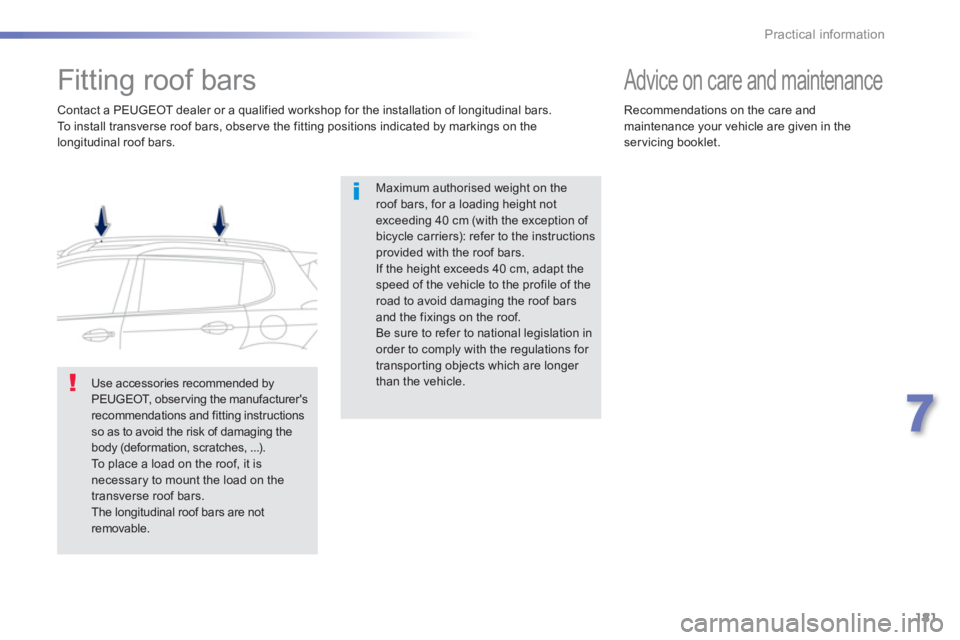
Fitting roof bars
Maximum authorised weight on theroof bars, for a loading height notexceeding 40 cm (with the exception of bicycle carriers): refer to the instructions provided with the roof bars. If the height exceeds 40 cm, adapt the speed of the vehicle to the profile of the road to avoid damaging the roof bars and the fixings on the roof.Be sure to refer to national legislation inorder to comply with the regulations for transporting objects which are longer than the vehicle.
Contact a PEUGE
OT dealer or a qualified workshop for the installation of longitudinal bars.
To install transverse roof bars, obser ve the fitting positions indicated by markings on the
longitudinal roof bars.
Use accessories recommended by PEUGEOT, o b s e r v i ng the manufacturer's recommendations and fitting instructions
so as to avoid the risk of damaging the body (deformation, scratches, ...).
To place a load on the roof, it is necessary to mount the load on thetransverse roof bars.
The longitudinal roof bars are not removable.
Advice on care and maintenance
Recommendations on the care andmaintenance your vehicle are given in the servicing booklet.
Page 201 of 324
9
199
Technical data
*
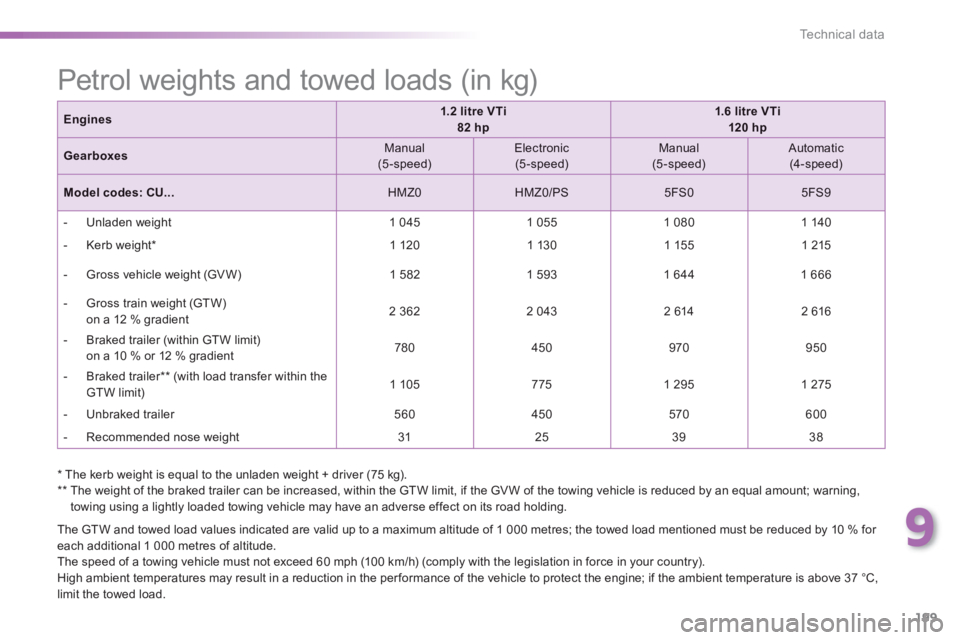
The kerb weight is equal to the unladen weight + driver (75 kg).
**
The weight of the braked trailer can be increased, within the GTW limit, if the GV W of the towing vehicle is reduced by an equal amount; warning,
towing using a lightly loaded towing vehicle may have an adverse effect on its road holding.
The GTW and towed load values indicated are valid up to a maximum altitude of 1 000 metres; the towed load mentioned must be reduced b
y 10 % for each additional 1 000 metres of altitude.
The speed of a towing vehicle must not exceed 60 mph (10 0 km/h) (comply with the legislation in force in your country).
High ambient temperatures may result in a reduction in the performance of the vehicle to protect the engine; if the ambient temperature is above 37 °C,
limit the towed load.
Petrol weights and towed loads (in kg)
Engines1.2 litre VTi82 hp1.6 litre VTi120 hp
Gearboxes
Manual(5-speed)
Electronic(5-speed)Manual
(5-speed)
Automatic
(4-speed)
Model codes: CU...
HMZ0
HMZ0/PS
5FS0
5FS9
- Unladen wei
ght 1 0451 055
1 0801 140
- Kerb weight * 1 120
1 13 0
1 155 1 215
- Gross vehicle wei
ght (GV W)
1 582 1 593
1 644 1 666
- Gross train weight (GTW)
on a 12 % gradient 2 3622 043
2 614 2 616
- Braked trailer
(within GTW limit) on a 10 % or 12 % gradient780450 970950
- Braked trailer **
(with load transfer within the GTW limit)
1 105
775
1 295
1 275
-
Unbraked trailer 560
450
570
600
- Recommended nose wei
ght 31
25
39
38
Page 204 of 324
202
Technical data
*
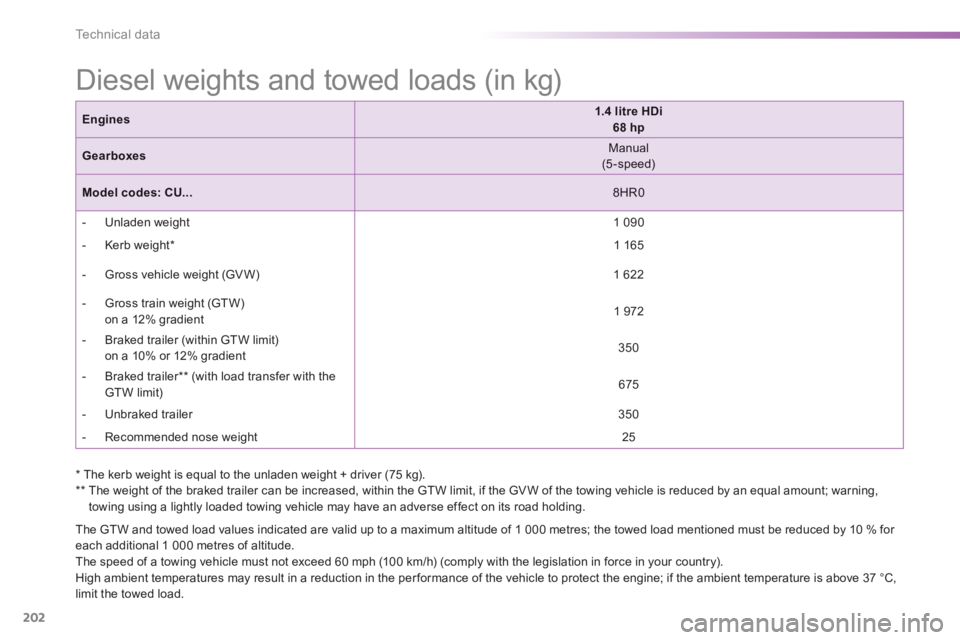
The kerb weight is equal to the unladen weight + driver (75 kg).
**
The weight of the braked trailer can be increased, within the GTW limit, if the GV W of the towing vehicle is reduced by an equal amount; warning,
towing using a lightly loaded towing vehicle may have an adverse effect on its road holding.
Diesel weights and towed loads (in kg)
Engines1.4 litre HDi 68 hp
Gearboxes
Manual(5-speed)
Model codes: CU...8HR0
- Unladen wei
ght1 090
- Kerb weight *
1 165
- Gross vehicle wei
ght (GV W)
1 622
- Gross train wei
ght (GT W)
on a 12% gradient 1 972
- Braked trailer
(within GTW limit) on a 10% or 12% gradient 350
- Braked trailer
**
(with load transfer with the GTW limit)
675
- Unbraked trailer
350
- Recommended nose wei
ght
25
The
GTW and towed load values indicated are valid up to a maximum altitude of 1 000 metres; the towed load mentioned must be reduced by 10 % for
each additional 1 000 metres of altitude.
The speed of a towing vehicle must not exceed 60 mph (10 0 km/h) (comply with the legislation in force in your country).
High ambient temperatures may result in a reduction in the per formance of the vehicle to protect the engine; if the ambient temperature is above 37 °C,
limit the towed load.