engine PEUGEOT 2008 2014 Workshop Manual
[x] Cancel search | Manufacturer: PEUGEOT, Model Year: 2014, Model line: 2008, Model: PEUGEOT 2008 2014Pages: 336, PDF Size: 9.35 MB
Page 127 of 336
125
6
Safety
A set of the following Electronic Stability systems: - anti-lock braking system (ABS) and electronic brake force distribution (EBFD), - emergency braking assistance, - wheel anti-slip regulation (ASR) or traction control, - dynamic stability control (DSC).
Electronic stability control (ESC)
Definitions
Anti-lock braking system (ABS) and electronic brake force distribution (EBFD)
This system improves the stability and manoeuvrability of your vehicle when braking and provides improved control in corners, in particular on poor or slippery road sur faces. The ABS prevents wheel lock in the event of emergency braking. The electronic brake force distribution system manages the braking pressure wheel by wheel.
Emergency braking assistance
In an emergency, this system enables you to reach the optimum braking pressure more quickly and therefore reduce the stopping distance. It is triggered in relation to the speed at which the brake pedal is pressed. This is felt by a reduction in the resistance of the pedal and an increase in the effectiveness of the braking.
Anti-slip regulation (ASR)
The ASR system (also known as Traction Control) optimises traction in order to avoid wheel slip by acting on the brakes of the driving wheels and on the engine. It also improves the directional stability of the vehicle on acceleration.
Dynamic stability control (DSC)
If there is a difference between the path followed by the vehicle and that required by the driver, the DSC monitors each wheel and automatically acts on the brake of one or more wheels and on the engine to return the vehicle to the required path, within the limits of the laws of physics.
Page 129 of 336
127
6
Safety
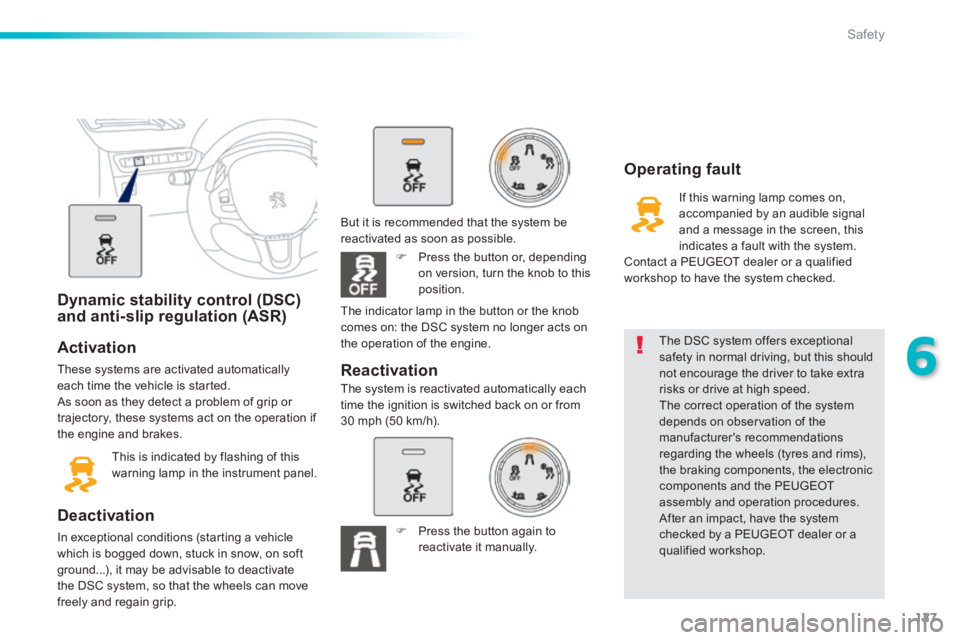
Dynamic stability control (DSC) and anti-slip regulation (ASR)
Activation
These systems are activated automatically each time the vehicle is started. As soon as they detect a problem of grip or trajectory, these systems act on the operation if the engine and brakes.
This is indicated by flashing of this warning lamp in the instrument panel.
Deactivation
In exceptional conditions (starting a vehicle which is bogged down, stuck in snow, on soft ground...), it may be advisable to deactivate the DSC system, so that the wheels can move freely and regain grip.
The DSC system offers exceptional safety in normal driving, but this should not encourage the driver to take extra risks or drive at high speed. The correct operation of the system depends on observation of the manufacturer's recommendations regarding the wheels (tyres and rims), the braking components, the electronic components and the PEUGEOT assembly and operation procedures. After an impact, have the system checked by a PEUGEOT dealer or a qualified workshop.
Operating fault
If this warning lamp comes on, accompanied by an audible signal and a message in the screen, this indicates a fault with the system. Contact a PEUGEOT dealer or a qualified workshop to have the system checked.
Reactivation
But it is recommended that the system be reactivated as soon as possible.
Press the button or, depending on version, turn the knob to this position.
The system is reactivated automatically each time the ignition is switched back on or from30 mph (50 km/h).
The indicator lamp in the button or the knob comes on: the DSC system no longer acts on the operation of the engine.
Press the button again to reactivate it manually.
Page 130 of 336

128
Safety
Grip control
Special patented traction control system which improves traction on snow, mud and sand. Associated with all-season M+S (Mud and Snow) tyres, this system offers a compromise between safety, grip and traction. This system, the operation of which has been optimised for each situation, allows you to manoeuvre in most conditions of poor grip (encountered during touring use).
Standard mode (ESC)
Mode calibrated for a low level of wheel spin, based on the different levels of grip normally encountered on the road.
Place the dial in this position.
Snow mode
Mode which adapts its strategy to the conditions of grip encountered for each of the two front wheels on moving off.
Place the dial in this position.
The accelerator pedal should be pressed sufficiently to allow the system to use the power of the engine. Operation at high engine speeds is completely normal.
A five-position selector allows you to choose the setting best suited to the driving conditions encountered. A message appears confirming the mode selected. Every time the ignition is switched off, the system automatically resets to this mode.
Page 155 of 336
153
7
Practical information
Repair procedure
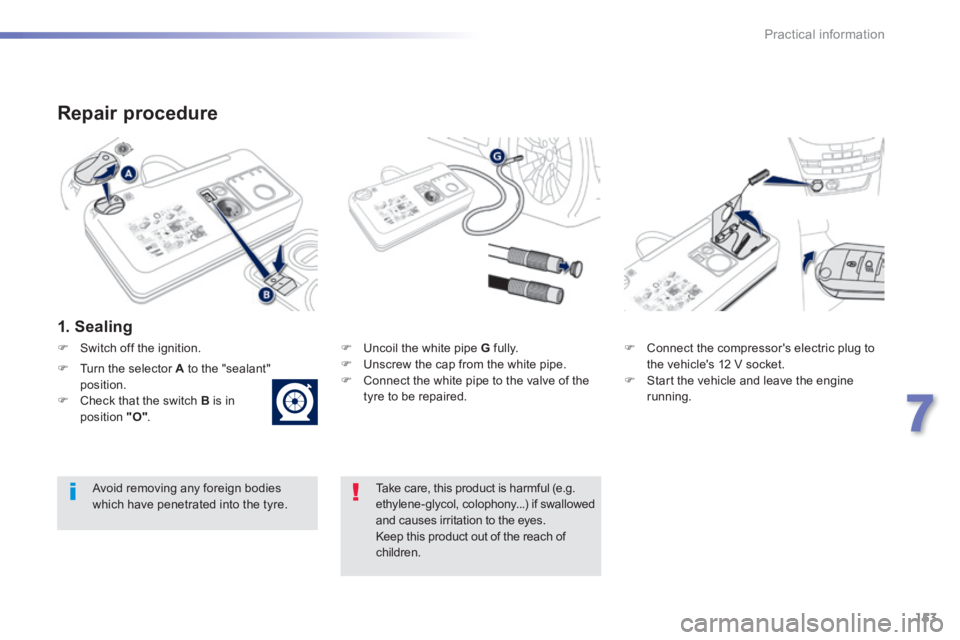
1. Sealing
Uncoil the white pipe G fully. Unscrew the cap from the white pipe. Connect the white pipe to the valve of the tyre to be repaired.
Connect the compressor's electric plug to the vehicle's 12 V socket. Start the vehicle and leave the engine running.
Take care, this product is harmful (e.g. ethylene-glycol, colophony...) if swallowed and causes irritation to the eyes. Keep this product out of the reach of children.
Avoid removing any foreign bodies which have penetrated into the tyre.
Switch off the ignition.
Turn the selector A to the "sealant" position. Check that the switch B is in position "O" .
Page 157 of 336
155
7
Practical information
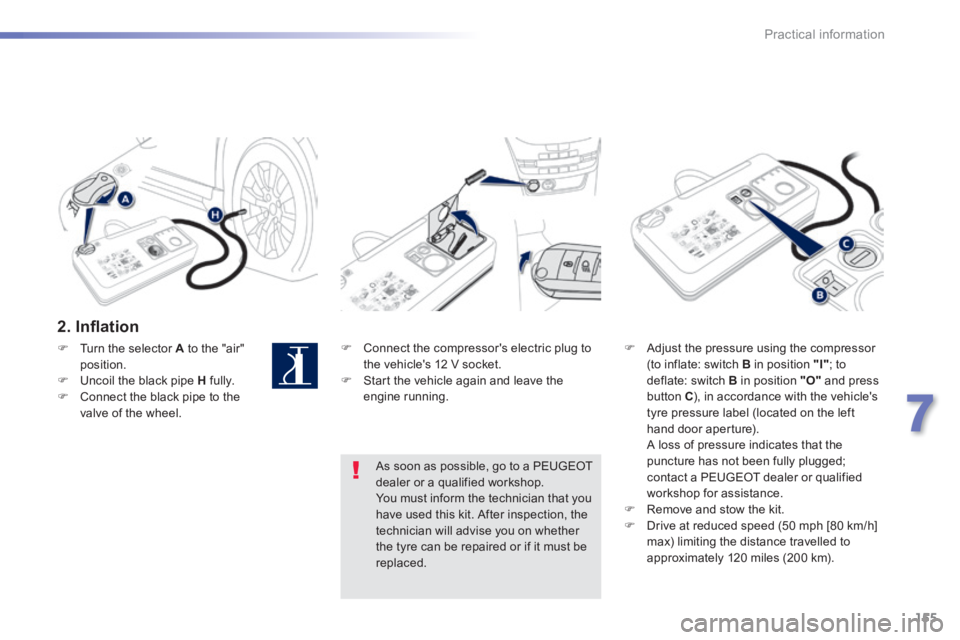
2 . I n fl a t i o n
Connect the compressor's electric plug to the vehicle's 12 V socket. Start the vehicle again and leave the engine running.
Adjust the pressure using the compressor (to inflate: switch B in position "I" ; to deflate: switch B in position "O" and press button C ), in accordance with the vehicle's tyre pressure label (located on the left hand door aperture).
A loss of pressure indicates that the puncture has not been fully plugged; contact a PEUGEOT dealer or qualified workshop for assistance. Remove and stow the kit. Drive at reduced speed (50 mph [80 km/h] max) limiting the distance travelled to approximately 120 miles (200 km).
As soon as possible, go to a PEUGEOT dealer or a qualified workshop. You must inform the technician that you have used this kit. After inspection, the technician will advise you on whether the tyre can be repaired or if it must be replaced.
Turn the selector A to the "air" position. Uncoil the black pipe H fully. Connect the black pipe to the valve of the wheel.
Page 158 of 336
156
Practical information
Removing the cartridge
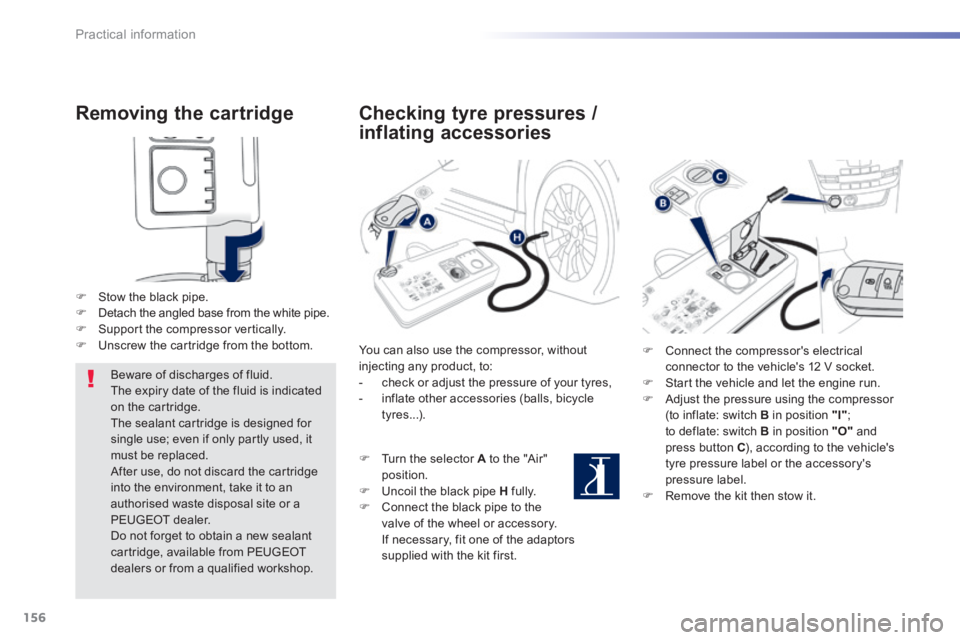
Stow the black pipe. Detach the angled base from the white pipe. Support the compressor vertically. Unscrew the cartridge from the bottom.
Beware of discharges of fluid. The expiry date of the fluid is indicated on the cartridge. The sealant cartridge is designed for single use; even if only partly used, it must be replaced. After use, do not discard the cartridge into the environment, take it to an authorised waste disposal site or a PEUGEOT dealer.
Do not forget to obtain a new sealant cartridge, available from PEUGEOT dealers or from a qualified workshop.
Checking tyre pressures /
inflating accessories
You can also use the compressor, without injecting any product, to: - check or adjust the pressure of your tyres, - inflate other accessories (balls, bicycle tyres...).
Turn the selector A to the "Air" position. Uncoil the black pipe H fully. Connect the black pipe to the valve of the wheel or accessory. If necessary, fit one of the adaptors supplied with the kit first.
Connect the compressor's electrical connector to the vehicle's 12 V socket. Start the vehicle and let the engine run. Adjust the pressure using the compressor (to inflate: switch B in position "I" ; to deflate: switch B in position "O" and press button C ), according to the vehicle's tyre pressure label or the accessory's pressure label. Remove the kit then stow it.
Page 173 of 336
171
7
Practical information
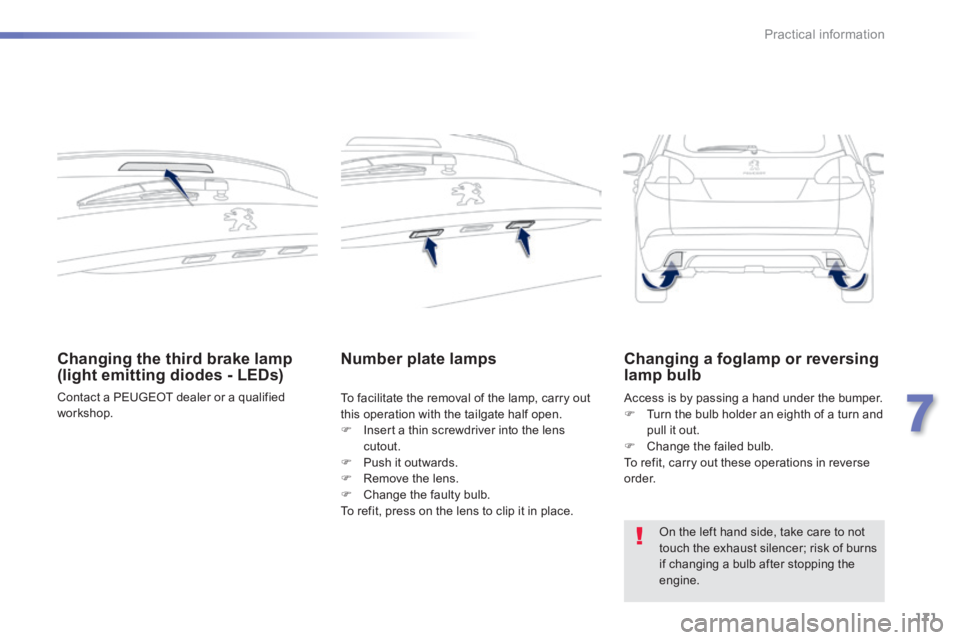
Changing the third brake lamp (light emitting diodes - LEDs)
Contact a PEUGEOT dealer or a qualified workshop.
Number plate lamps
To facilitate the removal of the lamp, carry out this operation with the tailgate half open.
Insert a thin screwdriver into the lens cutout. Push it outwards. Remove the lens. Change the faulty bulb. To refit, press on the lens to clip it in place.
Access is by passing a hand under the bumper. Turn the bulb holder an eighth of a turn and pull it out. Change the failed bulb. To refit, carry out these operations in reverse o r d e r.
Changing a foglamp or reversing lamp bulb
On the left hand side, take care to not touch the exhaust silencer; risk of burns if changing a bulb after stopping the engine.
Page 179 of 336
177
7
Practical information
Fuse N°RatingFunctions
F1615 A Front foglamps.
F1810 A Right hand main beam headlamp.
F1910 A Left hand main beam headlamp.
F2530 A Headlamp wash relay (accessory).
F2940 A Front wiper motor.
F3080 A Pre-heater plugs (Diesel).
Engine compartment fuses
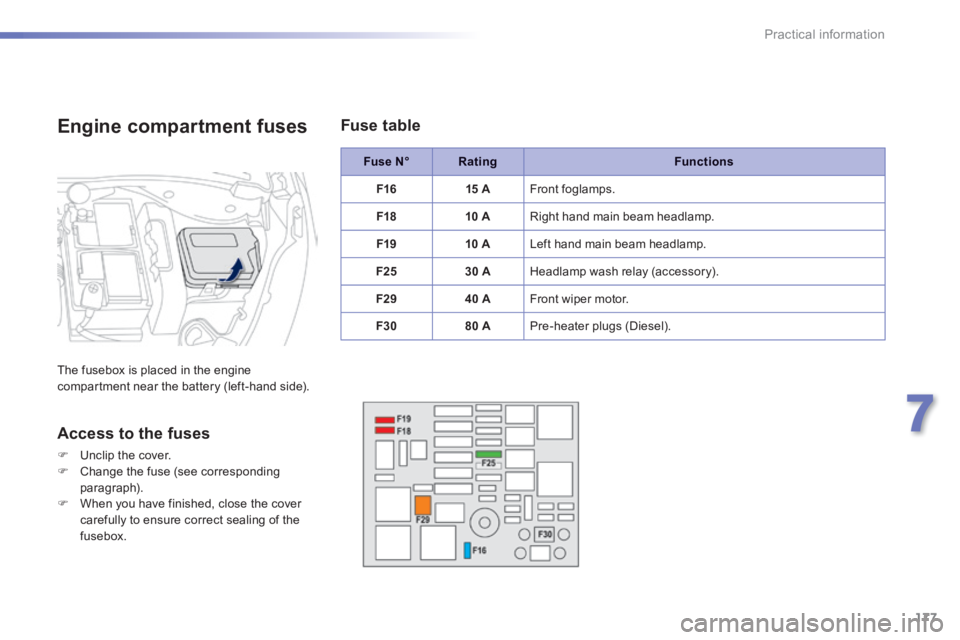
The fusebox is placed in the engine compartment near the battery (left-hand side).
Access to the fuses
Unclip the cover. Change the fuse (see corresponding paragraph). When you have finished, close the cover carefully to ensure correct sealing of the fusebox.
Fuse table
Page 180 of 336
178
Practical information
Battery
The presence of this label indicates the use of a 12 V lead-acid battery with special technology and specification, for which the involvement of a PEUGEOT dealer or qualified workshop is required when replacing or disconnecting the battery. Failure to observe this recommendation may cause premature wear of the battery.
After refitting the battery, the Stop & Start system will only be active after several hours depending on the climatic conditions and the state of charge of the battery (up to about 8 hours).
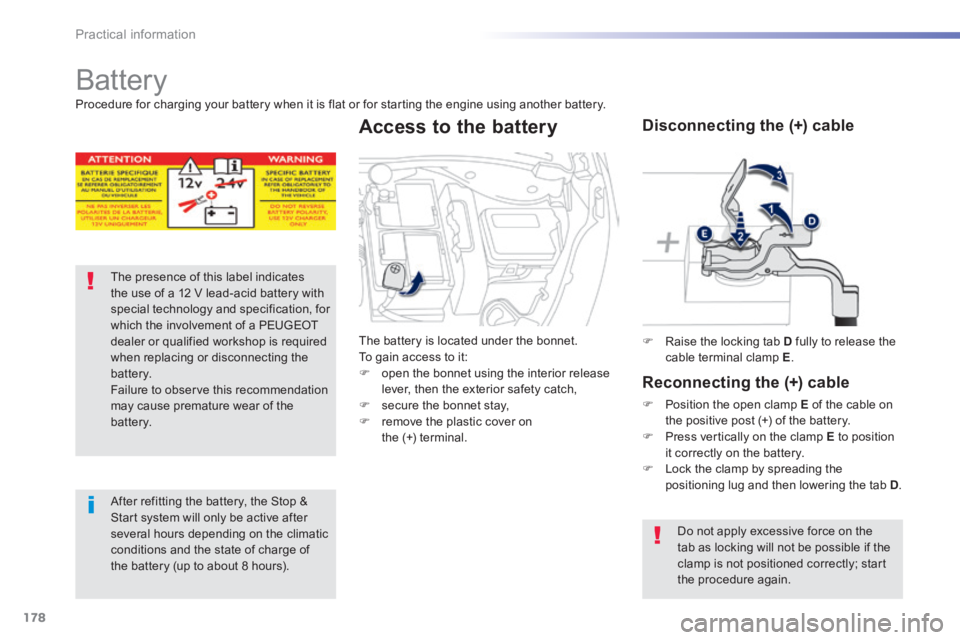
Raise the locking tab D fully to release the cable terminal clamp E .
Disconnecting the (+) cable
Reconnecting the (+) cable
Position the open clamp E of the cable on the positive post (+) of the battery.
Press vertically on the clamp E to position it correctly on the battery. Lock the clamp by spreading the positioning lug and then lowering the tab D .
Do not apply excessive force on the tab as locking will not be possible if the clamp is not positioned correctly; start the procedure again.
Procedure for charging your battery when it is flat or for starting the engine using another battery.
The battery is located under the bonnet. To gain access to it: open the bonnet using the interior release lever, then the exterior safety catch, secure the bonnet stay, remove the plastic cover on
the (+) terminal.
Access to the battery
Page 181 of 336
179
7
Practical information
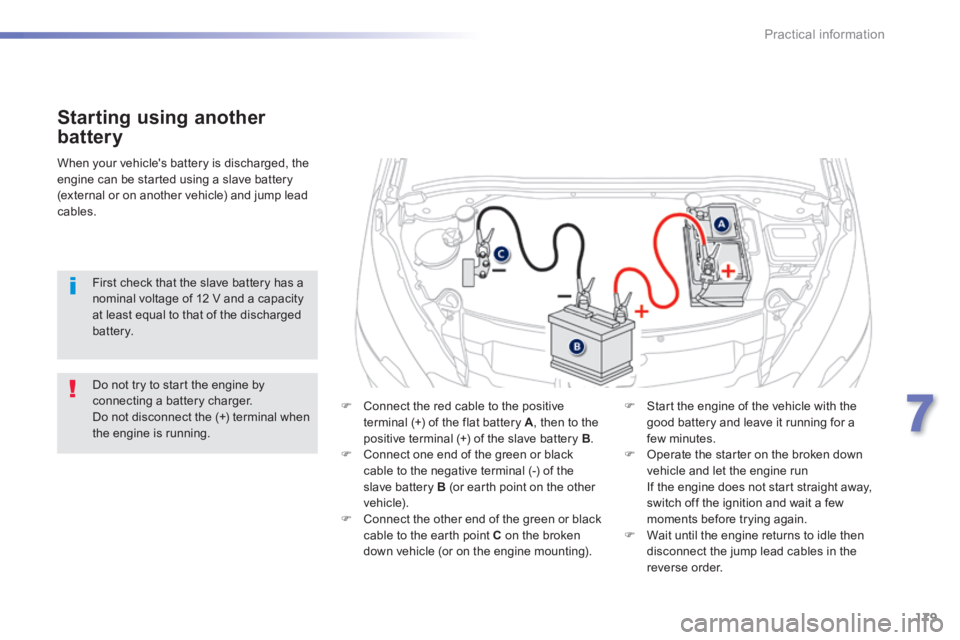
Starting using another
battery
Connect the red cable to the positive terminal (+) of the flat battery A , then to the
positive terminal (+) of the slave battery B . Connect one end of the green or black cable to the negative terminal (-) of the slave battery B (or earth point on the other vehicle). Connect the other end of the green or black cable to the earth point C on the broken down vehicle (or on the engine mounting).
Start the engine of the vehicle with the good battery and leave it running for a
few minutes. Operate the starter on the broken down vehicle and let the engine run If the engine does not start straight away, switch off the ignition and wait a few moments before trying again. Wait until the engine returns to idle then disconnect the jump lead cables in the reverse order.
When your vehicle's battery is discharged, the engine can be started using a slave battery (external or on another vehicle) and jump lead cables.
Do not try to start the engine by connecting a battery charger. Do not disconnect the (+) terminal when the engine is running.
First check that the slave battery has a nominal voltage of 12 V and a capacity at least equal to that of the discharged battery.