bonnet PEUGEOT 2008 2014 Owners Manual
[x] Cancel search | Manufacturer: PEUGEOT, Model Year: 2014, Model line: 2008, Model: PEUGEOT 2008 2014Pages: 336, PDF Size: 9.35 MB
Page 5 of 336
.
.
Contents
Direction indicators 123
Hazard warning lamps 123
Emergency or assistance call 124
H or n 124
ESC system 125
Grip control 128
Front seat belts 130
Airbags 133
Child seats 137
Deactivating the passenger's front airbag 139
ISOFIX child seats 146
Child lock 150
Safety
Temporary puncture repair kit 151
Changing a wheel 157
Snow chains 164
Changing a bulb 165
Changing a fuse 172
Battery 178
Electrical energy economy mode 181
Changing a wiper blade 182
Towing the vehicle 183
Towing a trailer 185
Fitting roof bars 187
Advice on care and maintenance 187
Accessories 188
Practical information
Bonnet 191
Petrol engines 192
Diesel engines 193
Fuel tank 194
Misfuel prevention (Diesel) 196
Running out of fuel (Diesel) 198
Checking levels 199
Checks 202
Checks
Petrol engines 204
Petrol weights 205
Diesel engines 206
Diesel weights 208
Dimensions 211
Identifi cation markings 212
Technical data
Emergency or assistance 213
Touch screen 215
Audio system / Bluetooth 277
Audio system 303
Audio equipment and telematics
Visual search
Alphabetical index
Page 8 of 336
6
194
44
191
Familiarisation
Open
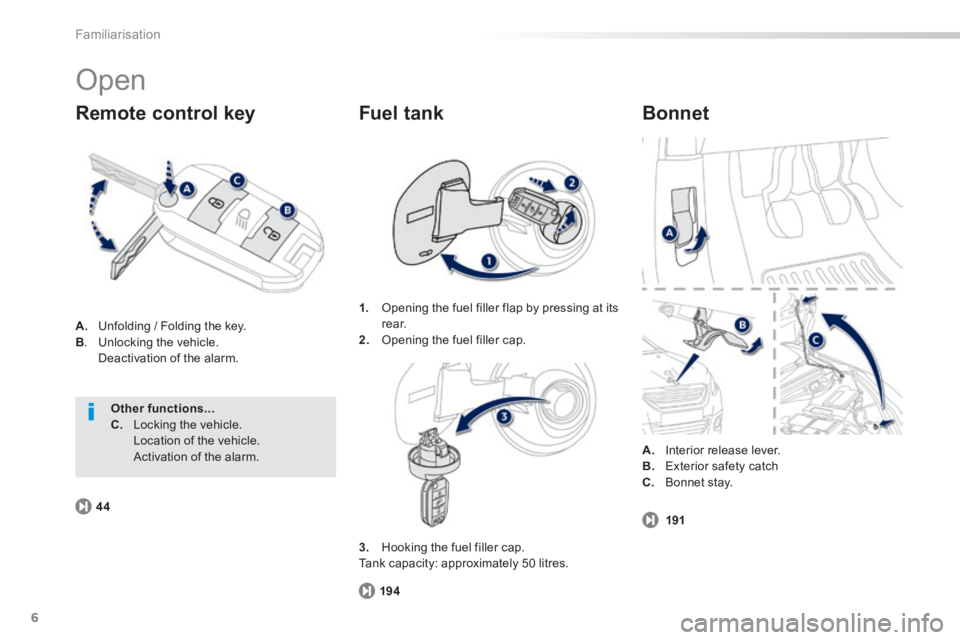
A. Unfolding / Folding the key. B . Unlocking the vehicle . Deactivation of the alarm.
Remote control key Bonnet
1. Opening the fuel filler flap by pressing at its r e a r. 2. Opening the fuel filler cap.
3. Hooking the fuel filler cap. Tank capacity: approximately 50 litres.
A. Interior release lever. B. Exterior safety catch C. Bonnet stay.
Other functions...C. Locking the vehicle.
Location of the vehicle. Activation of the alarm.
Fuel tank
Page 10 of 336
8Familiarisation
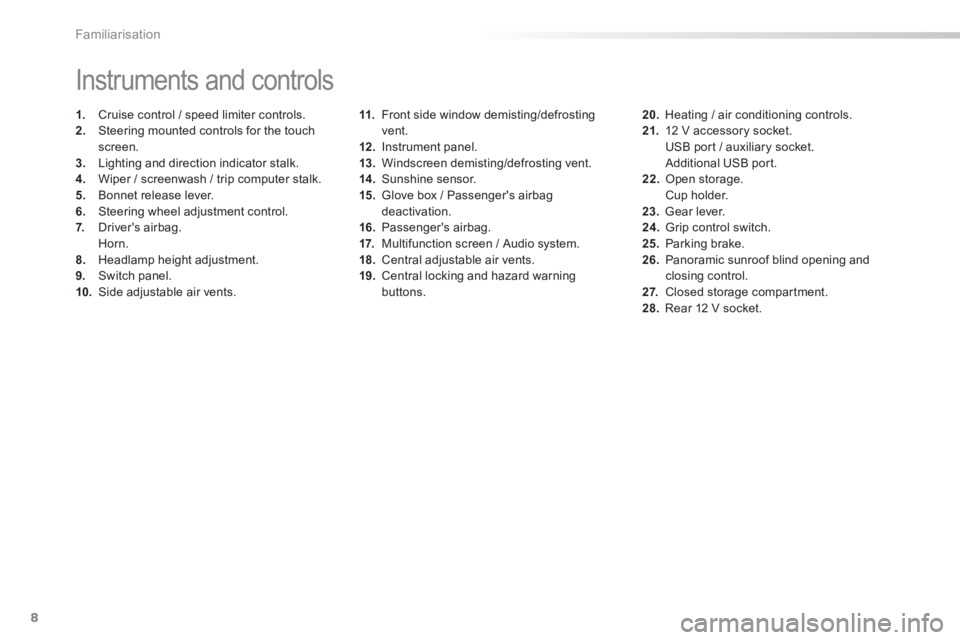
11. Front side window demisting/defrosting vent. 12 . Instrument panel. 13. Windscreen demisting/defrosting vent. 14 . Sunshine sensor. 15. Glove box / Passenger's airbag deactivation. 16. Passenger's airbag. 17. Multifunction screen / Audio system. 18. Central adjustable air vents. 19. Central locking and hazard warning buttons.
Instruments and controls
1. Cruise control / speed limiter controls. 2. Steering mounted controls for the touch screen. 3. Lighting and direction indicator stalk .4. Wiper / screenwash / trip computer stalk. 5. Bonnet release lever. 6. Steering wheel adjustment control. 7. Driver's airbag. Horn. 8. Headlamp height adjustment. 9. Switch panel. 10. Side adjustable air vents.
20. Heating / air conditioning controls. 21. 12 V accessory socket. USB port / auxiliary socket. Additional USB port. 22. Open storage. Cup holder. 23. Gear lever. 24. Grip control switch. 25. Parking brake. 26. Panoramic sunroof blind opening and closing control. 2 7. Closed storage compartment. 28. Rear 12 V socket.
Page 19 of 336
.
17
9394
94
Familiarisation
Driving safely
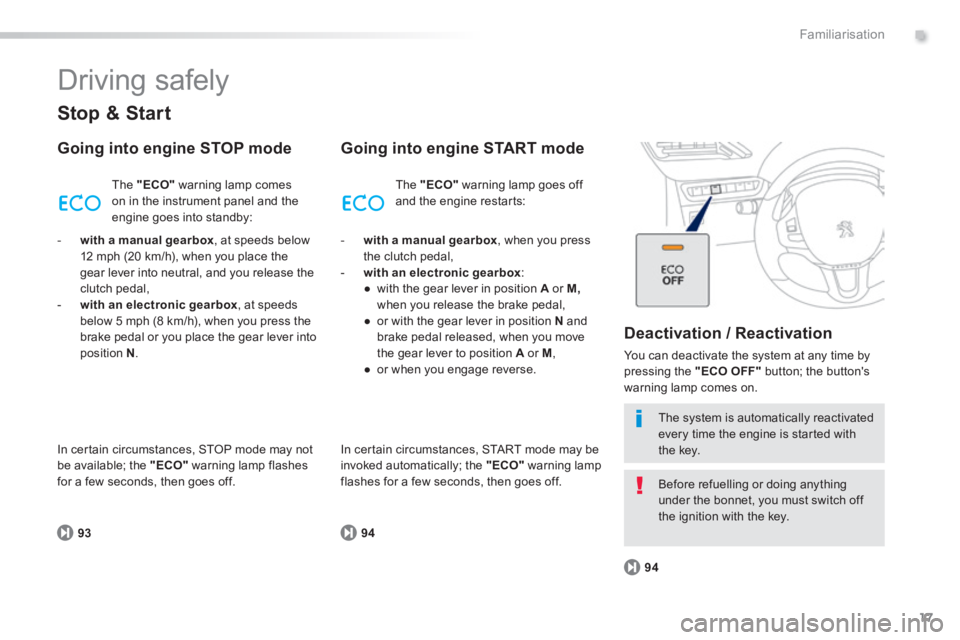
Stop & Start
Going into engine STOP mode
The "ECO" warning lamp comes on in the instrument panel and the engine goes into standby:
Going into engine START mode
Deactivation / Reactivation
You can deactivate the system at any time by pressing the "ECO OFF" button; the button's warning lamp comes on.
The system is automatically reactivated every time the engine is started with the key.
Before refuelling or doing anything under the bonnet, you must switch off the ignition with the key.
The "ECO" warning lamp goes off and the engine restarts:
- with a manual gearbox , when you press the clutch pedal, - with an electronic gearbox : ● with the gear lever in position A or M,when you release the brake pedal, ● or with the gear lever in position N and brake pedal released, when you move the gear lever to position A or M , ● or when you engage reverse.
- with a manual gearbox , at speeds below 12 mph (20 km/h), when you place the gear lever into neutral, and you release the clutch pedal, - with an electronic gearbox , at speeds below 5 mph (8 km/h), when you press the brake pedal or you place the gear lever into position N .
In certain circumstances, START mode may be invoked automatically; the "ECO" warning lamp flashes for a few seconds, then goes off.
In certain circumstances, STOP mode may not be available; the "ECO" warning lamp flashes for a few seconds, then goes off.
Page 53 of 336
51
2
Access
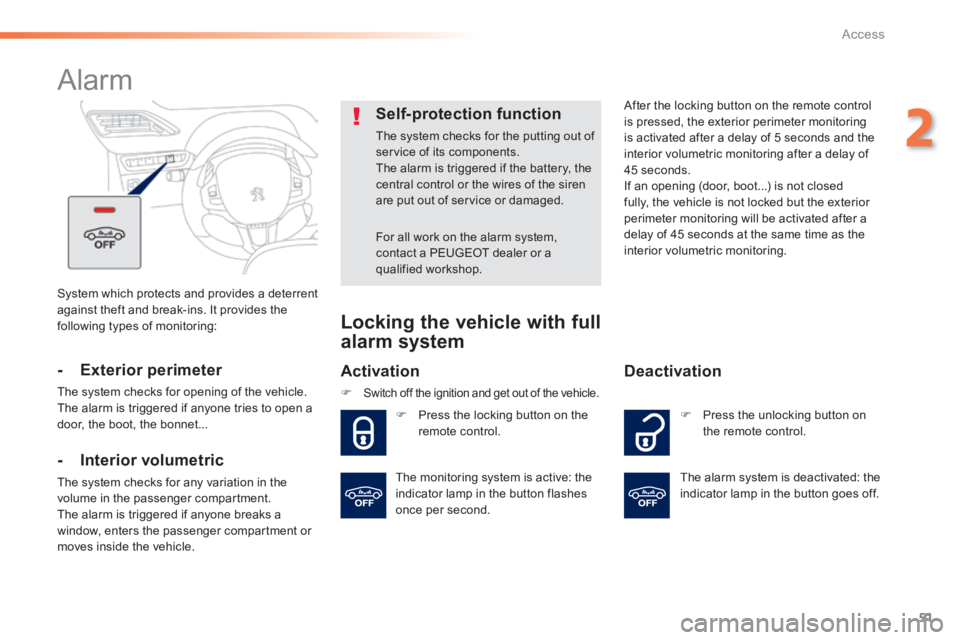
System which protects and provides a deterrent against theft and break-ins. It provides the following types of monitoring:
Alarm
- Exterior perimeter
The system checks for opening of the vehicle. The alarm is triggered if anyone tries to open a door, the boot, the bonnet...
- Interior volumetric
The system checks for any variation in the volume in the passenger compartment. The alarm is triggered if anyone breaks a window, enters the passenger compartment or
moves inside the vehicle.
Self-protection function
The system checks for the putting out of service of its components. The alarm is triggered if the battery, the central control or the wires of the siren are put out of service or damaged.
For all work on the alarm system, contact a PEUGEOT dealer or a qualified workshop.
Locking the vehicle with full
alarm system
Activation
Switch off the ignition and get out of the vehicle.
Press the locking button on the remote control.
After the locking button on the remote control is pressed, the exterior perimeter monitoring is activated after a delay of 5 seconds and the interior volumetric monitoring after a delay of 45 seconds. If an opening (door, boot...) is not closed fully, the vehicle is not locked but the exterior perimeter monitoring will be activated after a
delay of 45 seconds at the same time as the interior volumetric monitoring.
Press the unlocking button on the remote control.
Deactivation
The alarm system is deactivated: the indicator lamp in the button goes off. The monitoring system is active: the indicator lamp in the button flashes once per second.
Page 97 of 336
95
4
Driving
The system is reactivated automatically at every new start using the key.
Reactivation
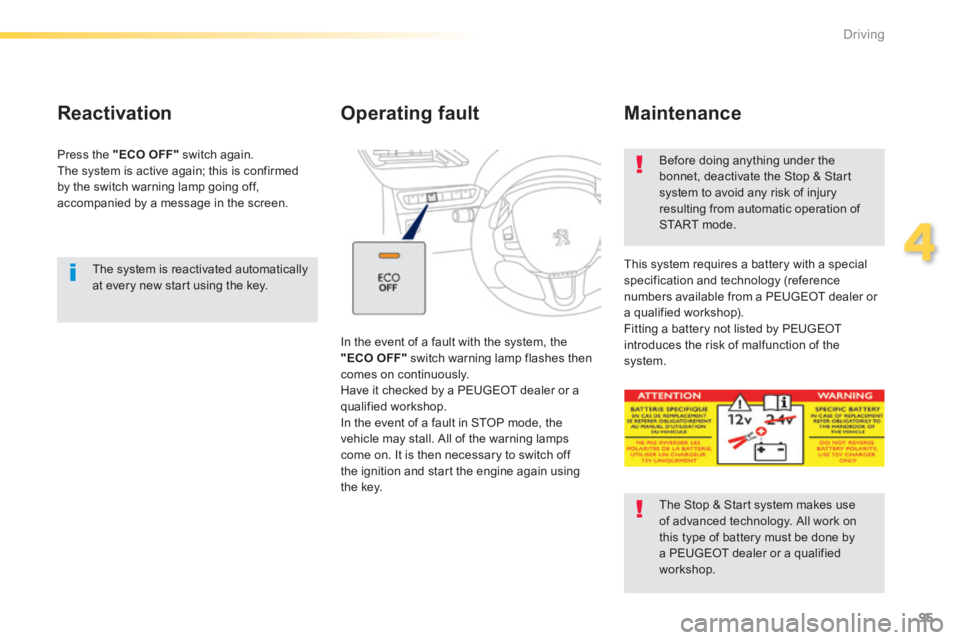
Press the "ECO OFF" switch again. The system is active again; this is confirmed by the switch warning lamp going off, accompanied by a message in the screen.
Operating fault
In the event of a fault with the system, the "ECO OFF" switch warning lamp flashes then comes on continuously. Have it checked by a PEUGEOT dealer or a qualified workshop. In the event of a fault in STOP mode, the
vehicle may stall. All of the warning lamps come on. It is then necessary to switch off the ignition and start the engine again using the key.
Before doing anything under the bonnet, deactivate the Stop & Start system to avoid any risk of injury resulting from automatic operation of START mode.
This system requires a battery with a special specification and technology (reference numbers available from a PEUGEOT dealer or a qualified workshop). Fitting a battery not listed by PEUGEOT introduces the risk of malfunction of the system.
Maintenance
The Stop & Start system makes use of advanced technology. All work on this type of battery must be done by a PEUGEOT dealer or a qualified workshop.
Page 180 of 336
178
Practical information
Battery
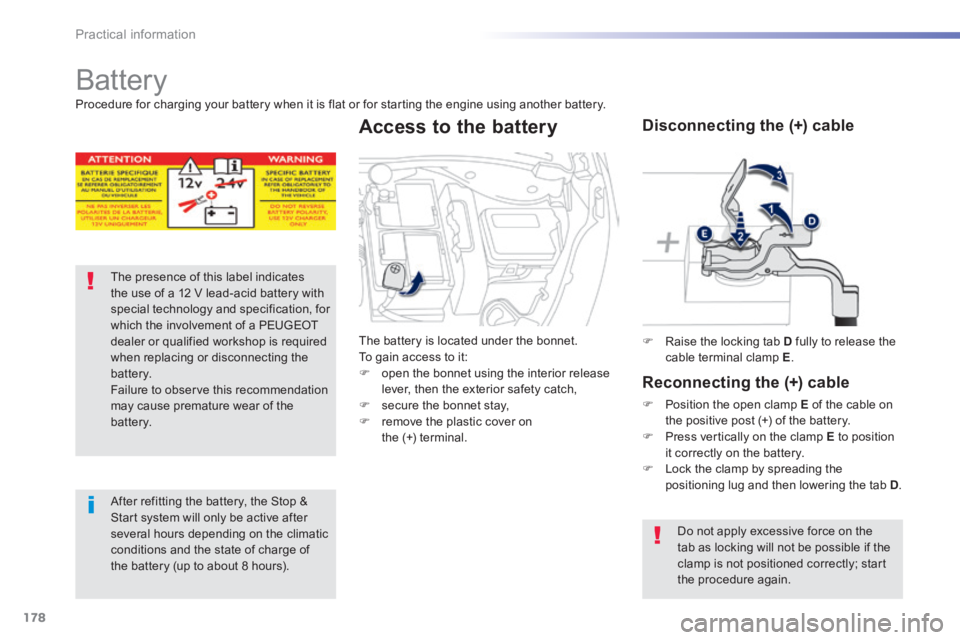
The presence of this label indicates the use of a 12 V lead-acid battery with special technology and specification, for which the involvement of a PEUGEOT dealer or qualified workshop is required when replacing or disconnecting the battery. Failure to observe this recommendation may cause premature wear of the battery.
After refitting the battery, the Stop & Start system will only be active after several hours depending on the climatic conditions and the state of charge of the battery (up to about 8 hours).
Raise the locking tab D fully to release the cable terminal clamp E .
Disconnecting the (+) cable
Reconnecting the (+) cable
Position the open clamp E of the cable on the positive post (+) of the battery.
Press vertically on the clamp E to position it correctly on the battery. Lock the clamp by spreading the positioning lug and then lowering the tab D .
Do not apply excessive force on the tab as locking will not be possible if the clamp is not positioned correctly; start the procedure again.
Procedure for charging your battery when it is flat or for starting the engine using another battery.
The battery is located under the bonnet. To gain access to it: open the bonnet using the interior release lever, then the exterior safety catch, secure the bonnet stay, remove the plastic cover on
the (+) terminal.
Access to the battery
Page 193 of 336
191
8
Checks
Bonnet
Before doing anything under the bonnet, switch off the Stop & Start system to avoid any risk of injury resulting from an automatic change to START mode.
Closing
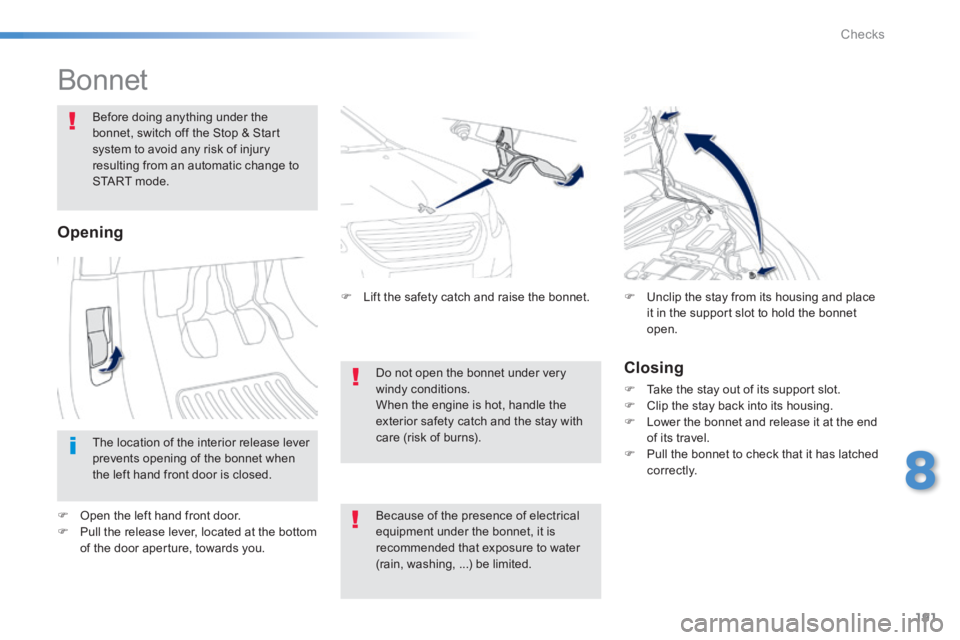
Take the stay out of its support slot. Clip the stay back into its housing. Lower the bonnet and release it at the end of its travel. Pull the bonnet to check that it has latched c o r r e c t l y.
Unclip the stay from its housing and place it in the support slot to hold the bonnet open.
Do not open the bonnet under very windy conditions. When the engine is hot, handle the exterior safety catch and the stay with care (risk of burns).
Opening
Lift the safety catch and raise the bonnet.
Open the left hand front door. Pull the release lever, located at the bottom of the door aperture, towards you.
Because of the presence of electrical equipment under the bonnet, it is recommended that exposure to water (rain, washing, ...) be limited.
The location of the interior release lever prevents opening of the bonnet when the left hand front door is closed.
Page 200 of 336
198
Checks
On vehicle fitted with HDi engines, the fuel system must be primed if you run out of fuel; refer to the engine compartment view on the "Diesel engine" section. If the tank on your vehicle is fitted with a misfuel prevention device, refer to the corresponding section.
Running out of fuel (Diesel)
If the engine does not start first time, don't keep trying. Start the procedure again from the beginning.
Fill the fuel tank with at least five litres of diesel. Open the bonnet. Press and release the priming pump until resistance is felt (there may be resistance on the first press). Operate the starter until the engine starts. Close the bonnet.
1.4 litre HDi engine
Fill the fuel tank with at least five litres of diesel. Open the bonnet. If necessary, unclip the styling cover for access to the priming pump. Squeeze and release the priming pump repeatedly until resistance is felt (there may be resistance at the first press). Operate the starter until the engine starts (if the engine does not start at the first attempt, wait around 15 seconds before trying again). If the engine does not start after a few attempts, operate the priming pump again then start the engine. Clip the styling cover back in place. Close the bonnet.
1.6 litre HDi engine
Page 201 of 336
199
8
Checks
Checking levels
Oil level
The check is carried out either when the ignition is switched on using the oil level indicator in the instrument panel, or using the dipstick.
Engine oil change
Refer to the warranty and maintenance record for details of the interval for this operation. In order to maintain the reliability of the engine and emission control system, the use of additives in the engine oil is prohibited.
Oil specifi cation
The oil must be the correct grade for your engine and conform to the manufacturer's recommendations.
The brake fluid level should be close to the "MA X" mark. If it is not, check the brake pad wear.
Brake fluid level
Changing the fl uid
Refer to the warranty and maintenance record for details of the interval for this operation.
Fluid specifi cation
The brake fluid must conform to the manufacturer's recommendations.
Take care when working under the bonnet, as certain areas of the engine may be extremely hot (risk of burns) and the cooling fan could start at any time (even with the ignition off).
Check all of these levels regularly, in line with the warranty and maintenance record. Top them up if necessary, unless other wise indicated. If a level drops significantly, have the corresponding system checked by a PEUGEOT dealer or a qualified workshop.
It is normal to top up the oil level between two services (or oil changes). PEUGEOT recommends that you check the level, and top up if necessary, every 3 000 miles (5 000 kms).
After topping up the oil, the check when switching on the ignition with the oil level indicator in the instrument panel is not valid during the 30 minutes after topping up.
It will only be correct if the vehicle is on level ground and the engine has been off for more than 30 minutes.