spare wheel PEUGEOT 2008 2014 Owners Manual
[x] Cancel search | Manufacturer: PEUGEOT, Model Year: 2014, Model line: 2008, Model: PEUGEOT 2008 2014Pages: 336, PDF Size: 9.35 MB
Page 22 of 336
20
Limit the causes of excess consumption
Spread loads throughout the vehicle; place the heaviest items in the bottom of the boot, as close as possible to the rear seats. Limit the loads carried in the vehicle and reduce wind resistance (roof bars, roof rack, bicycle carrier, trailer...). Use a roof box in preference. Remove roof bars and roof racks after use.
At the end of winter, remove snow tyres and refit your summer tyres.
Observe the recommendations on
maintenance
Check the tyre pressures regularly, when cold, referring to the label in the door aperture, driver's side. Carry out this check in particular: - before a long journey, - at each change of season, - after a long period out of use. Don't forget the spare wheel and the tyres on any trailer or caravan.
Have your vehicle serviced regularly (engine oil, oil filter, air filter, passenger compartment filter...) and observe the schedule of operations recommended in the warranty and maintenance record.
When refuelling, do not continue after the third cut-off of the nozzle to avoid any over flow.
At the wheel of your new vehicle, it is only after the first 1 800 miles (3 000 kilometres) that you will see the fuel consumption settle down to a consistent average.
Page 159 of 336
157
7
Practical information
Changing a wheel
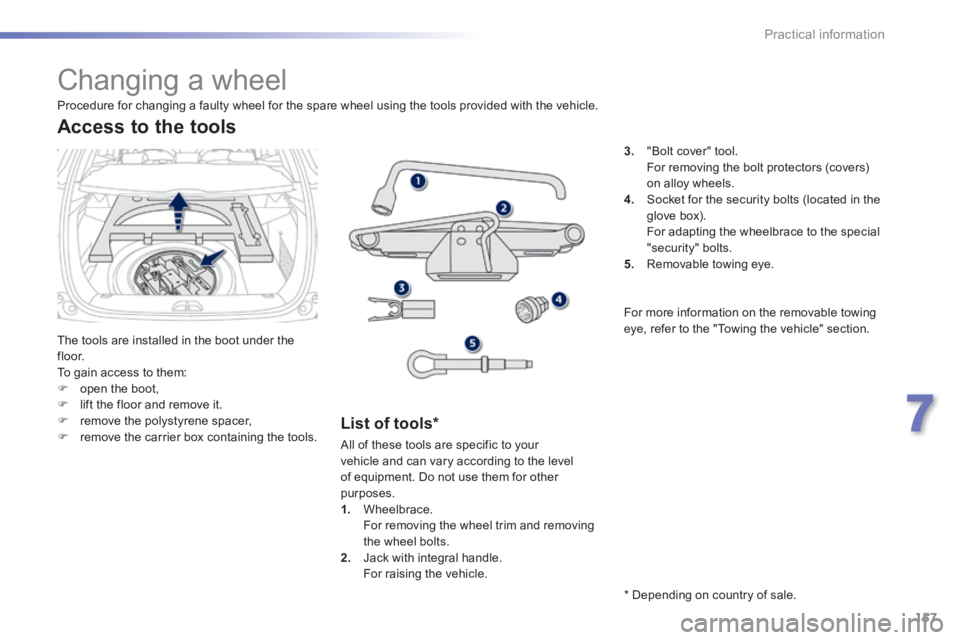
The tools are installed in the boot under the f l o o r. To gain access to them: open the boot, lift the floor and remove it. remove the polystyrene spacer, remove the carrier box containing the tools.
Access to the tools
List of tools *
3. "Bolt cover" tool. For removing the bolt protectors (covers) on alloy wheels. 4. Socket for the security bolts (located in the glove box).
For adapting the wheelbrace to the special "security" bolts. 5. Removable towing eye.
Procedure for changing a faulty wheel for the spare wheel using the tools provided with the vehicle.
All of these tools are specific to your vehicle and can vary according to the level of equipment. Do not use them for other purposes. 1. Wheelbrace. For removing the wheel trim and removing the wheel bolts. 2. Jack with integral handle. For raising the vehicle.
* Depending on country of sale.
For more information on the removable towing eye, refer to the "Towing the vehicle" section.
Page 160 of 336
158
Practical information
Wheel with trim
When refitting the wheel , refit the trim starting by placing its notch facing the valve and press around its edge with the palm of your hand.
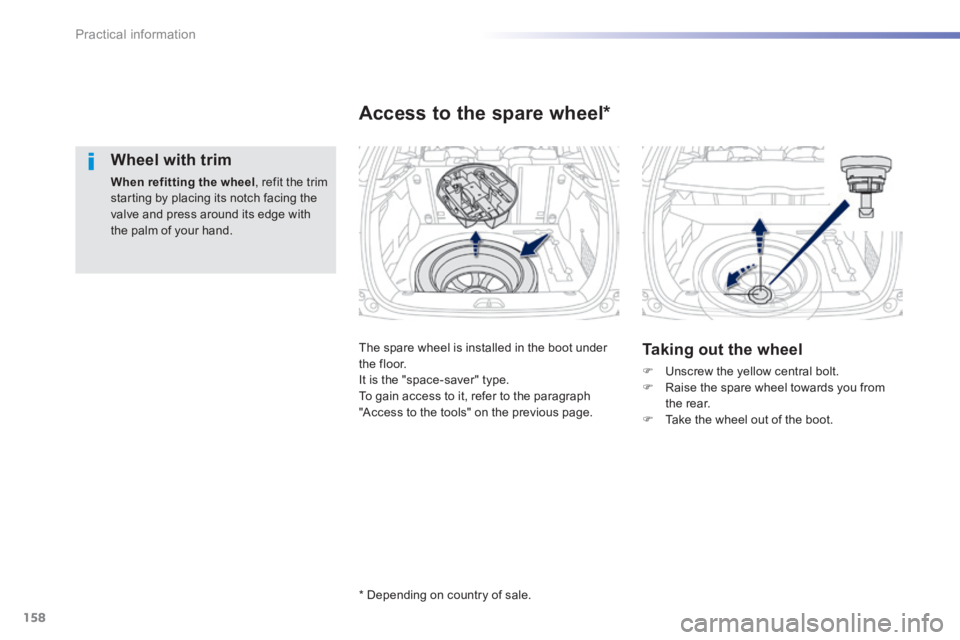
The spare wheel is installed in the boot under the floor. It is the "space-saver" type. To gain access to it, refer to the paragraph "Access to the tools" on the previous page.
Access to the spare wheel *
Taking out the wheel
Unscrew the yellow central bolt. Raise the spare wheel towards you from the rear. Take the wheel out of the boot.
* Depending on country of sale.
Page 163 of 336
161
7
Practical information
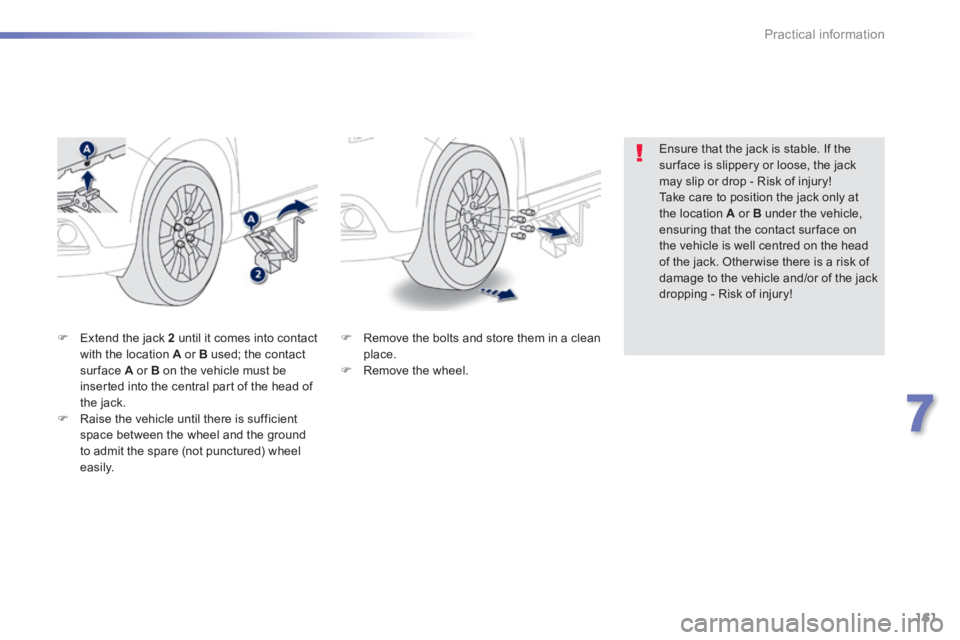
Remove the bolts and store them in a clean place. Remove the wheel.
Extend the jack 2 until it comes into contact with the location A or B used; the contact sur face A or B on the vehicle must be inserted into the central part of the head of the jack. Raise the vehicle until there is sufficient
space between the wheel and the ground to admit the spare (not punctured) wheel easily.
Ensure that the jack is stable. If the sur face is slippery or loose, the jack may slip or drop - Risk of injury! Take care to position the jack only at the location A or B under the vehicle,
ensuring that the contact sur face on the vehicle is well centred on the head of the jack. Otherwise there is a risk of damage to the vehicle and/or of the jack dropping - Risk of injury!
Page 164 of 336
162
Practical information
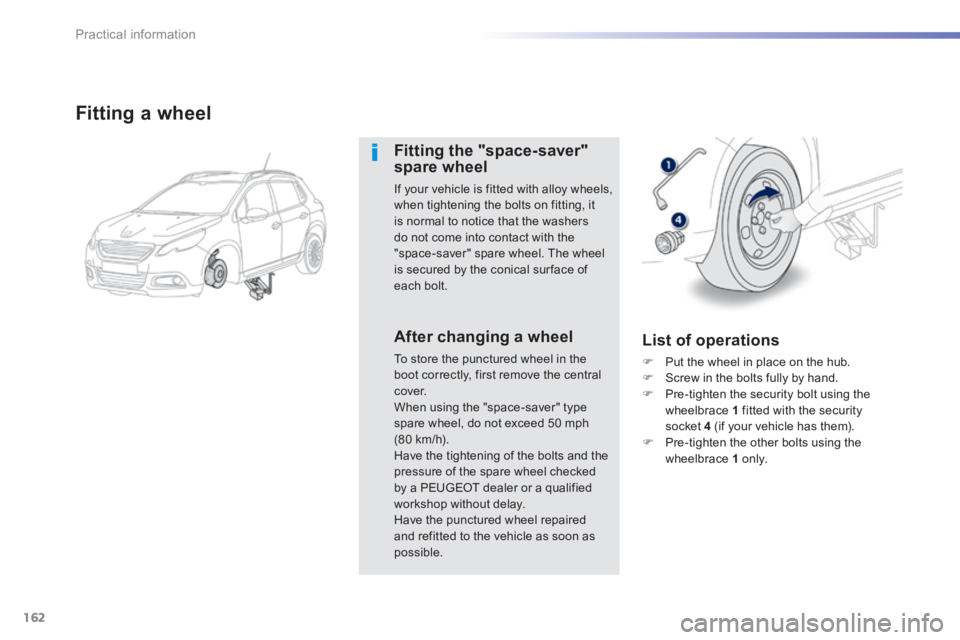
Fitting a wheel
Fitting the "space-saver" spare wheel
If your vehicle is fitted with alloy wheels, when tightening the bolts on fitting, it is normal to notice that the washers do not come into contact with the "space-saver" spare wheel. The wheel is secured by the conical sur face of each bolt.
After changing a wheel
To store the punctured wheel in the boot correctly, first remove the central cover. When using the "space-saver" type spare wheel, do not exceed 50 mph (80 km/h). Have the tightening of the bolts and the pressure of the spare wheel checked by a PEUGEOT dealer or a qualified workshop without delay. Have the punctured wheel repaired and refitted to the vehicle as soon as possible.
List of operations
Put the wheel in place on the hub. Screw in the bolts fully by hand. Pre-tighten the security bolt using the wheelbrace 1 fitted with the security socket 4 (if your vehicle has them). Pre-tighten the other bolts using the wheelbrace 1 o n l y.
Page 166 of 336
164
Practical information
Snow chains
In wintry conditions, snow chains improve traction as well as the behaviour of the vehicle when braking.
The snow chains must be fitted only to the front wheels. They must never be fitted to "space-saver" type spare wheels.
Take account of the legislation in force in your country on the use of snow chains and the maximum running speed authorised.
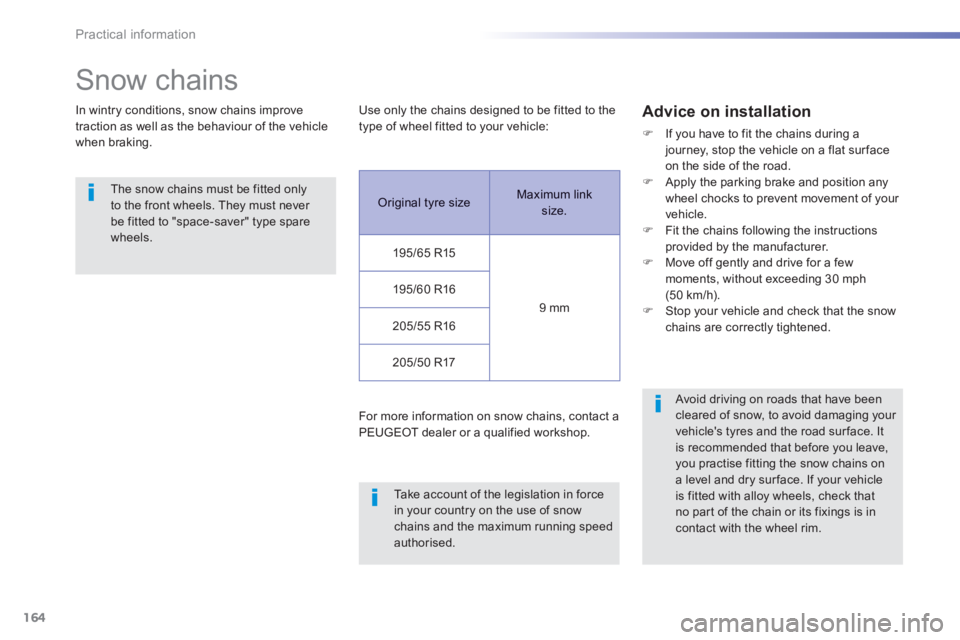
Use only the chains designed to be fitted to the type of wheel fitted to your vehicle:
For more information on snow chains, contact a
PEUGEOT dealer or a qualified workshop.
Advice on installation
If you have to fit the chains during a journey, stop the vehicle on a flat sur face on the side of the road. Apply the parking brake and position any wheel chocks to prevent movement of your vehicle. Fit the chains following the instructions provided by the manufacturer. Move off gently and drive for a few moments, without exceeding 30 mph (50 km/h). Stop your vehicle and check that the snow chains are correctly tightened.
Avoid driving on roads that have been cleared of snow, to avoid damaging your
vehicle's tyres and the road sur face. It is recommended that before you leave, you practise fitting the snow chains on a level and dry sur face. If your vehicle is fitted with alloy wheels, check that no part of the chain or its fixings is in contact with the wheel rim.
Original tyre size Maximum link size.
195/65 R15
9 mm
195/60 R16
205/55 R16
205/50 R17
Page 214 of 336
212
Technical data
Identifi cation markings
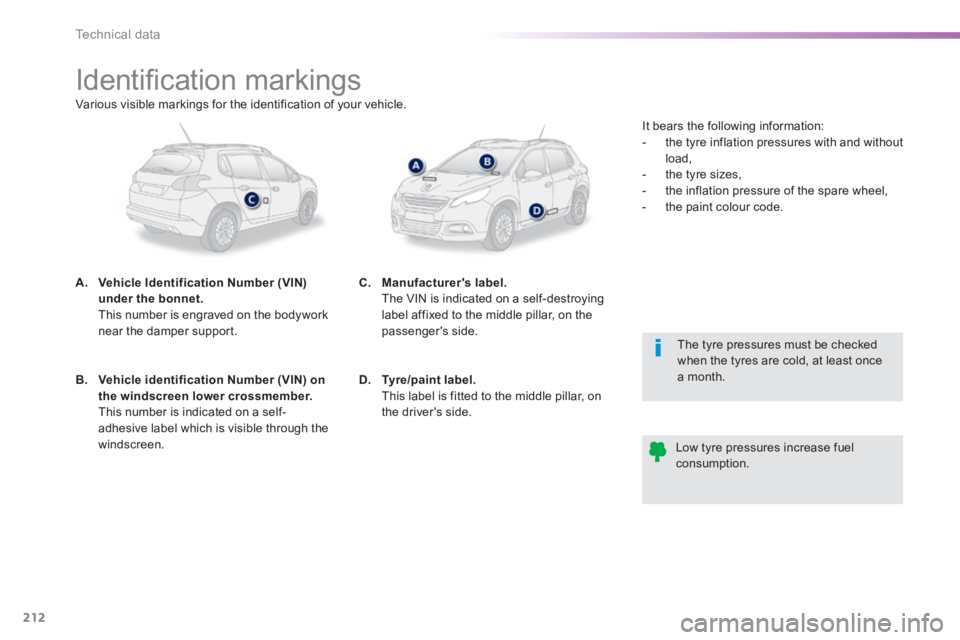
A. Vehicle Identification Number (VIN) under the bonnet. This number is engraved on the bodywork near the damper support. The tyre pressures must be checked when the tyres are cold, at least once a month.
Low tyre pressures increase fuel consumption.
B. Vehicle identification Number (VIN) on the windscreen lower crossmember. This number is indicated on a self-adhesive label which is visible through the windscreen.
C. Manufacturer's label. The VIN is indicated on a self-destroying label affixed to the middle pillar, on the passenger's side.
D. Tyre/paint label. This label is fitted to the middle pillar, on the driver's side.
It bears the following information: - the tyre inflation pressures with and without load, - the tyre sizes, - the inflation pressure of the spare wheel, - the paint colour code.
Various visible markings for the identification of your vehicle.
Page 329 of 336
.
327
Alphabetical index
Telephone ............................................258, 289Temperature adjustment ...........................65, 67Temperature control for heated seats ............58Temperature, coolant ......................................33Temporary puncture repair kit ......................151Third brake lamp ...........................................171TMC (Traffic info) ..........................................232To o l s ..............................................................157Touch screen...........................................40, 215To w b a r ...........................................................To w b a r ...........................................................To w b a r185Towed loads .........................................205, 208Towing another vehicle .................................18 4Traction control (ASR) ............................29, 125Traffic information (TA) .........................233, 282Traffic information (TMC) ......................232, 233Tr a i l e r ............................................................Tr a i l e r ............................................................Tr a i l e r185Trajectory control systems ............................125Trip computer ............................................Trip computer ............................................Trip computer38 - 42Tyre pressures ..............................................212Ty r e s ................................................................19
Unlocking ........................................................44Unlocking the boot ..........................................55Update risk areas ..........................................228Updating the date ............................................43Updating the time ............................................43USB .................................78, 248, 252, 287, 312
T
Warning lamps ..........................................23-32Warning triangle ..............................................78Washing (advice)...........................................187Wash-wipe, rear ............................................Wash-wipe, rear ............................................Wash-wipe, rear118Weights ................................................205, 208Window controls .............................................53Wiper control stalk .................................117-12 0Wiper, rear.....................................................118Wipers ..............................................26, 117-120
V
W
Screenwash fluid level ..................................200Screen-wash reservoir .................................Screen-wash reservoir .................................Screen-wash reservoir200Seat adjustment ..............................................57Seat belts .......................................13 0 -132, 142Seats, rear .......................................................Seats, rear .......................................................Seats, rear59Serial number, vehicle ..................................212Service indicator .............................................Service indicator .............................................Service indicator35Servicing .........................................................19Setting the clock .............................................43Sidelamps ......................108, 112, 113, 167, 169Side repeater ................................................Side repeater ................................................Side repeater168Snow chains ..................................................16 4Spare wheel ..........................................157, 15 8Speed limiter ...........................................Speed limiter ...........................................Speed limiter9 7, 1 0 1Start ing using another battery .........................................................179Starting the vehicle ......................79, 82, 85, 89Steering mounted controls, audio ...........................................218, 279, 305Stopping the vehicle ....................79, 82, 85, 89Stop & Start .........42, 70, 93, 178, 191, 194, 202Storage ......................................................71, 72Storage net ......................................................75Stowing rings ..................................................75Synchronising the remote control ...........................................................49Synthesiser, voice .........................................237U
Vehicle identification .....................................212Ventilation ...........................................14, 63 - 6 9
Table of weights ...................................205, 208Tables of engines .................................204, 206Tables of fuses ..............................................172Ta n k , f u e l ...............................................19 4, 19 6Technical data .......................................20 4 -212