oil PEUGEOT 2008 2016 User Guide
[x] Cancel search | Manufacturer: PEUGEOT, Model Year: 2016, Model line: 2008, Model: PEUGEOT 2008 2016Pages: 450, PDF Size: 14.16 MB
Page 186 of 450
184
2008_en_Chap09_info-pratiques_ed01-2016
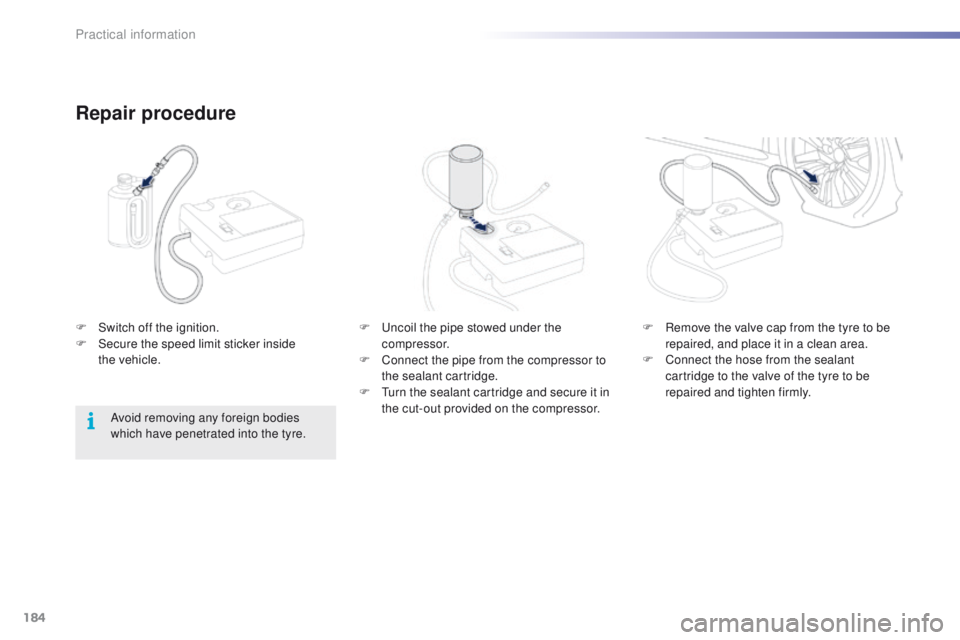
Repair procedure
F Uncoil the pipe stowed under the compressor.
F
C
onnect the pipe from the compressor to
the sealant cartridge.
F
T
urn the sealant cartridge and secure it in
the cut-out provided on the compressor. F
R emove the valve cap from the tyre to be
repaired, and place it in a clean area.
F
C
onnect the hose from the sealant
cartridge to the valve of the tyre to be
repaired and tighten firmly.
Avoid removing any foreign bodies
which have penetrated into the tyre.
F
S
witch off the ignition.
F
S
ecure the speed limit sticker inside
the
vehicle.
Practical information
Page 187 of 450
185
2008_en_Chap09_info-pratiques_ed01-2016
Take care, the sealant product is
harmful if swallowed and causes
irritation to the eyes.
Keep this product out of the reach of
children.
The use-by date is marked on the
cartridge.
After use, do not discard the
cartridge by the roadside, take it to a
PEUGEOT dealer or an authorised
waste disposal site.
Don't forget to obtain a new sealant
cartridge, available from a PEUGEOT
dealer or a qualified workshop.
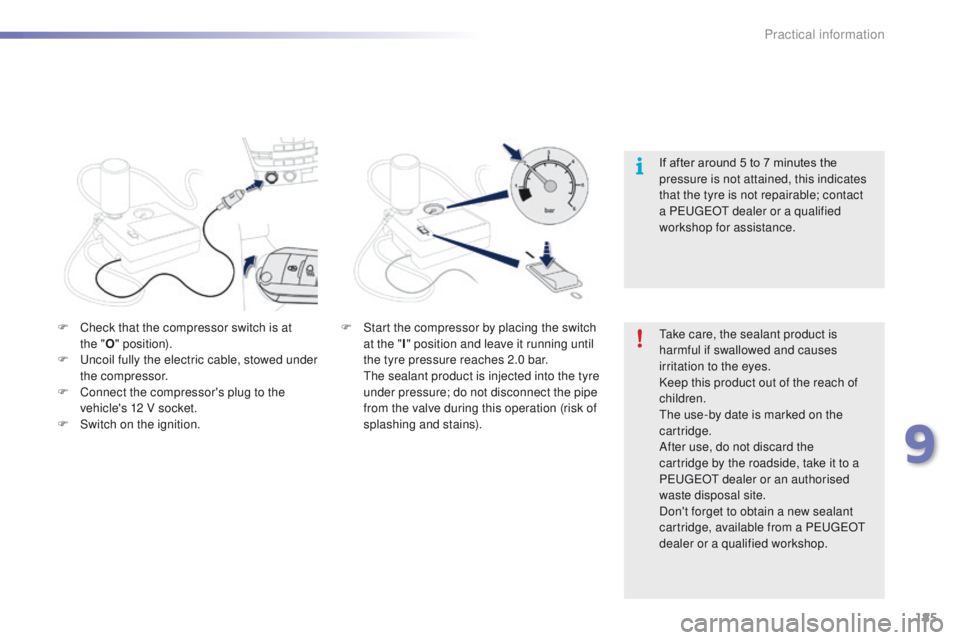
F
C
heck that the compressor switch is at
the
" O " position).
F
U
ncoil fully the electric cable, stowed under
the compressor.
F
C
onnect the compressor's plug to the
vehicle's 12 V socket.
F
S
witch on the ignition. If after around 5 to 7 minutes the
pressure is not attained, this indicates
that the tyre is not repairable; contact
a PEUGEOT dealer or a qualified
workshop for assistance.
F
S
tart the compressor by placing the switch
at the " I" position and leave it running until
the tyre pressure reaches 2.0 bar.
T
he sealant product is injected into the tyre
under pressure; do not disconnect the pipe
from the valve during this operation (risk of
splashing and stains).
9
Practical information
Page 188 of 450
186
2008_en_Chap09_info-pratiques_ed01-2016
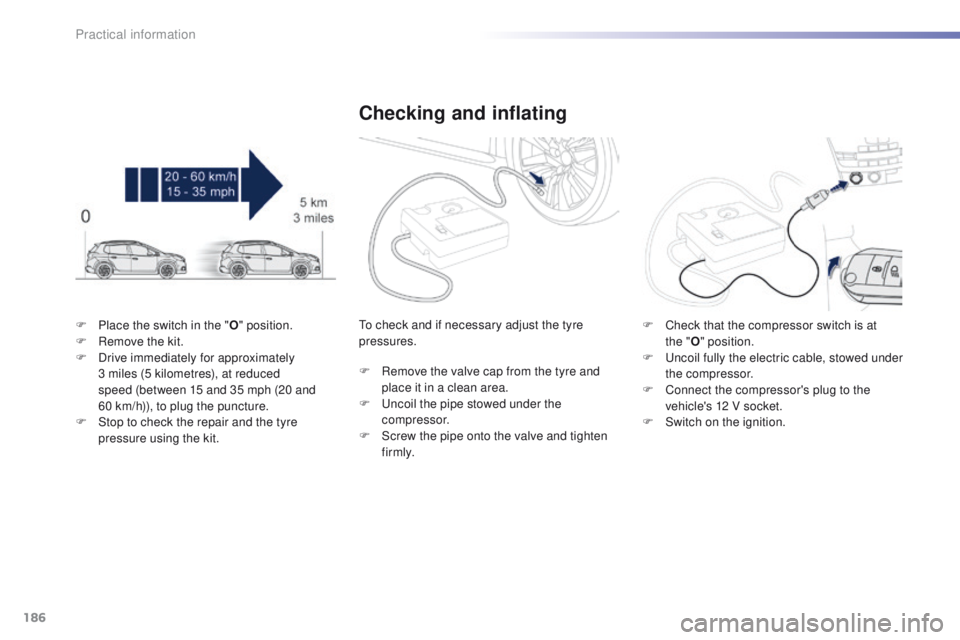
F Place the switch in the "O" position.
F R emove the kit.
F
D
rive immediately for approximately
3
miles (5 kilometres), at reduced
speed (between 15 and 35 mph (20 and
60
km/h)), to plug the puncture.
F
S
top to check the repair and the tyre
pressure using the kit.
Checking and inflating
To check and if necessary adjust the tyre
pressures.
F
R
emove the valve cap from the tyre and
place it in a clean area.
F
U
ncoil the pipe stowed under the
compressor.
F
S
crew the pipe onto the valve and tighten
f i r m l y. F
C heck that the compressor switch is at
the
"O " position.
F
U
ncoil fully the electric cable, stowed under
the compressor.
F
C
onnect the compressor's plug to the
vehicle's 12 V socket.
F
S
witch on the ignition.
Practical information
Page 192 of 450
190
2008_en_Chap09_info-pratiques_ed01-2016
Repair procedure
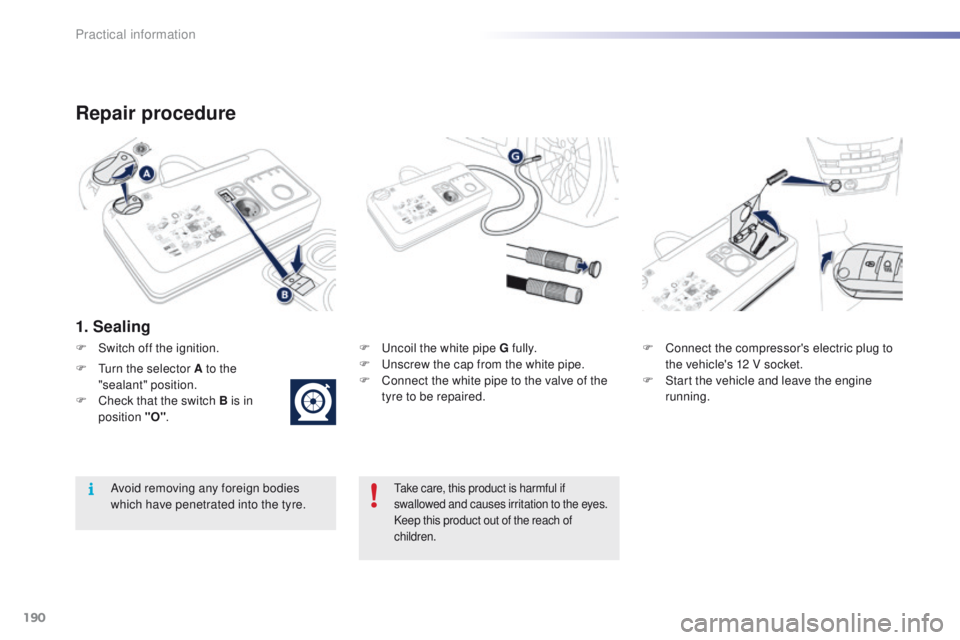
1. Sealing
F Uncoil the white pipe G fully.
F U nscrew the cap from the white pipe.
F
C
onnect the white pipe to the valve of the
tyre to be repaired. F
C onnect the compressor's electric plug to
the vehicle's 12 V socket.
F
S
tart the vehicle and leave the engine
running.
Take care, this product is harmful if
swallowed and causes irritation to the eyes.
Keep this product out of the reach of
children.Avoid removing any foreign bodies
which have penetrated into the tyre.
F
S
witch off the ignition.
F
T
urn the selector A to the
"sealant"
position.
F
C
heck that the switch B is in
position "O" .
Practical information
Page 194 of 450
192
2008_en_Chap09_info-pratiques_ed01-2016
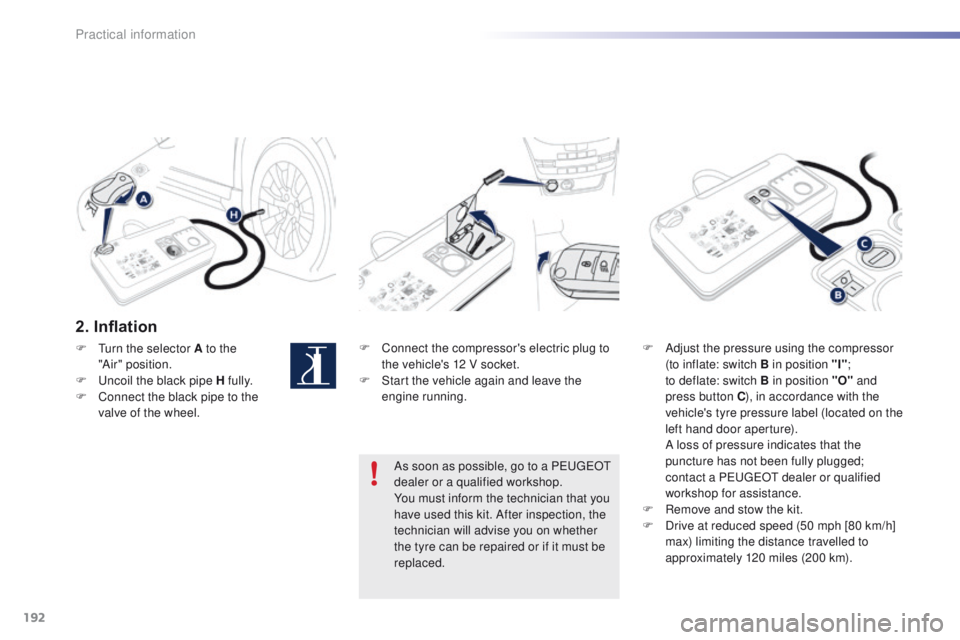
2. Inflation
F Connect the compressor's electric plug to the vehicle's 12 V socket.
F
S
tart the vehicle again and leave the
engine running. F
A djust the pressure using the compressor
(to inflate: switch B in position "I" ;
to
deflate: switch B in position "O" and
press button C ), in accordance with the
vehicle's tyre pressure label (located on the
left hand door aperture).
A l
oss of pressure indicates that the
puncture has not been fully plugged;
contact a PEUGEOT dealer or qualified
workshop for assistance.
F
R
emove and stow the kit.
F
D
rive at reduced speed (50 mph [80 km/h]
max) limiting the distance travelled to
approximately 120 miles (200 km).
As soon as possible, go to a PEUGEOT
dealer or a qualified workshop.
You must inform the technician that you
have used this kit. After inspection, the
technician will advise you on whether
the tyre can be repaired or if it must be
replaced.
F
T
urn the selector A to the
"Air"
position.
F
U
ncoil the black pipe H fully.
F
C
onnect the black pipe to the
valve of the wheel.
Practical information
Page 195 of 450
193
2008_en_Chap09_info-pratiques_ed01-2016
Removing the cartridge
F Stow the black pipe.
F D etach the angled base from the white pipe.
F
S
upport the compressor vertically.
F
U
nscrew the cartridge from the bottom.Beware of discharges of fluid.
The expiry date of the fluid is indicated
on the cartridge.
The sealant cartridge is designed for
single use; even if only partly used, it
must be replaced.
After use, do not discard the cartridge
into the environment, take it to an
authorised waste disposal site or a
PEUGEOT dealer.
Do not forget to obtain a new sealant
cartridge, available from PEUGEOT
dealers or from a qualified workshop.
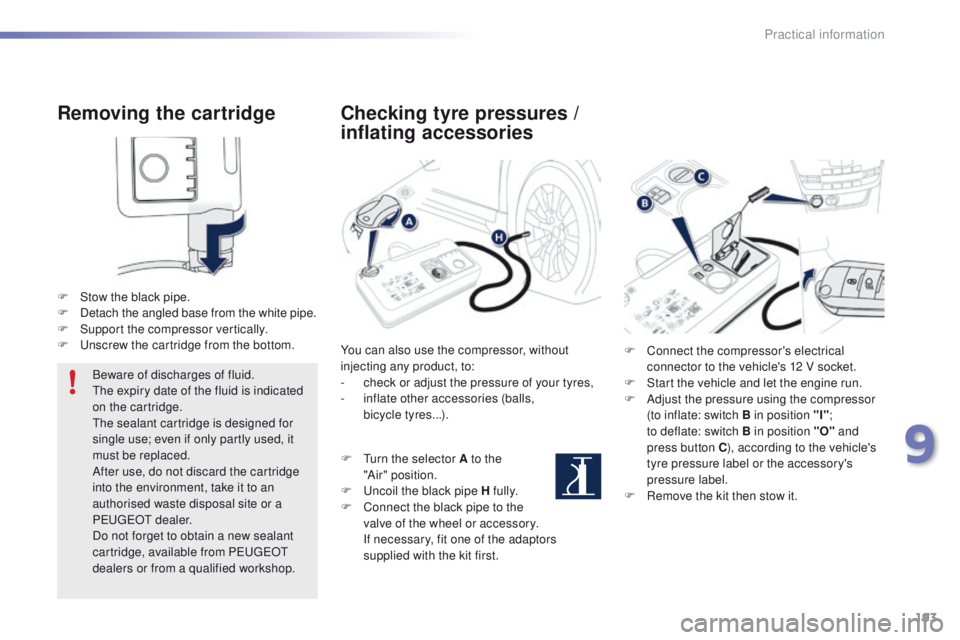
Checking tyre pressures /
inflating accessories
You can also use the compressor, without
injecting any product, to:
-
c
heck or adjust the pressure of your tyres,
-
i
nflate other accessories (balls,
bicycle
tyres...).
F
T
urn the selector A to the
"Air"
position.
F
U
ncoil the black pipe H fully.
F
C
onnect the black pipe to the
valve of the wheel or accessory.
I
f necessary, fit one of the adaptors
supplied with the kit first. F
C onnect the compressor's electrical
connector to the vehicle's 12 V socket.
F
S
tart the vehicle and let the engine run.
F
A
djust the pressure using the compressor
(to inflate: switch B in position "I" ;
to
deflate: switch B in position "O" and
press button C ), according to the vehicle's
tyre pressure label or the accessory's
pressure label.
F
R
emove the kit then stow it.
9
Practical information
Page 233 of 450
231
2008_en_Chap09_info-pratiques_ed01-2016
Accessories
A wide range of accessories and genuine parts is available from the PEUGEOT dealer network.
These accessories and parts are all suitable for your vehicle and benefit from PEUGEOT's
recommendation and warranty.
Conversion kits
You can obtain an "Enterprise" kit to convert a
private car into a trade vehicle.
"Comfort":
door deflectors, side blinds and rear blind,
cigarette lighter, boot dividers, coat hanger
fixed to head restraint, front and rear parking
sensors...
"Transport solutions":
boot liner, luggage net, roof bars, bicycle
carrier on roof bars, ski carrier, roof box, ....*
T
o avoid any risk of jamming of the pedals:
-
e
nsure that the mat is positioned and
secured correctly,
-
n
ever fit one mat on top of another.
"Styling":
gear lever knob, spoiler, styling strips, alloy
wheels, trims, chromed mirror shells, mirror
personalisation kits, wheel caps and exterior
stickers.....
"Safety and security":
anti-theft alarm, window engraving, wheel
security bolts, child seats and booster
cushions, breathalyzer, first aid kit, warning
triangle, high visibility jacket, stolen vehicle
tracking system, temporary puncture repair kit,
snow chains, non-slip covers, front foglamps
kit, dog guard...
"Protection":
mats*, seat covers compatible with lateral
airbags, mud flaps, door sill protectors, bumper
protection strips, aluminium foot rest...
9
Practical information
Page 237 of 450
235
2008_en_Chap10_verifications_ed01-2016
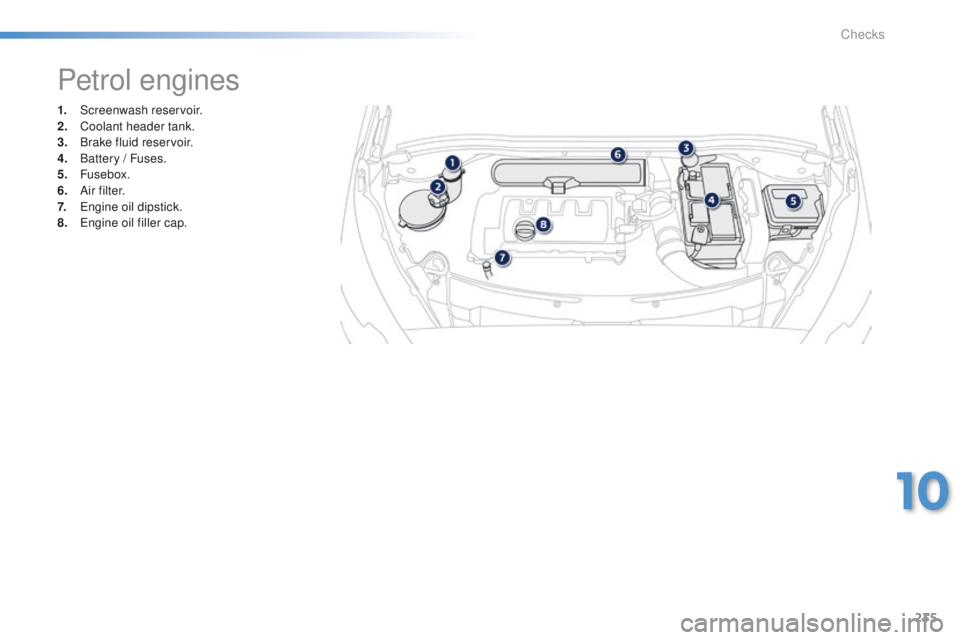
1. Screenwash reservoir.
2. Coolant header tank.
3.
B
rake fluid reservoir.
4.
B
attery / Fuses.
5.
Fusebox.
6.
A
i r f i l t e r.
7.
E
ngine oil dipstick.
8.
E
ngine oil filler cap.
Petrol engines
10
Checks
Page 238 of 450
236
2008_en_Chap10_verifications_ed01-2016
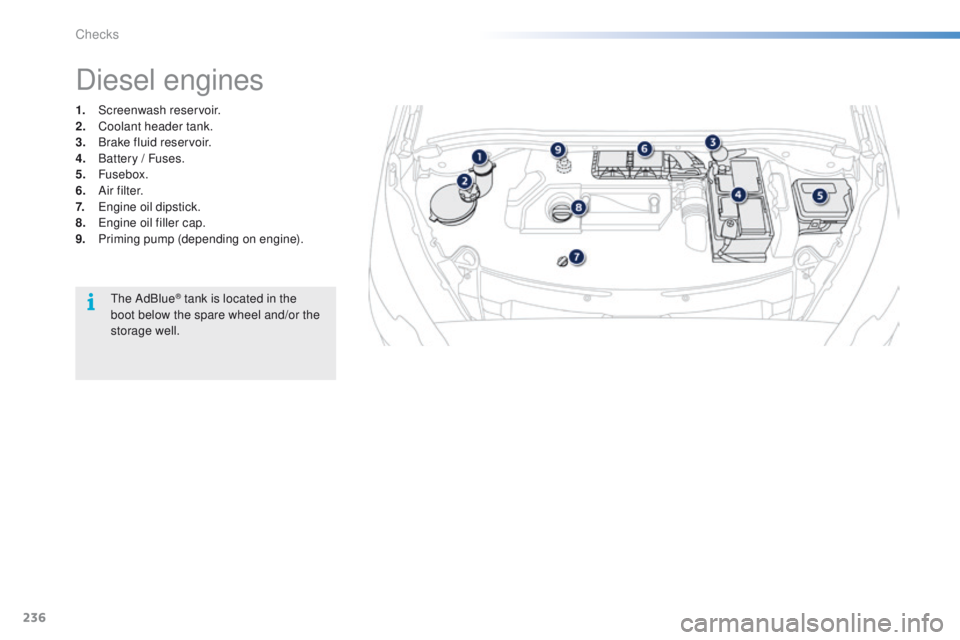
1. Screenwash reservoir.
2. Coolant header tank.
3.
B
rake fluid reservoir.
4.
B
attery / Fuses.
5.
Fusebox.
6.
A
i r f i l t e r.
7.
E
ngine oil dipstick.
8.
E
ngine oil filler cap.
9.
P
riming pump (depending on engine).
Diesel engines
The AdBlue® tank is located in the
boot below the spare wheel and/or the
storage well.
Checks
Page 239 of 450
237
2008_en_Chap10_verifications_ed01-2016
Checking levels
Oil level
The check is carried out either when the
ignition is switched on using the oil level
indicator in the instrument panel (depending
on version), or using the dipstick.Engine oil change
Refer to the warranty and maintenance record
for details of the interval for this operation.
In order to maintain the reliability of the engine
and emission control system, never use
additives in the engine oil.
Oil specification
The oil must be the correct grade for your
engine and conform to the manufacturer's
recommendations.The brake fluid level should be close
to the "MA X" mark. If it is not, check
the brake pad wear.
Brake fluid
Changing the fluid
Refer to the manufacturer's service schedule
for details of the interval for this operation.
Take care when working under the bonnet, as certain areas of the engine may be extremely hot (risk of burns) and the cooling fan could start at
any time (even with the ignition off).
Check all of these levels regularly, in line with the manufacturer's service schedule. Top them up if necessary, unless other wise indicated.
If a level drops significantly, have the corresponding system checked by a PEUGEOT dealer or a qualified workshop.
It is normal to top up the oil level
between two services (or oil changes).
PEUGEOT recommends that you check
the level, and top up if necessary, every
3 000 miles (5 000 kms).
It will only be correct if the vehicle is on level
ground and the engine has been off for more
than 30 minutes.
Fluid specification
The brake fluid must conform to the
manufacturer's recommendations.
Level
10
Checks