towing PEUGEOT 2008 2016 User Guide
[x] Cancel search | Manufacturer: PEUGEOT, Model Year: 2016, Model line: 2008, Model: PEUGEOT 2008 2016Pages: 450, PDF Size: 14.16 MB
Page 223 of 450
221
2008_en_Chap09_info-pratiques_ed01-2016
To w i n g
To w i n g e y e
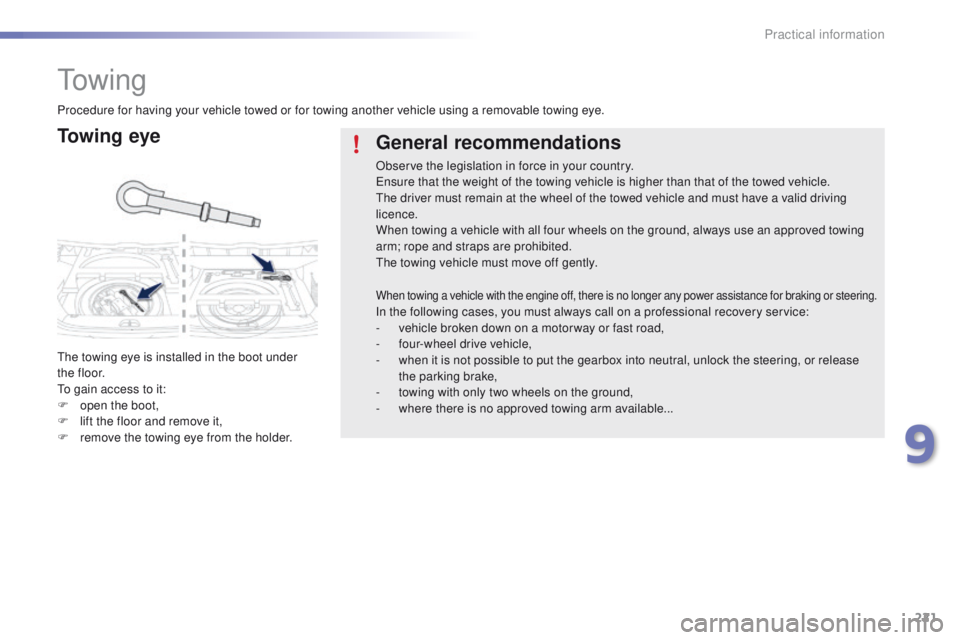
The towing eye is installed in the boot under
t h e f l o o r.
To gain access to it:
F
o
pen the boot,
F
l
ift the floor and remove it,
F
r
emove the towing eye from the holder.
General recommendations
Observe the legislation in force in your country.
Ensure that the weight of the towing vehicle is higher than that of the towed vehicle.
The driver must remain at the wheel of the towed vehicle and must have a valid driving
licence.
When towing a vehicle with all four wheels on the ground, always use an approved towing
arm; rope and straps are prohibited.
The towing vehicle must move off gently.
When towing a vehicle with the engine off, there is no longer any power assistance for braking or steering.In the following cases, you must always call on a professional recovery service:
- v ehicle broken down on a motor way or fast road,
-
f
our-wheel drive vehicle,
-
w
hen it is not possible to put the gearbox into neutral, unlock the steering, or release
the parking brake,
-
t
owing with only two wheels on the ground,
-
w
here there is no approved towing arm available...
Procedure for having your vehicle towed or for towing another vehicle using a removable towing eye.
9
Practical information
Page 224 of 450
222
2008_en_Chap09_info-pratiques_ed01-2016
Towing your vehicleTowing another vehicle
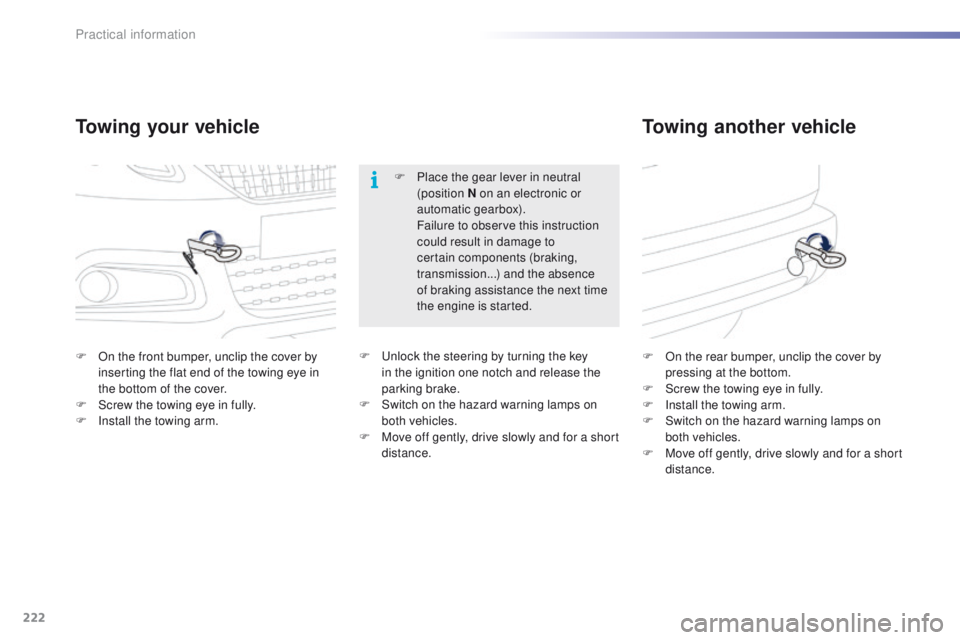
F On the front bumper, unclip the cover by
inserting the flat end of the towing eye in
the bottom of the cover.
F
S
crew the towing eye in fully.
F
I
nstall the towing arm. F
O n the rear bumper, unclip the cover by
pressing at the bottom.
F
S
crew the towing eye in fully.
F
I
nstall the towing arm.
F
S
witch on the hazard warning lamps on
both vehicles.
F
M
ove off gently, drive slowly and for a short
distance.
F
P
lace the gear lever in neutral
(position N on an electronic or
automatic gearbox).
F
ailure to observe this instruction
could result in damage to
certain components (braking,
transmission...) and the absence
of braking assistance the next time
the engine is started.
F U nlock the steering by turning the key
in the ignition one notch and release the
parking brake.
F
S
witch on the hazard warning lamps on
both vehicles.
F
M
ove off gently, drive slowly and for a short
distance.
Practical information
Page 225 of 450
223
2008_en_Chap09_info-pratiques_ed01-2016
Towing a trailer
We recommend the use of genuine
PEUGEOT towbars and their harnesses
that have been tested and approved
from the design stage of your vehicle,
and that the fitting of the towbar is
entrusted to a PEUGEOT dealer or a
qualified workshop.
If the towbar is not fitted by a
PEUGEOT dealer, it must still be
fitted in accordance with the vehicle
manufacturer's instructions.
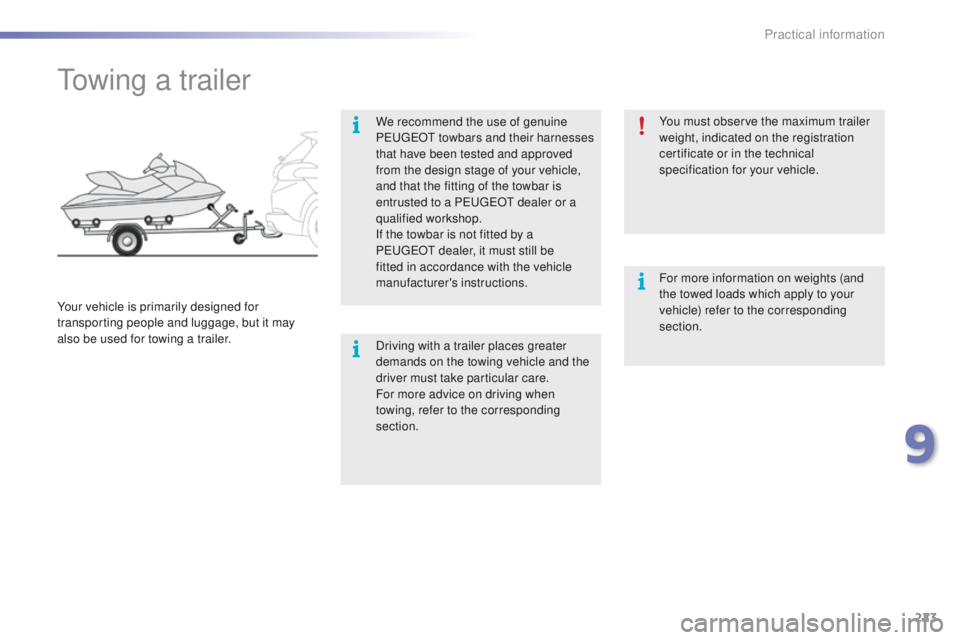
Your vehicle is primarily designed for
transporting people and luggage, but it may
also be used for towing a trailer. Driving with a trailer places greater
demands on the towing vehicle and the
driver must take particular care.
For more advice on driving when
towing, refer to the corresponding
section.You must observe the maximum trailer
weight, indicated on the registration
certificate or in the technical
specification for your vehicle.
For more information on weights (and
the towed loads which apply to your
vehicle) refer to the corresponding
section.
9
Practical information
Page 226 of 450
224
2008_en_Chap09_info-pratiques_ed01-2016
When towing
Distribution of loads
F Distribute the load in the trailer so that the heaviest items are as close as possible to
the axle and the nose weight approaches
the maximum permitted without
exceeding
it.
Air density decreases with altitude, thus
reducing engine performance. Above
1
000 metres, the maximum towed load must
be reduced by 10
% for every 1 000 metres of
altitude.
Side wind
F Take into account the increased sensitivity to side wind.For more information on weights (and
the towed loads which apply to your
vehicle) refer to the corresponding
section.
Cooling
Towing a trailer on a slope increases the
temperature of the coolant.
As the fan is electrically controlled, its cooling
capacity is not dependent on the engine speed.
F
T
o lower the engine speed, reduce your
speed.
The maximum towed load on a long incline
depends on the gradient and the ambient
temperature.
In all cases, keep a check on the coolant
temperature.
F
I
f the warning lamp and the
STOP warning lamp come on,
stop the vehicle and switch off
the engine as soon as possible.
Braking
Towing a trailer increases the braking distance.
To avoid overheating of the brakes, the use of
engine braking is recommended.
Ty r e s
F Check the tyre pressures of the towing vehicle and of the trailer, observing the
recommended pressures.
Lighting
F Check the electrical lighting and signalling on the trailer and the headlamp beam
height of your vehicle.
For more information on adjusting the
headlamp beam height, refer to the
corresponding section.
The rear parking sensors will be
deactivated automatically if a genuine
PEUGEOT towbar is used.
Practical information
Page 227 of 450
225
2008_en_Chap09_info-pratiques_ed01-2016
Towbar with quickly detachable towball
Presentation
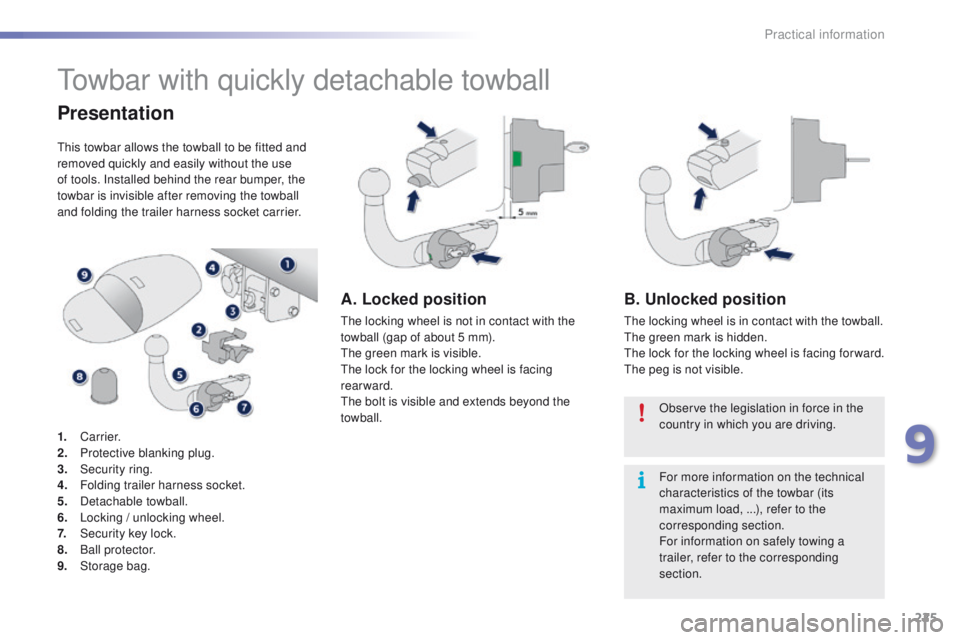
This towbar allows the towball to be fitted and
removed quickly and easily without the use
of tools. Installed behind the rear bumper, the
towbar is invisible after removing the towball
and folding the trailer harness socket carrier.
1.
Carrier.
2.
P
rotective blanking plug.
3.
S
ecurity ring.
4.
F
olding trailer harness socket.
5.
D
etachable towball.
6.
L
ocking / unlocking wheel.
7.
Sec
urity key lock.
8.
Ba
ll protector.
9.
St
orage bag.
A. Locked position
The locking wheel is not in contact with the
towball (gap of about 5 mm).
The green mark is visible.
The lock for the locking wheel is facing
rearward.
The bolt is visible and extends beyond the
towball.
B. Unlocked position
The locking wheel is in contact with the towball.
The green mark is hidden.
The lock for the locking wheel is facing for ward.
The peg is not visible. Observe the legislation in force in the
country in which you are driving.
For more information on the technical
characteristics of the towbar (its
maximum load, ...), refer to the
corresponding section.
For information on safely towing a
trailer, refer to the corresponding
section.
9
Practical information
Page 230 of 450
228
2008_en_Chap09_info-pratiques_ed01-2016
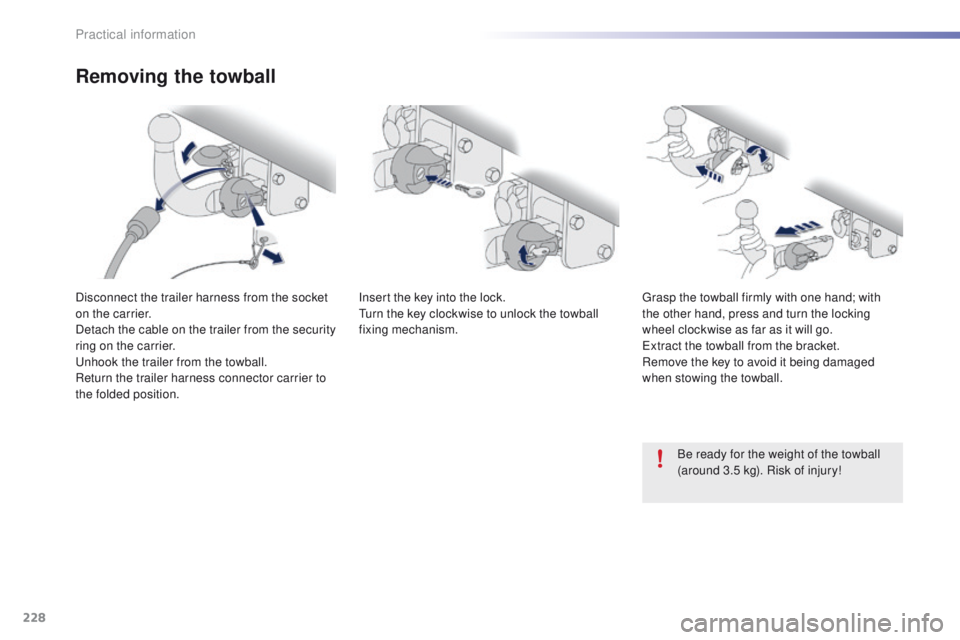
Removing the towball
Disconnect the trailer harness from the socket
on the carrier.
Detach the cable on the trailer from the security
ring on the carrier.
Unhook the trailer from the towball.
Return the trailer harness connector carrier to
the folded position.Insert the key into the lock.
Turn the key clockwise to unlock the towball
fixing mechanism.
Grasp the towball firmly with one hand; with
the other hand, press and turn the locking
wheel
clockwise as far as it will go.
Extract the towball from the bracket.
Remove the key to avoid it being damaged
when stowing the towball.
Be ready for the weight of the towball
(around 3.5 kg). Risk of injury!
Practical information
Page 231 of 450
229
2008_en_Chap09_info-pratiques_ed01-2016
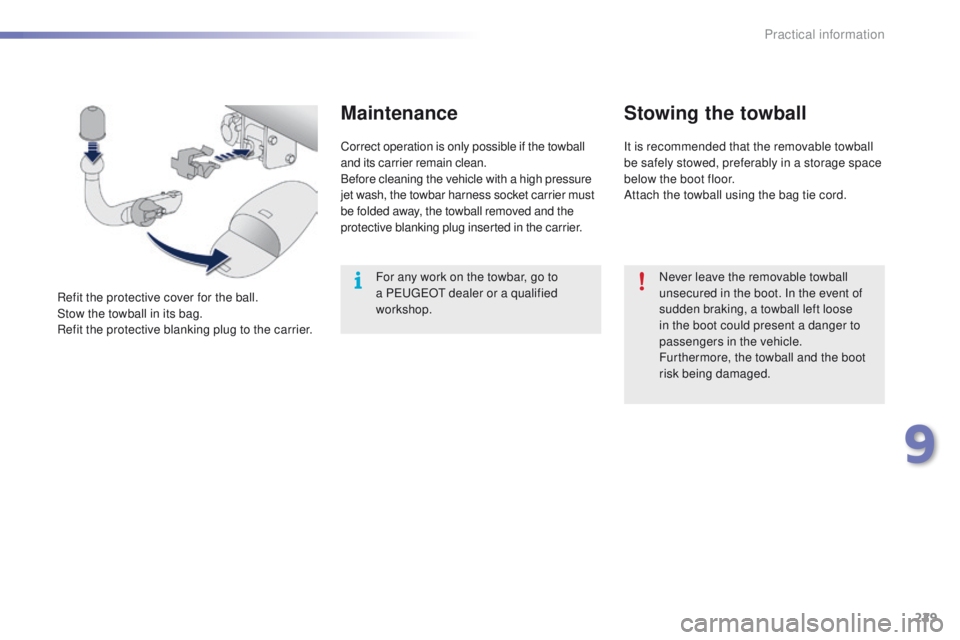
Refit the protective cover for the ball.
Stow the towball in its bag.
Refit the protective blanking plug to the carrier.
Maintenance
Correct operation is only possible if the towball
and its carrier remain clean.
Before cleaning the vehicle with a high pressure
jet wash, the towbar harness socket carrier must
be folded away, the towball removed and the
protective blanking plug inserted in the carrier.Never leave the removable towball
unsecured in the boot. In the event of
sudden braking, a towball left loose
in the boot could present a danger to
passengers in the vehicle.
Furthermore, the towball and the boot
risk being damaged.
For any work on the towbar, go to
a PEUGEOT dealer or a qualified
workshop.
Stowing the towball
It is recommended that the removable towball
be safely stowed, preferably in a storage space
below the boot floor.
Attach the towball using the bag tie cord.
9
Practical information
Page 244 of 450
242
2008_en_Chap11_caracteristiques-techniques_ed01-2016
General information
Towing with a lightly loaded vehicle can
adversely affect roadholding.
Braking distances are increased when
towing a trailer.
Never exceed 60 mph (100 km/h) when
towing (comply with the legislation in
force in your country). High ambient temperatures may result
in a reduction in the per formance of the
vehicle to protect the engine; when the
ambient temperature is higher than
37 °C, limit the towed weight.
Engine characteristics Weights and towed loads
The engine characteristics (capacity,
maximum power, maximum power speed, fuel,
CO
2 emissions...) for your vehicle are given in
t
he registration document, as well as in sales
brochures.
These characteristics correspond to the
values type-approved on a test bed, under
conditions defined in European legislation
(Directive
1999/99/EC).
For more information, contact a PEUGEOT
dealer or a qualified workshop. The maximum weights and towed loads for your
vehicle are given are given in the registration
document, as well as in sales brochures.
These values are also present on the
manufacturer's plate or label.
For more information on these identification
markings, refer to the corresponding section.
For further information, contact a PEUGEOT
dealer or a qualified workshop.
The kerb weight is equal to the unladen
weight
+ driver (75 kg).
The gross train weight and towed load values
indicated apply up to a maximum altitude of
1 000 metres; the towed load mentioned must
be reduced by 10 % for every additional
1 000 metres.
The weight of the braked trailer can be
increased, within the GTW limit, on condition
that the GV W of the towing vehicle is reduced
by the same amount.
The recommended nose weight is the vertical
load on the towball (removable with or without
to o l s). GV W:
g
ross vehicle weight, the maximum
authorised vehicle weight.
GT W: g ross train weight, the maximum
authorised weight of vehicle plus trailer.
Technical data
Page 247 of 450
245
2008_en_Chap11_caracteristiques-techniques_ed01-2016
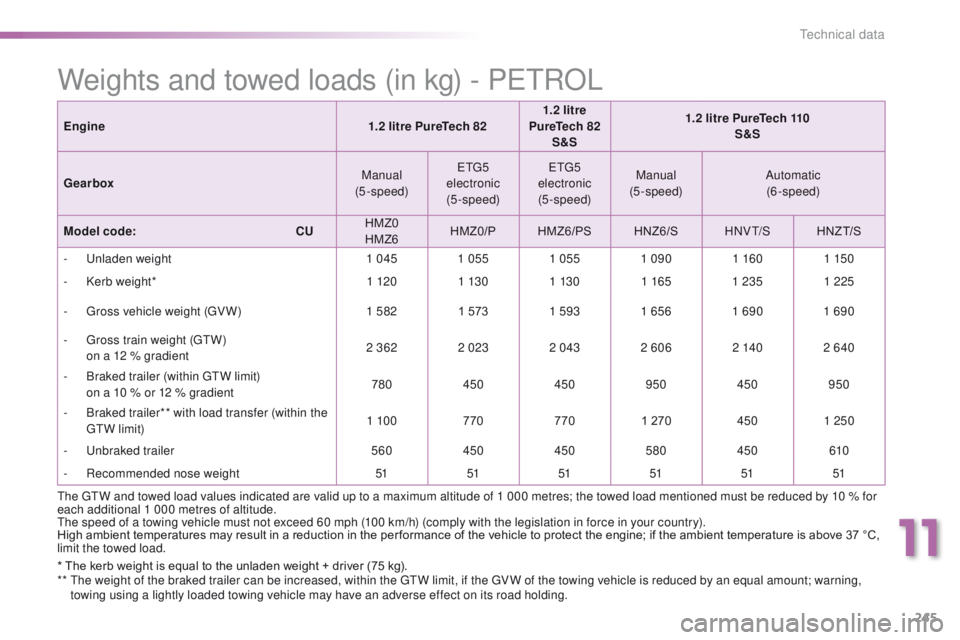
* The kerb weight is equal to the unladen weight + driver (75 kg).
** T he weight of the braked trailer can be increased, within the GTW limit, if the GV W of the towing vehicle is reduced by an equal amount; warning,
towing using a lightly loaded towing vehicle may have an adverse effect on its road holding.
Weights and towed loads (in kg) - PETROL
Engine 1.2 litre PureTech 821.
2 litre
PureTech 82 S&S 1.2 litre PureTech 110
S&S
Gearbox Manual
(5-speed) ETG5
electronic (5-speed) ETG5
electronic (5-speed) Manual
(5-speed) Automatic
(6-speed)
Model code:
C
UHMZ0
HMZ6 HMZ0/P
HMZ6/PS HNZ6/SH N V T/S H NZ T/S
-
U
nladen weight 1 0451 055 1 055 1 0901 1601 150
-
K
erb weight* 1 1201 13 0 1 13 01 1651 235 1 225
-
G
ross vehicle weight (GV W) 1 5821 5731 593 1 656 1 690 1 690
-
G
ross train weight (GTW)
o
n a 12 % gradient 2 362
2 0232 043 2 606 2 1402 640
-
B
raked trailer (within GTW limit)
o
n a 10 % or 12 % gradient 780
450 450950 450950
-
B
raked trailer** with load transfer (within the
GTW limit) 1 10 0
7707701 270 4501 250
-
U
nbraked trailer 560450450580 450 610
-
R
ecommended nose weight 515151515151
The GTW and towed load values indicated are valid up to a maximum altitude of 1 000 metres; the towed load mentioned must be reduced by 10 % for
each additional 1 000 metres of altitude.
The speed of a towing vehicle must not exceed 60 mph (100 km/h) (comply with the legislation in force in your country).
High ambient temperatures may result in a reduction in the per formance of the vehicle to protect the engine; if the ambient temperature is above 37 °C,
limit the towed load.
11
Technical data
Page 248 of 450
246
2008_en_Chap11_caracteristiques-techniques_ed01-2016
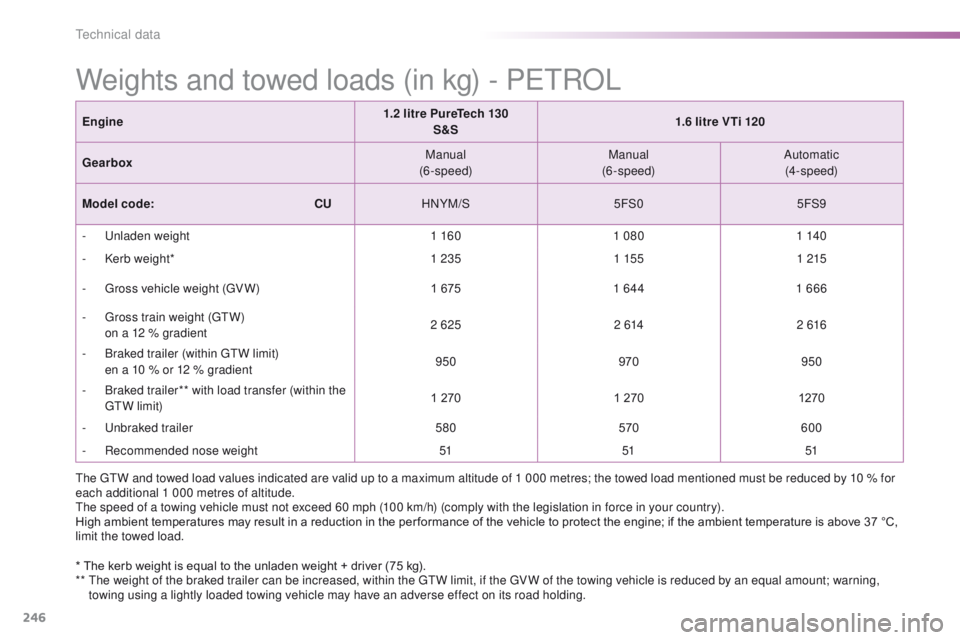
Weights and towed loads (in kg) - PETROL
Engine1.2 litre PureTech 130
S&S 1.6 litre VTi 120
Gearbox Manual
(6-speed) Manual
(6-speed) Automatic
(4-speed)
Model code:
C
UHNYM/S 5FS05FS9
-
U
nladen weight 1 1601 080 1 140
-
K
erb weight* 1 2351 1551 215
-
G
ross vehicle weight (GV W) 1 6751 644 1 666
-
G
ross train weight (GTW)
o
n a 12 % gradient 2 625
2 6142 616
-
B
raked trailer (within GTW limit)
e
n a 10 % or 12 % gradient 950
970950
-
B
raked trailer** with load transfer (within the
GTW limit) 1 270
1 270 1270
-
U
nbraked trailer 580570600
-
R
ecommended nose weight 515151
The GTW and towed load values indicated are valid up to a maximum altitude of 1 000 metres; the towed load mentioned must be reduced by 10 % for
each additional 1 000 metres of altitude.
The speed of a towing vehicle must not exceed 60 mph (100 km/h) (comply with the legislation in force in your country).
High ambient temperatures may result in a reduction in the per formance of the vehicle to protect the engine; if the ambient temperature is above 37 °C,
limit the towed load.
* The kerb weight is equal to the unladen weight + driver (75 kg).
**
T
he weight of the braked trailer can be increased, within the GTW limit, if the GV W of the towing vehicle is reduced by an equal amount; warning,
towing using a lightly loaded towing vehicle may have an adverse effect on its road holding.
Technical data