weight PEUGEOT 2008 2016 User Guide
[x] Cancel search | Manufacturer: PEUGEOT, Model Year: 2016, Model line: 2008, Model: PEUGEOT 2008 2016Pages: 450, PDF Size: 14.16 MB
Page 228 of 450
226
2008_en_Chap09_info-pratiques_ed01-2016
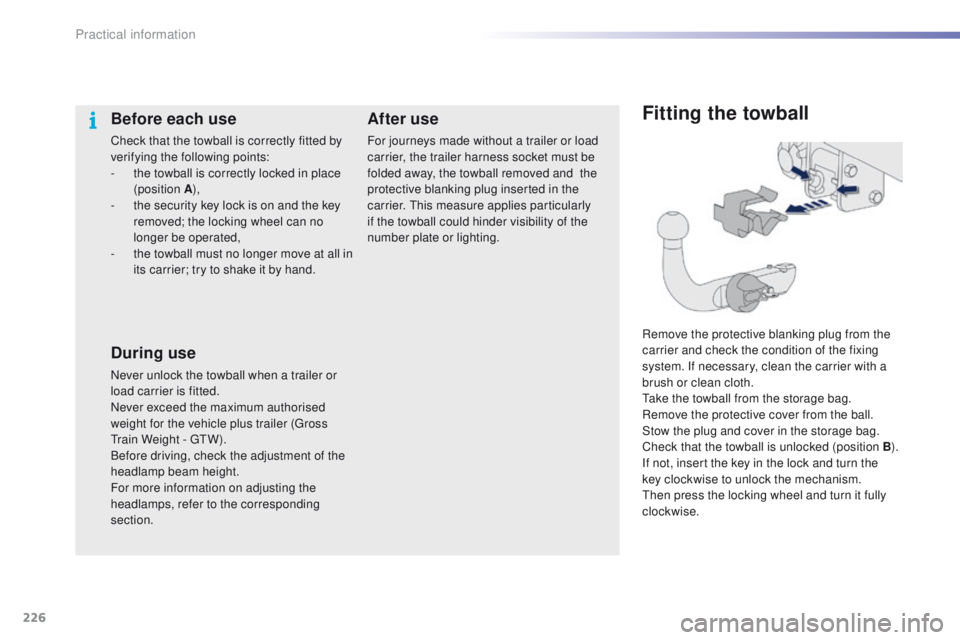
Fitting the towball
Remove the protective blanking plug from the
carrier and check the condition of the fixing
system. If necessary, clean the carrier with a
brush or clean cloth.
Take the towball from the storage bag.
Remove the protective cover from the ball.
Stow the plug and cover in the storage bag.
Check that the towball is unlocked (position B).
If not, insert the key in the lock and turn the
key clockwise to unlock the mechanism.
Then press the locking wheel and turn it fully
clockwise.
Before each use
Check that the towball is correctly fitted by
verifying the following points:
-
t
he towball is correctly locked in place
(position A ),
-
t
he security key lock is on and the key
removed; the locking wheel can no
longer be operated,
-
t
he towball must no longer move at all in
its carrier; try to shake it by hand.
During use
Never unlock the towball when a trailer or
load carrier is fitted.
Never exceed the maximum authorised
weight for the vehicle plus trailer (Gross
Train Weight - GTW).
Before driving, check the adjustment of the
headlamp beam height.
For more information on adjusting the
headlamps, refer to the corresponding
section.
After use
For journeys made without a trailer or load
carrier, the trailer harness socket must be
folded away, the towball removed and
the
protective blanking plug inserted in the
carrier. This measure applies particularly
if the towball could hinder visibility of the
number plate or lighting.
Practical information
Page 230 of 450
228
2008_en_Chap09_info-pratiques_ed01-2016
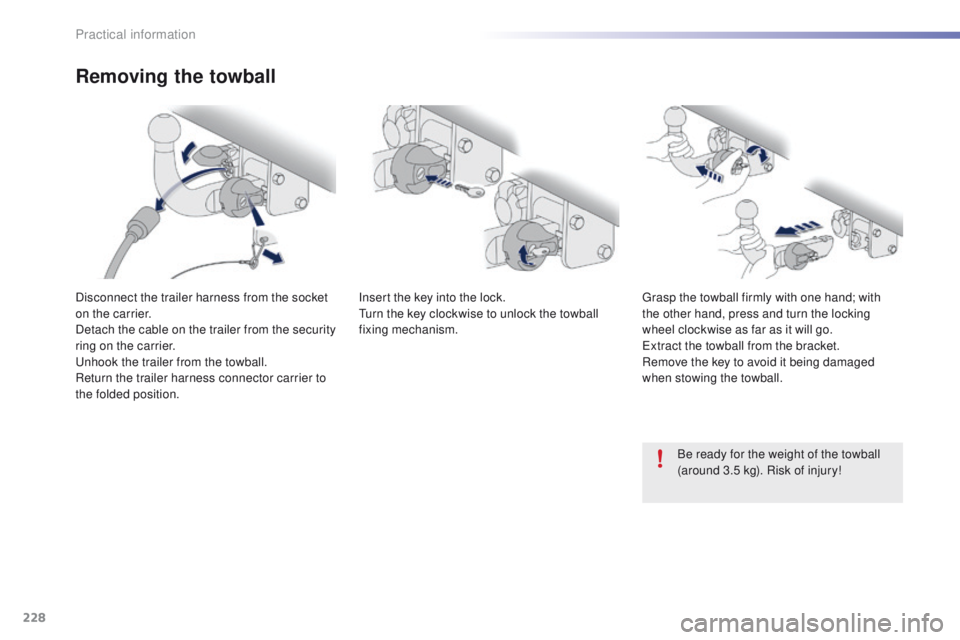
Removing the towball
Disconnect the trailer harness from the socket
on the carrier.
Detach the cable on the trailer from the security
ring on the carrier.
Unhook the trailer from the towball.
Return the trailer harness connector carrier to
the folded position.Insert the key into the lock.
Turn the key clockwise to unlock the towball
fixing mechanism.
Grasp the towball firmly with one hand; with
the other hand, press and turn the locking
wheel
clockwise as far as it will go.
Extract the towball from the bracket.
Remove the key to avoid it being damaged
when stowing the towball.
Be ready for the weight of the towball
(around 3.5 kg). Risk of injury!
Practical information
Page 232 of 450
230
2008_en_Chap09_info-pratiques_ed01-2016
Fitting roof bars
Maximum authorised weight on the roof
bars, for a loading height not exceeding
40 cm (with the exception of bicycle
carriers): refer to the instructions
provided with the roof bars.
If the height exceeds 40 cm, adapt the
speed of the vehicle to the profile of the
road to avoid damaging the roof bars
and the fixings on the roof.
Be sure to refer to national legislation in
order to comply with the regulations for
transporting objects which are longer
than the vehicle.
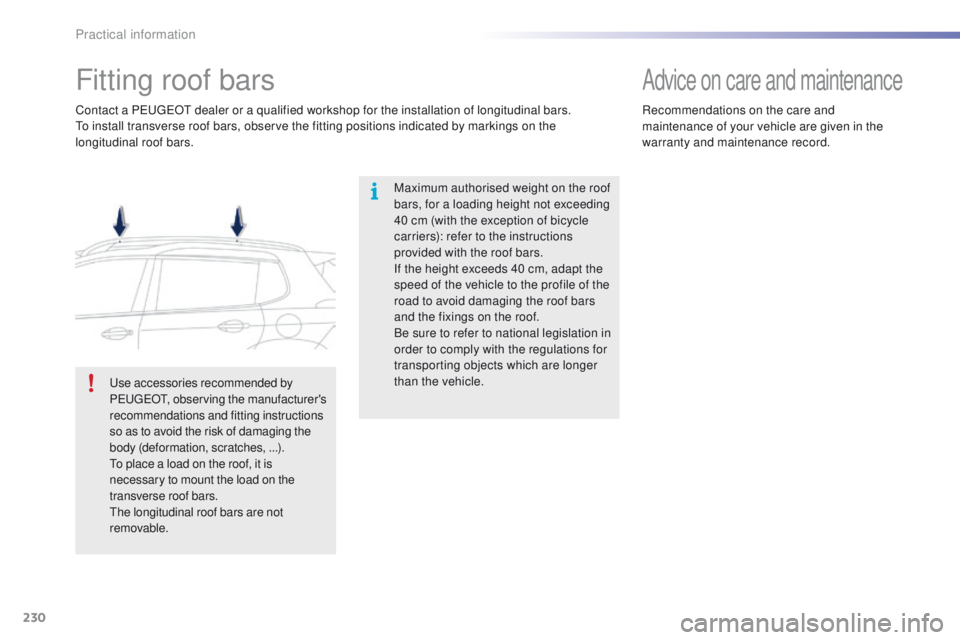
Contact a PEUGEOT dealer or a qualified workshop for the installation of longitudinal bars.
To install transverse roof bars, observe the fitting positions indicated by markings on the
longitudinal roof bars.
Use accessories recommended by
PEUGEOT,
observing the manufacturer's
recommendations and fitting instructions
so as to avoid the risk of damaging the
body (deformation, scratches, ...).
To place a load on the roof, it is
necessary to mount the load on the
transverse roof bars.
The longitudinal roof bars are not
removable.
Advice on care and maintenance
Recommendations on the care and
maintenance of your vehicle are given in the
warranty and maintenance record.
Practical information
Page 244 of 450
242
2008_en_Chap11_caracteristiques-techniques_ed01-2016
General information
Towing with a lightly loaded vehicle can
adversely affect roadholding.
Braking distances are increased when
towing a trailer.
Never exceed 60 mph (100 km/h) when
towing (comply with the legislation in
force in your country). High ambient temperatures may result
in a reduction in the per formance of the
vehicle to protect the engine; when the
ambient temperature is higher than
37 °C, limit the towed weight.
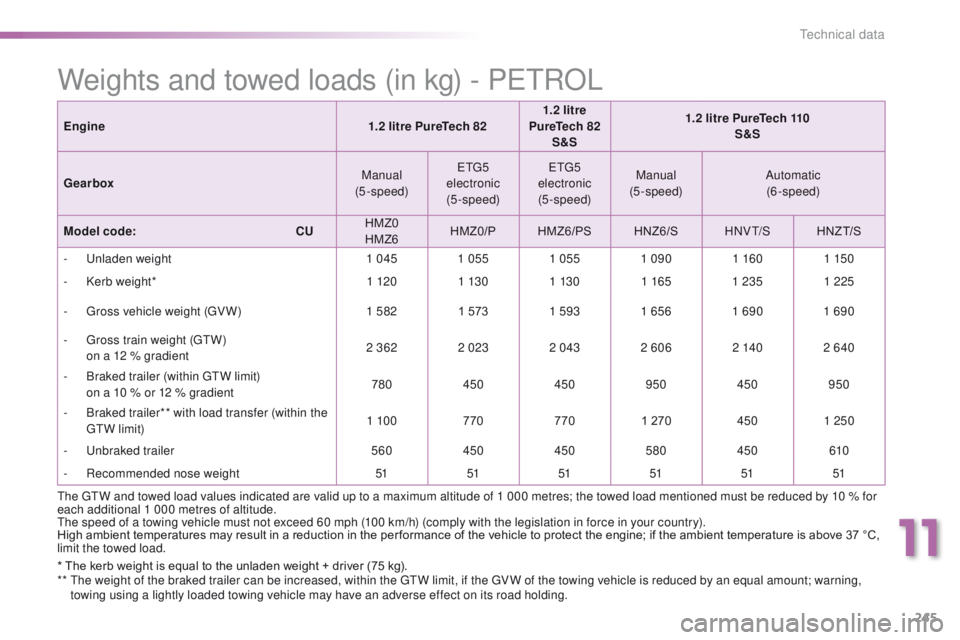
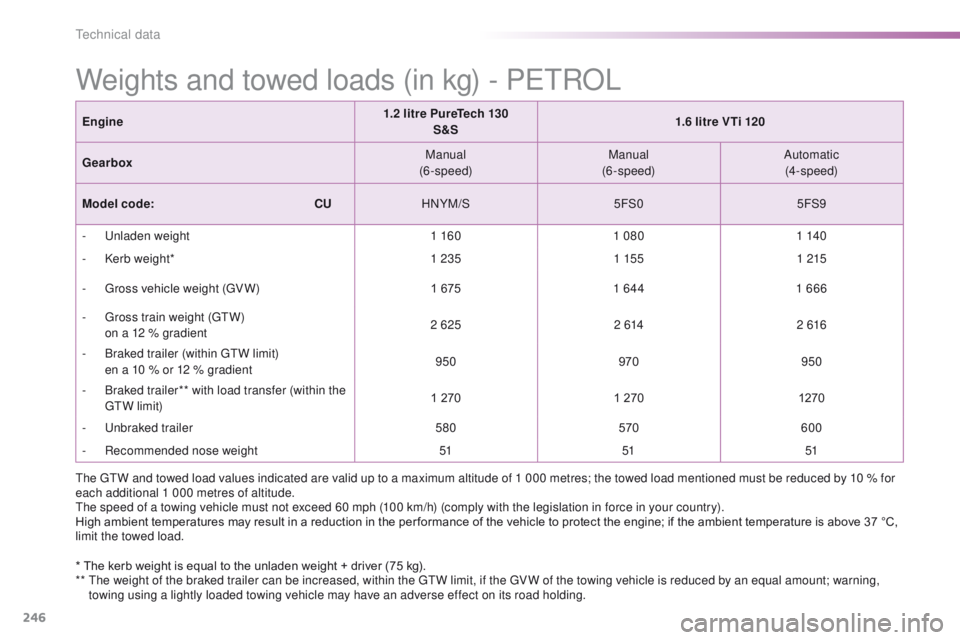
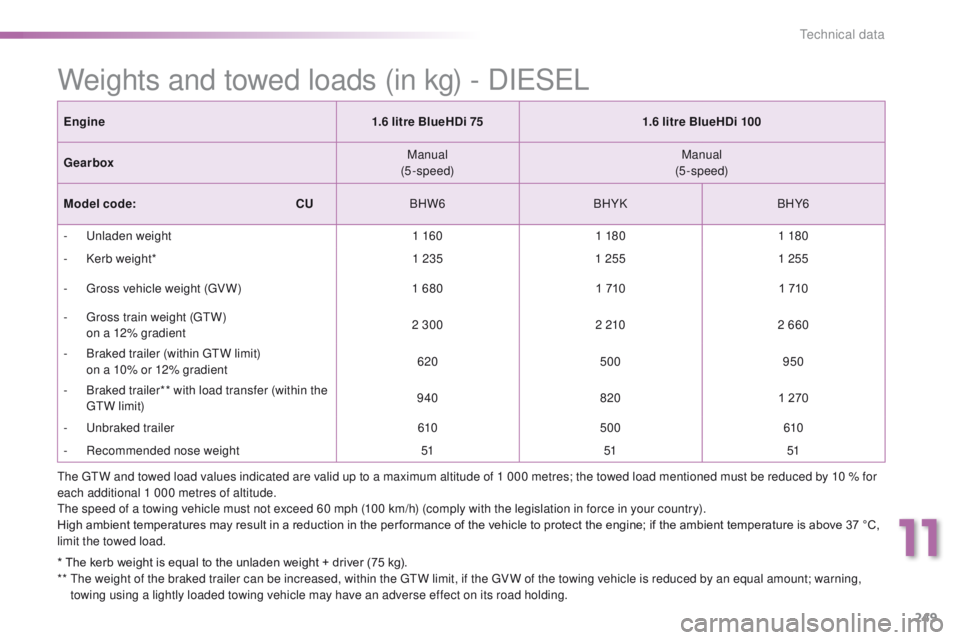
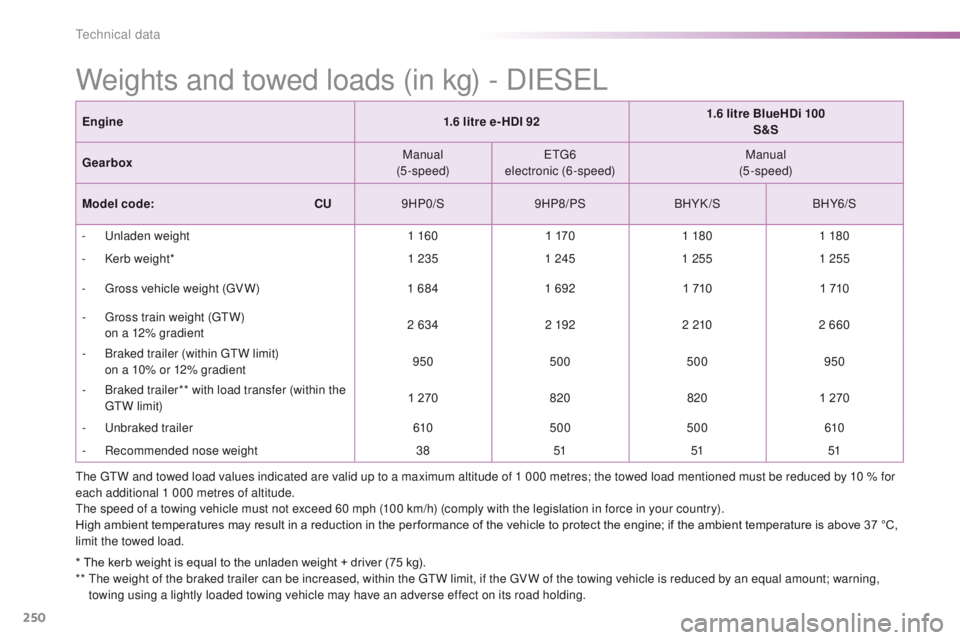
Engine characteristics Weights and towed loads
The engine characteristics (capacity,
maximum power, maximum power speed, fuel,
CO
2 emissions...) for your vehicle are given in
t
he registration document, as well as in sales
brochures.
These characteristics correspond to the
values type-approved on a test bed, under
conditions defined in European legislation
(Directive
1999/99/EC).
For more information, contact a PEUGEOT
dealer or a qualified workshop. The maximum weights and towed loads for your
vehicle are given are given in the registration
document, as well as in sales brochures.
These values are also present on the
manufacturer's plate or label.
For more information on these identification
markings, refer to the corresponding section.
For further information, contact a PEUGEOT
dealer or a qualified workshop.
The kerb weight is equal to the unladen
weight
+ driver (75 kg).
The gross train weight and towed load values
indicated apply up to a maximum altitude of
1 000 metres; the towed load mentioned must
be reduced by 10 % for every additional
1 000 metres.
The weight of the braked trailer can be
increased, within the GTW limit, on condition
that the GV W of the towing vehicle is reduced
by the same amount.
The recommended nose weight is the vertical
load on the towball (removable with or without
to o l s). GV W:
g
ross vehicle weight, the maximum
authorised vehicle weight.
GT W: g ross train weight, the maximum
authorised weight of vehicle plus trailer.
Technical data
Page 247 of 450
245
2008_en_Chap11_caracteristiques-techniques_ed01-2016
* The kerb weight is equal to the unladen weight + driver (75 kg).
** T he weight of the braked trailer can be increased, within the GTW limit, if the GV W of the towing vehicle is reduced by an equal amount; warning,
towing using a lightly loaded towing vehicle may have an adverse effect on its road holding.
Weights and towed loads (in kg) - PETROL
Engine 1.2 litre PureTech 821.
2 litre
PureTech 82 S&S 1.2 litre PureTech 110
S&S
Gearbox Manual
(5-speed) ETG5
electronic (5-speed) ETG5
electronic (5-speed) Manual
(5-speed) Automatic
(6-speed)
Model code:
C
UHMZ0
HMZ6 HMZ0/P
HMZ6/PS HNZ6/SH N V T/S H NZ T/S
-
U
nladen weight 1 0451 055 1 055 1 0901 1601 150
-
K
erb weight* 1 1201 13 0 1 13 01 1651 235 1 225
-
G
ross vehicle weight (GV W) 1 5821 5731 593 1 656 1 690 1 690
-
G
ross train weight (GTW)
o
n a 12 % gradient 2 362
2 0232 043 2 606 2 1402 640
-
B
raked trailer (within GTW limit)
o
n a 10 % or 12 % gradient 780
450 450950 450950
-
B
raked trailer** with load transfer (within the
GTW limit) 1 10 0
7707701 270 4501 250
-
U
nbraked trailer 560450450580 450 610
-
R
ecommended nose weight 515151515151
The GTW and towed load values indicated are valid up to a maximum altitude of 1 000 metres; the towed load mentioned must be reduced by 10 % for
each additional 1 000 metres of altitude.
The speed of a towing vehicle must not exceed 60 mph (100 km/h) (comply with the legislation in force in your country).
High ambient temperatures may result in a reduction in the per formance of the vehicle to protect the engine; if the ambient temperature is above 37 °C,
limit the towed load.
11
Technical data
Page 248 of 450
246
2008_en_Chap11_caracteristiques-techniques_ed01-2016
Weights and towed loads (in kg) - PETROL
Engine1.2 litre PureTech 130
S&S 1.6 litre VTi 120
Gearbox Manual
(6-speed) Manual
(6-speed) Automatic
(4-speed)
Model code:
C
UHNYM/S 5FS05FS9
-
U
nladen weight 1 1601 080 1 140
-
K
erb weight* 1 2351 1551 215
-
G
ross vehicle weight (GV W) 1 6751 644 1 666
-
G
ross train weight (GTW)
o
n a 12 % gradient 2 625
2 6142 616
-
B
raked trailer (within GTW limit)
e
n a 10 % or 12 % gradient 950
970950
-
B
raked trailer** with load transfer (within the
GTW limit) 1 270
1 270 1270
-
U
nbraked trailer 580570600
-
R
ecommended nose weight 515151
The GTW and towed load values indicated are valid up to a maximum altitude of 1 000 metres; the towed load mentioned must be reduced by 10 % for
each additional 1 000 metres of altitude.
The speed of a towing vehicle must not exceed 60 mph (100 km/h) (comply with the legislation in force in your country).
High ambient temperatures may result in a reduction in the per formance of the vehicle to protect the engine; if the ambient temperature is above 37 °C,
limit the towed load.
* The kerb weight is equal to the unladen weight + driver (75 kg).
**
T
he weight of the braked trailer can be increased, within the GTW limit, if the GV W of the towing vehicle is reduced by an equal amount; warning,
towing using a lightly loaded towing vehicle may have an adverse effect on its road holding.
Technical data
Page 251 of 450
249
2008_en_Chap11_caracteristiques-techniques_ed01-2016
Weights and towed loads (in kg) - DIESEL
Engine1.6 litre BlueHDi 751.6 litre BlueHDi 100
Gearbox Manual
(5-speed) Manual
(5-speed)
Model code:
C
UBHW6 BHYKBHY6
-
U
nladen weight 1 1601 1801 180
-
K
erb weight* 1 2351 2551 255
-
G
ross vehicle weight (GV W) 1 6801 7101 710
-
G
ross train weight (GTW)
o
n a 12% gradient 2 300
2 2102 660
-
B
raked trailer (within GTW limit)
o
n a 10% or 12% gradient 620
500 950
-
B
raked trailer** with load transfer (within the
GTW limit) 940
8201 270
-
U
nbraked trailer 610500 610
-
R
ecommended nose weight 515151
The GTW and towed load values indicated are valid up to a maximum altitude of 1 000 metres; the towed load mentioned must be reduced by 10 % for
each additional 1 000 metres of altitude.
The speed of a towing vehicle must not exceed 60 mph (100 km/h) (comply with the legislation in force in your country).
High ambient temperatures may result in a reduction in the per formance of the vehicle to protect the engine; if the ambient temperature is above 37 °C,
limit the towed load.
* The kerb weight is equal to the unladen weight + driver (75 kg).
**
T
he weight of the braked trailer can be increased, within the GTW limit, if the GV W of the towing vehicle is reduced by an equal amount; warning,
towing using a lightly loaded towing vehicle may have an adverse effect on its road holding.
11
Technical data
Page 252 of 450
250
2008_en_Chap11_caracteristiques-techniques_ed01-2016
Weights and towed loads (in kg) - DIESEL
* The kerb weight is equal to the unladen weight + driver (75 kg).
** T he weight of the braked trailer can be increased, within the GTW limit, if the GV W of the towing vehicle is reduced by an equal amount; warning,
towing using a lightly loaded towing vehicle may have an adverse effect on its road holding.
Engine
1.6 litre e- HDI 921.6 litre BlueHDi 100
S&S
Gearbox Manual
(5-speed) ETG6
electronic (6-speed) Manual
(5-speed)
Model code:
C
U
9HP0/S 9HP8/PS BHYK /SBHY6/S
-
U
nladen weight
1 1601 1701 180 1 180
-
K
erb weight*
1 2351 2451 255 1 255
-
G
ross vehicle weight (GV W)
1 6841 692 1 7101 710
-
G
ross train weight (GTW)
o
n a 12% gradient
2 634
2 1922 2102 660
-
B
raked trailer (within GTW limit)
o
n a 10% or 12% gradient
950
500 500 950
-
B
raked trailer** with load transfer (within the
GTW limit) 1 270
8208201 270
-
U
nbraked trailer
610500 500 610
-
R
ecommended nose weight
38515151
The GTW and towed load values indicated are valid up to a maximum altitude of 1 000 metres; the towed load mentioned must be reduced by 10 % for
each additional 1 000 metres of altitude.
The speed of a towing vehicle must not exceed 60 mph (100 km/h) (comply with the legislation in force in your country).
High ambient temperatures may result in a reduction in the per formance of the vehicle to protect the engine; if the ambient temperature is above 37 °C,
limit the towed load.
Technical data
Page 253 of 450
251
2008_en_Chap11_caracteristiques-techniques_ed01-2016
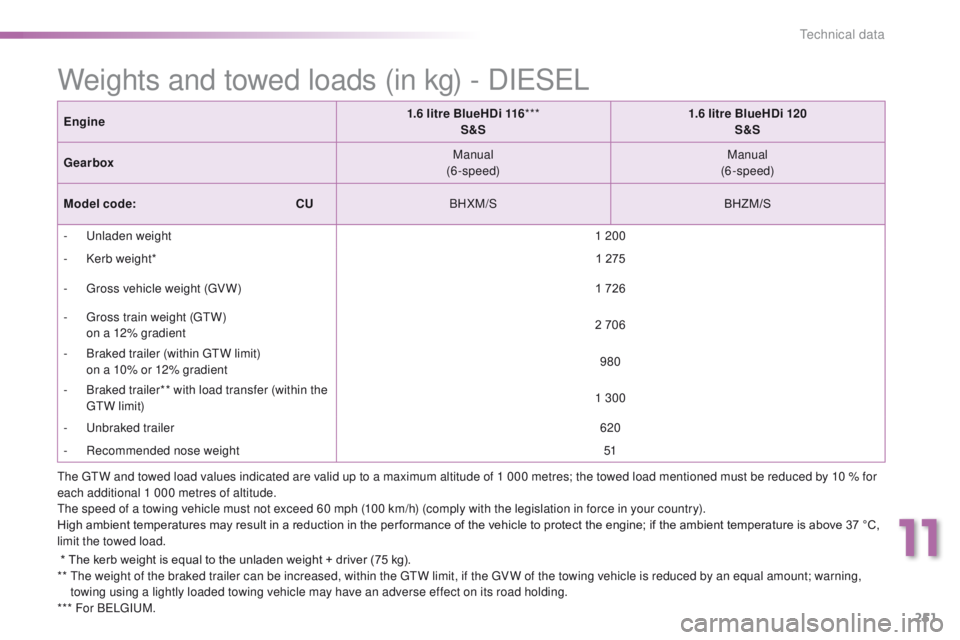
Weights and towed loads (in kg) - DIESEL
* The kerb weight is equal to the unladen weight + driver (75 kg).
** T he weight of the braked trailer can be increased, within the GTW limit, if the GV W of the towing vehicle is reduced by an equal amount; warning,
towing using a lightly loaded towing vehicle may have an adverse effect on its road holding.
*** For BELGIUM. The GTW and towed load values indicated are valid up to a maximum altitude of 1 000 metres; the towed load mentioned must be reduced by 10 % for
each additional 1 000 metres of altitude.
The speed of a towing vehicle must not exceed 60 mph (100 km/h) (comply with the legislation in force in your country).
High ambient temperatures may result in a reduction in the per formance of the vehicle to protect the engine; if the ambient temperature is above 37 °C,
limit the towed load. Engine
1.6 litre BlueHDi 116
***
S&S 1.6 litre BlueHDi 120
S&S
Gearbox Manual
(6-speed) Manual
(6-speed)
Model code:
C
U
BHXM/S BHZM/S
-
U
nladen weight
1 200
-
K
erb weight*
1 275
-
G
ross vehicle weight (GV W)
1 726
-
G
ross train weight (GTW)
o
n a 12% gradient
2 706
-
B
raked trailer (within GTW limit)
o
n a 10% or 12% gradient
980
-
B
raked trailer** with load transfer (within the
GTW limit) 1 300
-
U
nbraked trailer
620
-
R
ecommended nose weight
51
11
Technical data
Page 364 of 450
362
2008_en_Chap13_index-alpha_ed01-2016
Table of weights ....................................24 5, 249
Tables of engines .................................. 243, 247
Tables of fuses
.............................................. 208
Ta n k , f u e l
............................................... 170, 172
Technical data
....................................... 243-249
Telephone
............................................. 310, 33 6
Temperature, coolant
...................................... 33
T
S
Selector, gear .......................... 83, 84, 87, 91, 95
Serial number, vehicle .................................. 25
3
Service indicator
............................................. 28
Servicing
...............................
..........................12
Settings
...............
.........................290, 339, 354
Sidelamps
..................... 117, 121, 122, 204, 206
Side repeater
..............................
..................205
Snow chains
.......................................... 13
9, 201
Socket, 12 V accessory
..................................72
So
ckets, audio
.......................73, 286, 333, 352
Speed limiter
......................................... 104, 108
Starting the engine
......................................... 80
Starting using another battery
...................... 2
15
Station, radio
................................ 2
82, 330, 350
Stay, bonnet
.................................................. 234
Steering mounted controls, audio
.......................................... 260, 329, 349
Steering wheel, adjustment
............................59
Stop & Start
........................ 19, 40, 70, 100, 113,
170, 214, 218, 234, 240
Storage
...................................................... 71, 72
Stowing rings
.................................................. 75
Switching off the engine
................................. 80
S
ynchronising the remote control
...................46
Reminder, lighting on
.................................... 120
Remote control .......................................... 4
3 - 47
Removing a wheel
........................................ 197
Removing the mat
........................................... 74
Replacing bulbs
............................................ 202
Replacing fuses
..............................
.............. 208
Replacing the air filter
................................... 240
Replacing the oil filter
................................... 24
0
Replacing the passenger compartment filter
.... 240
Resetting the service indicator
....................... 30
Resetting the trip recorder
.............................. 41
Reversing camera
......................................... 112
Reversing lamp
..................................... 2
06, 207
Risk areas (update)
....................................... 273
Roof bars
....................................................... 23
0
Routine checks
..................................... 240, 241
Running out of fuel (Diesel)
.......................... 1
74
Petrol
............................................................. 173
PE
UGEOT C
onnect Assistance
................... 255
P
E
UGEOT
C
onnect Packs
........................... 255
P
E
UGEOT
C
onnect SOS
............................. 25
4
Player, Apple
® .............................. ........288, 335
Player, MP3 CD ............................ 286, 332, 352
Port, USB
....................................... 7
3, 286, 332
Pre-heater, Diesel
........................................... 18
Pressures, tyres
............................................ 253
Pre-tensioning seat belts
.............................. 151
Priming the fuel system
................................ 174
Protecting children
................. 151, 153, 15 6 -16 0
Puncture
........................................................ 183
Radio
............................................ 282, 330, 350
Radio, digital (Digital Audio Broadcasting - DAB)
................................... 284
Range, AdBlue
.............................................. 176
Range, fuel
...................................................... 40
RDS
............................................... 283, 331, 350
Rear foglamp ................................. 119, 206, 207
Rear screen, demisting
................................... 70
Recharging the battery
................................. 2
16
Recirculation, air
....................................... 66, 69
Reduction of electrical load
.......................... 219
Regeneration of the particle filter
.................24
0
Reinitialisation of the under-inflation detection system
......................................... 13 8
Reinitialising the remote control
..................... 46
R
eminder, key in ignition ................................. 81Safety, children
......................
15
1, 153, 15 6 -16 0
Screen, instrument panel
....................14, 15, 38
Screen menu map
...............262, 264, 268, 276,
278, 280, 290, 292, 294, 310, 312, 341, 355
Screenwash
..................................................126
Screenwash fluid level
..................................238
Screenwash, rear
..........................................127
SCR (Selective Catalytic Reduction)
............175
Seat belts
....................................... 1
4 9 -151, 161
Seats, front
...............................
.......................56
Seats, heated
..................................................57
Seats, rear
.......................................................58
R
Alphabetical index