check engine PEUGEOT 2008 2016 Owner's Manual
[x] Cancel search | Manufacturer: PEUGEOT, Model Year: 2016, Model line: 2008, Model: PEUGEOT 2008 2016Pages: 450, PDF Size: 14.16 MB
Page 195 of 450
193
2008_en_Chap09_info-pratiques_ed01-2016
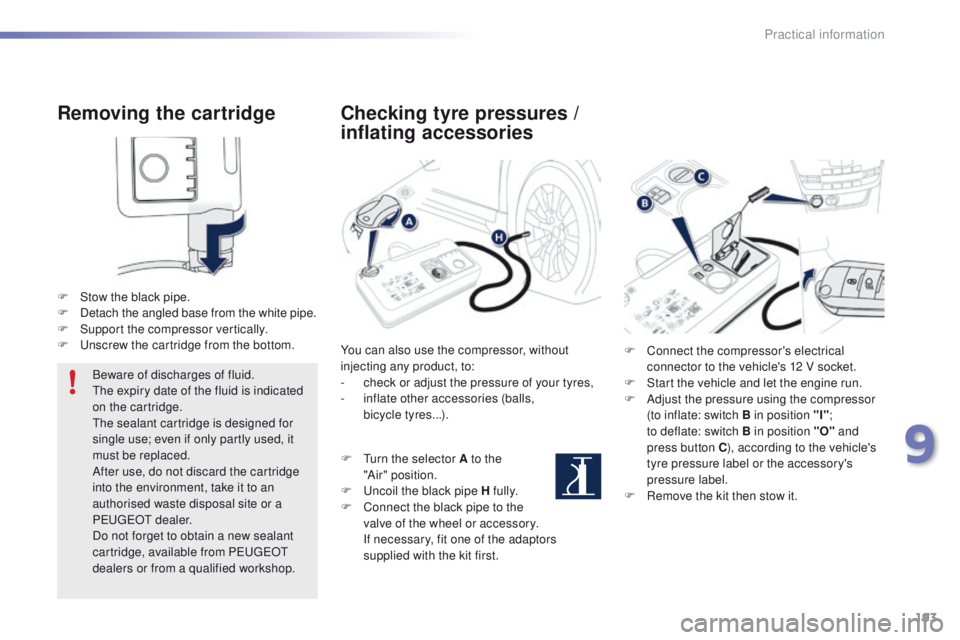
Removing the cartridge
F Stow the black pipe.
F D etach the angled base from the white pipe.
F
S
upport the compressor vertically.
F
U
nscrew the cartridge from the bottom.Beware of discharges of fluid.
The expiry date of the fluid is indicated
on the cartridge.
The sealant cartridge is designed for
single use; even if only partly used, it
must be replaced.
After use, do not discard the cartridge
into the environment, take it to an
authorised waste disposal site or a
PEUGEOT dealer.
Do not forget to obtain a new sealant
cartridge, available from PEUGEOT
dealers or from a qualified workshop.
Checking tyre pressures /
inflating accessories
You can also use the compressor, without
injecting any product, to:
-
c
heck or adjust the pressure of your tyres,
-
i
nflate other accessories (balls,
bicycle
tyres...).
F
T
urn the selector A to the
"Air"
position.
F
U
ncoil the black pipe H fully.
F
C
onnect the black pipe to the
valve of the wheel or accessory.
I
f necessary, fit one of the adaptors
supplied with the kit first. F
C onnect the compressor's electrical
connector to the vehicle's 12 V socket.
F
S
tart the vehicle and let the engine run.
F
A
djust the pressure using the compressor
(to inflate: switch B in position "I" ;
to
deflate: switch B in position "O" and
press button C ), according to the vehicle's
tyre pressure label or the accessory's
pressure label.
F
R
emove the kit then stow it.
9
Practical information
Page 217 of 450
215
2008_en_Chap09_info-pratiques_ed01-2016
Some functions, including Stop & Start,
are not available if the battery is not
sufficiently charged.
Starting using another
battery
When your vehicle's battery is discharged, the
engine can be started using a slave battery
(external or on another vehicle) and jump lead
cables or a battery booster.Never try to start the engine by
connecting a battery charger.
Never use a 24 V or higher battery
b o o s t e r.
First check that the slave battery has a
nominal voltage of 12 V and a capacity
at least equal to that of the discharged
battery.
The two vehicles must not be in contact
with each other.
Switch off the electrical consumers on
both vehicles (audio system, wipers,
lighting, ...).
Ensure that the jump lead cables do
not pass close to moving parts of the
engine (cooling fan, belts, ...).
Do not disconnect the (+) terminal when
the engine is running.
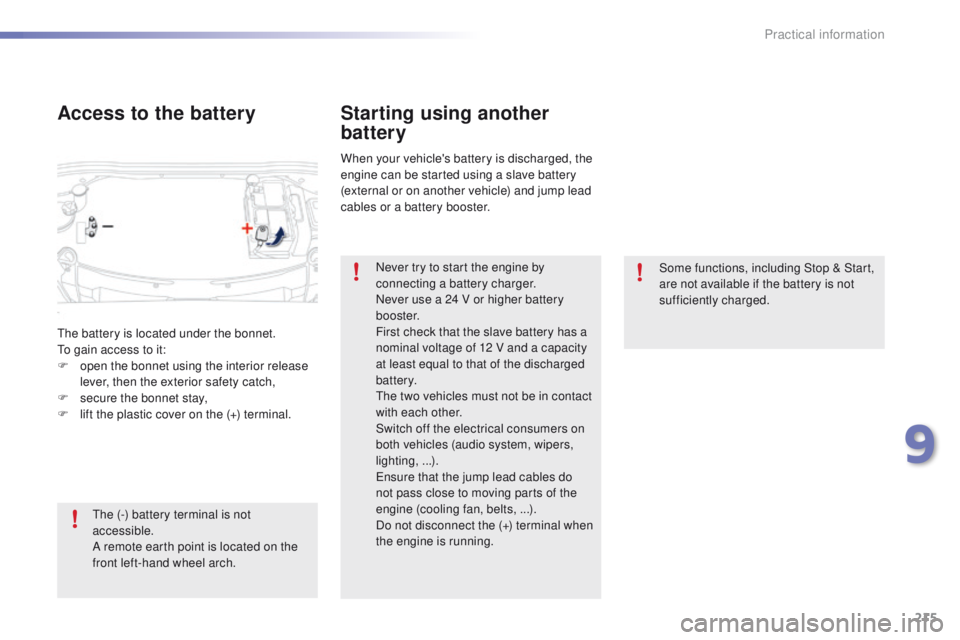
The battery is located under the bonnet.
To gain access to it:
F
o
pen the bonnet using the interior release
lever, then the exterior safety catch,
F
s
ecure the bonnet stay,
F
l
ift the plastic cover on the (+) terminal.
Access to the battery
The (-) battery terminal is not
accessible.
A remote earth point is located on the
front left-hand wheel arch.
9
Practical information
Page 220 of 450
218
2008_en_Chap09_info-pratiques_ed01-2016
Never try to charge a frozen battery.
If the battery has been frozen, have it
checked by a PEUGEOT dealer or a
qualified workshop, who will check that
the internal components have not been
damaged and the casing is not cracked,
which could cause a leak of toxic and
corrosive acid.The Stop & Start system may not be
operational during the trip following the
first engine start.
In this case, the system will only be
available again after a continuous
period of immobilisation of the vehicle,
a period which depends on the ambient
temperature and the state of charge of
the battery (up to about 8 hours).
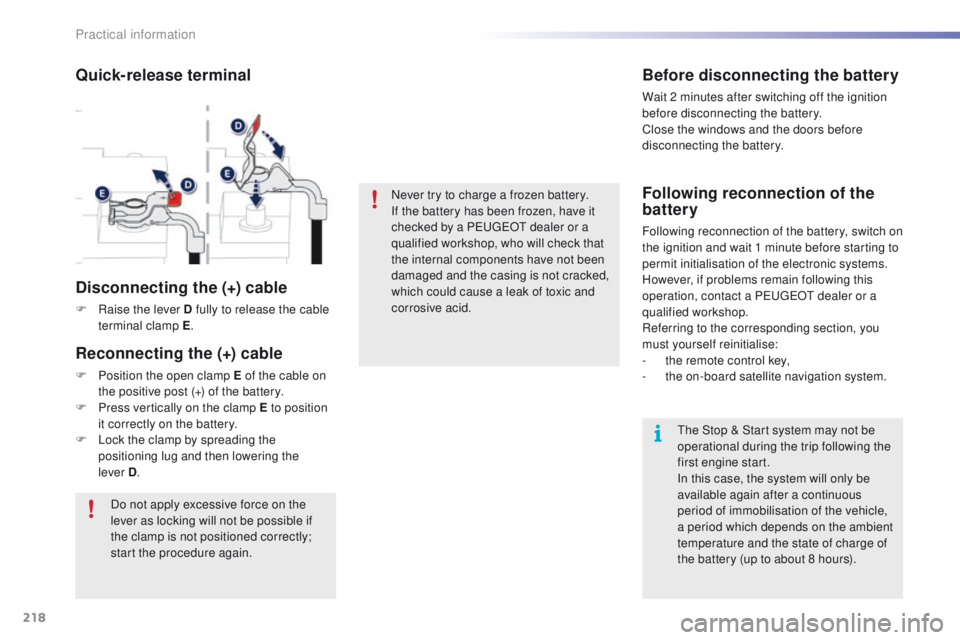
Quick-release terminal
Disconnecting the (+) cable
F Raise the lever D fully to release the cable terminal clamp E .
Do not apply excessive force on the
lever as locking will not be possible if
the clamp is not positioned correctly;
start the procedure again.
Before disconnecting the battery
Wait 2 minutes after switching off the ignition
before disconnecting the battery.
Close the windows and the doors before
disconnecting the battery.
Following reconnection of the
battery
Following reconnection of the battery, switch on
the ignition and wait 1 minute before starting to
permit initialisation of the electronic systems.
However, if problems remain following this
operation, contact a PEUGEOT dealer or a
qualified workshop.
Referring to the corresponding section, you
must yourself reinitialise:
-
t
he remote control key,
-
t
he on-board satellite navigation system.
Reconnecting the (+) cable
F Position the open clamp E of the cable on the positive post (+) of the battery.
F
P
ress vertically on the clamp E to position
it correctly on the battery.
F
L
ock the clamp by spreading the
positioning lug and then lowering the
lever
D.
Practical information
Page 226 of 450
224
2008_en_Chap09_info-pratiques_ed01-2016
When towing
Distribution of loads
F Distribute the load in the trailer so that the heaviest items are as close as possible to
the axle and the nose weight approaches
the maximum permitted without
exceeding
it.
Air density decreases with altitude, thus
reducing engine performance. Above
1
000 metres, the maximum towed load must
be reduced by 10
% for every 1 000 metres of
altitude.
Side wind
F Take into account the increased sensitivity to side wind.For more information on weights (and
the towed loads which apply to your
vehicle) refer to the corresponding
section.
Cooling
Towing a trailer on a slope increases the
temperature of the coolant.
As the fan is electrically controlled, its cooling
capacity is not dependent on the engine speed.
F
T
o lower the engine speed, reduce your
speed.
The maximum towed load on a long incline
depends on the gradient and the ambient
temperature.
In all cases, keep a check on the coolant
temperature.
F
I
f the warning lamp and the
STOP warning lamp come on,
stop the vehicle and switch off
the engine as soon as possible.
Braking
Towing a trailer increases the braking distance.
To avoid overheating of the brakes, the use of
engine braking is recommended.
Ty r e s
F Check the tyre pressures of the towing vehicle and of the trailer, observing the
recommended pressures.
Lighting
F Check the electrical lighting and signalling on the trailer and the headlamp beam
height of your vehicle.
For more information on adjusting the
headlamp beam height, refer to the
corresponding section.
The rear parking sensors will be
deactivated automatically if a genuine
PEUGEOT towbar is used.
Practical information
Page 236 of 450
234
2008_en_Chap10_verifications_ed01-2016
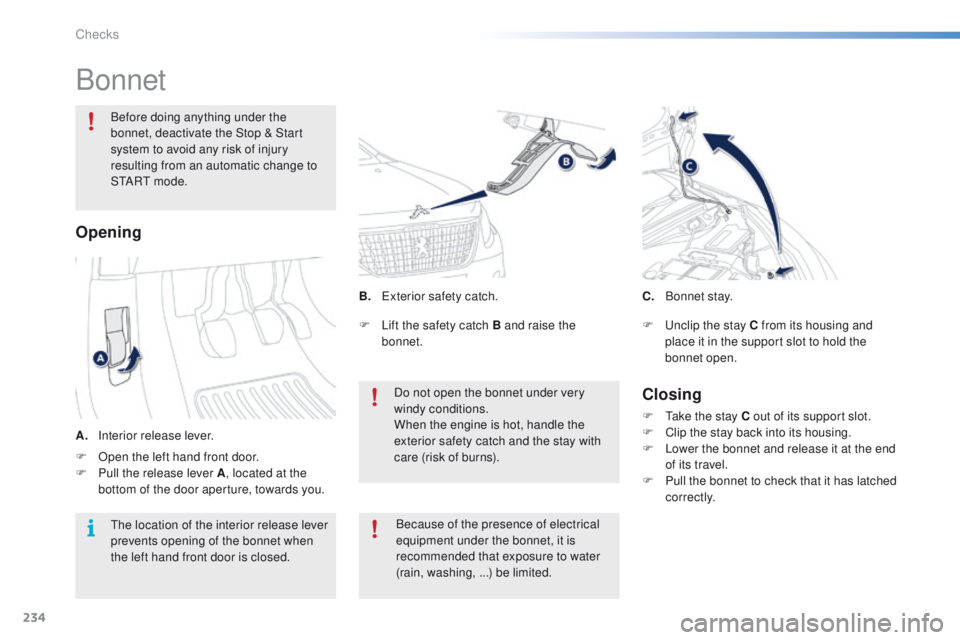
Bonnet
Before doing anything under the
bonnet, deactivate the Stop & Start
system to avoid any risk of injury
resulting from an automatic change to
S TA R T m o d e .
Closing
F Take the stay C out of its support slot.
F C lip the stay back into its housing.
F
L
ower the bonnet and release it at the end
of its travel.
F
P
ull the bonnet to check that it has latched
c o r r e c t l y.
F
L
ift the safety catch B and raise the
bonnet.
Do not open the bonnet under very
windy conditions.
When the engine is hot, handle the
exterior safety catch and the stay with
care (risk of burns).
Opening
B. Exterior safety catch.
A.
I
nterior release lever. Because of the presence of electrical
equipment under the bonnet, it is
recommended that exposure to water
(rain, washing,
...) be limited.
The location of the interior release lever
prevents opening of the bonnet when
the left hand front door is closed. C. B
o n n et st ay.
F
U
nclip the stay C from its housing and
place it in the support slot to hold the
bonnet open.
F
O
pen the left hand front door.
F
P
ull the release lever A , located at the
bottom of the door aperture, towards you.
Checks
Page 237 of 450
235
2008_en_Chap10_verifications_ed01-2016
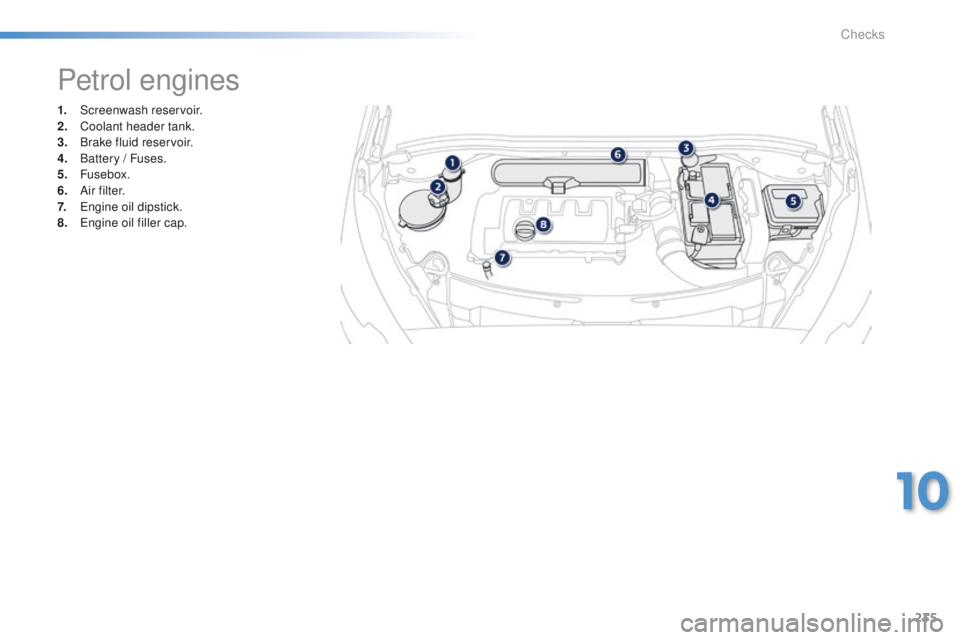
1. Screenwash reservoir.
2. Coolant header tank.
3.
B
rake fluid reservoir.
4.
B
attery / Fuses.
5.
Fusebox.
6.
A
i r f i l t e r.
7.
E
ngine oil dipstick.
8.
E
ngine oil filler cap.
Petrol engines
10
Checks
Page 238 of 450
236
2008_en_Chap10_verifications_ed01-2016
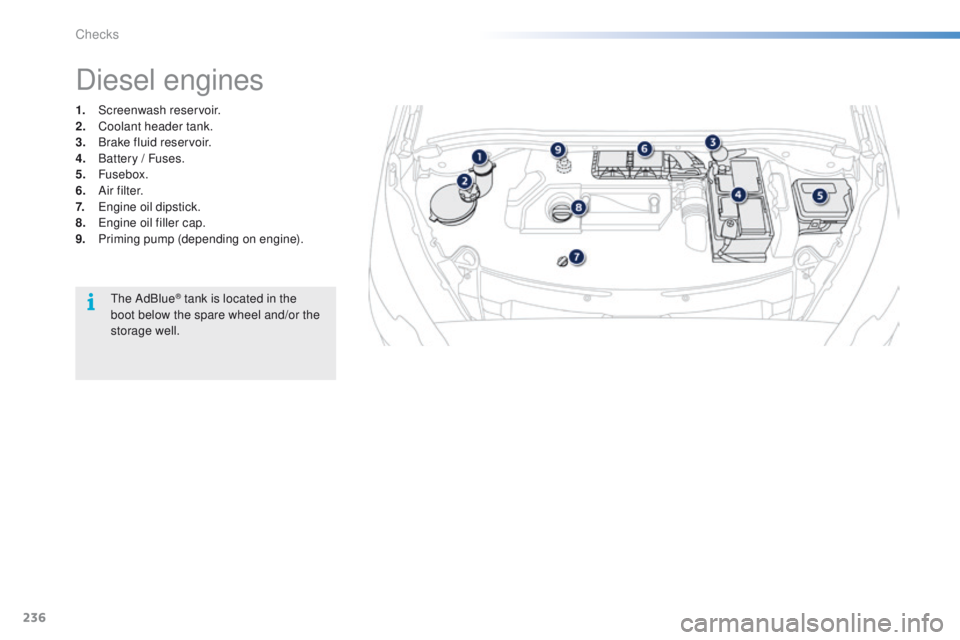
1. Screenwash reservoir.
2. Coolant header tank.
3.
B
rake fluid reservoir.
4.
B
attery / Fuses.
5.
Fusebox.
6.
A
i r f i l t e r.
7.
E
ngine oil dipstick.
8.
E
ngine oil filler cap.
9.
P
riming pump (depending on engine).
Diesel engines
The AdBlue® tank is located in the
boot below the spare wheel and/or the
storage well.
Checks
Page 239 of 450
237
2008_en_Chap10_verifications_ed01-2016
Checking levels
Oil level
The check is carried out either when the
ignition is switched on using the oil level
indicator in the instrument panel (depending
on version), or using the dipstick.Engine oil change
Refer to the warranty and maintenance record
for details of the interval for this operation.
In order to maintain the reliability of the engine
and emission control system, never use
additives in the engine oil.
Oil specification
The oil must be the correct grade for your
engine and conform to the manufacturer's
recommendations.The brake fluid level should be close
to the "MA X" mark. If it is not, check
the brake pad wear.
Brake fluid
Changing the fluid
Refer to the manufacturer's service schedule
for details of the interval for this operation.
Take care when working under the bonnet, as certain areas of the engine may be extremely hot (risk of burns) and the cooling fan could start at
any time (even with the ignition off).
Check all of these levels regularly, in line with the manufacturer's service schedule. Top them up if necessary, unless other wise indicated.
If a level drops significantly, have the corresponding system checked by a PEUGEOT dealer or a qualified workshop.
It is normal to top up the oil level
between two services (or oil changes).
PEUGEOT recommends that you check
the level, and top up if necessary, every
3 000 miles (5 000 kms).
It will only be correct if the vehicle is on level
ground and the engine has been off for more
than 30 minutes.
Fluid specification
The brake fluid must conform to the
manufacturer's recommendations.
Level
10
Checks
Page 240 of 450
238
2008_en_Chap10_verifications_ed01-2016
Coolant level
The coolant level should be close
to the "MA X" mark but should never
exceed it.
In addition, as the cooling system is
pressurised, wait at least one hour after
switching off the engine before carrying out
any work.
To avoid any risk of scalding, unscrew the cap
by two turns to allow the pressure to drop.
When the pressure has dropped, remove the
cap and top up the level.Changing the coolant
The coolant does not have to be replaced at
routine services.
Fluid specification
The coolant must conform to the
manufacturer's recommendations.
Fluid specification
For optimum cleaning and to avoid freezing,
this fluid must not be topped up or replaced
with plain water.
In wintry conditions, it is recommended that you
use an ethyl alcohol or methanol based fluid.
Screenwash fluid level
Top up the level when necessary.
When the engine is warm, the temperature of
the coolant is regulated by the fan. The cooling fan may star t after
switching off the engine: take care
with articles and clothing that might
be caught by the fan blades.
Checks
Page 242 of 450
240
2008_en_Chap10_verifications_ed01-2016
Checks
12 V battery
The battery does not require any maintenance.
However, check regularly that the terminals
are correctly tightened (versions without quick
release terminals) and that the connections
are clean.
Versions equipped with Stop & Start are
fitted with a 12 V lead-acid battery of specific
technology and specification.
Its replacement should be carried out only by a
PEUGEOT dealer or a qualified workshop.
Diesel
Particle filter
On a new vehicle, the first particle
filter regeneration operations may be
accompanied by a "burnt" smell, which
is normal.
Following prolonged operation of the
vehicle at very low speed or at idle,
you may, in exceptional circumstances,
notice the emission of water vapour at
the exhaust on acceleration. This does
not affect the behaviour of the vehicle
or the environment.
Unless other wise indicated, check these components in accordance with the warranty and maintenance record and according to your engine.
Other wise, have them checked by a PEUGEOT dealer or a qualified workshop.
Air filter and passenger compartment filter
Refer to the warranty and
maintenance record for details of
the replacement intervals for these
components.
Oil filter
Replace the oil filter each time the
engine oil is changed.
Refer to the warranty and
maintenance record for details of
the replacement interval for this
component.
When carrying out any operation on the 12 V
battery, refer to the corresponding section for
details of the precautions to be taken before
starting work.
Depending on the environment (e.g. dusty
atmosphere) and the use of the vehicle
(e.g. city driving), replace them twice as often
if necessary
.
A clogged passenger compartment filter may
have an adverse effect on the per formance
of the air conditioning system and generate
undesirable odours. The start of saturation of the
particle filter is indicated by
the fixed illumination of this warning lamp
accompanied by a warning message in the
screen (if a display screen is fitted).
As soon as the traffic conditions permit,
regenerate the filter by driving at a speed of at
least 40 mph (60 km/h) until the warning lamp
goes off.
If the warning lamp stays on, this indicates a
low additive level.
Checks