remove seats PEUGEOT 2008 2016 Owners Manual
[x] Cancel search | Manufacturer: PEUGEOT, Model Year: 2016, Model line: 2008, Model: PEUGEOT 2008 2016Pages: 450, PDF Size: 14.16 MB
Page 15 of 450
13
2008_en_Chap00c_eco-conduite_ed01-2016
Limit the causes of excess consumption
Spread loads throughout the vehicle; place the heaviest items in the
bottom of the boot, as close as possible to the rear seats.
Limit the loads carried in the vehicle and reduce wind resistance (roof
bars, roof rack, bicycle carrier, trailer...). Use a roof box in preference.
Remove roof bars and roof racks after use.
At the end of winter, remove snow tyres and refit your summer tyres.
Observe the recommendations on
maintenance
Check the tyre pressures regularly, when cold, referring to the label in
the door aperture, driver's side.
Carry out this check in particular:
-
b
efore a long journey,
-
a
t each change of season,
-
a
fter a long period out of use.
Don't forget the spare wheel and the tyres on any trailer or caravan.
Have your vehicle serviced regularly (engine oil, oil filter, air filter,
passenger compartment filter...) and observe the schedule of
operations recommended in the manufacturer's service schedule.
With a BlueHDi Diesel engine, if the SCR system is faulty your vehicle
becomes polluting; go to a PEUGEOT dealer or a qualified workshop
without delay to have the emissions of nitrous oxides brought back to
the legal level.
When refuelling, do not continue after the third cut-off of the nozzle to
avoid any over flow.
At the wheel of your new vehicle, it is only after the first 1 800 miles
(3 000 kilometres) that you will see the fuel consumption settle down to
a consistent average.
.
Eco-driving
Page 59 of 450

57
2008_en_Chap03_confort_ed01-2016
With the engine running, the front seats can be
heated separately.
F
U
se the adjustment dial, placed on the side
of each front seat, to switch on and select
the level of heating required:
0 : Of f.
1 : Low.
2 : Medium.
3 : High.
F
T
o raise the head restraint, pull it upwards.
F
T
o remove the head restraint, press the
lug
A and pull the head restraint upwards.
F
T
o put the head restraint back in place,
engage the head restraint stems in the
openings, keeping them in line with the
seat back.
F
T
o lower the head restraint, press the lug A
and the head restraint at the same time. The head restraint has a frame with
notches which prevent it from lowering;
this is a safety device in case of impact.
The adjustment is correct when the
upper edge of the head restraint is
level with the top of the head.
Never drive with the head restraints
removed; they must be in place and
adjusted correctly.
Head restraintsHeated seats
3
Comfort
Page 78 of 450
76
2008_en_Chap04_amenagements_ed01-2016
High load retaining net
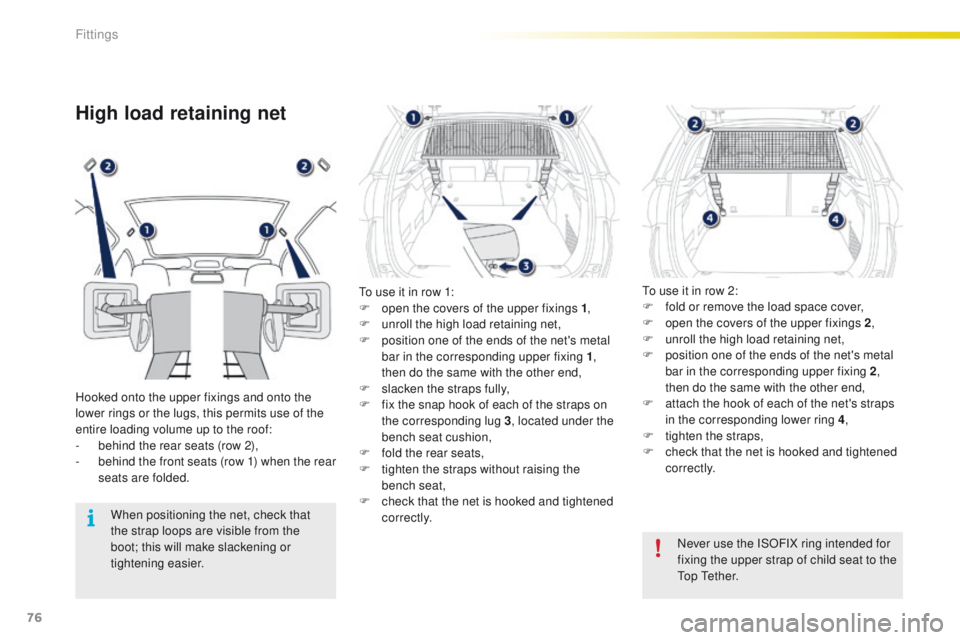
Hooked onto the upper fixings and onto the
lower rings or the lugs, this permits use of the
entire loading volume up to the roof:
-
b
ehind the rear seats (row 2),
-
b
ehind the front seats (row 1) when the rear
seats are folded.
When positioning the net, check that
the strap loops are visible from the
boot; this will make slackening or
tightening easier. Never use the ISOFIX ring intended for
fixing the upper strap of child seat to the
Top Tether.
To use it in row 1:
F
o
pen the covers of the upper fixings 1
,
F
u
nroll the high load retaining net,
F
p
osition one of the ends of the net's metal
bar in the corresponding upper fixing 1 ,
then do the same with the other end,
F s lacken the straps fully,
F f ix the snap hook of each of the straps on
the corresponding lug 3 , located under the
bench seat cushion,
F
f
old the rear seats,
F
t
ighten the straps without raising the
bench
seat,
F
c
heck that the net is hooked and tightened
c o r r e c t l y. To use it in row 2:
F
f
old or remove the load space cover,
F
o
pen the covers of the upper fixings 2
,
F
u
nroll the high load retaining net,
F
p
osition one of the ends of the net's metal
bar in the corresponding upper fixing 2 ,
then do the same with the other end,
F a ttach the hook of each of the net's straps
in the corresponding lower ring 4 ,
F
t
ighten the straps,
F
c
heck that the net is hooked and tightened
c o r r e c t l y.
Fittings
Page 157 of 450
155
2008_en_Chap07_securite_ed01-2016
For the airbags to be fully
effective, observe the safety
recommendations below:
Sit in a normal upright position.
Wear a correctly adjusted seat belt.
Do not leave anything between the
occupants and the airbags (a child, pet,
object...), nor fix or attach anything close to
the inflation trajectory of the airbags; this
could cause injuries during their deployment.
Never modify the original definition of your
vehicle, particularly in the area directly
around the airbags.
After an accident or if the vehicle has been
stolen or broken into, have the airbag
systems checked.
All work on the airbag system must be
carried out by a PEUGEOT dealer or a
qualified workshop.
Lateral airbags
Use only approved covers on the seats,
compatible with the deployment the lateral
airbags. For information on the range of seat
covers suitable for your vehicle, you can
contact a PEUGEOT dealer.
For more information on accessories, refer
to the corresponding section.
Do not fix or attach anything to the seat
backs (clothing...). This could cause injury
to the chest or arms if the lateral airbag is
deployed.
Do not sit with the upper part of the body any
nearer to the door than necessary.
Even if all of the precautions mentioned
are observed, a risk of injury or of minor
burns to the head, chest or arms when an
airbag is deployed cannot be ruled out. The
bag inflates almost instantly (within a few
milliseconds) then deflates within the same
time discharging the hot gas via openings
provided for this purpose.
Front airbags
Do not drive holding the steering wheel by its
spokes or resting your hands on the centre
part of the wheel.
Passengers must not place their feet on the
dashboard.
Do not smoke as deployment of the airbags
can cause burns or the risk of injury from a
cigarette or pipe.
Never remove or pierce the steering wheel or
hit it violently.
Do not fit or attach anything to the steering
wheel or dashboard, this could cause
injuries with deployment of the airbags.
Advice
Curtain airbags
Do not fix or attach anything to the roof. This
could cause injury to the head if the curtain
airbag is deployed.
If fitted on your vehicle, do not remove the
grab handles installed on the roof, they play
a part in securing the curtain airbags.
7
Safety
Page 158 of 450
156
2008_en_Chap08_securite-enfants_ed01-2016
Carrying children
General pointsPEUGEOT recommends that children
should travel in the outer rear seats of
your vehicle:
-
"
rearward facing" up to the age of 3,
-
"
forward facing" over the age of 3.
Although one of PEUGEOT's main criteria when designing your vehicle, the safety of your children
also depends on you.
At the rear
Rearward facing
When a rear ward facing child seat is installed
on a rear passenger seat
, move the vehicle's
front seat for ward and straighten the backrest
so that the rear ward facing child seat does not
touch the vehicle's front seat.
Remove and stow the head restraint before
installing a child seat with backrest on a
passenger seat.
Refit the head restraint once the child seat has
been removed.
Ensure that the seat belt is correctly
tensioned.
For child seats with a support leg,
ensure that this is in firm contact with
the floor. If necessary, adjust the front
seat of the vehicle.
*
T
he regulations on carrying children are
specific to each country. Refer to the
legislation in force in your country.
For maximum safety, please observe the
following recommendations:
-
i
n accordance with European regulations,
all children under the age of 12 or less
than one and a half metres tall must
travel in approved child seats suited to
their weight , on seats fitted with a seat
belt or ISOFIX mountings*,
-
s
tatistically, the safest seats in your
vehicle for carr ying children are the
rear seats,
-
a c
hild weighing less than 9 kg must
travel in the rear ward facing position
both in the front and in the rear.
Forward facing
When a for ward facing child seat is installed
on a rear passenger seat , move the vehicle's
front seat for ward and straighten the backrest
so that the legs of the child in the for ward
facing child seat do not touch the vehicle's front
seat.
Child safety
Page 165 of 450
163
2008_en_Chap08_securite-enfants_ed01-2016
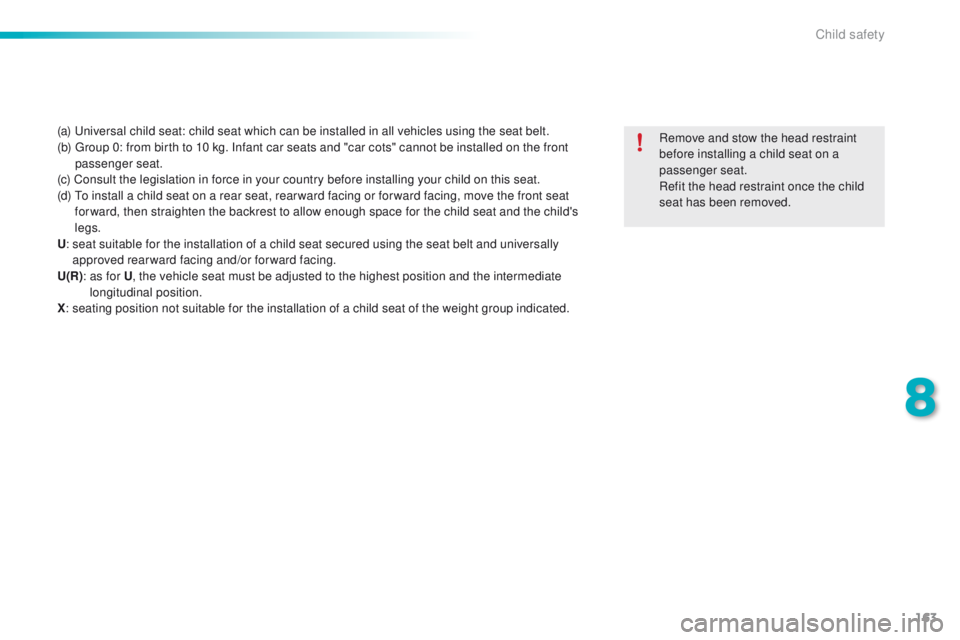
(a) Universal child seat: child seat which can be installed in all vehicles using the seat belt.
(b) G roup 0: from birth to 10 kg. Infant car seats and "car cots" cannot be installed on the front
passenger seat.
(c) Consult the legislation in force in your country before installing your child on this seat.
(d)
T
o install a child seat on a rear seat, rear ward facing or for ward facing, move the front seat
for ward, then straighten the backrest to allow enough space for the child seat and the child's
legs.
U :
s
eat suitable for the installation of a child seat secured using the seat belt and universally
approved rearward facing and/or forward facing.
U(R) :
a
s for U, the vehicle seat must be adjusted to the highest position and the intermediate
longitudinal position.
X : seating position not suitable for the installation of a child seat of the weight group indicated. Remove and stow the head restraint
before installing a child seat on a
passenger seat.
Refit the head restraint once the child
seat has been removed.
8
Child safety
Page 167 of 450
165
2008_en_Chap08_securite-enfants_ed01-2016
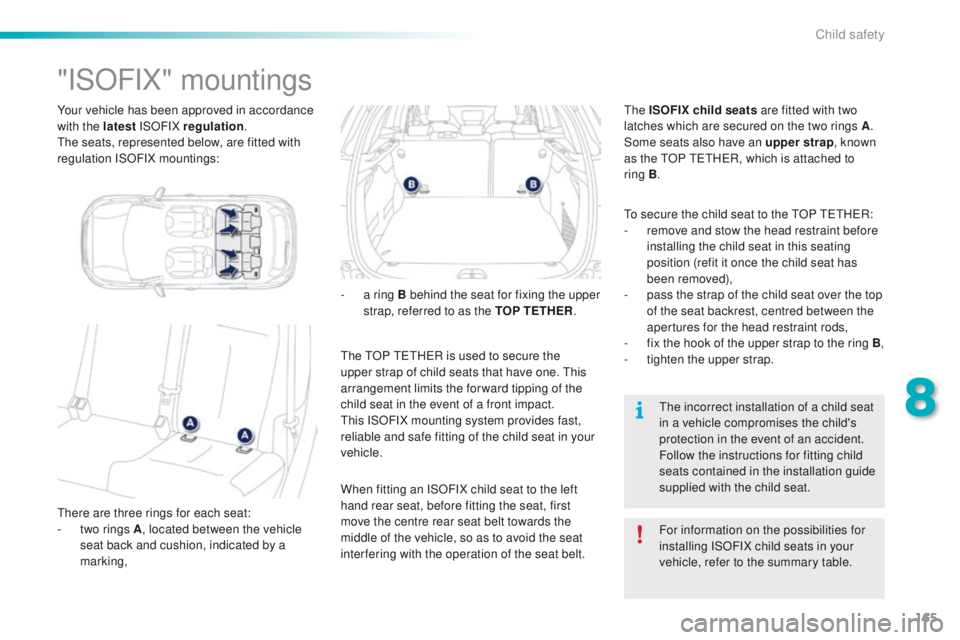
Your vehicle has been approved in accordance
with the latest ISOFIX regulation .
The seats, represented below, are fitted with
regulation ISOFIX mountings:
"ISOFIX" mountings
There are three rings for each seat:
- t wo rings A , located between the vehicle
seat back and cushion, indicated by a
marking, When fitting an ISOFIX child seat to the left
hand rear seat, before fitting the seat, first
move the centre rear seat belt towards the
middle of the vehicle, so as to avoid the seat
interfering with the operation of the seat belt.
For information on the possibilities for
installing ISOFIX child seats in your
vehicle, refer to the summary table.
-
a r
ing B behind the seat for fixing the upper
strap, referred to as the TOP TETHER .
The TOP TETHER is used to secure the
upper strap of child seats that have one. This
arrangement limits the forward tipping of the
child seat in the event of a front impact.
This ISOFIX mounting system provides fast,
reliable and safe fitting of the child seat in your
vehicle. To secure the child seat to the TOP TETHER:
-
r
emove and stow the head restraint before
installing the child seat in this seating
position (refit it once the child seat has
been removed),
-
p
ass the strap of the child seat over the top
of the seat backrest, centred between the
apertures for the head restraint rods,
-
f
ix the hook of the upper strap to the ring B
,
-
t
ighten the upper strap.
The incorrect installation of a child seat
in a vehicle compromises the child's
protection in the event of an accident.
Follow the instructions for fitting child
seats contained in the installation guide
supplied with the child seat.
The ISOFIX child seats are fitted with two
latches which are secured on the two rings A
.
Some seats also have an upper strap , known
as the TOP TETHER, which is attached to
ring B
.
8
Child safety
Page 170 of 450
168
2008_en_Chap08_securite-enfants_ed01-2016
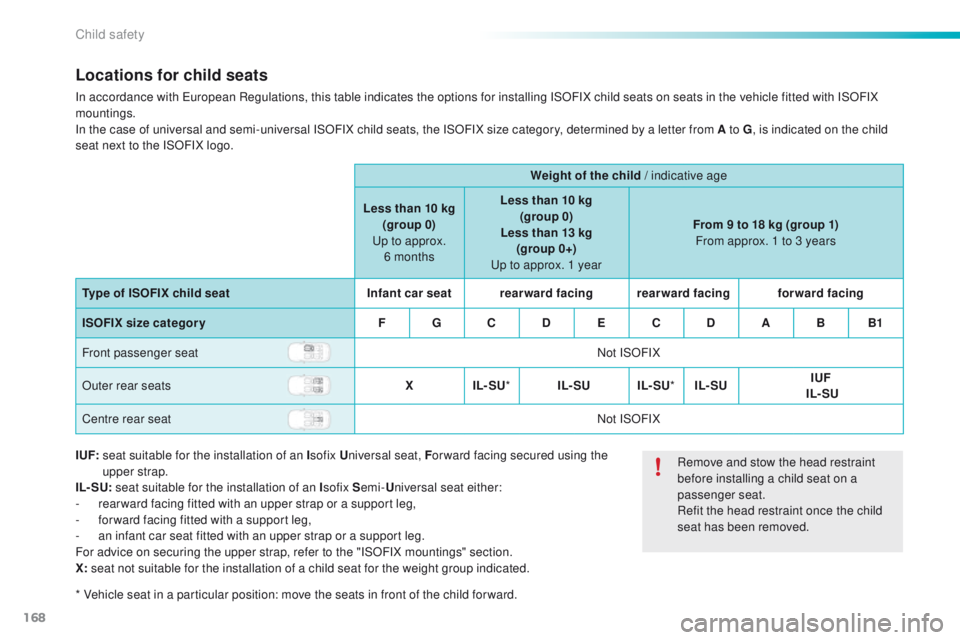
Locations for child seats
In accordance with European Regulations, this table indicates the options for installing ISOFIX child seats on seats in the vehicle fitted with ISOFIX
mountings.
In the case of universal and semi-universal ISOFIX child seats, the ISOFIX size category, determined by a letter from A to G, is indicated on the child
seat next to the ISOFIX logo.
Weight of the child / indicative age
Less than 10 kg (group 0)
Up to approx. 6 months Less than 10 kg
(group 0)
Less than 13 kg (group 0+)
Up to approx. 1 year From 9 to 18 kg (group 1)
From approx. 1 to 3 years
Type of ISOFIX child seat Infant car seatrearward facing rearward facing forward facing
ISOFIX size categor y F G C D E C D A B B1
Front passenger seat Not ISOFIX
Outer rear seats XIL- SU* IL- SU IL- SU *IL- SU IUF
IL- SU
Centre rear seat Not ISOFIX
I UF:
s
eat suitable for the installation of an I sofix Universal seat, F or ward facing secured using the
upper strap.
IL- SU: seat suitable for the installation of an I sofix Semi-Universal seat either:
-
r
ear ward facing fitted with an upper strap or a support leg,
-
f
or ward facing fitted with a support leg,
-
a
n infant car seat fitted with an upper strap or a support leg.
For advice on securing the upper strap, refer to the "ISOFIX mountings" section.
X: seat not suitable for the installation of a child seat for the weight group indicated.
* Vehicle seat in a particular position: move the seats in front of the child for ward. Remove and stow the head restraint
before installing a child seat on a
passenger seat.
Refit the head restraint once the child
seat has been removed.
Child safety