spare wheel PEUGEOT 2008 2016 Owners Manual
[x] Cancel search | Manufacturer: PEUGEOT, Model Year: 2016, Model line: 2008, Model: PEUGEOT 2008 2016Pages: 450, PDF Size: 14.16 MB
Page 15 of 450
13
2008_en_Chap00c_eco-conduite_ed01-2016
Limit the causes of excess consumption
Spread loads throughout the vehicle; place the heaviest items in the
bottom of the boot, as close as possible to the rear seats.
Limit the loads carried in the vehicle and reduce wind resistance (roof
bars, roof rack, bicycle carrier, trailer...). Use a roof box in preference.
Remove roof bars and roof racks after use.
At the end of winter, remove snow tyres and refit your summer tyres.
Observe the recommendations on
maintenance
Check the tyre pressures regularly, when cold, referring to the label in
the door aperture, driver's side.
Carry out this check in particular:
-
b
efore a long journey,
-
a
t each change of season,
-
a
fter a long period out of use.
Don't forget the spare wheel and the tyres on any trailer or caravan.
Have your vehicle serviced regularly (engine oil, oil filter, air filter,
passenger compartment filter...) and observe the schedule of
operations recommended in the manufacturer's service schedule.
With a BlueHDi Diesel engine, if the SCR system is faulty your vehicle
becomes polluting; go to a PEUGEOT dealer or a qualified workshop
without delay to have the emissions of nitrous oxides brought back to
the legal level.
When refuelling, do not continue after the third cut-off of the nozzle to
avoid any over flow.
At the wheel of your new vehicle, it is only after the first 1 800 miles
(3 000 kilometres) that you will see the fuel consumption settle down to
a consistent average.
.
Eco-driving
Page 139 of 450
137
2008_en_Chap07_securite_ed01-2016
The under-inflation detection system
does not replace the need for vigilance
on the part of the driver.
This system does not avoid the need to
check the tyre pressures (including the
spare wheel) every month as well as
before a long journey.
Driving with under-inflated tyres impairs
road holding, extends braking distances
and causes premature tyre wear,
particularly under arduous conditions
(high loading, high speed, long journey).The inflation pressures defined for
your vehicle can be found on the tyre
pressure label.
For more information on the
identification markings, refer to the
corresponding section.
Tyre pressures should be checked
when the tyres are "cold" (vehicle
stopped for 1 hour or after a journey of
less than 6 miles (10 km) at moderate
speeds).
Other wise (when hot), add 0.3 bar to
the pressures shown on the label.
Driving with under-inflated tyres
increases fuel consumption.
Under-inflation detection
System which automatically checks the pressures of the tyres while driving.
The system monitors the pressures in the four
tyres, once the vehicle is moving.
It compares the information given by the four
wheel speed sensors with reference values,
which must be reinitialised ever y time the
tyre pressures are adjusted or a wheel
changed
.
The system triggers an alert as soon as it
detects a drop in the inflation pressure of one
or more tyres.
7
Safety
Page 140 of 450
138
2008_en_Chap07_securite_ed01-2016
Under-inflation alert
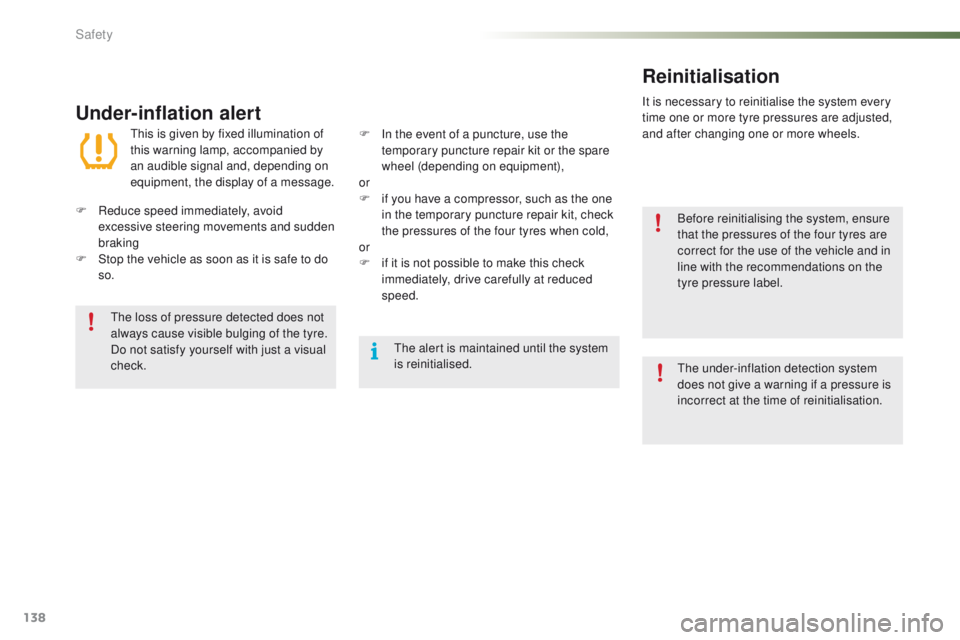
This is given by fixed illumination of
this warning lamp, accompanied by
an audible signal and, depending on
equipment, the display of a message.
F
R
educe speed immediately, avoid
excessive steering movements and sudden
braking
F
S
top the vehicle as soon as it is safe to do
so.
The loss of pressure detected does not
always cause visible bulging of the tyre.
Do not satisfy yourself with just a visual
check. Before reinitialising the system, ensure
that the pressures of the four tyres are
correct for the use of the vehicle and in
line with the recommendations on the
tyre pressure label.
The alert is maintained until the system
is reinitialised.
F
I n the event of a puncture, use the
temporary puncture repair kit or the spare
wheel (depending on equipment),
or
F
i
f you have a compressor, such as the one
in the temporary puncture repair kit, check
the pressures of the four tyres when cold,
or
F
i
f it is not possible to make this check
immediately, drive carefully at reduced
speed.
Reinitialisation
It is necessary to reinitialise the system every
time one or more tyre pressures are adjusted,
and after changing one or more wheels.
The under-inflation detection system
does not give a warning if a pressure is
incorrect at the time of reinitialisation.
Safety
Page 183 of 450
181
2008_en_Chap09_info-pratiques_ed01-2016
Never store bottles of AdBlue® in your
vehicle.
Recommendations on storage
AdBlue® freezes at about -11°C and
deteriorates above 25°C. It is recommended
that bottles be stored in a cool area and
protected from direct sunlight.
Under these conditions, the fluid can be kept
for at least a year.
If the additive has frozen, it can be used once it
has completely thawed out.
Procedure
Before topping-up, ensure that the vehicle is
parked on a flat and level sur face.
In wintry conditions, ensure that the
temperature of the vehicle is above -11°C.
Otherwise the AdBlue
® may be frozen and
so cannot be poured into its tank. Park your
vehicle in a warmer area for a few hours to
allow the top-up to be carried out.
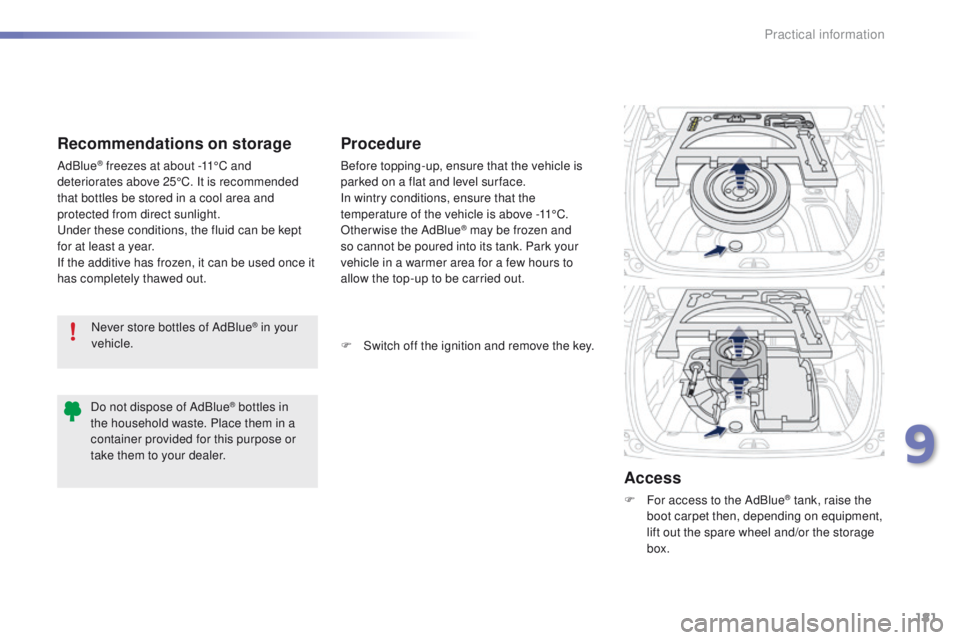
Access
F For access to the AdBlue® tank, raise the
boot carpet then, depending on equipment,
lift out the spare wheel and/or the storage
box.
F
S
witch off the ignition and remove the key.
Do not dispose of AdBlue
® bottles in
the household waste. Place them in a
container provided for this purpose or
take them to your dealer.
9
Practical information
Page 184 of 450
182
2008_en_Chap09_info-pratiques_ed01-2016
Opening
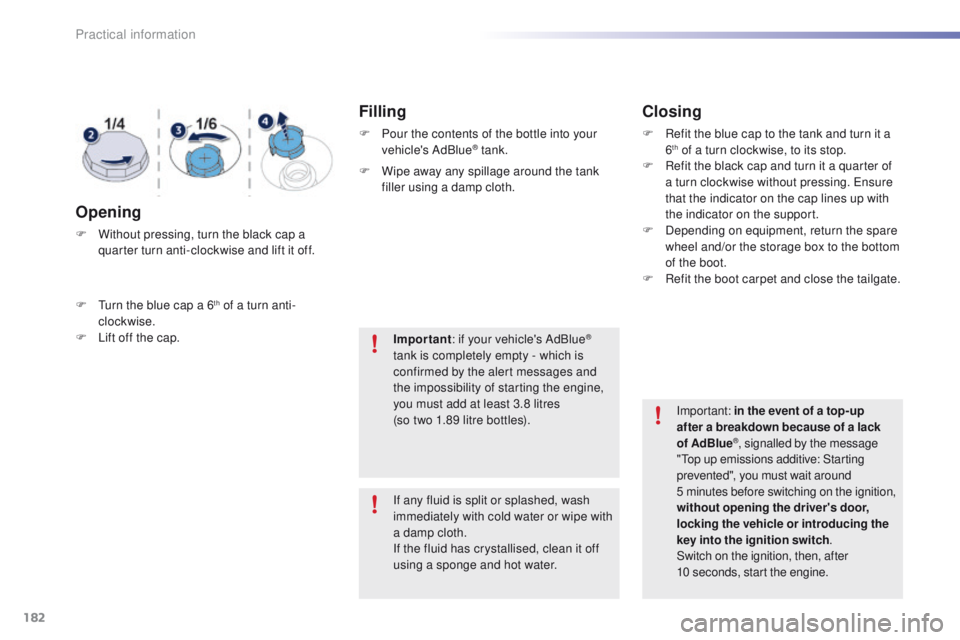
F Without pressing, turn the black cap a quarter turn anti-clockwise and lift it off.
F
T
urn the blue cap a 6
th of a turn anti-
clockwise.
F
L
ift off the cap. Important: if your vehicle's AdBlue
®
tank is completely empty - which is
confirmed by the alert messages and
the impossibility of starting the engine,
you must add at least 3.8 litres
(so two 1.89 litre bottles).
If any fluid is split or splashed, wash
immediately with cold water or wipe with
a damp cloth.
If the fluid has crystallised, clean it off
using a sponge and hot water. Important:
in the event of a top-up
after a breakdown because of a lack
of AdBlue
®, signalled by the message
"Top up emissions additive: Starting
prevented", you must wait around
5
minutes before switching on the ignition,
without opening the driver's door,
locking the vehicle or introducing the
key into the ignition switch .
Switch on the ignition, then, after
10
seconds, start the engine.
Filling
F Pour the contents of the bottle into your vehicle's AdBlue® tank.
F
W
ipe away any spillage around the tank
filler using a damp cloth.
Closing
F Refit the blue cap to the tank and turn it a 6th of a turn clockwise, to its stop.
F
R
efit the black cap and turn it a quarter of
a turn clockwise without pressing. Ensure
that the indicator on the cap lines up with
the indicator on the support.
F
D
epending on equipment, return the spare
wheel and/or the storage box to the bottom
of the boot.
F
R
efit the boot carpet and close the tailgate.
Practical information
Page 196 of 450
194
2008_en_Chap09_info-pratiques_ed01-2016
Changing a wheel
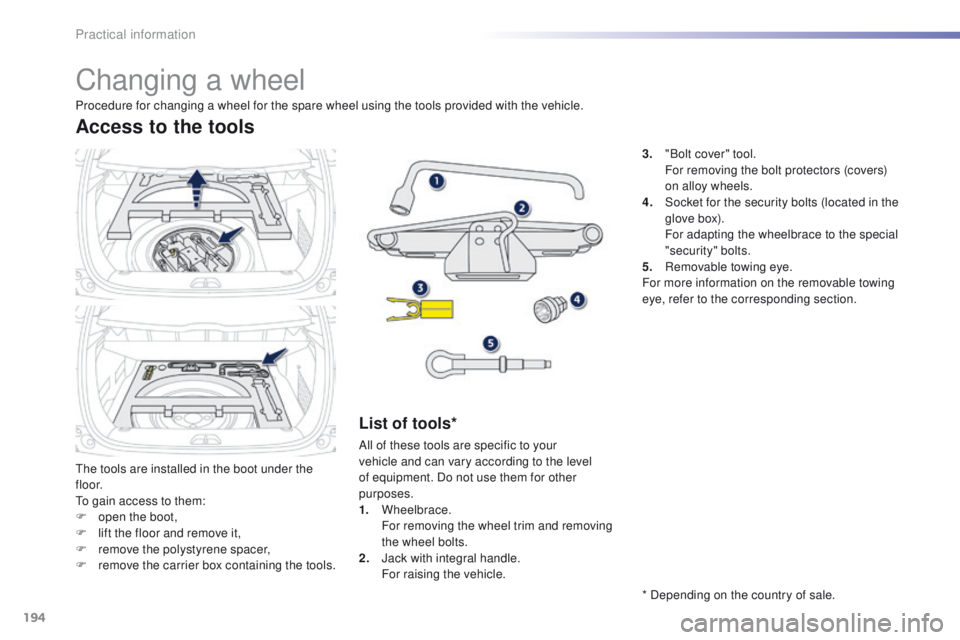
The tools are installed in the boot under the
f l o o r.
To gain access to them:
F
o
pen the boot,
F
l
ift the floor and remove it,
F
r
emove the polystyrene spacer,
F
r
emove the carrier box containing the tools.
Access to the tools
List of tools*
All of these tools are specific to your
vehicle and can vary according to the level
of equipment. Do not use them for other
purposes.
1.
Wheelbrace.
F
or removing the wheel trim and removing
the wheel bolts.
2.
J
ack with integral handle.
F
or raising the vehicle.
Procedure for changing a wheel for the spare wheel using the tools provided with the vehicle.
* Depending on the country of sale. 3.
"
Bolt cover" tool.
F
or removing the bolt protectors (covers)
on alloy wheels.
4.
S
ocket for the security bolts (located in the
glove box).
F
or adapting the wheelbrace to the special
"security" bolts.
5.
R
emovable towing eye.
For more information on the removable towing
eye, refer to the corresponding section.
Practical information
Page 197 of 450
195
2008_en_Chap09_info-pratiques_ed01-2016
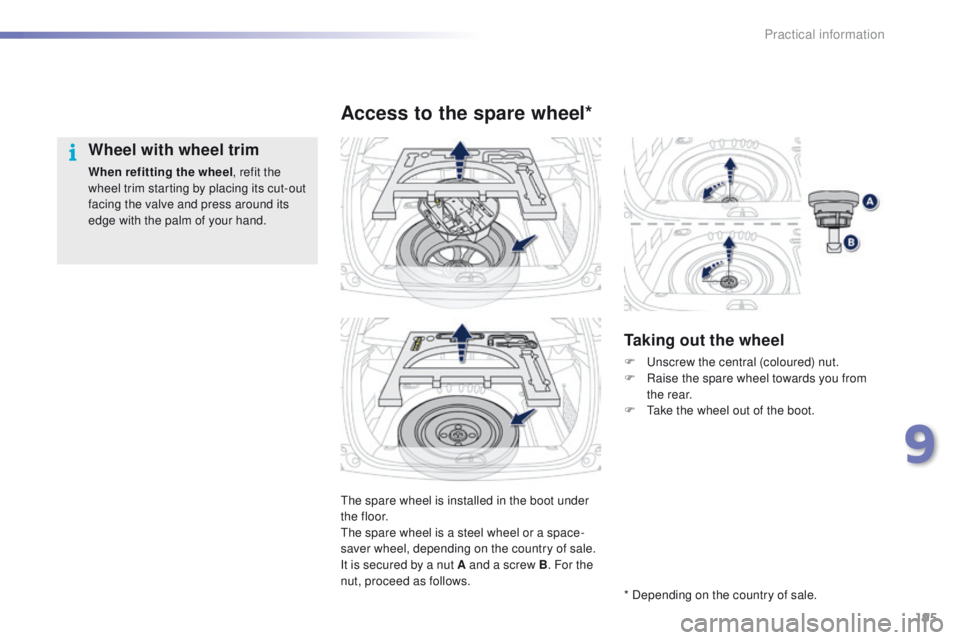
The spare wheel is installed in the boot under
t h e f l o o r.
The spare wheel is a steel wheel or a space-
saver wheel, depending on the country of sale.
It is secured by a nut A and a screw B. For the
nut, proceed as follows.
Access to the spare wheel*
Taking out the wheel
F Unscrew the central (coloured) nut.
F R aise the spare wheel towards you from
the rear.
F
T
ake the wheel out of the boot.
* Depending on the country of sale.
Wheel with wheel trim
When refitting the wheel , refit the
wheel trim starting by placing its cut-out
facing the valve and press around its
edge with the palm of your hand.
9
Practical information
Page 200 of 450
198
2008_en_Chap09_info-pratiques_ed01-2016
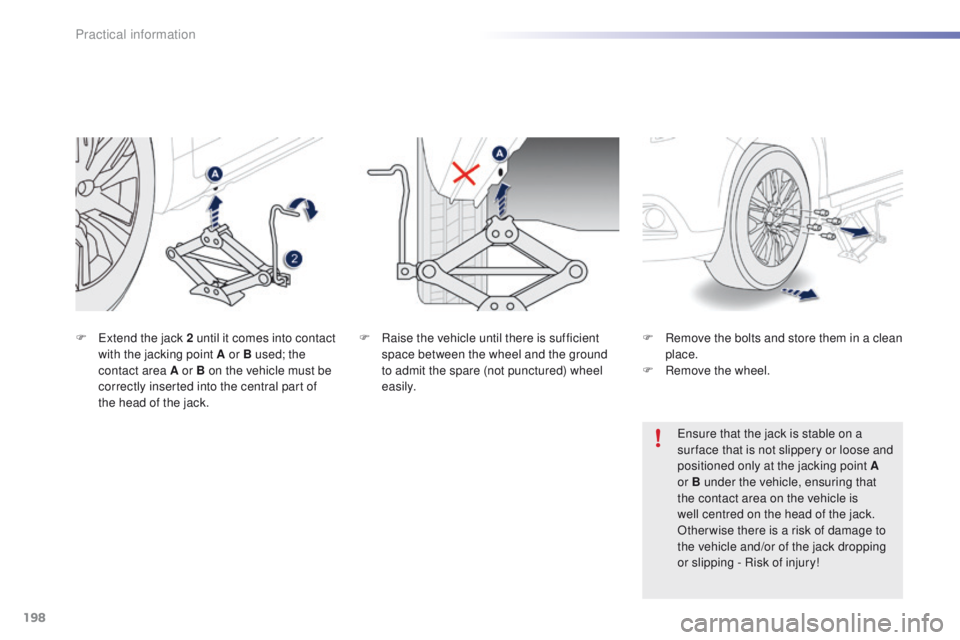
F Raise the vehicle until there is sufficient space between the wheel and the ground
to admit the spare (not punctured) wheel
easily.
F
E
xtend the jack 2 until it comes into contact
with the jacking point A or B used; the
contact area A or B on the vehicle must be
correctly inserted into the central part of
the head of the jack.
Ensure that the jack is stable on a
sur face that is not slippery or loose and
positioned only at the jacking point
A
or B under the vehicle, ensuring that
the contact area on the vehicle is
well centred on the head of the jack.
Otherwise there is a risk of damage to
the vehicle and/or of the jack dropping
or slipping - Risk of injury!
F
R emove the bolts and store them in a clean
place.
F
R
emove the wheel.
Practical information
Page 201 of 450
199
2008_en_Chap09_info-pratiques_ed01-2016
Fitting a wheel
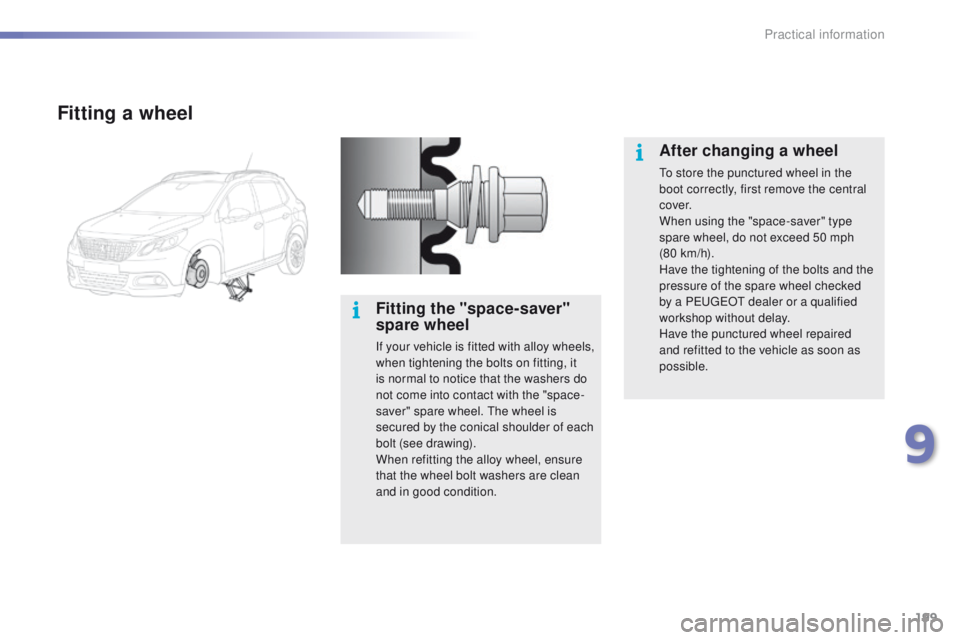
Fitting the "space-saver"
spare wheel
If your vehicle is fitted with alloy wheels,
when tightening the bolts on fitting, it
is normal to notice that the washers do
not come into contact with the "space-
saver" spare wheel. The wheel is
secured by the conical shoulder of each
bolt (see drawing).
When refitting the alloy wheel, ensure
that the wheel bolt washers are clean
and in good condition.
After changing a wheel
To store the punctured wheel in the
boot correctly, first remove the central
c ove r.
When using the "space-saver" type
spare wheel, do not exceed 50 mph
(80 km/h).
Have the tightening of the bolts and the
pressure of the spare wheel checked
by a PEUGEOT dealer or a qualified
workshop without delay.
Have the punctured wheel repaired
and refitted to the vehicle as soon as
possible.
9
Practical information
Page 203 of 450
201
2008_en_Chap09_info-pratiques_ed01-2016
Snow chains
In wintry conditions, snow chains improve
traction as well as the behaviour of the vehicle
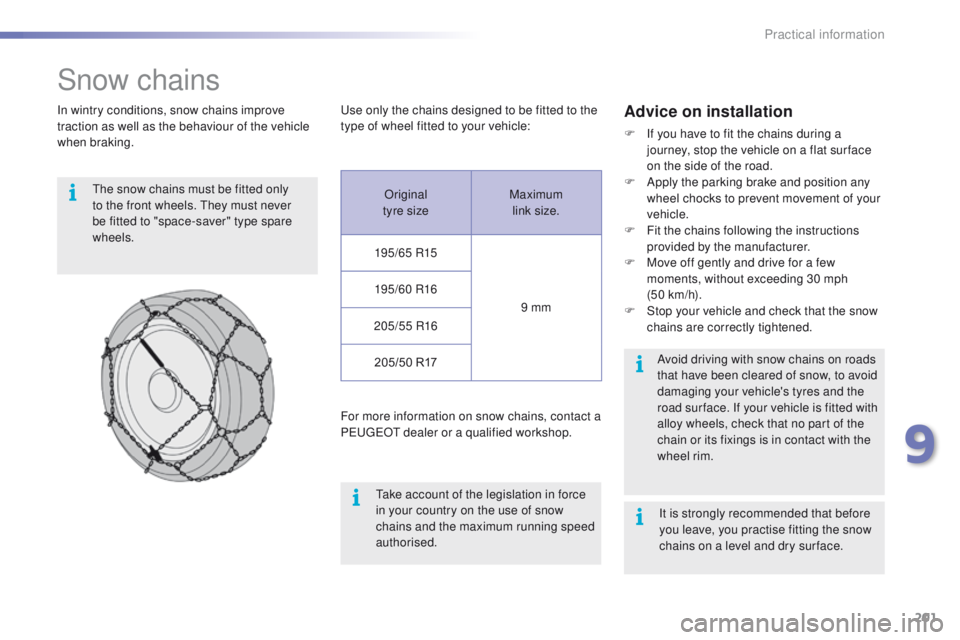
when braking.The snow chains must be fitted only
to the front wheels. They must never
be fitted to "space-saver" type spare
wheels.
Take account of the legislation in force
in your country on the use of snow
chains and the maximum running speed
authorised.
Use only the chains designed to be fitted to the
type of wheel fitted to your vehicle:
For more information on snow chains, contact a
PEUGEOT dealer or a qualified workshop.Advice on installation
F If you have to fit the chains during a
journey, stop the vehicle on a flat sur face
on the side of the road.
F
A
pply the parking brake and position any
wheel chocks to prevent movement of your
vehicle.
F
F
it the chains following the instructions
provided by the manufacturer.
F
M
ove off gently and drive for a few
moments, without exceeding 30 mph
(50
km/h).
F
S
top your vehicle and check that the snow
chains are correctly tightened.
Avoid driving with snow chains on roads
that have been cleared of snow, to avoid
damaging your vehicle's tyres and the
road sur face. If your vehicle is fitted with
alloy wheels, check that no part of the
chain or its fixings is in contact with the
wheel rim.
Original
tyre size Maximum
link size.
195/65 R15
9 mm
195/60 R16
205/55 R16 205/50 R17
It is strongly recommended that before
you leave, you practise fitting the snow
chains on a level and dry sur face.
9
Practical information