lights PEUGEOT 206 CC 2001 User Guide
[x] Cancel search | Manufacturer: PEUGEOT, Model Year: 2001, Model line: 206 CC, Model: PEUGEOT 206 CC 2001Pages: 123, PDF Size: 2.88 MB
Page 86 of 123

YOUR 206 CC IN DETAIL
86
Operating programmes
You have a choice of three operating pro- grammes:
Ð Autoadaptive (normal).
Ð Sport.
Ð Snow.One press on button
Aor Bwill select
Sport or Snow respectively. The selec- tion is displayed on the instrumentpanel. Pressing the button a secondtime will return to the autoadaptive(normal) programme. Autoadaptive programme (normal) Gear changes are carried out on the basis of various parameters, such as:
Ð driving style,
Ð road characteristics,
Ð vehicle load.The gearbox continuously scans the
different programmes in the memoryand selects the one most suitable forthe driving conditions at any givenmoment. Sport programme The Sport programme automatically favours more dynamic driving. Snow Programme In position
D, the Snow programme
provides smooth driving suited to slip- pery roads in order to improve traction
and stability. Starting is in 2nd gear
and changing down is at low enginespeeds. Special operating features
Ð During prolonged braking, the gearbox changes down automatically, so as to
provide efficient engine braking.
Ð If you take your foot off the accele- rator suddenly (when you are takenby surprise, for example), the gear-box will not change up, so as to
improve safety.
Ð When the engine is cold, the gear- box automatically selects a specialprogramme that enables the engineto reach its ideal temperature more quickly in order to decrease pollu-tion.
Kickdown For immediate maximum acceleration
without touching the gear lever, press theaccelerator pedal down as far as it will go.The gearbox will change down automati-cally or stay in the gear selected, up tomaximum engine speed.Any disruption of the system is signalled by the simulta-neous flashing of the Sportand Snow lights on the ins-
trument panel. In such a case, thegearbox will operate in downgrade
mode. You may feel a substantialknock when reverse is selected from P
to Ror Nto R(without any risk of
damage to the gearbox). Do not exceed 60 m.p.h. (100km/h).Contact a PEUGEOT dealer without
delay. When the engine is idling with the car
in gear, the car will move even withoutyou accelerating. Do not accelerate while a gear is being
selected, when the vehicle is stationary.
When stationary, have your foot on the
brake pedal when selecting a gear. Do not accelerate in gear with the brakes on. If work needs to be done with the engi- ne running, apply the handbrake andselect position P.
Do not change down to brake on slip-pery roads. Never select position Nwhen the
vehicle is moving.Never engage Por Rif the vehicle is
not stationary.Do not leave children inside the vehicle unsupervised when the engineis running.
Page 101 of 123
PRACTICAL ASPECTS OF YOUR VEHICLE99
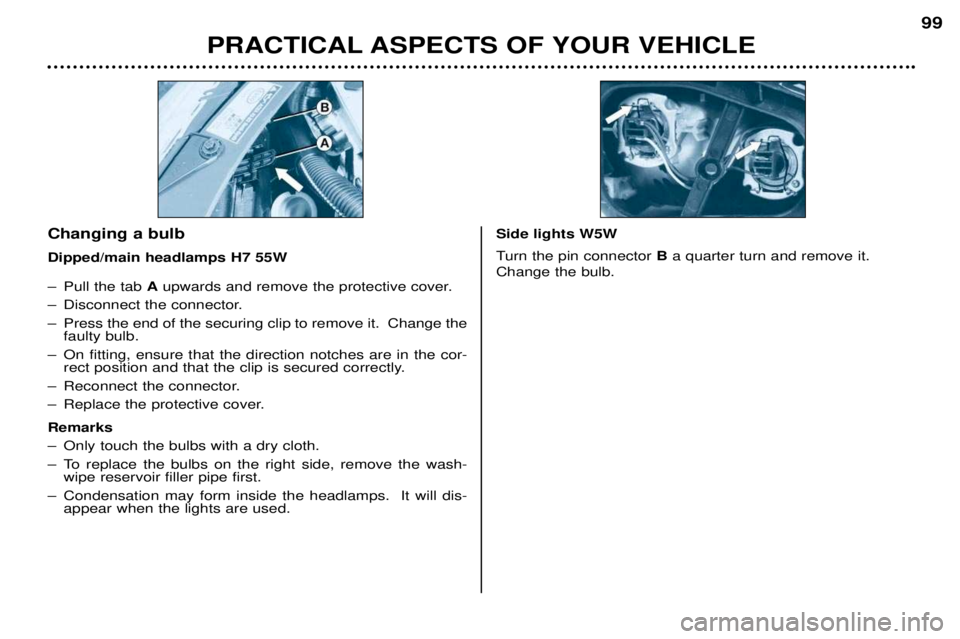
Ð Pull the tab
Aupwards and remove the protective cover.
Ð Disconnect the connector.
Ð Press the end of the securing clip to remove it. Change the faulty bulb.
Ð On fitting, ensure that the direction notches are in the cor- rect position and that the clip is secured correctly.
Ð Reconnect the connector.
Ð Replace the protective cover. Remarks
Ð Only touch the bulbs with a dry cloth.
Ð To replace the bulbs on the right side, remove the wash- wipe reservoir filler pipe first.
Ð Condensation may form inside the headlamps. It will dis- appear when the lights are used.
Changing a bulb Dipped/main headlamps H7 55WSide lights W5W
Turn the pin connector B a quarter turn and remove it.
Change the bulb.
Page 103 of 123
PRACTICAL ASPECTS OF YOUR VEHICLE101
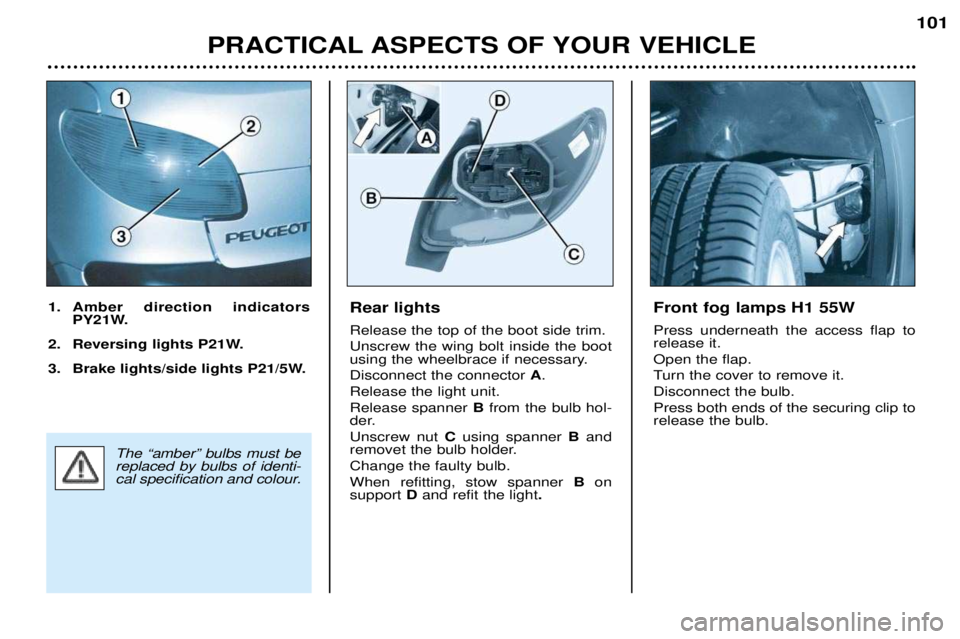
Rear lights Release the top of the boot side trim. Unscrew the wing bolt inside the boot
using the wheelbrace if necessary. Disconnect the connector
A.
Release the light unit.Release spanner B from the bulb hol-
der.Unscrew nut Cusing spanner B and
removet the bulb holder.Change the faulty bulb.When refitting, stow spanner B on
support D and refit the light .
1. Amber direction indicators
PY21W.
2. Reversing lights P21W.
3. Brake lights/side lights P21/5W.Front fog lamps H1 55W Press underneath the access flap to release it. Open the flap.
Turn the cover to remove it.Disconnect the bulb.Press both ends of the securing clip to release the bulb.
The ÒamberÓ bulbs must be replaced by bulbs of identi-
cal specification and colour.
Page 104 of 123
PRACTICAL ASPECTS OF YOUR VEHICLE101
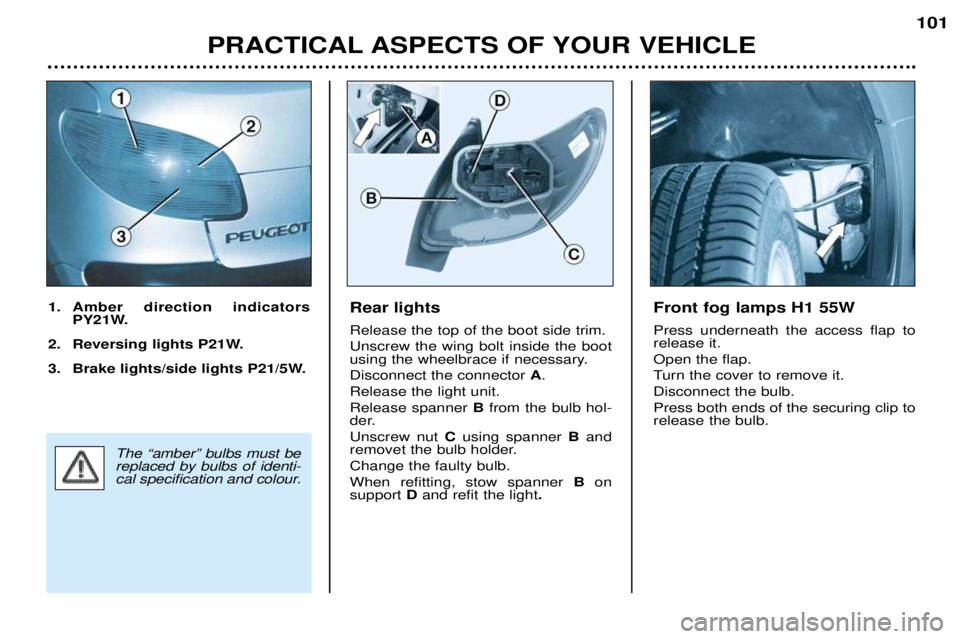
Rear lights Release the top of the boot side trim. Unscrew the wing bolt inside the boot
using the wheelbrace if necessary. Disconnect the connector
A.
Release the light unit.Release spanner B from the bulb hol-
der.Unscrew nut Cusing spanner B and
removet the bulb holder.Change the faulty bulb.When refitting, stow spanner B on
support D and refit the light .
1. Amber direction indicators
PY21W.
2. Reversing lights P21W.
3. Brake lights/side lights P21/5W.Front fog lamps H1 55W Press underneath the access flap to release it. Open the flap.
Turn the cover to remove it.Disconnect the bulb.Press both ends of the securing clip to release the bulb.
The ÒamberÓ bulbs must be replaced by bulbs of identi-
cal specification and colour.
Page 105 of 123
PRACTICAL ASPECTS OF YOUR VEHICLE
102
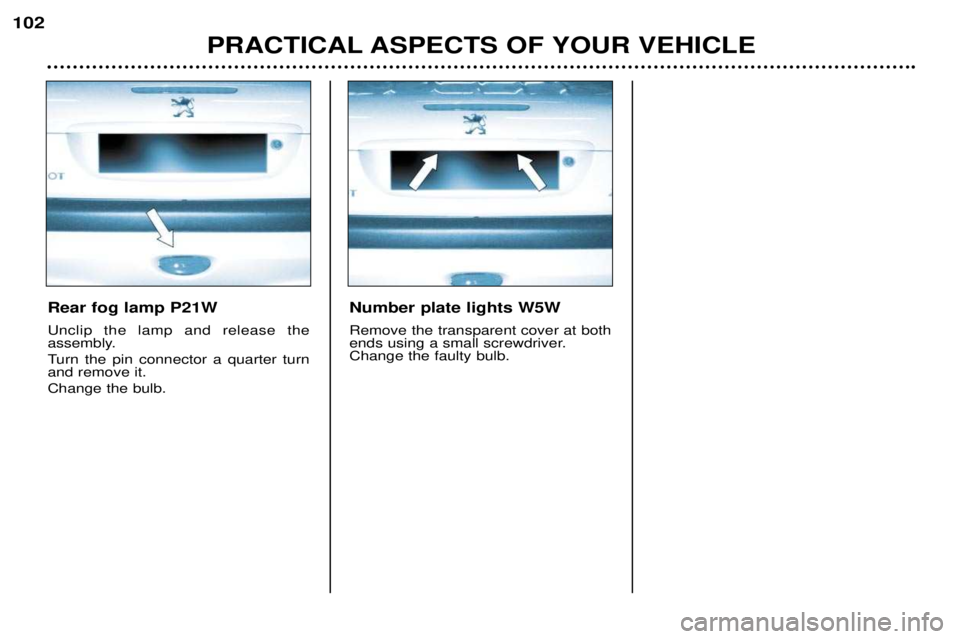
Rear fog lamp P21W Unclip the lamp and release the
assembly.
Turn the pin connector a quarter turn and remove it. Change the bulb. Number plate lights W5W Remove the transparent cover at both
ends using a small screwdriver.Change the faulty bulb.
Page 110 of 123
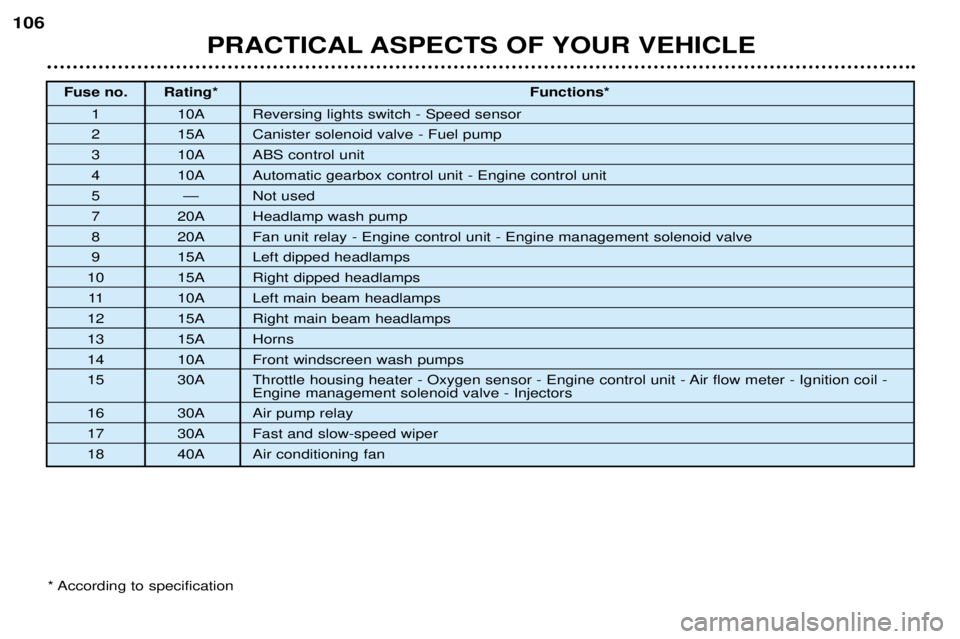
PRACTICAL ASPECTS OF YOUR VEHICLE
106
* According to specification
Fuse no. Rating*
Functions*
1 10A Reversing lights switch - Speed sensor
2 15A Canister solenoid valve - Fuel pump
3 10A ABS control unit
4 10A Automatic gearbox control unit - Engine control unit
5 Ñ Not used
7 20A Headlamp wash pump
8 20A Fan unit relay - Engine control unit - Engine management solenoid valve
9 15A Left dipped headlamps
10 15A Right dipped headlamps
11 10A Left main beam headlamps
12 15A Right main beam headlamps
13 15A Horns
14 10A Front windscreen wash pumps
15 30A Throttle housing heater - Oxygen sensor - Engine control unit - Air flow meter - Ignition coil -
Engine management solenoid valve - Injectors
16 30A Air pump relay
17 30A Fast and slow-speed wiper
18 40A Air conditioning fan
Page 111 of 123
PRACTICAL ASPECTS OF YOUR VEHICLE107
Battery
To charge the battery using a battery charger:
Ð Disconnect the battery.
Ð Follow the instructions for use given by the battery charger manufacturer.
Ð Reconnect starting with the negative (-) terminal.
Ð Check that the terminals and connectors are clean. If they are covered with sul-
phate (white or greenish deposit), disconnect them and clean them.
To start the vehicle and charge the battery from another battery:
Ð Connect the red cable to the positive (+) terminals of the two batteries.
Ð Connect one end of the green or black cable to the negative (-) terminal of the slave battery.
Ð Connect the other end of the green or black cable to an earth point on the bro- ken down vehicle as far as possible from the battery.
Operate the starter, let the engine run.
Wait for the engine to return to idle, then disconnect the cables. Economy mode function After the engine has stopped, with the key in the accessories position, cer-
tain functions (windscreen wiper, elec-tric windows, courtesy lights, audioequipment etc.) can only be used forthirty minutes, to prevent discharging
the battery.
Once the thirty minutes are over, the message
"Economy mode active"
appears on the multifunction displayand the active functions are put on
standby.
A flat battery will prevent the engine from starting.
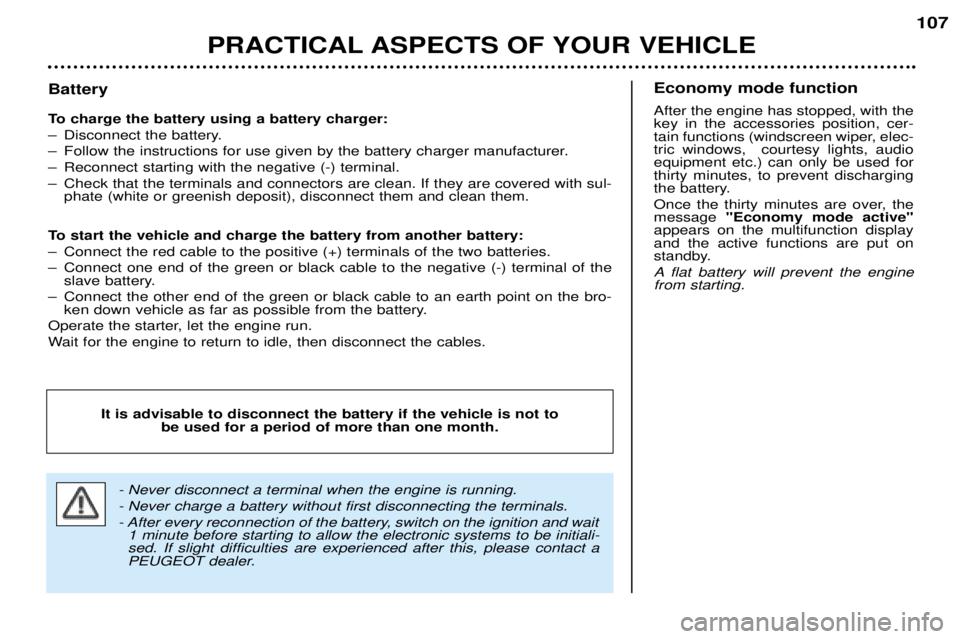
- Never disconnect a terminal when the engine is running.
- Never charge a battery without first disconnecting the terminals.
- After every reconnection of the battery, switch on the ignition and wait 1 minute before starting to allow the electronic systems to be initiali- sed. If slight difficulties are experienced after this, please contact a
PEUGEOT dealer.
It is advisable to disconnect the battery if the vehicle is not to be used for a period of more than one month.
Page 112 of 123
PRACTICAL ASPECTS OF YOUR VEHICLE
108
Fitting audio equipment
Your vehicle is equipped with certain factory-fitted audio equipment:
Ð roof aerial,
Ð coaxial aerial cable,
Ð basic interference suppression,
Ð supply to front speakers,
Ð supply to rear speakers* and
tweeters*,
Ð two 8-way connectors.
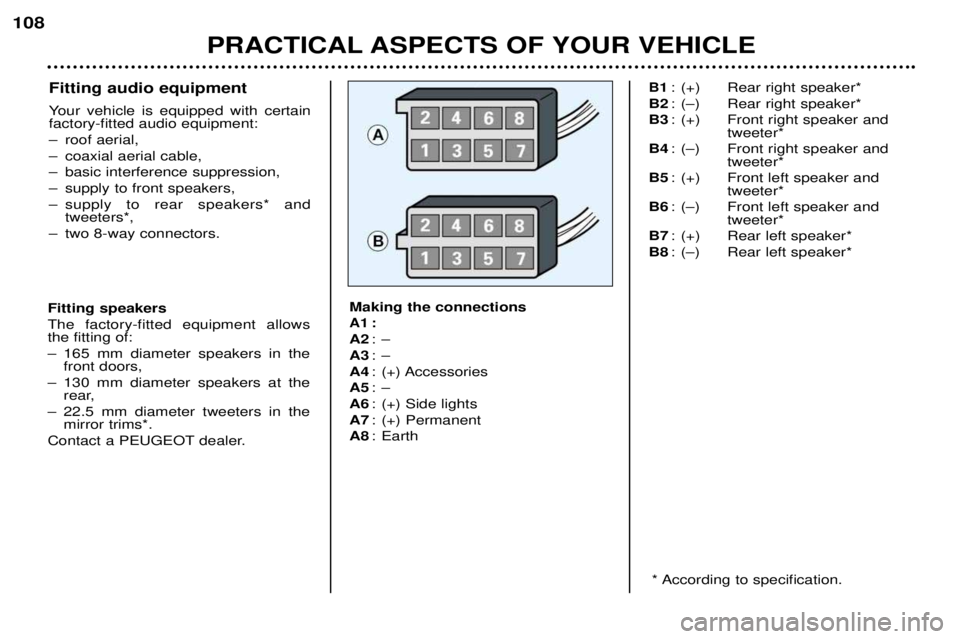
Making the connections
A1 :
A2:Ð
A3 :Ð
A4 : (+) Accessories
A5 :Ð
A6 : (+) Side lights
A7 : (+) Permanent
A8 : Earth
B1: (+) Rear right speaker*
B2 : (Ð) Rear right speaker*
B3 : (+) Front right speaker and
tweeter*
B4 : (Ð) Front right speaker and
tweeter*
B5 : (+) Front left speaker and
tweeter*
B6 : (Ð) Front left speaker and
tweeter*
B7 : (+) Rear left speaker*
B8 : (Ð) Rear left speaker*
Fitting speakers The factory-fitted equipment allows the fitting of:
Ð 165 mm diameter speakers in the front doors,
Ð 130 mm diameter speakers at the rear,
Ð 22.5 mm diameter tweeters in the mirror trims*.
Contact a PEUGEOT dealer.
* According to specification.
Page 114 of 123

PRACTICAL ASPECTS OF YOUR VEHICLE
110
Towing a trailer, caravan, boat etc.
Only use original PEUGEOT tow bars that have been tested and approvedfrom the design stage of your vehicle.The tow bar must be fitted by a
PEUGEOT dealer.
Your vehicle is mainly designed for transporting people and luggage but it
may also be used for towing a trailer. Driving with a trailer subjects the tow- ing vehicle to more significant stressand its driver must be particularlycareful. Air density decreases with altitude, thus reducing engine performance.The maximum towing load must bereduced by 10% for every1000 metres of altitude. Driving advice Distribution of loadsDistribute the load in the trailer so that the heaviest items are as close aspossible to the axle and the noseweight approaches the maximum per-mitted without exceeding it. Cooling
Towing a trailer on a slope increases the temperature of the coolant. As the fan is electrically controlled, its cooling capacity is not dependent onthe engine speed.
On the contrary, use a high gear to lower the engine speed, and reduceyour speed. The maximum towing load on a long slope depends on the gradient and theoutside temperature. Always pay attention to the coolant temperature. If the warning light comes on, stop the
vehicle and switch off the engine assoon as possible.
Tyres Check the tyre pressures of the towing
vehicle and of the trailer, observing therecommended pressures.
Braking
Towing increases the braking dis- tance. Lights Adjust your headlamps so that they do not dazzle other road users.Check the electrical signalling on the
trailer. Side wind
Take into acount the increased sensi- tivity to side wind.