lights Peugeot 206 Dag 2003 Owner's Guide
[x] Cancel search | Manufacturer: PEUGEOT, Model Year: 2003, Model line: 206 Dag, Model: Peugeot 206 Dag 2003Pages: 168, PDF Size: 2.1 MB
Page 147 of 168
26-05-2003
PRACTICAL INFORMATION135
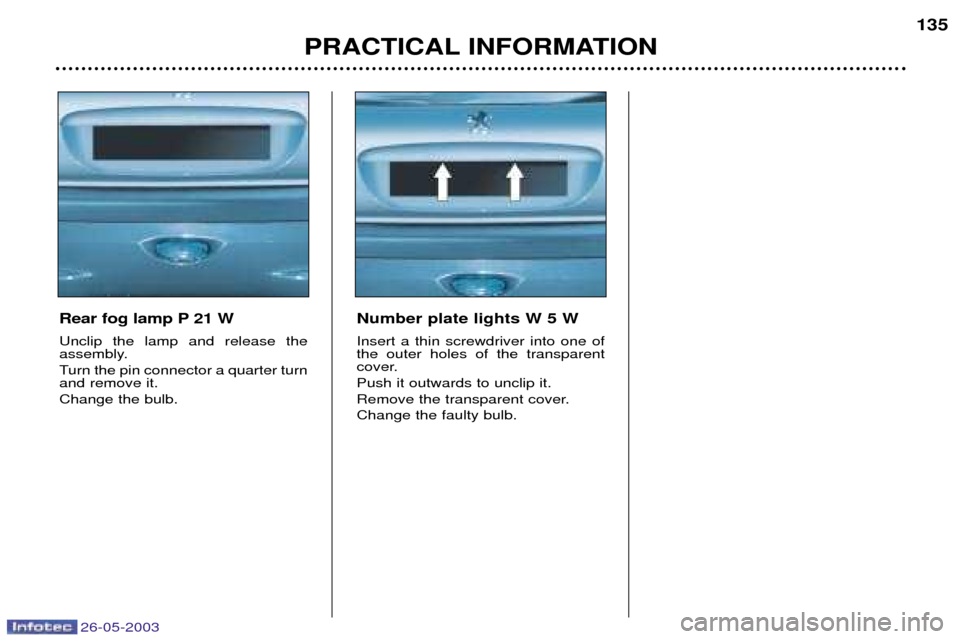
Rear fog lamp P 21 W Unclip the lamp and release the
assembly.
Turn the pin connector a quarter turn and remove it. Change the bulb. Number plate lights W 5 W Insert a thin screwdriver into one of the outer holes of the transparent
cover. Push it outwards to unclip it.
Remove the transparent cover.Change the faulty bulb.
Page 150 of 168
26-05-2003
PRACTICAL INFORMATION139
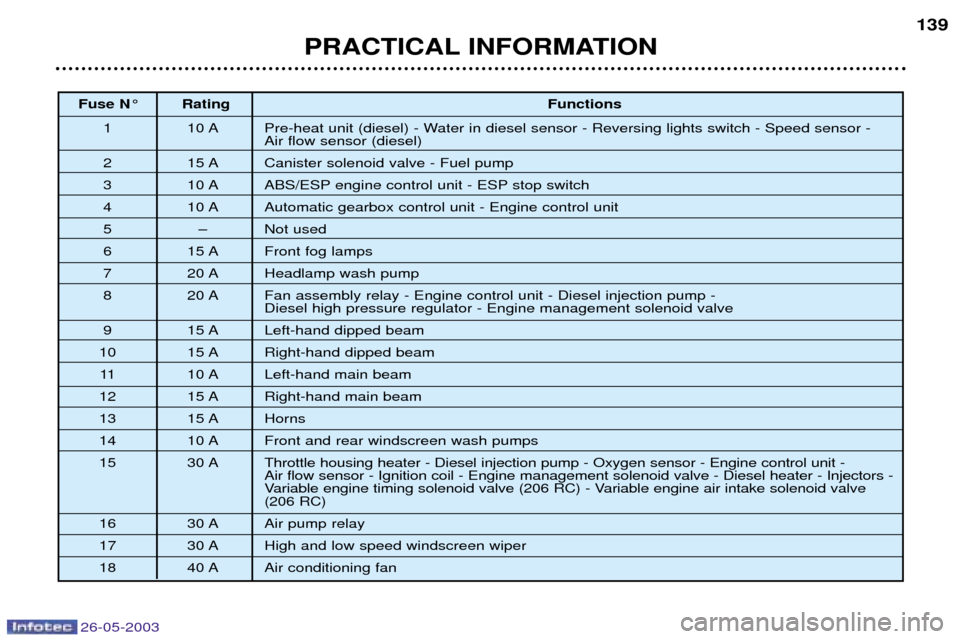
Fuse N¡ Rating
Functions
1 10 A Pre-heat unit (diesel) - Water in diesel sensor - Reversing lights switch - Speed sensor - Air flow sensor (diesel)
2 15 A Canister solenoid valve - Fuel pump
3 10 A ABS/ESP engine control unit - ESP stop switch
4 10 A Automatic gearbox control unit - Engine control unit
5 Ð Not used
6 15 A Front fog lamps
7 20 A Headlamp wash pump
8 20 A Fan assembly relay - Engine control unit - Diesel injection pump - Diesel high pressure regulator - Engine management solenoid valve
9 15 A Left-hand dipped beam
10 15 A Right-hand dipped beam 11 10 A Left-hand main beam
12 15 A Right-hand main beam
13 15 A Horns
14 10 A Front and rear windscreen wash pumps
15 30 A Throttle housing heater - Diesel injection pump - Oxygen sensor - Engine control unit - Air flow sensor - Ignition coil - Engine management solenoid valve - Diesel heater - Injectors -
Variable engine timing solenoid valve (206 RC) - Variable engine air intake solenoid valve (206 RC)
16 30 A Air pump relay
17 30 A High and low speed windscreen wiper
18 40 A Air conditioning fan
Page 153 of 168
PRACTICAL INFORMATION
140
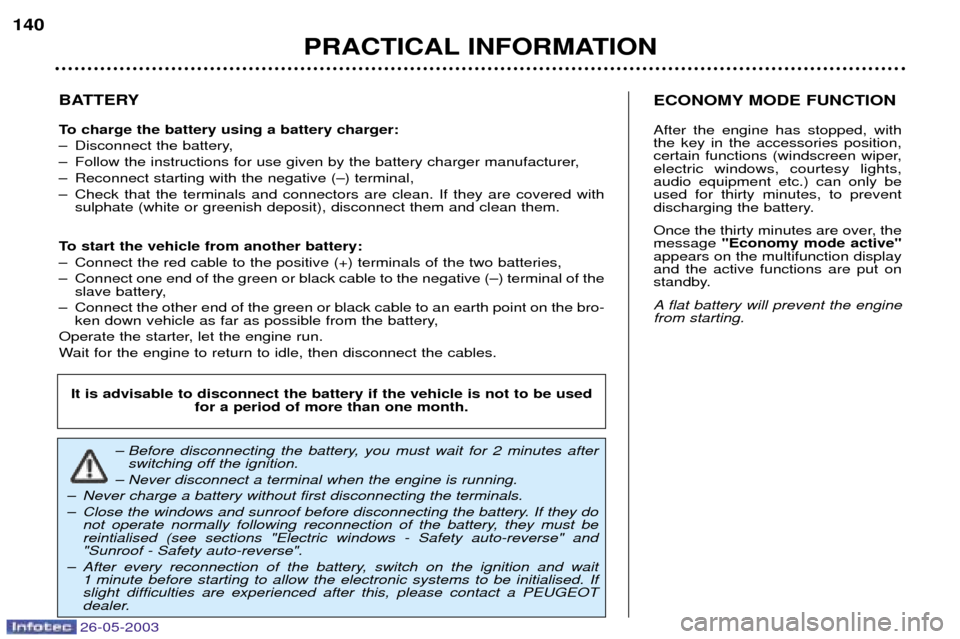
BATTERY
To charge the battery using a battery charger:
Ð Disconnect the battery,
Ð Follow the instructions for use given by the battery charger manufacturer,
Ð Reconnect starting with the negative (Ð) terminal,
Ð Check that the terminals and connectors are clean. If they are covered withsulphate (white or greenish deposit), disconnect them and clean them.
To start the vehicle from another battery:
Ð Connect the red cable to the positive (+) terminals of the two batteries,
Ð Connect one end of the green or black cable to the negative (Ð) terminal of the slave battery,
Ð Connect the other end of the green or black cable to an earth point on the bro- ken down vehicle as far as possible from the battery,
Operate the starter, let the engine run.
Wait for the engine to return to idle, then disconnect the cables.
Ð Before disconnecting the battery, you must wait for 2 minutes after switching off the ignition.
Ð Never disconnect a terminal when the engine is running.
Ð Never charge a battery without first disconnecting the terminals.
Ð Close the windows and sunroof before disconnecting the battery. If they do not operate normally following reconnection of the battery, they must be reintialised (see sections "Electric windows - Safety auto-reverse" and"Sunroof - Safety auto-reverse".
Ð After every reconnection of the battery, switch on the ignition and wait 1 minute before starting to allow the electronic systems to be initialised. Ifslight difficulties are experienced after this, please contact a PEUGEOT
dealer.
It is advisable to disconnect the battery if the vehicle is not to be used for a period of more than one month.
ECONOMY MODE FUNCTION After the engine has stopped, with the key in the accessories position,
certain functions (windscreen wiper,electric windows, courtesy lights,audio equipment etc.) can only beused for thirty minutes, to prevent
discharging the battery.
Once the thirty minutes are over, the message "Economy mode active"
appears on the multifunction displayand the active functions are put on
standby.
A flat battery will prevent the engine from starting.
26-05-2003
Page 156 of 168
26-05-2003
PRACTICAL INFORMATION143
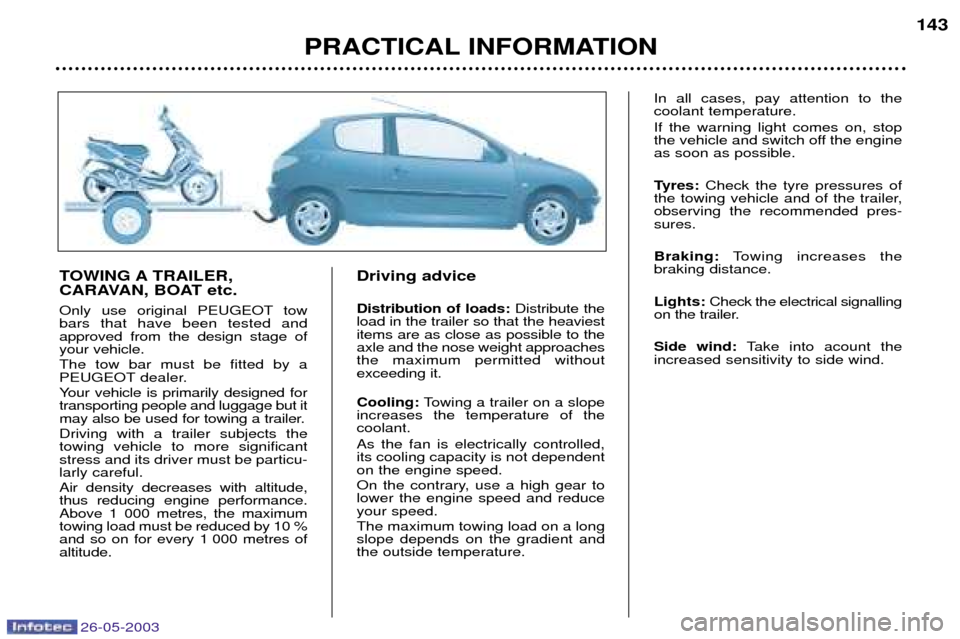
TOWING A TRAILER,
CARAVAN, BOAT etc.
Only use original PEUGEOT tow bars that have been tested andapproved from the design stage ofyour vehicle. The tow bar must be fitted by a
PEUGEOT dealer.
Your vehicle is primarily designed for transporting people and luggage but it
may also be used for towing a trailer. Driving with a trailer subjects the towing vehicle to more significantstress and its driver must be particu-larly careful. Air density decreases with altitude, thus reducing engine performance.Above 1 000 metres, the maximumtowing load must be reduced by 10 %
and so on for every 1 000 metres ofaltitude. Driving advice Distribution of loads:
Distribute the
load in the trailer so that the heaviest items are as close as possible to theaxle and the nose weight approachesthe maximum permitted withoutexceeding it. Cooling: Towing a trailer on a slope
increases the temperature of the coolant. As the fan is electrically controlled, its cooling capacity is not dependenton the engine speed.
On the contrary, use a high gear to lower the engine speed and reduceyour speed. The maximum towing load on a long slope depends on the gradient andthe outside temperature. In all cases, pay attention to thecoolant temperature. If the warning light comes on, stop
the vehicle and switch off the engineas soon as possible.
Tyres:
Check the tyre pressures of
the towing vehicle and of the trailer, observing the recommended pres-sures. Braking: Towing increases the
braking distance. Lights: Check the electrical signalling
on the trailer.Side wind: Take into acount the
increased sensitivity to side wind.