brake Peugeot 208 2015 - RHD (UK, Australia) Owner's Guide
[x] Cancel search | Manufacturer: PEUGEOT, Model Year: 2015, Model line: 208, Model: Peugeot 208 2015Pages: 341, PDF Size: 38.75 MB
Page 170 of 341
168
208_en_Chap07_ Amenagements_ed01-2015
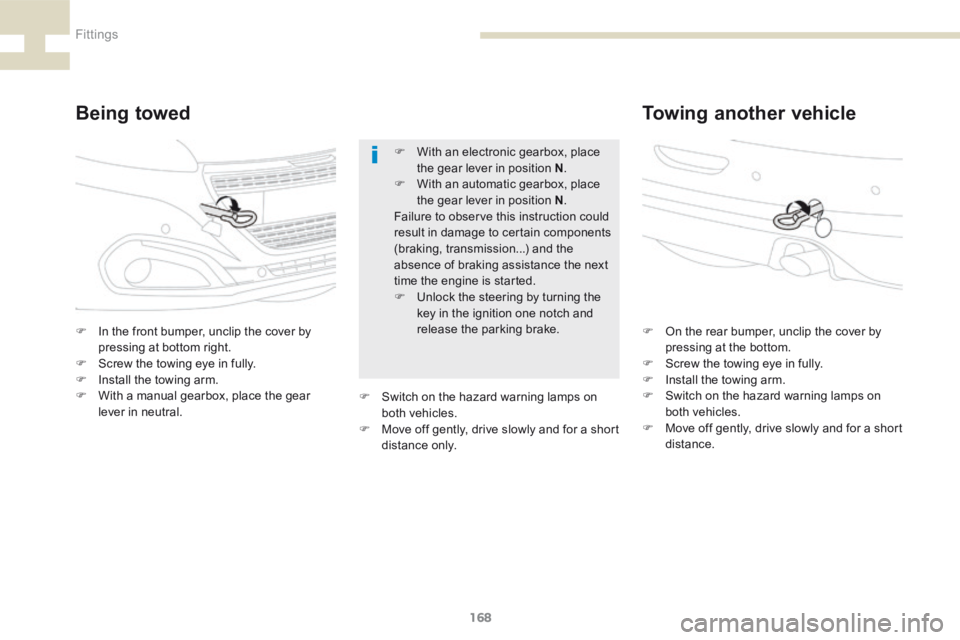
Being towedTowing another vehicle
F In the front bumper, unclip the cover by
pressing at bottom right.
F Screw the towing eye in fully.
F Install the towing arm.
F With a manual gearbox, place the gear
lever in neutral. F
On the rear bumper, unclip the cover by
pressing at the bottom.
F Screw the towing eye in fully.
F Install the towing arm.
F Switch on the hazard warning lamps on
both vehicles.
F Move off gently, drive slowly and for a short
distance.
F
With an electronic gearbox, place
the gear lever in position N .
F With an automatic gearbox, place
the gear lever in position N .
Failure to observe this instruction could
result in damage to certain components
(braking, transmission...) and the
absence of braking assistance the next
time the engine is started.
F Unlock the steering by turning the
key in the ignition one notch and
release the parking brake.
F Switch on the hazard warning lamps on
both vehicles.
F Move off gently, drive slowly and for a short
distance only.
Fittings
Page 171 of 341

169
208_en_Chap07_ Amenagements_ed01-2015
Accessories
A wide range of accessories and genuine parts
is available from the PEUGEOT dealer network.
These accessories and parts are all suitable
for your vehicle and benefit from PEUGEOT's
recommendation and warranty.
Conversion kits
You can obtain an "Enterprise" kit to convert a
trade vehicle to a private car and vice-versa.
"Comfort":
door deflectors, side blinds and rear blind,
cigarette lighter, boot dividers, coat hanger
fixed to head restraint, front centre armrest,
under shelf storage, front and rear parking
sensors...
"Transport solutions":
boot liner with dividers, luggage net, roof bars,
bicycle carrier on roof bars, ski carrier, roof
box....
"Styling":
aluminium gear lever knob, spoiler, styling
strips, alloy wheels, trims, chromed mirror
shells, body kit, three styling kits (Ligne S,
Street and Graffic), stickers, interior and
exterior mirror shells, parking brake lever grips,
alloy wheels, alloy wheel caps...
"Security":
anti-theft alarm, window engraving, wheel
security bolts, child seats and booster
cushions, breathalyzer, first aid kit, warning
triangle, high visibility jacket, stolen vehicle
tracking system, temporary puncture repair kit,
snow chains, non-slip covers, front foglamps
kit...
"Protection":
mats, seat covers compatible with lateral
airbags, mud flaps, side protection rubbing
strips, bumper protection rubbing strips,
aluminium or PVC door aperture finishers...
To avoid any risk of jamming of the pedals:
- ensure that the mat is positioned and
secured correctly,
- never fit one mat on top of another.
Tow bar, which must be fitted by
PEUGEOT dealer or a qualified
workshop.
The fitting of electrical equipment
or accessories which are not
recommended by PEUGEOT may result
in a failure of your vehicle's electronic
system and excessive electrical
consumption.
Contact a PEUGEOT dealer
for information on the range of
recommended equipment and
accessories.
7
Fittings
Page 173 of 341

171
208_en_Chap07_ Amenagements_ed01-2015
Snow chains
The snow chains must be fitted only
to the front wheels. They must never
be fitted to "space-saver" type spare
wheels.
Take account of the legislation in force
in your country on the use of snow
chains and the maximum running speed
authorised.Avoid driving with snow chains on roads
that have been cleared of snow, to
avoid damaging your vehicle's tyres and
the road sur face. If your vehicle is fitted
with alloy wheels, check that no part of
the chain or its fixings is in contact with
the wheel rim.
Advice on installation
F
If you have to fit the chains during a
journey, stop the vehicle on a flat sur face
on the side of the road.
F Apply the parking brake and position any
wheel chocks to prevent movement of your
vehicle.
F Fit the chains following the instructions
provided by the manufacturer.
F Move off gently and drive for a few
moments, without exceeding 30 mph
(50 km/h).
F Stop your vehicle and check that the snow
chains are correctly tightened.
Use only the chains designed to be fitted to the
type of wheel fitted to your vehicle:
For more information on snow chains, contact a
PEUGEOT dealer or a qualified workshop.
Original
tyre size Maximum link
size.
185/65 R15 9 mm
195/55 R16
2 0 5 /4 5 R17 7 mm
It is strongly recommended that before
you leave, you practise fitting the snow
chains on a level and dry sur face.
In wintry conditions, snow chains improve
traction as well as the behaviour of the vehicle
when braking.
7
Fittings
Page 176 of 341
174
208_en_Chap08_Informations-pratiques_ed01-2015
General information
Engine characteristicsWeights and towed loads
The kerb weight is equal to the unladen
weight + driver (75 kg).
The gross train weight and towed load values
indicated apply up to a maximum altitude of
1 000 metres; the towed load mentioned must
be reduced by 10 % for every additional
1 000 metres.
The weight of the braked trailer can be
increased, within the GTW limit, on condition
that the GV W of the towing vehicle is reduced
by the same amount.
The recommended nose weight is the vertical
load on the towbar ball (removable with or
without tools). High ambient temperatures may result
in a reduction in the per formance of
the vehicle to protect the engine; when
the ambient temperature is higher than
37 °C, limit the towed weight.
Towing with a lightly loaded vehicle can
adversely affect roadholding.
Braking distances are increased when
towing a trailer.
Never exceed 60 mph (100 km/h) when
towing (comply with the legislation in
force in your country).
GV W:
gross vehicle weight, the maximum authorised vehicle weight.
GT W: gross train weight, the maximum authorised weight of vehicle
plus trailer.
The engine characteristics (capacity,
maximum power, maximum power speed, fuel,
CO
2 emissions...) for your vehicle are given in
the registration document, as well as in sales
brochures.
These characteristics correspond to the
values type-approved on a test bed, under
conditions defined in European legislation
(Directive 1999/99/EC).
For more information, contact a PEUGEOT
dealer or a qualified workshop. The maximum weights and towed loads for your
vehicle are given are given in the registration
document, as well as in sales brochures.
These values are also present on the
manufacturer's plate or label.
See the "Identification markings" section.
For more information, contact a PEUGEOT
dealer or a qualified workshop.
Practical information
Page 178 of 341
176
208_en_Chap08_Informations-pratiques_ed01-2015
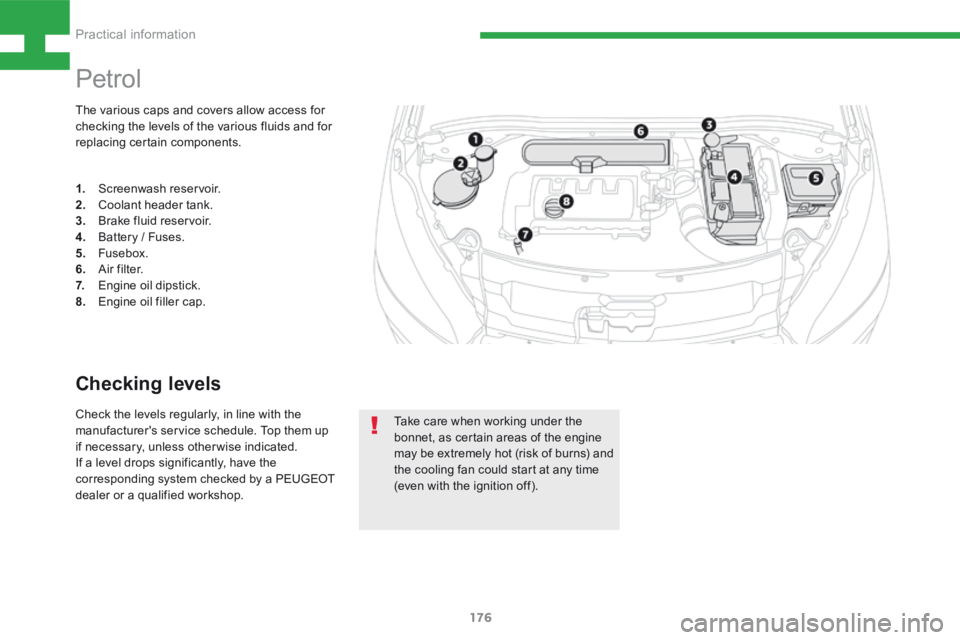
The various caps and covers allow access for
checking the levels of the various fluids and for
replacing certain components.
Petrol
1. Screenwash reservoir.
2. Coolant header tank.
3. Brake fluid reservoir.
4. Battery / Fuses.
5. Fusebox.
6. A i r f i l t e r.
7. Engine oil dipstick.
8. Engine oil filler cap.
Take care when working under the
bonnet, as certain areas of the engine
may be extremely hot (risk of burns) and
the cooling fan could start at any time
(even with the ignition off).
Checking levels
Check the levels regularly, in line with the
manufacturer's service schedule. Top them up
if necessary, unless otherwise indicated.
If a level drops significantly, have the
corresponding system checked by a PEUGEOT
dealer or a qualified workshop.
Practical information
Page 179 of 341
177
208_en_Chap08_Informations-pratiques_ed01-2015
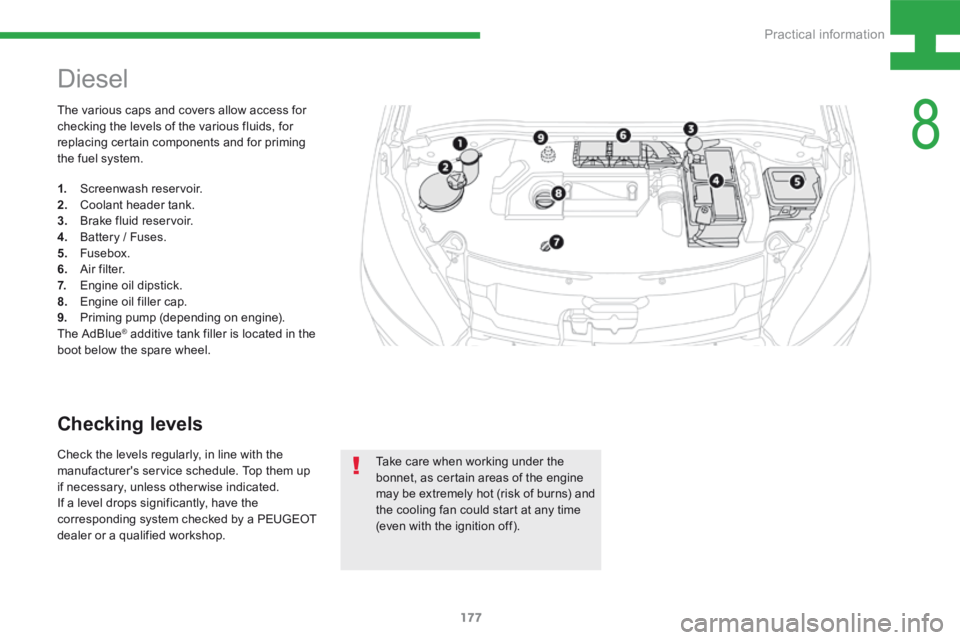
The various caps and covers allow access for
checking the levels of the various fluids, for
replacing certain components and for priming
the fuel system.
Diesel
1. Screenwash reservoir.
2. Coolant header tank.
3. Brake fluid reservoir.
4. Battery / Fuses.
5. Fusebox.
6. A i r f i l t e r.
7. Engine oil dipstick.
8. Engine oil filler cap.
9. Priming pump (depending on engine).
The AdBlue
® additive tank filler is located in the
boot below the spare wheel.
Take care when working under the
bonnet, as certain areas of the engine
may be extremely hot (risk of burns) and
the cooling fan could start at any time
(even with the ignition off).
Checking levels
Check the levels regularly, in line with the
manufacturer's service schedule. Top them up
if necessary, unless otherwise indicated.
If a level drops significantly, have the
corresponding system checked by a PEUGEOT
dealer or a qualified workshop.
8
Practical information
Page 180 of 341
178
208_en_Chap08_Informations-pratiques_ed01-2015
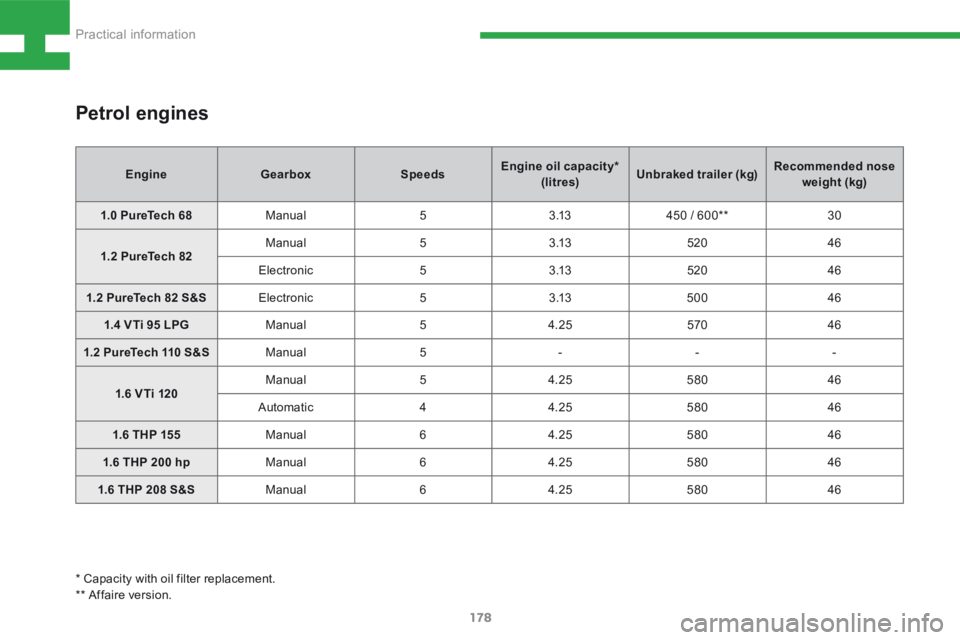
EngineGearbox SpeedsEngine oil capacity*
(litres) Unbraked trailer (kg) Recommended nose
weight (kg)
1.0 PureTech 68 Manual53 .13450 / 600** 30
1.2 PureTech 82 Manual
53 .13 520 46
Electronic 53 .13 520 46
1.2 PureTech 82 S&S Electronic53 .13 500 46
1.4 VTi 95 LPG Manual54.25 570 46
1.2 PureTech 110 S&S Manual5---
1.6 VTi 120 Manual
54.25 580 46
Automatic 44.25 580 46
1.6 THP 155 Manual 64.25 580 46
1.6 THP 200 hp Manual64.25 580 46
1.6 THP 208 S&S Manual64.25 580 46
* Capacity with oil filter replacement.
** Affaire version.
Petrol engines
Practical information
Page 181 of 341
179
208_en_Chap08_Informations-pratiques_ed01-2015
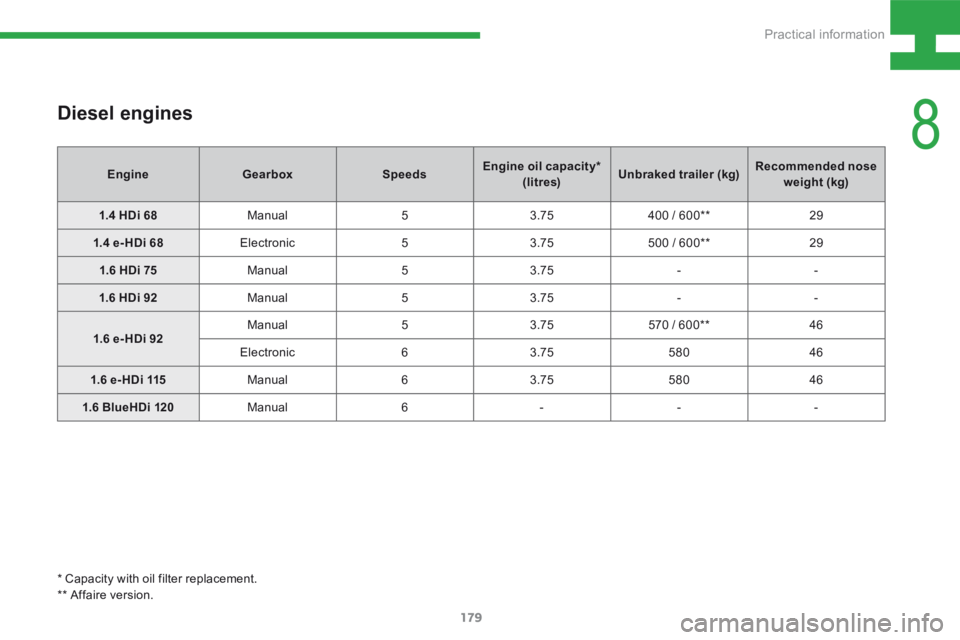
* Capacity with oil filter replacement.
** Affaire version.
Diesel engines
EngineGearbox SpeedsEngine oil capacity*
(litres) Unbraked trailer (kg) Recommended nose
weight (kg)
1.4 HDi 68 Manual 53.75400 / 600** 29
1.4 e- HDi 68 Electronic 53.75500 / 600** 29
1.6 HDi 75 Manual 53.75 --
1.6 HDi 92 Manual 53.75 --
1.6 e- HDi 92 Manual
53.75570 / 600** 46
Electronic 63.75 580 46
1.6 e- HDi 115 Manual63.75 580 46
1.6 BlueHDi 120 Manual6---
8
Practical information
Page 213 of 341

211
208_en_Chap08_Informations-pratiques_ed01-2015
F Place the foot of the jack 2 on the ground
and ensure that it is directly below the
front A or rear B jacking point provided on
the underbody, whichever is closest to the
wheel to be changed.
Removing a wheel
Parking the vehicle
Immobilise the vehicle where it does not
block traffic: the ground must be level,
stable and not slippery.
Apply the parking brake.
Switch off the ignition.
With a manual gearbox, engage first
gear to block the wheels.
With an electronic gearbox, place the
lever in position R to block the wheels.
With an automatic gearbox, place the
lever in position P to block the wheels.
Check that the parking brake warning
lamps in the instrument panel come on.
The occupants must get out of the
vehicle and wait where they are safe.
Never go underneath a vehicle raised
using a jack; use an axle stand.
List of operations
F Remove the bolt cover from each of
the bolts using the tool 3 (according to
equipment).
F Fit the security socket 4 on the
wheelbrace 1 to slacken the security bolt
(if fitted).
F Slacken the other bolts using the
wheelbrace 1 o n l y.
Never use:
- the jack for any other purpose than
raising the vehicle,
- a jack other than the one provided
by the manufacturer.
8
Practical information
Page 217 of 341
215
208_en_Chap08_Informations-pratiques_ed01-2015
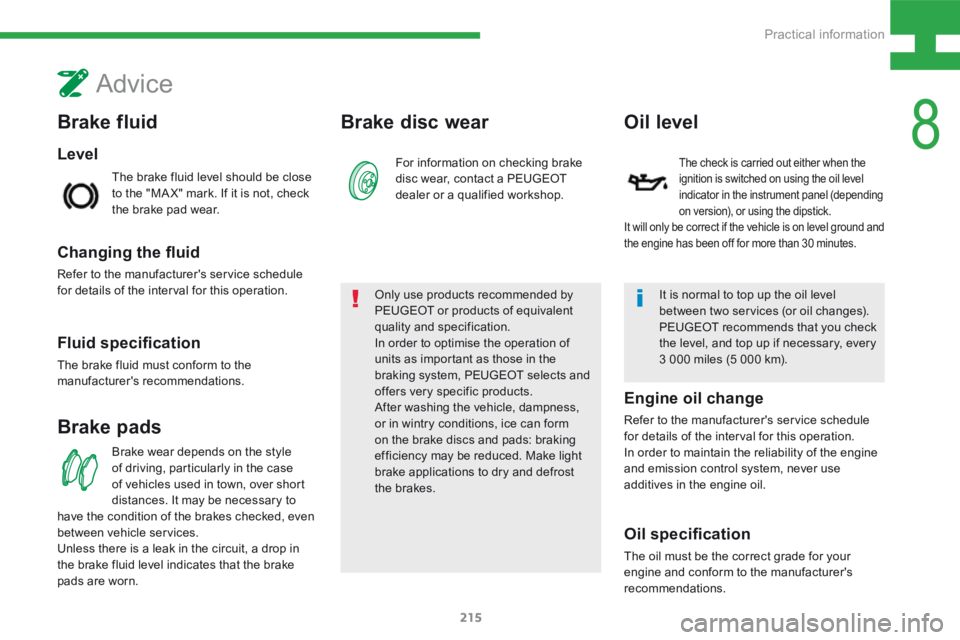
Level
Brake fluid
The brake fluid level should be close
to the "MA X" mark. If it is not, check
the brake pad wear.
Advice
Changing the fluid
Refer to the manufacturer's service schedule
for details of the interval for this operation.
Brake padsBrake disc wear
For information on checking brake
disc wear, contact a PEUGEOT
dealer or a qualified workshop.
Brake wear depends on the style
of driving, particularly in the case
of vehicles used in town, over short
distances. It may be necessary to
have the condition of the brakes checked, even
between vehicle services.
Unless there is a leak in the circuit, a drop in
the brake fluid level indicates that the brake
pads are worn. Only use products recommended by
PEUGEOT or products of equivalent
quality and specification.
In order to optimise the operation of
units as important as those in the
braking system, PEUGEOT selects and
offers very specific products.
After washing the vehicle, dampness,
or in wintry conditions, ice can form
on the brake discs and pads: braking
efficiency may be reduced. Make light
brake applications to dry and defrost
the brakes.
Fluid specification
The brake fluid must conform to the
manufacturer's recommendations.
It is normal to top up the oil level
between two services (or oil changes).
PEUGEOT recommends that you check
the level, and top up if necessary, every
3 000 miles (5 000 km).
Oil level
The check is carried out either when the
ignition is switched on using the oil level
indicator in the instrument panel (depending
on version), or using the dipstick.
It will only be correct if the vehicle is on level ground and
the engine has been off for more than 30 minutes.
Engine oil change
Refer to the manufacturer's service schedule
for details of the interval for this operation.
In order to maintain the reliability of the engine
and emission control system, never use
additives in the engine oil.
Oil specification
The oil must be the correct grade for your
engine and conform to the manufacturer's
recommendations.
8
Practical information