brake light Peugeot 208 2015 Owner's Manual - RHD (UK, Australia)
[x] Cancel search | Manufacturer: PEUGEOT, Model Year: 2015, Model line: 208, Model: Peugeot 208 2015Pages: 341, PDF Size: 38.75 MB
Page 4 of 341
2
208_en_Chap00a_sommaire_ed01-2015
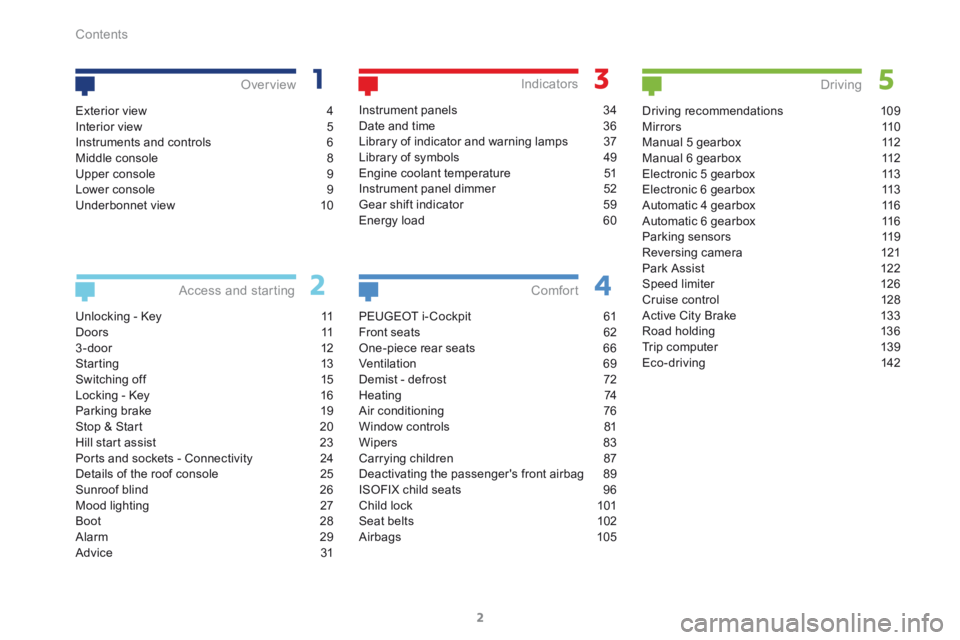
Unlocking - Key 11
D o o r s 11
3 - door 12
Starting 13
Switching off 15
Locking - Key 16
Parking brake 19
Stop & Start 20
Hill start assist 23
Ports and sockets - Connectivity 24
Details of the roof console 25
Sunroof blind 26
Mood lighting 27
Boot 28
Alarm 29
Advice 31
Access and starting Over view
Instrument panels
34
Date and time 36
Library of indicator and warning lamps 37
Library of symbols 49
Engine coolant temperature 51
Instrument panel dimmer 52
Gear shift indicator 59
Energy load 60
Indicators
PEUGEOT i- Cockpit 61
Front seats 62
One-piece rear seats 66
Ventilation 69
Demist - defrost 72
Heating 74
Air conditioning 76
Window controls 81
Wipers 83
Carrying children 87
Deactivating the passenger's front airbag 89
ISOFIX child seats 96
Child lock 101
Seat belts 102
Airbags 105
Comfort
Driving recommendations 109
M i r r o r s 11 0
Manual 5 gearbox 112
Manual 6 gearbox 112
Electronic 5 gearbox 113
Electronic 6 gearbox 113
Automatic 4 gearbox 116
Automatic 6 gearbox 116
Parking sensors 119
Reversing camera 121
Park Assist 122
Speed limiter 126
Cruise control 128
Active City Brake 133
Road holding 136
Trip computer 139
Eco-driving 142
Driving
Exterior view 4
Interior view 5
Instruments and controls 6
Middle console 8
Upper console 9
Lower console 9
Underbonnet view 10
Contents
Page 6 of 341
4
208_en_Chap01_vue-ensemble_ed01-2015
Exterior view
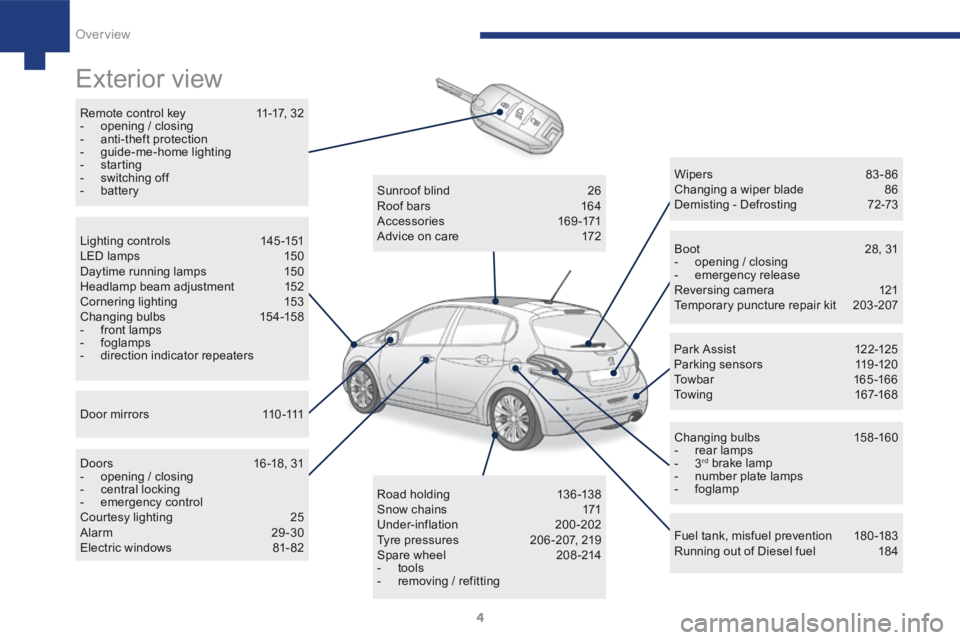
Remote control key 11-17, 32
- opening / closing
- anti-theft protection
- guide-me-home lighting
- starting
- switching off
- battery
Boot 28, 31
- opening / closing
- emergency release
Reversing camera 121
Temporary puncture repair kit 203-207
Wipers 83 - 86
Changing a wiper blade
86
Demisting - Defrosting 72-73
Changing bulbs 158-160
- rear lamps
- 3
rd brake lamp
- number plate lamps
- foglamp
Fuel tank, misfuel prevention 180-183
Running out of Diesel fuel 184
Sunroof blind
26
Roof bars 164
Accessories 169-171
Advice on care 172
Road holding 13 6 -13 8
Snow chains 171
Under-inflation 200-202
Tyre pressures 206 -207, 219
Spare wheel 208-214
- tools
- removing / refitting
Lighting controls
145-151
LED lamps 150
Daytime running lamps 150
Headlamp beam adjustment 152
Cornering lighting 153
Changing bulbs 154-158
- front lamps
- foglamps
- direction indicator repeaters
D o o r m i r r o r s 11 0 -111
Doors 16 -18, 31
- opening / closing
- central locking
- emergency control
Courtesy lighting 25
Alarm 29-30
Electric windows 81- 82 Par k A ssist
12 2-125
Parking sensors 119-120
Towbar 165 -166
Towing 167-168
Over view
Page 22 of 341
20
208_en_Chap02_ Acces-Demarrage_ed01-2015
Stop & Start
Principle
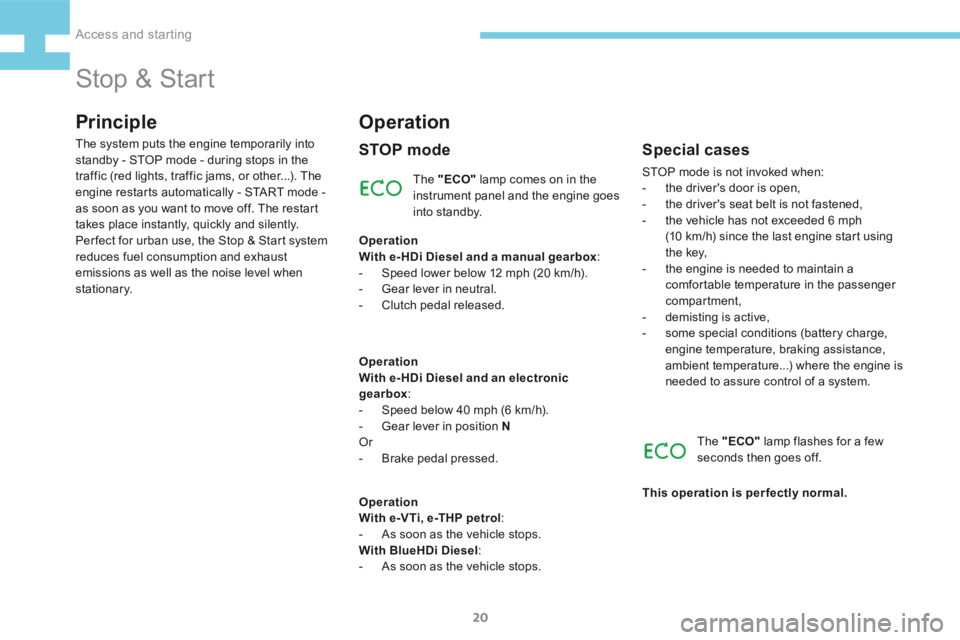
The "ECO" lamp comes on in the
instrument panel and the engine goes
into standby.
The system puts the engine temporarily into
standby - STOP mode - during stops in the
traffic (red lights, traffic jams, or other...). The
engine restarts automatically - START mode -
as soon as you want to move off. The restart
takes place instantly, quickly and silently.
Per fect for urban use, the Stop & Start system
reduces fuel consumption and exhaust
emissions as well as the noise level when
stationary.
Operation
STOP mode
Operation
With e- HDi Diesel and a manual gearbox
:
- Speed lower below 12 mph (20 km/h).
- Gear lever in neutral.
- Clutch pedal released.
Operation
With e- HDi Diesel and an electronic
gearbox :
- Speed below 40 mph (6 km/h).
- Gear lever in position N
Or
- Brake pedal pressed.
Operation
With e-VTi, e-THP petrol :
- As soon as the vehicle stops.
With BlueHDi Diesel :
- As soon as the vehicle stops.
Special cases
STOP mode is not invoked when:
- the driver's door is open,
- the driver's seat belt is not fastened,
- the vehicle has not exceeded 6 mph
(10 km/h) since the last engine start using
t h e key,
- the engine is needed to maintain a
comfortable temperature in the passenger
compartment,
- demisting is active,
- some special conditions (battery charge,
engine temperature, braking assistance,
ambient temperature...) where the engine is
needed to assure control of a system.
The "ECO" lamp flashes for a few
seconds then goes off.
This operation is perfectly normal.
Access and starting
Page 111 of 341

109
208_en_Chap05_conduite_ed01-2015
Never drive with the parking brake
applied - Risk of overheating and
damage to the braking system!
Do not park or run the engine when
stationary in areas where inflammable
substances and materials (dry grass,
dead leaves...) might come into contact
with the hot exhaust system - Risk of
fire!
Never leave a vehicle unsupervised
with the engine running. If you have
to leave your vehicle with the engine
running, apply the parking brake
and put the gearbox into neutral or
position N or P, depending on the type
of gearbox.
Driving recommendations
Observe the driving regulations and remain
vigilant whatever the traffic conditions.
Pay close attention to the traffic and keep your
hands on the wheel so that you are ready to
react at any time to any eventuality.
On a long journey, a break every two hours is
strongly recommended.
In difficult weather, drive smoothly, anticipate
the need to brake and increase the distance
from other vehicles. If you are obliged to drive through water:Important!
Driving on flooded
roads
- check that the depth of water does not
exceed 15 cm, taking account of waves
that might be generated by other users,
- deactivate the Stop & Start system,
- drive as slowly as possible without
stalling. In all cases, do not exceed 6 mph
(10 km/h),
- do not stop and do not switch off the
engine.
We strongly advise against driving on flooded
roads, as this could cause serious damage
to the engine or gearbox, as well as to the
electrical systems of your vehicle.
On leaving the flooded road, as soon as
circumstances allow, make several light brake
applications to dry the brake discs and pads.
If in doubt on the state of your vehicle, contact
a PEUGEOT dealer or a qualified workshop.
5
Driving
Page 139 of 341

137
208_en_Chap05_conduite_ed01-2015
Anti-lock braking system
(ABS) and electronic brake
force distribution (EBFD)
Operation
In emergency braking, press
very firmly without releasing the
pressure. When changing wheels (tyres and rims),
make sure that these are approved for
your vehicle.
Normal operation of the ABS may make
itself felt by slight vibrations of the brake
pedal.
The fixed illumination of this warning
lamp indicates that there is a fault
with the ABS.
When this warning lamp comes on,
coupled with the STOP
and ABS
warning lamps, accompanied by
The vehicle retains conventional braking. Drive
carefully at moderate speed.
an audible signal and a message, it indicates
that there is a fault with the electronic brake
force distribution (EBFD).
You must stop as soon as it is safe to do so.
In both cases, have the system checked by a
PEUGEOT dealer or a qualified workshop as
soon as possible.
5
Driving
Page 144 of 341
142
208_en_Chap05_conduite_ed01-2015
Eco-driving
Eco-driving is a range of everyday practices that allow the motorist to optimise their fuel consumption and CO2 emissions.
Optimise the use of your gearbox
With a manual gearbox, move off gently and change up without waiting.
During acceleration change up early.
With an automatic or electronic gearbox, give preference to automatic
mode and avoid pressing the accelerator pedal heavily or suddenly.
The gear shift indicator invites you engage the most suitable gear: as
soon as the indication is displayed in the instrument panel, follow it
straight away.
For vehicles fitted with an electronic or automatic gearbox, this
indicator appears only in manual mode.
Drive smoothly
Maintain a safe distance between vehicles, use engine braking rather
than the brake pedal, and press the accelerator progressively. These
practices contribute towards a reduction in fuel consumption and CO
2
emissions and also helps reduce the background traffic noise.
If your vehicle has cruise control, make use of the system at speeds
above 25 mph (40 km/h) when the traffic is flowing well.
Control the use of your electrical
equipment
Before moving off, if the passenger compartment is too warm, ventilate it
by opening the windows and air vents before using the air conditioning.
Above 30 mph (50 km/h), close the windows and leave the air vents
open.
Remember to make use of equipment that can help keep the
temperature in the passenger compartment down (sunroof and window
blinds...).
Switch off the air conditioning, unless it has automatic regulation, as
soon as the desired temperature is attained.
Switch off the demisting and defrosting controls, if not automatic.
Switch off the heated seat as soon as possible.
Switch off the headlamps and front foglamps when the level of light
does not require their use.
Avoid running the engine before moving off, particularly in winter; your
vehicle will warm up much faster while driving.
As a passenger, if you avoid connecting your multimedia devices
(film, music, video game...), you will contribute towards limiting the
consumption of electrical energy, and so of fuel.
Disconnect your portable devices before leaving the vehicle.
Driving
Page 160 of 341
158
208_en_Chap06_Feux-Signalisations_ed01-2015
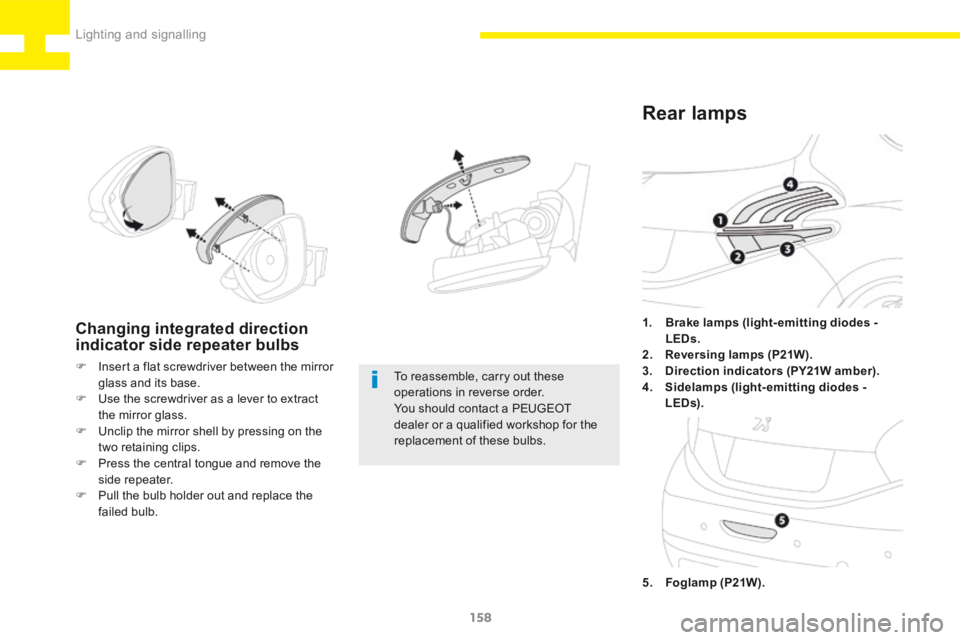
1. Brake lamps (light- emitting diodes -
LEDs.
2. Reversing lamps (P21W).
3. Direction indicators (PY21W amber).
4. Sidelamps (light-emitting diodes -
LEDs).
Rear lamps
5. Foglamp (P21W).
Changing integrated direction
indicator side repeater bulbs
F Insert a flat screwdriver between the mirror
glass and its base.
F Use the screwdriver as a lever to extract
the mirror glass.
F Unclip the mirror shell by pressing on the
two retaining clips.
F Press the central tongue and remove the
side repeater.
F Pull the bulb holder out and replace the
failed bulb. To reassemble, carry out these
operations in reverse order.
You should contact a PEUGEOT
dealer or a qualified workshop for the
replacement of these bulbs.
Lighting and signalling
Page 162 of 341
160
208_en_Chap06_Feux-Signalisations_ed01-2015
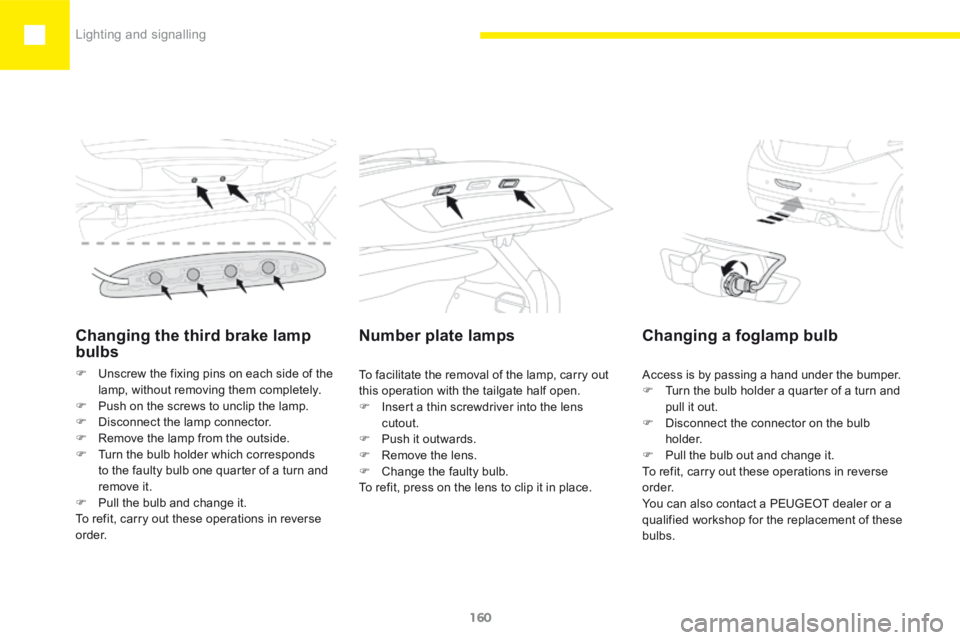
Changing the third brake lamp
bulbs
F Unscrew the fixing pins on each side of the
lamp, without removing them completely.
F Push on the screws to unclip the lamp.
F Disconnect the lamp connector.
F Remove the lamp from the outside.
F Turn the bulb holder which corresponds
to the faulty bulb one quarter of a turn and
remove it.
F Pull the bulb and change it.
To refit, carry out these operations in reverse
o r d e r.
Number plate lamps
To facilitate the removal of the lamp, carry out
this operation with the tailgate half open.
F Insert a thin screwdriver into the lens
cutout.
F Push it outwards.
F Remove the lens.
F Change the faulty bulb.
To refit, press on the lens to clip it in place. Access is by passing a hand under the bumper.
F
Turn the bulb holder a quarter of a turn and
pull it out.
F Disconnect the connector on the bulb
h o l d e r.
F Pull the bulb out and change it.
To refit, carry out these operations in reverse
o r d e r.
You can also contact a PEUGEOT dealer or a
qualified workshop for the replacement of these
bulbs.
Changing a foglamp bulb
Lighting and signalling
Page 168 of 341
166
208_en_Chap07_ Amenagements_ed01-2015
Driving advice
Distribution of loads
F Distribute the load in the trailer so that the
heaviest items are as close as possible to
the axle and the nose weight approaches
the maximum permitted without
exceeding it.
Air density decreases with altitude, thus
reducing engine performance. Above
1 000 metres, the maximum towed load must
be reduced by 10 % for every 1 000 metres of
altitude.
Side wind
F Take into account the increased sensitivity
to side wind.
Cooling
Towing a trailer on a slope increases the
temperature of the coolant.
As the fan is electrically controlled, its cooling
capacity is not dependent on the engine speed.
F To lower the engine speed, reduce your
speed.
The maximum towed load on a long incline
depends on the gradient and the ambient
temperature.
In all cases, keep a check on the coolant
temperature.
F If the warning lamp and the
STOP warning lamp come on,
stop the vehicle and switch off
the engine as soon as possible.
Braking
Towing a trailer increases the braking distance.
To avoid overheating of the brakes on a long
mountain type of descent, the use of engine
braking is recommended.
Ty r e s
F Check the tyre pressures of the towing
vehicle and of the trailer, observing the
recommended pressures.
Lighting
F Check the electrical lighting and signalling
on the trailer.
Refer to the "Technical data" section for details
of the weights and towed loads which apply to
your vehicle.
Fittings
Page 171 of 341

169
208_en_Chap07_ Amenagements_ed01-2015
Accessories
A wide range of accessories and genuine parts
is available from the PEUGEOT dealer network.
These accessories and parts are all suitable
for your vehicle and benefit from PEUGEOT's
recommendation and warranty.
Conversion kits
You can obtain an "Enterprise" kit to convert a
trade vehicle to a private car and vice-versa.
"Comfort":
door deflectors, side blinds and rear blind,
cigarette lighter, boot dividers, coat hanger
fixed to head restraint, front centre armrest,
under shelf storage, front and rear parking
sensors...
"Transport solutions":
boot liner with dividers, luggage net, roof bars,
bicycle carrier on roof bars, ski carrier, roof
box....
"Styling":
aluminium gear lever knob, spoiler, styling
strips, alloy wheels, trims, chromed mirror
shells, body kit, three styling kits (Ligne S,
Street and Graffic), stickers, interior and
exterior mirror shells, parking brake lever grips,
alloy wheels, alloy wheel caps...
"Security":
anti-theft alarm, window engraving, wheel
security bolts, child seats and booster
cushions, breathalyzer, first aid kit, warning
triangle, high visibility jacket, stolen vehicle
tracking system, temporary puncture repair kit,
snow chains, non-slip covers, front foglamps
kit...
"Protection":
mats, seat covers compatible with lateral
airbags, mud flaps, side protection rubbing
strips, bumper protection rubbing strips,
aluminium or PVC door aperture finishers...
To avoid any risk of jamming of the pedals:
- ensure that the mat is positioned and
secured correctly,
- never fit one mat on top of another.
Tow bar, which must be fitted by
PEUGEOT dealer or a qualified
workshop.
The fitting of electrical equipment
or accessories which are not
recommended by PEUGEOT may result
in a failure of your vehicle's electronic
system and excessive electrical
consumption.
Contact a PEUGEOT dealer
for information on the range of
recommended equipment and
accessories.
7
Fittings