battery PEUGEOT 3008 2011.5 User Guide
[x] Cancel search | Manufacturer: PEUGEOT, Model Year: 2011.5, Model line: 3008, Model: PEUGEOT 3008 2011.5Pages: 328, PDF Size: 62.67 MB
Page 114 of 328
11 2
FITTINGS
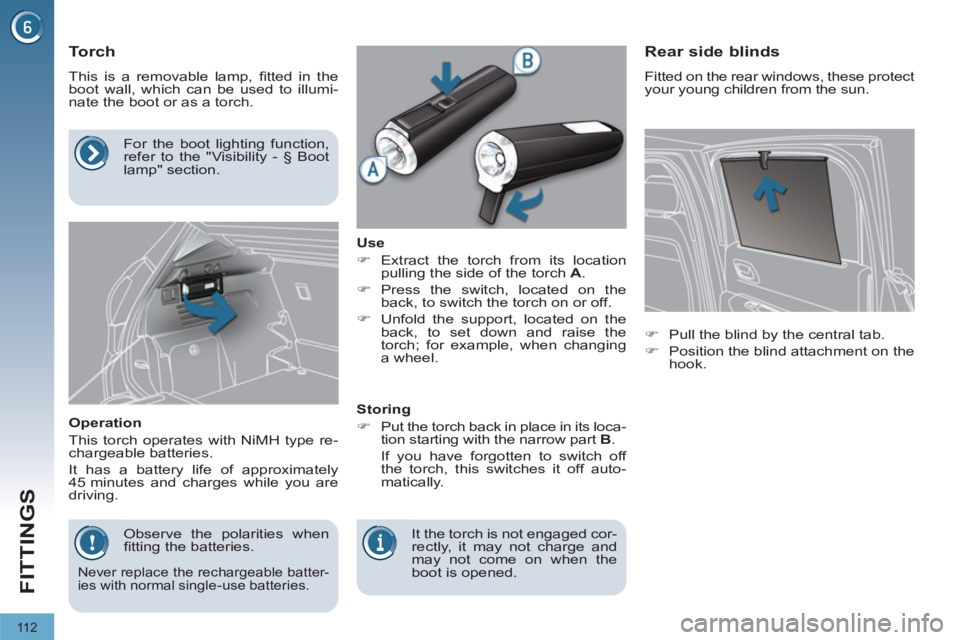
Torch
This is a removable lamp, fi tted in the
boot wall, which can be used to illumi-
nate the boot or as a torch.
Operation
This torch operates with NiMH type re-
chargeable batteries.
It has a battery life of approximately
45 minutes and charges while you are
driving.
Use
)
Extract the torch from its location
pulling the side of the torch A
.
)
Press the switch, located on the
back, to switch the torch on or off.
)
Unfold the support, located on the
back, to set down and raise the
torch; for example, when changing
a wheel.
Storing
)
Put the torch back in place in its loca-
tion starting with the narrow part B
.
If you have forgotten to switch off
the torch, this switches it off auto-
matically.
Rear side blinds
Fitted on the rear windows, these protect
your young children from the sun.
)
Pull the blind by the central tab.
)
Position the blind attachment on the
hook.
Observe the polarities when
fi tting the batteries.
Never replace the rechargeable batter-
ies with normal single-use batteries.
It the torch is not engaged cor-
rectly, it may not charge and
may not come on when the
boot is opened.
For the boot lighting function,
refer to the "Visibility - § Boot
lamp" section.
Page 142 of 328
140
DRIVING
Particular situations
In certain situations (e.g. start-
ing the engine), the parking brake
can automatically alter its force. This
is normal operation.
To advance your vehicle a few cen-
timetres without starting the engine,
but with the ignition on, press on the
brake pedal and release the park-
ing brake by pulling
then releasing
control lever A
. The full release of
the parking brake is confi rmed by the
warning lamp in the control lever A
and the warning lamp in the instru-
ment panel going off and the display
of the message "Handbrake off".
If a parking brake fault occurs while
applied
or if the battery runs fl at, an
emergency release is always pos-
sible.
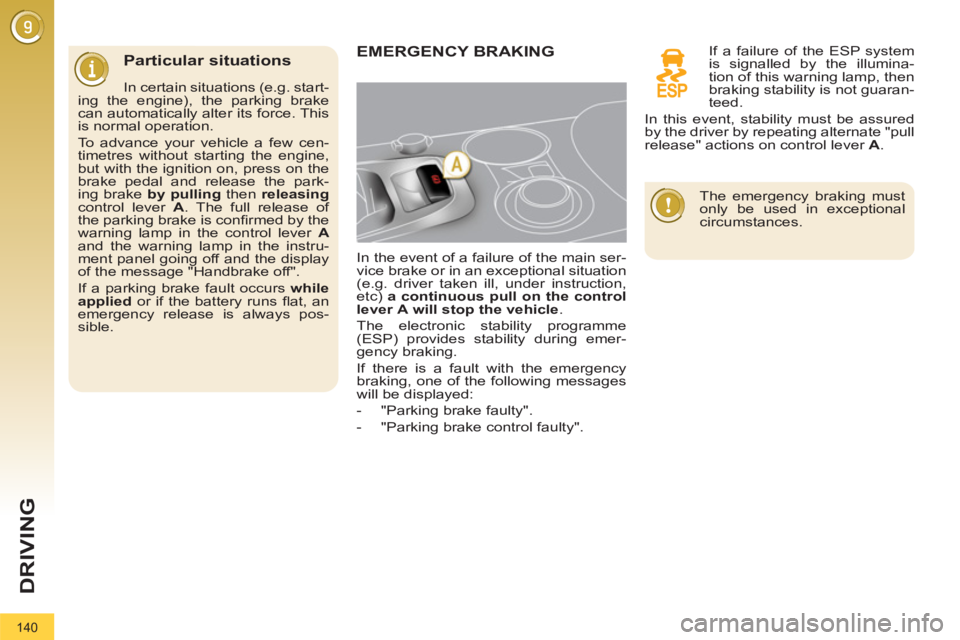
EMERGENCY BRAKING
In the event of a failure of the main ser-
vice brake or in an exceptional situation
(e.g. driver taken ill, under instruction,
etc) a continuous pull
on the control
lever
A
will stop the vehicle
.
The electronic stability programme
(ESP) provides stability during emer-
gency braking.
If there is a fault with the emergency
braking, one of the following messages
will be displayed:
- "Parking brake faulty".
- "Parking brake control faulty".
If a failure of the ESP system
is signalled by the illumina-
tion of this warning lamp, then
braking stability is not guaran-
teed.
In this event, stability must be assured
by the driver by repeating alternate "pull
release" actions on control lever A
.
The emergency braking must
only be used in exceptional
circumstances.
Page 143 of 328
141
DRIVING
Front left seat moved back fully.
In the event of the electric parking brake
malfunctioning or the battery running
fl at, an emergency manual device can
release the parking brake.
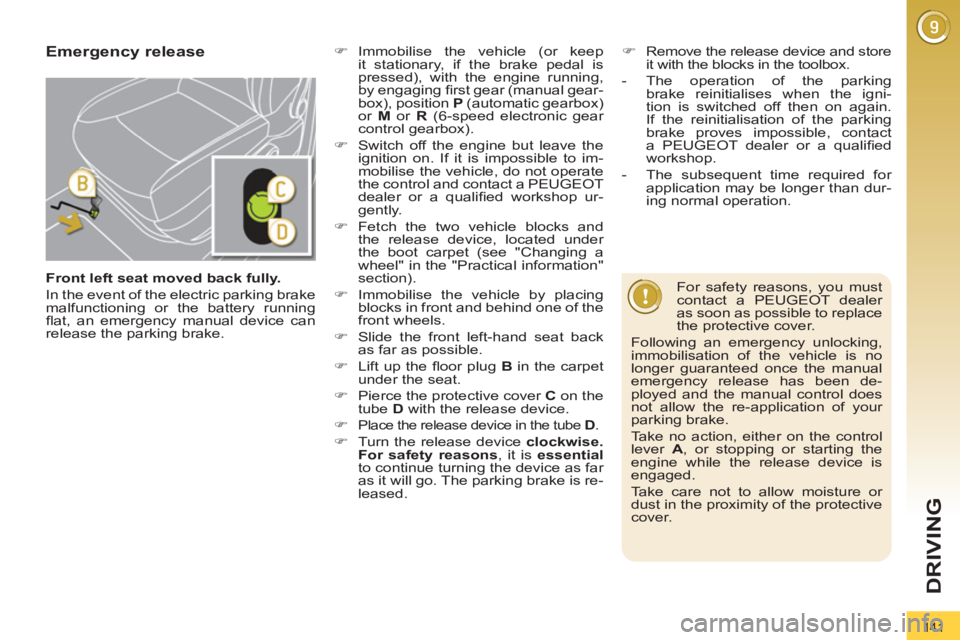
Emergency release
)
Immobilise the vehicle (or keep
it stationary, if the brake pedal is
pressed), with the engine running,
by engaging fi rst gear (manual gear-
box), position P
(automatic gearbox)
or M
or R
(6-speed electronic gear
control gearbox).
)
Switch off the engine but leave the
ignition on. If it is impossible to im-
mobilise the vehicle, do not operate
the control and contact a PEUGEOT
dealer or a qualifi ed workshop ur-
gently.
)
Fetch the two vehicle blocks and
the release device, located under
the boot carpet (see "Changing a
wheel" in the "Practical information"
section).
)
Immobilise the vehicle by placing
blocks in front and behind one of the
front wheels.
)
Slide the front left-hand seat back
as far as possible.
)
Lift up the fl oor plug B
in the carpet
under the seat.
)
Pierce the protective cover C
on the
tube D
with the release device.
)
Place the release device in the tube D
.
)
Turn the release device clockwise.
For safety reasons
, it is essential
to continue turning the device as far
as it will go. The parking brake is re-
leased.
)
Remove the release device and store
it with the blocks in the toolbox.
- The operation of the parking
brake reinitialises when the igni-
tion is switched off then on again.
If the reinitialisation of the parking
brake proves impossible, contact
a PEUGEOT dealer or a qualifi ed
workshop.
- The subsequent time required for
application may be longer than dur-
ing normal operation.
For safety reasons, you must
contact a PEUGEOT dealer
as soon as possible to replace
the protective cover.
Following an emergency unlocking,
immobilisation of the vehicle is no
longer guaranteed once the manual
emergency release has been de-
ployed and the manual control does
not allow the re-application of your
parking brake.
Take no action, either on the control
lever A
, or stopping or starting the
engine while the release device is
engaged.
Take care not to allow moisture or
dust in the proximity of the protective
cover.
Page 146 of 328
144
DRIVING
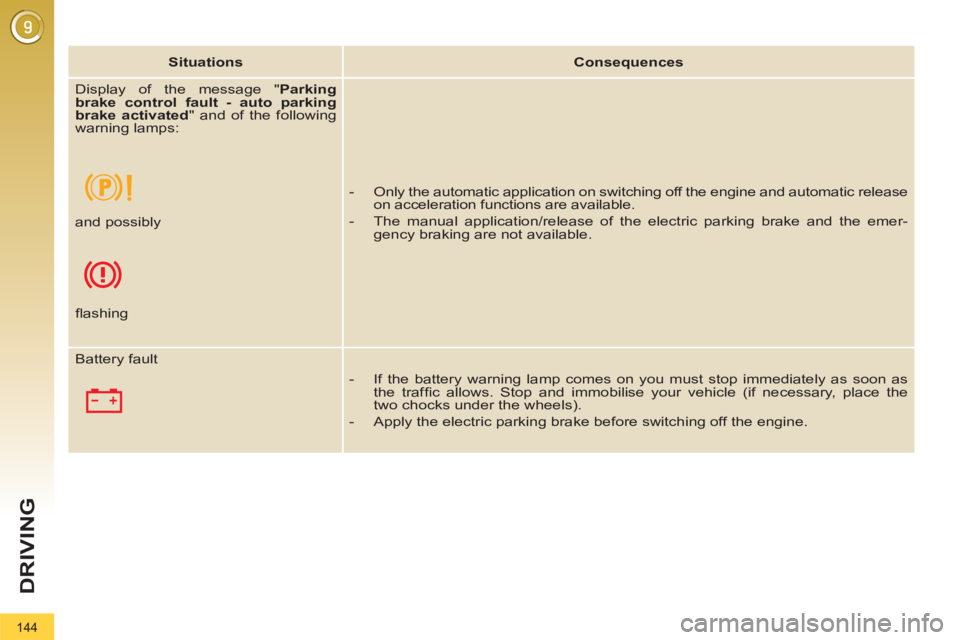
Situations
Consequences
Display of the message " Parking
brake control fault - auto parking
brake activated
" and of the following
warning lamps:
- Only the automatic application on switching off the engine and automatic release
on acceleration functions are available.
- The manual application/release of the electric parking brake and the emer-
gency braking are not available. and possibly
fl ashing
Battery fault
- If the battery warning lamp comes on you must stop immediately as soon as
the traffi c allows. Stop and immobilise your vehicle (if necessary, place the
two chocks under the wheels).
- Apply the electric parking brake before switching off the engine.
Page 162 of 328
160
DRIVING
Stopping the vehicle
Before switching off the engine, you
can engage position P
or N
to place the
gearbox in neutral.
In both cases, apply the parking brake
to immobilise the vehicle, unless it is
programmed to automatic mode.
Operating fault
When the ignition is on, the
lighting of this warning lamp,
accompanied by an audible
signal and a message in the
multifunction screen, indicates
a gearbox malfunction.
In this case, the gearbox switches to
back-up mode and is locked in 3rd gear.
You may feel a substantial knock when
changing from P
to R
and from N
to R
.
This will not cause any damage to the
gearbox.
Do not exceed 60 mph (100 km/h), local
speed restrictions permitting.
Have it checked by a PEUGEOT dealer
or a qualifi ed workshop.
This warning lamp may also come on if
a door is opened.
You risk damaging the gear-
box:
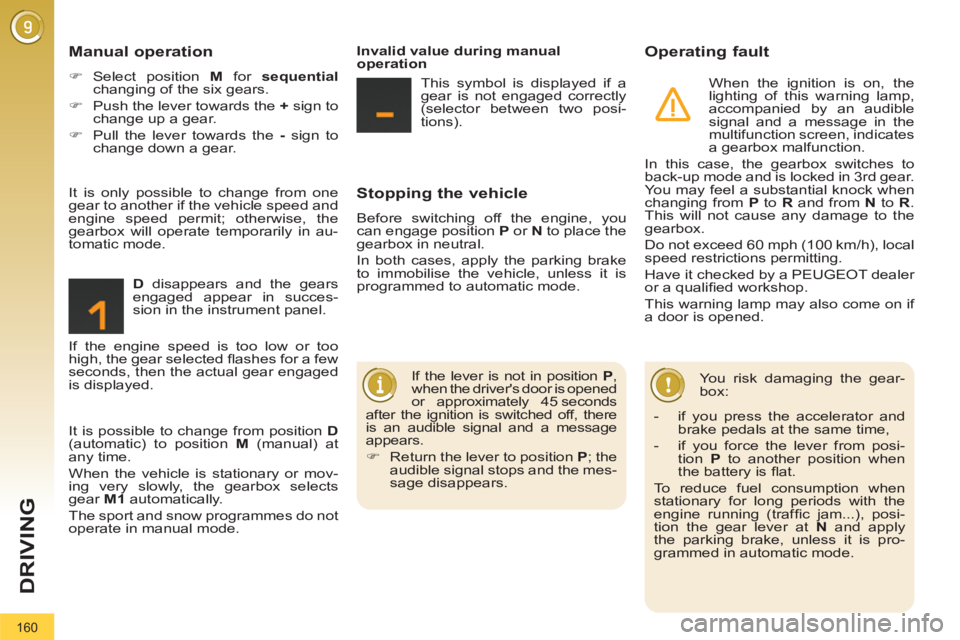
Manual operation
)
Select position M
for sequential
changing of the six gears.
)
Push the lever towards the +
sign to
change up a gear.
)
Pull the lever towards the -
sign to
change down a gear.
D
disappears and the gears
engaged appear in succes-
sion in the instrument panel.
If the lever is not in position P
,
when the driver's door is opened
or approximately 45 seconds
after the ignition is switched off, there
is an audible signal and a message
appears.
)
Return the lever to position P
; the
audible signal stops and the mes-
sage disappears.
It is only possible to change from one
gear to another if the vehicle speed and
engine speed permit; otherwise, the
gearbox will operate temporarily in au-
tomatic mode.
Invalid value during manual
operation
This symbol is displayed if a
gear is not engaged correctly
(selector between two posi-
tions).
It is possible to change from position D
(automatic) to position M
(manual) at
any time.
When the vehicle is stationary or mov-
ing very slowly, the gearbox selects
gear M1
automatically.
The sport and snow programmes do not
operate in manual mode. If the engine speed is too low or too
high, the gear selected fl ashes for a few
seconds, then the actual gear engaged
is displayed.
- if you press the accelerator and
brake pedals at the same time,
- if you force the lever from posi-
tion P
to another position when
the battery is fl at.
To reduce fuel consumption when
stationary for long periods with the
engine running (traffi c jam...), posi-
tion the gear lever at N
and apply
the parking brake, unless it is pro-
grammed in automatic mode.
Page 163 of 328
161
DRIVING
STOP & START
The Stop & Start system puts the engine
temporarily into standby - STOP mode -
during stops in the traffi c (red lights,
traffi c jams, or other...). The engine re-
starts automatically - START mode - as
soon as you want to move off. The re-
start takes place instantly, quickly and
silently.
Perfect for urban use, the Stop & Start
system reduces fuel consumption and
exhaust emissions as well as the noise
level when stationary.
Operation
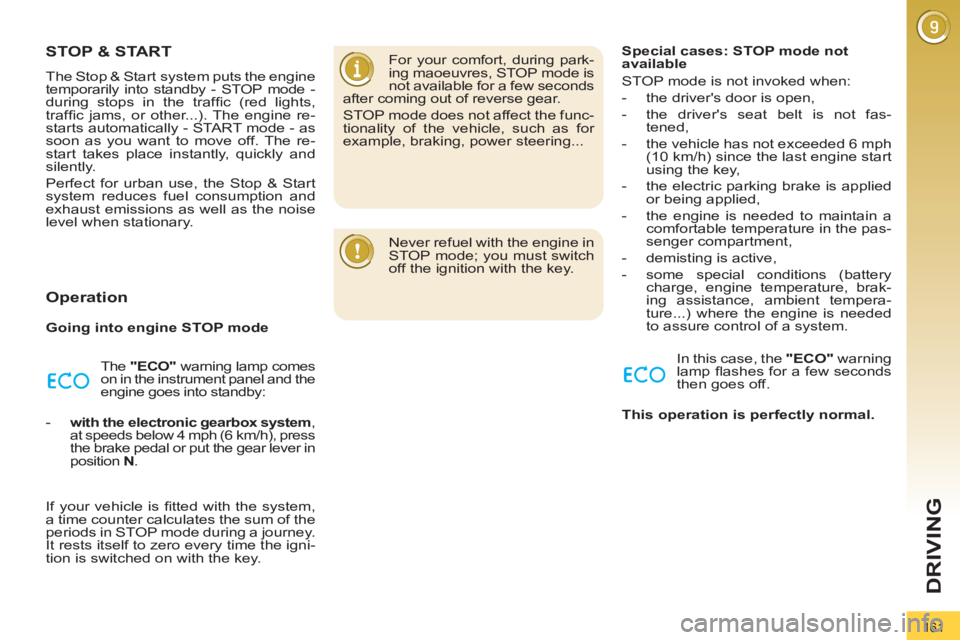
Going into engine STOP mode
The "ECO"
warning lamp comes
on in the instrument panel and the
engine goes into standby:
- with the electronic gearbox system
,
at speeds below 4 mph (6 km/h), press
the brake pedal or put the gear lever in
position N
.
If your vehicle is fi tted with the system,
a time counter calculates the sum of the
periods in STOP mode during a journey.
It rests itself to zero every time the igni-
tion is switched on with the key.
For your comfort, during park-
ing maoeuvres, STOP mode is
not available for a few seconds
after coming out of reverse gear.
STOP mode does not affect the func-
tionality of the vehicle, such as for
example, braking, power steering...
Never refuel with the engine in
STOP mode; you must switch
off the ignition with the key.
Special cases: STOP mode not
available
STOP mode is not invoked when:
- the driver's door is open,
- the driver's seat belt is not fas-
tened,
- the vehicle has not exceeded 6 mph
(10 km/h) since the last engine start
using the key,
- the electric parking brake is applied
or being applied,
- the engine is needed to maintain a
comfortable temperature in the pas-
senger compartment,
- demisting is active,
- some special conditions (battery
charge, engine temperature, brak-
ing assistance, ambient tempera-
ture...) where the engine is needed
to assure control of a system.
In this case, the "ECO"
warning
lamp fl ashes for a few seconds
then goes off.
This operation is perfectly normal.
Page 164 of 328
162
DRIVING
Going into engine START mode
The "ECO"
warning lamp goes
off and the engine starts with the
electronic gearbox
system
:
- gear lever in position A
or M
, release
the brake pedal,
- or gear lever in position N
and the
brake pedal released, move the
gear lever to position A
or M
,
- or engage reverse gear.
In this case the "ECO"
warning
lamp fl ashes for a few seconds,
then goes off.
Special cases: START invoked
automatically
START mode is invoked automatically when:
- the driver's door is open,
- the driver's seat belt is not fas-
tened,
- the speed of the vehicle exceeds
7 mph (11 km/h) with the electronic
gearbox system,
- the electric parking brake is being
applied,
- some special conditions (battery
charge, engine temperature, brak-
ing assistance, ambient tempera-
ture...) where the engine is needed
for control of a system.
This operation is perfectly normal.
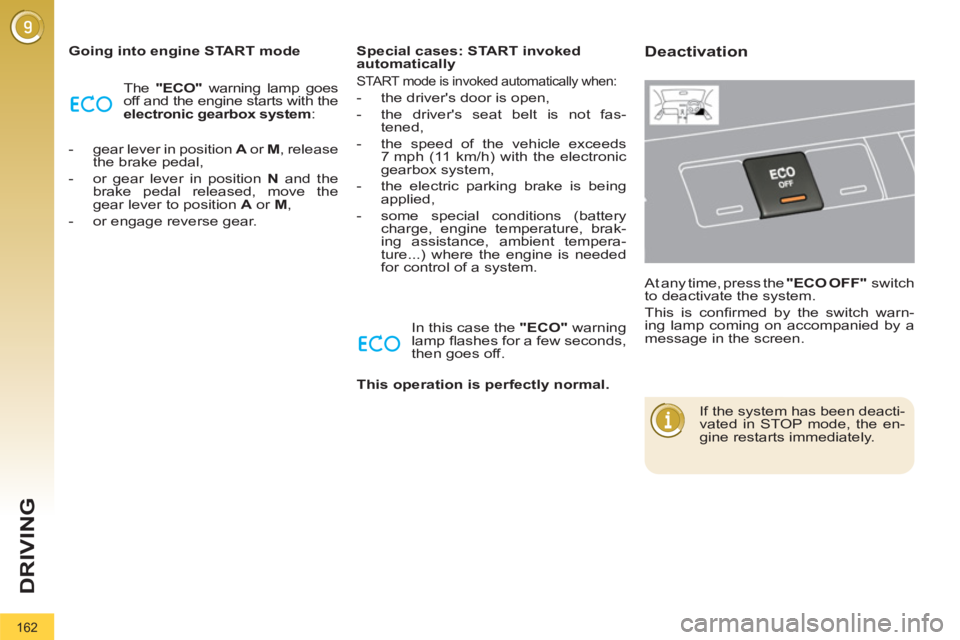
Deactivation
At any time, press the "ECO OFF"
switch
to deactivate the system.
This is confi rmed by the switch warn-
ing lamp coming on accompanied by a
message in the screen.
If the system has been deacti-
vated in STOP mode, the en-
gine restarts immediately.
Page 165 of 328
163
DRIVING
Reactivation
Press the "ECO OFF"
switch again.
The system is active again; this is con-
fi rmed by the switch warning lamp go-
ing off and a message in the screen.
The system is reactivated au-
tomatically at every new start
using the key.
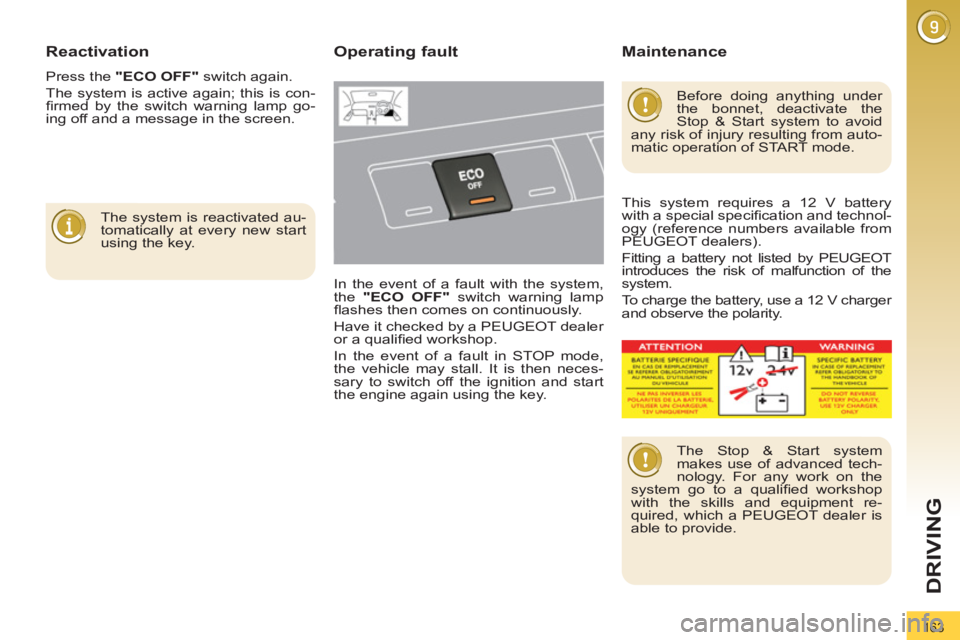
Operating fault
In the event of a fault with the system,
the "ECO OFF"
switch warning lamp
fl ashes then comes on continuously.
Have it checked by a PEUGEOT dealer
or a qualifi ed workshop.
In the event of a fault in STOP mode,
the vehicle may stall. It is then neces-
sary to switch off the ignition and start
the engine again using the key.
Before doing anything under
the bonnet, deactivate the
Stop & Start system to avoid
any risk of injury resulting from auto-
matic operation of START mode.
The Stop & Start system
makes use of advanced tech-
nology. For any work on the
system go to a qualifi ed workshop
with the skills and equipment re-
quired, which a PEUGEOT dealer is
able to provide.
Maintenance
This system requires a 12 V battery
with a special specifi cation and technol-
ogy (reference numbers available from
PEUGEOT dealers).
Fitting a battery not listed by PEUGEOT
introduces the risk of malfunction of the
system.
To charge the battery, use a 12 V charger
and observe the polarity.
Page 171 of 328
169
CHECKS
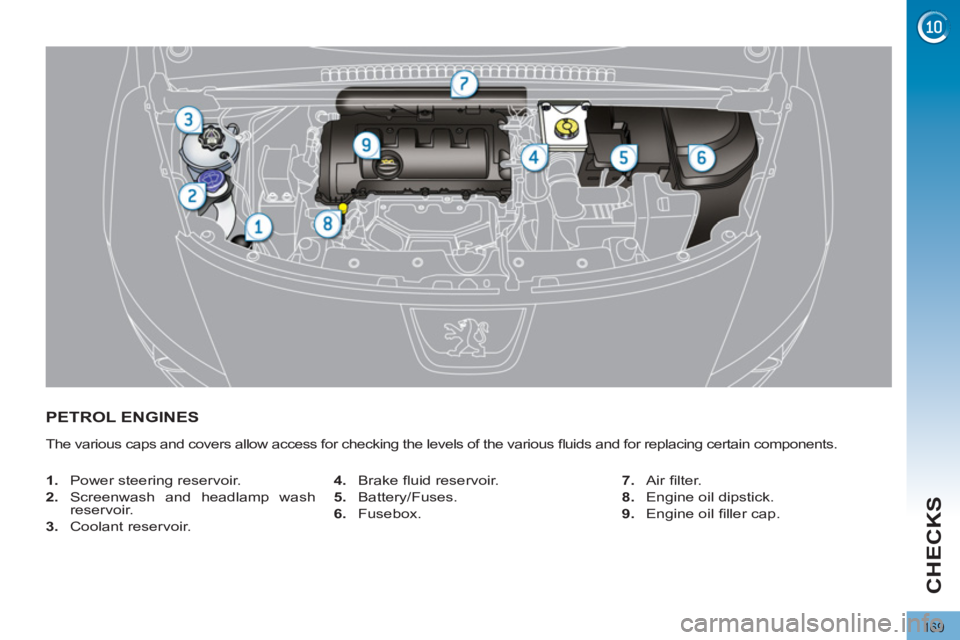
PETROL ENGINES
The various caps and covers allow access for checking the levels of the various fl uids and for replacing certain components.
1.
Power steering reservoir.
2.
Screenwash and headlamp wash
reservoir.
3.
Coolant reservoir.
4.
Brake fl uid reservoir.
5.
Battery/Fuses.
6.
Fusebox.
7.
Air fi lter.
8.
Engine oil dipstick.
9.
Engine oil fi ller cap.
Page 172 of 328
170
CHECKS
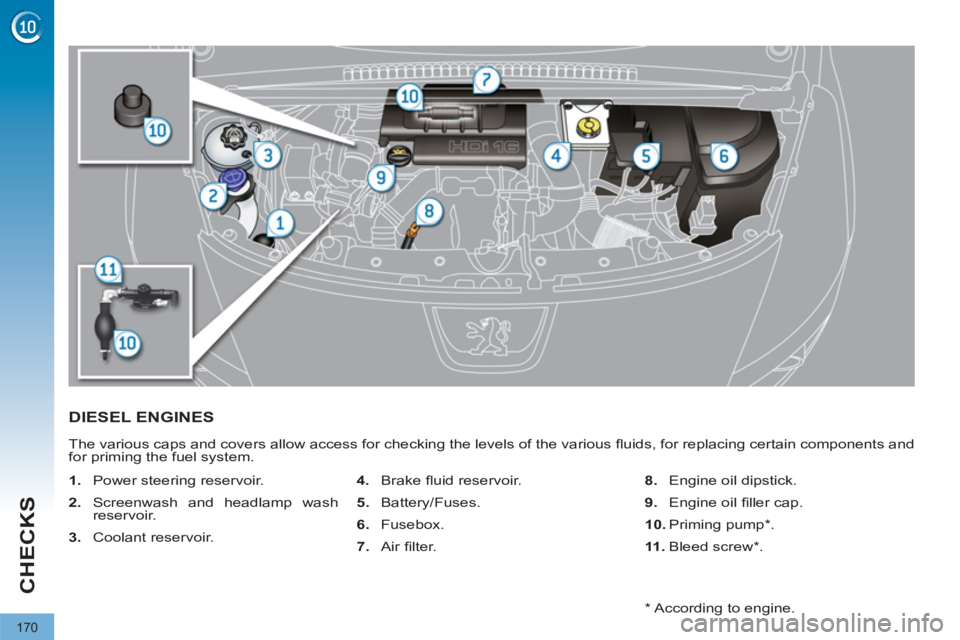
DIESEL ENGINES
The various caps and covers allow access for checking the levels of the various fl uids, for replacing certain components and
for priming the fuel system.
1.
Power steering reservoir.
2.
Screenwash and headlamp wash
reservoir.
3.
Coolant reservoir.
4.
Brake fl uid reservoir.
5.
Battery/Fuses.
6.
Fusebox.
7.
Air fi lter.
8.
Engine oil dipstick.
9.
Engine oil fi ller cap.
10.
Priming pump * .
11 .
Bleed screw * .
* According to engine.