Water Peugeot 301 2017 User Guide
[x] Cancel search | Manufacturer: PEUGEOT, Model Year: 2017, Model line: 301, Model: Peugeot 301 2017Pages: 306, PDF Size: 9.87 MB
Page 148 of 306
146
Checks
Unless otherwise indicated, check these components in accordance with the manufacturer's
service schedule and according to your engine.
Other wise, have them checked by a PEUGEOT dealer or a qualified workshop.
12 V battery
For more information and the precautions to
take before starting work on the 12 V batter y,
refer to the corresponding section. The battery does not require any
maintenance.
However, check regularly that the
terminals are correctly tightened
(versions without quick release
terminals) and that the connections
are clean.
Air filter and passenger compartment filter
Depending on the environment (e.g. dusty
atmosphere) and the use of the vehicle (e.g.
city driving), replace them twice as often if
necessary
.
A clogged passenger compartment filter may
have an adverse effect on the per formance
of the air conditioning system and generate
undesirable odours. Refer to the manufacturer's
service schedule for details of the
replacement intervals for these
components.
Oil filter
Replace the oil filter each time the
engine oil is changed.
Refer to the manufacturer's
service schedule for details of
the replacement interval for this
component.
Particle filter (Diesel)
As soon as the traffic conditions permit,
regenerate the filter by driving at a speed of at
least 40 mph (60 km/h) until the warning light
goes off.
If the warning light stays on, this indicates a low
additive level; refer to “Diesel additive level”
section.
or
The start of saturation of the particle
filter is indicated by the fixed
illumination of this warning light
accompanied by a warning message
in the screen (if a display screen is
fitted).
On a new vehicle, the first particle
filter regeneration operations may be
accompanied by a "burning" smell, which
is per fectly normal.
Following prolonged operation of the
vehicle at very low speed or at idle,
you may, in exceptional circumstances,
notice the emission of water vapour at the
exhaust on acceleration. This does not
affect the behaviour of the vehicle or the
environment.
Practical information
Page 163 of 306
161
Changing a bulb
The headlamps have polycarbonate
lenses with a protective coating:
F
d
o not clean them using a dr y or
abrasive cloth, nor with a detergent
or solvent product,
F
u
se a sponge and soapy water or a
pH neutral product,
F
w
hen using a high pressure washer
on persistent marks, do not keep the
lance directed towards the lamps or
their edges for too long, so as not to
damage their protective coating and
seals.
Changing a bulb should only be done after
the headlamp has been switched off for
several minutes (risk of serious burns).
F
D
o not touch the bulb directly with
your fingers, use a lint-free cloth.
It is essential only to use anti-ultraviolet
(UV) type bulbs, so as not to damage the
headlamp.
Always replace a failed bulb with a new
bulb with the same type and specification. In some climate conditions (low
temperature, humidity), the presence
of mist on the internal sur face of the
headlamp and rear lamp glass is normal;
this disappears a few minutes after the
lights are switched on.Front lamps
Halogen headlamps
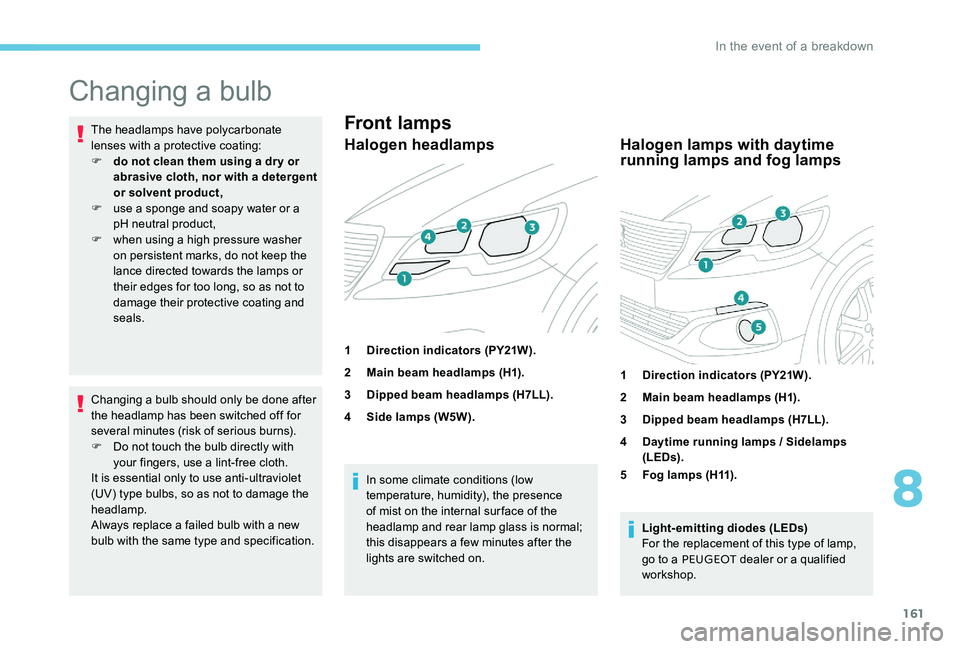
1
Direction indicators (PY21W).
2 Main beam headlamps (H1).
3 Dipped beam headlamps (H7LL).
4 Side lamps (W5W).
Halogen lamps with daytime
running lamps and fog lamps
1 Direction indicators (PY21W).
2 Main beam headlamps (H1).
3 Dipped beam headlamps (H7LL).
4 Daytime running lamps / Sidelamps (LEDs).
5 Fog lamps (H11).
Light-emitting diodes (LEDs)
For the replacement of this type of lamp,
go to a PEUGEOT dealer or a qualified
workshop.
8
In the event of a breakdown