belt Peugeot 306 C 2001 Owner's Manual
[x] Cancel search | Manufacturer: PEUGEOT, Model Year: 2001, Model line: 306 C, Model: Peugeot 306 C 2001Pages: 133, PDF Size: 2.08 MB
Page 14 of 133
MAINTENANCE OF YOUR 306 CABRIOLET19
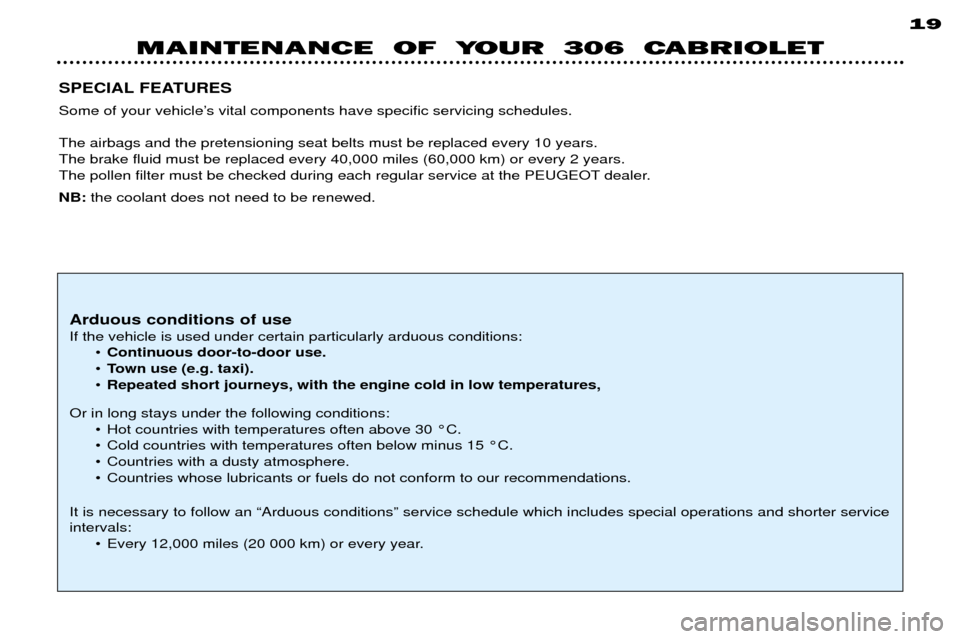
SPECIAL FEATURES
Some of your vehicleÕs vital components have specific servicing schedules. The airbags and the pretensioning seat belts must be replaced every 10 years. The brake fluid must be replaced every 40,000 miles (60,000 km) or every 2 years.
The pollen filter must be checked during each regular service at the PEUGEOT dealer. NB:
the coolant does not need to be renewed.
Arduous conditions of use If the vehicle is used under certain particularly arduous conditions: ¥Continuous door-to-door use.
¥ Town use (e.g. taxi).
¥ Repeated short journeys, with the engine cold in low temperatures,
Or in long stays under the following conditions: ¥ Hot countries with temperatures often above 30 ¡C.
¥ Cold countries with temperatures often below minus 15 ¡C.
¥ Countries with a dusty atmosphere.
¥ Countries whose lubricants or fuels do not conform to our recommendations.
It is necessary to follow an ÒArduous conditionsÓ service schedule which includes special operations and shorter service intervals: ¥ Every 12,000 miles (20 000 km) or every year.
Page 18 of 133
MAINTENANCE OF YOUR 306 CABRIOLET19
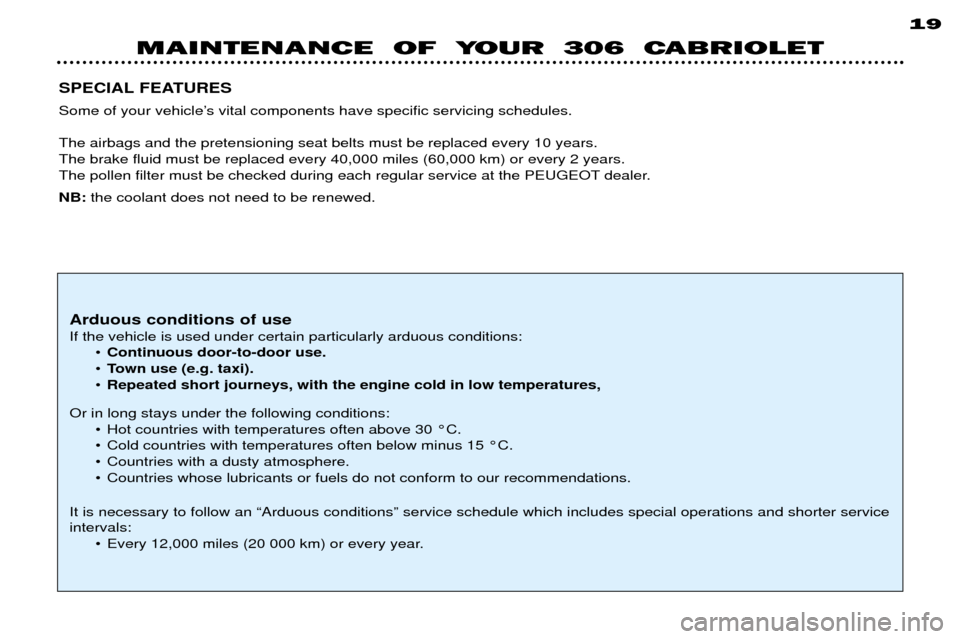
SPECIAL FEATURES
Some of your vehicleÕs vital components have specific servicing schedules. The airbags and the pretensioning seat belts must be replaced every 10 years. The brake fluid must be replaced every 40,000 miles (60,000 km) or every 2 years.
The pollen filter must be checked during each regular service at the PEUGEOT dealer. NB:
the coolant does not need to be renewed.
Arduous conditions of use If the vehicle is used under certain particularly arduous conditions: ¥Continuous door-to-door use.
¥ Town use (e.g. taxi).
¥ Repeated short journeys, with the engine cold in low temperatures,
Or in long stays under the following conditions: ¥ Hot countries with temperatures often above 30 ¡C.
¥ Cold countries with temperatures often below minus 15 ¡C.
¥ Countries with a dusty atmosphere.
¥ Countries whose lubricants or fuels do not conform to our recommendations.
It is necessary to follow an ÒArduous conditionsÓ service schedule which includes special operations and shorter service intervals: ¥ Every 12,000 miles (20 000 km) or every year.
Page 19 of 133
20TYPES OF SERVICE
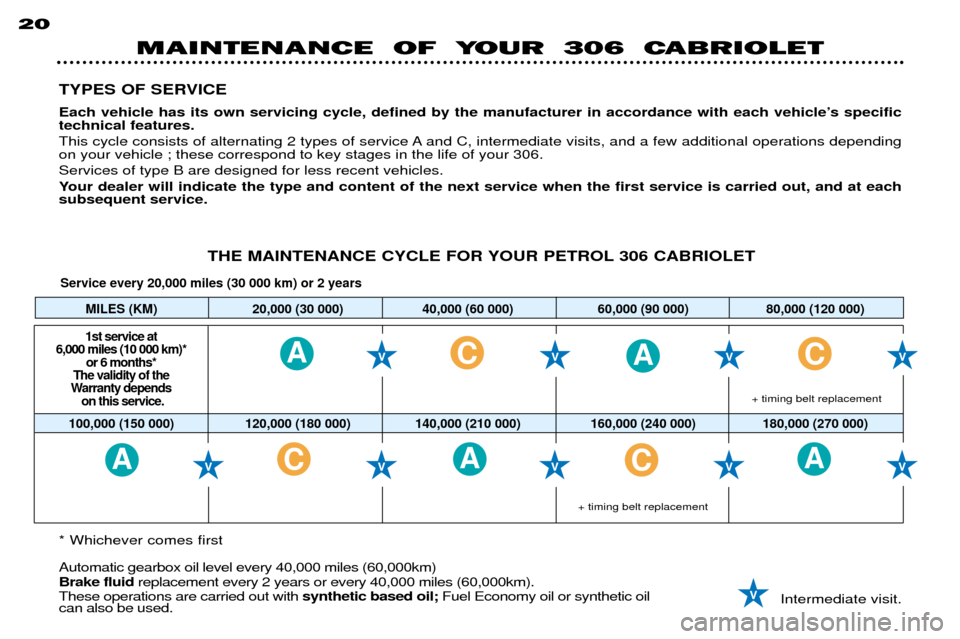
Each vehicle has its own servicing cycle, defined by the manufacturer in accordance with each vehicleÕs specific technical features.
This cycle consists of alternating 2 types of service A and C, intermediate visits, and a few additional operations depending on your vehicle ; these correspond to key stages in the life of your 306. Services of type B are designed for less recent vehicles.
Your dealer will indicate the type and content of the next service when the first service is carried out, and at each subsequent service.
MAINTENANCE OF YOUR 306 CABRIOLET
MILES (KM) 20,000 (30 000) 40,000 (60 000) 60,000 (90 000) 80,000 (120 000)
1st service at
6,000 miles (10 000 km)* or 6 months*
The validity of the
Warranty depends on this service.
100,000 (150 000) 120,000 (180 000) 140,000 (210 000) 160,000 (240 000) 180,000 (270 000)
Intermediate visit.
* Whichever comes first Automatic gearbox oil level every 40,000 miles (60,000km) Brake fluid
replacement every 2 years or every 40,000 miles (60,000km).
These operations are carried out with synthetic based oil;Fuel Economy oil or synthetic oil
can also be used.
THE MAINTENANCE CYCLE FOR YOUR PETROL 306 CABRIOLET
Service every 20,000 miles (30 000 km) or 2 years
+ timing belt replacement + timing belt replacement
AA
A
CC
AACC
Page 20 of 133

MAINTENANCE OF YOUR 306 CABRIOLET21
PEUGEOT SERVICING LEVELS A AND C
Level
Operations Description of operations for 1st serviceServicesACIntermediate visit
DRAIN AND REFILL- Engine drain and refill.- Oil filter.
REPLACEMENT- Fuel filter (Petrol).
- Air filter element.
- Spark plugs (Petrol).
- Engine oil (check + top up).
- Manual gearbox oil (check + top up).
- Battery (check + top up) if plug is removable.
LEVEL- Front/rear windscreen wash (check + top up).
- Coolant (check + top up).
- Brake fluid (check + top up).
- Power steering fluid (check + top up according to specification).
- Operation of lights and indicators.
- Condition of glass, headlamp and light lenses and mirrors.
- Horn.
- Windscreen washer jets.
- Condition of wiper blades.
- Condition and tension of ancillary drive belts.
- Handbrake.
- Condition of hydraulic circuits (hoses and covers), check for leaks.
CHECK- Condition of rubber boots and gaiters.
- Brake pad wear.
- Clearances, hubs, rods, ball joints, flxible mountings.
- Sealing of dampers.
- Wear of rear linings.
- Condition and pressure of tyres (including spare wheel).
- Emission control check according to current legislation (Petrol).
- Pollen filter check (according to specification).
- Visual check of the whole vehicle by a PEUGEOT dealer.
ROAD TEST
: All driving conditions : Specific conditions
Page 23 of 133
88
YOUR 306 CABRIOLET IN DETAIL
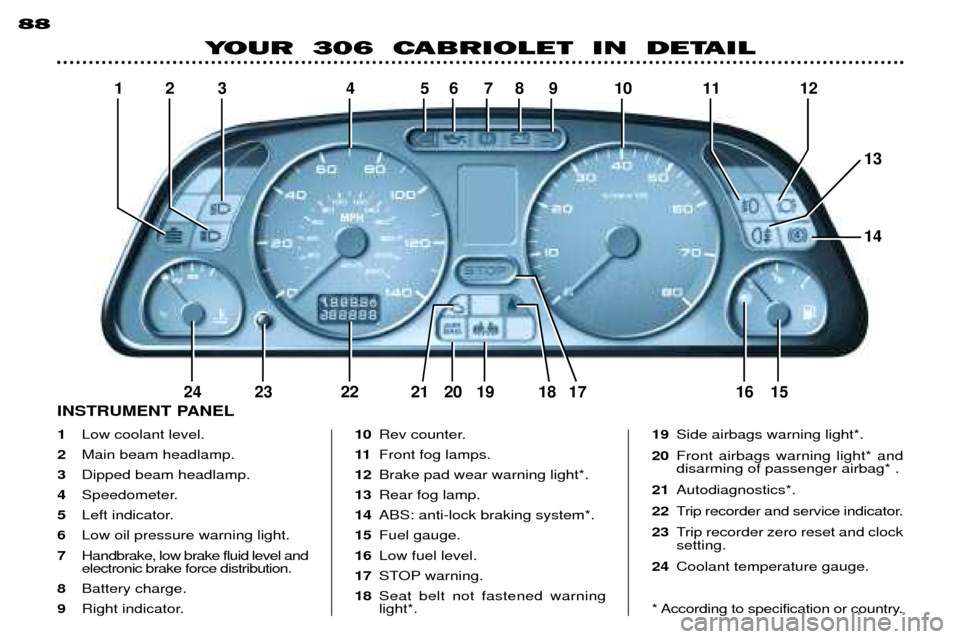
1Low coolant level.
2 Main beam headlamp.
3 Dipped beam headlamp.
4 Speedometer.
5 Left indicator.
6 Low oil pressure warning light.
7 Handbrake, low brake fluid level and electronic brake force distribution.
8 Battery charge.
9 Right indicator. 10
Rev counter.
11 Front fog lamps.
12 Brake pad wear warning light*.
13 Rear fog lamp.
14 ABS: anti-lock braking system*.
15 Fuel gauge.
16 Low fuel level.
17 STOP warning.
18 Seat belt not fastened warninglight*. 19
Side airbags warning light*.
20 Front airbags warning light* anddisarming of passenger airbag* .
21 Autodiagnostics*.
22 Trip recorder and service indicator.
23 Trip recorder zero reset and clocksetting.
24 Coolant temperature gauge.
* According to specification or country.
12 3 4 56789 1 0 11 1 2
24 23 22 21 20 19 18 17 16 15
13 14
INSTRUMENT PANEL
Page 24 of 133
89
YOUR 306 CABRIOLET IN DETAIL
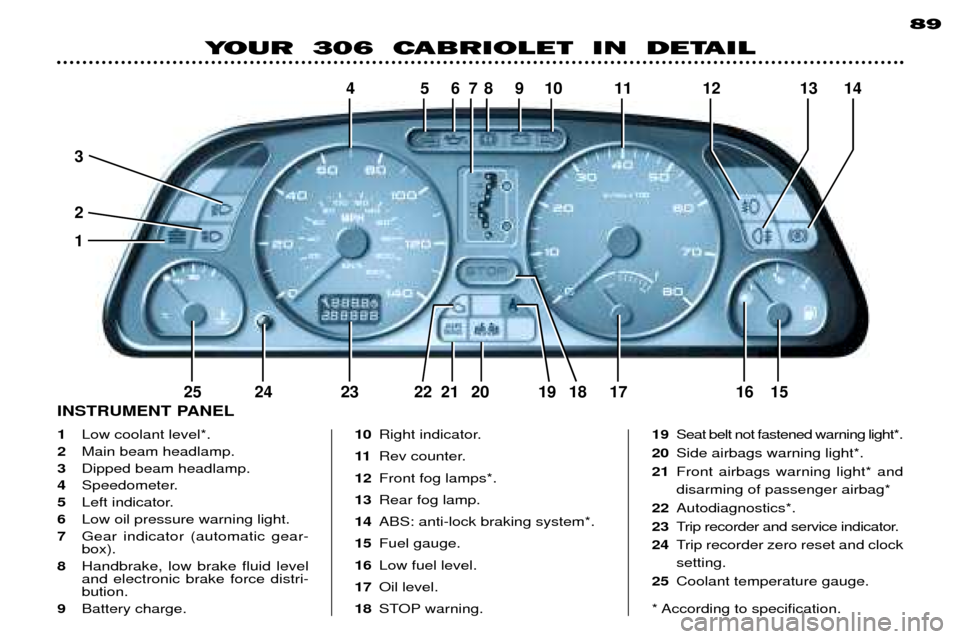
1Low coolant level*.
2 Main beam headlamp.
3 Dipped beam headlamp.
4 Speedometer.
5 Left indicator.
6 Low oil pressure warning light.
7 Gear indicator (automatic gear- box).
8 Handbrake, low brake fluid leveland electronic brake force distri-bution.
9 Battery charge. 10
Right indicator.
11 Rev counter.
12 Front fog lamps*.
13 Rear fog lamp.
14 ABS: anti-lock braking system*.
15 Fuel gauge.
16 Low fuel level.
17 Oil level.
18 STOP warning. 19
Seat belt not fastened warning light*.
20 Side airbags warning light*.
21 Front airbags warning light* and disarming of passenger airbag*
22 Autodiagnostics*.
23 Trip recorder and service indicator.
24 Trip recorder zero reset and clocksetting.
25 Coolant temperature gauge.
* According to specification.
INSTRUMENT PANEL
4 5 6 7 8 9 10 11 12 13 14
3 2 1
25 24 23 22 21 20 19 18 17 16 15
Page 25 of 133

90
YOUR 306 CABRIOLET IN DETAIL
A warning light which remains permanently lit indicates that the unit
concerned is not operating correctly.Do not ignore this warning: contact
a PEUGEOT dealer as soon as pos-sible.
Handbrake, low brake fluid level and electronic brakeforce distribution warninglight
Indicates either:
- that the handbrake is on or has not been released correctly,
- an excessive drop in the brake fluid level (if the light remains lit even with the handbrake released),
- lit at the same time as the ABS war- ning light, it indicates a malfunction ofthe braking system.`
- a malfunction of the braking system, if lit at the same time as the ABSwarning light.
Stop immediately.
Contact a PEUGEOT dealer.
STOP warning light
(Together with the oil pressure warning light)
You must stop.
Contact a PEUGEOT dealer. Oil pressure warning light
Together with the STOP warning light.
You must stop. Indicates either:
- oil pressure is too low
- a lack of oil in the lubricating circuit
Top up the oil level if necessary.
Contact a PEUGEOT dealer.
Battery charge warning light Indicates either:
- faulty operation of the
battery charging circuit
- loose battery or starter terminals
- a broken or loose alternator drive belt
- an alternator fault
Contact a PEUGEOT dealer.
Low coolant level warning light*
You must stop.
Wait until the engine cools before topping up.
The cooling circuit is pressurised. When opening to top up, turn the cap to the first notch to let the pressuredrop.
Contact a PEUGEOT dealer. Engine autodiagnostic warning light* This comes on each time the ignition is switched on. If itcomes on when driving, this
indicates faulty operation of the injec-tion, ignition or emission controlsystem. There is a risk of damage to the cat- alytic converter if your vehicle is fitted with one.
Contact a PEUGEOT dealer.
Low fuel warning light Indicates that there are approximately 1.3 gallons(6 litres) of fuel remainingin the fuel tank.
(The capacity of the tank is approxi-mately 50 litres).
INSTRUMENTS AND CONTROLS
* According to specification.
Page 65 of 133
Never leave a child in a vehicle which is exposedto the sun and has thewindows closed.
To protect young children
from the sun, fit sunblinds to the rear windows. Never leave the keys in the reach
of children inside the car. Strap children into their child seats even on short journeys.
84
YOUR 306 CABRIOLET IN DETAIL
Observe the precautions concern- ing the passenger airbag.
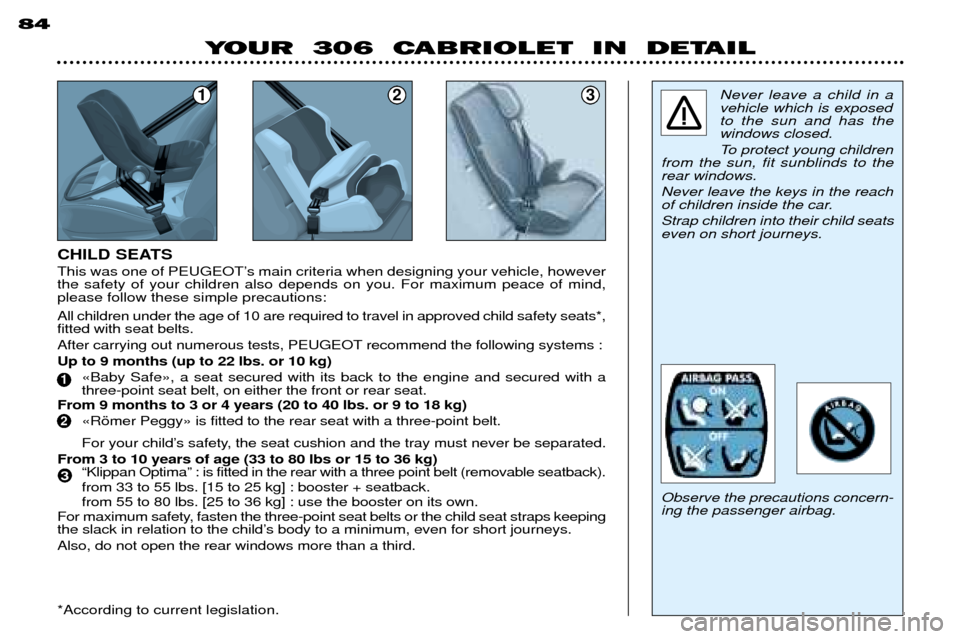
CHILD SEATS All children under the age of 10 are required to travel in approved child safety seats*, fitted with seat belts.
After carrying out numerous tests, PEUGEOT recommend the following systems :Up to 9 months (up to 22 lbs. or 10 kg)
ÇBaby SafeÈ, a seat secured with its back to the engine and secured with a three-point seat belt, on either the front or rear seat.
From 9 months to 3 or 4 years (20 to 40 lbs. or 9 to 18 kg)
ÇRšmer PeggyÈ is fitted to the rear seat with a three-point belt.
For your childÕs safety, the seat cushion and the tray must never be separated.
From 3 to 10 years of age (33 to 80 lbs or 15 to 36 kg) ÒKlippan OptimaÓ : is fitted in the rear with a three point belt (removable seatback). from 33 to 55 lbs. [15 to 25 kg] : booster + seatback.from 55 to 80 lbs. [25 to 36 kg] : use the booster on its own.
For maximum safety, fasten the three-point seat belts or the child seat straps keeping
the slack in relation to the childÕs body to a minimum, even for short journeys. Also, do not open the rear windows more than a third.
This was one of PEUGEOTÕs main criteria when designing your vehicle, however the safety of your children also depends on you. For maximum peace of mind,please follow these simple precautions: *According to current legislation.
1
2
3
123
Page 66 of 133
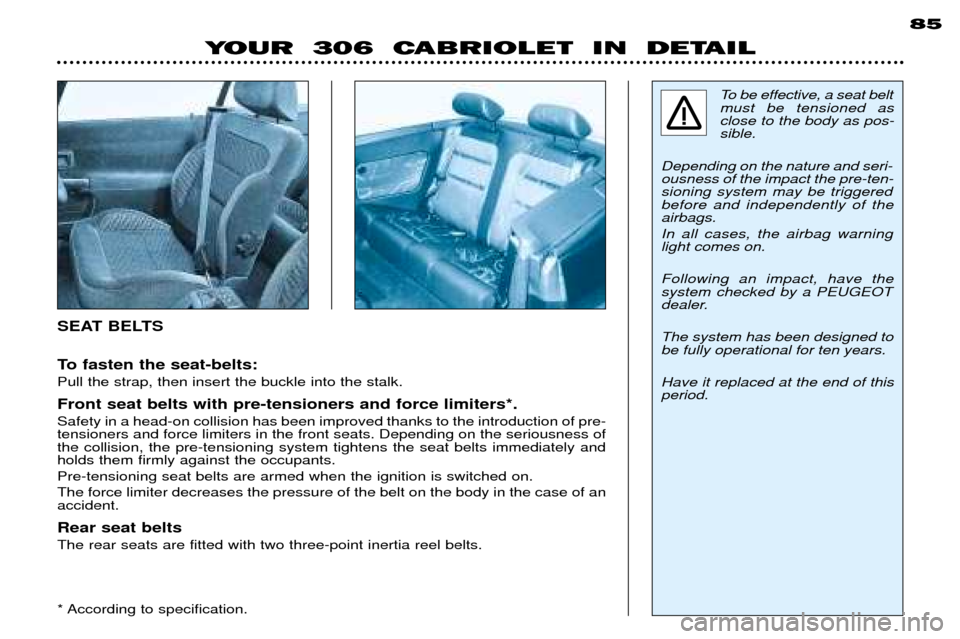
To fasten the seat-belts: Pull the strap, then insert the buckle into the stalk. Front seat belts with pre-tensioners and force limiters*. Safety in a head-on collision has been improved thanks to the introduction of pre- tensioners and force limiters in the front seats. Depending on the seriousness ofthe collision, the pre-tensioning system tightens the seat belts immediately andholds them firmly against the occupants. Pre-tensioning seat belts are armed when the ignition is switched on.The force limiter decreases the pressure of the belt on the body in the case of an accident. Rear seat belts The rear seats are fitted with two three-point inertia reel belts.
* According to specification.To be effective, a seat belt must be tensioned asclose to the body as pos-sible.
Depending on the nature and seri-ousness of the impact the pre-ten-sioning system may be triggeredbefore and independently of theairbags. In all cases, the airbag warning light comes on. Following an impact, have the system checked by a PEUGEOT
dealer. The system has been designed to be fully operational for ten years. Have it replaced at the end of this period. 85
YOUR 306 CABRIOLET IN DETAIL
SEAT BELTS
Page 82 of 133
103
DRIVING YOUR 306 CABRIOLET
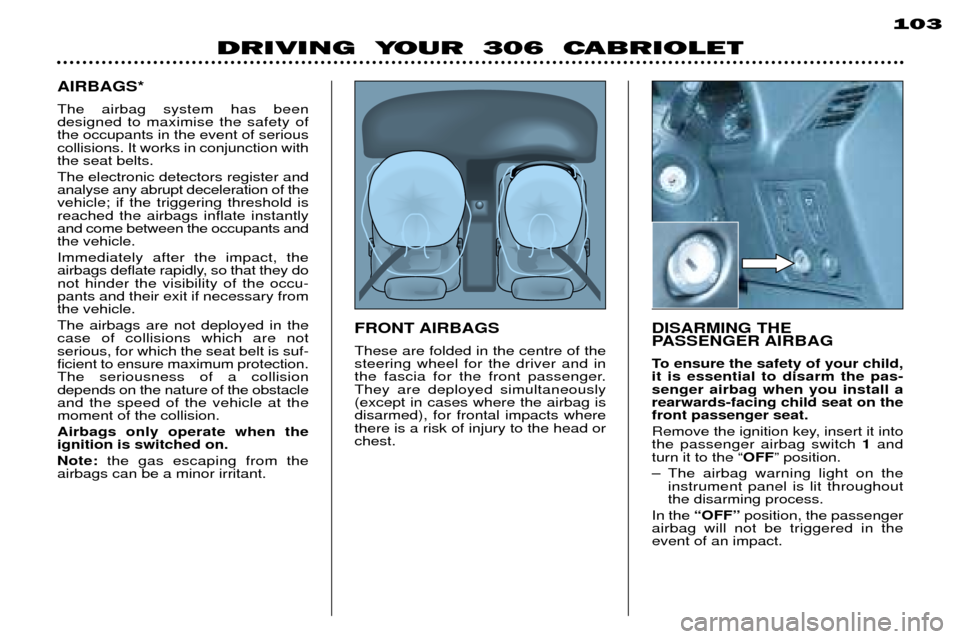
AIRBAGS* The airbag system has been designed to maximise the safety ofthe occupants in the event of seriouscollisions. It works in conjunction withthe seat belts. The electronic detectors register and analyse any abrupt deceleration of thevehicle; if the triggering threshold isreached the airbags inflate instantlyand come between the occupants andthe vehicle. Immediately after the impact, the
airbags deflate rapidly, so that they donot hinder the visibility of the occu-pants and their exit if necessary fromthe vehicle. The airbags are not deployed in the case of collisions which are notserious, for which the seat belt is suf-ficient to ensure maximum protection.The seriousness of a collisiondepends on the nature of the obstacleand the speed of the vehicle at themoment of the collision. Airbags only operate when the ignition is switched on. Note:the gas escaping from the
airbags can be a minor irritant. FRONT AIRBAGS These are folded in the centre of the steering wheel for the driver and in
the fascia for the front passenger.They are deployed simultaneously(except in cases where the airbag isdisarmed), for frontal impacts wherethere is a risk of injury to the head orchest.
DISARMING THE
PASSENGER AIRBAG
To ensure the safety of your child, it is essential to disarm the pas-senger airbag when you install arearwards-facing child seat on thefront passenger seat.
Remove the ignition key, insert it into the passenger airbag switch
1and
turn it to the Ò OFFÓ position.
Ð The airbag warning light on the instrument panel is lit throughoutthe disarming process.
In the ÒOFFÓ position, the passenger
airbag will not be triggered in theevent of an impact.