oil pressure Peugeot 306 C 2001 Owner's Manual
[x] Cancel search | Manufacturer: PEUGEOT, Model Year: 2001, Model line: 306 C, Model: Peugeot 306 C 2001Pages: 133, PDF Size: 2.08 MB
Page 20 of 133

MAINTENANCE OF YOUR 306 CABRIOLET21
PEUGEOT SERVICING LEVELS A AND C
Level
Operations Description of operations for 1st serviceServicesACIntermediate visit
DRAIN AND REFILL- Engine drain and refill.- Oil filter.
REPLACEMENT- Fuel filter (Petrol).
- Air filter element.
- Spark plugs (Petrol).
- Engine oil (check + top up).
- Manual gearbox oil (check + top up).
- Battery (check + top up) if plug is removable.
LEVEL- Front/rear windscreen wash (check + top up).
- Coolant (check + top up).
- Brake fluid (check + top up).
- Power steering fluid (check + top up according to specification).
- Operation of lights and indicators.
- Condition of glass, headlamp and light lenses and mirrors.
- Horn.
- Windscreen washer jets.
- Condition of wiper blades.
- Condition and tension of ancillary drive belts.
- Handbrake.
- Condition of hydraulic circuits (hoses and covers), check for leaks.
CHECK- Condition of rubber boots and gaiters.
- Brake pad wear.
- Clearances, hubs, rods, ball joints, flxible mountings.
- Sealing of dampers.
- Wear of rear linings.
- Condition and pressure of tyres (including spare wheel).
- Emission control check according to current legislation (Petrol).
- Pollen filter check (according to specification).
- Visual check of the whole vehicle by a PEUGEOT dealer.
ROAD TEST
: All driving conditions : Specific conditions
Page 23 of 133
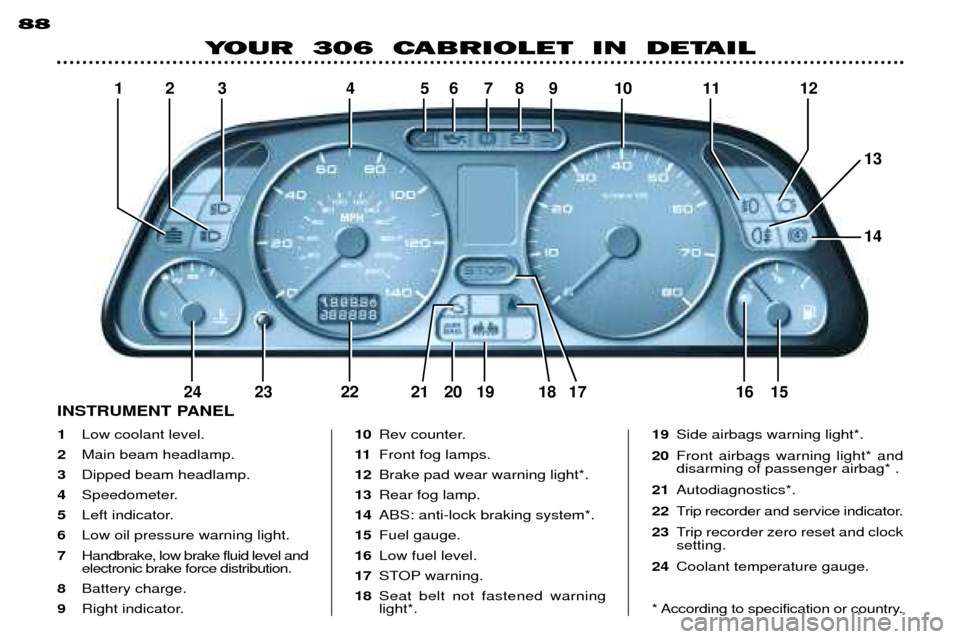
88
YOUR 306 CABRIOLET IN DETAIL
1Low coolant level.
2 Main beam headlamp.
3 Dipped beam headlamp.
4 Speedometer.
5 Left indicator.
6 Low oil pressure warning light.
7 Handbrake, low brake fluid level and electronic brake force distribution.
8 Battery charge.
9 Right indicator. 10
Rev counter.
11 Front fog lamps.
12 Brake pad wear warning light*.
13 Rear fog lamp.
14 ABS: anti-lock braking system*.
15 Fuel gauge.
16 Low fuel level.
17 STOP warning.
18 Seat belt not fastened warninglight*. 19
Side airbags warning light*.
20 Front airbags warning light* anddisarming of passenger airbag* .
21 Autodiagnostics*.
22 Trip recorder and service indicator.
23 Trip recorder zero reset and clocksetting.
24 Coolant temperature gauge.
* According to specification or country.
12 3 4 56789 1 0 11 1 2
24 23 22 21 20 19 18 17 16 15
13 14
INSTRUMENT PANEL
Page 24 of 133
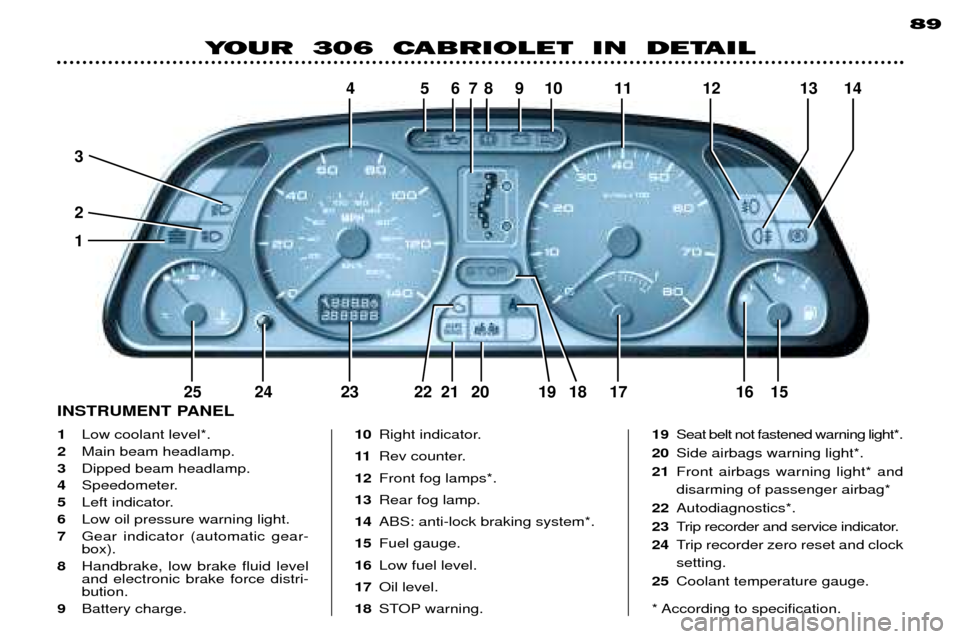
89
YOUR 306 CABRIOLET IN DETAIL
1Low coolant level*.
2 Main beam headlamp.
3 Dipped beam headlamp.
4 Speedometer.
5 Left indicator.
6 Low oil pressure warning light.
7 Gear indicator (automatic gear- box).
8 Handbrake, low brake fluid leveland electronic brake force distri-bution.
9 Battery charge. 10
Right indicator.
11 Rev counter.
12 Front fog lamps*.
13 Rear fog lamp.
14 ABS: anti-lock braking system*.
15 Fuel gauge.
16 Low fuel level.
17 Oil level.
18 STOP warning. 19
Seat belt not fastened warning light*.
20 Side airbags warning light*.
21 Front airbags warning light* and disarming of passenger airbag*
22 Autodiagnostics*.
23 Trip recorder and service indicator.
24 Trip recorder zero reset and clocksetting.
25 Coolant temperature gauge.
* According to specification.
INSTRUMENT PANEL
4 5 6 7 8 9 10 11 12 13 14
3 2 1
25 24 23 22 21 20 19 18 17 16 15
Page 25 of 133
90
YOUR 306 CABRIOLET IN DETAIL
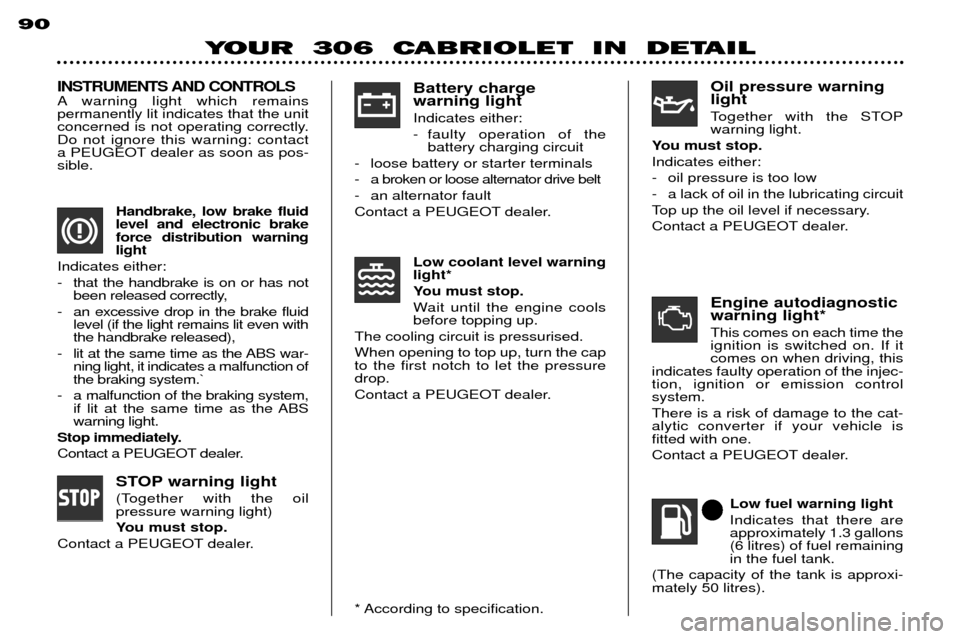
A warning light which remains permanently lit indicates that the unit
concerned is not operating correctly.Do not ignore this warning: contact
a PEUGEOT dealer as soon as pos-sible.
Handbrake, low brake fluid level and electronic brakeforce distribution warninglight
Indicates either:
- that the handbrake is on or has not been released correctly,
- an excessive drop in the brake fluid level (if the light remains lit even with the handbrake released),
- lit at the same time as the ABS war- ning light, it indicates a malfunction ofthe braking system.`
- a malfunction of the braking system, if lit at the same time as the ABSwarning light.
Stop immediately.
Contact a PEUGEOT dealer.
STOP warning light
(Together with the oil pressure warning light)
You must stop.
Contact a PEUGEOT dealer. Oil pressure warning light
Together with the STOP warning light.
You must stop. Indicates either:
- oil pressure is too low
- a lack of oil in the lubricating circuit
Top up the oil level if necessary.
Contact a PEUGEOT dealer.
Battery charge warning light Indicates either:
- faulty operation of the
battery charging circuit
- loose battery or starter terminals
- a broken or loose alternator drive belt
- an alternator fault
Contact a PEUGEOT dealer.
Low coolant level warning light*
You must stop.
Wait until the engine cools before topping up.
The cooling circuit is pressurised. When opening to top up, turn the cap to the first notch to let the pressuredrop.
Contact a PEUGEOT dealer. Engine autodiagnostic warning light* This comes on each time the ignition is switched on. If itcomes on when driving, this
indicates faulty operation of the injec-tion, ignition or emission controlsystem. There is a risk of damage to the cat- alytic converter if your vehicle is fitted with one.
Contact a PEUGEOT dealer.
Low fuel warning light Indicates that there are approximately 1.3 gallons(6 litres) of fuel remainingin the fuel tank.
(The capacity of the tank is approxi-mately 50 litres).
INSTRUMENTS AND CONTROLS
* According to specification.
Page 29 of 133
YOUR 306 CABRIOLET IN DETAIL
46
1
4
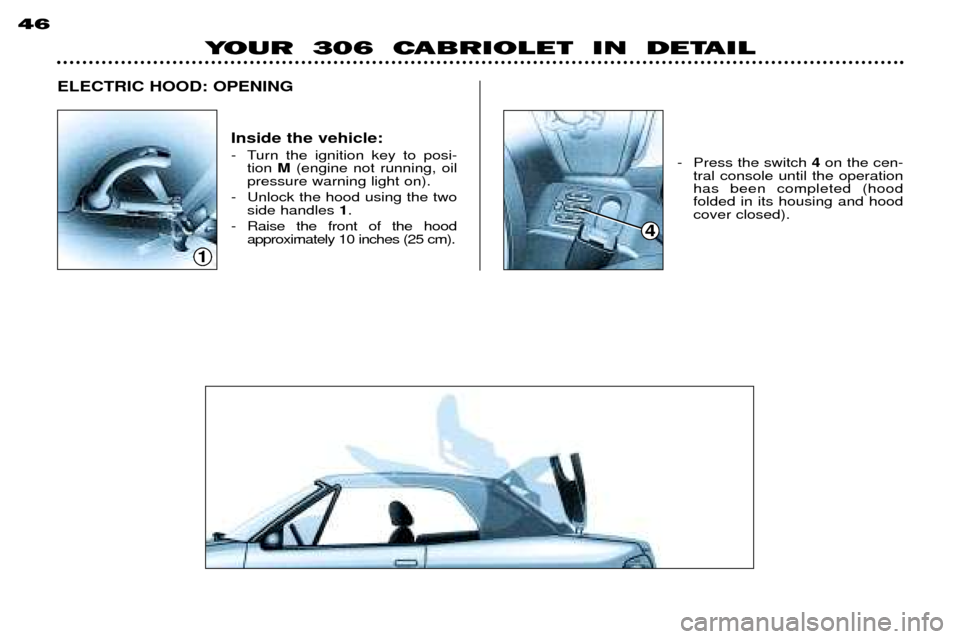
Inside the vehicle:
- Turn the ignition key to posi-
tion M(engine not running, oil
pressure warning light on).
- Unlock the hood using the two side handles 1.
- Raise the front of the hood approximately 10 inches (25 cm). - Press the switch
4on the cen-
tral console until the operation has been completed (hoodfolded in its housing and hoodcover closed).
ELECTRIC HOOD: OPENING
Page 30 of 133
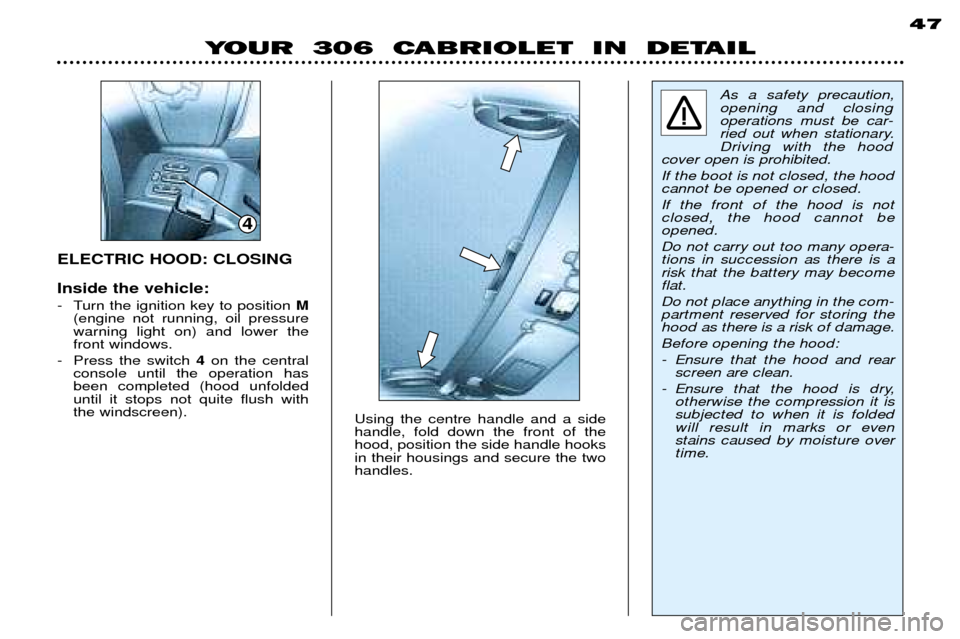
ELECTRIC HOOD: CLOSING Inside the vehicle:
- Turn the ignition key to position M
(engine not running, oil pressure warning light on) and lower thefront windows.
- Press the switch 4on the central
console until the operation hasbeen completed (hood unfoldeduntil it stops not quite flush withthe windscreen). Using the centre handle and a sidehandle, fold down the front of thehood, position the side handle hooksin their housings and secure the twohandles. As a safety precaution,opening and closingoperations must be car-
ried out when stationary.Driving with the hood
cover open is prohibited.
If the boot is not closed, the hood
cannot be opened or closed.
If the front of the hood is not
closed, the hood cannot be
opened.
Do not carry out too many opera-
tions in succession as there is a
risk that the battery may become
flat.
Do not place anything in the com-
partment reserved for storing the
hood as there is a risk of damage.
Before opening the hood:
- Ensure that the hood and rear screen are clean.
- Ensure that the hood is dry, otherwise the compression it is
subjected to when it is folded
will result in marks or even
stains caused by moisture over
time.
YOUR 306 CABRIOLET IN DETAIL 47
4
Page 89 of 133

MAINTENANCE OF YOUR 306 CABRIOLET
26
CHECKING THE LEVELS Engine Checking the oil level Check the level regularly and top up between changes
(maximum
consumption is 0.5 litres per 600 miles (1,000 km). The oil level should be checked with the vehicle level, engine cold. There are two marks on the dipstick:
A= maximum.
B = minimum. Oil change:
according to the manu-
facturerÕs servicing schedule.
Ð Dipstick. Never fill past the maximum mark A.
Ð Oil level gauge on the instrument panel.
Viscosity selection In all cases, the oil selected must meet the manufacturer's require-ments. Oil filter Change the filter regularly in accor- dance with the maintenance schedule. Used oil Prevent used oil from coming into pro- longed contact with the skin. Do not dispose of used oil into drains or into the ground.
To maintain the reliability of engines and emission control systems, the useof additives in the engine oil is pro-hibited. Brake fluid reservoir
Ð The level should always be above
the DANGER mark on the reser-
voir.
Ð If the level drops substantially, contact a PEUGEOT dealer imme-
diately.
Fluid change
Ð must be carried out according to the manufacturerÕs schedule.
Ð use fluids approved by the manu- facturer, which fulfil DOT4 stan- dards.
Coolant reservoir Use the fluid approved by the manu-
facturer. When the engine is warm, the tem- perature of the coolant is controlledby the engine fan: because this fancan operate with the ignition keyremoved, and because the coolingsystem is pressurised, wait for at leastone hour after the engine has stoppedbefore carrying out any work.
If necessary, in a breakdown, slacken the cap to the first notch to releasethe pressure to prevent any risk ofscalding. When the pressure hasdropped remove the cap and top upthe level.
A
B
A
B
Page 105 of 133

MAINTENANCE OF YOUR 306 CABRIOLET21
PEUGEOT SERVICING LEVELS A AND C
Level
Operations Description of operations for 1st serviceServicesACIntermediate visit
DRAIN AND REFILL- Engine drain and refill.- Oil filter.
REPLACEMENT- Fuel filter (Petrol).
- Air filter element.
- Spark plugs (Petrol).
- Engine oil (check + top up).
- Manual gearbox oil (check + top up).
- Battery (check + top up) if plug is removable.
LEVEL- Front/rear windscreen wash (check + top up).
- Coolant (check + top up).
- Brake fluid (check + top up).
- Power steering fluid (check + top up according to specification).
- Operation of lights and indicators.
- Condition of glass, headlamp and light lenses and mirrors.
- Horn.
- Windscreen washer jets.
- Condition of wiper blades.
- Condition and tension of ancillary drive belts.
- Handbrake.
- Condition of hydraulic circuits (hoses and covers), check for leaks.
CHECK- Condition of rubber boots and gaiters.
- Brake pad wear.
- Clearances, hubs, rods, ball joints, flxible mountings.
- Sealing of dampers.
- Wear of rear linings.
- Condition and pressure of tyres (including spare wheel).
- Emission control check according to current legislation (Petrol).
- Pollen filter check (according to specification).
- Visual check of the whole vehicle by a PEUGEOT dealer.
ROAD TEST
: All driving conditions : Specific conditions
Page 110 of 133

MAINTENANCE OF YOUR 306 CABRIOLET
26
CHECKING THE LEVELS Engine Checking the oil level Check the level regularly and top up between changes
(maximum
consumption is 0.5 litres per 600 miles (1,000 km). The oil level should be checked with the vehicle level, engine cold. There are two marks on the dipstick:
A= maximum.
B = minimum. Oil change:
according to the manu-
facturerÕs servicing schedule.
Ð Dipstick. Never fill past the maximum mark A.
Ð Oil level gauge on the instrument panel.
Viscosity selection In all cases, the oil selected must meet the manufacturer's require-ments. Oil filter Change the filter regularly in accor- dance with the maintenance schedule. Used oil Prevent used oil from coming into pro- longed contact with the skin. Do not dispose of used oil into drains or into the ground.
To maintain the reliability of engines and emission control systems, the useof additives in the engine oil is pro-hibited. Brake fluid reservoir
Ð The level should always be above
the DANGER mark on the reser-
voir.
Ð If the level drops substantially, contact a PEUGEOT dealer imme-
diately.
Fluid change
Ð must be carried out according to the manufacturerÕs schedule.
Ð use fluids approved by the manu- facturer, which fulfil DOT4 stan- dards.
Coolant reservoir Use the fluid approved by the manu-
facturer. When the engine is warm, the tem- perature of the coolant is controlledby the engine fan: because this fancan operate with the ignition keyremoved, and because the coolingsystem is pressurised, wait for at leastone hour after the engine has stoppedbefore carrying out any work.
If necessary, in a breakdown, slacken the cap to the first notch to releasethe pressure to prevent any risk ofscalding. When the pressure hasdropped remove the cap and top upthe level.
A
B
A
B
Page 128 of 133

MAINTENANCE OF YOUR 306 CABRIOLET
44
BODYWORK MAINTENANCE
To preserve the paintwork and the plastic trim on your vehicle, we recommend that you wash them
regularly,
- by hand, there are no specific pre-cautions to take;
- using a high pressure washer, always follow the recommenda- tions on the equipment (pressureand spraying distance).If there are areas of damage onthe vehicle (painted bumpers, orheadlamps), it is not recommen-ded to direct the high pressure jetonto them: wash the areas ofdamage by hand. Also avoid the entry of water into the locks. Waxing:
the regular use of wax
added to the washing water orapplied separately is strongly recom-mended, it protects the upper coats ofpaintwork against external attack. For all questions relating to the main- tenance of your vehicle, contact anapproved dealer who can advise youon quality products selected by ourdepartments. - Clean off, as soon as
possible, bird drop-pings, resinousdeposits, tar stainsand grease marks; (as
these all contain substanceswhich can cause serious damage to the paintwork).
- Brake briefly several times to expel any dampness from thebrake pads, when you are setting off after washing yourvehicle.
- Do not use a dry or abrasive cloth, or detergent or solventproducts to clean the doublelens, complex surface head-lamps as they are fitted withpolycarbonate glass covered ina protective finish.
- Do not use petrol, oil or cloth stain removers to clean thebodywork and plastic parts ofyour vehicle.
- To prevent the development of bodywork corrosion as a resultof accidental damage (stonechips, scratches etc.) have them
repaired swiftly.