belt PEUGEOT 306 DAG 2002 User Guide
[x] Cancel search | Manufacturer: PEUGEOT, Model Year: 2002, Model line: 306 Dag, Model: Peugeot 306 Dag 2002Pages: 127, PDF Size: 2.17 MB
Page 28 of 127
A
B
95
YOUR 306 IN DETAIL
A warning light which remains perma- nently lit indicates that the unit
concerned is not operating correctly. Donot ignore this warning: contact a
PEUGEOT dealer as soon as possible.
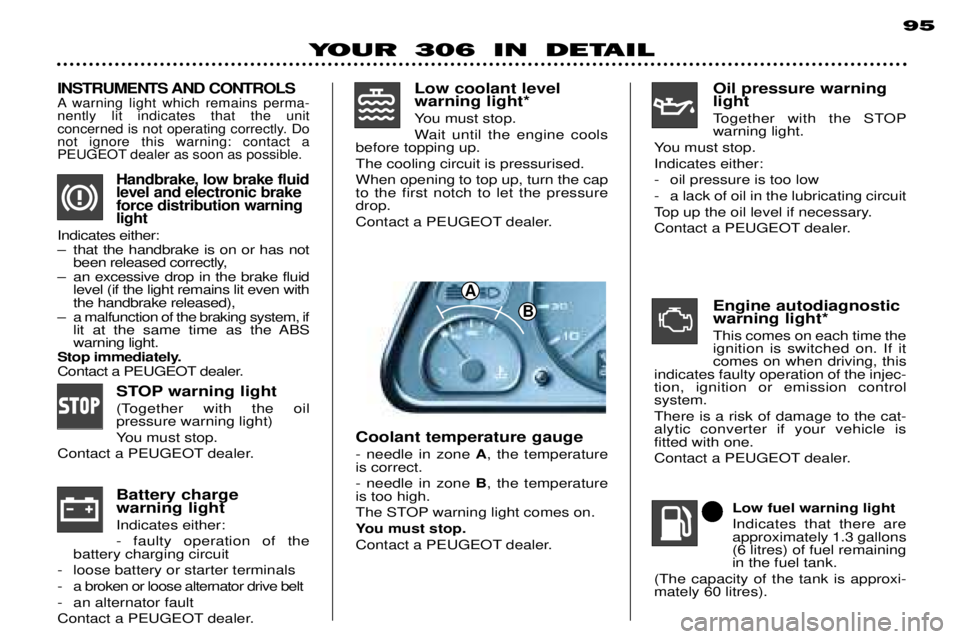
Coolant temperature gauge - needle in zone A, the temperature
is correct. - needle in zone B, the temperature
is too high.
The STOP warning light comes on.
You must stop.
Contact a PEUGEOT dealer.
Handbrake, low brake fluid level and electronic brakeforce distribution warninglight
Indicates either:
Ð that the handbrake is on or has not been released correctly,
Ð an excessive drop in the brake fluid level (if the light remains lit even with the handbrake released),
Ð a malfunction of the braking system, if lit at the same time as the ABSwarning light.
Stop immediately.
Contact a PEUGEOT dealer.
STOP warning light
(Together with the oil pressure warning light)
You must stop.
Contact a PEUGEOT dealer. Oil pressure warning light
Together with the STOP warning light.
You must stop. Indicates either:
- oil pressure is too low
- a lack of oil in the lubricating circuit
Top up the oil level if necessary.
Contact a PEUGEOT dealer.
Battery charge warning light Indicates either: - faulty operation of the
battery charging circuit
- loose battery or starter terminals
- a broken or loose alternator drive belt
- an alternator fault
Contact a PEUGEOT dealer. Low coolant level warning light*
You must stop.
Wait until the engine cools
before topping up. The cooling circuit is pressurised.When opening to top up, turn the cap to the first notch to let the pressuredrop.
Contact a PEUGEOT dealer.
Engine autodiagnostic warning light* This comes on each time the ignition is switched on. If itcomes on when driving, this
indicates faulty operation of the injec-tion, ignition or emission controlsystem. There is a risk of damage to the cat- alytic converter if your vehicle is fitted with one.
Contact a PEUGEOT dealer.
Low fuel warning lightIndicates that there are approximately 1.3 gallons(6 litres) of fuel remainingin the fuel tank.
(The capacity of the tank is approxi-mately 60 litres).
INSTRUMENTS AND CONTROLS
Page 63 of 127
84
YOUR 306 IN DETAIL
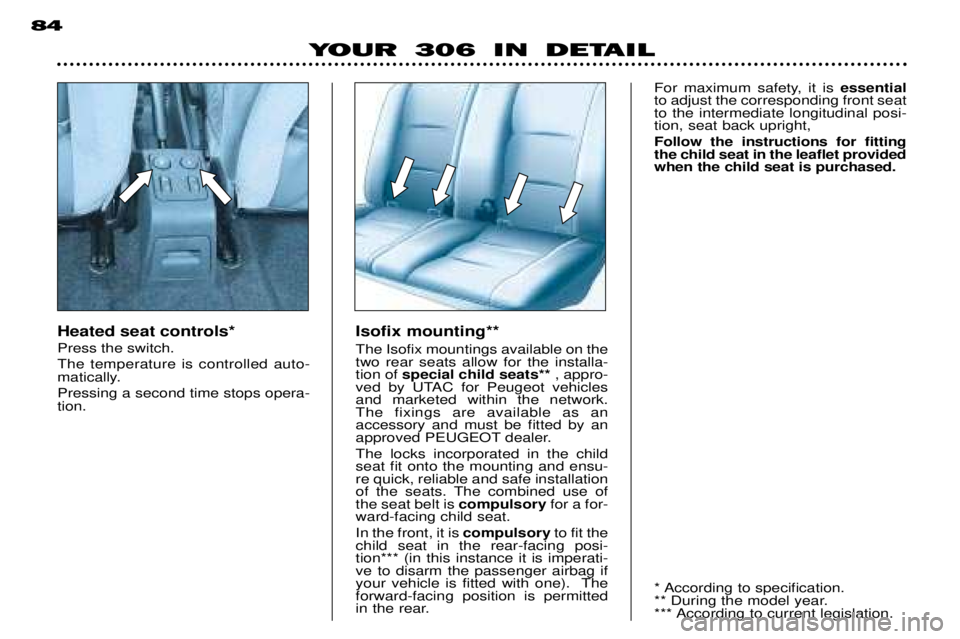
Heated seat controls* Press the switch.The temperature is controlled auto-
matically. Pressing a second time stops opera- tion.Isofix mounting** The Isofix mountings available on the two rear seats allow for the installa-tion of
special child seats** , appro-
ved by UTAC for Peugeot vehiclesand marketed within the network.The fixings are available as anaccessory and must be fitted by an
approved PEUGEOT dealer. The locks incorporated in the child seat fit onto the mounting and ensu-re quick, reliable and safe installation
of the seats. The combined use ofthe seat belt is compulsoryfor a for-
ward-facing child seat. In the front, it is compulsoryto fit the
child seat in the rear-facing posi- tion*** (in this instance it is imperati-ve to disarm the passenger airbag if
your vehicle is fitted with one). Theforward-facing position is permitted
in the rear.
* According to specification.
** During the model year.
*** According to current legislation.
For maximum safety, it is
essential
to adjust the corresponding front seat to the intermediate longitudinal posi-tion, seat back upright, Follow the instructions for fitting the child seat in the leaflet providedwhen the child seat is purchased.
Page 64 of 127
1
1
3
5
2
A4
85
YOUR 306 IN DETAIL
REAR SEATS (3 and 5 doors)
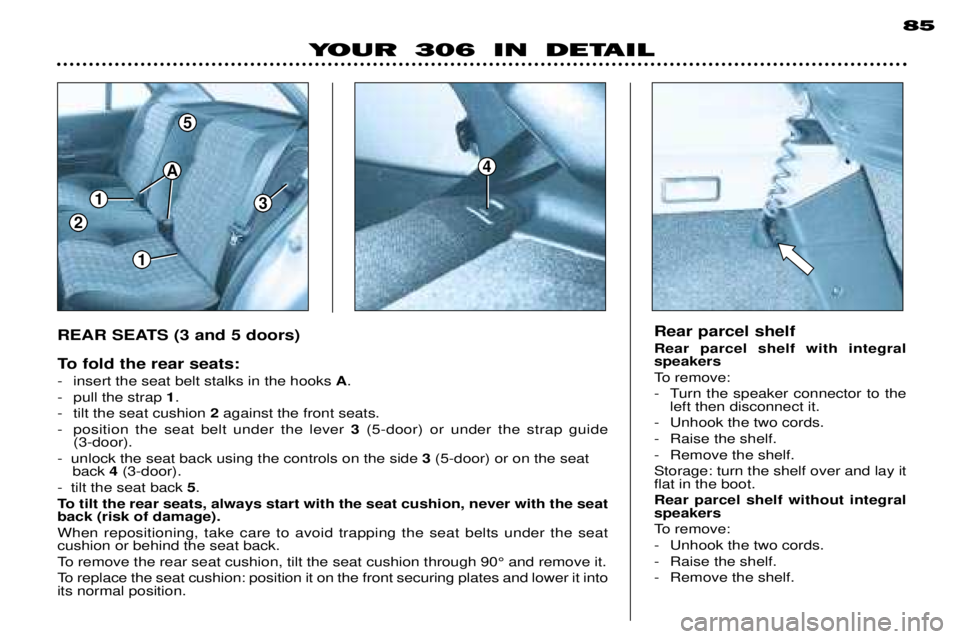
To fold the rear seats:
- insert the seat belt stalks in the hooks A.
- pull the strap 1.
- tilt the seat cushion 2against the front seats.
- position the seat belt under the lever 3(5-door) or under the strap guide
(3-door).
- unlock the seat back using the controls on the side 3(5-door) or on the seat
back 4(3-door).
- tilt the seat back 5.
To tilt the rear seats, always start with the seat cushion, never with the seat back (risk of damage). When repositioning, take care to avoid trapping the seat belts under the seat cushion or behind the seat back.
To remove the rear seat cushion, tilt the seat cushion through 90¡ and remove it.
To replace the seat cushion: position it on the front securing plates and lower it into its normal position. Rear parcel shelf Rear parcel shelf with integral speakers
To remove:
- Turn the speaker connector to the
left then disconnect it.
- Unhook the two cords.
- Raise the shelf.
- Remove the shelf.Storage: turn the shelf over and lay it flat in the boot. Rear parcel shelf without integral speakers
To remove:
- Unhook the two cords.
- Raise the shelf.
- Remove the shelf.
Page 65 of 127
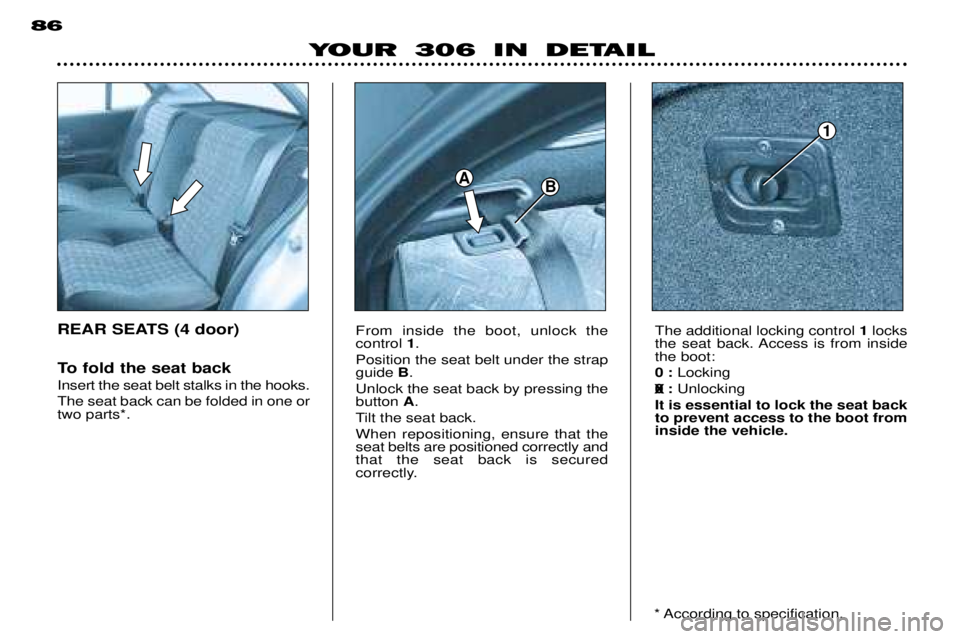
86The additional locking control 1locks
the seat back. Access is from inside the boot: 0 : Locking
0 : Unlocking
It is essential to lock the seat back to prevent access to the boot frominside the vehicle.
X
From inside the boot, unlock the control
1.
Position the seat belt under the strapguide B.
Unlock the seat back by pressing thebutton A.
Tilt the seat back. When repositioning, ensure that the seat belts are positioned correctly andthat the seat back is secured
correctly.
* According to specification.
To fold the seat back Insert the seat belt stalks in the hooks. The seat back can be folded in one or two parts*.
YOUR 306 IN DETAIL
REAR SEATS (4 door)
AB
1
Page 66 of 127
1
4
3
A
2
87
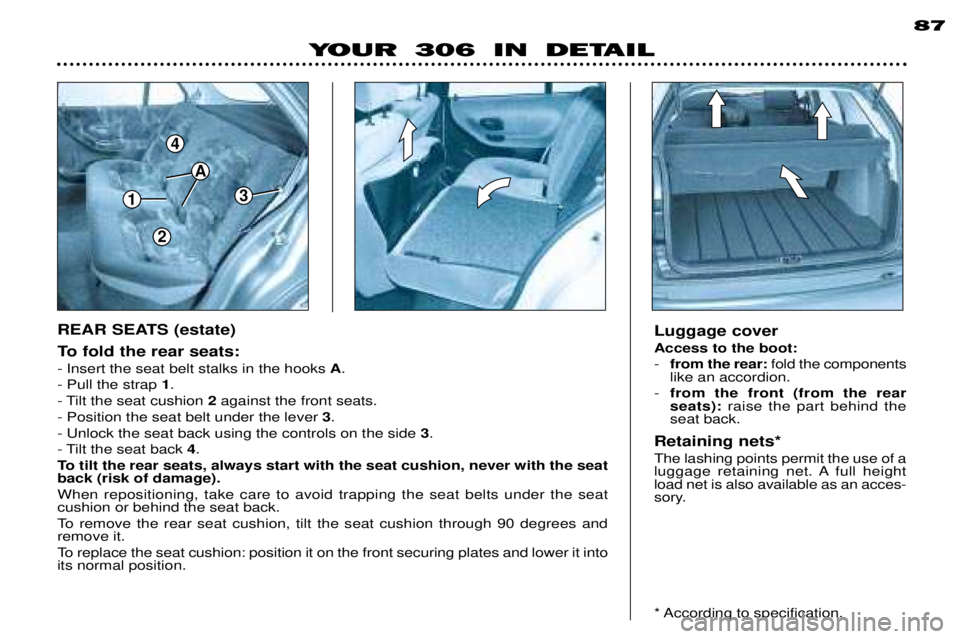
To fold the rear seats: - Insert the seat belt stalks in the hooks A.
- Pull the strap 1.
- Tilt the seat cushion 2against the front seats.
- Position the seat belt under the lever 3.
- Unlock the seat back using the controls on the side 3.
- Tilt the seat back 4.
To tilt the rear seats, always start with the seat cushion, never with the seat back (risk of damage). When repositioning, take care to avoid trapping the seat belts under the seat cushion or behind the seat back.
To remove the rear seat cushion, tilt the seat cushion through 90 degrees and remove it.
To replace the seat cushion: position it on the front securing plates and lower it into its normal position. Luggage cover Access to the boot: -
from the rear: fold the components
like an accordion.
- from the front (from the rear seats): raise the part behind the
seat back.
Retaining nets* The lashing points permit the use of a
luggage retaining net. A full heightload net is also available as an acces-
sory.
* According to specification.
YOUR 306 IN DETAIL
REAR SEATS (estate)
Page 67 of 127
84
YOUR 306 IN DETAIL
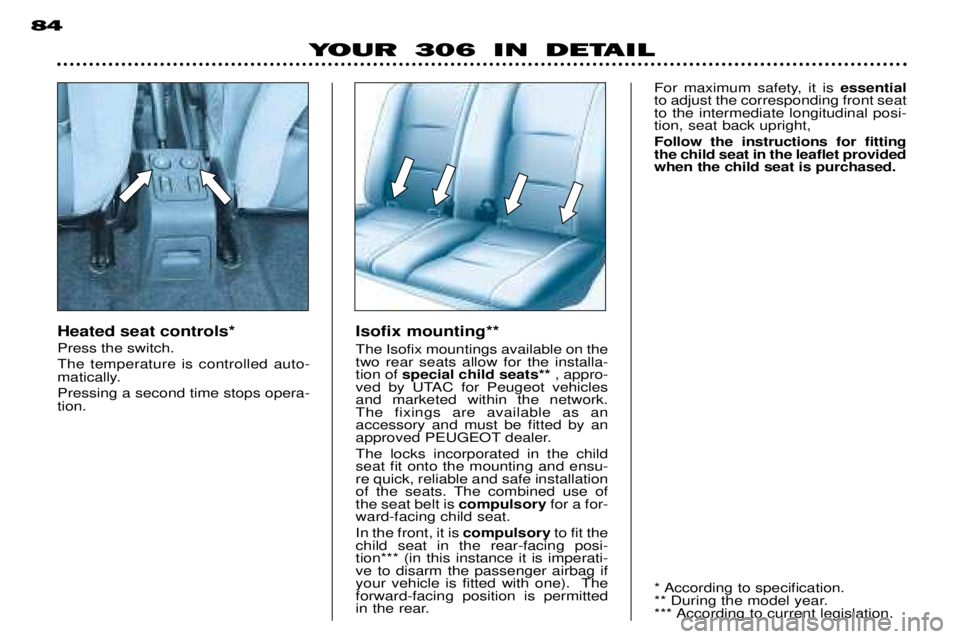
Heated seat controls* Press the switch.The temperature is controlled auto-
matically. Pressing a second time stops opera- tion.Isofix mounting** The Isofix mountings available on the two rear seats allow for the installa-tion of
special child seats** , appro-
ved by UTAC for Peugeot vehiclesand marketed within the network.The fixings are available as anaccessory and must be fitted by an
approved PEUGEOT dealer. The locks incorporated in the child seat fit onto the mounting and ensu-re quick, reliable and safe installation
of the seats. The combined use ofthe seat belt is compulsoryfor a for-
ward-facing child seat. In the front, it is compulsoryto fit the
child seat in the rear-facing posi- tion*** (in this instance it is imperati-ve to disarm the passenger airbag if
your vehicle is fitted with one). Theforward-facing position is permitted
in the rear.
* According to specification.
** During the model year.
*** According to current legislation.
For maximum safety, it is
essential
to adjust the corresponding front seat to the intermediate longitudinal posi-tion, seat back upright, Follow the instructions for fitting the child seat in the leaflet providedwhen the child seat is purchased.
Page 68 of 127
123
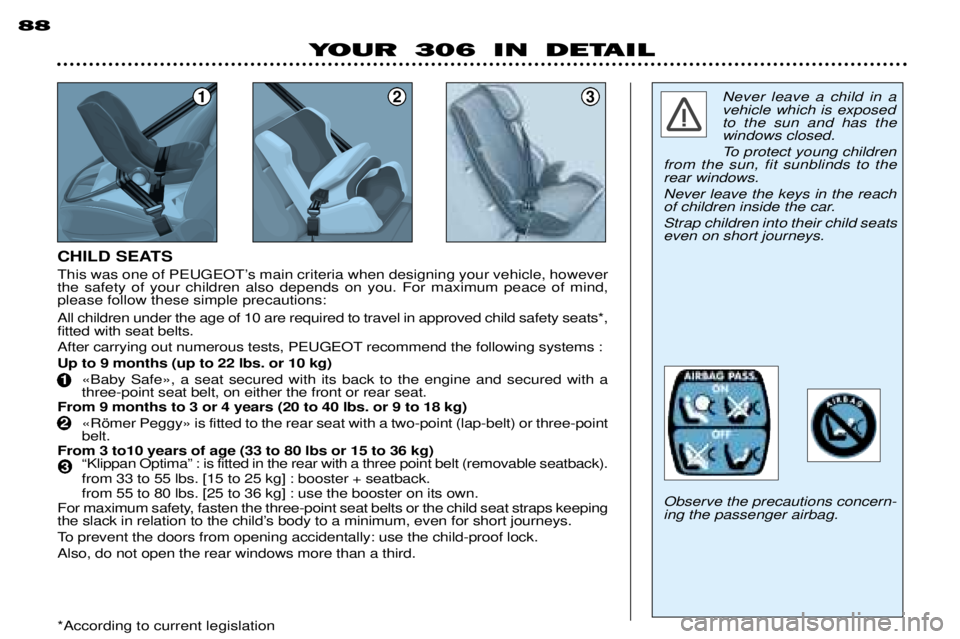
CHILD SEATS All children under the age of 10 are required to travel in approved child safety seats*, fitted with seat belts.
After carrying out numerous tests, PEUGEOT recommend the following systems :Up to 9 months (up to 22 lbs. or 10 kg) ÇBaby SafeÈ, a seat secured with its back to the engine and secured with a three-point seat belt, on either the front or rear seat.
From 9 months to 3 or 4 years (20 to 40 lbs. or 9 to 18 kg)
ÇRšmer PeggyÈ is fitted to the rear seat with a two-point (lap-belt) or three-pointbelt.
From 3 to10 years of age (33 to 80 lbs or 15 to 36 kg) ÒKlippan OptimaÓ : is fitted in the rear with a three point belt (removable seatback). from 33 to 55 lbs. [15 to 25 kg] : booster + seatback.from 55 to 80 lbs. [25 to 36 kg] : use the booster on its own.
For maximum safety, fasten the three-point seat belts or the child seat straps keeping
the slack in relation to the childÕs body to a minimum, even for short journeys.
To prevent the doors from opening accidentally: use the child-proof lock.Also, do not open the rear windows more than a third.
88
YOUR 306 IN DETAIL
Never leave a child in a vehicle which is exposedto the sun and has thewindows closed.
To protect young children
from the sun, fit sunblinds to the rear windows. Never leave the keys in the reach
of children inside the car. Strap children into their child seats even on short journeys. Observe the precautions concern- ing the passenger airbag.
This was one of PEUGEOTÕs main criteria when designing your vehicle, however the safety of your children also depends on you. For maximum peace of mind,please follow these simple precautions: *According to current legislation
1
2
3
Page 69 of 127
1
89
YOUR 306 IN DETAIL
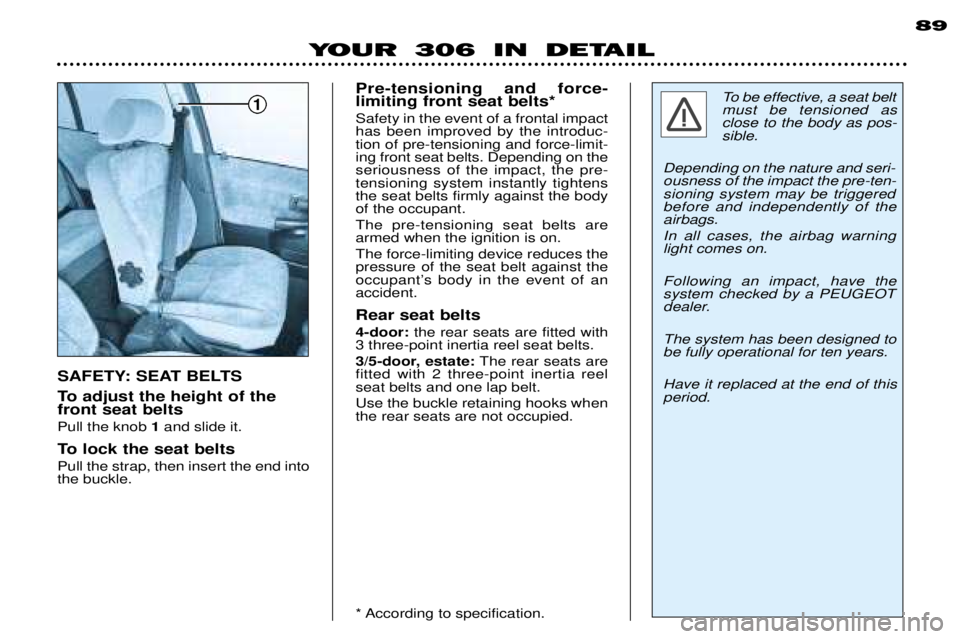
To adjust the height of the front seat belts Pull the knob 1and slide it.
To lock the seat beltsPull the strap, then insert the end into the buckle. Pre-tensioning and force-limiting front seat belts* Safety in the event of a frontal impact has been improved by the introduc-tion of pre-tensioning and force-limit-ing front seat belts. Depending on theseriousness of the impact, the pre-tensioning system instantly tightensthe seat belts firmly against the bodyof the occupant. The pre-tensioning seat belts are armed when the ignition is on. The force-limiting device reduces the pressure of the seat belt against the
occupantÕs body in the event of anaccident. Rear seat belts 4-door:
the rear seats are fitted with
3 three-point inertia reel seat belts.
3/5-door, estate: The rear seats are
fitted with 2 three-point inertia reel seat belts and one lap belt. Use the buckle retaining hooks when the rear seats are not occupied.
* According to specification. To be effective, a seat belt must be tensioned asclose to the body as pos-sible.
Depending on the nature and seri-ousness of the impact the pre-ten-sioning system may be triggeredbefore and independently of theairbags. In all cases, the airbag warning light comes on. Following an impact, have the system checked by a PEUGEOT
dealer. The system has been designed to be fully operational for ten years. Have it replaced at the end of this period.
SAFETY: SEAT BELTS
Page 85 of 127
108
DRIVING YOUR 306
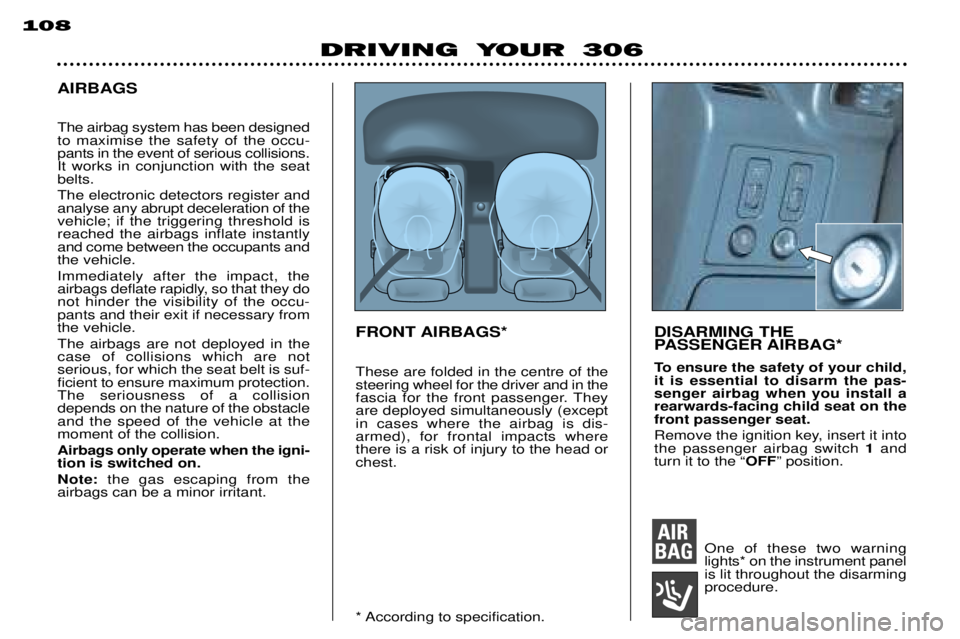
AIRBAGSFRONT AIRBAGS* DISARMING THEPASSENGER AIRBAG*
To ensure the safety of your child, it is essential to disarm the pas-senger airbag when you install arearwards-facing child seat on thefront passenger seat.
Remove the ignition key, insert it into the passenger airbag switch 1and
turn it to the Ò OFFÓ position.
One of these two warninglights* on the instrument panelis lit throughout the disarming
procedure.
The airbag system has been designedto maximise the safety of the occu-pants in the event of serious collisions.It works in conjunction with the seatbelts. The electronic detectors register and analyse any abrupt deceleration of thevehicle; if the triggering threshold isreached the airbags inflate instantlyand come between the occupants andthe vehicle. Immediately after the impact, the
airbags deflate rapidly, so that they donot hinder the visibility of the occu-pants and their exit if necessary fromthe vehicle. The airbags are not deployed in the case of collisions which are notserious, for which the seat belt is suf-ficient to ensure maximum protection.The seriousness of a collisiondepends on the nature of the obstacleand the speed of the vehicle at themoment of the collision. Airbags only operate when the igni- tion is switched on. Note:
the gas escaping from the
airbags can be a minor irritant. These are folded in the centre of the steering wheel for the driver and in the
fascia for the front passenger. Theyare deployed simultaneously (exceptin cases where the airbag is dis-armed), for frontal impacts wherethere is a risk of injury to the head orchest.
* According to specification.
Page 88 of 127
111
DRIVING YOUR 306
WARNING
For the front and side airbags to be fully effective, observe the following safety rules:
¥ Wear a correctly adjusted seat belt.
¥ Sit in a normal upright position.
¥ Do not leave an accessory, or any other object between the occupants of the front seats and the airbags. It could hamper the operation of the airbags or injure the occupants.
¥ All work on the airbag system is strictly forbidden unless it is carried out by qualified personnel of the PEUGEOT network.
¥ After an accident or if the vehicle has been stolen or broken into, have the airbag systems checked.
¥ The airbag systems have been designed to be fully operational for 10 years after the vehicle has been registered. Have them checked by a PEUGEOT dealer at this time.
¥ Front air bags*
¥ Do not drive holding the steering wheel by its spokes or resting your hands on the centre part of the wheel.
¥ Smoke as little as possible; deployment of the airbags can cause burns or the risk of injury from a cigarette or pipe.
¥ Never remove or pierce the steering wheel or hit it violently. ¥ Side air bags*
¥ Fit only approved covers to the front seats.
¥ Do not fix or glue anything to the front seat backs. This could cause injury to the chest or arms when the side airbag inflates.
¥ Do not sit with the upper part of the body any nearer to the door than necessary.
* According to specification.