brake light PEUGEOT 308 2009 User Guide
[x] Cancel search | Manufacturer: PEUGEOT, Model Year: 2009, Model line: 308, Model: PEUGEOT 308 2009Pages: 290, PDF Size: 20.67 MB
Page 115 of 290
118
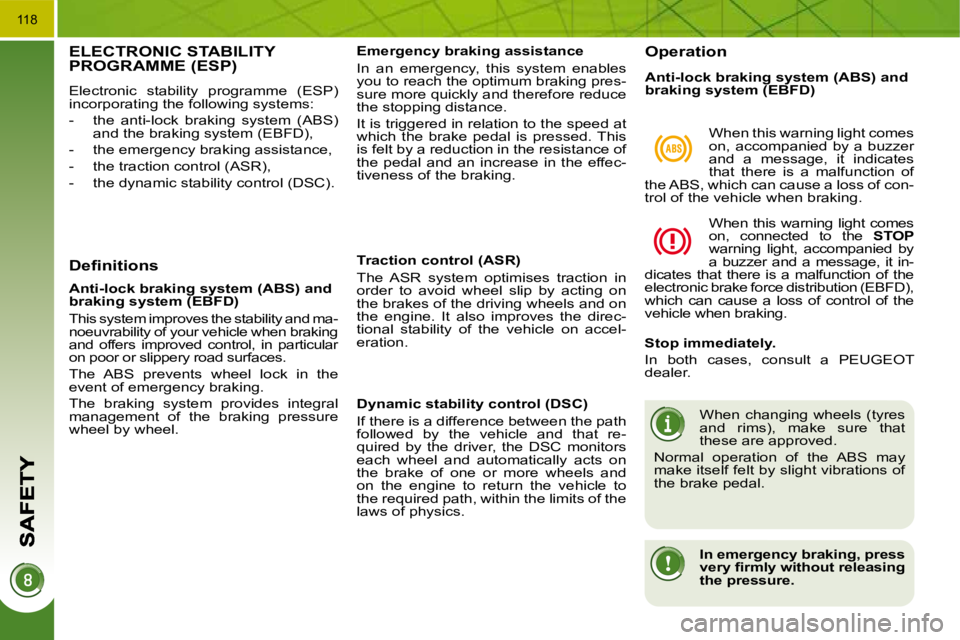
ELECTRONIC STABILITY PROGRAMME (ESP)
Electronic stability programme (ESP)
incorporating the following systems:
- the anti-lock braking system (ABS) and the braking system (EBFD),
- the emergency braking assistance,
- the traction control (ASR),
- the dynamic stability control (DSC).
Definitions Traction control (ASR)
The ASR system optimises traction in
order to avoid wheel slip by acting on
the brakes of the driving wheels and on
the engine. It also improves the direc-
tional stability of the vehicle on accel-
eration.
Dynamic stability control (DSC)
If there is a difference between the path
followed by the vehicle and that re-
quired by the driver, the DSC monitors
each wheel and automatically acts on
the brake of one or more wheels and
on the engine to return the vehicle to
the required path, within the limits of the
laws of physics.
Emergency braking assistance
In an emergency, this system enables
you to reach the optimum braking pres-
sure more quickly and therefore reduce
the stopping distance.
It is triggered in relation to the speed at
which the brake pedal is pressed. This
is felt by a reduction in the resistance of
the pedal and an increase in the effec-
tiveness of the braking.
Anti-lock braking system (ABS) and
braking system (EBFD)
This system improves the stability and ma-
noeuvrability of your vehicle when braking
and offers improved control, in particular
on poor or slippery road surfaces.
The ABS prevents wheel lock in the
event of emergency braking.
The braking system provides integral
management of the braking pressure
wheel by wheel.
Operation
When this warning light comes
on, accompanied by a buzzer
and a message, it indicates
that there is a malfunction of
the ABS, which can cause a loss of con-
trol of the vehicle when braking.
When this warning light comes
on, connected to the STOP
warning light, accompanied by
a buzzer and a message, it in-
dicates that there is a malfunction of the
electronic brake force distribution (EBFD),
which can cause a loss of control of the
vehicle when braking.
Stop immediately.
In both cases, consult a PEUGEOT
dealer.
When changing wheels (tyres
and rims), make sure that
these are approved.
Normal operation of the ABS may
make itself felt by slight vibrations of
the brake pedal.
In emergency braking, press
very fi rmly without releasing
the pressure.
Anti-lock braking system (ABS) and
braking system (EBFD)
Page 116 of 290
118
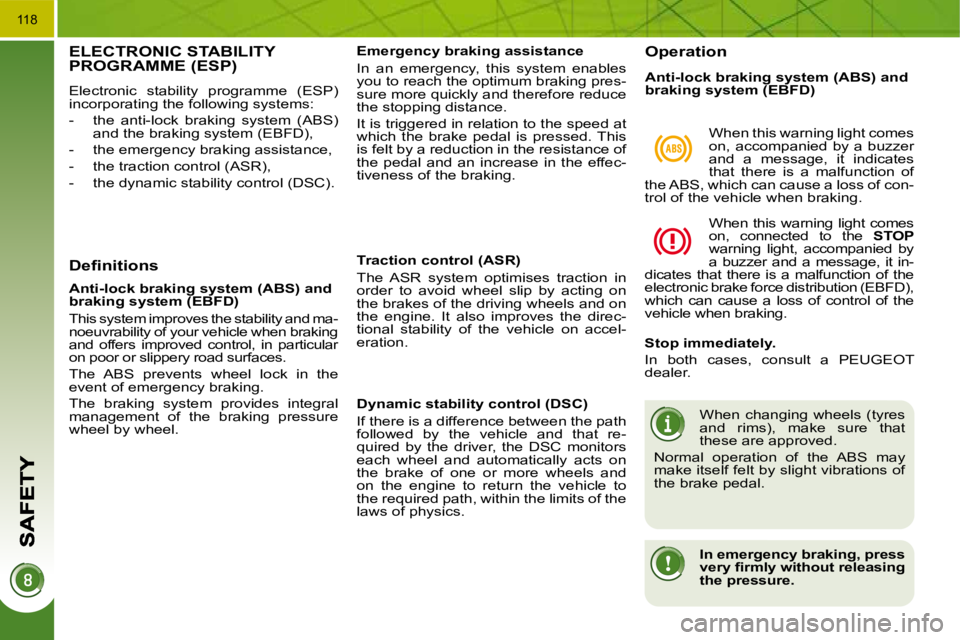
ELECTRONIC STABILITY PROGRAMME (ESP)
Electronic stability programme (ESP)
incorporating the following systems:
- the anti-lock braking system (ABS) and the braking system (EBFD),
- the emergency braking assistance,
- the traction control (ASR),
- the dynamic stability control (DSC).
Definitions Traction control (ASR)
The ASR system optimises traction in
order to avoid wheel slip by acting on
the brakes of the driving wheels and on
the engine. It also improves the direc-
tional stability of the vehicle on accel-
eration.
Dynamic stability control (DSC)
If there is a difference between the path
followed by the vehicle and that re-
quired by the driver, the DSC monitors
each wheel and automatically acts on
the brake of one or more wheels and
on the engine to return the vehicle to
the required path, within the limits of the
laws of physics.
Emergency braking assistance
In an emergency, this system enables
you to reach the optimum braking pres-
sure more quickly and therefore reduce
the stopping distance.
It is triggered in relation to the speed at
which the brake pedal is pressed. This
is felt by a reduction in the resistance of
the pedal and an increase in the effec-
tiveness of the braking.
Anti-lock braking system (ABS) and
braking system (EBFD)
This system improves the stability and ma-
noeuvrability of your vehicle when braking
and offers improved control, in particular
on poor or slippery road surfaces.
The ABS prevents wheel lock in the
event of emergency braking.
The braking system provides integral
management of the braking pressure
wheel by wheel.
Operation
When this warning light comes
on, accompanied by a buzzer
and a message, it indicates
that there is a malfunction of
the ABS, which can cause a loss of con-
trol of the vehicle when braking.
When this warning light comes
on, connected to the STOP
warning light, accompanied by
a buzzer and a message, it in-
dicates that there is a malfunction of the
electronic brake force distribution (EBFD),
which can cause a loss of control of the
vehicle when braking.
Stop immediately.
In both cases, consult a PEUGEOT
dealer.
When changing wheels (tyres
and rims), make sure that
these are approved.
Normal operation of the ABS may
make itself felt by slight vibrations of
the brake pedal.
In emergency braking, press
very fi rmly without releasing
the pressure.
Anti-lock braking system (ABS) and
braking system (EBFD)
Page 129 of 290
130
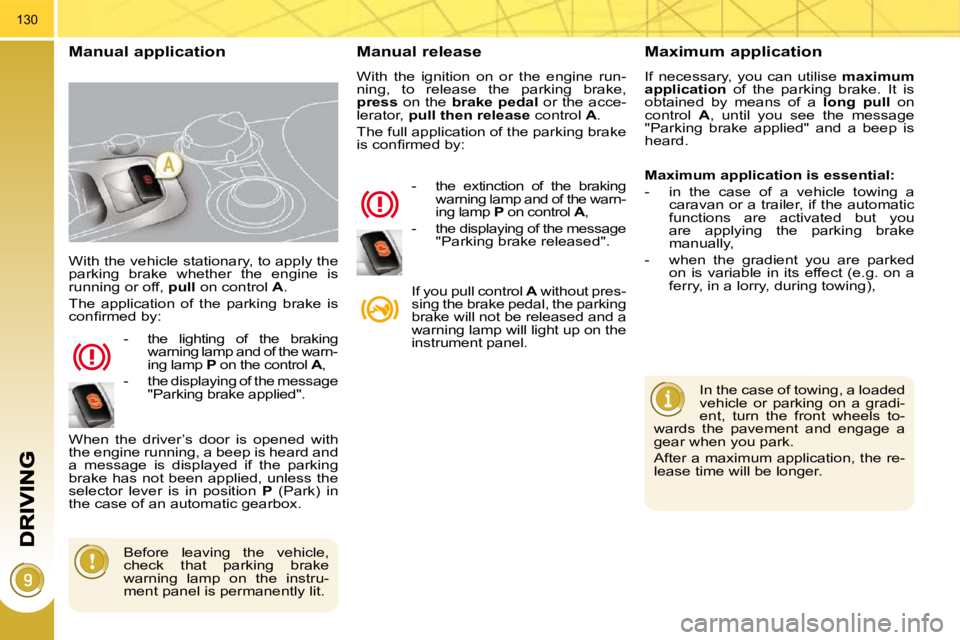
With the vehicle stationary, to apply the
parking brake whether the engine is
running or off, pull on control A .
The application of the parking brake is
confi rmed by:
- the lighting of the braking warning lamp and of the warn-
ing lamp P on the control A ,
- the displaying of the message "Parking brake applied".
When the driver’s door is opened with
the engine running, a beep is heard and
a message is displayed if the parking
brake has not been applied, unless the
selector lever is in position P (Park) in
the case of an automatic gearbox.
Manual release
With the ignition on or the engine run-
ning, to release the parking brake,
press on the brake pedal or the acce-
lerator, pull then release control A .
The full application of the parking brake
is confi rmed by:
-
the extinction of the braking
warning lamp and of the warn-
ing lamp P on control A ,
- the displaying of the message
"Parking brake released".
If you pull control A without pres-
sing the brake pedal, the parking
brake will not be released and a
warning lamp will light up on the
instrument panel.
Manual application Maximum application
If necessary, you can utilise maximum
application of the parking brake. It is
obtained by means of a long pull on
control A , until you see the message
"Parking brake applied" and a beep is
heard.
In the case of towing, a loaded
vehicle or parking on a gradi-
ent, turn the front wheels to-
wards the pavement and engage a
gear when you park.
After a maximum application, the re-
lease time will be longer.
Before leaving the vehicle,
check that parking brake
warning lamp on the instru-
ment panel is permanently lit.
Maximum application is essential:
- in the case of a vehicle towing a caravan or a trailer, if the automatic
functions are activated but you
are applying the parking brake
manually,
- when the gradient you are parked on is variable in its effect (e.g. on a
ferry, in a lorry, during towing),
Page 130 of 290
131
Automatic application, engine off
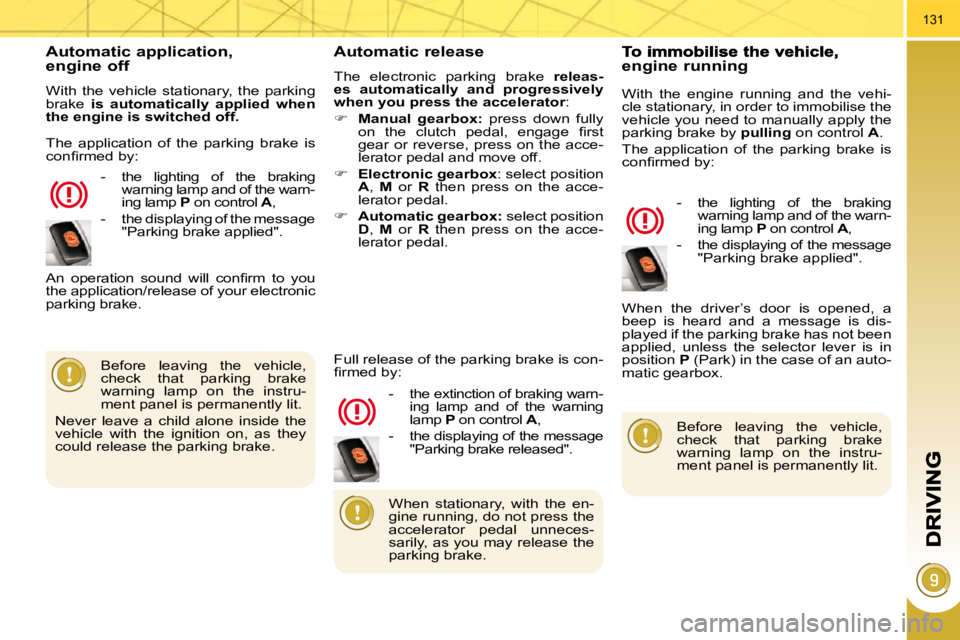
With the vehicle stationary, the parking
brake is automatically applied when
the engine is switched off.
- the lighting of the braking warning lamp and of the warn-
ing lamp P on control A ,
- the displaying of the message "Parking brake applied".
Automatic release
The electronic parking brake releas-
es automatically and progressively
when you press the accelerator :
Manual gearbox: press down fully
on the clutch pedal, engage fi rst
gear or reverse, press on the acce-
lerator pedal and move off.
Electronic gearbox : select position
A , M or R then press on the acce-
lerator pedal.
Automatic gearbox: select position
D , M or R then press on the acce-
lerator pedal.
Before leaving the vehicle,
check that parking brake
warning lamp on the instru-
ment panel is permanently lit.
Never leave a child alone inside the
vehicle with the ignition on, as they
could release the parking brake. - the extinction of braking warn-
ing lamp and of the warning
lamp P on control A ,
- the displaying of the message "Parking brake released".
An operation sound will confi rm to you
the application/release of your electronic
parking brake.
Full release of the parking brake is con-
fi rmed by: engine running
With the engine running and the vehi-
cle stationary, in order to immobilise the
vehicle you need to manually apply the
parking brake by pulling on control A .
The application of the parking brake is
confi rmed by:
- the lighting of the braking warning lamp and of the warn-
ing lamp P on control A ,
- the displaying of the message "Parking brake applied".
When the driver’s door is opened, a
beep is heard and a message is dis-
played if the parking brake has not been
applied, unless the selector lever is in
position P (Park) in the case of an auto-
matic gearbox.
Before leaving the vehicle,
check that parking brake
warning lamp on the instru-
ment panel is permanently lit.
When stationary, with the en-
gine running, do not press the
accelerator pedal unneces-
sarily, as you may release the
parking brake.
The application of the parking brake is
confi rmed by:
Page 131 of 290
132
Particular situations
In certain situations (e.g. star-
ting the engine), the parking brake
can automatically alter its force. This
is normal operation.
Emergency braking
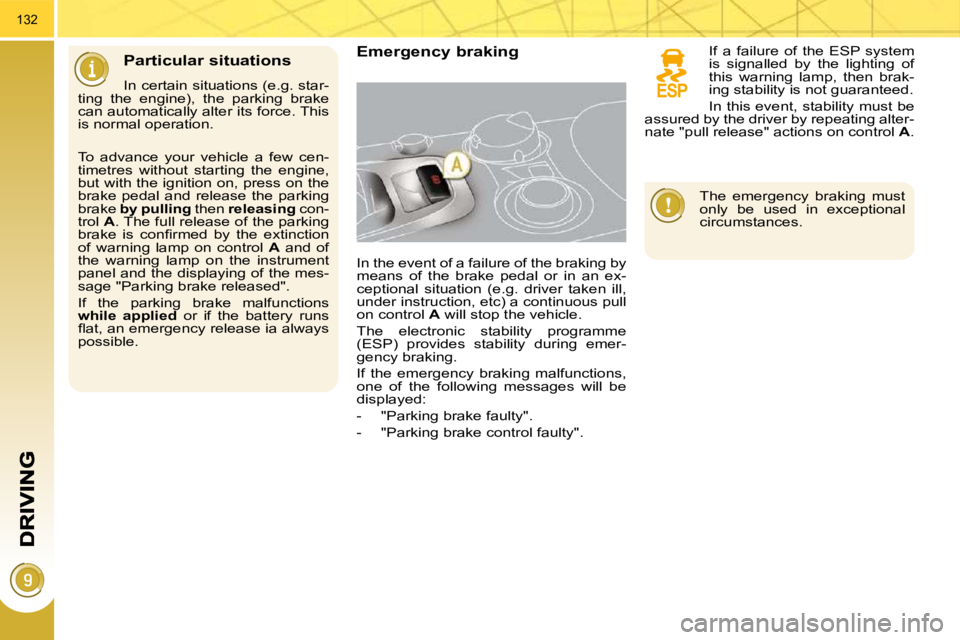
In the event of a failure of the braking by
means of the brake pedal or in an ex-
ceptional situation (e.g. driver taken ill,
under instruction, etc) a continuous pull
on control A will stop the vehicle.
The electronic stability programme
(ESP) provides stability during emer-
gency braking.
If the emergency braking malfunctions,
one of the following messages will be
displayed:
- "Parking brake faulty".
- "Parking brake control faulty".
To advance your vehicle a few cen-
timetres without starting the engine,
but with the ignition on, press on the
brake pedal and release the parking
brake
by pulling then releasing con-
trol A . The full release of the parking
brake is confi rmed by the extinction
of warning lamp on control A and of
the warning lamp on the instrument
panel and the displaying of the mes-
sage "Parking brake released".
If the parking brake malfunctions
while applied or if the battery runs
fl at, an emergency release ia always
possible. If a failure of the ESP system
is signalled by the lighting of
this warning lamp, then brak-
ing stability is not guaranteed.
In this event, stability must be
assured by the driver by repeating alter-
nate "pull release" actions on control A .
The emergency braking must
only be used in exceptional
circumstances.
Page 134 of 290
135
Operating faults
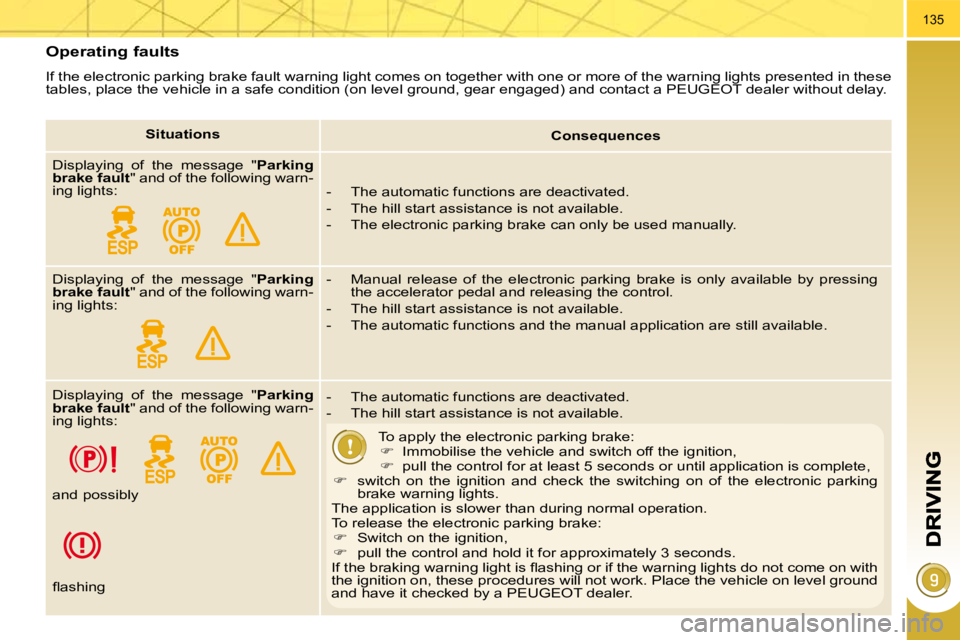
If the electronic parking brake fault warning light comes on together with one or more of the warning lights presented in these
tables, place the vehicle in a safe condition (on level grou nd, gear engaged) and contact a PEUGEOT dealer without dela y.
Situations
Consequences
Displaying of the message " Parking
brake fault " and of the following warn-
ing lights: - The automatic functions are deactivated.
- The hill start assistance is not available.
- The electronic parking brake can only be used manually.
Displaying of the message " Parking
brake fault " and of the following warn-
ing lights: - Manual release of the electronic parking brake is only avai
lable by pressing
the accelerator pedal and releasing the control.
- The hill start assistance is not available.
- The automatic functions and the manual application are still available.
- The automatic functions are deactivated.
- The hill start assistance is not available. To apply the electronic parking brake:
Immobilise the vehicle and switch off the ignition,
pull the control for at least 5 seconds or until applicati on is complete,
switch on the ignition and check the switching on of the electronic parking
brake warning lights.
The application is slower than during normal operation.
To release the electronic parking brake:
Switch on the ignition,
pull the control and hold it for approximately 3 seconds.
If the braking warning light is fl ashing or if the warnin g lights do not come on with
the ignition on, these procedures will not work. Place the ve hicle on level ground
and have it checked by a PEUGEOT dealer.
Displaying of the message "
Parking
brake fault " and of the following warn-
ing lights:
and possibly
fl ashing
Page 135 of 290
136
Situations
Consequences
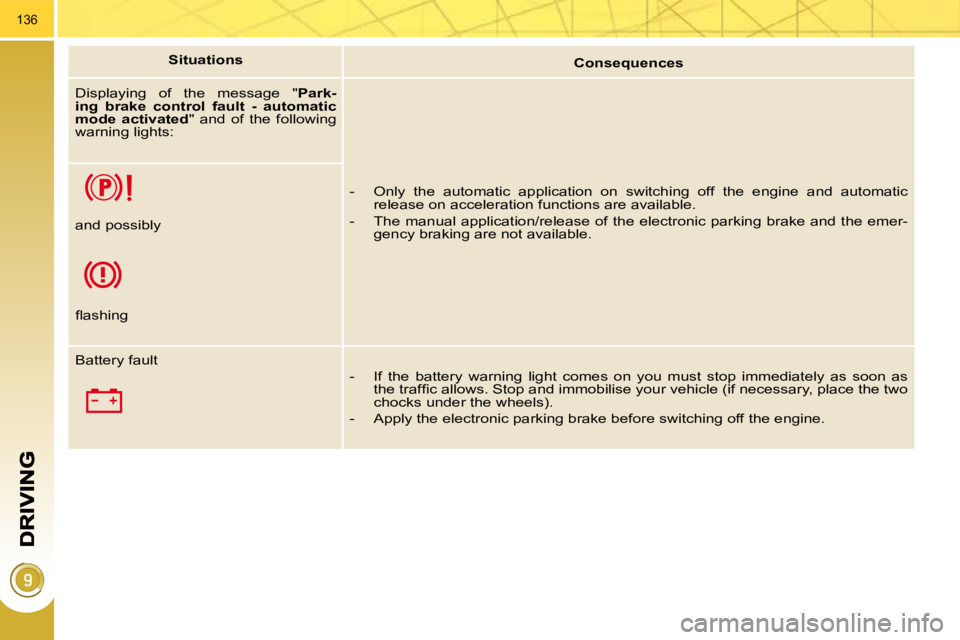
Displaying of the message " Park-
ing brake control fault - automatic
mode activated " and of the following
warning lights:
- Only the automatic application on switching off the engine and automatic
release on acceleration functions are available.
- The manual application/release of the electronic parking brake and the emer-
gency braking are not available.
and possibly
fl ashing
Battery fault
- If the battery warning light comes on you must stop immedi ately as soon as
the traffi c allows. Stop and immobilise your vehicle (if necessary, place the two
chocks under the wheels).
- Apply the electronic parking brake before switching off the engine.
Page 136 of 290
132
Particular situations
In certain situations (e.g. star-
ting the engine), the parking brake
can automatically alter its force. This
is normal operation.
Emergency braking
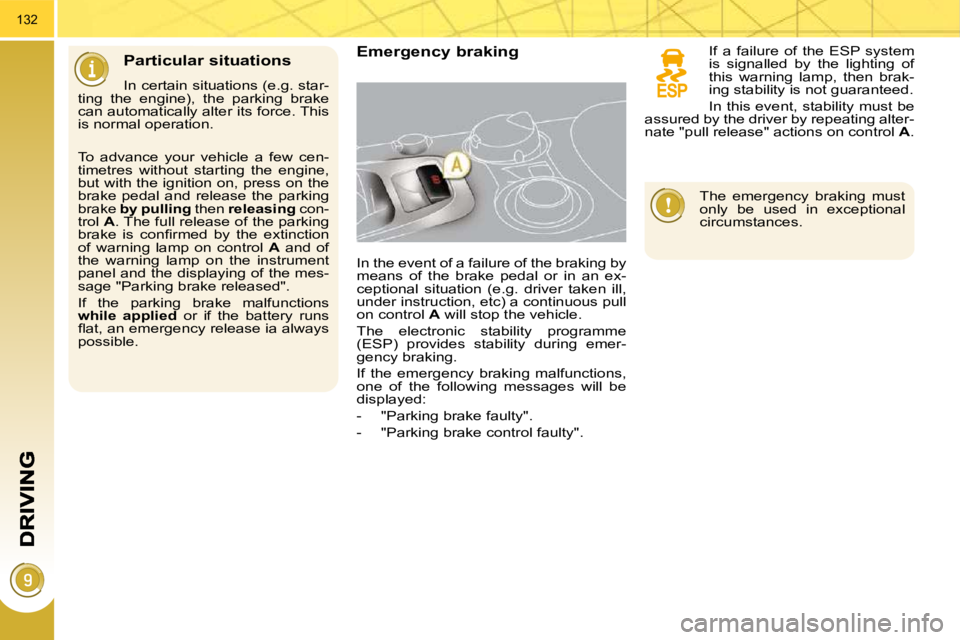
In the event of a failure of the braking by
means of the brake pedal or in an ex-
ceptional situation (e.g. driver taken ill,
under instruction, etc) a continuous pull
on control A will stop the vehicle.
The electronic stability programme
(ESP) provides stability during emer-
gency braking.
If the emergency braking malfunctions,
one of the following messages will be
displayed:
- "Parking brake faulty".
- "Parking brake control faulty".
To advance your vehicle a few cen-
timetres without starting the engine,
but with the ignition on, press on the
brake pedal and release the parking
brake
by pulling then releasing con-
trol A . The full release of the parking
brake is confi rmed by the extinction
of warning lamp on control A and of
the warning lamp on the instrument
panel and the displaying of the mes-
sage "Parking brake released".
If the parking brake malfunctions
while applied or if the battery runs
fl at, an emergency release ia always
possible. If a failure of the ESP system
is signalled by the lighting of
this warning lamp, then brak-
ing stability is not guaranteed.
In this event, stability must be
assured by the driver by repeating alter-
nate "pull release" actions on control A .
The emergency braking must
only be used in exceptional
circumstances.
Page 149 of 290
147
Displays on the instrument panel
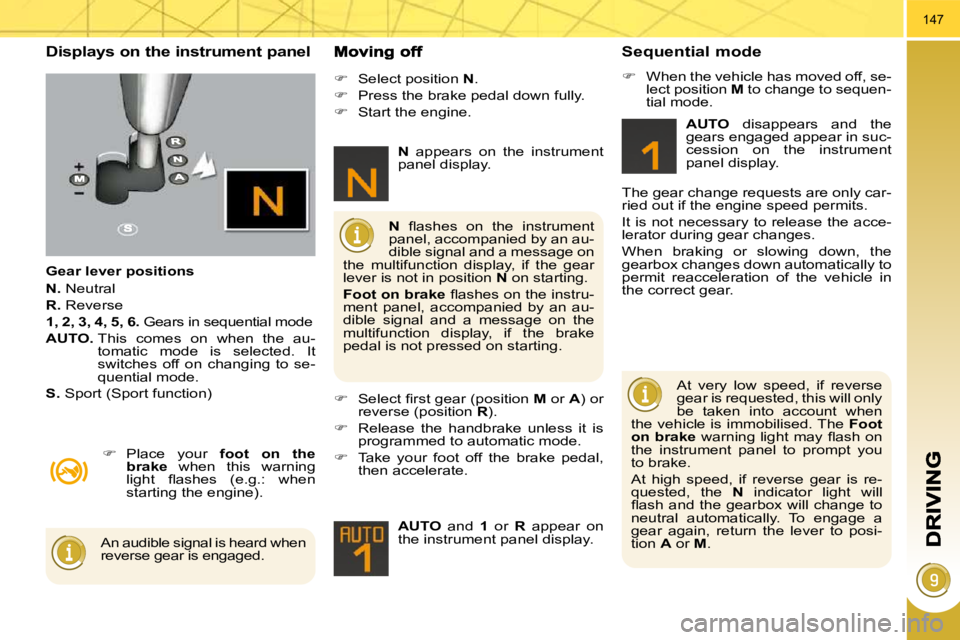
Gear lever positions
N. Neutral
R. Reverse
1, 2, 3, 4, 5, 6. Gears in sequential mode
AUTO. This comes on when the au-
tomatic mode is selected. It
switches off on changing to se-
quential mode.
S. Sport (Sport function)
Place your foot on the
brake when this warning
light fl ashes (e.g.: when
starting the engine).
Select position N .
Press the brake pedal down fully.
Start the engine.
Select fi rst gear (position M or A ) or
reverse (position R ).
Release the handbrake unless it is
programmed to automatic mode.
Take your foot off the brake pedal,
then accelerate.
AUTO and 1 or R appear on
the instrument panel display.
N fl ashes on the instrument
panel, accompanied by an au-
dible signal and a message on
the multifunction display, if the gear
lever is not in position N on starting.
Foot on brake fl ashes on the instru-
ment panel, accompanied by an au-
dible signal and a message on the
multifunction display, if the brake
pedal is not pressed on starting.
An audible signal is heard when
reverse gear is engaged.
N appears on the instrument
panel display.
Sequential mode
When the vehicle has moved off, se-
lect position M to change to sequen-
tial mode.
AUTO disappears and the
gears engaged appear in suc-
cession on the instrument
panel display.
The gear change requests are only car-
ried out if the engine speed permits.
It is not necessary to release the acce-
lerator during gear changes.
When braking or slowing down, the
gearbox changes down automatically to
permit reacceleration of the vehicle in
the correct gear.
At very low speed, if reverse
gear is requested, this will only
be taken into account when
the vehicle is immobilised. The Foot
on brake warning light may fl ash on
the instrument panel to prompt you
to brake.
At high speed, if reverse gear is re-
quested, the N indicator light will
fl ash and the gearbox will change to
neutral automatically. To engage a
gear again, return the lever to posi-
tion A or M .
Page 151 of 290
149
Stopping the vehicle Operating fault
With the ignition on, if this
warning light comes on and
AUTO fl ashes, accompanied
by an audible signal and a
message on the multifunction
display, this indicates a malfunction of
the gearbox.
Have it checked by a PEUGEOT dealer.
It is essential to press the
brake pedal when starting the
engine.
When parking, is it essential to apply
the handbrake to immobilise the ve-
hicle, whatever the circumstances.
When immobilising the vehi-
cle, with the engine running, it
is essential to place the gear
lever in neutral N .
Before carrying out any work in the
engine compartment, check that the
gear lever is in neutral N and that
the handbrake is applied.
Sport function
Following selection of the sequential
mode or automatic mode, press but-
ton S to activate the Sport function
which offers you a more dynamic
style of driving.
S appears next to the gear en-
gaged on the instrument panel
display.
Press button S again to deactivate
the function.
S is then cleared from the instrument
panel display.
The gearbox returns to normal
mode automatically each time
the ignition is switched off. Before switching off the engine, you can
choose to:
- move to position
N to engage neutral,
- leave the gear engaged; in this case, it will not be possible to move
the vehicle.
In both cases, it is essential that you
apply the handbrake to immobilise the
vehicle.