wheel PEUGEOT 308 2011 User Guide
[x] Cancel search | Manufacturer: PEUGEOT, Model Year: 2011, Model line: 308, Model: PEUGEOT 308 2011Pages: 328, PDF Size: 62.67 MB
Page 111 of 328
109
FITTINGS
When changing a wheel
The hooks facilitate access
to the spare wheel, retain-
ing the boot carpet by means of the
two cords.
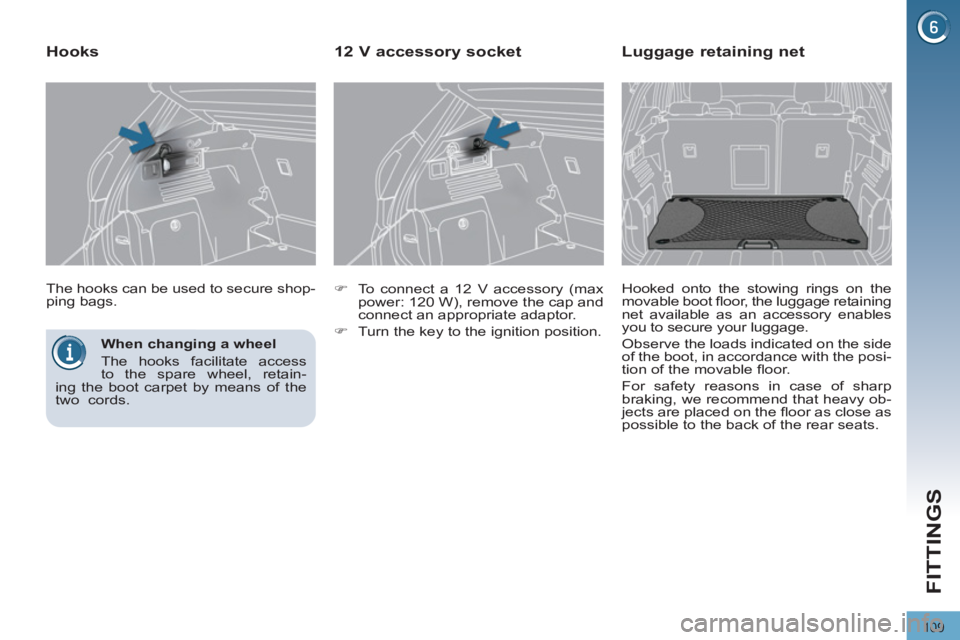
The hooks can be used to secure shop-
ping bags.
Hooks
)
To connect a 12 V accessory (max
power: 120 W), remove the cap and
connect an appropriate adaptor.
)
Turn the key to the ignition position.
12 V accessory socket
Luggage retaining net
Hooked onto the stowing rings on the
movable boot fl oor, the luggage retaining
net available as an accessory enables
you to secure your luggage.
Observe the loads indicated on the side
of the boot, in accordance with the posi-
tion of the movable fl oor.
For safety reasons in case of sharp
braking, we recommend that heavy ob-
jects are placed on the fl oor as close as
possible to the back of the rear seats.
Page 114 of 328
11 2
FITTINGS
Torch
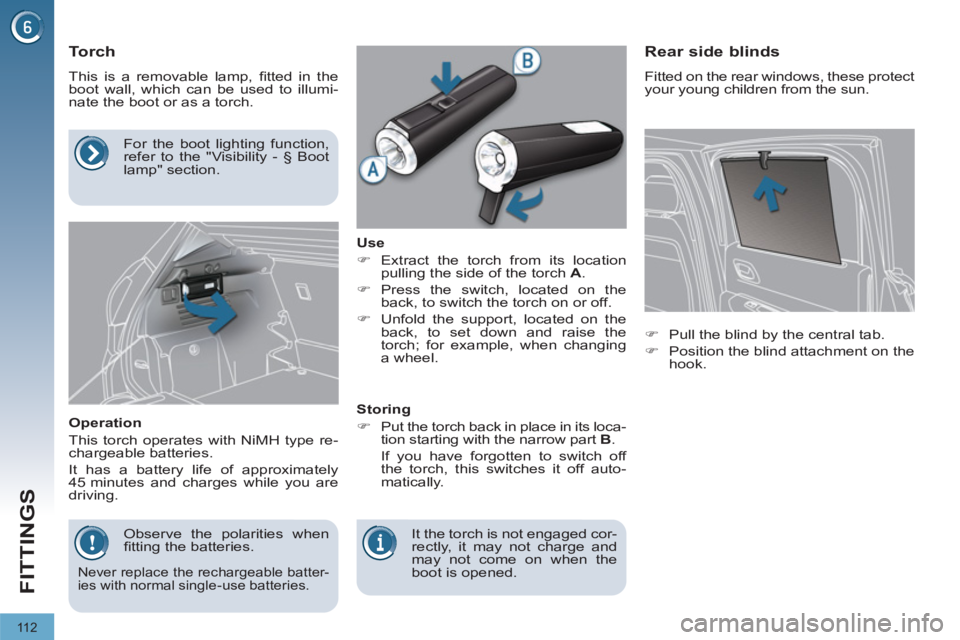
This is a removable lamp, fi tted in the
boot wall, which can be used to illumi-
nate the boot or as a torch.
Operation
This torch operates with NiMH type re-
chargeable batteries.
It has a battery life of approximately
45 minutes and charges while you are
driving.
Use
)
Extract the torch from its location
pulling the side of the torch A
.
)
Press the switch, located on the
back, to switch the torch on or off.
)
Unfold the support, located on the
back, to set down and raise the
torch; for example, when changing
a wheel.
Storing
)
Put the torch back in place in its loca-
tion starting with the narrow part B
.
If you have forgotten to switch off
the torch, this switches it off auto-
matically.
Rear side blinds
Fitted on the rear windows, these protect
your young children from the sun.
)
Pull the blind by the central tab.
)
Position the blind attachment on the
hook.
Observe the polarities when
fi tting the batteries.
Never replace the rechargeable batter-
ies with normal single-use batteries.
It the torch is not engaged cor-
rectly, it may not charge and
may not come on when the
boot is opened.
For the boot lighting function,
refer to the "Visibility - § Boot
lamp" section.
Page 126 of 328
124
SAFETY
DIRECTION INDICATORS
If you forget to cancel the di-
rection indicators for more
than twenty seconds, the
volume of the audible signal will in-
crease if the speed is above 40 mph
(60 km/h).
)
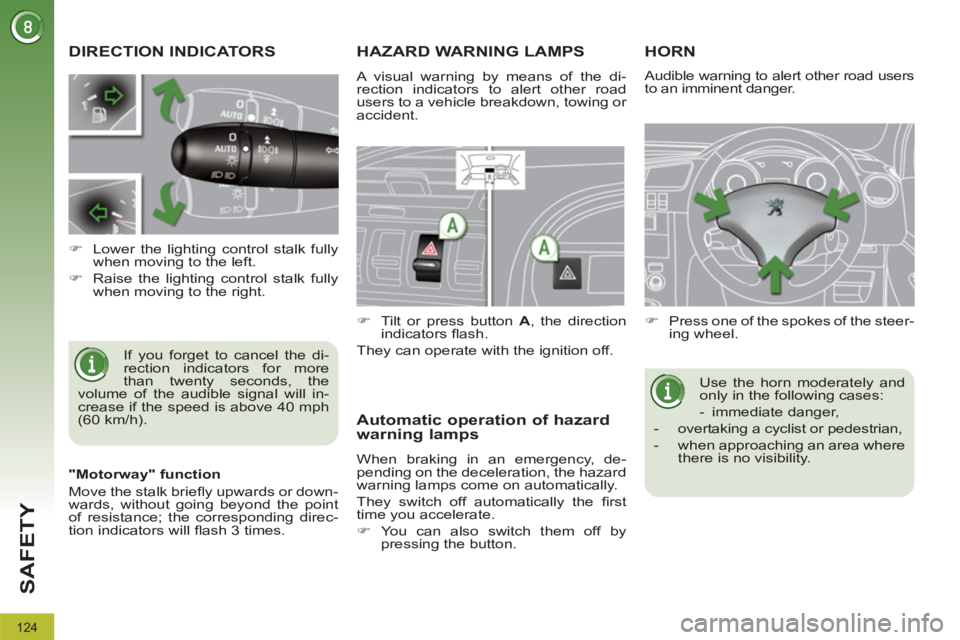
Lower the lighting control stalk fully
when moving to the left.
)
Raise the lighting control stalk fully
when moving to the right.
HAZARD WARNING LAMPS
A visual warning by means of the di-
rection indicators to alert other road
users to a vehicle breakdown, towing or
accident.
)
Tilt or press button A
, the direction
indicators fl ash.
They can operate with the ignition off.
Automatic operation of hazard
warning lamps
When braking in an emergency, de-
pending on the deceleration, the hazard
warning lamps come on automatically.
They switch off automatically the fi rst
time you accelerate.
)
You can also switch them off by
pressing the button.
HORN
)
Press one of the spokes of the steer-
ing wheel.
Use the horn moderately and
only in the following cases:
- immediate danger,
- overtaking a cyclist or pedestrian,
- when approaching an area where
there is no visibility.
Audible warning to alert other road users
to an imminent danger.
"Motorway" function
Move the stalk briefl y upwards or down-
wards, without going beyond the point
of resistance; the corresponding direc-
tion indicators will fl ash 3 times.
Page 127 of 328
125
SAFETY
TYRE UNDER-INFLATION
DETECTION
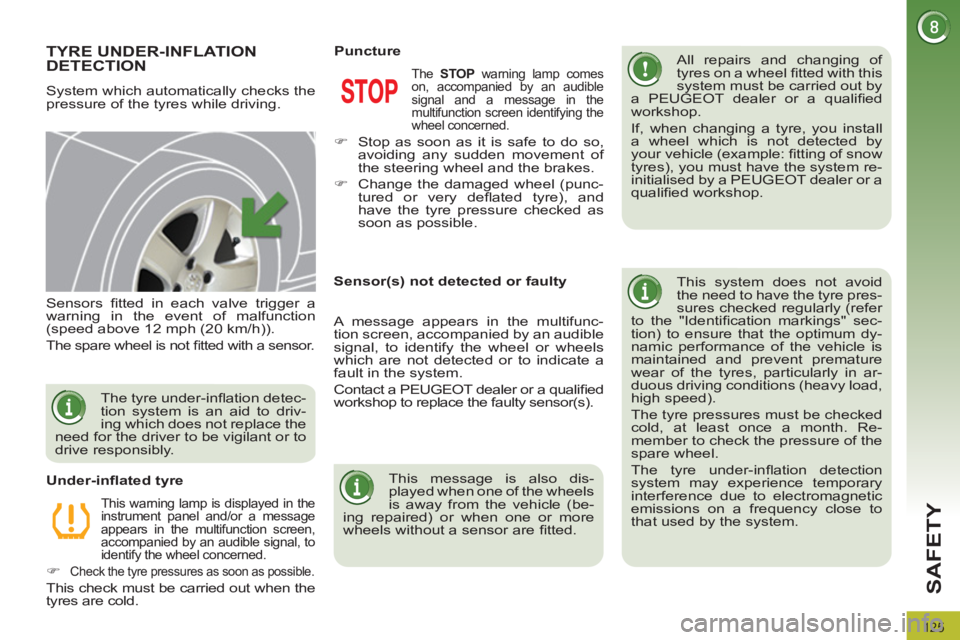
System which automatically checks the
pressure of the tyres while driving.
All repairs and changing of
tyres on a wheel fi tted with this
system must be carried out by
a PEUGEOT dealer or a qualifi ed
workshop.
If, when changing a tyre, you install
a wheel which is not detected by
your vehicle (example: fi tting of snow
tyres), you must have the system re-
initialised by a PEUGEOT dealer or a
qualifi ed workshop.
This system does not avoid
the need to have the tyre pres-
sures checked regularly (refer
to the "Identifi cation markings" sec-
tion) to ensure that the optimum dy-
namic performance of the vehicle is
maintained and prevent premature
wear of the tyres, particularly in ar-
duous driving conditions (heavy load,
high speed).
The tyre pressures must be checked
cold, at least once a month. Re-
member to check the pressure of the
spare wheel.
The tyre under-infl ation detection
system may experience temporary
interference due to electromagnetic
emissions on a frequency close to
that used by the system.
Sensors fi tted in each valve trigger a
warning in the event of malfunction
(speed above 12 mph (20 km/h)).
The spare wheel is not fi tted with a sensor.
This warning lamp is displayed in the
instrument panel and/or a message
appears in the multifunction screen,
accompanied by an audible signal, to
identify the wheel concerned.
)
Check the tyre pressures as soon as possible.
This check must be carried out when the
tyres are cold.
Under-infl ated tyre
The STOP
warning lamp comes
on, accompanied by an audible
signal and a message in the
multifunction screen identifying the
wheel concerned.
)
Stop as soon as it is safe to do so,
avoiding any sudden movement of
the steering wheel and the brakes.
)
Change the damaged wheel (punc-
tured or very defl ated tyre), and
have the tyre pressure checked as
soon as possible.
Puncture
The tyre under-infl ation detec-
tion system is an aid to driv-
ing which does not replace the
need for the driver to be vigilant or to
drive responsibly.
Sensor(s) not detected or faulty
A message appears in the multifunc-
tion screen, accompanied by an audible
signal, to identify the wheel or wheels
which are not detected or to indicate a
fault in the system.
Contact a PEUGEOT dealer or a qualifi ed
workshop to replace the faulty sensor(s).
This message is also dis-
played when one of the wheels
is away from the vehicle (be-
ing repaired) or when one or more
wheels without a sensor are fi tted.
Page 128 of 328
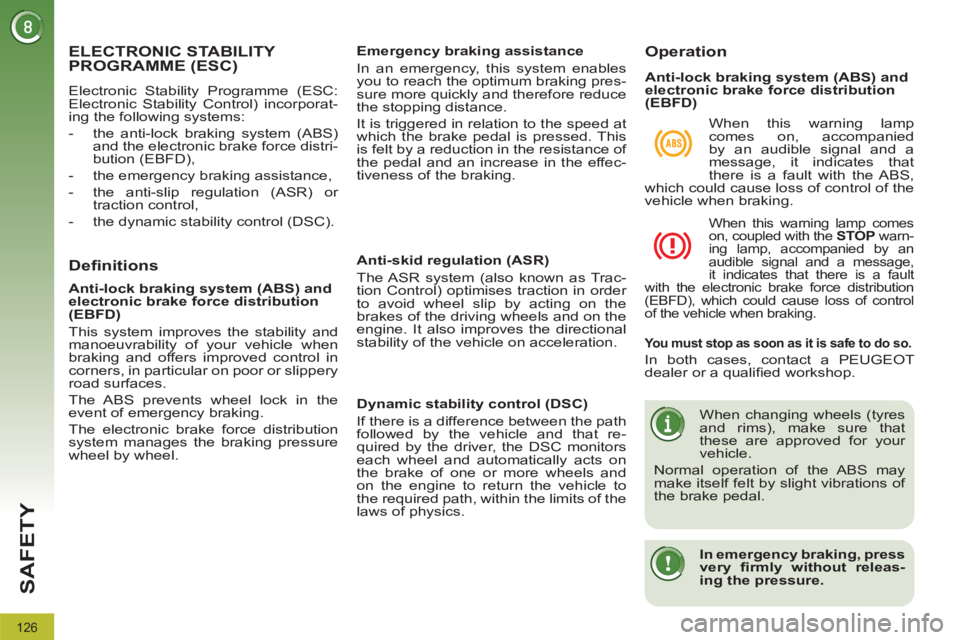
126
SAFETY
ELECTRONIC STABILITY
PROGRAMME (ESC)
Electronic Stability Programme (ESC:
Electronic Stability Control) incorporat-
ing the following systems:
- the anti-lock braking system (ABS)
and the electronic brake force distri-
bution (EBFD),
- the emergency braking assistance,
- the anti-slip regulation (ASR) or
traction control,
- the dynamic stability control (DSC).
Definitions
Anti-skid regulation (ASR)
The ASR system (also known as Trac-
tion Control) optimises traction in order
to avoid wheel slip by acting on the
brakes of the driving wheels and on the
engine. It also improves the directional
stability of the vehicle on acceleration.
Dynamic stability control (DSC)
If there is a difference between the path
followed by the vehicle and that re-
quired by the driver, the DSC monitors
each wheel and automatically acts on
the brake of one or more wheels and
on the engine to return the vehicle to
the required path, within the limits of the
laws of physics.
Emergency braking assistance
In an emergency, this system enables
you to reach the optimum braking pres-
sure more quickly and therefore reduce
the stopping distance.
It is triggered in relation to the speed at
which the brake pedal is pressed. This
is felt by a reduction in the resistance of
the pedal and an increase in the effec-
tiveness of the braking.
Anti-lock braking system (ABS) and
electronic brake force distribution
(EBFD)
This system improves the stability and
manoeuvrability of your vehicle when
braking and offers improved control in
corners, in particular on poor or slippery
road surfaces.
The ABS prevents wheel lock in the
event of emergency braking.
The electronic brake force distribution
system manages the braking pressure
wheel by wheel.
Operation
When this warning lamp
comes on, accompanied
by an audible signal and a
message, it indicates that
there is a fault with the ABS,
which could cause loss of control of the
vehicle when braking.
When this warning lamp comes
on, coupled with the STOP
warn-
ing lamp, accompanied by an
audible signal and a message,
it indicates that there is a fault
with the electronic brake force distribution
(EBFD), which could cause loss of control
of the vehicle when braking.
You must stop as soon as it is safe to do so.
In both cases, contact a PEUGEOT
dealer or a qualifi ed workshop.
When changing wheels (tyres
and rims), make sure that
these are approved for your
vehicle.
Normal operation of the ABS may
make itself felt by slight vibrations of
the brake pedal.
In emergency braking, press
very fi rmly without releas-
ing the pressure.
Anti-lock braking system (ABS) and
electronic brake force distribution
(EBFD)
Page 129 of 328
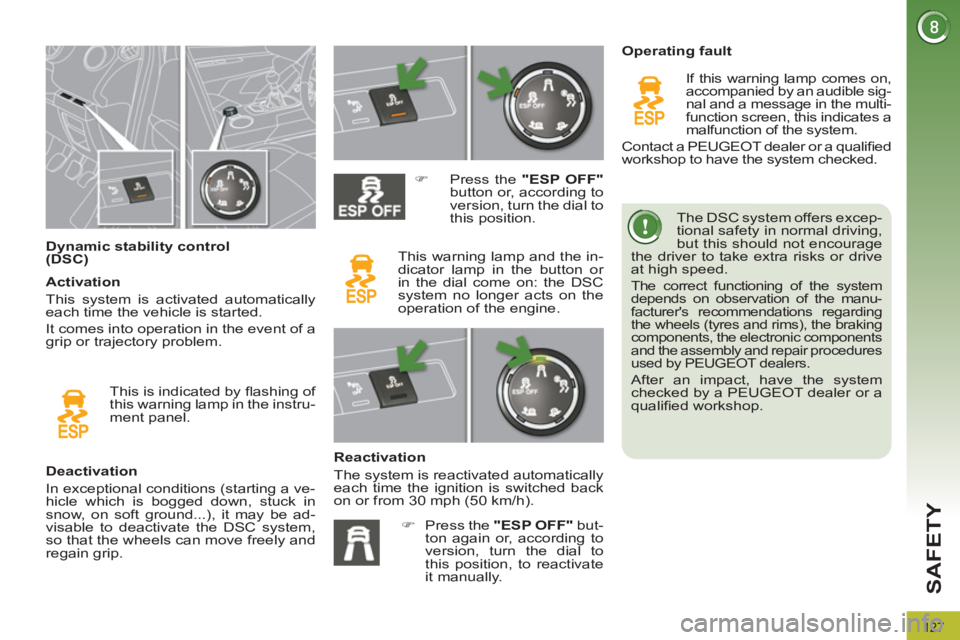
127
SAFETY
Dynamic stability control
(DSC) The DSC system offers excep-
tional safety in normal driving,
but this should not encourage
the driver to take extra risks or drive
at high speed.
The correct functioning of the system
depends on observation of the manu-
facturer's recommendations regarding
the wheels (tyres and rims), the braking
components, the electronic components
and the assembly and repair procedures
used by PEUGEOT dealers.
After an impact, have the system
checked by a PEUGEOT dealer or a
qualifi ed workshop.
Deactivation
In exceptional conditions (starting a ve-
hicle which is bogged down, stuck in
snow, on soft ground...), it may be ad-
visable to deactivate the DSC system,
so that the wheels can move freely and
regain grip.
)
Press the "ESP OFF"
button or, according to
version, turn the dial to
this position.
This warning lamp and the in-
dicator lamp in the button or
in the dial come on: the DSC
system no longer acts on the
operation of the engine.
Reactivation
The system is reactivated automatically
each time the ignition is switched back
on or from 30 mph (50 km/h).
Operating fault
If this warning lamp comes on,
accompanied by an audible sig-
nal and a message in the multi-
function screen, this indicates a
malfunction of the system.
Contact a PEUGEOT dealer or a qualifi ed
workshop to have the system checked.
This is indicated by fl ashing of
this warning lamp in the instru-
ment panel.
Activation
This system is activated automatically
each time the vehicle is started.
It comes into operation in the event of a
grip or trajectory problem.
)
Press the "ESP OFF"
but-
ton again or, according to
version, turn the dial to
this position, to reactivate
it manually.
Page 130 of 328
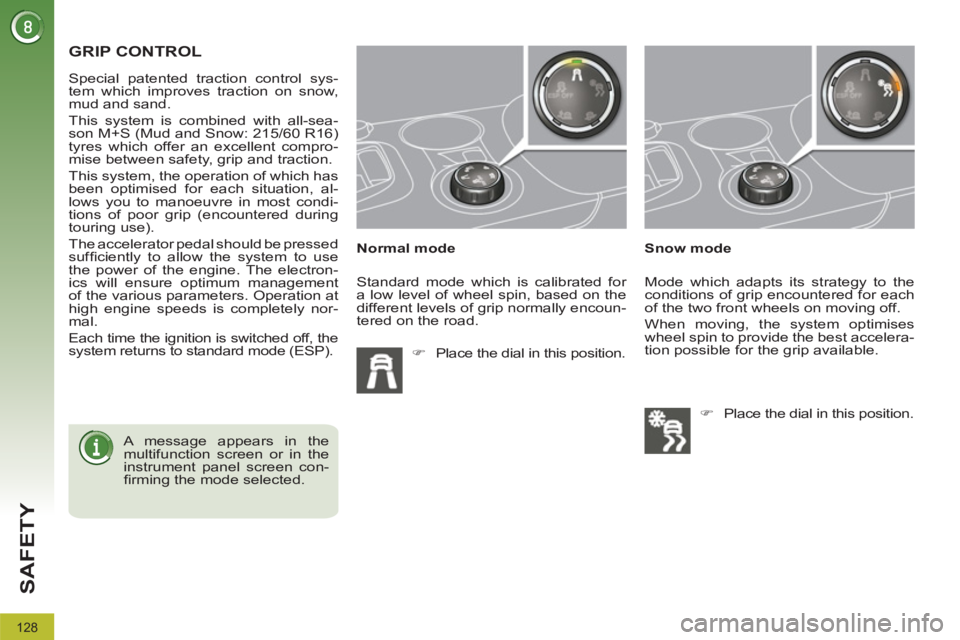
128
SAFETY
GRIP CONTROL
Normal mode
)
Place the dial in this position.
Snow mode Special patented traction control sys-
tem which improves traction on snow,
mud and sand.
This system is combined with all-sea-
son M+S (Mud and Snow: 215/60 R16)
tyres which offer an excellent compro-
mise between safety, grip and traction.
This system, the operation of which has
been optimised for each situation, al-
lows you to manoeuvre in most condi-
tions of poor grip (encountered during
touring use).
The accelerator pedal should be pressed
suffi ciently to allow the system to use
the power of the engine. The electron-
ics will ensure optimum management
of the various parameters. Operation at
high engine speeds is completely nor-
mal.
Each time the ignition is switched off, the
system returns to standard mode (ESP). Standard mode which is calibrated for
a low level of wheel spin, based on the
different levels of grip normally encoun-
tered on the road. Mode which adapts its strategy to the
conditions of grip encountered for each
of the two front wheels on moving off.
When moving, the system optimises
wheel spin to provide the best accelera-
tion possible for the grip available.
)
Place the dial in this position.
A message appears in the
multifunction screen or in the
instrument panel screen con-
fi rming the mode selected .
Page 131 of 328
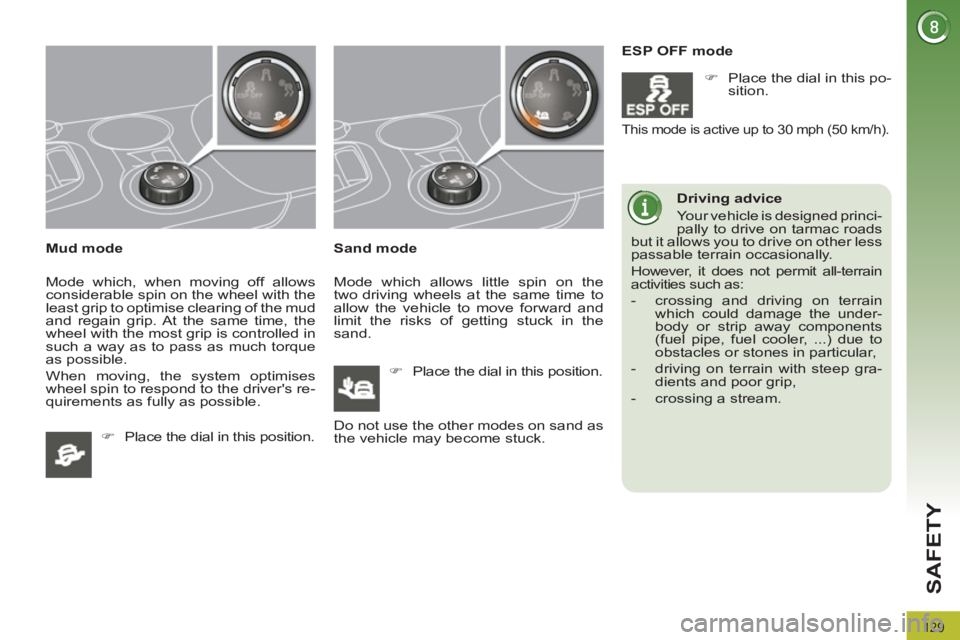
129
SAFETY
Mud mode
Mode which, when moving off allows
considerable spin on the wheel with the
least grip to optimise clearing of the mud
and regain grip. At the same time, the
wheel with the most grip is controlled in
such a way as to pass as much torque
as possible.
When moving, the system optimises
wheel spin to respond to the driver's re-
quirements as fully as possible.
Sand mode
Mode which allows little spin on the
two driving wheels at the same time to
allow the vehicle to move forward and
limit the risks of getting stuck in the
sand.
Driving advice
Your vehicle is designed princi-
pally to drive on tarmac roads
but it allows you to drive on other less
passable terrain occasionally.
However, it does not permit all-terrain
activities such as:
- crossing and driving on terrain
which could damage the under-
body or strip away components
(fuel pipe, fuel cooler, ...) due to
obstacles or stones in particular,
- driving on terrain with steep gra-
dients and poor grip,
- crossing a stream.
)
Place the dial in this position.
)
Place the dial in this position.
ESP OFF mode
)
Place the dial in this po-
sition.
Do not use the other modes on sand as
the vehicle may become stuck.
This mode is active up to 30 mph (50 km/h).
Page 135 of 328
133
SAFETY
AIRBAGS
Deployment of the airbag(s) is
accompanied by a slight emis-
sion of harmless smoke and
a noise, due to the activation of the
pyrotechnic cartridge incorporated in
the system.
This smoke is not harmful, but sensi-
tive individuals may experience slight
irritation.
The noise of the detonation may re-
sult in a slight loss of hearing for a
short time.
Front airbags
System which protects the driver and
front passenger in the event of a seri-
ous front impact in order to limit the risk
of injury to the head and thorax.
The driver's airbag is fi tted in the centre
of the steering wheel; the front passen-
ger's airbag is fi tted in the dashboard
above the glove box.
Deployment
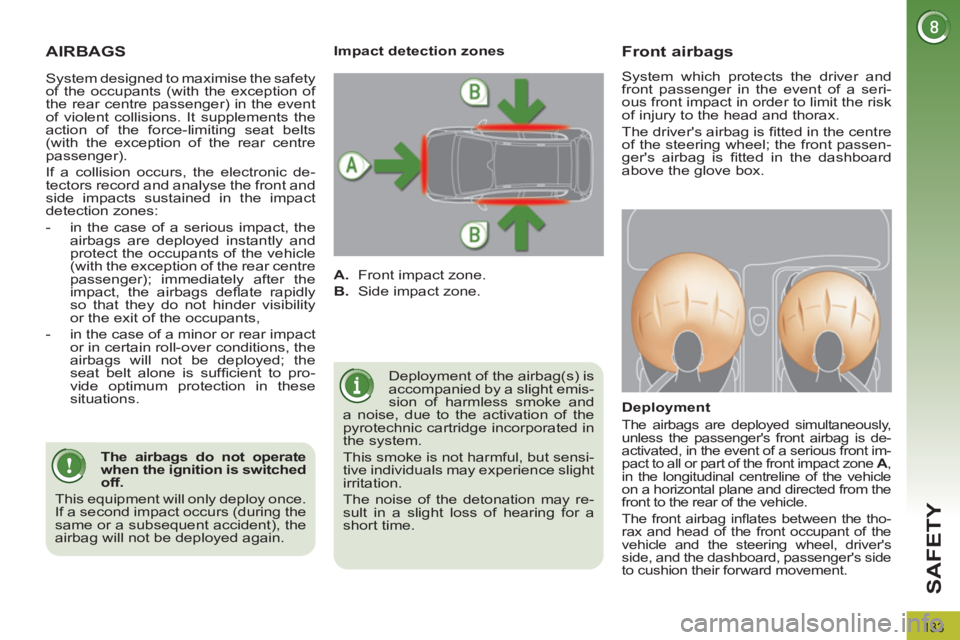
The airbags are deployed simultaneously,
unless the passenger's front airbag is de-
activated, in the event of a serious front im-
pact to all or part of the front impact zone A
,
in the longitudinal centreline of the vehicle
on a horizontal plane and directed from the
front to the rear of the vehicle.
The front airbag infl ates between the tho-
rax and head of the front occupant of the
vehicle and the steering wheel, driver's
side, and the dashboard, passenger's side
to cushion their forward movement.
Impact detection zones
A.
Front impact zone.
B.
Side impact zone.
The airbags do not operate
when the ignition is switched
off.
This equipment will only deploy once.
If a second impact occurs (during the
same or a subsequent accident), the
airbag will not be deployed again.
System designed to maximise the safety
of the occupants (with the exception of
the rear centre passenger) in the event
of violent collisions. It supplements the
action of the force-limiting seat belts
(with the exception of the rear centre
passenger).
If a collision occurs, the electronic de-
tectors record and analyse the front and
side impacts sustained in the impact
detection zones:
- in the case of a serious impact, the
airbags are deployed instantly and
protect the occupants of the vehicle
(with the exception of the rear centre
passenger); immediately after the
impact, the airbags defl ate rapidly
so that they do not hinder visibility
or the exit of the occupants,
- in the case of a minor or rear impact
or in certain roll-over conditions, the
airbags will not be deployed; the
seat belt alone is suffi cient to pro-
vide optimum protection in these
situations.
Page 138 of 328
136
SAFETY
For the airbags to be fully
effective, observe the
following safety rules:
Sit in a normal upright position.
Wear a correctly adjusted seat belt.
Do not leave anything between the
occupants and the airbags (a child,
pet, object...). This could hamper the
operation of the airbags or injure the
occupants.
After an accident or if the vehicle has
been stolen or broken into, have the
airbag systems checked.
All work on the airbag system must
be carried out by a PEUGEOT dealer
or a qualifi ed workshop.
Even if all of the precautions mentioned
are observed, a risk of injury or of minor
burns to the head, chest or arms when
an airbag is deployed cannot be ruled
out. The bag infl ates almost instantly
(within a few milliseconds) then defl ates
within the same time discharging the
hot gas via openings provided for this
purpose.
Front airbags
Do not drive holding the steering wheel
by its spokes or resting your hands on
the centre part of the wheel.
Passengers must not place their feet
on the dashboard.
If possible, do not smoke as deploy-
ment of the airbags can cause burns
or the risk of injury from a cigarette
or pipe.
Never remove or pierce the steering
wheel or hit it violently.
Lateral airbags
Use only approved covers on the seats,
compatible with the deployment the lat-
eral airbags. For information on the range
of seat covers suitable for your vehicle,
you can contact a PEUGEOT dealer (see
"Practical information - § Accessories").
Do not fi x or attach anything to the
seat backs (clothing...). This could
cause injury to the chest or arms if
the lateral airbag is deployed.
Do not sit with the upper part of the
body any nearer to the door than
necessary.
Curtain airbags
Do not fi x or attach anything to the
roof. This could cause injury to the
head if the curtain airbag is deployed.
If fi tted on your vehicle, do not re-
move the grab handles installed on
the roof, they play a part in securing
the curtain airbags.