gearbox PEUGEOT 308 2011 Owner's Manual
[x] Cancel search | Manufacturer: PEUGEOT, Model Year: 2011, Model line: 308, Model: PEUGEOT 308 2011Pages: 328, PDF Size: 62.67 MB
Page 163 of 328
161
DRIVING
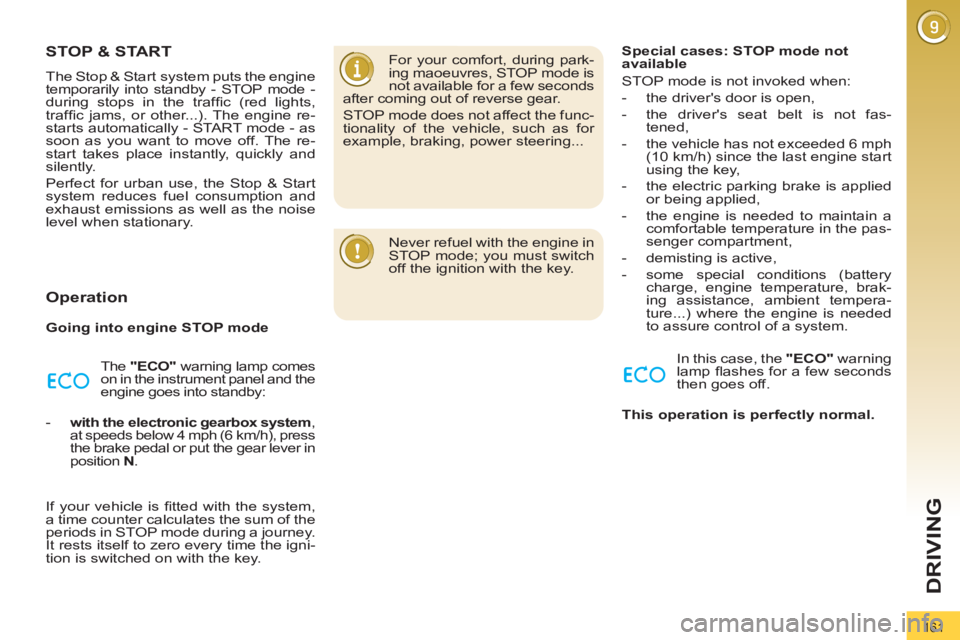
STOP & START
The Stop & Start system puts the engine
temporarily into standby - STOP mode -
during stops in the traffi c (red lights,
traffi c jams, or other...). The engine re-
starts automatically - START mode - as
soon as you want to move off. The re-
start takes place instantly, quickly and
silently.
Perfect for urban use, the Stop & Start
system reduces fuel consumption and
exhaust emissions as well as the noise
level when stationary.
Operation
Going into engine STOP mode
The "ECO"
warning lamp comes
on in the instrument panel and the
engine goes into standby:
- with the electronic gearbox system
,
at speeds below 4 mph (6 km/h), press
the brake pedal or put the gear lever in
position N
.
If your vehicle is fi tted with the system,
a time counter calculates the sum of the
periods in STOP mode during a journey.
It rests itself to zero every time the igni-
tion is switched on with the key.
For your comfort, during park-
ing maoeuvres, STOP mode is
not available for a few seconds
after coming out of reverse gear.
STOP mode does not affect the func-
tionality of the vehicle, such as for
example, braking, power steering...
Never refuel with the engine in
STOP mode; you must switch
off the ignition with the key.
Special cases: STOP mode not
available
STOP mode is not invoked when:
- the driver's door is open,
- the driver's seat belt is not fas-
tened,
- the vehicle has not exceeded 6 mph
(10 km/h) since the last engine start
using the key,
- the electric parking brake is applied
or being applied,
- the engine is needed to maintain a
comfortable temperature in the pas-
senger compartment,
- demisting is active,
- some special conditions (battery
charge, engine temperature, brak-
ing assistance, ambient tempera-
ture...) where the engine is needed
to assure control of a system.
In this case, the "ECO"
warning
lamp fl ashes for a few seconds
then goes off.
This operation is perfectly normal.
Page 164 of 328
162
DRIVING
Going into engine START mode
The "ECO"
warning lamp goes
off and the engine starts with the
electronic gearbox
system
:
- gear lever in position A
or M
, release
the brake pedal,
- or gear lever in position N
and the
brake pedal released, move the
gear lever to position A
or M
,
- or engage reverse gear.
In this case the "ECO"
warning
lamp fl ashes for a few seconds,
then goes off.
Special cases: START invoked
automatically
START mode is invoked automatically when:
- the driver's door is open,
- the driver's seat belt is not fas-
tened,
- the speed of the vehicle exceeds
7 mph (11 km/h) with the electronic
gearbox system,
- the electric parking brake is being
applied,
- some special conditions (battery
charge, engine temperature, brak-
ing assistance, ambient tempera-
ture...) where the engine is needed
for control of a system.
This operation is perfectly normal.
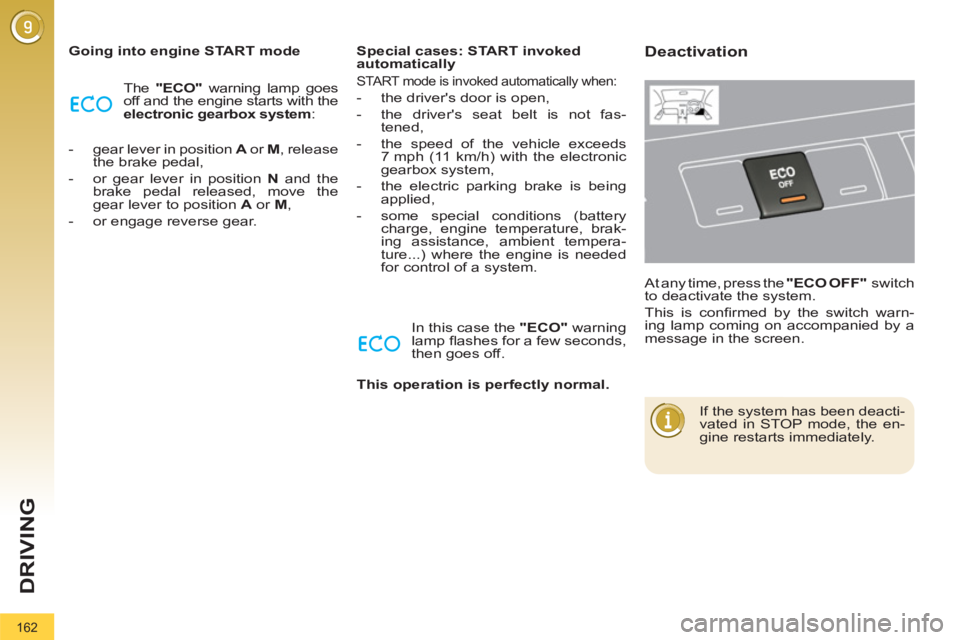
Deactivation
At any time, press the "ECO OFF"
switch
to deactivate the system.
This is confi rmed by the switch warn-
ing lamp coming on accompanied by a
message in the screen.
If the system has been deacti-
vated in STOP mode, the en-
gine restarts immediately.
Page 175 of 328
173
CHECKS
Brake disc wear
Brake pads
Brake wear depends on the
style of driving, particularly in
the case of vehicles used in
town, over short distances. It
may be necessary to have the
condition of the brakes checked, even
between vehicle services.
Unless there is a leak in the circuit, a
drop in the brake fl uid level indicates
that the brake pads are worn.
For information on checking
brake disc wear, contact a
PEUGEOT dealer or a quali-
fi ed workshop.
Manual gearbox
The gearbox does not re-
quire any maintenance (no oil
change).
Refer to the servicing booklet for
the details of the level checking
interval for this component.
6-speed electronic
gearbox system
The gearbox does not re-
quire any maintenance (no oil
change).
Refer to the servicing booklet
for details of the checking in-
terval for this component.
Automatic gearbox
The gearbox does not re-
quire any maintenance (no oil
change).
Refer to the servicing booklet
for details of the level checking
interval for this component. This system does not require any
routine servicing. However, in
the event of a problem, have the
system checked by a PEUGEOT
dealer or a qualifi ed workshop.
For more information, see "Driving -
Electric parking brake - § Operating
faults".
Electric parking brake
Particle emission filter (Diesel)
Maintenance of the particle emission fi l-
ter must be carried out by a PEUGEOT
dealer or a qualifi ed workshop.
On a new vehicle, the fi rst few
particle emissions fi lter regen-
erations may be accompanied
by a "burning" smell, which is perfect-
ly normal. Following prolonged oper-
ation of the vehicle at very low speed
or at idle, you may, in exceptional
circumstances, notice water vapour
from the exhaust on acceleration.
This does not affect the performance
of the vehicle or the environment.
Dust filter/Anti-odour filter
(activated carbon)
Your vehicle is fi tted with a fi lter which
traps certain dust and limits odours in
the ventilation and air conditioning.
Refer to the servicing booklet for its re-
placement interval.
Do not hesitate to change it if you notice
unpleasant odours, contact a PEUGEOT
dealer or a qualifi ed workshop.
A clogged passenger compartment fi lter
may reduce the performance of the air
conditioning system and produce un-
pleasant odours.
Page 185 of 328
183
PRACTICAL INFORMATION
Parking the vehicle
Immobilise the vehicle where
it does not block traffi c: the
ground must be level, stable and
non-slippery ground.
Apply the parking brake unless it
has been programmed to automatic
mode, switch off the ignition and en-
gage fi rst gear * to lock the wheels.
Check that the braking warning lamp
and the P
warning lamp on the park-
ing brake control come on.
If necessary, place a chock under the
wheel diagonally opposite the wheel
to be changed.
The occupants must get out of the ve-
hicle and wait where they are safe.
Never go underneath a vehicle raised
using a jack; use an axle stand.
Removing a wheel
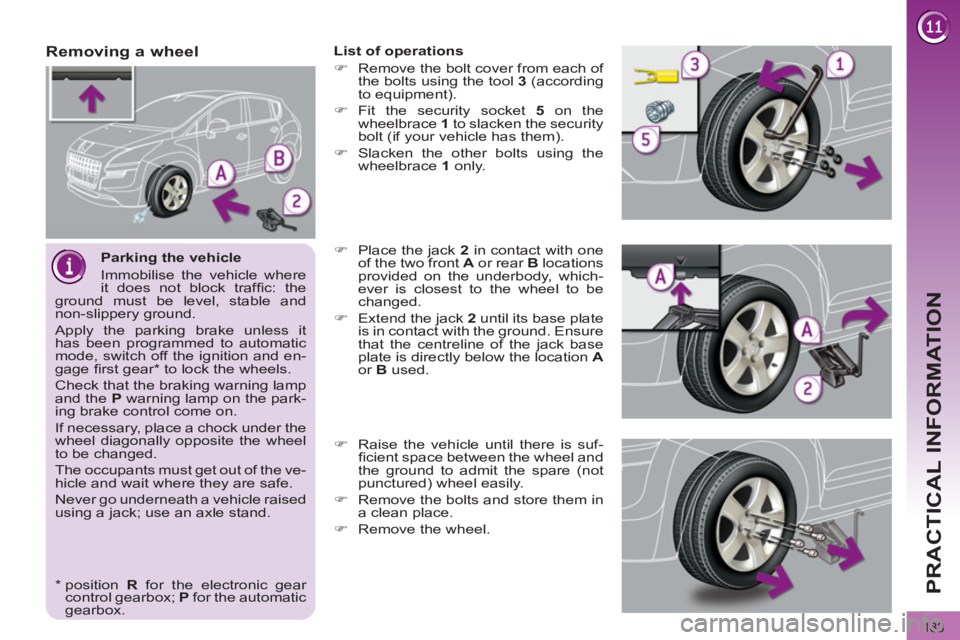
List of operations
)
Remove the bolt cover from each of
the bolts using the tool 3
(according
to equipment).
)
Fit the security socket 5
on the
wheelbrace 1
to slacken the security
bolt (if your vehicle has them).
)
Slacken the other bolts using the
wheelbrace 1
only.
)
Place the jack 2
in contact with one
of the two front A
or rear B
locations
provided on the underbody, which-
ever is closest to the wheel to be
changed.
)
Extend the jack 2
until its base plate
is in contact with the ground. Ensure
that the centreline of the jack base
plate is directly below the location A
or B
used.
)
Raise the vehicle until there is suf-
fi cient space between the wheel and
the ground to admit the spare (not
punctured) wheel easily.
)
Remove the bolts and store them in
a clean place.
)
Remove the wheel.
*
position R
for the electronic gear
control gearbox; P
for the automatic
gearbox.
Page 195 of 328
193
PRACTICAL INFORMATION
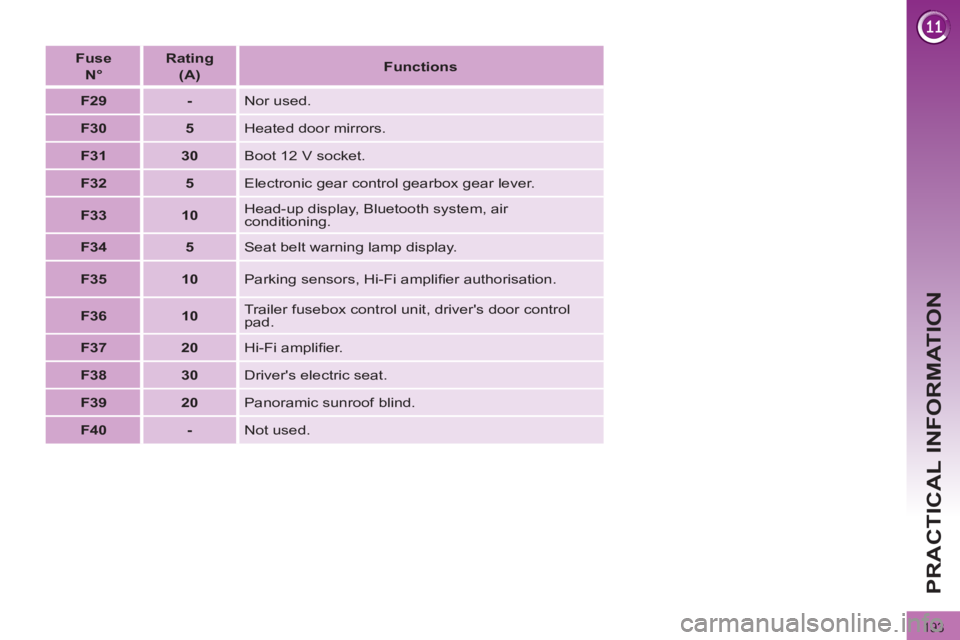
Fuse
N°
Rating
(A)
Functions
F29
-
Nor used.
F30
5
Heated door mirrors.
F31
30
Boot 12 V socket.
F32
5
Electronic gear control gearbox gear lever.
F33
10
Head-up display, Bluetooth system, air
conditioning.
F34
5
Seat belt warning lamp display.
F35
10
Parking sensors, Hi-Fi amplifi er authorisation.
F36
10
Trailer fusebox control unit, driver's door control
pad.
F37
20
Hi-Fi amplifi er.
F38
30
Driver's electric seat.
F39
20
Panoramic sunroof blind.
F40
-
Not used.
Page 196 of 328
194
PRACTICAL INFORMATION
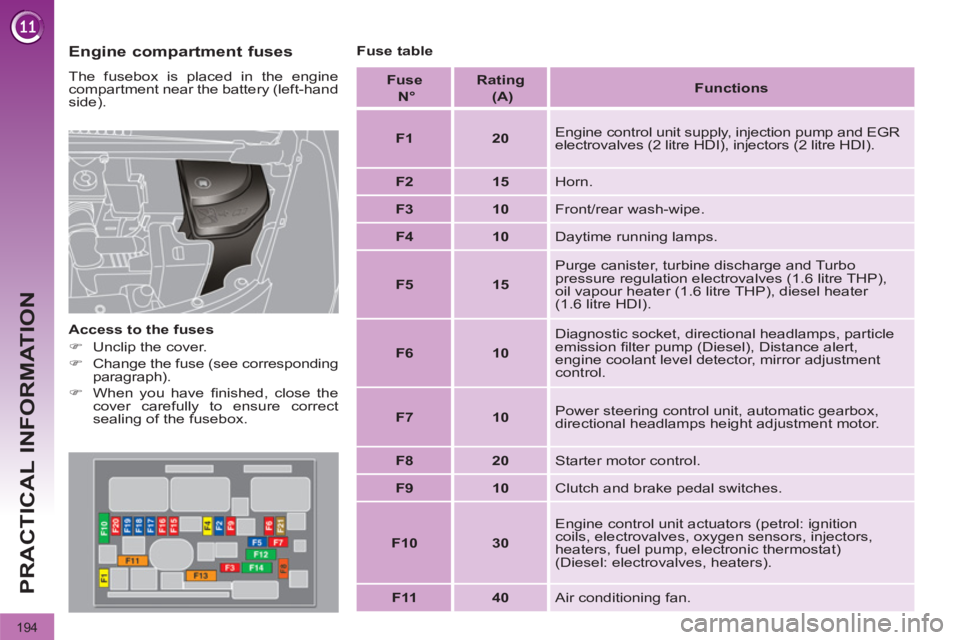
Engine compartment fuses
The fusebox is placed in the engine
compartment near the battery (left-hand
side).
Access to the fuses
)
Unclip the cover.
)
Change the fuse (see corresponding
paragraph).
)
When you have fi nished, close the
cover carefully to ensure correct
sealing of the fusebox.
Fuse table
Fuse
N°
Rating
(A)
Functions
F1
20
Engine control unit supply, injection pump and EGR
electrovalves (2 litre HDI), injectors (2 litre HDI).
F2
15
Horn.
F3
10
Front/rear wash-wipe.
F4
10
Daytime running lamps.
F5
15
Purge canister, turbine discharge and Turbo
pressure regulation electrovalves (1.6 litre THP),
oil vapour heater (1.6 litre THP), diesel heater
(1.6 litre HDI).
F6
10
Diagnostic socket, directional headlamps, particle
emission fi lter pump (Diesel), Distance alert,
engine coolant level detector, mirror adjustment
control.
F7
10
Power steering control unit, automatic gearbox,
directional headlamps height adjustment motor.
F8
20
Starter motor control.
F9
10
Clutch and brake pedal switches.
F10
30
Engine control unit actuators (petrol: ignition
coils, electrovalves, oxygen sensors, injectors,
heaters, fuel pump, electronic thermostat)
(Diesel: electrovalves, heaters).
F11
40
Air conditioning fan.
Page 198 of 328
196
PRACTICAL INFORMATION
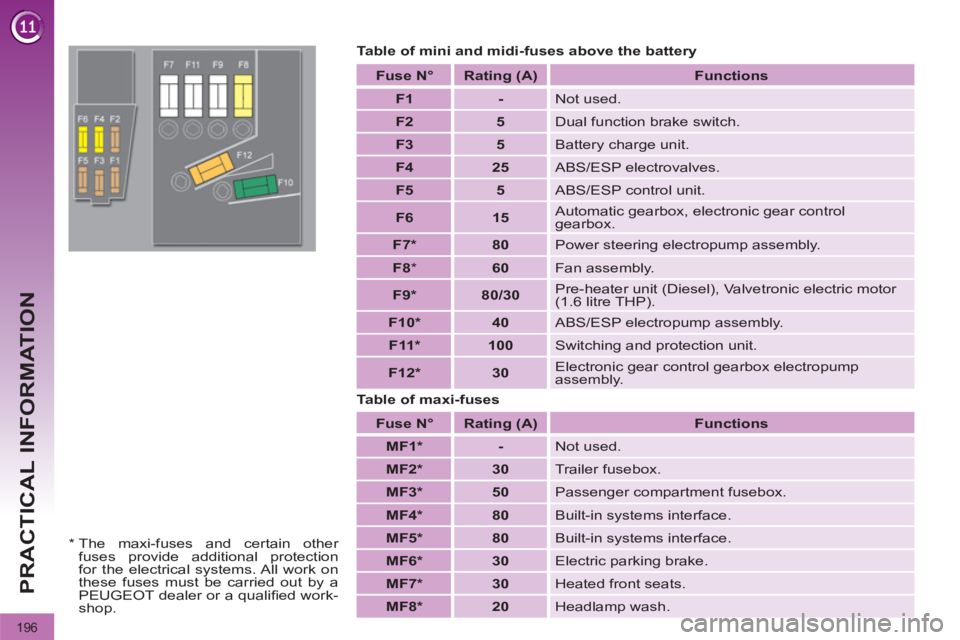
Table of mini and midi-fuses above the battery
Table of maxi-fuses
Fuse
N°
Rating
(A)
Functions
F1
-
Not used.
F2
5
Dual function brake switch.
F3
5
Battery charge unit.
F4
25
ABS/ESP electrovalves.
F5
5
ABS/ESP control unit.
F6
15
Automatic gearbox, electronic gear control
gearbox.
F7 *
80
Power steering electropump assembly.
F8
*
60
Fan assembly.
F9 *
80/30
Pre-heater unit (Diesel), Valvetronic electric motor
(1.6 litre THP).
F10 *
40
ABS/ESP electropump assembly.
F11 *
100
Switching and protection unit.
F12 *
30
Electronic gear control gearbox electropump
assembly.
Fuse
N°
Rating (A)
Functions
MF1 *
-
Not used.
MF2 *
30
Trailer fusebox.
MF3 *
50
Passenger compartment fusebox.
MF4 *
80
Built-in systems interface.
MF5 *
80
Built-in systems interface.
MF6 *
30
Electric parking brake.
MF7 *
30
Heated front seats.
MF8 *
20
Headlamp wash.
*
The maxi-fuses and certain other
fuses provide additional protection
for the electrical systems. All work on
these fuses must be carried out by a
PEUGEOT dealer or a qualifi ed work-
shop.
Page 200 of 328
198
PRACTICAL INFORMATION
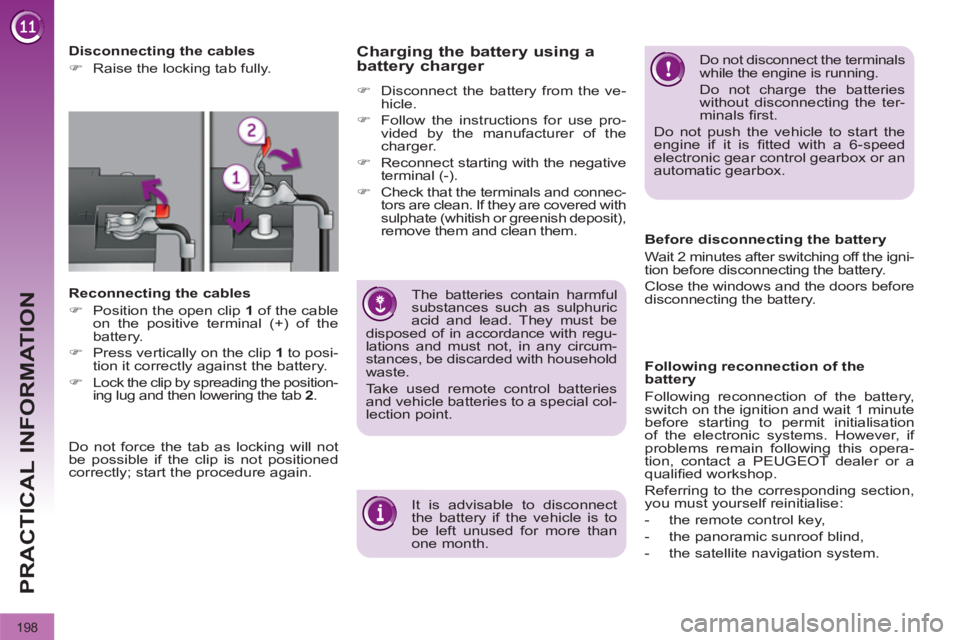
Disconnecting the cables
)
Raise the locking tab fully.
Reconnecting the cables
)
Position the open clip 1
of the cable
on the positive terminal (+) of the
battery.
)
Press vertically on the clip 1
to posi-
tion it correctly against the battery.
)
Lock the clip by spreading the position-
ing lug and then lowering the tab 2
.
Do not disconnect the terminals
while the engine is running.
Do not charge the batteries
without disconnecting the ter-
minals fi rst.
Do not push the vehicle to start the
engine if it is fi tted with a 6-speed
electronic gear control gearbox or an
automatic gearbox.
The batteries contain harmful
substances such as sulphuric
acid and lead. They must be
disposed of in accordance with regu-
lations and must not, in any circum-
stances, be discarded with household
waste.
Take used remote control batteries
and vehicle batteries to a special col-
lection point.
Charging the battery using a
battery charger
)
Disconnect the battery from the ve-
hicle.
)
Follow the instructions for use pro-
vided by the manufacturer of the
charger.
)
Reconnect starting with the negative
terminal (-).
)
Check that the terminals and connec-
tors are clean. If they are covered with
sulphate (whitish or greenish deposit),
remove them and clean them.
It is advisable to disconnect
the battery if the vehicle is to
be left unused for more than
one month.
Before disconnecting the battery
Wait 2 minutes after switching off the igni-
tion before disconnecting the battery.
Close the windows and the doors before
disconnecting the battery.
Following reconnection of the
battery
Following reconnection of the battery,
switch on the ignition and wait 1 minute
before starting to permit initialisation
of the electronic systems. However, if
problems remain following this opera-
tion, contact a PEUGEOT dealer or a
qualifi ed workshop.
Referring to the corresponding section,
you must yourself reinitialise:
- the remote control key,
- the panoramic sunroof blind,
- the satellite navigation system.
Do not force the tab as locking will not
be possible if the clip is not positioned
correctly; start the procedure again.
Page 202 of 328
200
PRACTICAL INFORMATION
CHANGING A WIPER BLADE
Removing
)
Raise the corresponding wiper arm.
)
Unclip the wiper blade and remove it.
Fitting
)
Put the corresponding new wiper
blade in place and clip it.
)
Fold down the wiper arm carefully.
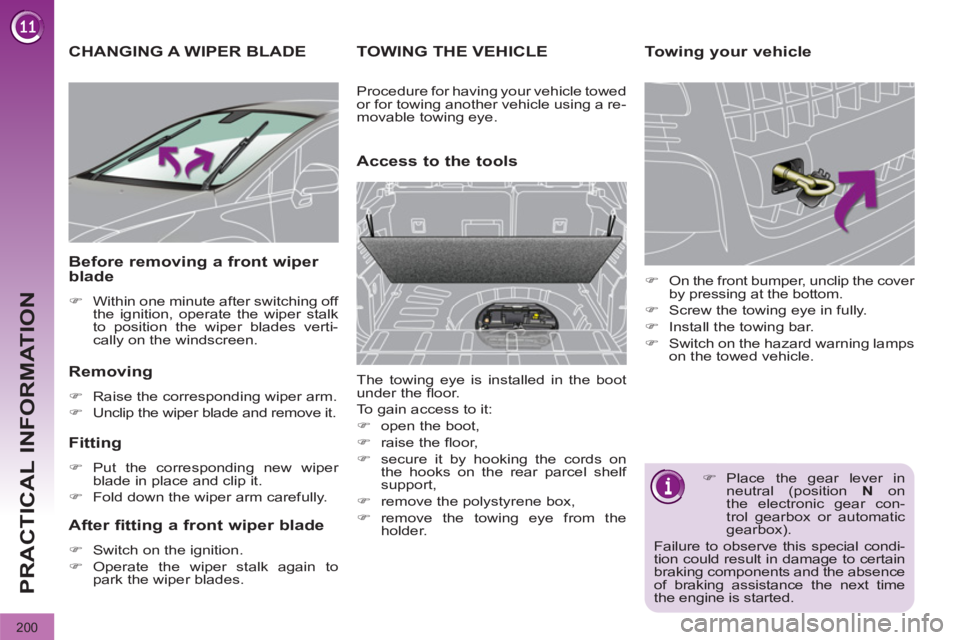
Before removing a front wiper
blade
)
Within one minute after switching off
the ignition, operate the wiper stalk
to position the wiper blades verti-
cally on the windscreen.
After fitting a front wiper blade
)
Switch on the ignition.
)
Operate the wiper stalk again to
park the wiper blades.
TOWING THE VEHICLE
Access to the tools
Towing your vehicle
)
On the front bumper, unclip the cover
by pressing at the bottom.
)
Screw the towing eye in fully.
)
Install the towing bar.
)
Switch on the hazard warning lamps
on the towed vehicle.
The towing eye is installed in the boot
under the fl oor.
To gain access to it:
)
open the boot,
)
raise the fl oor,
)
secure it by hooking the cords on
the hooks on the rear parcel shelf
support,
)
remove the polystyrene box,
)
remove the towing eye from the
holder.
)
Place the gear lever in
neutral (position N
on
the electronic gear con-
trol gearbox or automatic
gearbox).
Failure to observe this special condi-
tion could result in damage to certain
braking components and the absence
of braking assistance the next time
the engine is started.
Procedure for having your vehicle towed
or for towing another vehicle using a re-
movable towing eye.
Page 203 of 328
201
PRACTICAL INFORMATION
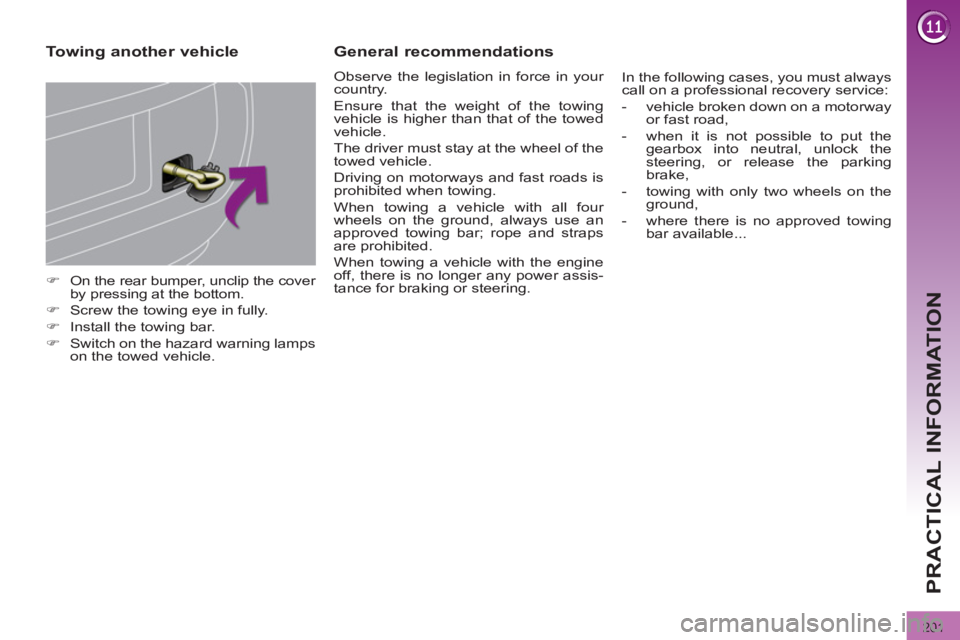
)
On the rear bumper, unclip the cover
by pressing at the bottom.
)
Screw the towing eye in fully.
)
Install the towing bar.
)
Switch on the hazard warning lamps
on the towed vehicle.
Towing another vehicle
General recommendations
Observe the legislation in force in your
country.
Ensure that the weight of the towing
vehicle is higher than that of the towed
vehicle.
The driver must stay at the wheel of the
towed vehicle.
Driving on motorways and fast roads is
prohibited when towing.
When towing a vehicle with all four
wheels on the ground, always use an
approved towing bar; rope and straps
are prohibited.
When towing a vehicle with the engine
off, there is no longer any power assis-
tance for braking or steering. In the following cases, you must always
call on a professional recovery service:
- vehicle broken down on a motorway
or fast road,
- when it is not possible to put the
gearbox into neutral, unlock the
steering, or release the parking
brake,
- towing with only two wheels on the
ground,
- where there is no approved towing
bar available...