towing Peugeot 308 2014 User Guide
[x] Cancel search | Manufacturer: PEUGEOT, Model Year: 2014, Model line: 308, Model: Peugeot 308 2014Pages: 400, PDF Size: 10.05 MB
Page 120 of 400
118
Driving
308_EN_CHAP04_CONDUITE_ED02-2013
Emergency braking
In the event of a failure of the main service brake or in an exceptional situation (e.g. driver taken ill, under instruction, etc) a continuous pull on the control lever will brake the vehicle. Braking takes place while the control lever is being pulled. It is interrupted if the control lever is released. The ABS and DSC systems provide stability of the vehicle during emergency braking. If the emergency braking malfunctions, the message "Parking brake control faulty" will be displayed.
The emergency braking should only be used in an exceptional situation.
Repeat this procedure to reactivate automatic operation. Reactivation of automatic operation is confirmed by the indicator lamp in the instrument panel going off.
Deactivating automatic operation
In some situations, such as very cold weather or towing (caravan, recovery), it may be necessary to deactivate automatic operation of the system. Start the engine. Apply the parking brake with the control
lever, if it is released. Take your foot off the brake pedal. Push and hold the control lever in the release direction for at least 10 seconds and no more than 15 seconds. Release the control lever. Press and hold the brake pedal. Pull the control lever in the apply direction for 2 seconds.
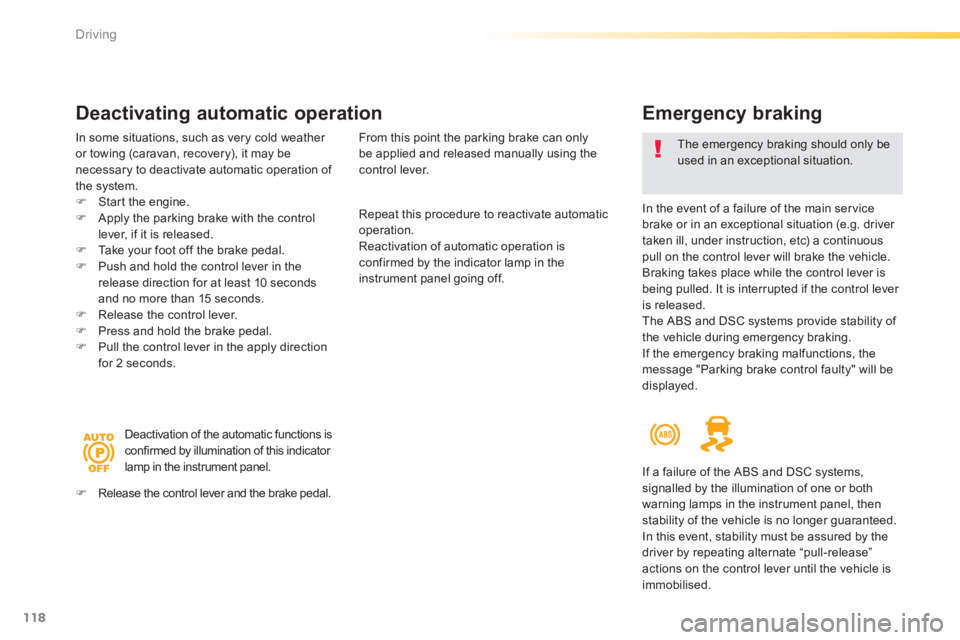
Deactivation of the automatic functions is confirmed by illumination of this indicator lamp in the instrument panel.
Release the control lever and the brake pedal.
From this point the parking brake can only be applied and released manually using the control lever.
If a failure of the ABS and DSC systems, signalled by the illumination of one or both warning lamps in the instrument panel, then stability of the vehicle is no longer guaranteed. In this event, stability must be assured by the driver by repeating alternate “pull-release” actions on the control lever until the vehicle is
immobilised.
Page 140 of 400
138
Driving
308_EN_CHAP04_CONDUITE_ED02-2013
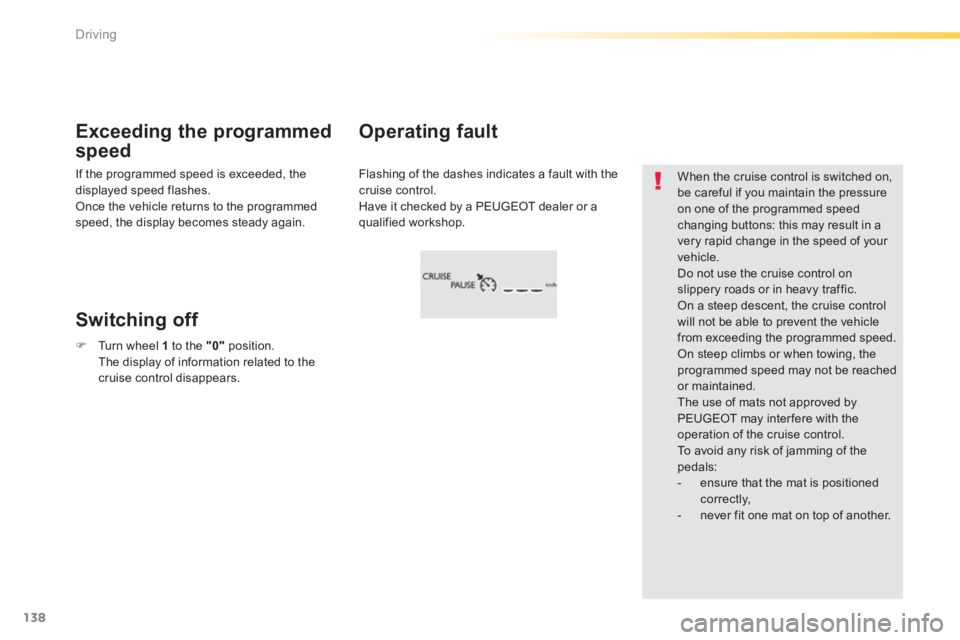
Flashing of the dashes indicates a fault with the cruise control. Have it checked by a PEUGEOT dealer or a qualified workshop.
Operating fault Exceeding the programmed
speed
Switching off
When the cruise control is switched on, be careful if you maintain the pressure on one of the programmed speed
changing buttons: this may result in a very rapid change in the speed of your vehicle. Do not use the cruise control on slippery roads or in heavy traffic. On a steep descent, the cruise control will not be able to prevent the vehicle from exceeding the programmed speed. On steep climbs or when towing, the programmed speed may not be reached or maintained. The use of mats not approved by PEUGEOT may inter fere with the operation of the cruise control. To avoid any risk of jamming of the pedals: - ensure that the mat is positioned c o r r e c t l y, - never fit one mat on top of another.
If the programmed speed is exceeded, the displayed speed flashes. Once the vehicle returns to the programmed speed, the display becomes steady again.
Turn wheel 1 to the "0" position. The display of information related to the cruise control disappears.
Page 148 of 400
146
Driving
308_EN_CHAP04_CONDUITE_ED02-2013
In the event of a fault with the active cruise control, you are alerted by an audible signal and display of the message message "Driving aid functions fault". Have the system checked by a PEUGEOT dealer or a qualified workshop.
When the cruise control is working, take care if making a maintained press on one of the cruise control programmed speed modification buttons: this can lead to a very quick change in the speed of your vehicle. Do not use the active cruise control on slippery sur faces or in heavy traffic. When descending a steep hill, the cruise control may not be able to prevent the vehicle from exceeding the programmed speed. When ascending a steep hill or when towing, it might not be possible to attain or maintain the programmed speed.
Operating fault
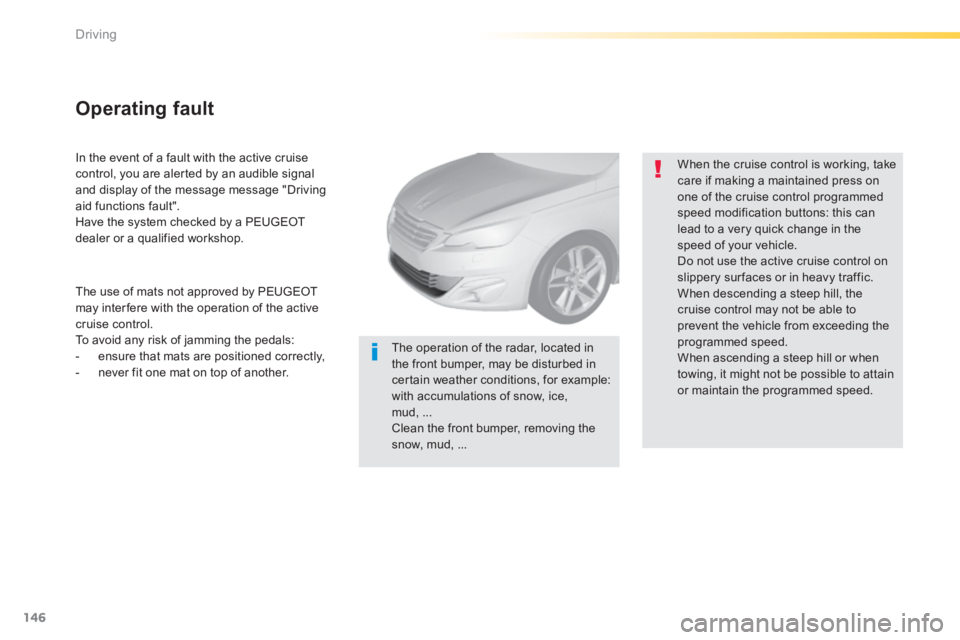
The operation of the radar, located in the front bumper, may be disturbed in certain weather conditions, for example: with accumulations of snow, ice, mud, ... Clean the front bumper, removing the snow, mud, ...
The use of mats not approved by PEUGEOT may inter fere with the operation of the active cruise control. To avoid any risk of jamming the pedals: - ensure that mats are positioned correctly, - never fit one mat on top of another.
Page 160 of 400
158
Driving
308_EN_CHAP04_CONDUITE_ED02-2013
To deactivate the system, press this button again; its indicator lamp goes off as well as the associated indicator in the instrument panel.
In the event of a fault, the warning lamp flashes then goes off.
Operating fault
Have it checked by a PEUGEOT dealer or a qualified workshop.
The system is automatically deactivated when towing with a towbar approved by P E U G E O T.
The system may suffer temporary interference in certain weather conditions (rain, hail...). In particular, driving on a wet sur face or moving from a dry area to a wet area can cause false alerts (for example, the presence of a fog of water droplets in the blind spot angle is interpreted as a vehicle). In bad or wintry weather, ensure that the sensors are not covered by mud, ice or snow. Take care not to cover the warning zone in the door mirrors or the detection zones on the front and rear bumpers with adhesive labels or other objects; they may hamper the correct operation of the system.
The state of the system remains in memory on switching off the ignition.
High pressure jet wash When washing your vehicle, direct the lance at least 30 cm away from the sensors.
Page 171 of 400
169
4
Driving
308_EN_CHAP04_CONDUITE_ED02-2013
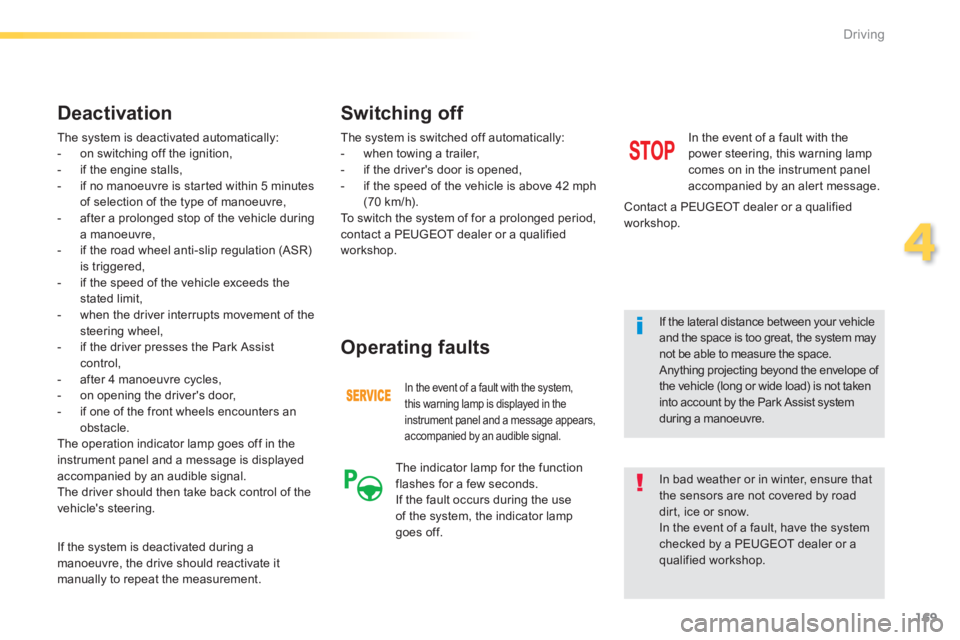
The system is deactivated automatically: - on switching off the ignition, - if the engine stalls, - if no manoeuvre is started within 5 minutes of selection of the type of manoeuvre, - after a prolonged stop of the vehicle during a manoeuvre, - if the road wheel anti-slip regulation (ASR) is triggered, - if the speed of the vehicle exceeds the stated limit, - when the driver interrupts movement of the steering wheel, - if the driver presses the Park Assist control, - after 4 manoeuvre cycles, - on opening the driver's door, - if one of the front wheels encounters an obstacle.
The operation indicator lamp goes off in the instrument panel and a message is displayed accompanied by an audible signal. The driver should then take back control of the vehicle's steering.
Deactivation
If the system is deactivated during a manoeuvre, the drive should reactivate it manually to repeat the measurement.
The system is switched off automatically: - when towing a trailer, - if the driver's door is opened, - if the speed of the vehicle is above 42 mph (70 km/h). To switch the system of for a prolonged period, contact a PEUGEOT dealer or a qualified workshop.
In the event of a fault with the system, this warning lamp is displayed in the instrument panel and a message appears, accompanied by an audible signal.
Operating faults
In the event of a fault with the power steering, this warning lamp comes on in the instrument panel accompanied by an alert message.
Contact a PEUGEOT dealer or a qualified workshop.
Switching off
If the lateral distance between your vehicle and the space is too great, the system may not be able to measure the space. Anything projecting beyond the envelope of the vehicle (long or wide load) is not taken into account by the Park Assist system during a manoeuvre.
In bad weather or in winter, ensure that the sensors are not covered by road dirt, ice or snow. In the event of a fault, have the system checked by a PEUGEOT dealer or a qualified workshop.
The indicator lamp for the function flashes for a few seconds. If the fault occurs during the use of the system, the indicator lamp goes off.
Page 189 of 400
187
6
Safety
308_EN_CHAP06_SECURITE_ED02-2013
Automatic operation of
hazard warning lamps
Direction indicators
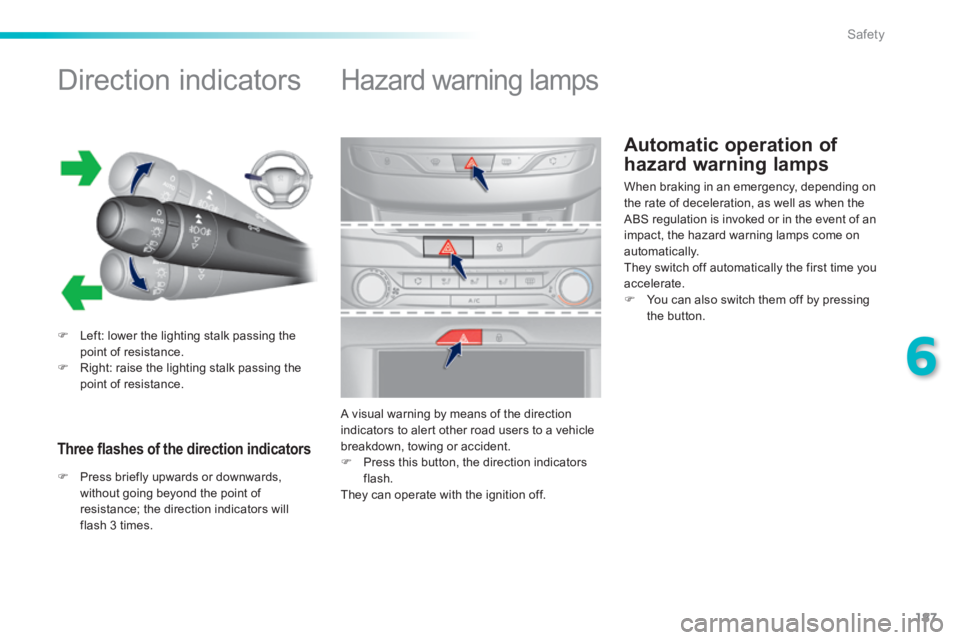
Left: lower the lighting stalk passing the point of resistance. Right: raise the lighting stalk passing the point of resistance.
Three fl ashes of the direction indicators
Hazard warning lamps
A visual warning by means of the direction indicators to alert other road users to a vehicle breakdown, towing or accident. Press this button, the direction indicators flash. They can operate with the ignition off.
Press briefly upwards or downwards, without going beyond the point of resistance; the direction indicators will flash 3 times.
When braking in an emergency, depending on the rate of deceleration, as well as when the ABS regulation is invoked or in the event of an impact, the hazard warning lamps come on automatically. They switch off automatically the first time you accelerate. You can also switch them off by pressing the button.
Page 223 of 400
221
7
Practical information
308_EN_CHAP07_INFO PR ATIQUES_ED02-2013
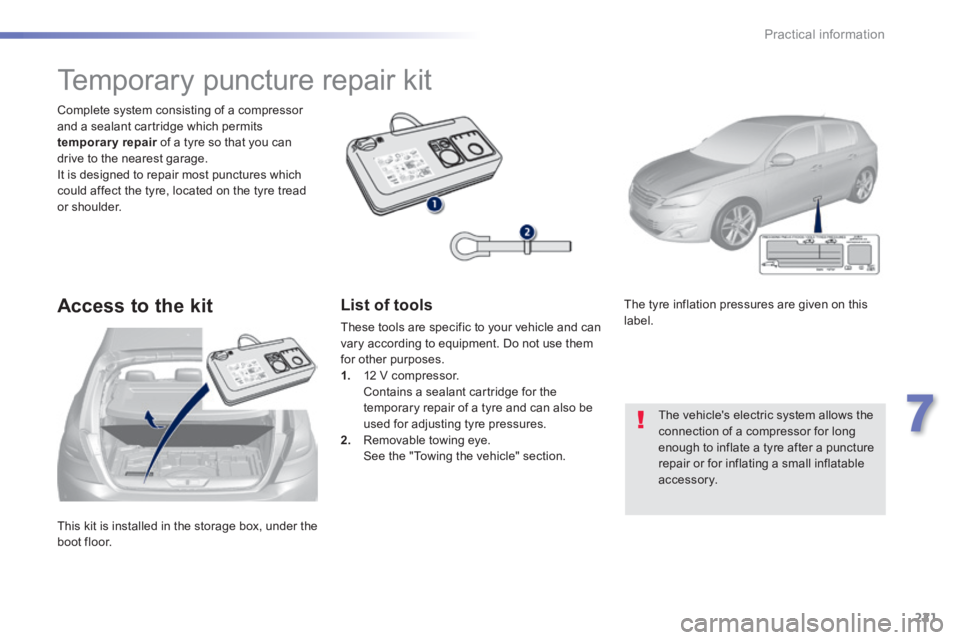
This kit is installed in the storage box, under the boot floor.
Complete system consisting of a compressor and a sealant cartridge which permits temporary repair of a tyre so that you can temporary repair of a tyre so that you can temporary repairdrive to the nearest garage. It is designed to repair most punctures which could affect the tyre, located on the tyre tread or shoulder.
Temporary puncture repair kit
Access to the kit List of tools
These tools are specific to your vehicle and can vary according to equipment. Do not use them for other purposes. 1. 12 V compressor. Contains a sealant cartridge for the temporary repair of a tyre and can also be used for adjusting tyre pressures. 2. Removable towing eye. See the "Towing the vehicle" section.
The tyre inflation pressures are given on this label.
The vehicle's electric system allows the connection of a compressor for long enough to inflate a tyre after a puncture repair or for inflating a small inflatable accessory.
Page 229 of 400
227
7
Practical information
308_EN_CHAP07_INFO PR ATIQUES_ED02-2013
Changing a wheel
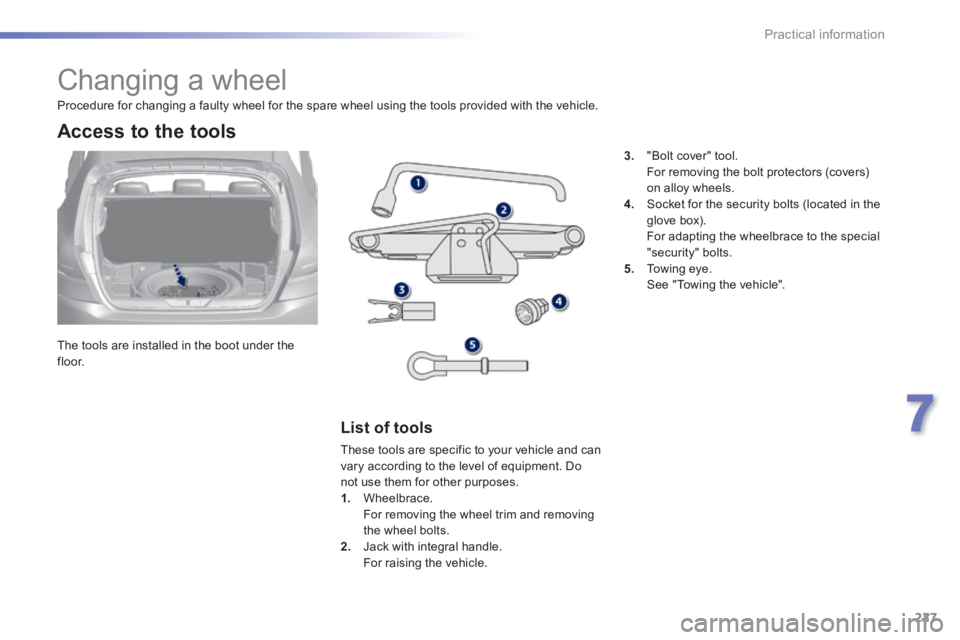
The tools are installed in the boot under the f l o o r.
Access to the tools
List of tools
These tools are specific to your vehicle and can vary according to the level of equipment. Do not use them for other purposes. 1. Wheelbrace. For removing the wheel trim and removing the wheel bolts. 2. Jack with integral handle. For raising the vehicle.
3. "Bolt cover" tool. For removing the bolt protectors (covers) on alloy wheels. 4. Socket for the security bolts (located in the glove box). For adapting the wheelbrace to the special "security" bolts. 5. Towing eye. See "Towing the vehicle".
Procedure for changing a faulty wheel for the spare wheel using the tools provided with the vehicle.
Page 259 of 400
257
7
Practical information
308_EN_CHAP07_INFO PR ATIQUES_ED02-2013
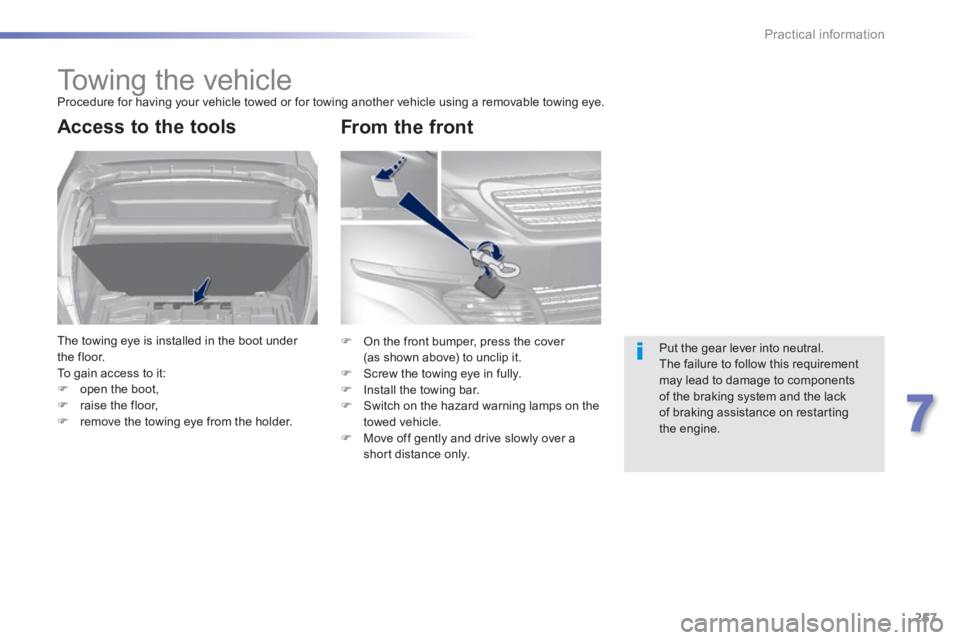
Towing the vehicle Procedure for having your vehicle towed or for towing another vehicle using a removable towing eye.
Access to the tools
The towing eye is installed in the boot under the floor. To gain access to it: open the boot, raise the floor, remove the towing eye from the holder.
Put the gear lever into neutral. The failure to follow this requirement may lead to damage to components of the braking system and the lack of braking assistance on restarting the engine.
On the front bumper, press the cover (as shown above) to unclip it. Screw the towing eye in fully. Install the towing bar. Switch on the hazard warning lamps on the towed vehicle. Move off gently and drive slowly over a short distance only.
From the front
Page 260 of 400
258
Practical information
308_EN_CHAP07_INFO PR ATIQUES_ED02-2013
General recommendations
Observe the legislation in force in your country. Ensure that the weight of the towing vehicle is higher than that of the towed vehicle. The driver must remain at the wheel of the towed vehicle and must have a valid driving licence. When towing a vehicle with all four wheels on the ground, always use an approved towing bar; rope and straps are prohibited. The towing vehicle must move off gently. When towing a vehicle with the engine off, there is no longer any power assistance for braking or steering. In the following cases, you must always call on a professional recovery service: - vehicle broken down on a motor way or fast road, - four-wheel drive vehicle, - when it is not possible to put the gearbox into neutral, unlock the steering, or release the parking brake, - towing with only two wheels on the ground, - where there is no approved towing bar available...
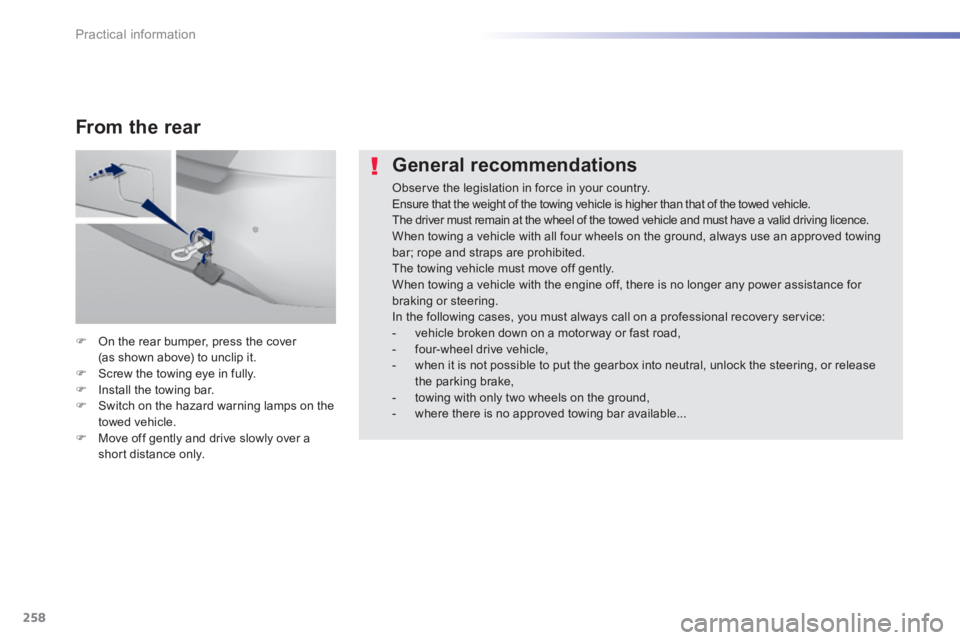
On the rear bumper, press the cover (as shown above) to unclip it. Screw the towing eye in fully. Install the towing bar. Switch on the hazard warning lamps on the towed vehicle. Move off gently and drive slowly over a short distance only.
From the rear