weight Peugeot 308 2015 Owner's Manual
[x] Cancel search | Manufacturer: PEUGEOT, Model Year: 2015, Model line: 308, Model: Peugeot 308 2015Pages: 416, PDF Size: 11.81 MB
Page 5 of 416
.
308_en_Chap00a_sommaire_ed01-2015
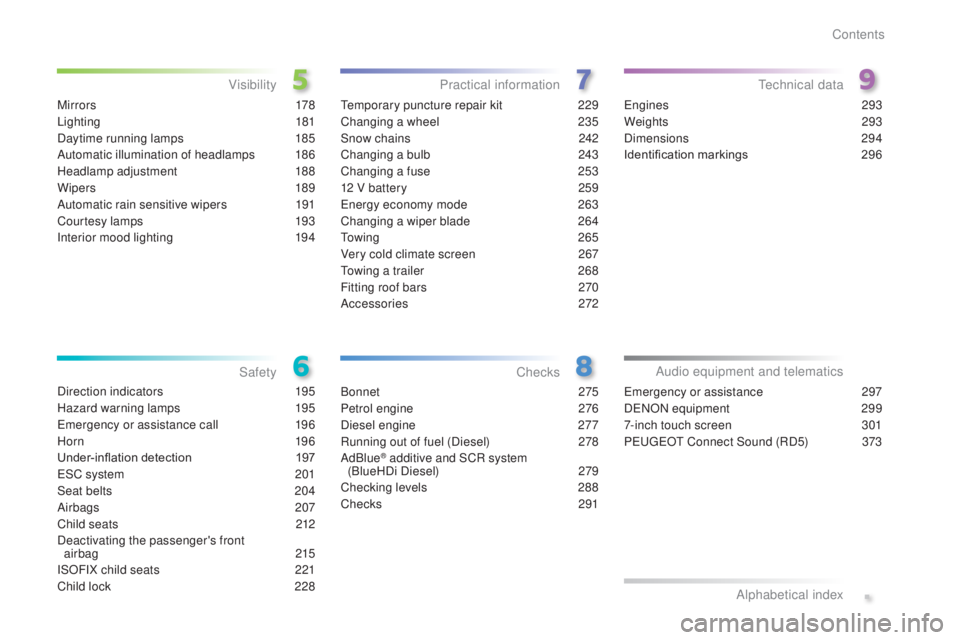
M i r r o r s 178
Lighting
181
Daytime running lamps
1
85
Automatic illumination of headlamps
1
86
Headlamp adjustment
1
88
Wipers
189
Automatic rain sensitive wipers
1
91
Courtesy lamps
1
93
Interior mood lighting
1
94te mporary puncture repair kit 2 29
Changing a wheel
2
35
Snow chains
2
42
Changing a bulb
2
43
Changing a fuse
2
53
12 V battery
2
59
en
ergy economy mode
26
3
Changing a wiper blade
2
64
to
w i n g
2 6 5
Very cold climate screen
2
67
to
wing a trailer
2
68
Fitting roof bars
2
70
Accessories
272
Bonnet
275
Petrol engine
2
76
Diesel engine
2
77
Running out of fuel (Diesel)
2
78
AdBlue
® additive and SCR system
(BlueHDi Diesel) 2 79
Checking levels
2
88
Checks
2
91
en
gines
293
Weights
2
93
Dimensions
2
94
Identification markings
2
96
Direction indicators
1
95
Hazard warning lamps
1
95
em
ergency or assistance call
1
96
Horn
19
6
Under-inflation detection 1
97
e
SC system
2
01
Seat belts
20
4
Airbags
207
Child seats
2
12
Deactivating the passenger's front airbag
215
ISOFIX child seats
2
21
Child lock
2
28
Visibility
Safety Practical information
Checkste chnical data
emergency or assistance 297
D
eN
ON equipment
2
99
7-inch touch screen
3
01
Peuge
O
t Connect Sound (RD5)
3
73
Audio equipment and telematics
Alphabetical index
Contents
Page 11 of 416
9
308_en_Chap00b_aide-visuelle_ed01-2015
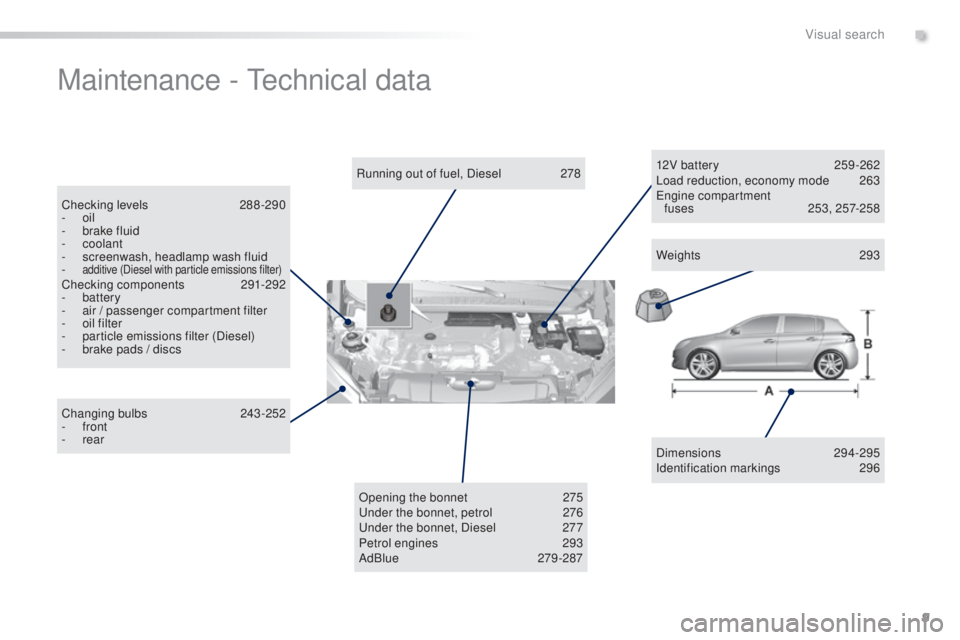
Maintenance - technical data
Dimensions 294-295
Identification markings 2 96
Running out of fuel, Diesel
2
78
Checking levels
2
88 -290
-
oil
-
b
rake fluid
-
coolant
-
s
creenwash, headlamp wash fluid
-
additive (Diesel with particle emissions filter)Checking components 2
91-292
- battery
-
a
ir / passenger compartment filter
-
o
il filter
-
p
article emissions filter (Diesel)
-
b
rake pads / discs
Changing bulbs
2
43-252
-
front
-
rear 12V battery
2
59 -262
Load reduction, economy mode
26
3
en
gine compartment
fuses
25
3, 257-258
Opening the bonnet
2
75
un
der the bonnet, petrol
2
76
un
der the bonnet, Diesel
2
77
Petrol engines
2
93
AdBlue
279 -287Weights
293
.
Visual search
Page 32 of 416
30
308_en_Chap01_controle-de-marche_ed01-2015
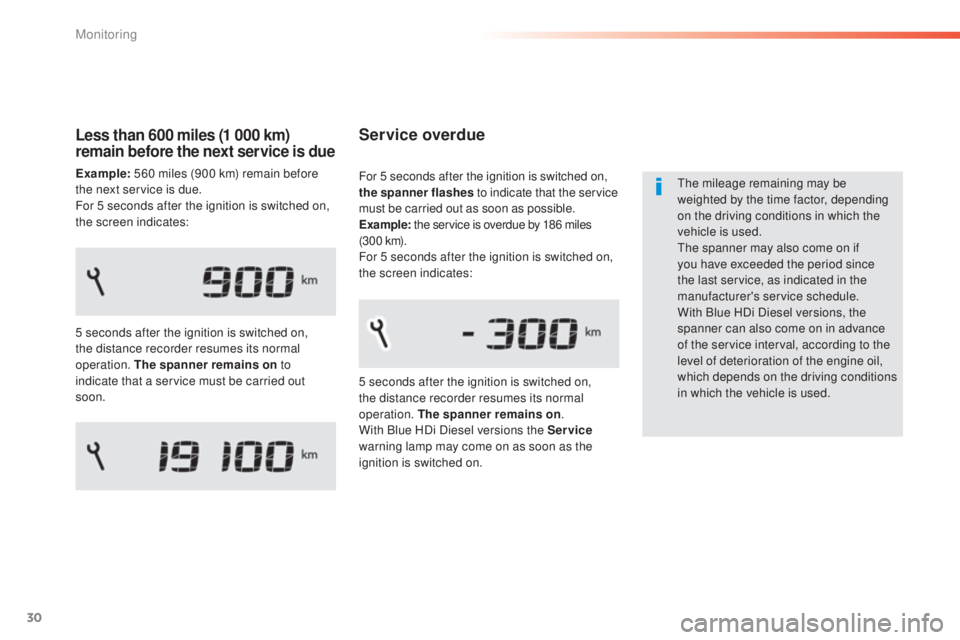
Service overdue
the mileage remaining may be
weighted by the time factor, depending
on the driving conditions in which the
vehicle is used.
th
e spanner may also come on if
you have exceeded the period since
the last service, as indicated in the
manufacturer's service schedule.
With Blue HDi Diesel versions, the
spanner can also come on in advance
of the service interval, according to the
level of deterioration of the engine oil,
which depends on the driving conditions
in which the vehicle is used.
5 seconds after the ignition is switched on,
the distance recorder resumes its normal
operation. The spanner remains on
.
With Blue HDi Diesel versions the Service
warning lamp may come on as soon as the
ignition is switched on. For 5 seconds after the ignition is switched on,
the spanner flashes to indicate that the service
must be carried out as soon as possible.
Example: the service is overdue by 186 miles
(3 0 0 k m).
For 5 seconds after the ignition is switched on,
the screen indicates:
Less than 600 miles (1 000 km)
remain before the next service is due
Example: 560 miles (900 km) remain before
the next service is due.
For 5 seconds after the ignition is switched on,
the screen indicates:
5 seconds after the ignition is switched on,
the distance recorder resumes its normal
operation. The spanner remains on to
indicate that a service must be carried out
soon.
Monitoring
Page 214 of 416
212
308_en_Chap06_securite_ed01-2015
general points relating to child seats
For maximum safety, please observe the
following recommendations:
-
i
n accordance with e
u
ropean regulations,
all children under the age of 12 or less
than one and a half metres tall must
travel in approved child seats suited to
their weight , on seats fitted with a seat
belt or ISOFIX mountings*,
-
s
tatistically, the safest seats in your
vehicle for carr ying children are the
rear seats,
-
a c
hild weighing less than 9 kg must
travel in the rear ward facing position
both in the front and in the rear. PEUGEOT recommends
that children
should travel on the rear seats of your
vehicle:
-
r
earward facing up to the age of 3,
-
fo
rward facing over the age of 3.
Although one of P
e
uge
Ot
main criteria when designing your vehicle, the safety of your children
also depends on you.
* t
h
e regulations on carrying children are
specific to each country. Refer to the
legislation in force in your country.
Safety
Page 221 of 416
219
308_en_Chap06_securite_ed01-2015
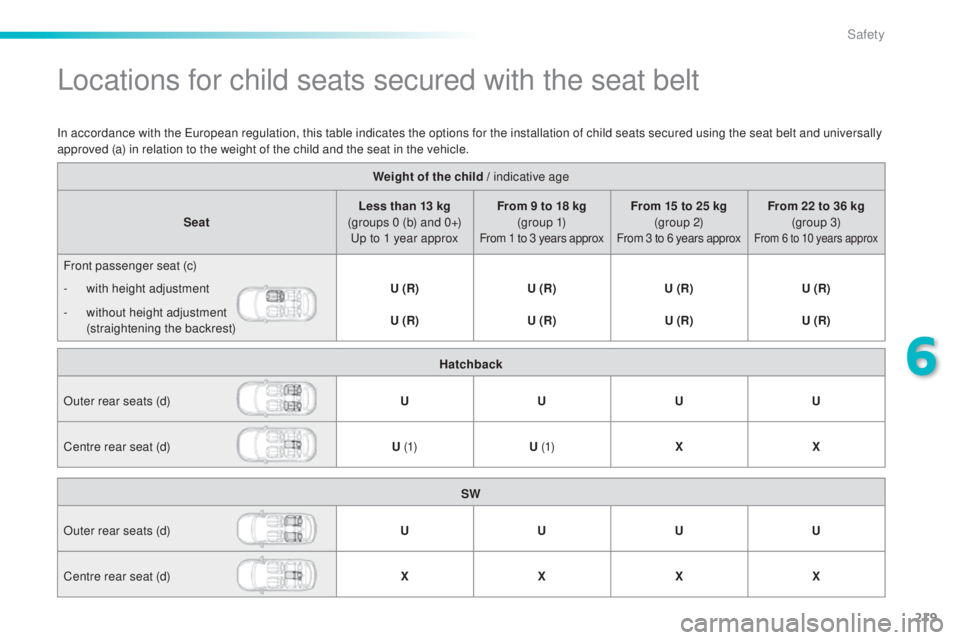
Locations for child seats secured with the seat belt
Weight of the child / indicative age
Seat Less than 13 kg
(groups 0 (b) and 0+)
up t
o 1 year approx From 9 to 18 kg
(g r o u p 1)
From 1 to 3 years approx
From 15 to 25 kg (group 2)
From 3 to 6 years approx
From 22 to 36 kg (group 3)
From 6 to 10 years approx
Front passenger seat (c)
-
w
ith height adjustment U (R)U (R)U (R)U (R)
-
w
ithout height adjustment
(straightening the backrest) U (R)
U (R)U (R)U (R)
In accordance with the
e
u
ropean regulation, this table indicates the options for the installation of child seats secured using the seat belt and universally
approved (a) in relation to the weight of the child and the seat in the vehicle.
Hatchback
Outer rear seats (d) UUUU
Centre rear seat (d) U (1)U (1) XX
SW
Outer rear seats (d) UUUU
Centre rear seat (d) XXXX
6
Safety
Page 222 of 416
220
308_en_Chap06_securite_ed01-2015
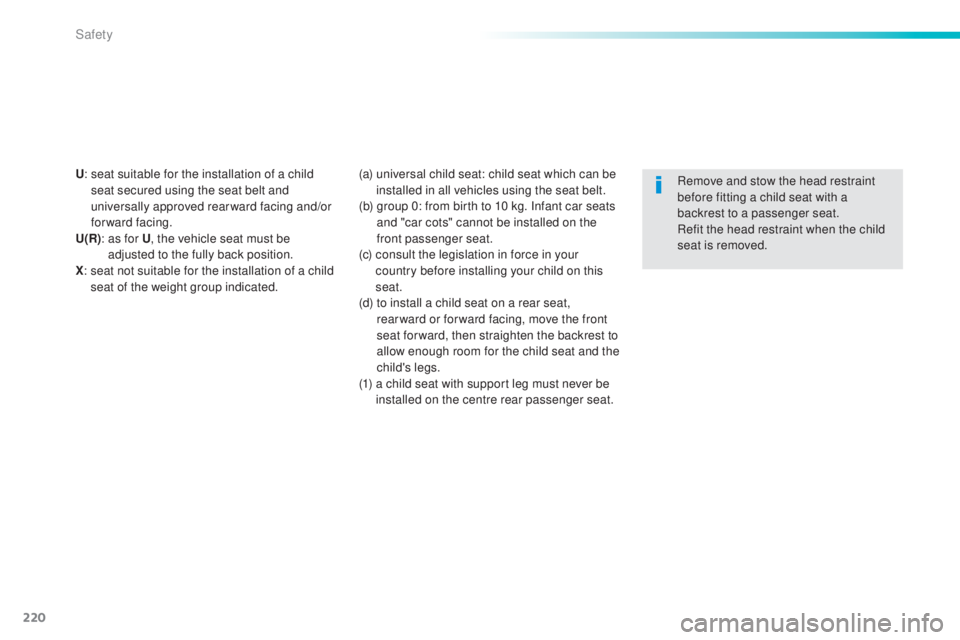
U: seat suitable for the installation of a child
seat secured using the seat belt and
universally approved rear ward facing and/or
forward facing.
U(R) :
a
s for U, the vehicle seat must be
adjusted to the fully back position.
X :
s
eat not suitable for the installation of a child
seat of the weight group indicated. Remove and stow the head restraint
before fitting a child seat with a
backrest to a passenger seat.
Refit the head restraint when the child
seat is removed.
(a)
u niversal child seat: child seat which can be
installed in all vehicles using the seat belt.
(b)
g
roup 0: from birth to 10 kg. Infant car seats
and "car cots" cannot be installed on the
front passenger seat.
(c)
c
onsult the legislation in force in your
country before installing your child on this
seat.
(d)
t
o install a child seat on a rear seat,
rear ward or for ward facing, move the front
seat for ward, then straighten the backrest to
allow enough room for the child seat and the
child's legs.
(1)
a c
hild seat with support leg must never be
installed on the centre rear passenger seat.
Safety
Page 227 of 416
225
308_en_Chap06_securite_ed01-2015
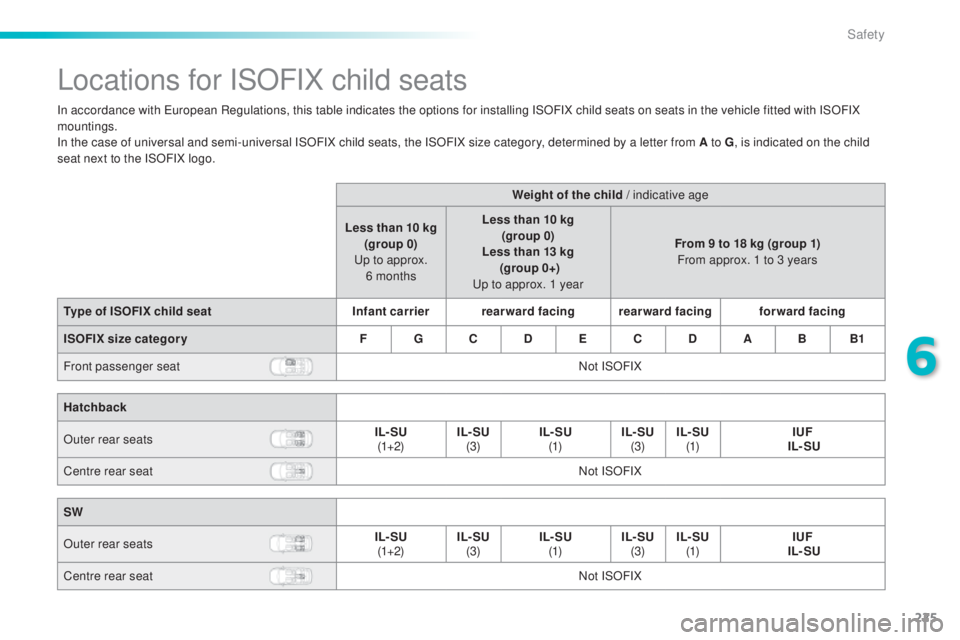
Locations for ISOFIX child seats
In accordance with european Regulations, this table indicates the options for installing ISOFIX child seats on seats in the vehicle fitted with ISOFIX
mountings.
In the case of universal and semi-universal ISOFIX child seats, the ISOFIX size category, determined by a letter from A to G , is indicated on the child
seat next to the ISOFIX logo.
Weight of the child
/ indicative age
Less than 10 kg (group 0)
u
p to approx. 6
monthsLess than 10 kg
(group 0)
Less than 13 kg (group 0+)
up t
o approx. 1 yearFrom 9 to 18 kg (group 1)
From approx. 1 to 3 years
Type of ISOFIX child seat Infant carrierrearward facing rearward facing forward facing
ISOFIX size categor y F G C D E C D A B B1
Front passenger seat Not ISOFIX
Hatchback
Outer rear seats IL- SU
(1+2) IL- SU
(3) IL- SU
(1) IL- SU
(3) IL- SU
(1) IUF
IL- SU
Centre rear seat Not ISOFIX
SW
Outer rear seats IL- SU
(1+2) IL- SU
(3) IL- SU
(1) IL- SU
(3) IL- SU
(1) IUF
IL- SU
Centre rear seat Not ISOFIX
6
Safety
Page 268 of 416
266
308_en_Chap07_info-pratiques_ed01-2015
General recommendations
Observe the legislation in force in your country.ensure that the weight of the towing vehicle is higher than that of the towed vehicle.
th
e driver must remain at the wheel of the towed vehicle and must have a valid driving licence.
When towing a vehicle with all four wheels on the ground, always use an approved towing
arm; rope and straps are prohibited.
th
e towing vehicle must move off gently.
When towing a vehicle with the engine off, there is no longer any power assistance for
braking or steering.
In the following cases, you must always call on a professional recovery service:
-
v
ehicle broken down on a motor way or fast road,
-
f
our-wheel drive vehicle,
-
w
hen it is not possible to put the gearbox into neutral, unlock the steering, or release
the parking brake,
-
t
owing with only two wheels on the ground,
-
w
here there is no approved towing arm available...
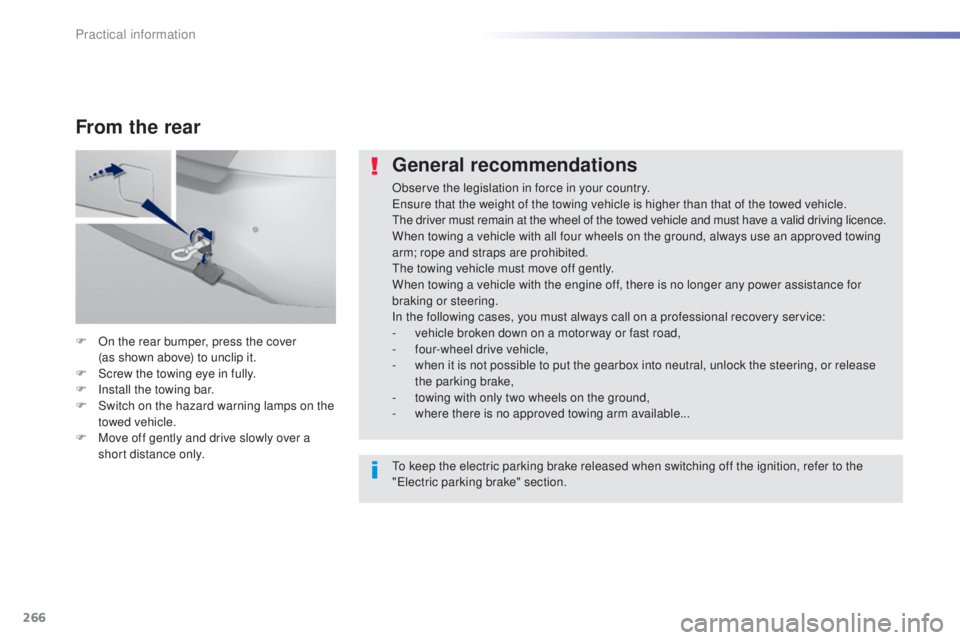
F
O
n the rear bumper, press the cover
(as shown above) to unclip it.
F
S
crew the towing eye in fully.
F
I
nstall the towing bar.
F
S
witch on the hazard warning lamps on the
towed vehicle.
F
M
ove off gently and drive slowly over a
short distance only.
From the rear
to keep the electric parking brake released when switching off the ignition, refer to the
"el ectric parking brake" section.
Practical information
Page 271 of 416
269
308_en_Chap07_info-pratiques_ed01-2015
Driving advice
Distribution of loads
F Distribute the load in the trailer so that the heaviest items are as close as possible to
the axle and the nose weight approaches
the maximum permitted without
exceeding
it.
Air density decreases with altitude, thus
reducing engine performance. Above
1
000 metres, the maximum towed load must
be reduced by 10
% for every 1 000 metres of
altitude.
Side wind
F take into account the increased sensitivity to side wind.
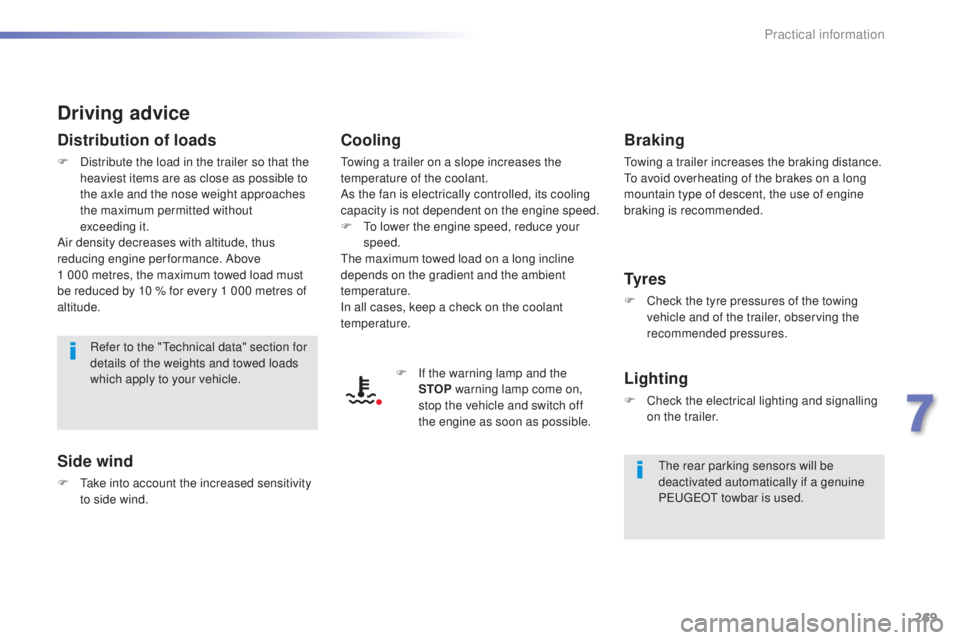
Cooling
towing a trailer on a slope increases the
temperature of the coolant.
As the fan is electrically controlled, its cooling
capacity is not dependent on the engine speed.
F
t
o l
ower the engine speed, reduce your
speed.
th
e maximum towed load on a long incline
depends on the gradient and the ambient
temperature.
In all cases, keep a check on the coolant
temperature.
F
I
f the warning lamp and the
STOP warning lamp come on,
stop the vehicle and switch off
the engine as soon as possible.
Braking
towing a trailer increases the braking distance.to a void overheating of the brakes on a long
mountain type of descent, the use of engine
braking is recommended.
Ty r e s
F Check the tyre pressures of the towing vehicle and of the trailer, observing the
recommended pressures.
Lighting
F Check the electrical lighting and signalling on the trailer.
Refer to the "
te
chnical data" section for
details of the weights and towed loads
which apply to your vehicle.
th
e rear parking sensors will be
deactivated automatically if a genuine
P
e
uge
Ot
towbar is used.
7
Practical information
Page 295 of 416
293
308_en_Chap09_caracteristiques-techniques_ed01-2015
Weights and towed loads
the weights are given in the registration
certificate for your vehicle and on the
manufacturer's VIN plate.
th
e information can also be obtained from
P
e
uge
Ot
dealers and is included in the
descriptive table of technical characteristics for
the vehicle in sales brochures.
th
e maximum type-approved trailer weight
varies according to market zone.
In each country, you must comply with local
legislation on towed loads.
For information on your vehicle's towing
capabilities and its gross train weight,
contact a P
e
uge
Ot
dealer.Load transfer
If the towing vehicle has not reached the gV W,
it is possible to transfer this weight to the trailer.
th
e gross train weight and maximum
trailer weight are valid up to an altitude of
1
000 metres; the maximum trailer weight
specified must be reduced by 10 % for every
additional 1
000 metres of altitude.
In all cases, do not exceed the weight of
the trailer and the
gt
W
, indicated on your
registration certificate.
Observe the towing capacities of your vehicle.
th
e weight of a braked trailer with load
transfer can be increased on condition that the
equivalent weight is removed from the vehicle
and the
gt
W i
s not exceeded.
High ambient temperatures may result in a
reduction in the per formance of the vehicle to
protect the engine. If the ambient temperature
is above 37 °C, limit the towed load to 700 kg,
without any transfer of load.
th
e speed of a towing vehicle must not exceed
60 mph (100 km/h) (comply with the legislation
in force in your country).
th
e recommended nose weight (weight on the
towbar ball) is 75 kg.
engines
the values (engine capacity, net maximum
power, power to weight ratio, engine speed,
CO
2 emissions, ...) are given in your vehicle's
registration document.
th
ey can also be obtained from P
e
uge
Ot
dealers and are included in the descriptive
table of technical characteristics for the vehicle
in sales brochures.
For more information, contact a
P
e
uge
Ot
dealer or a qualified
workshop.
9
technical data