display PEUGEOT 308 2015 Repair Manual
[x] Cancel search | Manufacturer: PEUGEOT, Model Year: 2015, Model line: 308, Model: Peugeot 308 2015Pages: 344, PDF Size: 12.22 MB
Page 166 of 344
164
"Porsche Tiptronic System" automatic gearbox
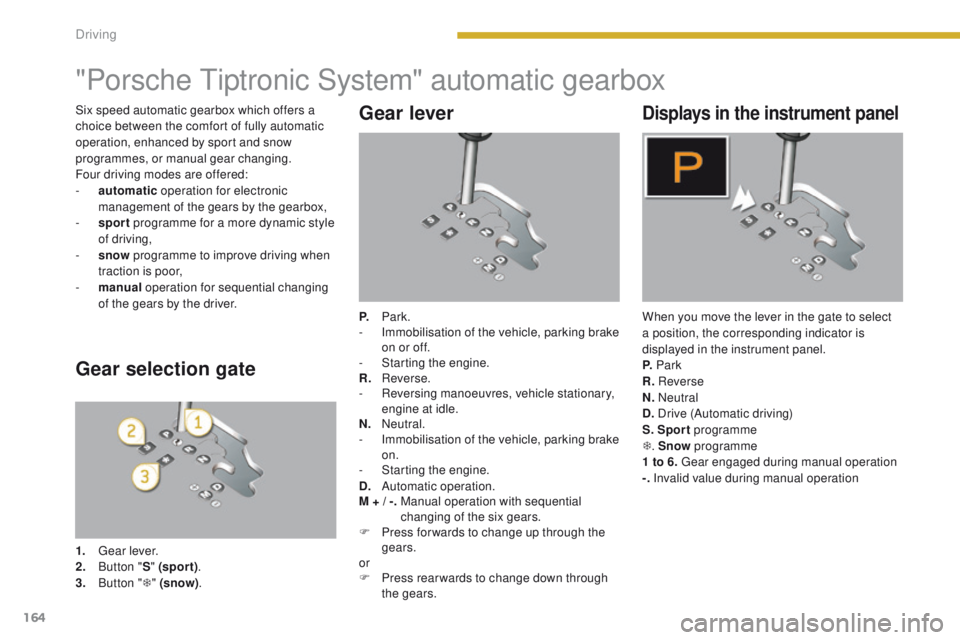
Gear lever
P. Park.
- I mmobilisation of the vehicle, parking brake
on or off.
-
S
tarting the engine.
R.
R
everse.
-
R
eversing manoeuvres, vehicle stationary,
engine at idle.
N.
N
eutral.
-
I
mmobilisation of the vehicle, parking brake
on.
-
S
tarting the engine.
D.
Aut
omatic operation.
M +
/ -.
M
anual operation with sequential
changing of the six gears.
F
P
ress for wards to change up through the
gears.
or
F
P
ress rear wards to change down through
the gears.
Displays in the instrument panel
When you move the lever in the gate to select
a position, the corresponding indicator is
displayed in the instrument panel.
P. Park
R. Reverse
N. Neutral
D. Drive (Automatic driving)
S. Sport programme
T . Snow programme
1 to 6. Gear engaged during manual operation
-. Invalid value during manual operation
Gear selection gate
1. Gear lever.
2. B
utton " S" (spor t) .
3.
B
utton " T" (snow) .
Six speed automatic gearbox which offers a
choice between the comfort of fully automatic
operation, enhanced by sport and snow
programmes, or manual gear changing.
Four driving modes are offered:
-
a
utomatic
operation for electronic
management of the gears by the gearbox,
-
sp
ort
programme for a more dynamic style
of driving,
-
s
now
programme to improve driving when
traction is poor,
-
m
anual
operation for sequential changing
of the gears by the driver.
Driving
Page 167 of 344
165
Moving off
F With your foot on the brake, select position P or N.
F
S
tart the engine.
If this procedure is not followed, there is an
audible signal, accompanied by a message in
the multifunction screen.
F
W
ith the engine running, press the brake
pedal.
F
R
elease the parking brake, unless it is
programmed to automatic mode.
F
Sel
ect position R , D or M.
F
G
radually release the brake pedal.
The vehicle moves off immediately.
Automatic operation
F Select position D for automatic changing
of the six gears.
The gearbox then operates in auto-adaptive
mode, without any intervention on the part
of the driver. It continuously selects the
most suitable gear according to the style of
driving, the profile of the road and the load in
the
vehicle.
For maximum acceleration without touching
the lever, press the accelerator pedal down
fully (kick down). The gearbox changes down
automatically or maintains the gear selected
until the maximum engine speed is reached.
On braking, the gearbox changes down
automatically to provide efficient engine
braking.
If you release the accelerator sharply, the
gearbox will not change to a higher gear for
safety reasons.
When the engine is running at idle, with
the brakes released, if position R
, D or
M is selected, the vehicle moves even
without the accelerator being pressed.
When the engine is running, never
leave children in the vehicle without
supervision.
When carrying out maintenance with
the engine running, apply the parking
brake and select position P .
If position N is engaged inadvertently
while driving, allow the engine to
return to idle then engage position D to
accelerate.
Never select position N while the
vehicle is moving.
Never select positions P or R unless the
vehicle is completely stationary.
A message is displayed if you try to
move the gear lever from position P to
another position without pressing the
brake pedal.
8
Driving
Page 168 of 344
166
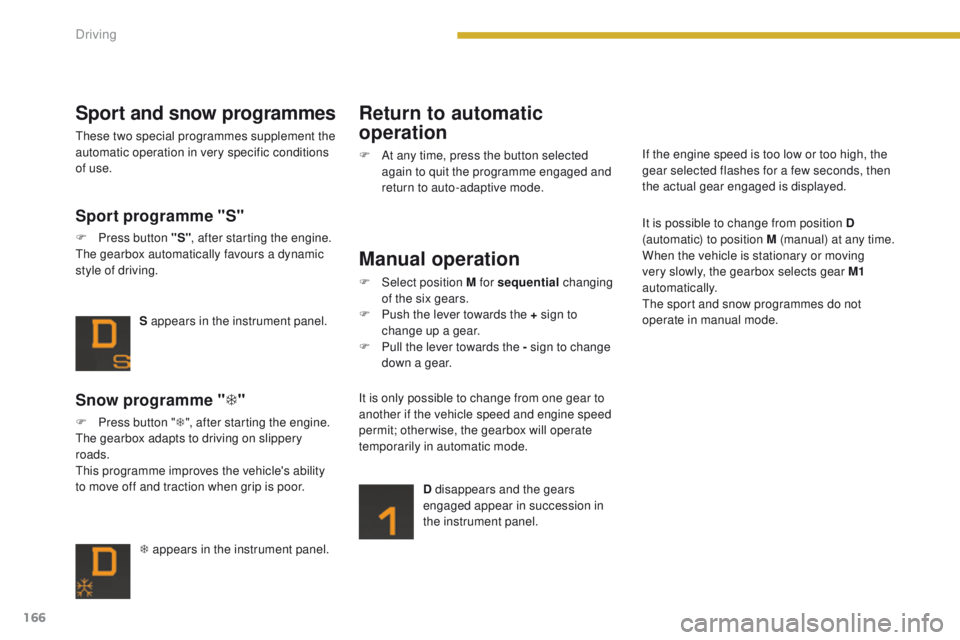
T appears in the instrument panel.
Snow programme "T"
F Press button " T", after starting the engine.
The gearbox adapts to driving on slippery
roads.
This programme improves the vehicle's ability
to move off and traction when grip is poor. S appears in the instrument panel.
Sport programme "S"
F Press button "S"
, after starting the engine.
The gearbox automatically favours a dynamic
style of driving.
Sport and snow programmes
These two special programmes supplement the
automatic operation in very specific conditions
of use.
Return to automatic
operation
F At any time, press the button selected again to quit the programme engaged and
return to auto-adaptive mode.
Manual operation
F Select position M for sequential changing
of the six gears.
F
P
ush the lever towards the + sign to
change up a gear.
F
P
ull the lever towards the - sign to change
down a gear.
D disappears and the gears
engaged appear in succession in
the instrument panel.
It is only possible to change from one gear to
another if the vehicle speed and engine speed
permit; otherwise, the gearbox will operate
temporarily in automatic mode. It is possible to change from position D
(automatic) to position M (manual) at any time.
When the vehicle is stationary or moving
very slowly, the gearbox selects gear M1
automatically.
The sport and snow programmes do not
operate in manual mode. If the engine speed is too low or too high, the
gear selected flashes for a few seconds, then
the actual gear engaged is displayed.
Driving
Page 169 of 344
167
Stopping the vehicle
Before switching off the engine, you can
engage position P or N to place the gearbox in
neutral.
In both cases, apply the parking brake to
immobilise the vehicle, unless it is programmed
to automatic mode.
Operating fault
When the ignition is on, the lighting
of this warning lamp, accompanied
by an audible signal and a message
in the multifunction screen,
indicates a gearbox malfunction.
In this case, the gearbox switches to back-up
mode and is locked in 3rd gear. You may feel
a substantial knock when changing from P
to R and from N to R . This will not cause any
damage to the gearbox.
Do not exceed 60 mph (100 km/h), local speed
restrictions permitting.
Have it checked by a PEUGEOT dealer or a
qualified workshop.
This warning lamp may also come on if a door
is opened.Invalid value during manual
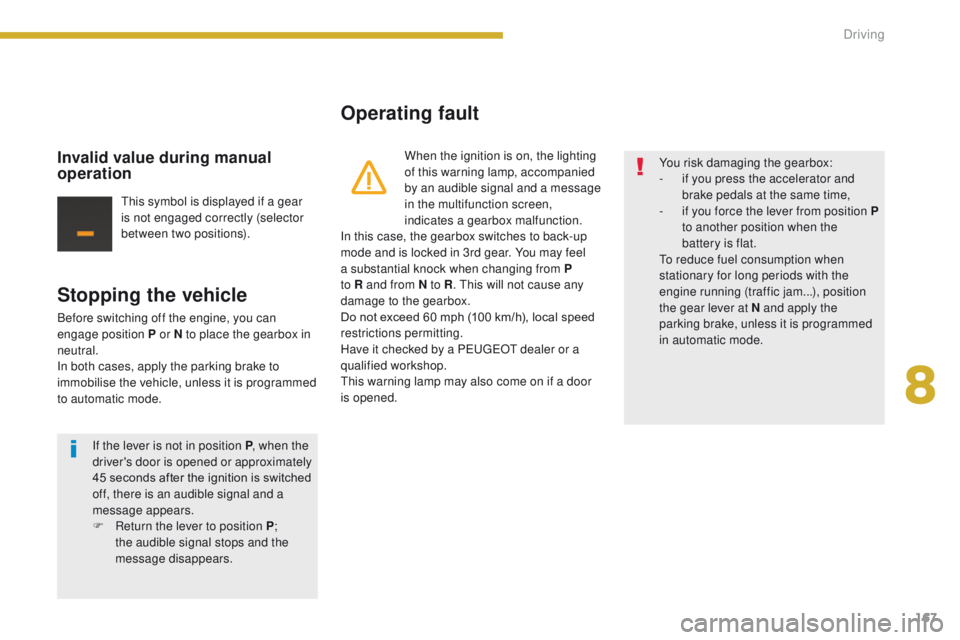
operation
This symbol is displayed if a gear
is not engaged correctly (selector
between two positions). You risk damaging the gearbox:
-
i
f you press the accelerator and
brake pedals at the same time,
- i f you force the lever from position P
to another position when the
battery is flat.
To reduce fuel consumption when
stationary for long periods with the
engine running (traffic jam...), position
the gear lever at N and apply the
parking brake, unless it is programmed
in automatic mode.
If the lever is not in position P , when the
driver's door is opened or approximately
45 seconds after the ignition is switched
off, there is an audible signal and a
message appears.
F
R
eturn the lever to position P ;
the audible signal stops and the
message disappears.
8
Driving
Page 170 of 344
168
Gear shift indicator*
* Depending on engine.
The system adapts its gear change
recommendation according to the
driving conditions (slope, load, ...) and
the demands of the driver (power,
acceleration, braking, ...).
The system never suggests:
-
e
ngaging first gear,
-
enga
ging reverse gear.
System which reduces fuel consumption by
recommending the most appropriate gear.
Operation
Depending on the driving situation and your
vehicle's equipment, the system may advise
you to skip one (or more) gear(s). You can
follow this instruction without engaging the
intermediate gears.
The gear engagement recommendations must
not be considered compulsory. In fact, the
configuration of the road, the amount of traffic
and safety remain determining factors when
choosing the best gear. Therefore, the driver
remains responsible for deciding whether or not
to follow the advice given by the system.
This function cannot be deactivated.
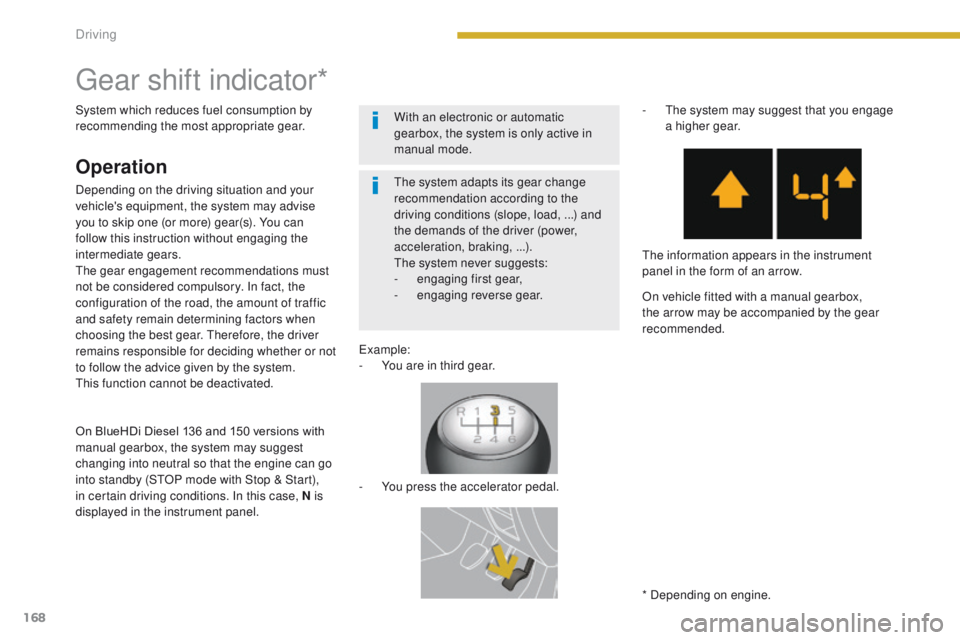
Example:
-
Y
ou are in third gear.
-
Y
ou press the accelerator pedal.-
T
he system may suggest that you engage
a higher gear.
The information appears in the instrument
panel in the form of an arrow.
On vehicle fitted with a manual gearbox,
the arrow may be accompanied by the gear
recommended.
With an electronic or automatic
gearbox, the system is only active in
manual mode.
On BlueHDi Diesel 136 and 150 versions with
manual gearbox, the system may suggest
changing into neutral so that the engine can go
into standby (STOP mode with Stop & Start),
in certain driving conditions. In this case, N is
displayed in the instrument panel.
Driving
Page 175 of 344
173
The flashing and then fixed
illumination of the under-inflation
warning lamp accompanied by
the illumination of the service warning lamp
indicates a fault with the system.
In this case, monitoring of the tyre pressures is
not assured.
This alert is also displayed when one or
more wheels is not fitted with a sensor
(for example, a space-saver or steel
spare wheel).
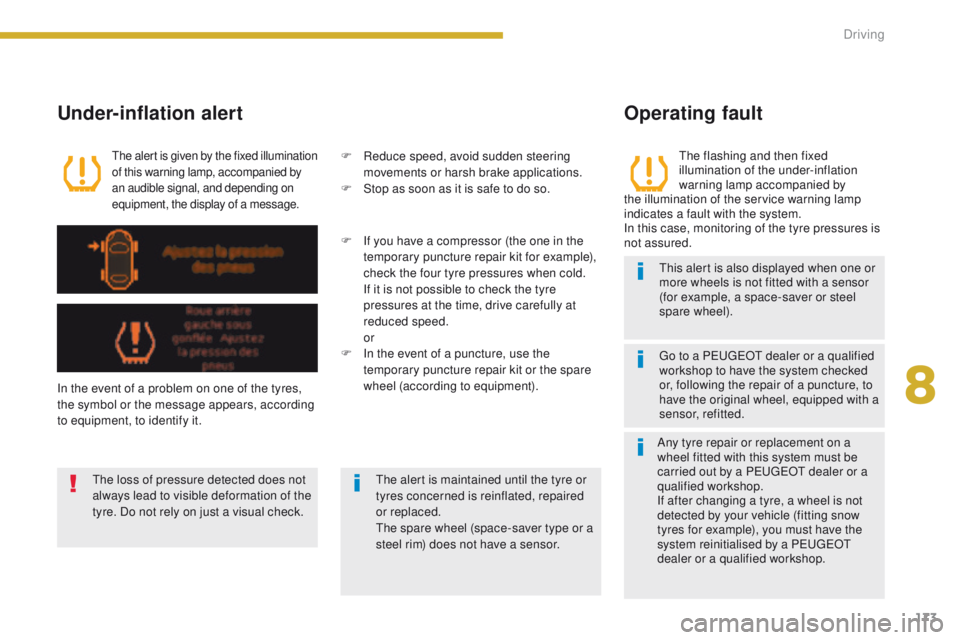
Under-inflation alert
The alert is given by the fixed illumination
of this warning lamp, accompanied by
an audible signal, and depending on
equipment, the display of a message.
In the event of a problem on one of the tyres,
the symbol or the message appears, according
to equipment, to identify it. F
R
educe speed, avoid sudden steering
movements or harsh brake applications.
F
S
top as soon as it is safe to do so.
The loss of pressure detected does not
always lead to visible deformation of the
tyre. Do not rely on just a visual check. The alert is maintained until the tyre or
tyres concerned is reinflated, repaired
or replaced.
The spare wheel (space-saver type or a
steel rim) does not have a sensor.
Operating fault
Go to a PEUGEOT dealer or a qualified
workshop
to have the system checked
or, following the repair of a puncture, to
have the original wheel, equipped with a
sensor, refitted.
F
I
f you have a compressor (the one in the
temporary puncture repair kit for example),
check the four tyre pressures when cold.
I
f it is not possible to check the tyre
pressures at the time, drive carefully at
reduced speed.
or
F
I
n the event of a puncture, use the
temporary puncture repair kit or the spare
wheel (according to equipment).
Any tyre repair or replacement on a
wheel fitted with this system must be
carried out by a PEUGEOT dealer or a
qualified workshop.
If after changing a tyre, a wheel is not
detected by your vehicle (fitting snow
tyres for example), you must have the
system reinitialised by a PEUGEOT
dealer or a qualified workshop.
8
Driving
Page 176 of 344
174
Visual and audible front and rear parking sensors
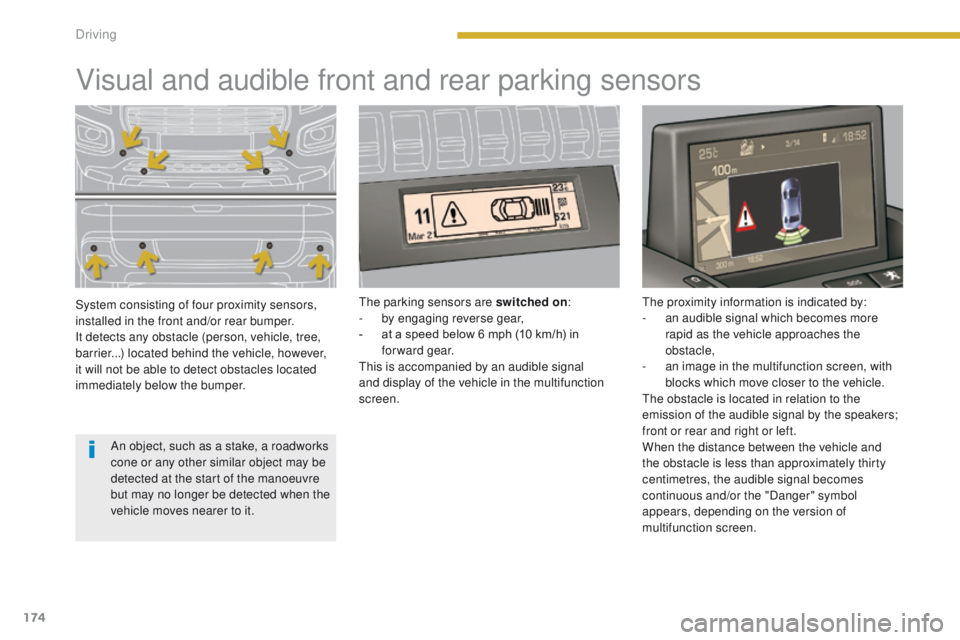
System consisting of four proximity sensors,
installed in the front and/or rear bumper.
It detects any obstacle (person, vehicle, tree,
barrier...) located behind the vehicle, however,
it will not be able to detect obstacles located
immediately below the bumper.The parking sensors are switched on
:
- b y engaging reverse gear,
-
a
t a speed below 6 mph (10 km/h) in
forward gear.
This is accompanied by an audible signal
and display of the vehicle in the multifunction
screen. The proximity information is indicated by:
-
a n audible signal which becomes more
rapid as the vehicle approaches the
obstacle,
-
a
n image in the multifunction screen, with
blocks which move closer to the vehicle.
The obstacle is located in relation to the
emission of the audible signal by the speakers;
front or rear and right or left.
When the distance between the vehicle and
the obstacle is less than approximately thirty
centimetres, the audible signal becomes
continuous and/or the "Danger" symbol
appears, depending on the version of
multifunction screen.
An object, such as a stake, a roadworks
cone or any other similar object may be
detected at the start of the manoeuvre
but may no longer be detected when the
vehicle moves nearer to it.
Driving
Page 177 of 344
175
The parking sensors are switched off:
- w hen you come out of reverse gear,
-
w
hen the speed is higher than 6 mph
(10 km/h) in for ward gear,
-
w
hen the vehicle has been stationary for
more than three seconds in forward gear.
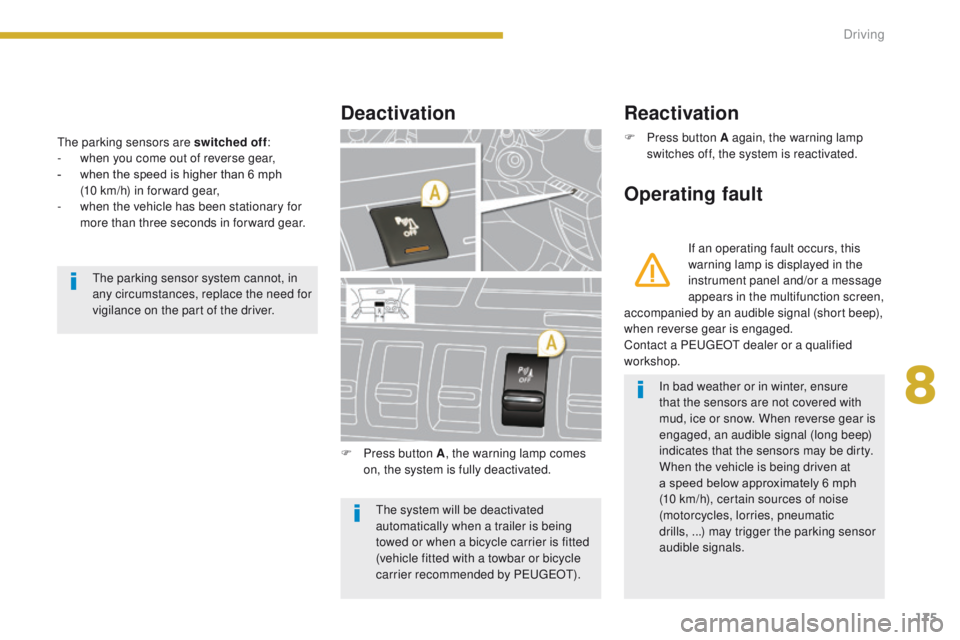
Deactivation
Operating fault
F Press button A again, the warning lamp switches off, the system is reactivated.
F
P
ress button A , the warning lamp comes
on, the system is fully deactivated. If an operating fault occurs, this
warning lamp is displayed in the
instrument panel and/or a message
appears in the multifunction screen,
accompanied by an audible signal (short beep),
when reverse gear is engaged.
Contact a PEUGEOT dealer or a qualified
workshop.
The parking sensor system cannot, in
any circumstances, replace the need for
vigilance on the part of the driver.
The system will be deactivated
automatically when a trailer is being
towed or when a bicycle carrier is fitted
(vehicle fitted with a towbar or bicycle
carrier recommended by PEUGEOT).In bad weather or in winter, ensure
that the sensors are not covered with
mud, ice or snow. When reverse gear is
engaged, an audible signal (long beep)
indicates that the sensors may be dirty.
When the vehicle is being driven at
a speed below approximately 6 mph
(10 km/h), certain sources of noise
(motorcycles, lorries, pneumatic
drills, ...) may trigger the parking sensor
audible signals.
Reactivation
8
Driving
Page 178 of 344
176
Reversing camera
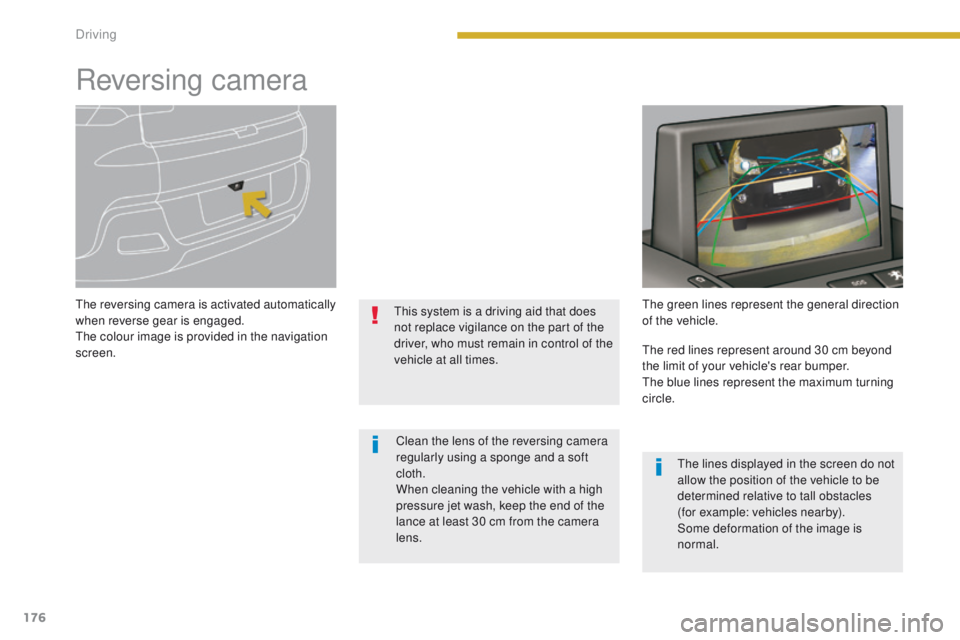
The reversing camera is activated automatically
when reverse gear is engaged.
The colour image is provided in the navigation
screen.This system is a driving aid that does
not replace vigilance on the part of the
driver, who must remain in control of the
vehicle at all times.The green lines represent the general direction
of the vehicle.
Clean the lens of the reversing camera
regularly using a sponge and a soft
cloth.
When cleaning the vehicle with a high
pressure jet wash, keep the end of the
lance at least 30 cm from the camera
lens. The red lines represent around 30 cm beyond
the limit of your vehicle's rear bumper.
The blue lines represent the maximum turning
circle.
The lines displayed in the screen do not
allow the position of the vehicle to be
determined relative to tall obstacles
(for example: vehicles nearby).
Some deformation of the image is
normal.
Driving
Page 179 of 344
177
Parking space sensors
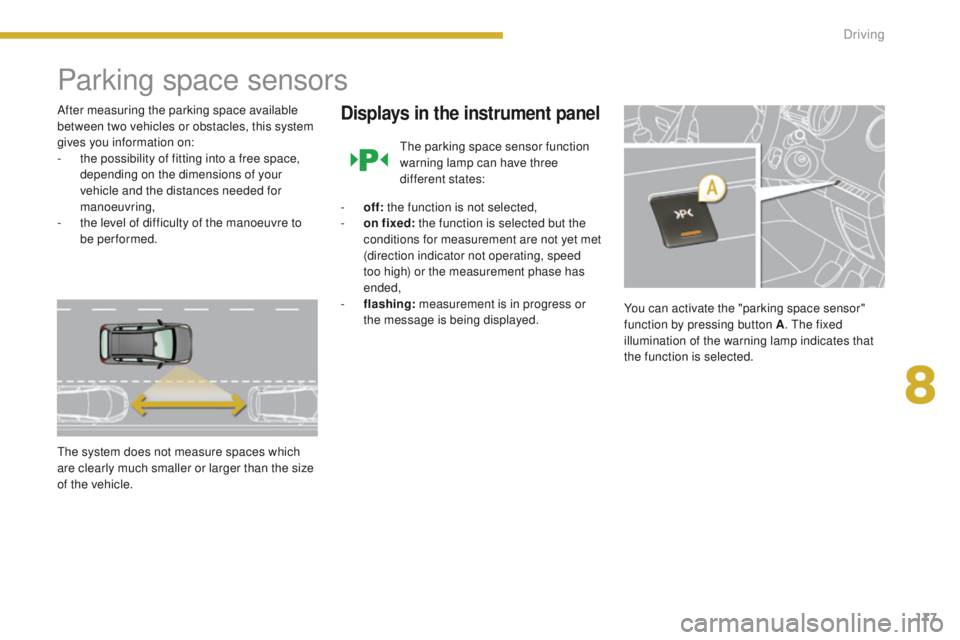
After measuring the parking space available
between two vehicles or obstacles, this system
gives you information on:
-
t
he possibility of fitting into a free space,
depending on the dimensions of your
vehicle and the distances needed for
manoeuvring,
-
t
he level of difficulty of the manoeuvre to
be performed.
The system does not measure spaces which
are clearly much smaller or larger than the size
of the vehicle.Displays in the instrument panel
The parking space sensor function
warning lamp can have three
different states:
-
o
ff: the function is not selected,
-
o
n fixed: the function is selected but the
conditions for measurement are not yet met
(direction indicator not operating, speed
too high) or the measurement phase has
ended,
-
f
lashing: measurement is in progress or
the message is being displayed. You can activate the "parking space sensor"
function by pressing button A
. The fixed
illumination of the warning lamp indicates that
the function is selected.
8
Driving