ESP Peugeot 308 2016 User Guide
[x] Cancel search | Manufacturer: PEUGEOT, Model Year: 2016, Model line: 308, Model: Peugeot 308 2016Pages: 398, PDF Size: 9.38 MB
Page 42 of 398
40
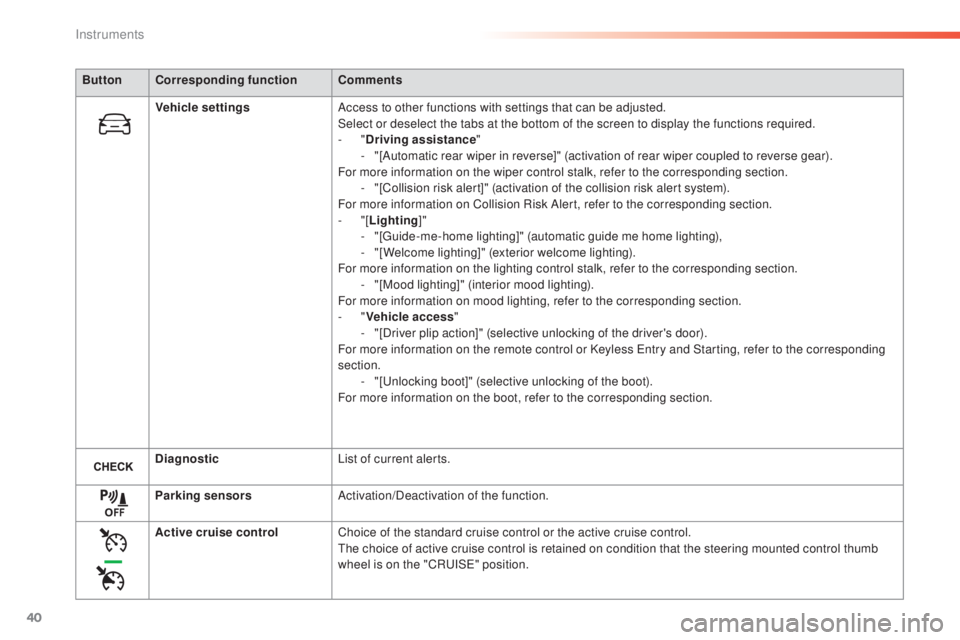
ButtonCorresponding function Comments
Vehicle settings Access to other functions with settings that can be adjusted.
Select or deselect the tabs at the bottom of the screen to display the functions required.
-
"D
riving assistance"
-
"[
Automatic rear wiper in reverse]" (activation of rear wiper coupled to reverse gear).
For more information on the wiper control stalk, refer to the corresponding section. -
"[
Collision risk alert]" (activation of the collision risk alert system).
For more information on Collision Risk Alert, refer to the corresponding section.
-
"
[Lighting ]"
-
"[gui
de-me-home lighting]" (automatic guide me home lighting),
-
"[
Welcome lighting]" (exterior welcome lighting).
For more information on the lighting control stalk, refer to the corresponding section. -
"[
Mood lighting]" (interior mood lighting).
For more information on mood lighting, refer to the corresponding section.
-
" V
ehicle access"
-
"[
Driver plip action]" (selective unlocking of the driver's door).
For more information on the remote control or Keyless
ent
ry and Starting, refer to the corresponding
section. -
"[unl
ocking boot]" (selective unlocking of the boot).
For more information on the boot, refer to the corresponding section.
Diagnostic List of current alerts.
Parking sensors Activation/Deactivation of the function.
Active cruise control Choice of the standard cruise control or the active cruise control.
the c
hoice of active cruise control is retained on condition that the steering mounted control thumb
wheel is on the "CR
uISe" p
osition.
Instruments
Page 43 of 398
41
308_en_Chap01_instruments-de-bord_ed02-2015
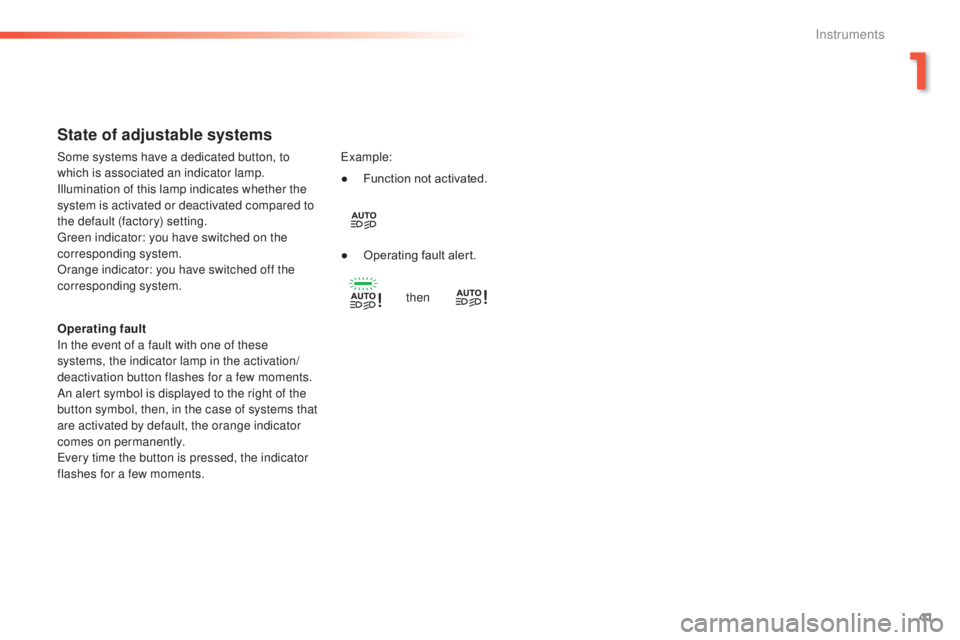
State of adjustable systems
Operating fault
In the event of a fault with one of these
systems, the indicator lamp in the activation/
deactivation button flashes for a few moments.
An alert symbol is displayed to the right of the
button symbol, then, in the case of systems that
are activated by default, the orange indicator
comes on permanently.
eve
ry time the button is pressed, the indicator
flashes for a few moments.
exa
mple:
Some systems have a dedicated button, to
which is associated an indicator lamp.
Illumination of this lamp indicates whether the
system is activated or deactivated compared to
the default (factory) setting.
gre
en indicator: you have switched on the
corresponding system.
Orange indicator: you have switched off the
corresponding system. ●
Fu
nction not activated.
●
Op
erating fault alert.
then
1
Instruments
Page 44 of 398
42
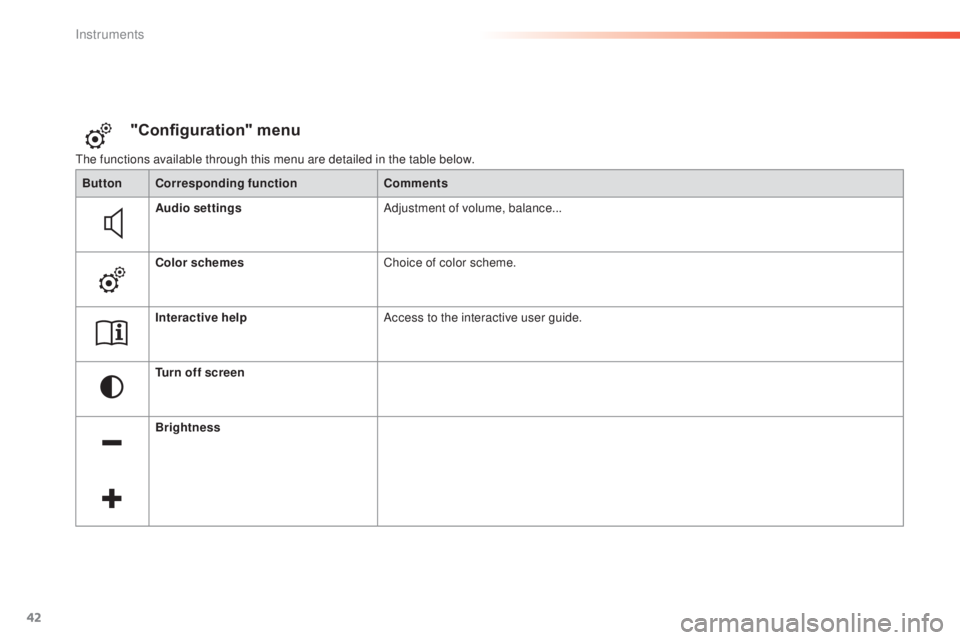
the functions available through this menu are detailed in the table below.
"Configuration" menu
ButtonCorresponding function Comments
Audio settings Adjustment of volume, balance...
Color schemes Choice of color scheme.
Interactive help Access to the interactive user guide.
Turn off screen
Brightness
Instruments
Page 45 of 398
43
308_en_Chap01_instruments-de-bord_ed02-2015
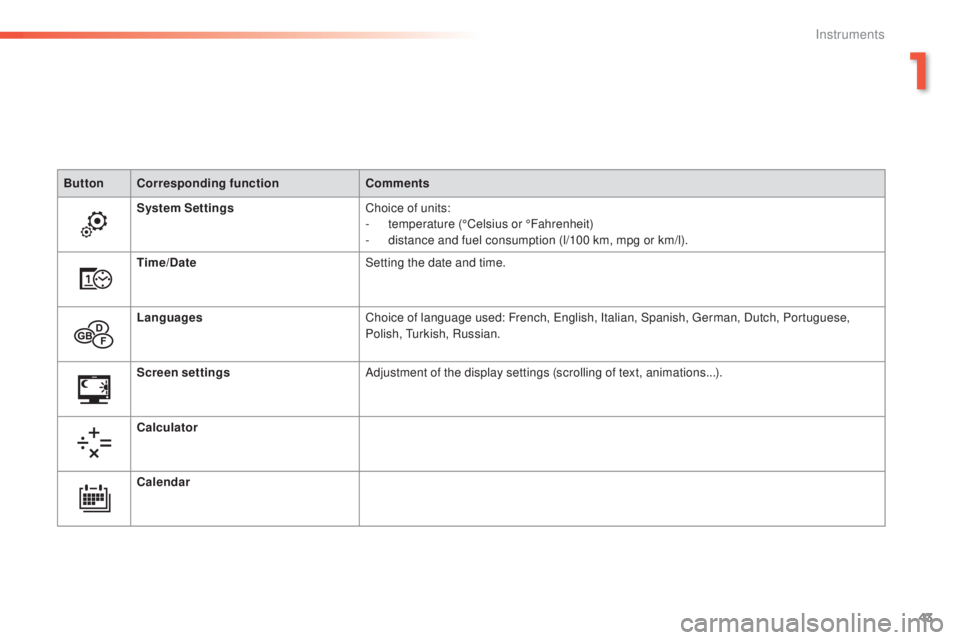
ButtonCorresponding function Comments
System Settings Choice of units:
-
te
mperature (°Celsius or °Fahrenheit)
-
di
stance and fuel consumption (l/100 km, mpg or km/l).
Time/Date Setting the date and time.
Languages Choice of language used: French,
eng
lish, Italian, Spanish,
ger
man, Dutch, Portuguese,
Polish,
tur
kish, Russian.
Screen settings Adjustment of the display settings (scrolling of text, animations...).
Calculator
Calendar
1
Instruments
Page 48 of 398
46
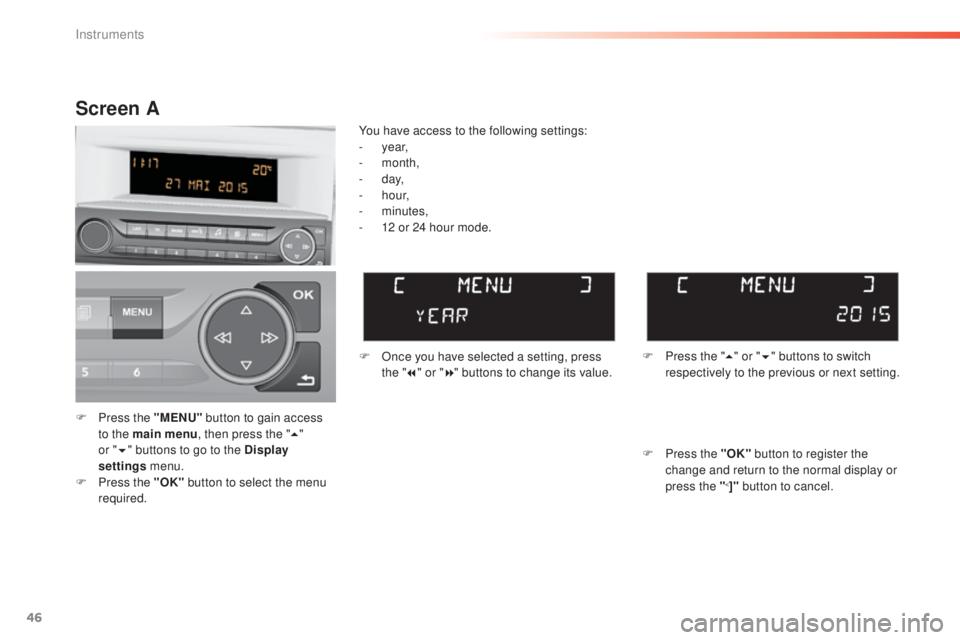
F Press the "MENU" b utton to gain access
to the main menu , then press the "5"
or
" 6 " b
uttons to go to the Display
settings menu.
F
Pr
ess the "OK" button to select the menu
required. F
On
ce you have selected a setting, press
the " 7" or " 8" buttons to change its value.
You have access to the following settings:
- ye
ar,
-
m
onth,
-
d
ay,
-
h
o u r,
-
m
inutes,
-
12 o
r 24 hour mode.
Screen A
F Press the " 5" o r "6 " buttons to switch
respectively to the previous or next setting.
F
Pr
ess the "OK" button to register the
change and return to the normal display or
press the "
<]" button to cancel.
Instruments
Page 63 of 398
61
308_en_Chap02_ouvertures_ed02-2015
Back-up key
Unlocking/locking using the
integral key with Keyless
Entry and Starting
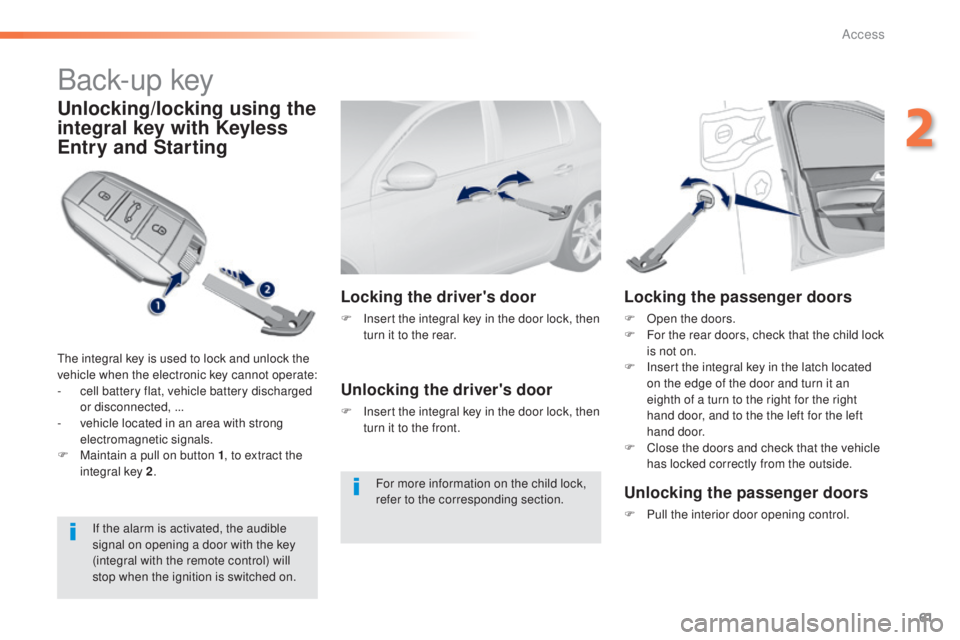
the integral key is used to lock and unlock the
v ehicle when the electronic key cannot operate:
-
ce
ll battery flat, vehicle battery discharged
or disconnected, ...
-
ve
hicle located in an area with strong
electromagnetic signals.
F
Ma
intain a pull on button 1 , to extract the
integral key 2 .
Locking the driver's door
F Insert the integral key in the door lock, then
t
urn it to the rear.
Unlocking the driver's door
F Insert the integral key in the door lock, then
turn it to the front.
Locking the passenger doors
F Open the doors.
F Fo r the rear doors, check that the child lock
is not on.
F
In
sert the integral key in the latch located
on the edge of the door and turn it an
eighth of a turn to the right for the right
hand door, and to the the left for the left
hand door.
F
Cl
ose the doors and check that the vehicle
has locked correctly from the outside.
If the alarm is activated, the audible
signal on opening a door with the key
(integral with the remote control) will
stop when the ignition is switched on.
Unlocking the passenger doors
F Pull the interior door opening control.
F
or more information on the child lock,
refer to the corresponding section.
2
Access
Page 72 of 398
70
308_en_Chap02_ouvertures_ed02-2015
Reinitialising the electric
windows
Always remove the key when leaving
the vehicle, even for a short time.
In the event of contact during operation
of the windows, you must reverse the
movement of the window.
to do t
his,
press the switch concerned.
When operating the passenger electric
window switches, the driver must
ensure that no one is preventing correct
closing of the windows.
the d
river must ensure that the
passengers use the electric windows
c o r r e c t l y.
Be aware of children when operating
the windows.
For the safety of your children, press
this switch to prevent operation
of the windows of the rear doors,
irrespective of their position.Deactivating the rear
window controls
With the indicator lamp on, the rear switches
are deactivated.
With the indicator lamp off, the switches are
active.
Following reconnection of the battery, the
safety anti-pinch function must be reinitialised.
the s
afety anti-pinch is not active during these
operations:
-
lo
wer the window completely, then raise
it, it will rise in steps of a few centimetres
each time the switch is pressed. Repeat
the operation until the window closes
completely,
-
pr
ess and hold the switch upwards for
at least one second after reaching this
position, window closed.
Access
Page 76 of 398
74
308_en_Chap03_ergonomie-et-confort_ed02-2015
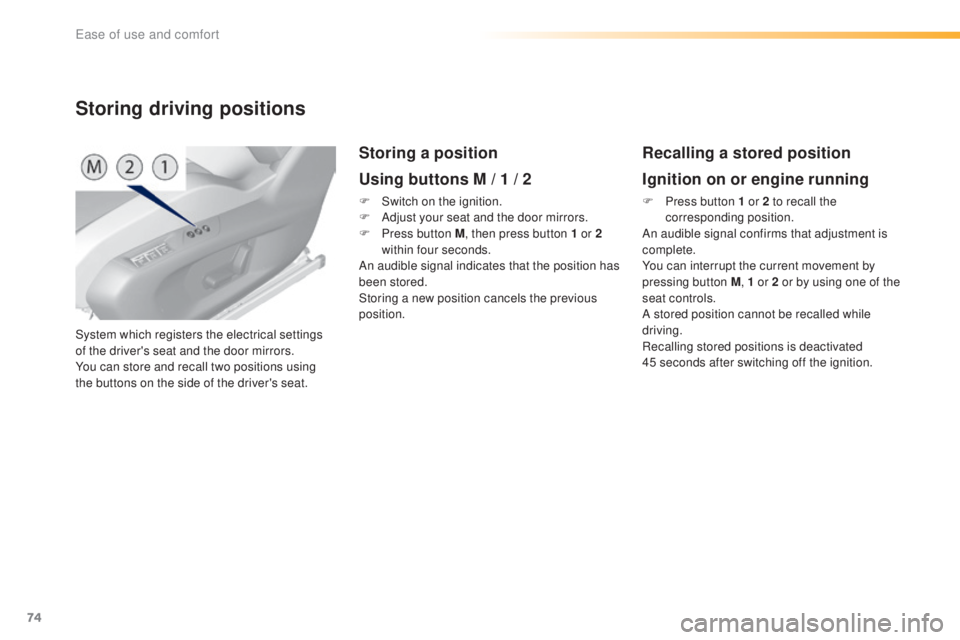
System which registers the electrical settings
of the driver's seat and the door mirrors.
You can store and recall two positions using
the buttons on the side of the driver's seat.
Storing driving positions
Storing a position
Using buttons M / 1 / 2
F Switch on the ignition.
F Ad just your seat and the door mirrors.
F
Pr
ess button M , then press button 1 or 2
within four seconds.
An audible signal indicates that the position has
been stored.
Storing a new position cancels the previous
position.
Recalling a stored position
Ignition on or engine running
F Press button 1 or 2 to recall the
c orresponding position.
An audible signal confirms that adjustment is
complete.
You can interrupt the current movement by
pressing button M , 1 or 2 or by using one of the
seat controls.
A stored position cannot be recalled while
driving.
Recalling stored positions is deactivated
45
s
econds after switching off the ignition.
ease of use and comfort
Page 79 of 398
77
308_en_Chap03_ergonomie-et-confort_ed02-2015
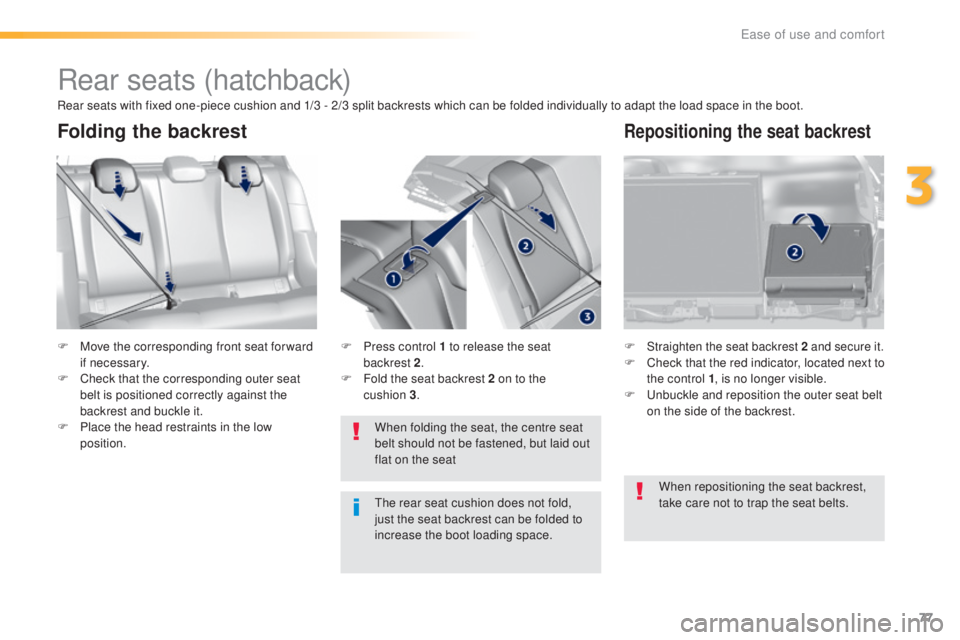
Rear seats (hatchback)
F Move the corresponding front seat for ward
if necessary.
F
Che
ck that the corresponding outer seat
belt is positioned correctly against the
backrest and buckle it.
F
Pl
ace the head restraints in the low
position. F Straighten the seat backrest 2 and secure it.F Check that the red indicator, located next to
t
he control 1 , is no longer visible.
F
u
nb
uckle and reposition the outer seat belt
on the side of the backrest.
When folding the seat, the centre seat
belt should not be fastened, but laid out
flat on the seat
F
Pr
ess control 1 to release the seat
backrest 2 .
F Fo
ld the seat backrest 2 on to the
cushion
3 .
Folding the backrestRepositioning the seat backrest
Rear seats with fixed one-piece cushion and 1/3 - 2/3 split backrests which can be folded individually to adapt the load space in the boot.
the r
ear seat cushion does not fold,
just the seat backrest can be folded to
increase the boot loading space. When repositioning the seat backrest,
take care not to trap the seat belts.
3
ease of use and comfort
Page 80 of 398
78
308_en_Chap03_ergonomie-et-confort_ed02-2015
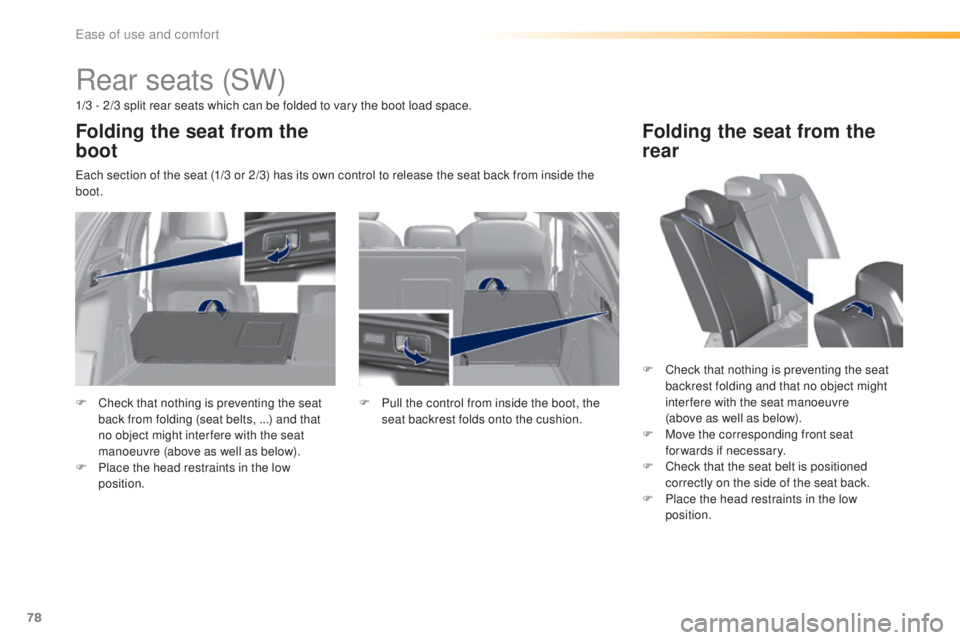
Rear seats (SW)
1/3 - 2/3 split rear seats which can be folded to vary the boot load space.
eac
h section of the seat (1/3 or 2/3) has its own control to release the seat back from inside the
boot.
Folding the seat from the
boot
F Check that nothing is preventing the seat
b ack from folding (seat belts, . ..) and that
no object might inter fere with the seat
manoeuvre (above as well as below).
F
Pl
ace the head restraints in the low
position. F Pu
ll the control from inside the boot, the
seat backrest folds onto the cushion.
Folding the seat from the
rear
F Check that nothing is preventing the seat
b ackrest folding and that no object might
interfere with the seat manoeuvre
(above as well as below).
F
Mov
e the corresponding front seat
forwards if necessary.
F
Ch
eck that the seat belt is positioned
correctly on the side of the seat back.
F
Pl
ace the head restraints in the low
position.
ease of use and comfort