automatic brake Peugeot 308 2016 User Guide
[x] Cancel search | Manufacturer: PEUGEOT, Model Year: 2016, Model line: 308, Model: Peugeot 308 2016Pages: 398, PDF Size: 9.38 MB
Page 150 of 398
148
308_en_Chap06_conduite_ed02-2015
Starting-switching off the engine, remote control
Put the gear lever into neutral.
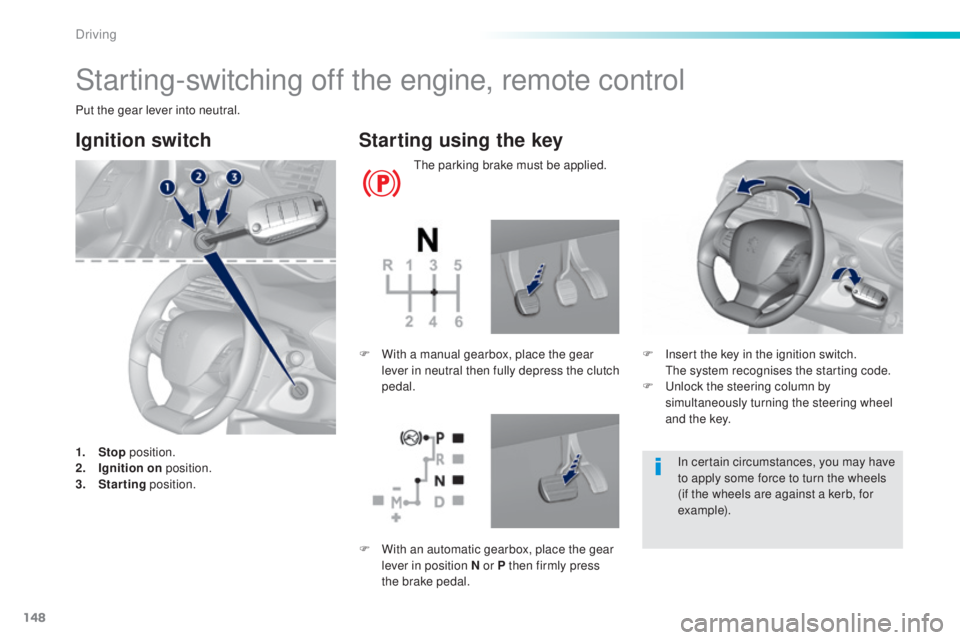
Ignition switch
1. Stop p osition.
2. Ig nition on position.
3.
Sta
rting position.
Starting using the key
the parking brake must be applied.
F
In
sert the key in the ignition switch.
the s
ystem recognises the starting code.
F
u
nl
ock the steering column by
simultaneously turning the steering wheel
and the key.
F
Wi
th a manual gearbox, place the gear
lever in neutral then fully depress the clutch
pedal.
In certain circumstances, you may have
to apply some force to turn the wheels
(if the wheels are against a kerb, for
example).
F
Wi
th an automatic gearbox, place the gear
lever in position N or P then firmly press
the brake pedal.
Driving
Page 152 of 398
150
308_en_Chap06_conduite_ed02-2015
Avoid attaching heavy objects to the
key, which would weigh down on its
blade in the ignition switch and could
cause a malfunction.
Switching off the engine leads to a loss
of braking assistance.
Key left in the "Ignition on"
position
If the key has been left in the ignition switch
at position 2 (Ignition on)
, the ignition will
be switched off automatically after one hour.
to sw
itch the ignition back on, turn the
key to position 1 (Stop) , then back to
position
2 (
Ignition on) .
Never leave the engine running in
an enclosed area without adequate
ventilation: internal combustion
engines emit toxic exhaust gases,
such as carbon monoxide. Danger of
intoxication and death.
In very severe wintry conditions
(temperatures below -23°C), to ensure
the correct operation and the durability
of the mechanical components of your
vehicle, the engine and gearbox, it is
necessary to leave the engine running
for 4 minutes before moving off. F Immo
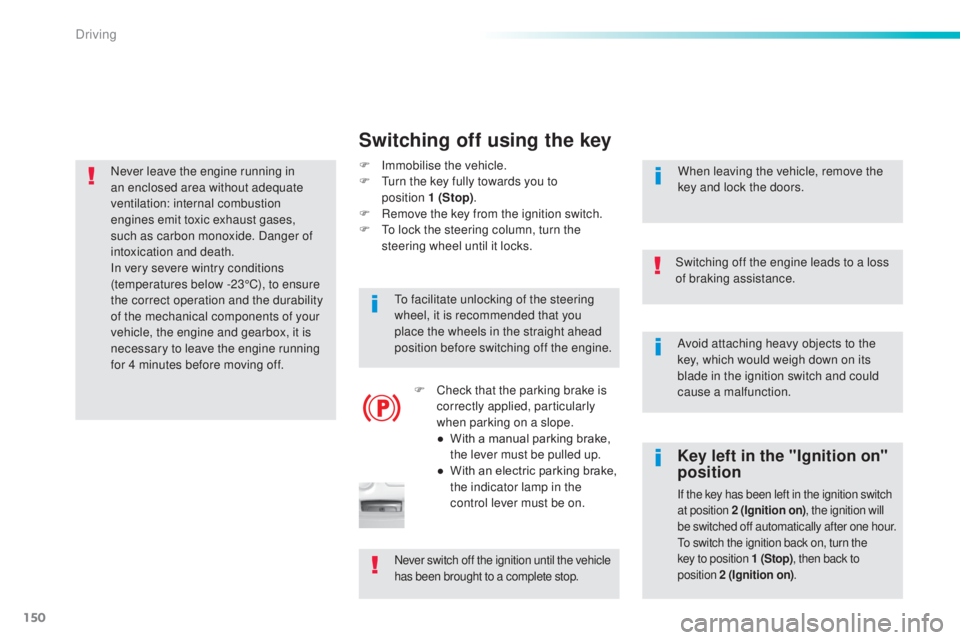
bilise the vehicle.
F tur n the key fully towards you to
position
1 (
Stop).
F
Re
move the key from the ignition switch.
F
t
o lo
ck the steering column, turn the
steering wheel until it locks.
Switching off using the key
to facilitate unlocking of the steering
w heel, it is recommended that you
place the wheels in the straight ahead
position before switching off the engine.
F
Ch
eck that the parking brake is
correctly applied, particularly
when parking on a slope.
●
Wi
th a manual parking brake,
the lever must be pulled up.
●
Wi
th an electric parking brake,
the indicator lamp in the
control lever must be on. When leaving the vehicle, remove the
key and lock the doors.
Never switch off the ignition until the vehicle
has been brought to a complete stop.
Driving
Page 158 of 398
156
308_en_Chap06_conduite_ed02-2015
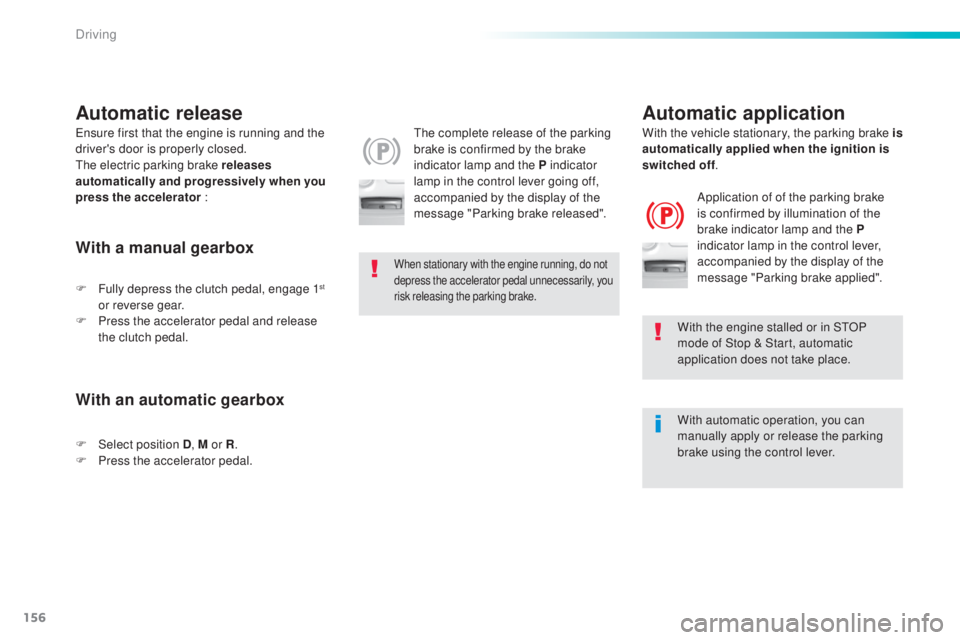
Automatic release
the complete release of the parking
b rake is confirmed by the brake
indicator lamp and the P indicator
lamp in the control lever going off,
accompanied by the display of the
message "Parking brake released".
When stationary with the engine running, do not
depress the accelerator pedal unnecessarily, you
risk releasing the parking brake.
Automatic application
Application of of the parking brake
is confirmed by illumination of the
brake indicator lamp and the P
indicator lamp in the control lever,
accompanied by the display of the
message "Parking brake applied".
With the engine stalled or in S
tOP
m
ode of Stop & Start, automatic
application does not take place.
With automatic operation, you can
manually apply or release the parking
brake using the control lever.
ens
ure first that the engine is running and the
driver's door is properly closed.
the e
lectric parking brake releases
automatically and progressively when you
press the accelerator : With the vehicle stationary, the parking brake is
automatically applied when the ignition is
switched off
.
With a manual gearbox
F Fully depress the clutch pedal, engage 1st
or reverse gear.
F
Pr
ess the accelerator pedal and release
the clutch pedal.
With an automatic gearbox
F Select position D , M or R.
F Pr ess the accelerator pedal.
Driving
Page 161 of 398
159
308_en_Chap06_conduite_ed02-2015
Emergency braking
In the event of a failure of the main service
brake or in an exceptional situation (e.g. driver
taken ill, under instruction, etc) a continuous
pull on the control lever will brake the vehicle.
Braking takes place while the control lever is
being pulled. It is interrupted if the control lever
is released.
the A
BS and DSC systems provide stability of
the vehicle during emergency braking.
If the emergency braking malfunctions, the
message "Parking brake control faulty" will be
displayed.
the em
ergency braking should only be
used in an exceptional situation.
Repeat this procedure to reactivate automatic
operation.
Reactivation of automatic operation is
confirmed by the indicator lamp in the
instrument panel going off.
Deactivating automatic operation
In some situations, such as very cold weather
or towing (caravan, recovery), it may be
necessary to deactivate automatic operation of
the system.
F
St
art the engine.
F
Ap
ply the parking brake with the control
lever, if it is released.
F
t
ak
e your foot off the brake pedal.
F
Pu
sh and hold the control lever in the
release direction for at least 10 seconds
and no more than 15 seconds.
F
Re
lease the control lever.
F
Pr
ess and hold the brake pedal.
F
Pu
ll the control lever in the apply direction
for 2 seconds.
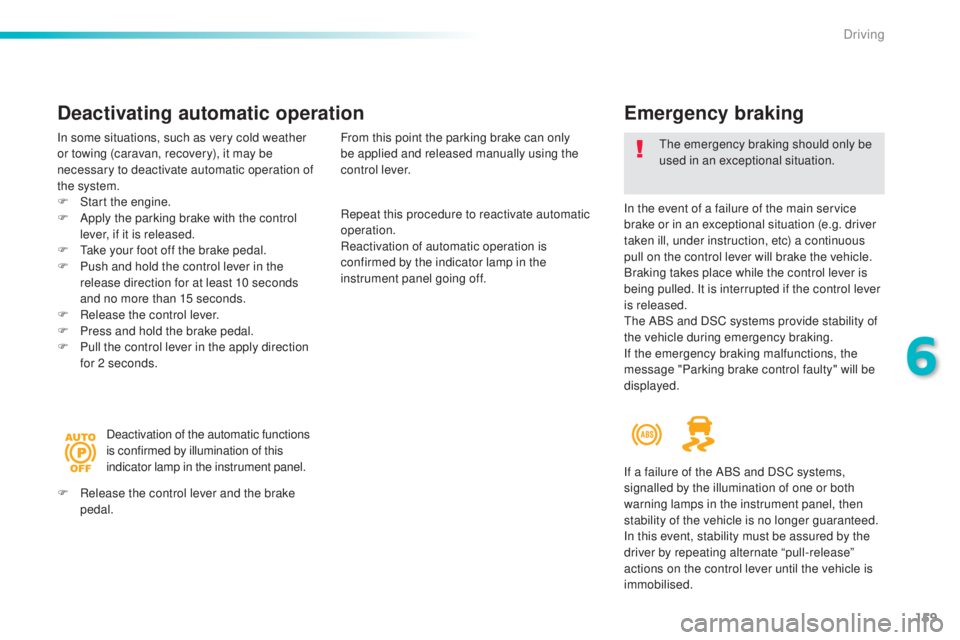
Deactivation of the automatic functions
is confirmed by illumination of this
indicator lamp in the instrument panel.
F
Re
lease the control lever and the brake
pedal. From this point the parking brake can only
be applied and released manually using the
control lever.
If a failure of the ABS and DSC systems,
signalled by the illumination of one or both
warning lamps in the instrument panel, then
stability of the vehicle is no longer guaranteed.
In this event, stability must be assured by the
driver by repeating alternate “pull-release”
actions on the control lever until the vehicle is
immobilised.
6
Driving
Page 162 of 398
160
308_en_Chap06_conduite_ed02-2015
Operating faults
the various alert situations are described in this table.
I n the event of a fault with the electric parking brake it is recommended that you contact a Peu geOt d ealer or a qualified workshop without delay.
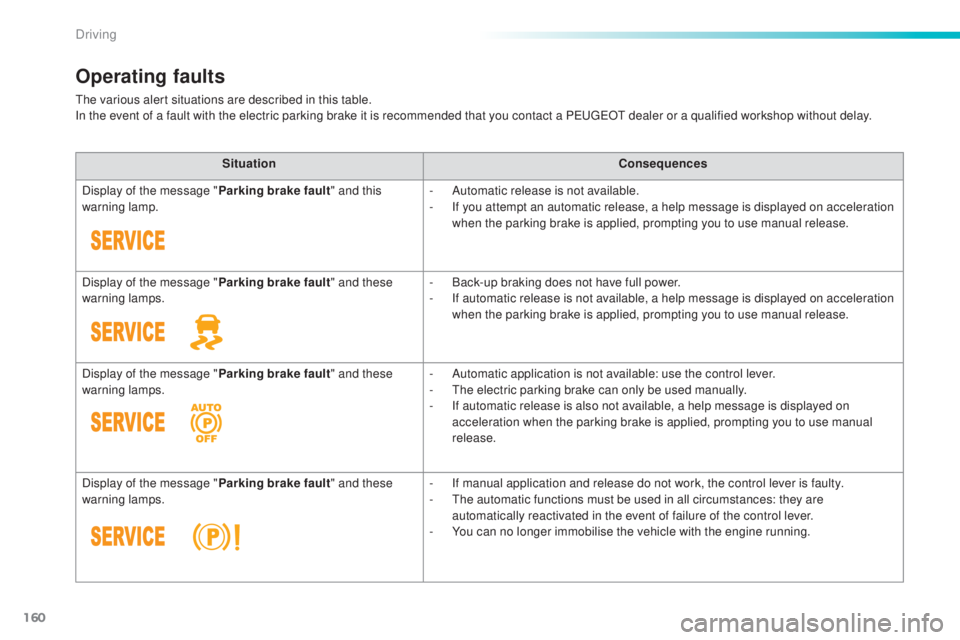
Situation Consequences
Display of the message " Parking brake fault" and this
warning lamp. -
Au
tomatic release is not available.
-
If y
ou attempt an automatic release, a help message is displayed on acceleration
when the parking brake is applied, prompting you to use manual release.
Display of the message " Parking brake fault" and these
warning lamps. -
Ba
ck-up braking does not have full power.
-
If a
utomatic release is not available, a help message is displayed on acceleration
when the parking brake is applied, prompting you to use manual release.
Display of the message " Parking brake fault" and these
warning lamps. -
Au
tomatic application is not available: use the control lever.
-
t
he e
lectric parking brake can only be used manually.
-
If a
utomatic release is also not available, a help message is displayed on
acceleration when the parking brake is applied, prompting you to use manual
release.
Display of the message " Parking brake fault" and these
warning lamps. -
If m
anual application and release do not work, the control lever is faulty.
-
t
he a
utomatic functions must be used in all circumstances: they are
automatically reactivated in the event of failure of the control lever.
-
Yo
u can no longer immobilise the vehicle with the engine running.
Driving
Page 163 of 398
161
308_en_Chap06_conduite_ed02-2015
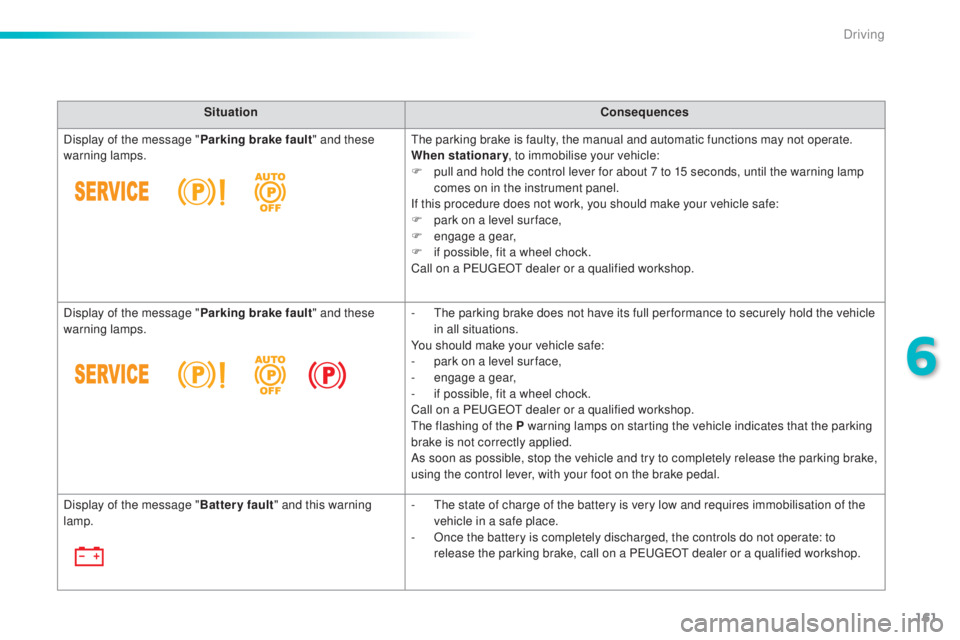
SituationConsequences
Display of the message " Parking brake fault" and these
warning lamps.
the p
arking brake is faulty, the manual and automatic functions may not operate.
When stationary , to immobilise your vehicle:
F
pu
ll and hold the control lever for about 7 to 15 seconds, until the warning lamp
comes on in the instrument panel.
If this procedure does not work, you should make your vehicle safe:
F
pa
rk on a level sur face,
F
engag
e a gear,
F
if p
ossible, fit a wheel chock.
Call on a P
eu
ge
Ot d
ealer or a qualified workshop.
Display of the message " Parking brake fault" and these
warning lamps. -
t
he p
arking brake does not have its full per formance to securely hold the vehicle
in all situations.
You should make your vehicle safe:
-
pa
rk on a level sur face,
-
engag
e a gear,
-
if p
ossible, fit a wheel chock.
Call on a P
eu
ge
Ot d
ealer or a qualified workshop.
the f
lashing of the P warning lamps on starting the vehicle indicates that the parking
brake is not correctly applied.
As soon as possible, stop the vehicle and try to completely release the parking brake,
using the control lever, with your foot on the brake pedal.
Display of the message " Battery fault" and this warning
lamp. -
t
he s
tate of charge of the battery is very low and requires immobilisation of the
vehicle in a safe place.
-
On
ce the battery is completely discharged, the controls do not operate: to
release the parking brake, call on a P
eu
ge
Ot d
ealer or a qualified workshop.
6
Driving
Page 164 of 398
162
308_en_Chap06_conduite_ed02-2015
Hill start assist
System which keeps your vehicle immobilised
temporarily (approximately 2 seconds) when
starting on a gradient, the time it takes to move your
foot from the brake pedal to the accelerator pedal.
this system is either not available or is
s tandard.
It only operates when:
-
th
e vehicle is completely stationary, with
your foot on the brake pedal,
-
pa
rticular conditions on a slope are met,
-
wi
th the driver’s door closed.
thi
s hill start assist system cannot be
deactivated.
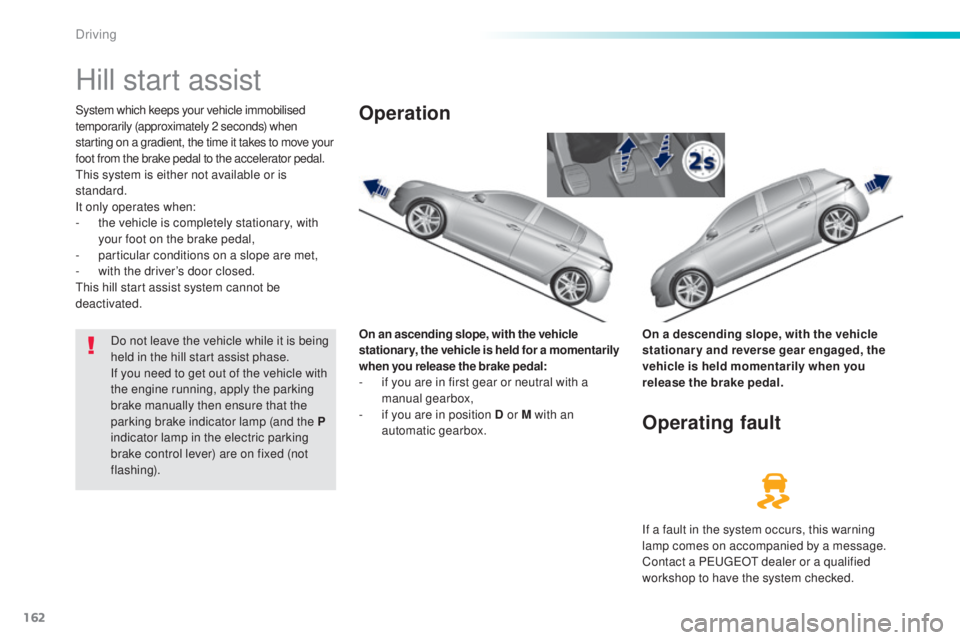
On an ascending slope, with the vehicle
stationary, the vehicle is held for a momentarily
when you release the brake pedal:
-
if y
ou are in first gear or neutral with a
manual gearbox,
-
if y
ou are in position D or M with an
automatic gearbox.
Operation
On a descending slope, with the vehicle
stationary and reverse gear engaged, the
vehicle is held momentarily when you
release the brake pedal.
Operating fault
If a fault in the system occurs, this warning
lamp comes on accompanied by a message.
Contact a P
eu
ge
Ot d
ealer or a qualified
workshop to have the system checked.
Do not leave the vehicle while it is being
held in the hill start assist phase.
If you need to get out of the vehicle with
the engine running, apply the parking
brake manually then ensure that the
parking brake indicator lamp (and the
P
indicator lamp in the electric parking
brake control lever) are on fixed (not
flashing).
Driving
Page 167 of 398
165
308_en_Chap06_conduite_ed02-2015
Automatic gearbox
Six speed automatic gearbox which offers a
choice between the comfort of fully automatic
operation, enhanced by sport and snow
programmes, or manual gear changing.
two d
riving modes are offered:
-
au
tomatic operation for electronic
management of the gears by the gearbox,
●
wi
th the sport programme for a more
dynamic style of driving,
●
or t
he snow programme to improve
driving when traction is poor,
-
man
ual operation for sequential changing
of the gears by the driver.
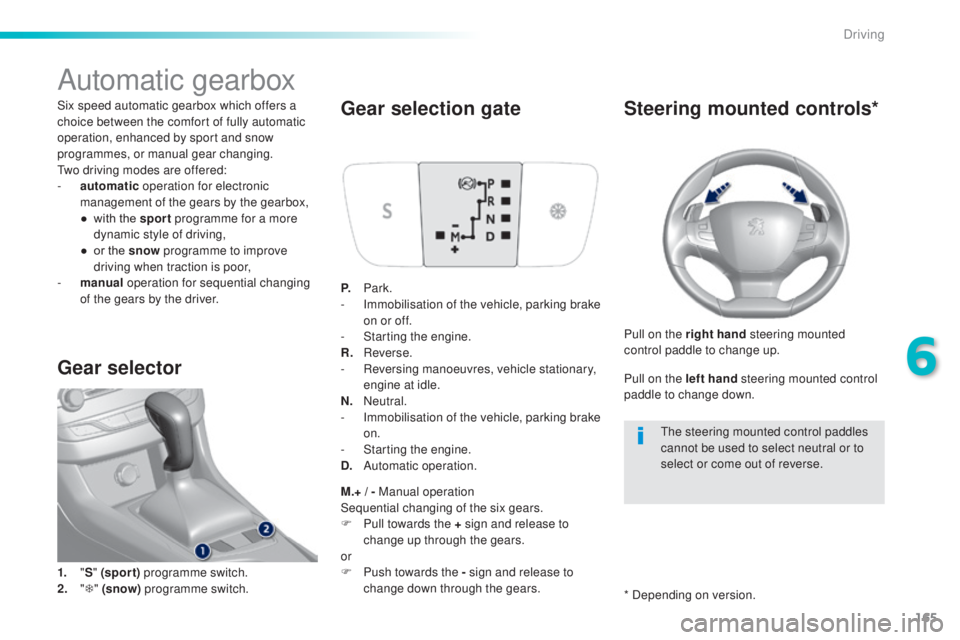
Gear selector
1. " S " (spor t) programme switch.
2. " T " (s
now) programme switch.
Gear selection gate
P. Park.
- Im
mobilisation of the vehicle, parking brake
on or off.
-
St
arting the engine.
R.
Re
verse.
-
Re
versing manoeuvres, vehicle stationary,
engine at idle.
N.
Ne
utral.
-
Im
mobilisation of the vehicle, parking brake
on.
-
St
arting the engine.
D.
Au
tomatic operation.
M.+ / - Manual operation
Sequential changing of the six gears.
F
Pu
ll towards the + sign and release to
change up through the gears.
or
F
Pu
sh towards the - sign and release to
change down through the gears.
Steering mounted controls*
Pull on the right hand steering mounted
control paddle to change up.
Pull on the left hand steering mounted control
paddle to change down.
the s
teering mounted control paddles
cannot be used to select neutral or to
select or come out of reverse.
* Depending on version.
6
Driving
Page 168 of 398
166
308_en_Chap06_conduite_ed02-2015
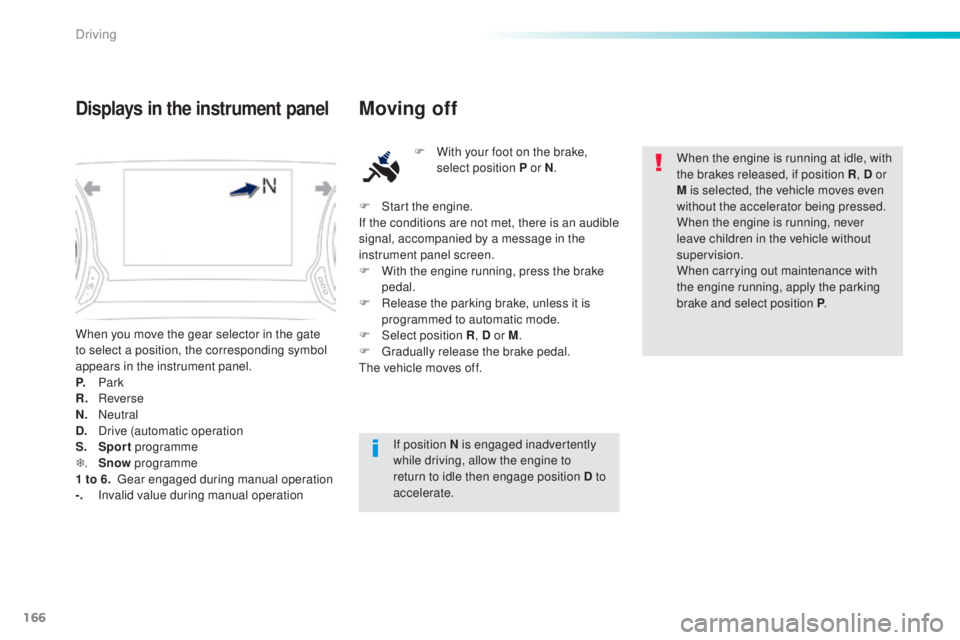
When you move the gear selector in the gate
to select a position, the corresponding symbol
appears in the instrument panel.
P.
Pa
rk
R.
Re
verse
N.
Ne
utral
D.
Dr
ive (automatic operation
S.
Sp
ort programme
T .
Sn
ow programme
1 to 6.
g
ear
engaged during manual operation
-.
In
valid value during manual operation
Displays in the instrument panelMoving off
F With your foot on the brake,
select position P or N .
If position N is engaged inadvertently
while driving, allow the engine to
return to idle then engage position D to
accelerate. When the engine is running at idle, with
the brakes released, if position R
, D or
M is selected, the vehicle moves even
without the accelerator being pressed.
When the engine is running, never
leave children in the vehicle without
supervision.
When carrying out maintenance with
the engine running, apply the parking
brake and select position P .
F
St
art the engine.
If the conditions are not met, there is an audible
signal, accompanied by a message in the
instrument panel screen.
F
Wi
th the engine running, press the brake
pedal.
F
Re
lease the parking brake, unless it is
programmed to automatic mode.
F
Selec
t position R , D or M.
F
g
rad
ually release the brake pedal.
the v
ehicle moves off.
Driving
Page 169 of 398
167
308_en_Chap06_conduite_ed02-2015
Automatic operation
Never select position N while the
vehicle is moving.
Never select positions P or R unless the
vehicle is completely stationary.
Sport and snow programmes
these two special programmes supplement the
a utomatic operation in very specific conditions
of use.
S appears in the instrument panel.
Snow "T"
F Press the " T" s witch, after starting the
engine.
the g
earbox adapts to driving on slippery
roads.
thi
s programme improves starting and drive
when traction is poor. T appears in the instrument panel.
Return to automatic operation
F At any time, press the button selected
(
S or " T") again at any time to quit the
programme engaged and return to auto-
adaptive mode.
Creep function (moving
without using the
accelerator)
this function provides great flexibility in
m anoeuvring the vehicle at low speed (when
parking, in traffic jams, …).
With the engine at idle, parking brake released
and position D , M or R selected, the vehicle
moves
a
s soon as you take your foot off
the brake pedal (even without pressing the
accelerator).
For your safety, this function will be activated
only if you press the brake pedal when
changing from forward drive to reverse.
It is deactivated on opening the driver's door.
Closing the door then pressing the brake or
accelerator pedal, reactivates the function.
Never leave children inside the vehicle
without supervision when the engine is
running.
If you vehicle is equipped with the "Dynamic
function", refer to the section covering this,
which is part of sport mode.
F
Selec
t position D for automatic
changing
of the six gears.the g
earbox then operates in auto-adaptive
mode, without any intervention on the part
of the driver. It continuously selects the most
suitable gear according to the style of driving,
the profile of the road and the load in the
vehicle.
For maximum acceleration, without touching
the gear selector press the accelerator pedal
down fully (kick-down).
the g
earbox changes
down automatically or maintains the gear
selected until the maximum engine speed is
reached.
On braking, the gearbox changes down
automatically to provide efficient engine
braking.
If you release the accelerator sharply, the
gearbox will not change to a higher gear for
safety reasons.Sport "S"
F Press the "S" s witch, after starting the engine.the g
earbox automatically favours a dynamic style
of driving.
6
Driving