service Peugeot 308 2016 User Guide
[x] Cancel search | Manufacturer: PEUGEOT, Model Year: 2016, Model line: 308, Model: Peugeot 308 2016Pages: 398, PDF Size: 9.38 MB
Page 56 of 398
54
308_en_Chap02_ouvertures_ed02-2015
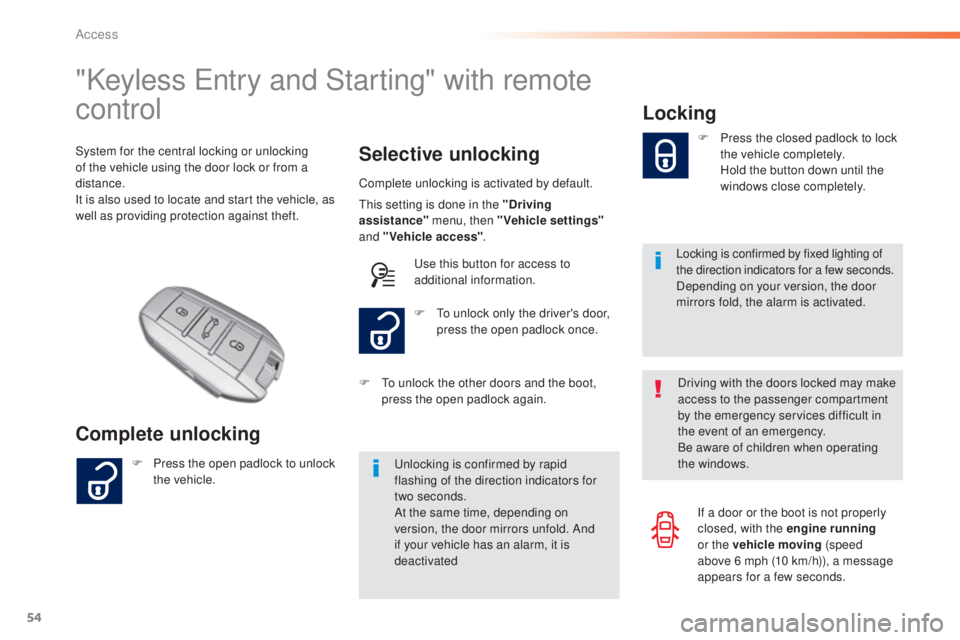
"Keyless entry and Starting" with remote
control
Complete unlocking Selective unlocking
System for the central locking or unlocking
of the vehicle using the door lock or from a
distance.
It is also used to locate and start the vehicle, as
well as providing protection against theft.
Complete unlocking is activated by default.
unl
ocking is confirmed by rapid
flashing of the direction indicators for
two
se
conds.
At the same time, depending on
version, the door mirrors unfold. And
if your vehicle has an alarm, it is
deactivated F
t
o un
lock only the driver's door,
press the open padlock once.
F
Pr
ess the open padlock to unlock
the vehicle. F
t
o un
lock the other doors and the boot,
press the open padlock again.
thi
s setting is done in the "Driving
assistance" menu, then "Vehicle settings"
and "Vehicle access" .
use t
his button for access to
additional information.
Locking
Locking is confirmed by fixed lighting of
the direction indicators for a few s econds.
Depending on your version, the door
mirrors fold, the alarm is activated. F
Pr
ess the closed padlock to lock
the vehicle completely.
Ho
ld the button down until the
windows close completely.
Driving with the doors locked may make
access to the passenger compartment
by the emergency services difficult in
the event of an emergency.
Be aware of children when operating
the windows. If a door or the boot is not properly
closed, with the engine running
or the vehicle moving (speed
above 6
m
ph (10 km/h)), a message
appears for a few seconds.
Access
Page 65 of 398
63
308_en_Chap02_ouvertures_ed02-2015
Lost keys, remote control, electronic key
Visit a PeugeOt dealer with the vehicle's registration certificate, your personal identification documents and if possible, the label bearing the
key code.
the Peu
ge
Ot d
ealer will be able to retrieve the key code and the transponder code required to order a new key
Remote control
the high frequency remote control is a sensitive system; do not operate it while it is in your pocket as there is a possibility that it may unlock the
v ehicle, without you being aware of it.
Do not repeatedly press the buttons of your remote control out of range and out of sight of your vehicle. You run the risk of stopping it from
working and the remote control would have to be reinitialised.
the r
emote control does not operate when the key is in the ignition, even when the ignition is switched off.
Locking the vehicle
Driving with the doors locked may make access to the passenger compartment by the emergency services more difficult in an emergency.
As a safety precaution (with children on board), remove the key from the ignition or take the electronic key when you leave the vehicle, even for
a short time.
Electrical interference
the Keyless ent ry and Starting electronic key may not operate if close to certain electronic devices: telephone, laptop computer, strong
magnetic fields, ...
Anti-theft protection
Do not make any modifications to the electronic engine immobiliser system; this could cause malfunctions.
Don't forget to turn the steering to engage the steering lock.
When purchasing a second-hand vehicle
Have the key codes memorised by a Peu geOt d ealer, to ensure that the keys in your possession are the only ones which can start the vehicle.
2
Access
Page 66 of 398
64
308_en_Chap02_ouvertures_ed02-2015
Locking/ unlocking from the inside
After unlocking, if no door is opened
within 30 seconds, the doors lock again
automatically.If the vehicle is deadlocked or locked
with the remote control or the door
handles, the button is not active. In this
case, use the key or the remote control
to unlock. Driving with the doors locked may make
access to the passenger compartment
by the emergency services more
difficult in an emergency.
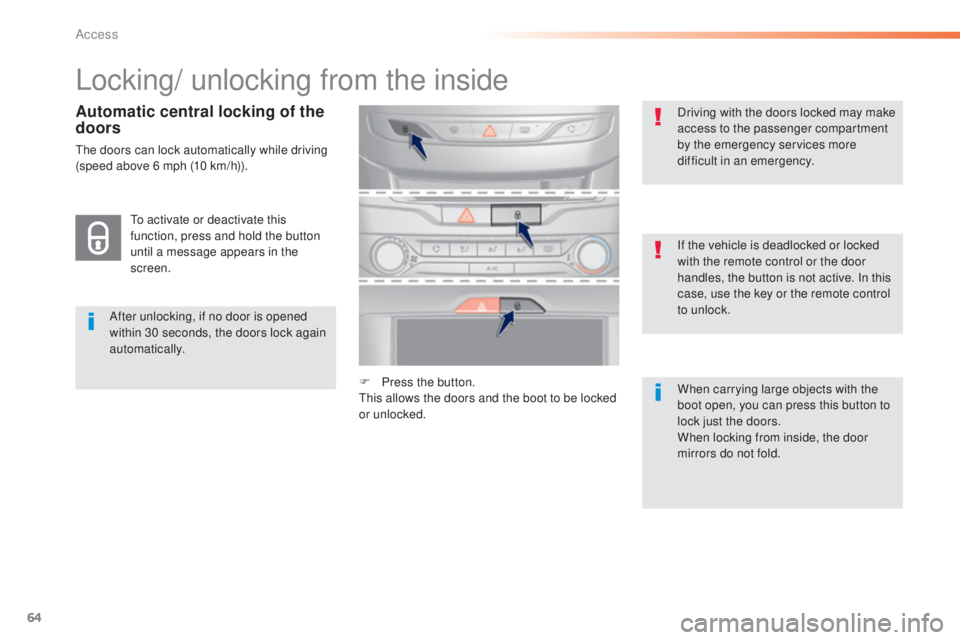
F
Pr
ess the button.
thi
s allows the doors and the boot to be locked
or unlocked. When carrying large objects with the
boot open, you can press this button to
lock just the doors.
When locking from inside, the door
mirrors do not fold.
to ac
tivate or deactivate this
function, press and hold the button
until a message appears in the
screen.
Automatic central locking of the
doors
the doors can lock automatically while driving
( speed above 6 mph (10 km/h)).
Access
Page 121 of 398
119
308_en_Chap05_securite_ed02-2015
Automatic operation of
hazard warning lamps
Hazard warning lamps
When braking in an emergency, depending on
the rate of deceleration, as well as when the
ABS regulation is invoked or in the event of an
impact, the hazard warning lamps come on
automatically.
the
y switch off automatically the first time you
accelerate.
F
Yo
u can also switch them off by pressing
the button.
emergency or
a ssistance call
this system allows you to make an emergency
o r assistance call to the emergency services or
to the dedicated P
eu
ge
Ot s
ervice.
For more information on the use of this
function, refer to the "Audio equipment
and telematics" section.
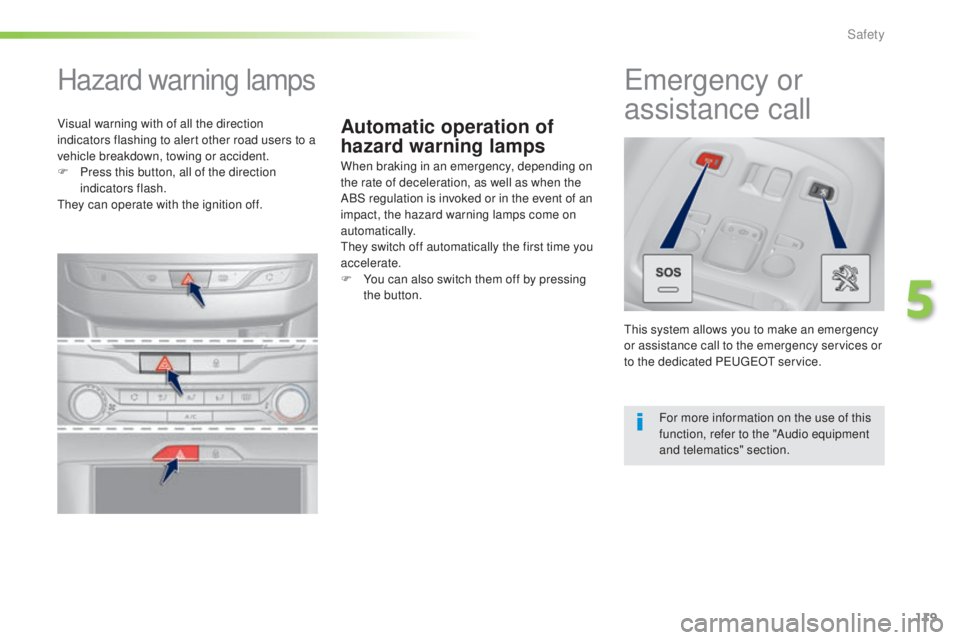
Visual warning with of all the direction
indicators flashing to alert other road users to a
vehicle breakdown, towing or accident.
F
Pr
ess this button, all of the direction
indicators flash.
the
y can operate with the ignition off.
5
Safety
Page 161 of 398
159
308_en_Chap06_conduite_ed02-2015
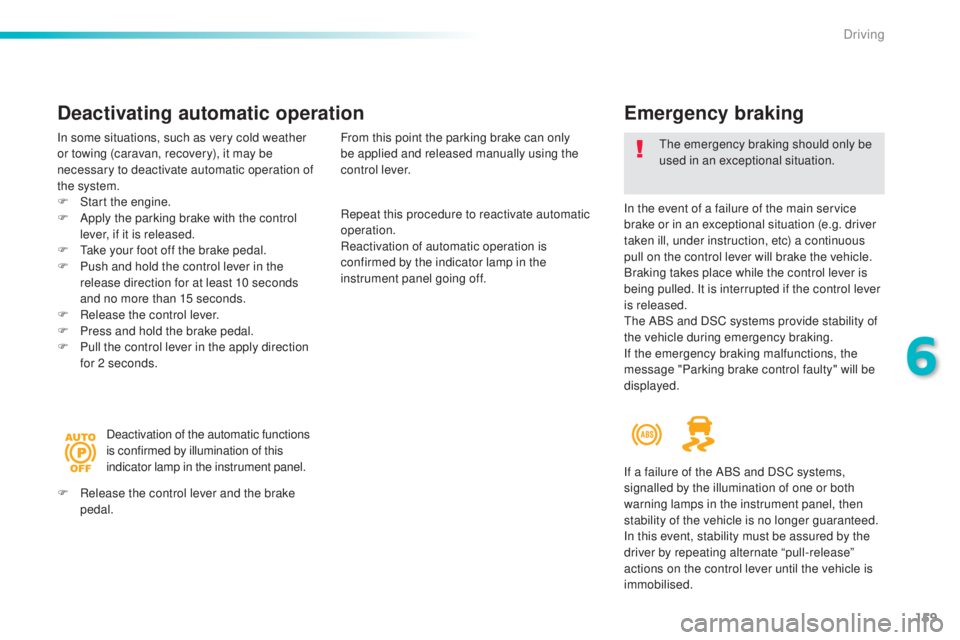
Emergency braking
In the event of a failure of the main service
brake or in an exceptional situation (e.g. driver
taken ill, under instruction, etc) a continuous
pull on the control lever will brake the vehicle.
Braking takes place while the control lever is
being pulled. It is interrupted if the control lever
is released.
the A
BS and DSC systems provide stability of
the vehicle during emergency braking.
If the emergency braking malfunctions, the
message "Parking brake control faulty" will be
displayed.
the em
ergency braking should only be
used in an exceptional situation.
Repeat this procedure to reactivate automatic
operation.
Reactivation of automatic operation is
confirmed by the indicator lamp in the
instrument panel going off.
Deactivating automatic operation
In some situations, such as very cold weather
or towing (caravan, recovery), it may be
necessary to deactivate automatic operation of
the system.
F
St
art the engine.
F
Ap
ply the parking brake with the control
lever, if it is released.
F
t
ak
e your foot off the brake pedal.
F
Pu
sh and hold the control lever in the
release direction for at least 10 seconds
and no more than 15 seconds.
F
Re
lease the control lever.
F
Pr
ess and hold the brake pedal.
F
Pu
ll the control lever in the apply direction
for 2 seconds.
Deactivation of the automatic functions
is confirmed by illumination of this
indicator lamp in the instrument panel.
F
Re
lease the control lever and the brake
pedal. From this point the parking brake can only
be applied and released manually using the
control lever.
If a failure of the ABS and DSC systems,
signalled by the illumination of one or both
warning lamps in the instrument panel, then
stability of the vehicle is no longer guaranteed.
In this event, stability must be assured by the
driver by repeating alternate “pull-release”
actions on the control lever until the vehicle is
immobilised.
6
Driving
Page 196 of 398
194
308_en_Chap06_conduite_ed02-2015
Operating fault
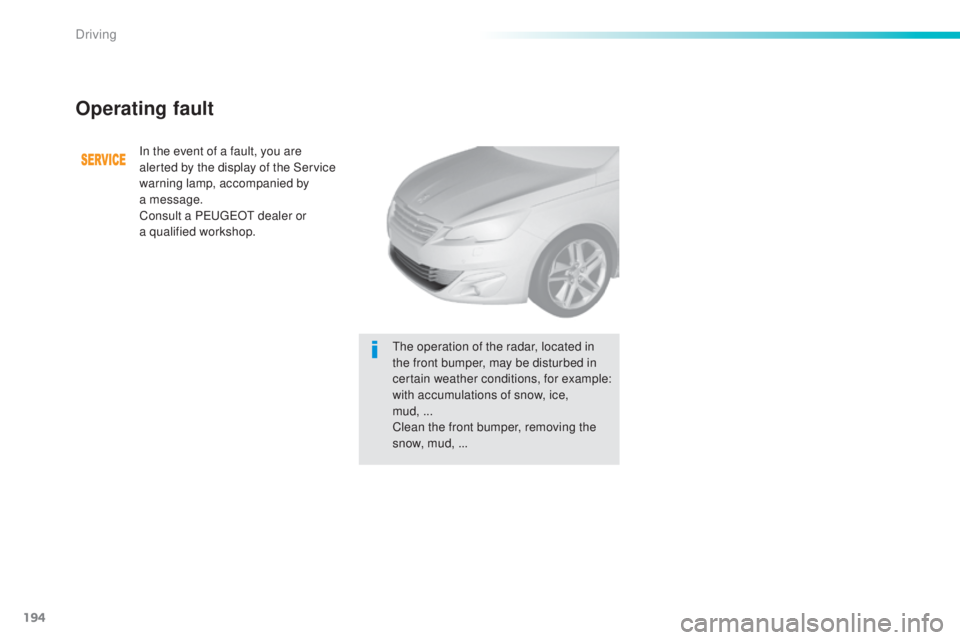
In the event of a fault, you are
alerted by the display of the Service
warning lamp, accompanied by
a
m
essage.
Consult a P
eu
ge
Ot d
ealer or
a
q
ualified workshop.
the o
peration of the radar, located in
the front bumper, may be disturbed in
certain weather conditions, for example:
with accumulations of snow, ice,
mud,
...
C
lean the front bumper, removing the
snow, mud, ...
Driving
Page 214 of 398
212
308_en_Chap06_conduite_ed02-2015
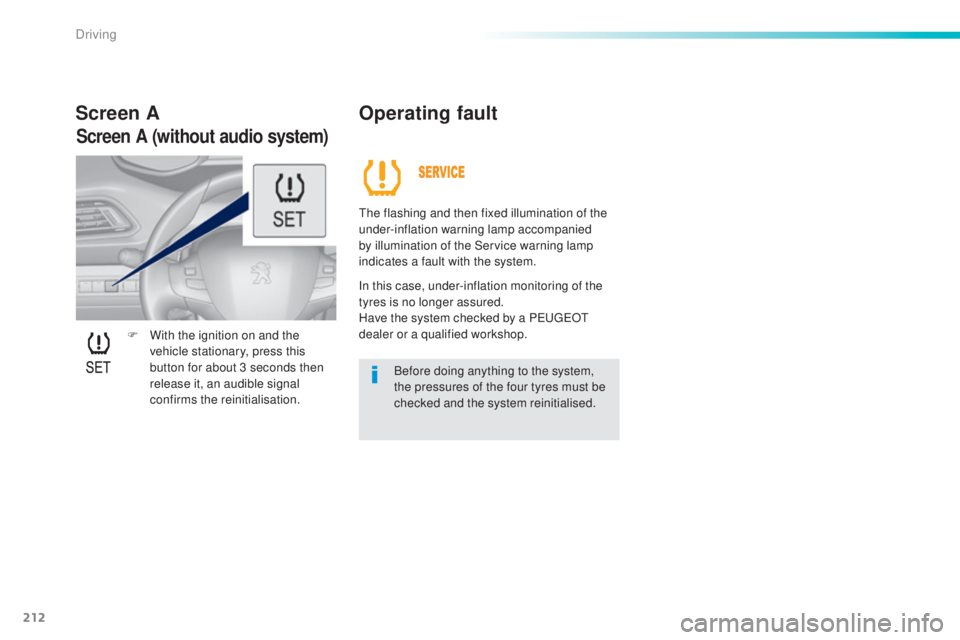
F With the ignition on and the
vehicle stationary, press this
button for about 3 seconds then
release it, an audible signal
confirms the reinitialisation.
Screen A Operating fault
the flashing and then fixed illumination of the
u nder-inflation warning lamp accompanied
by illumination of the Service warning lamp
indicates a fault with the system.
In this case, under-inflation monitoring of the
tyres is no longer assured.
Have the system checked by a P
eu
ge
Ot
d
ealer or a qualified workshop. Before doing anything to the system,
the pressures of the four tyres must be
checked and the system reinitialised.
Screen A (without audio system)
Driving
Page 231 of 398
229
308_en_Chap07_info-pratiques_ed02-2015
Checking levels
take care when working under the bonnet, as certain areas of the engine may be extremely hot (risk of burns) and the cooling fan could start at
a ny time (even with the ignition off).
Engine oil level
the check is carried out either when
t he ignition is switched on using the
oil level indicator in the instrument
panel for vehicles so equipped, or
using the dipstick.Checking using the dipstick
F Locate the dipstick in the engine
c ompartment of your vehicle.
For more information on the petrol or Diesel
engine, refer to the corresponding section.
F
t
ak
e the dipstick by its coloured grip and
remove it completely.
F
Wi
pe the end of the dipstick using a clean
non-fluffy cloth.
F
Re
fit the dipstick and push fully down, then
pull it out again to make the visual check:
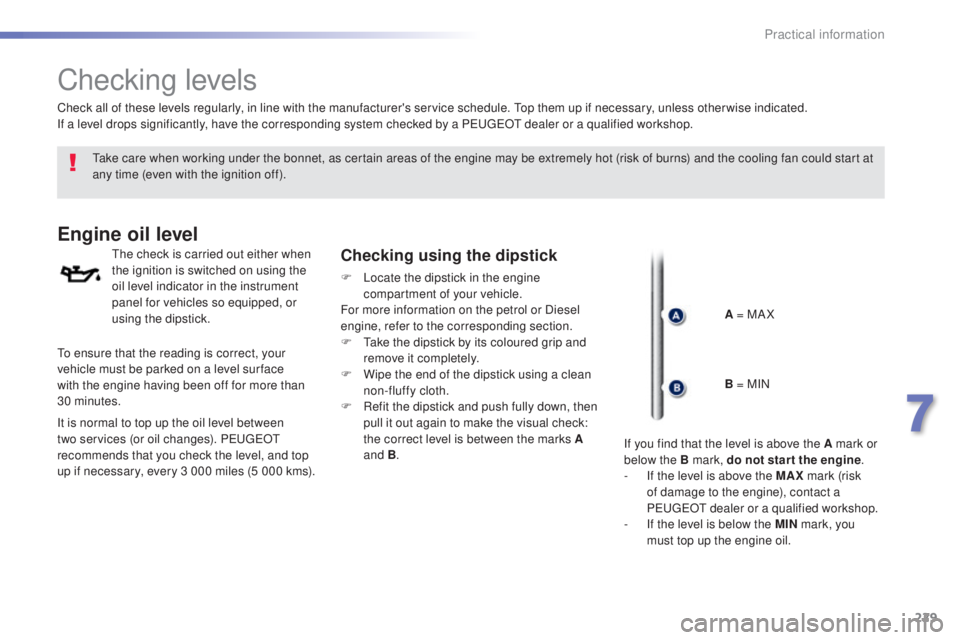
the correct level is between the marks A
and B .
Check all of these levels regularly, in line with the manufacturer's service schedule.
top t
hem up if necessary, unless other wise indicated.
If a level drops significantly, have the corresponding system checked by a P
eu
ge
Ot d
ealer or a qualified workshop.
A = MA X
to en
sure that the reading is correct, your
vehicle must be parked on a level sur face
with the engine having been off for more than
30
m
inutes.
It is normal to top up the oil level between
two services (or oil changes). P
eu
ge
Ot
r
ecommends that you check the level, and top
up if necessary, every 3 000 miles (5 000 kms). B = MIN
If you find that the level is above the A mark or
below the B mark, do not star t the engine .
-
If t
he level is above the MAX mark (risk
of damage to the engine), contact a
P
eu
ge
Ot d
ealer or a qualified workshop.
-
If t
he level is below the MIN mark, you
must top up the engine oil.
7
Practical information
Page 232 of 398
230
308_en_Chap07_info-pratiques_ed02-2015
Oil grade
Before topping-up the oil or changing the oil,
check that the oil is the correct grade for your
engine and conforms to the manufacturer's
recommendations.
Topping-up the engine oil level
F Locate the oil filler cap in the engine
compartment of your vehicle.
For more information on the petrol or Diesel
engine, refer to the corresponding section.
F
u
ns
crew the oil filler cap to reveal the filler
aperture.
F
Ad
d oil in small quantities, avoiding any
spills on engine components (risk of fire).
F
Wa
it a few minutes before checking the
level again using the dipstick.
F
Ad
d more oil if necessary.
F
Af
ter checking the level, carefully refit the
oil filler cap and the dipstick in its tube. After topping-up the oil, the check when
switching on the ignition with the oil
level indicator in the instrument panel
is not valid during the 30 minutes after
topping up.
Engine oil change
Refer to the manufacturer's service schedule
for details of the interval for this operation.
In order to maintain the reliability of the engine
and emission control system, never use
additives in the engine oil.
Practical information
Page 233 of 398
231
308_en_Chap07_info-pratiques_ed02-2015
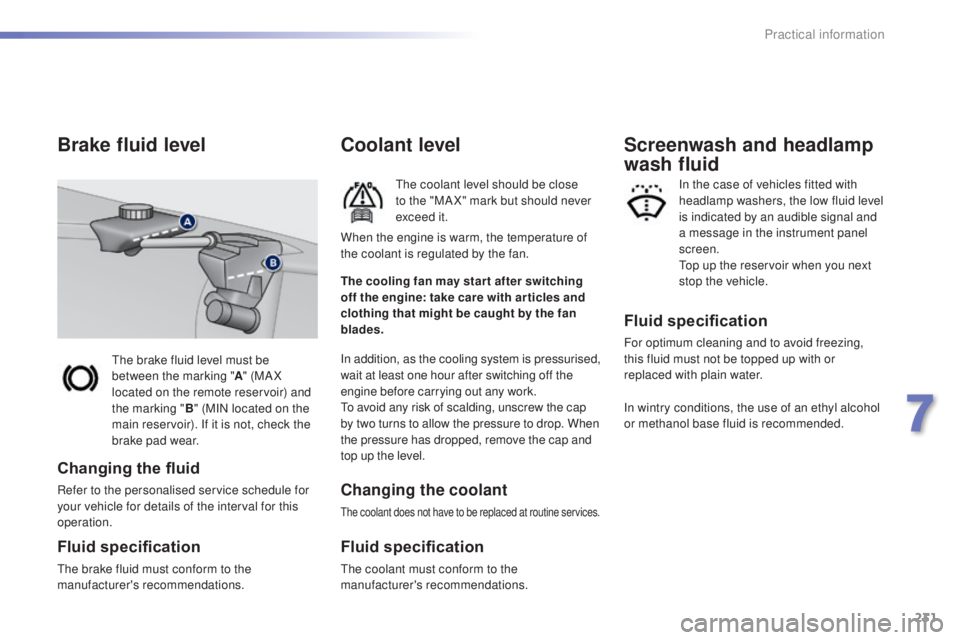
the brake fluid level must be
b etween the marking " A" (MA X
located on the remote reservoir) and
the marking " B" (MIN located on the
main reservoir). If it is not, check the
brake pad wear.
Brake fluid level
Changing the fluid
Refer to the personalised service schedule for
your vehicle for details of the interval for this
operation.
Fluid specification
the brake fluid must conform to the
ma nufacturer's recommendations.
Coolant level
the coolant level should be close
t o the "MA X" mark but should never
exceed it.
In addition, as the cooling system is pressurised,
wait at least one hour after switching off the
engine before carrying out any work.
to av
oid any risk of scalding, unscrew the cap
by two turns to allow the pressure to drop. When
the pressure has dropped, remove the cap and
top up the level.
Changing the coolant
the coolant does not have to be replaced at routine services.
Fluid specification
the coolant must conform to the
ma nufacturer's recommendations.
The cooling fan may star t after switching
off the engine: take care with ar ticles and
clothing that might be caught by the fan
blades. When the engine is warm, the temperature of
the coolant is regulated by the fan.
Fluid specification
For optimum cleaning and to avoid freezing,
this fluid must not be topped up with or
replaced with plain water.
Screenwash and headlamp
wash fluid
In the case of vehicles fitted with
headlamp washers, the low fluid level
is indicated by an audible signal and
a message in the instrument panel
screen.
top u
p the reservoir when you next
stop the vehicle.
In wintry conditions, the use of an ethyl alcohol
or methanol base fluid is recommended.
7
Practical information