electric Peugeot 308 2016 Owner's Guide
[x] Cancel search | Manufacturer: PEUGEOT, Model Year: 2016, Model line: 308, Model: Peugeot 308 2016Pages: 398, PDF Size: 9.38 MB
Page 162 of 398
160
308_en_Chap06_conduite_ed02-2015
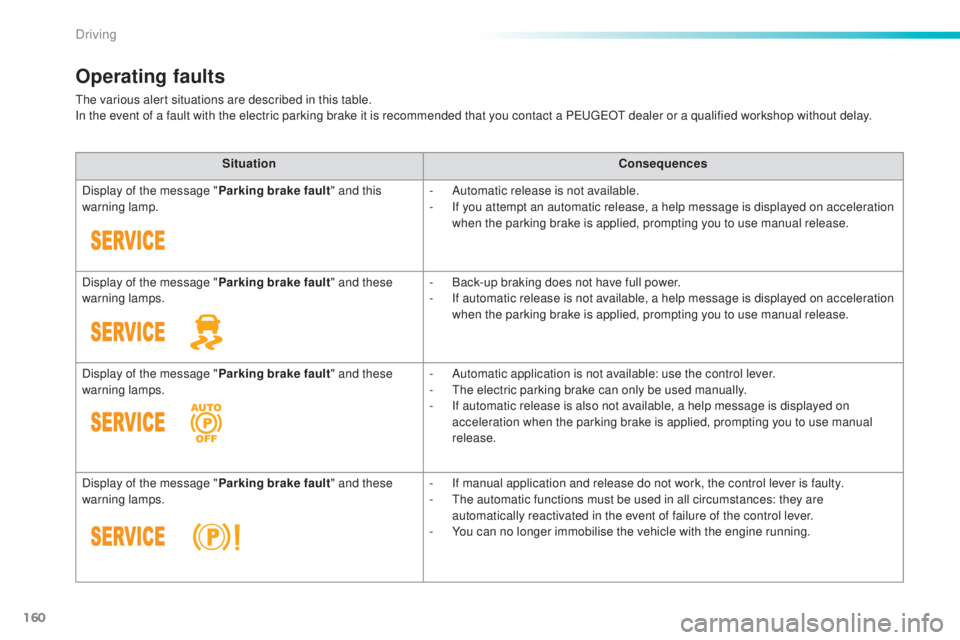
Operating faults
the various alert situations are described in this table.
I n the event of a fault with the electric parking brake it is recommended that you contact a Peu geOt d ealer or a qualified workshop without delay.
Situation Consequences
Display of the message " Parking brake fault" and this
warning lamp. -
Au
tomatic release is not available.
-
If y
ou attempt an automatic release, a help message is displayed on acceleration
when the parking brake is applied, prompting you to use manual release.
Display of the message " Parking brake fault" and these
warning lamps. -
Ba
ck-up braking does not have full power.
-
If a
utomatic release is not available, a help message is displayed on acceleration
when the parking brake is applied, prompting you to use manual release.
Display of the message " Parking brake fault" and these
warning lamps. -
Au
tomatic application is not available: use the control lever.
-
t
he e
lectric parking brake can only be used manually.
-
If a
utomatic release is also not available, a help message is displayed on
acceleration when the parking brake is applied, prompting you to use manual
release.
Display of the message " Parking brake fault" and these
warning lamps. -
If m
anual application and release do not work, the control lever is faulty.
-
t
he a
utomatic functions must be used in all circumstances: they are
automatically reactivated in the event of failure of the control lever.
-
Yo
u can no longer immobilise the vehicle with the engine running.
Driving
Page 164 of 398
162
308_en_Chap06_conduite_ed02-2015
Hill start assist
System which keeps your vehicle immobilised
temporarily (approximately 2 seconds) when
starting on a gradient, the time it takes to move your
foot from the brake pedal to the accelerator pedal.
this system is either not available or is
s tandard.
It only operates when:
-
th
e vehicle is completely stationary, with
your foot on the brake pedal,
-
pa
rticular conditions on a slope are met,
-
wi
th the driver’s door closed.
thi
s hill start assist system cannot be
deactivated.
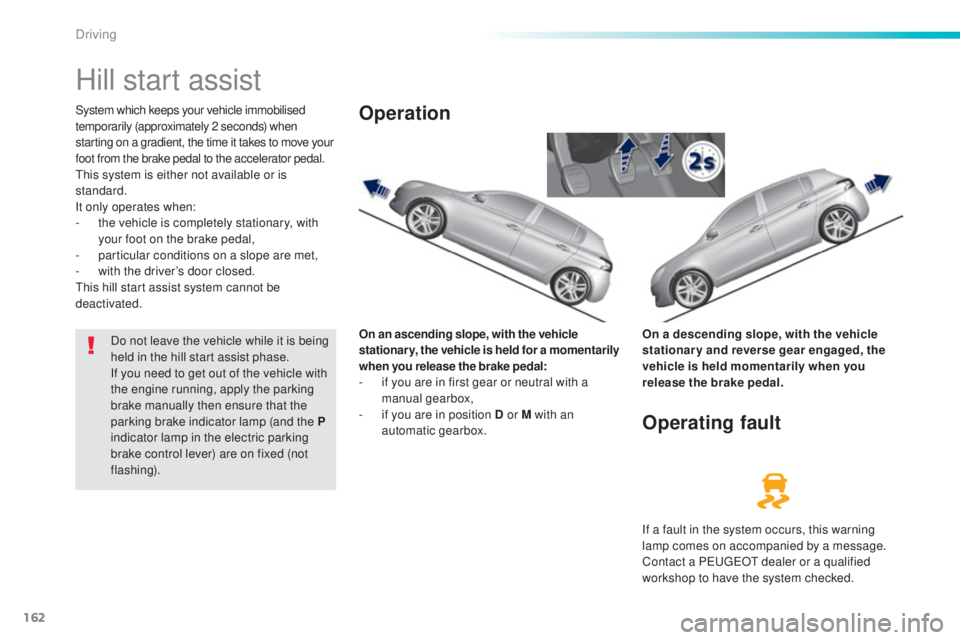
On an ascending slope, with the vehicle
stationary, the vehicle is held for a momentarily
when you release the brake pedal:
-
if y
ou are in first gear or neutral with a
manual gearbox,
-
if y
ou are in position D or M with an
automatic gearbox.
Operation
On a descending slope, with the vehicle
stationary and reverse gear engaged, the
vehicle is held momentarily when you
release the brake pedal.
Operating fault
If a fault in the system occurs, this warning
lamp comes on accompanied by a message.
Contact a P
eu
ge
Ot d
ealer or a qualified
workshop to have the system checked.
Do not leave the vehicle while it is being
held in the hill start assist phase.
If you need to get out of the vehicle with
the engine running, apply the parking
brake manually then ensure that the
parking brake indicator lamp (and the
P
indicator lamp in the electric parking
brake control lever) are on fixed (not
flashing).
Driving
Page 172 of 398
170
308_en_Chap06_conduite_ed02-2015
Stop & Start
Operation
Going into engine STOP mode
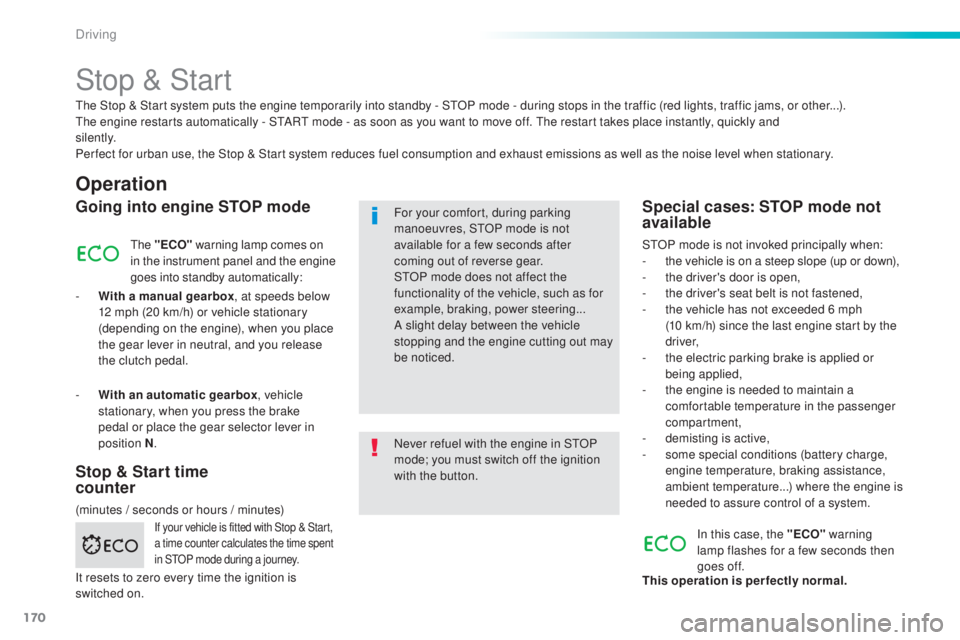
the "ECO" warning lamp comes on
in the instrument panel and the engine
goes into standby automatically:
-
Wi
th a manual gearbox , at speeds below
12 mph (20 km/h) or vehicle stationary
(depending on the engine), when you place
the gear lever in neutral, and you release
the clutch pedal.
Never refuel with the engine in S
tOP
m
ode; you must switch off the ignition
with the button. For your comfort, during parking
manoeuvres, S
tOP m
ode is not
available for a few seconds after
coming out of reverse gear.
S
tOP m
ode does not affect the
functionality of the vehicle, such as for
example, braking, power steering...
A slight delay between the vehicle
stopping and the engine cutting out may
be noticed.
Special cases: STOP mode not
available
StOP mode is not invoked principally when:
- th e vehicle is on a steep slope (up or down),
-
the
driver's door is open,
-
th
e driver's seat belt is not fastened,
-
th
e vehicle has not exceeded 6 mph
(10
k
m/h) since the last engine start by the
driver,
-
th
e electric parking brake is applied or
being applied,
-
th
e engine is needed to maintain a
comfortable temperature in the passenger
compartment,
-
dem
isting is active,
-
som
e special conditions (battery charge,
engine temperature, braking assistance,
ambient temperature...) where the engine is
needed to assure control of a system.
If your vehicle is fitted with Stop & Start,
a time counter calculates the time spent
in S
tOP m
ode during a journey.In this case, the "ECO" warning
lamp flashes for a few seconds then
goes
o
ff.
This operation is perfectly normal.
the S
top & Start
s
ystem puts the engine temporarily into standby - S
tOP m
ode - during stops in the traffic (red lights, traffic jams, or other...).
the e
ngine restarts automatically - S
tARt m
ode - as soon as you want to move off.
the r
estart takes place instantly, quickly and
silently.
Per fect for urban use, the Stop & Start system reduces fuel consumption and exhaust emissions as well as the noise level when stationary.
Stop & Start time
counter
(minutes / seconds or hours / minutes) -
Wi
th an automatic gearbox
, vehicle
stationary, when you press the brake
pedal or place the gear selector lever in
position
N .
I
t resets to zero every time the ignition is
switched on.
Driving
Page 173 of 398
171
308_en_Chap06_conduite_ed02-2015
Going into engine START mode
the "ECO" w arning lamp goes off
and the engine starts automatically:
-
Wi
th a manual gearbox , when you fully
depress the clutch pedal. StARt m
ode is invoked automatically
when:
Special cases: START invoked
automatically
- you open the driver's door,
- you unfasten the driver's seat belt,
-
th
e speed of the vehicle exceeds 15 mph
(25 km/h) or 2 mph (3 km/h) (depending on
the engine) with a manual gearbox,
-
th
e speed of the vehicle exceeds 2 mph
(3
k
m/h) with an automatic gearbox,
-
th
e electric parking brake is being applied,
-
som
e special conditions (battery charge,
engine temperature, braking assistance,
ambient temperature...) where the engine is
needed for control of a system. If the system has been deactivated
in S
tOP m
ode, the engine restarts
immediately.
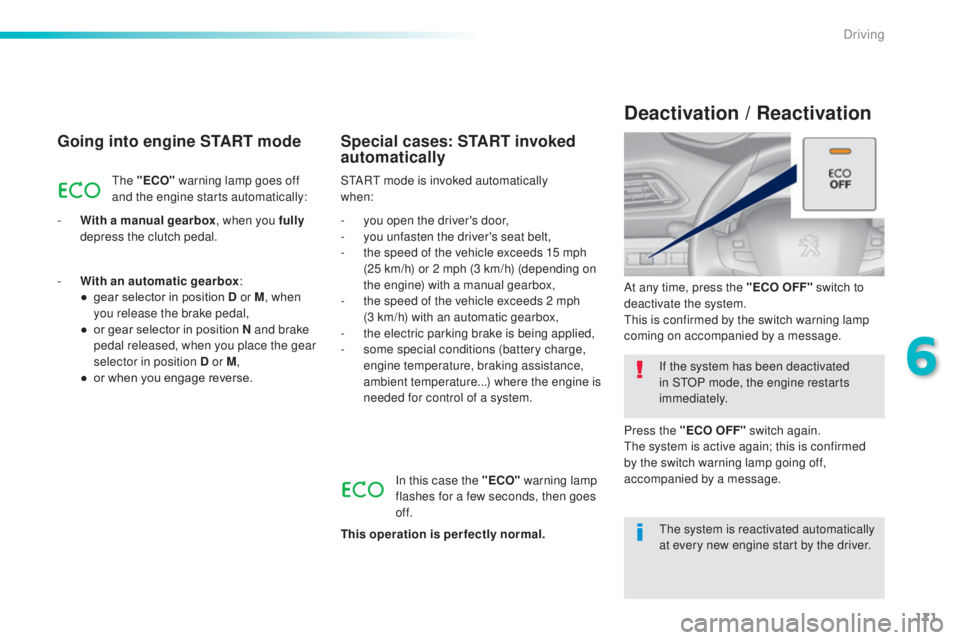
At any time, press the "ECO OFF" switch to
deactivate the system.
thi
s is confirmed by the switch warning lamp
coming on accompanied by a message.
Deactivation / Reactivation
In this case the "ECO" warning lamp
flashes for a few seconds, then goes
of f.
This operation is perfectly normal.
-
Wi
th an automatic gearbox
:
●
ge
ar selector in position D or M
, when
you release the brake pedal,
●
or g
ear selector in position N and brake
pedal released, when you place the gear
selector in position D or M ,
●
or w
hen you engage reverse.
the s
ystem is reactivated automatically
at every new engine start by the driver.
Press the "ECO OFF" switch again.
the s
ystem is active again; this is confirmed
by the switch warning lamp going off,
accompanied by a message.
6
Driving
Page 183 of 398
181
308_en_Chap06_conduite_ed02-2015
the active cruise control is switched on m anually,
it requires that the speed of the vehicle be between
25 mph (40 km/h) and 90 mph (150 km/h).
General points
the active cruise control can be paused
m anually with the control, or automatically:
-
by p
ressing the brake or clutch pedal,
-
in t
he event of operation of the
eS
C, for
safety reasons,
-
in t
he event of an action of the electric
parking brake control,
-
wh
en an inter-vehicle time threshold is
reached (calculated according to the
relative speeds of your vehicle and the
vehicle in front and the inter-vehicle time
setting chosen),
-
wh
en the distance between your vehicle
and the one in front becomes to small,
-
wh
en the speed of the vehicle in front is
to
l
ow,
-
wh
en the speed of your vehicle becomes
too low.
the a
ctive cruise control cannot in any
circumstances replace the observation
of speed limits, nor the need for the
vigilance on the part of the driver.
It is recommended that you always keep
your feet close to the pedals.
the i
nter-vehicle time setting is
memorised when switching off the
ignition.
With a manual gearbox, third or fourth gear
(depending on engine) or higher must be
engaged.
With an automatic gearbox, second gear or
higher must be engaged.
If the cruise speed setting is above 90 mph
(150 km/h), the active cruise control switches to
normal cruise control mode (without automatic
adjustment of the safety inter-vehicle distance).
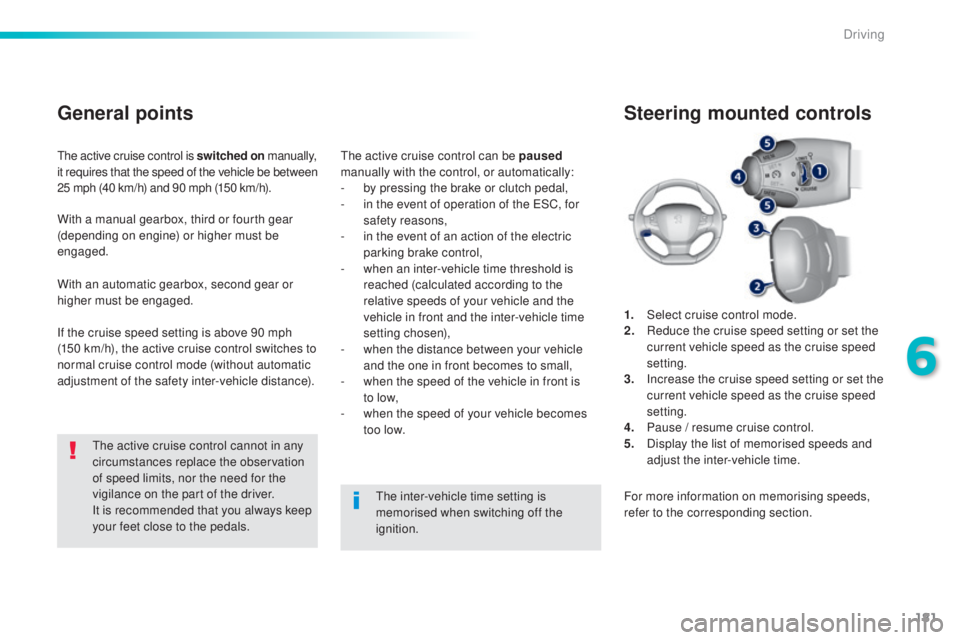
1.
Selec
t cruise control mode.
2.
Re
duce the cruise speed setting or set the
current vehicle speed as the cruise speed
setting.
3.
In
crease the cruise speed setting or set the
current vehicle speed as the cruise speed
setting.
4.
Pa
use / resume cruise control.
5.
Di
splay the list of memorised speeds and
adjust the inter-vehicle time.
Steering mounted controls
For more information on memorising speeds,
refer to the corresponding section.
6
Driving
Page 223 of 398
221
308_en_Chap07_info-pratiques_ed02-2015
the fitting of electrical equipment
o r accessories which are not
recommended by P
eu
ge
Ot m
ay result
in a failure of your vehicle's electronic
system and excessive electrical
consumption.
Contact a P
eu
ge
Ot d
ealer
for information on the range of
recommended equipment and
accessories.
Installation of radio
communication
transmitters
Before installing any after-market radio
communication transmitter, you can
contact a P
eu
ge
Ot d
ealer for the
specification of transmitters which can
be fitted (frequency, maximum power,
aerial position, specific installation
requirements), in line with the Vehicle
ele
ctromagnetic Compatibility
Directive
(
2004/104/
eC)
. Depending on the legislation in force in
the country, certain safety equipment
may be compulsory: high visibility
safety vests, warning triangles,
breathalyzers, spare bulbs, spare fuses,
fire extinguisher, first aid kit, mud flaps
at the rear of the vehicle.
By visiting a P
eu
ge
Ot d
ealer, you can also
obtain products for cleaning and maintenance
(exterior and interior) - including ecological
products in the "
teCH
NA
tuRe" ra
nge, topping
up products (screenwash...), touch-up pens
and paint aerosols for the exact colour of your
vehicle, refills (cartridge for the temporary
puncture repair kit...), ...
7
Practical information
Page 228 of 398
226
308_en_Chap07_info-pratiques_ed02-2015
Bonnet
Before doing anything under the
bonnet, switch off the Stop & Start
system to avoid any risk of injury
resulting from an automatic change to
S
tA
R
t m o
d e .
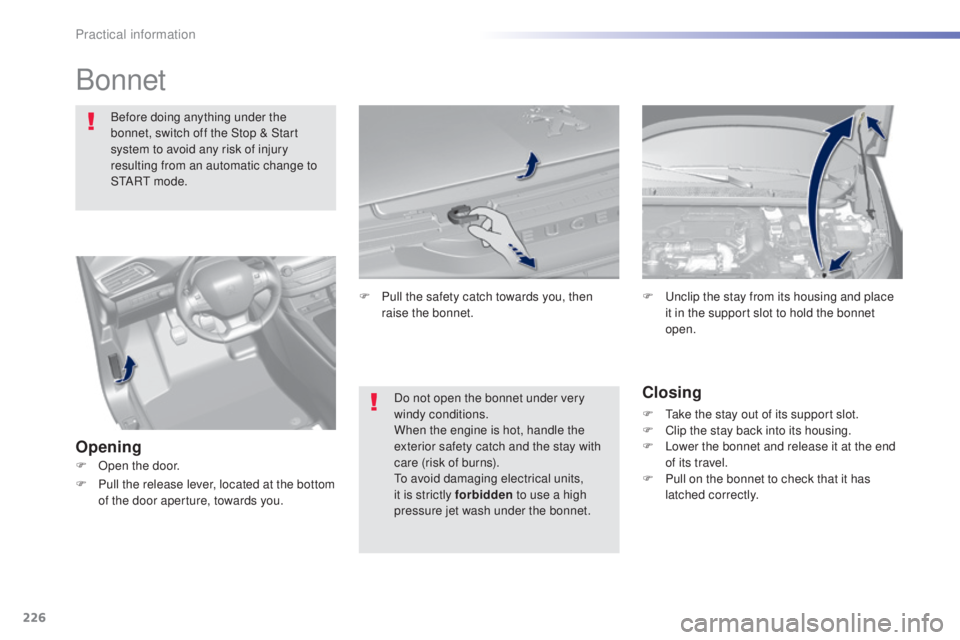
Opening Closing
F take the stay out of its support slot.
F Cl ip the stay back into its housing.
F
Lo
wer the bonnet and release it at the end
of its travel.
F
Pu
ll on the bonnet to check that it has
latched correctly.
F
u
nc
lip the stay from its housing and place
it in the support slot to hold the bonnet
open.
Do not open the bonnet under very
windy conditions.
When the engine is hot, handle the
exterior safety catch and the stay with
care (risk of burns).
to a
void damaging electrical units,
it is strictly forbidden to use a high
pressure jet wash under the bonnet.
F
Pu
ll the safety catch towards you, then
raise the bonnet.
F
Op
en the door.
F
Pu
ll the release lever, located at the bottom
of the door aperture, towards you.
Practical information
Page 236 of 398
234
308_en_Chap07_info-pratiques_ed02-2015
Manual gearbox
the gearbox does not require any
m aintenance (no oil change).
Refer to the manufacturer's service
schedule for the checking interval for
this component. Brake wear depends on the style
of driving, particularly in the case
of vehicles used in town, over short
distances. It may be necessary to
Brake pads
For information on checking brake
disc wear, contact a Peu
geOt
d
ealer or a qualified workshop.
Brake disc wear Electric parking brake
this system does not require any
r outine servicing. However, in the
event of a problem, have the system
checked by a P
eu
ge
Ot d
ealer or a
qualified workshop.
Only use products recommended by
P
eu
ge
Ot o
r products of equivalent
quality and specification.
In order to optimise the operation of
units as important as those in the
braking system, P
eu
ge
Ot s
elects and
offers very specific products.
After washing the vehicle, dampness,
or in wintry conditions, ice can form
on the brake discs and pads: braking
efficiency may be reduced. Make light
brake applications to dry and defrost
the brakes.
Parking brake
If excessive travel or a loss of
effectiveness of this system is
noticed, the parking brake must be
checked, even between two services.
Checking this system must be done by a
P
eu
ge
Ot d
ealer or a qualified workshop. have the condition of the brakes checked, even
between vehicle services.
unl
ess there is a leak in the circuit, a drop in
the brake fluid level indicates that the brake
pads are worn. For more information on the electric parking
brake, refer to the corresponding section.
Automatic gearbox
the gearbox does not require any
m aintenance (no oil change).
Refer to the manufacturer's service
schedule for details of the level
checking interval for this component.
Practical information
Page 246 of 398
244
308_en_Chap08_en-cas-de-panne_ed02-2015
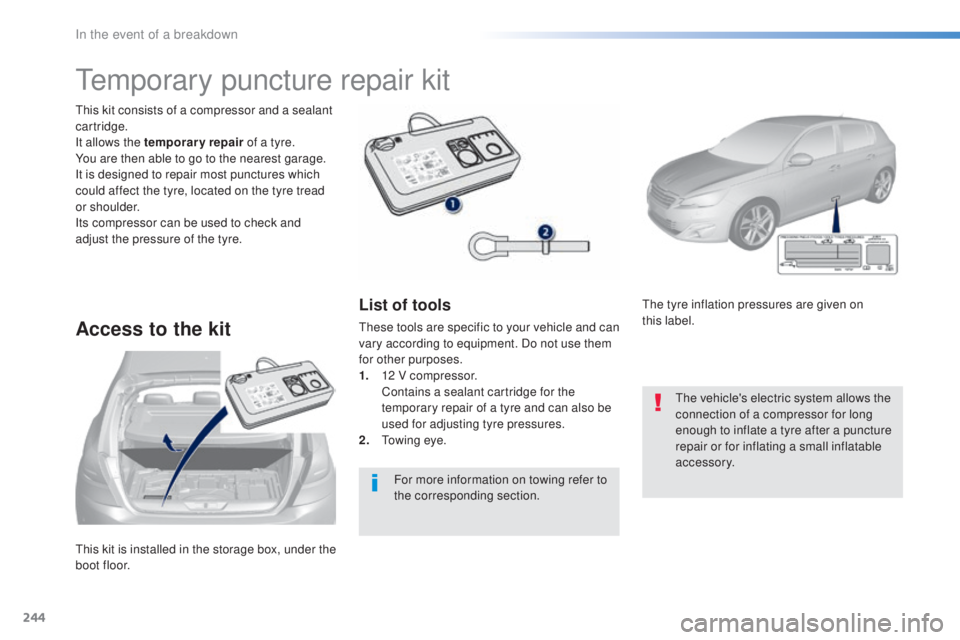
this kit is installed in the storage box, under the
bo ot floor.
thi
s kit consists of a compressor and a sealant
cartridge.
It allows the temporary repair of a tyre.
You are then able to go to the nearest garage.
It is designed to repair most punctures which
could affect the tyre, located on the tyre tread
or shoulder.
Its compressor can be used to check and
adjust the pressure of the tyre.
temporary puncture repair kit
Access to the kit
List of tools
these tools are specific to your vehicle and can
v ary according to equipment. Do not use them
for other purposes.
1.
12 V c
ompressor.
Co
ntains a sealant cartridge for the
temporary repair of a tyre and can also be
used for adjusting tyre pressures.
2.
tow
ing eye.
the t
yre inflation pressures are given on
this lab el.
the v
ehicle's electric system allows the
connection of a compressor for long
enough to inflate a tyre after a puncture
repair or for inflating a small inflatable
accessory.
For more information on towing refer to
the corresponding section.
In the event of a breakdown
Page 248 of 398
246
308_en_Chap08_en-cas-de-panne_ed02-2015
Repair procedure
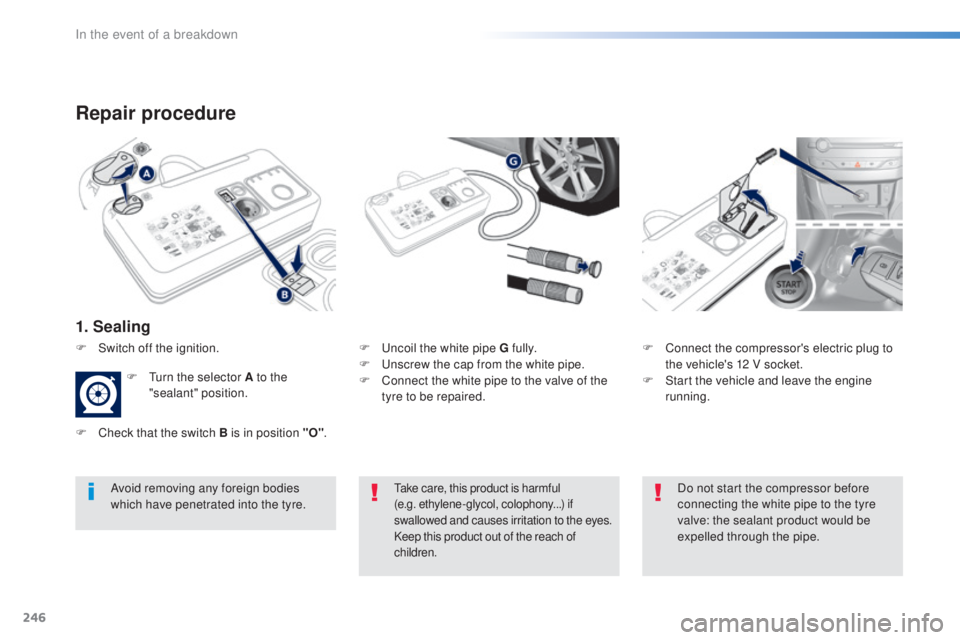
1. Sealing
F uncoil the white pipe G fully.
F uns crew the cap from the white pipe.
F
Co
nnect the white pipe to the valve of the
tyre to be repaired. F Co
nnect the compressor's electric plug to
the vehicle's 12 V socket.
F
St
art the vehicle and leave the engine
running.
take care, this product is harmful
( e.g. e thylene-glycol, colophony...) if
swallowed and causes irritation to the eyes.
Keep this product out of the reach of
children.Avoid removing any foreign bodies
which have penetrated into the tyre. Do not start the compressor before
connecting the white pipe to the tyre
valve: the sealant product would be
expelled through the pipe.
F
Swi
tch off the ignition.
F
t
ur
n the selector A to the
"sealant" position.
F
Ch
eck that the switch B is in position "O"
.
In the event of a breakdown