fuel tank Peugeot 308 2016 Owner's Manual
[x] Cancel search | Manufacturer: PEUGEOT, Model Year: 2016, Model line: 308, Model: Peugeot 308 2016Pages: 398, PDF Size: 9.38 MB
Page 5 of 398
308_en_Chap00a_sommaire_ed02-2015
Driving recommendations 146
Starting-switching off the engine
14
8
Manual parking brake
15
4
ele
ctric parking brake
15
5
Hill start assist
16
2
5-speed manual gearbox
16
3
6-speed manual gearbox
16
3
Gear ef ficiency indicator
16
4
Automatic gearbox
16
5
Dynamic pack
16
9
Stop & Start
17
0
Memorising speeds
17
3
Speed limiter
17
4
Cruise control
17
7
Active cruise control
18
0
Display of inter-vehicle time
187
emer
gency collision alert system,
emergency collision braking system
19
0
Blind spot sensors
19
5
Parking sensors
19
8
Reversing camera
20
0
Park Assist
20
1
Under-inflation detection
209 F
uel tank 21 3
Diesel misfuel prevention
21
4
Snow chains
21
6
Very cold climate screen
21
7
tow
ing a trailer
21
8
ene
rgy economy mode
21
9
Accessories
22
0
Changing a wiper blade
22
2
Fitting roof bars
22
3
Bonnet
2
26
Petrol engine
22
7
Diesel engine
22
8
Checking levels
22
9
Checks
23
3
AdBlue
® additive and SCR system
(BlueHDi Diesel) 235
W
arning triangle
24
3
temp
orary puncture
repair kit
24
4
Changing a wheel
25
0
Changing a bulb
25
6
Changing a fuse
26
6
12 V battery
27
2
to w
i n g
2
7 5
Running out of fuel (Diesel)
27
7Petrol engines
27
8
Petrol weights
28
1
Diesel engines
28
4
Diesel weights
28
8
Dimensions
29
2
Identification markings
29
5
Driving
Practical information
In the event of a breakdowntec hnical data
.
emergency or assistance 296
D
eNO
N equipment
29
8
7-inch touch screen
29
9
P
eu
ge
Ot C
onnect Sound (RD5)
36
3
Audio equipment and telematics
Alphabetical index
Contents
Page 6 of 398
4
308_en_Chap00b_vue-ensemble_ed02-2015
exterior
W i p e r s 115 -118
Changing a wiper blade 11 8, 222
Keyless
ent
ry and Starting remote
control
54
-58, 61- 63
Remote control key
48
-53, 63
Starting
14
8-154
elec
tronic stability
control (
eS
C)
120
-12 2
Snow chains
21
6
tyr
e pressures
24
4, 255, 295
Inder-inflation detection
209
-212
Changing a wheel
25
0-255
-
t
ools
-
re
moving / refitting
Automatic emergency braking
19
0-194
Lighting
1
08-114
Daytime running lamps (L
eDs
)
11
2
Headlamp beam adjustment
11
4
Changing bulbs
25
6-260
- fr ont lamps
- fo glamps
-
di
rection indicator repeaters
Very cold climate screen
21
7
ele
ctric windows, deactivation
69
-70
Keyless
ent
ry and Starting
54
-58
Doors
48
-50, 52
-
open
ing / closing
-
ce
ntral locking
-
emer
gency control
Alarm
6
5-68
Fuel tank, misfuel prevention
21
3-215
Panoramic sunroof
10
3
Roof bars, bicycle carrier
22
3 -224
Accessories
22
0-221
Boot
5
9-60
-
open
ing / closing
-
emer
gency release
tem
porary puncture repair kit
24
4-249
Warning triangle
24
3
Parking sensors
19
8-199
Reversing camera
20
0
tow
bar
14
7, 218
tow
ing
27
5 -276
Park Assist
20
1-208
Changing bulbs
26
1-265
-
re
ar lamps
-
3rd brake lamp
- nu mber plate lamps
-
fo
glamp Door mirrors
10
6, 114
Blind spot sensors
19
5 -197
Over view
Page 24 of 398

22
Engine
autodiagnosis
systemflashing.the eng
ine management system has
a fault. Risk of destruction of the catalytic converter.
Have it checked by a Peu
geOt d ealer or a qualified
workshop.
fixed.
the e
mission control system has a
fault.
the warning lamp should go off when the engine is started.
I f it does not go off, contact a Peu geOt d ealer or qualified
workshop without delay.
Emergency
Collision
Braking System flashing.the emer
gency Collision Braking
System is active.the s ystem brakes briefly so as to reduce the speed
of collision with the vehicle ahead.
fixed,
accompanied by
a mesage and an
audible signal
the emer
gency Collision Braking
System has a fault. Have it checked by a P
eu
ge
Ot d
ealer or a qualified
workshop.
fixed.
the emergency Collision Braking System
h as been deactivated (via the menu).
Warning / indicator lamp StateCause Action / Observations
Low fuel level fixed, with the needle
in the red zone. When it first comes on there remains
less than 10 litres of fuel
in the
tank. You must refuel as soon as possible to avoid running
out of fuel.
thi
s warning lamp will come on every time the ignition
is switched on, until a sufficient addition of fuel is
made.
Fuel tank capacity: approximately 53 litres or 45 litres
depending on version.
Never continue to drive until you run out of fuel as
this could damage the emission control and injection
systems.
Instruments
Page 38 of 398
36
Trip computer, a few definitions
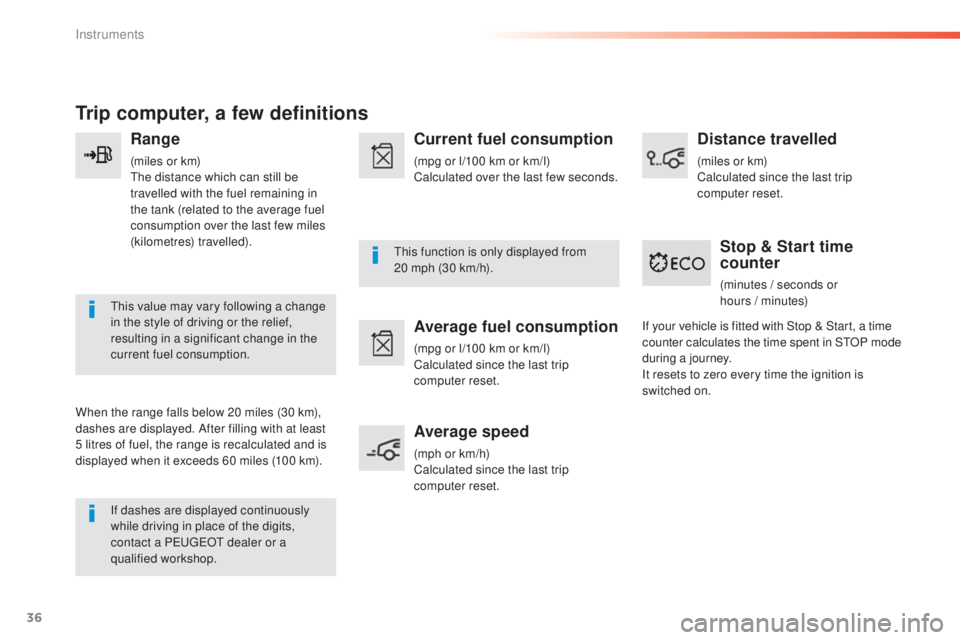
Range
(miles or km)the distance which can still be
travelled with the fuel remaining in
the tank (related to the average fuel
consumption over the last few miles
(kilometres) travelled).
thi
s value may vary following a change
in the style of driving or the relief,
resulting in a significant change in the
current fuel consumption.
When the range falls below 20 miles (30 km),
dashes are displayed. After filling with at least
5 litres of fuel, the range is recalculated and is
displayed when it exceeds 60 miles (100 km). If dashes are displayed continuously
while driving in place of the digits,
contact a P
eu
ge
Ot d
ealer or a
qualified workshop.
thi
s function is only displayed from
20
m
ph (30 km/h).
Current fuel consumption
(mpg or l/100 km or km/l)
Calculated over the last few seconds.
Average fuel consumption
(mpg or l/100 km or km/l)
Calculated since the last trip
computer reset.
Average speed
(mph or km/h)
Calculated since the last trip
computer reset.
Distance travelled
(miles or km)
Calculated since the last trip
computer reset.
Stop & Start time
counter
(minutes / seconds or
ho urs / m inutes)
If your vehicle is fitted with Stop & Start, a time
counter calculates the time spent in S
tOP m
ode
during a journey.
It resets to zero every time the ignition is
switched on.
Instruments
Page 215 of 398
213
308_en_Chap07_info-pratiques_ed02-2015
Fuel tank
Additions of fuel must be of at least 10 litres to
be registered by the fuel gauge.
Opening the filler cap may result in an inrush of
air.
thi
s vacuum is entirely normal and results
from the sealing of the fuel system.
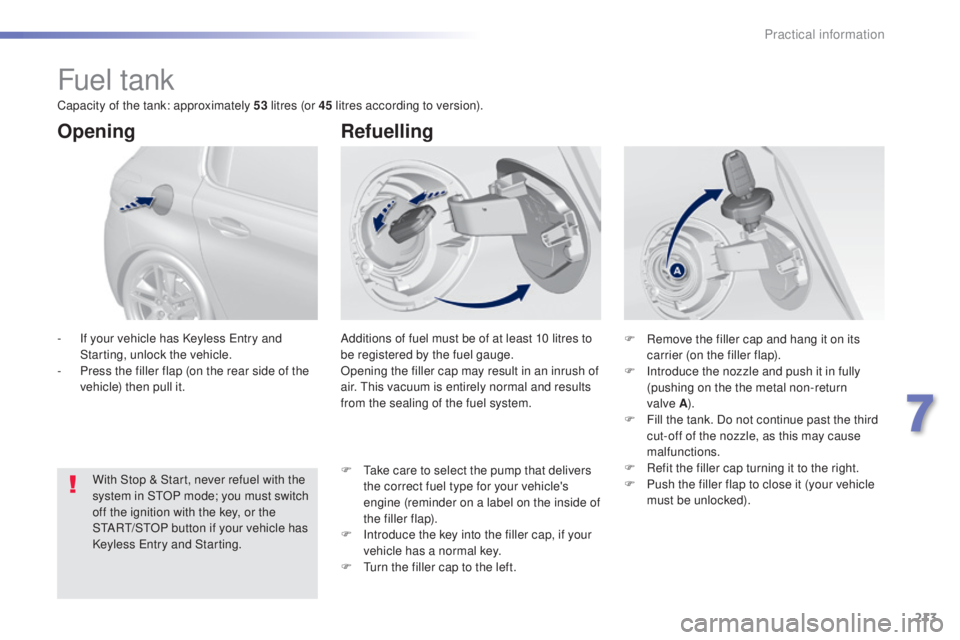
Opening
With Stop & Start, never refuel with the
system in StOP m ode; you must switch
off the ignition with the key, or the
S
tARt/StOP b
utton if your vehicle has
Keyless
ent
ry and Starting.
-
If y
our vehicle has Keyless
ent
ry and
Starting, unlock the vehicle.
-
Pr
ess the filler flap (on the rear side of the
vehicle) then pull it.
Refuelling
F Remove the filler cap and hang it on its
c arrier (on the filler flap).
F
In
troduce the nozzle and push it in fully
(pushing on the the metal non-return
valve
A ).
F Fi
ll the tank. Do not continue past the third
cut-off of the nozzle, as this may cause
malfunctions.
F
Re
fit the filler cap turning it to the right.
F
Pu
sh the filler flap to close it (your vehicle
must be unlocked).
F
t
ak
e care to select the pump that delivers
the correct fuel type for your vehicle's
engine (reminder on a label on the inside of
the filler flap).
F
In
troduce the key into the filler cap, if your
vehicle has a normal key.
F
t
ur
n the filler cap to the left.
Capacity of the tank: approximately 53
litres (or 45 litres according to version).
7
Practical information
Page 216 of 398
214
308_en_Chap07_info-pratiques_ed02-2015
Low fuel level
When the low fuel level in the tank is
reached, this warning lamp comes on
in the instrument panel, accompanied
by an audible warning and a message.
Fuel supply cut-off
Your vehicle is equipped with a safety device
which cuts off the fuel supply in the event of a
collision. When it first comes on, less than 10 litres of
fuel remain in the tank.
You must refuel as soon as possible to avoid
running out.If you have put in the wrong fuel for
your vehicle, you must have have
the tank drained and refilled with
the correct fuel before you star t the
engine.
Your vehicle is fitted with a catalytic converter,
a device which helps to reduce the level of
harmful emissions in the exhaust gases.
For petrol engines, you must use unleaded
fuel only.
the f
iller neck is narrower, admitting petrol
nozzles only. It is still possible to use a fuel can to fill
the tank but this must be done slowly.
In order to ensure a good flow of fuel,
do not place the nozzle of the fuel can
in direct contact with the flap of the
misfuel prevention device.
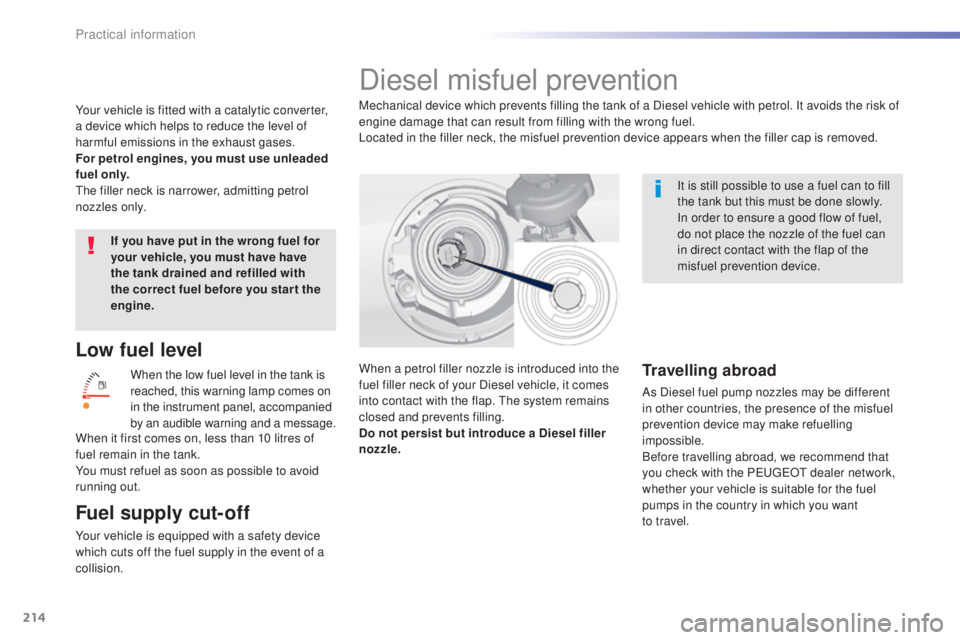
Diesel misfuel prevention
Mechanical device which prevents filling the tank of a Diesel vehicle with petrol. It avoids the risk of
engine damage that can result from filling with the wrong fuel.
Located in the filler neck, the misfuel prevention device appears when the filler cap is removed.
When a petrol filler nozzle is introduced into the
fuel filler neck of your Diesel vehicle, it comes
into contact with the flap.
the s
ystem remains
closed and prevents filling.
Do not persist but introduce a Diesel filler
nozzle.
Travelling abroad
As Diesel fuel pump nozzles may be different
in other countries, the presence of the misfuel
prevention device may make refuelling
impossible.
Before travelling abroad, we recommend that
you check with the P
eu
ge
Ot d
ealer network,
whether your vehicle is suitable for the fuel
pumps in the country in which you want
to
t
ravel.
Practical information
Page 237 of 398
235
308_en_Chap07_info-pratiques_ed02-2015
AdBlue® additive and SCR system
for BlueHDi Diesel engines
to assure respect for the environment and
c onformity with the new eur o 6 emissions
standard, without adversely affecting the
per formance or fuel consumption of Diesel
engines, P
eu
ge
Ot h
as taken the decision to
equip its vehicles with an effective system that
associates SCR (Selective Catalytic Reduction)
with a particle filter (FAP) for the treatment of
exhaust gases.
Presentation of the SCR system
using an additive called AdBlue® containing
urea, a catalytic converter turns up to 85%
of nitrous oxides (NOx) into nitrogen and
water, which are harmless to health and the
environment.
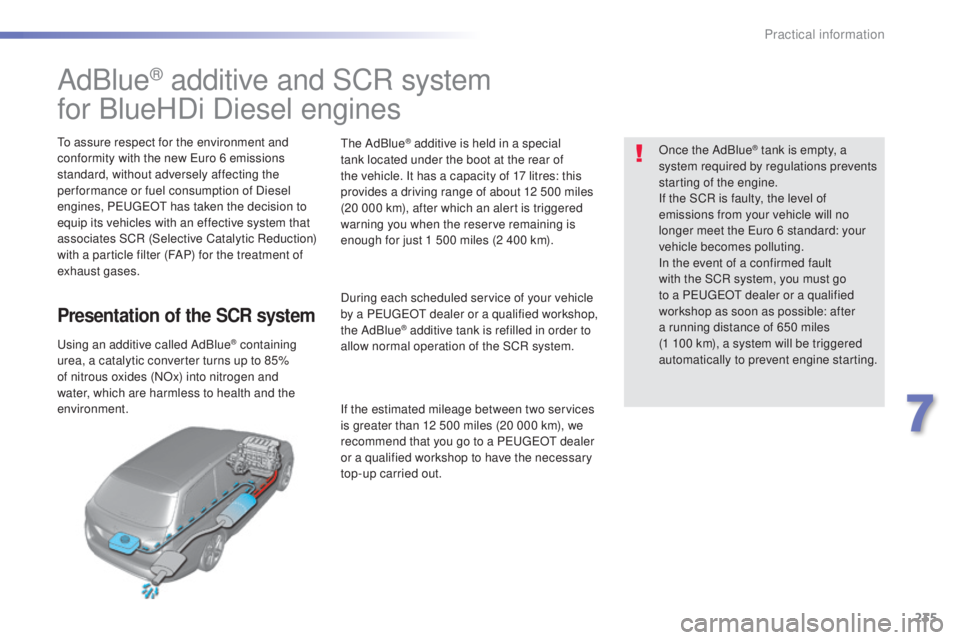
the
AdBlue
® additive is held in a special
tank located under the boot at the rear of
the vehicle. It has a capacity of 17 litres: this
provides a driving range of about 12 500 miles
(20 000 km), after which an alert is triggered
warning you when the reserve remaining is
enough for just 1 500 miles (2 400 km).
During each scheduled service of your vehicle
by a P
eu
ge
Ot d
ealer or a qualified workshop,
the AdBlue
® additive tank is refilled in order to
allow normal operation of the SCR system.
If the estimated mileage between two services
is greater than 12 500 miles (20 000 km), we
recommend that you go to a P
eu
ge
Ot d
ealer
or a qualified workshop to have the necessary
top-up carried out. Once the AdBlue
® tank is empty, a
sy
stem required by regulations prevents
starting of the engine.
If the SCR is faulty, the level of
emissions from your vehicle will no
longer meet the
eur
o 6 standard: your
vehicle becomes polluting.
In the event of a confirmed fault
with the SCR system, you must go
to a P
eu
ge
Ot d
ealer or a qualified
workshop as soon as possible: after
a running distance of 650 miles
(1
1
00 km), a system will be triggered
automatically to prevent engine starting.
7
Practical information
Page 241 of 398
239
308_en_Chap07_info-pratiques_ed02-2015
Topping-up the AdBlue® additive
Filling the AdBlue® tank is an operation
included in every routine service on your
vehicle by a P
eu
ge
Ot d
ealer or a qualified
workshop.
Nevertheless, given the capacity of the tank,
it may be necessary to top-up the additive
between services, more particularly if an alert
(warning lamps and a message) signals the
requirement.
You can got to a P
eu
ge
Ot d
ealer or a
qualified workshop.
If you envisage topping-up yourself, please
read the following warnings carefully.Precautions in use
Keep AdBlue® out of the reach of
children, in its original bottle.
Never transfer AdBlue
® to another
container: it would lose its purity.
use
only AdBlue
® additive that meets the
ISO 22241 standard.
Never dilute the additive with water.
Never pour the additive into the Diesel
fuel tank.
the s
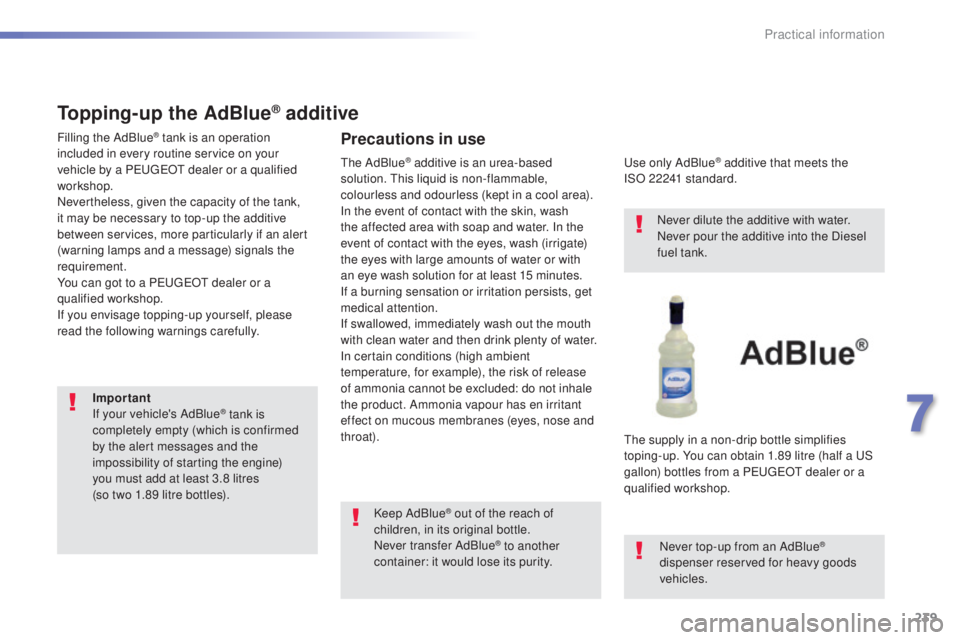
upply in a non-drip bottle simplifies
toping-up. You can obtain 1.89 litre (half a
uS
ga
llon) bottles from a P
eu
ge
Ot d
ealer or a
qualified workshop.
Never top-up from an AdBlue
®
dispenser reserved for heavy goods
vehicles.
the
AdBlue
® additive is an urea-based
solution. thi
s liquid is non-flammable,
colourless and odourless (kept in a cool area).
In the event of contact with the skin, wash
the affected area with soap and water. In the
event of contact with the eyes, wash (irrigate)
the eyes with large amounts of water or with
an eye wash solution for at least 15 minutes.
If a burning sensation or irritation persists, get
medical attention.
If swallowed, immediately wash out the mouth
with clean water and then drink plenty of water.
In certain conditions (high ambient
temperature, for example), the risk of release
of ammonia cannot be excluded: do not inhale
the product. Ammonia vapour has en irritant
effect on mucous membranes (eyes, nose and
throat).
Important
If your vehicle's AdBlue
® tank is
co
mpletely empty (which is confirmed
by the alert messages and the
impossibility of starting the engine)
you must add at least 3.8 litres
(so two 1.89 litre bottles).
7
Practical information
Page 279 of 398
277
308_en_Chap08_en-cas-de-panne_ed02-2015
On vehicles fitted with Diesel engines, the fuel
system must be primed if you run out of fuel.
For all versions other than BlueHDi, refer to the
corresponding engine compartment view.
Running out of fuel (Diesel)
For more information on the Diesel
misfuel prevention device, refer to the
corresponding section. (except BlueHDi)
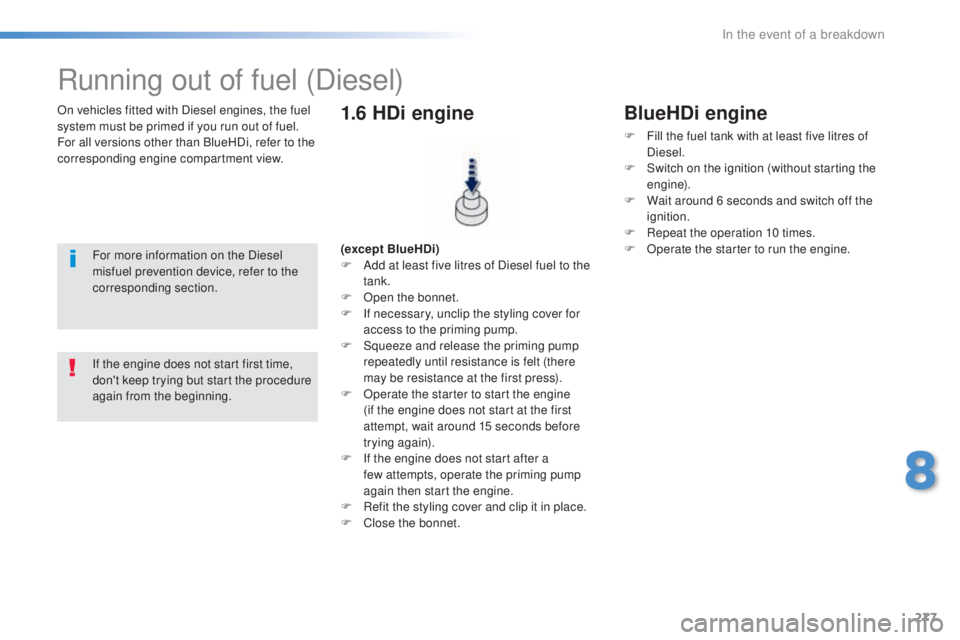
F Ad
d at least five litres of Diesel fuel to the
tank.
F
Op
en the bonnet.
F
If n
ecessary, unclip the styling cover for
access to the priming pump.
F
Sq
ueeze and release the priming pump
repeatedly until resistance is felt (there
may be resistance at the first press).
F
Op
erate the starter to start the engine
(if the engine does not start at the first
attempt, wait around 15 seconds before
trying again).
F
If t
he engine does not start after a
few
a
ttempts, operate the priming pump
again then start the engine.
F
Re
fit the styling cover and clip it in place.
F
Clos
e the bonnet.
1.6 HDi engine
If the engine does not start first time,
don't keep trying but start the procedure
again from the beginning.
BlueHDi engine
F Fill the fuel tank with at least five litres of
Diesel.
F
Sw
itch on the ignition (without starting the
engine).
F
Wa
it around 6 seconds and switch off the
ignition.
F
Re
peat the operation 10 times.
F
Op
erate the starter to run the engine.
8
In the event of a breakdown
Page 385 of 398
383
308_en_Chap11_index-alpha_ed02-2015
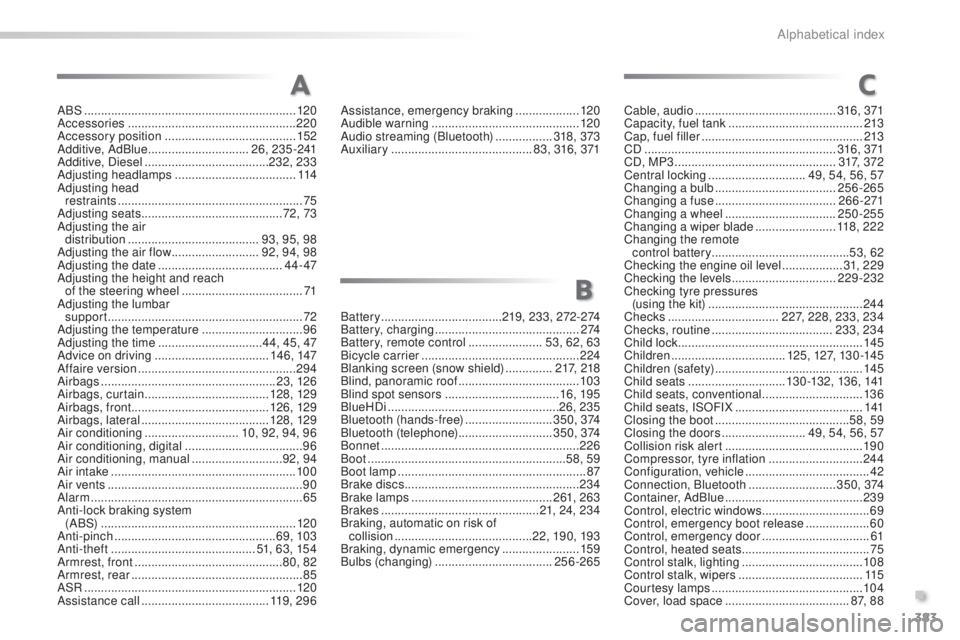
ABS ...............................................................12 0
Accessories .............................. ....................220
Accessory position
....................................... 15
2
Additive, AdBlue
.............................. 26
, 235-241
Additive, Diesel
...............................
......232, 233
Adjusting headlamps
.................................... 11
4
Adjusting head restraints
....................................................... 75
Ad
justing seats
.......................................... 7
2, 73
Adjusting the air distribution
....................................... 93
, 95, 98
Adjusting the air flow
.......................... 9
2, 94, 98
Adjusting the date
..................................... 4
4 - 47
Adjusting the height and reach of the steering wheel
.................................... 71
Adj
usting the lumbar
support
.......................................................... 7
2
Adjusting the temperature
.............................. 96
Ad
justing the time
............................... 4
4, 45, 47
Advice on driving
..............................
....146, 147
Affaire version
............................................... 29
4
Airbags
...............
..................................... 23, 126
Airbags, curtain
..................................... 128
, 129
Airbags, front ......................................... 126, 129
Airbags, lateral
...................................... 12
8, 129
Air conditioning
............................ 1
0, 92, 94, 96
Air conditioning, digital
................................... 96
A
ir conditioning, manual
........................... 9
2, 94
Air intake
...............
........................................ 10 0
Air vents
..............................
............................90
Alarm
............................................................... 65
A
nti-lock braking system
(A BS)
...............
........................................... 120
Anti-pinch
................................................ 6
9, 103
Anti-theft
..............................
.............51, 63, 154
Armrest, front
............................................ 8
0, 82
Armrest, rear
................................................... 85
ASR ............................................................... 12
0
Assistance call
...............................
.......11 9 , 2 9 6 Assistance, emergency braking ...................
120
A
udible warning ............................................12
0
Audio streaming (Bluetooth)
................. 318
, 373
Auxiliary
.......................................... 8
3, 316, 371
A
B
C
Battery ....................................219, 233, 272-274
Battery, charging ............................... ............2 74
Battery, remote control
...................... 53
, 62, 63
Bicycle carrier
............................................... 2
24
Blanking screen (snow shield)
.............. 217
, 218
Blind, panoramic roof
.................................... 10
3
Blind spot sensors
.................................. 1
6, 195
BlueHDi
...............................
....................26, 235
Bluetooth (hands-free)
.......................... 3 5
0 , 374
Bluetooth (telephone)
............................ 3
5 0 , 374
Bonnet
...............
............................................ 226
Boot
........
................................................... 58, 59
Boot lamp
........................................................ 87
B
rake discs
.................................................... 234
B
rake lamps
...............................
...........261, 263
Brakes
............................................... 2
1, 24, 234
Braking, automatic on risk of collision
................
.........................22, 19 0, 193
Braking, dynamic emergency
....................... 15
9
Bulbs (changing)
................................... 2
56-265Cable, audio
..........................................
3
16 , 371
Capacity, fuel tank
........................................ 2
13
Cap, fuel filler
................................................ 2
13
CD
..............................
...........................
316 , 371
CD, MP3
................................................ 3 1
7, 3 7 2
Central locking
............................. 4
9, 54, 56, 57
Changing a bulb
.................................... 2
56-265
Changing a fuse
.................................... 2
6 6 -271
Changing a wheel
...............................
..
250-255
Changing a wiper blade
........................ 1
18, 222
Changing the remote control battery .........................................53, 62
Checking the engine oil level
.................. 3
1, 2 29
Checking the levels
............................... 2
29-232
Checking tyre pressures (using the kit) .............................................. 24 4
Checks ................................. 2
27, 228, 233, 234
Checks, routine .................................... 23
3, 234
Child lock
....................................................... 14
5
Children
.................................. 12
5, 127, 13 0 -14 5
Children (safety)
............................................ 14
5
Child seats
............................. 13 0
-132, 13 6, 141
Child seats, conventional
.............................. 13
6
Child seats, ISOFIX
...................................... 141
C
losing the boot
...............................
.........58, 59
Closing the doors
......................... 4
9, 54, 56, 57
Collision risk alert
......................................... 19
0
Compressor, tyre inflation
............................ 24
4
Configuration, vehicle
..................................... 42
C
onnection, Bluetooth
..........................3
5 0 , 374
Container, AdBlue
......................................... 23
9
Control, electric windows
................................ 69
C
ontrol, emergency boot release
...................60
C
ontrol, emergency door
................................61
C
ontrol, heated seats
......................................75
C
ontrol stalk, lighting
....................................108
C
ontrol stalk, wipers
.....................................11
5
Courtesy lamps
............................................. 10
4
Cover, load space
..................................... 87, 8
8
.
Alphabetical index