seat adjustment Peugeot 308 2016 Owner's Manual
[x] Cancel search | Manufacturer: PEUGEOT, Model Year: 2016, Model line: 308, Model: Peugeot 308 2016Pages: 398, PDF Size: 9.38 MB
Page 4 of 398
.
.
308_en_Chap00a_sommaire_ed02-2015
Over view
Instrument panel 12
I ndicator and warning lamps
13
gau
ges and indicators
28
D
istance recorders
32
tri
p computer
34
tou
ch screen
37
S
etting the date and time
44 R
emote control key
48
"
Keyless
ent
ry and Starting" with
remote
c
ontrol
54
"
Keyless
ent
ry and Starting"
on your person
56
Boo
t
59
A
larm
6
5
ele
ctric windows
69
P
eu
ge
Ot i
- Cockpit
71
S
teering wheel adjustment
71
F
ront seats
72
R
ear seats (hatchback)
77
R
ear seats (SW)
78
I
nterior fittings
80
F
ront armrest 82
B oot fittings (hatchback)
86
B
oot fittings (SW)
87
Hea
ting and Ventilation
90
H
eating
92
M
anual air conditioning
92
M
anual air conditioning (
touc
h screen)
94
D
ual-zone digital air conditioning (
tou
ch screen)
96
F
ront demist - defrost
10
1
Rear screen demist - defrost
10
2
Panoramic sunroof
10
3
Courtesy lamps
10
4
Interior mood lighting
10
5Mirrors
10
6
Lighting control stalk
10
8
Direction indicators
11
1
Daytime running lamps
11
2
Automatic illumination of headlamps
11
2
Side spotlamps
11
4
Headlamp beam height adjustment
11
4
Wiper controls
11
5
Automatic rain sensitive wipers
11
7
Hazard warning lamps 11 9
eme
rgency or assistance call
11
9
H or n
120
eS
C system
12
0
Seat belts
123
A
irbags
12
6
Child seats
13
0
Deactivating the passenger's front airbag
13
3
ISOFIX mountings and child seats
13
9
Child lock
14
5
eco-driving
Ins truments Access
eas
e of use and comfort Lighting and visibility
Safety
Contents
Page 7 of 398
5
308_en_Chap00b_vue-ensemble_ed02-2015
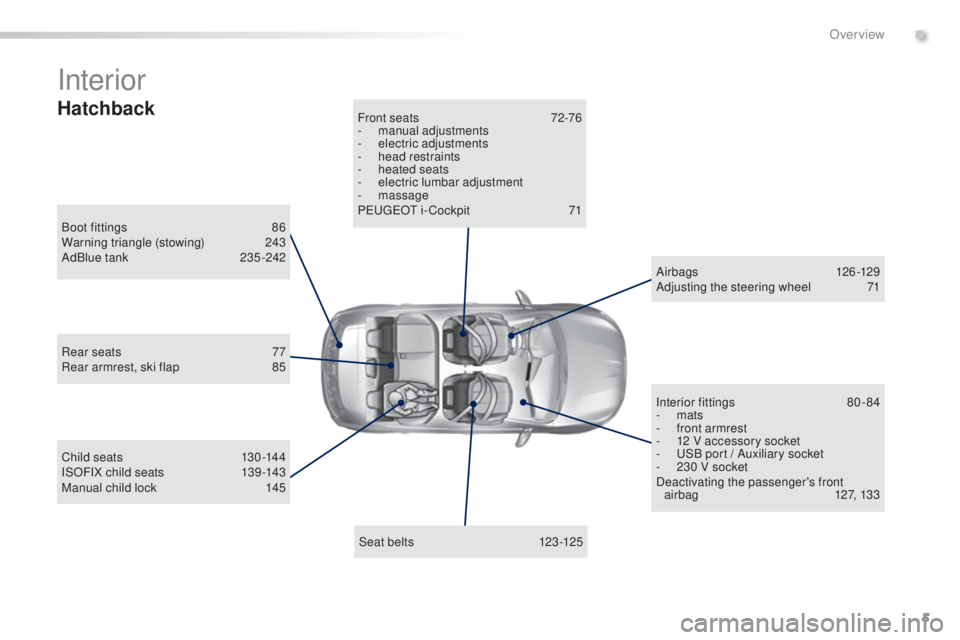
Interior
Boot fittings 86
W arning triangle (stowing) 24 3
AdBlue tank
23
5 -242
Seat belts
123
-125
Front seats
72
-76
-
man
ual adjustments
-
ele
ctric adjustments
-
he
ad restraints
-
heat
ed seats
-
el
ectric lumbar adjustment
-
m
assage
P
eu
ge
Ot i
- Cockpit
71
C
hild seats
13
0 -144
ISOFIX child seats
13
9 -143
Manual child lock
145 A
ir bags
12
6 -129
Adjusting the steering wheel
71
I
nterior fittings
80
-84
-
m
ats
-
fr
ont armrest
-
12 V a
ccessory socket
-
u
SB p
ort / Auxiliary socket
-
23
0 V socket
Deactivating the passenger's front airbag
12
7, 133
Rear seats
77
R
ear armrest, ski flap
85
Hatchback
.
Over view
Page 8 of 398
6
308_en_Chap00b_vue-ensemble_ed02-2015
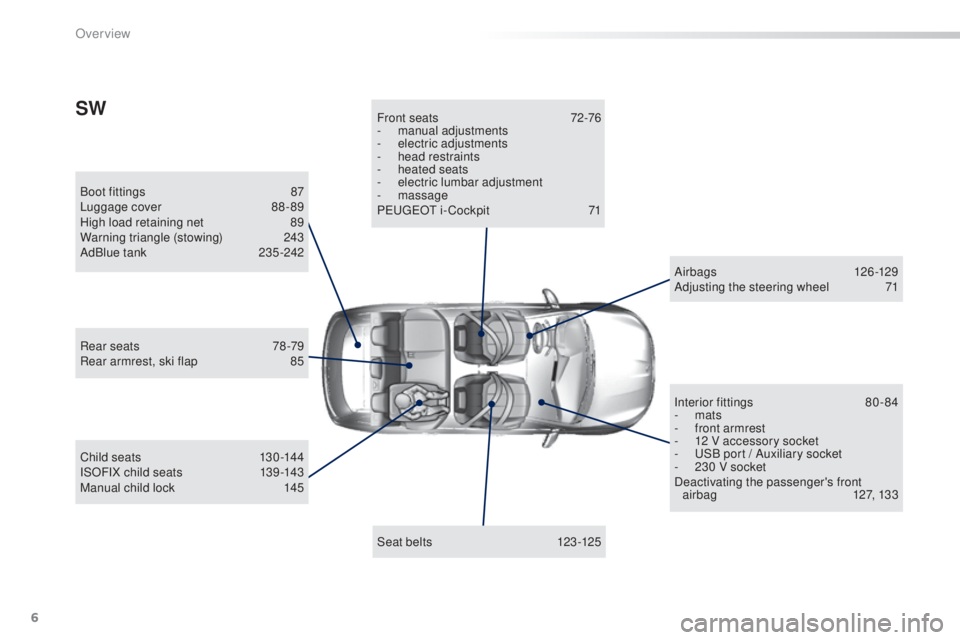
Boot fittings 87
Lu ggage cover 88 - 89
High load retaining net
89
W
arning triangle (stowing)
24
3
AdBlue tank
23
5 -242
Seat belts
123
-125
Front seats
72
-76
-
man
ual adjustments
-
ele
ctric adjustments
-
he
ad restraints
-
heat
ed seats
- el ectric lumbar adjustment
- m assage
P
eu
ge
Ot i
- Cockpit
71
C
hild seats
13
0 -144
ISOFIX child seats
13
9 -143
Manual child lock
145 A
ir bags
12
6 -129
Adjusting the steering wheel
71
I
nterior fittings
80
-84
-
m
ats
-
fr
ont armrest
-
12 V a
ccessory socket
-
u
SB p
ort / Auxiliary socket
-
23
0 V socket
Deactivating the passenger's front airbag
12
7, 133
Rear seats
78
-79
Rear armrest, ski flap
85
SW
Over view
Page 73 of 398
71
308_en_Chap03_ergonomie-et-confort_ed02-2015
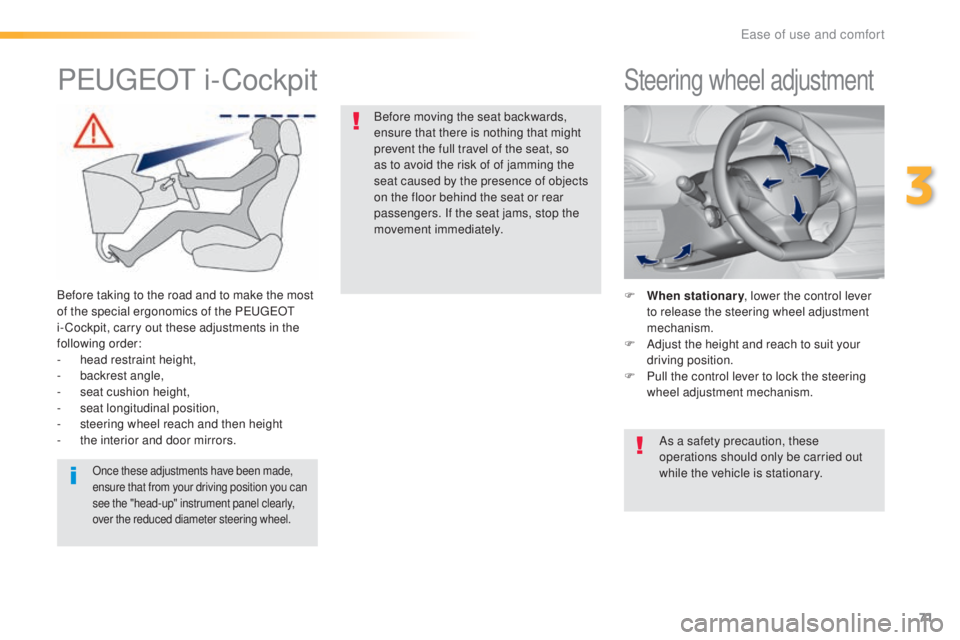
Steering wheel adjustment
F When stationary, l ower the control lever
to release the steering wheel adjustment
mechanism.
F
Ad
just the height and reach to suit your
driving position.
F
Pu
ll the control lever to lock the steering
wheel adjustment mechanism.
As a safety precaution, these
operations should only be carried out
while the vehicle is stationary.
PeugeOt i- Cockpit
Before taking to the road and to make the most
of the special ergonomics of the Peu
geOt
i
- Cockpit, carry out these adjustments in the
following order:
-
head
restraint height,
-
ba
ckrest angle,
-
seat
cushion height,
-
se
at longitudinal position,
-
st
eering wheel reach and then height
-
th
e interior and door mirrors.
Once these adjustments have been made,
ensure that from your driving position you can
see the "head-up" instrument panel clearly,
over the reduced diameter steering wheel.
Before moving the seat backwards,
ensure that there is nothing that might
prevent the full travel of the seat, so
as to avoid the risk of of jamming the
seat caused by the presence of objects
on the floor behind the seat or rear
passengers. If the seat jams, stop the
movement immediately.
3
ease of use and comfort
Page 74 of 398
72
308_en_Chap03_ergonomie-et-confort_ed02-2015
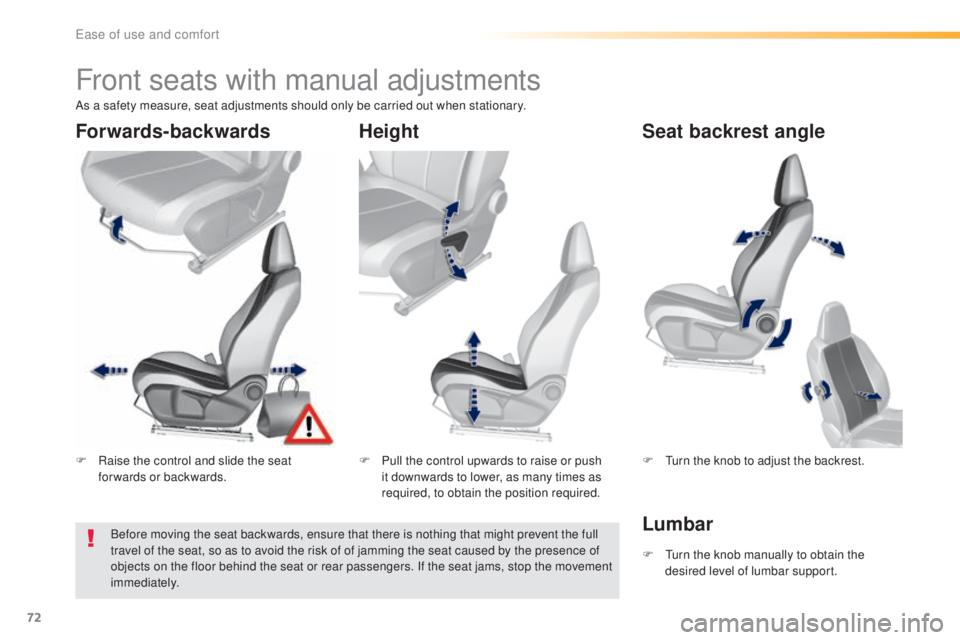
Front seats with manual adjustments
F Raise the control and slide the seat
forwards or backwards. F Pu
ll the control upwards to raise or push
it downwards to lower, as many times as
required, to obtain the position required. F
tur n the knob to adjust the backrest.
Forwards-backwards
HeightSeat backrest angle
As a safety measure, seat adjustments should only be carried out when stationary.
F
t
ur
n the knob manually to obtain the
desired level of lumbar support.
LumbarBefore moving the seat backwards, ensure that there is nothing that might prevent the full
travel of the seat, so as to avoid the risk of of jamming the seat caused by the presence of
objects on the floor behind the seat or rear passengers. If the seat jams, stop the movement
immediately.
ease of use and comfort
Page 75 of 398
73
308_en_Chap03_ergonomie-et-confort_ed02-2015
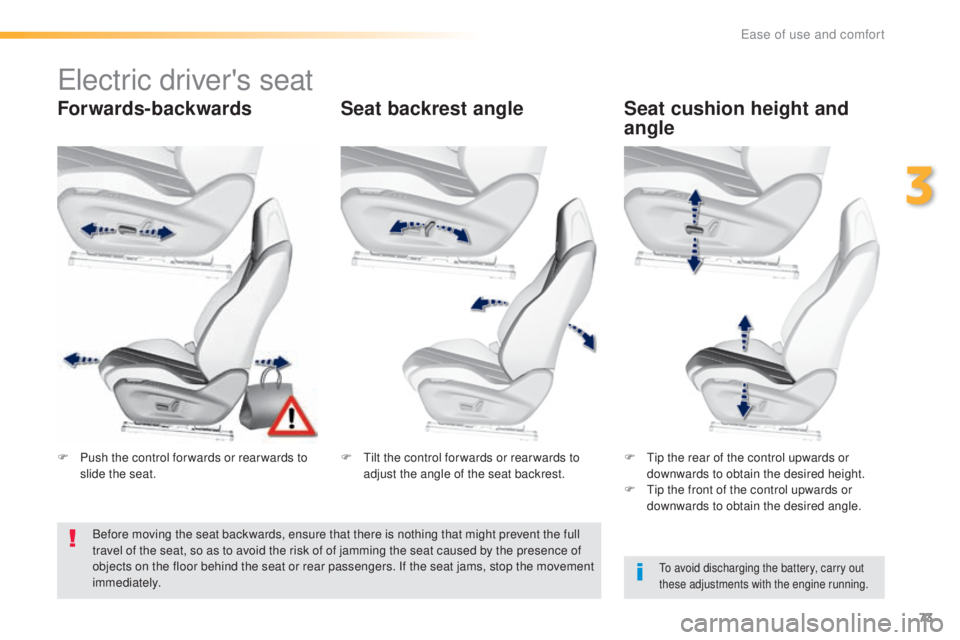
electric driver's seat
Forwards-backwardsSeat backrest angleSeat cushion height and
angle
to avoid discharging the battery, carry out
t hese adjustments with the engine running.
F Push the control for wards or rear wards to
sl ide the seat. F
til t the control for wards or rear wards to
adjust the angle of the seat backrest. F
tip t he rear of the control upwards or
downwards to obtain the desired height.
F
t
ip t
he front of the control upwards or
downwards to obtain the desired angle.
Before moving the seat backwards, ensure that there is nothing that might prevent the full
travel of the seat, so as to avoid the risk of of jamming the seat caused by the presence of
objects on the floor behind the seat or rear passengers. If the seat jams, stop the movement
immediately.
3
ease of use and comfort
Page 76 of 398
74
308_en_Chap03_ergonomie-et-confort_ed02-2015
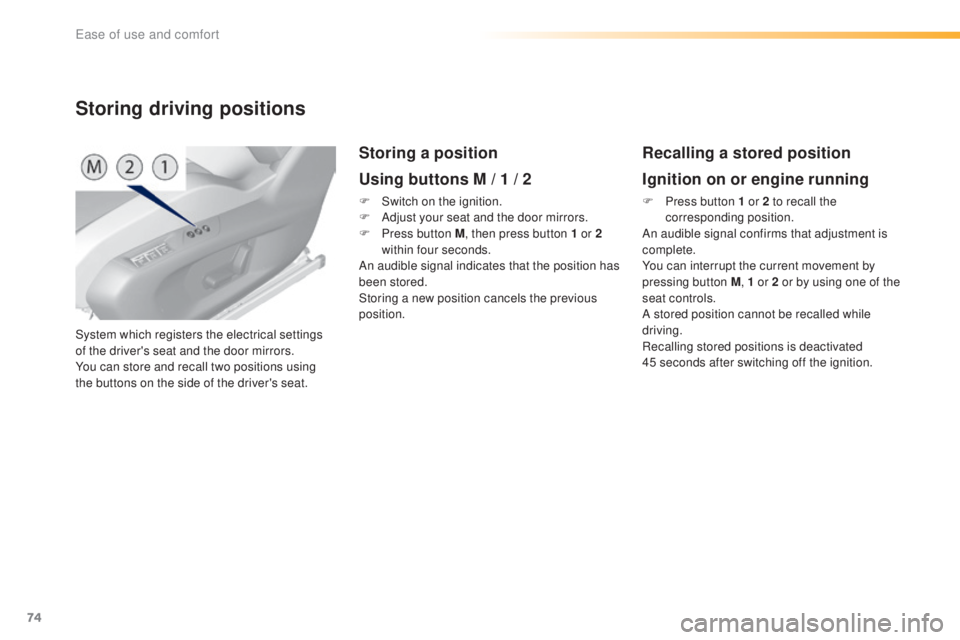
System which registers the electrical settings
of the driver's seat and the door mirrors.
You can store and recall two positions using
the buttons on the side of the driver's seat.
Storing driving positions
Storing a position
Using buttons M / 1 / 2
F Switch on the ignition.
F Ad just your seat and the door mirrors.
F
Pr
ess button M , then press button 1 or 2
within four seconds.
An audible signal indicates that the position has
been stored.
Storing a new position cancels the previous
position.
Recalling a stored position
Ignition on or engine running
F Press button 1 or 2 to recall the
c orresponding position.
An audible signal confirms that adjustment is
complete.
You can interrupt the current movement by
pressing button M , 1 or 2 or by using one of the
seat controls.
A stored position cannot be recalled while
driving.
Recalling stored positions is deactivated
45
s
econds after switching off the ignition.
ease of use and comfort
Page 77 of 398
75
308_en_Chap03_ergonomie-et-confort_ed02-2015
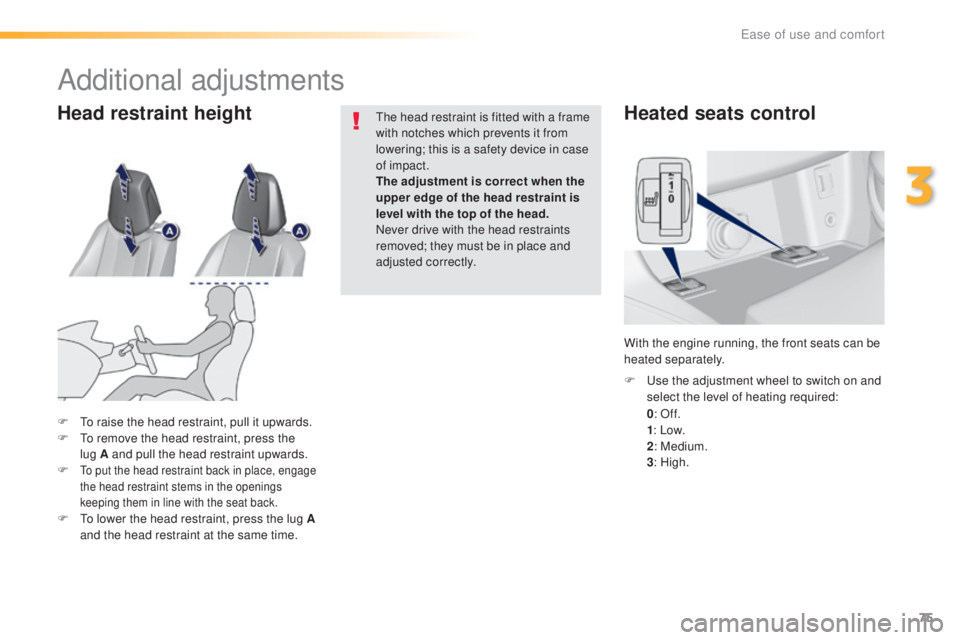
Heated seats control
0: Of f.
1 : Low.
2 : Medium.
3 : High.
F
u
se t
he adjustment wheel to switch on and
select the level of heating required:
With the engine running, the front seats can be
heated separately.
F
to ra
ise the head restraint, pull it upwards.
F
t
o re
move the head restraint, press the
lug
A
and pull the head restraint upwards.
F
to put the head restraint back in place, engage
t he head restraint stems in the openings
keeping them in line with the seat back.
F to lower the head restraint, press the lug A
a nd the head restraint at the same time.
the h
ead restraint is fitted with a frame
with notches which prevents it from
lowering; this is a safety device in case
of impact.
The adjustment is correct when the
upper edge of the head restraint is
level with the top of the head.
Never drive with the head restraints
removed; they must be in place and
adjusted correctly.
Head restraint height
Additional adjustments
3
ease of use and comfort
Page 127 of 398
125
308_en_Chap05_securite_ed02-2015
Advice
Recommendations for children
use a suitable child seat if the passenger is
l ess than 12 years old or shorter than one
and a half metres.
Never use the same seat belt to secure more
than one person.
Never allow a child to travel on your lap.
For more information on child seats, refer to
the corresponding section.
In order to be effective, a seat belt must:
- be t
ightened as close to the body as
possible,
-
be p
ulled in front of you with a smooth
movement, checking that it does not
twist,
-
be u
sed to restrain only one person,
-
no
t bear any trace of cuts or fraying,
-
no
t be converted or modified to avoid
affecting its performance.
In accordance with current safety
regulations, for all repairs on your vehicle's
seat belts, go to a qualified workshop with
the skills and equipment needed, which a
P
eug
e
Ot de
aler is able to provide.
Have your seat belts checked regularly by a
P
eu
ge
Ot d
ealer or a qualified workshop,
particularly if the straps show signs of
damage.
Clean the seat belt straps with soapy
water or a textile cleaning product, sold by
P
eu
ge
Ot dea
lers.
After folding or moving a seat or rear bench
seat, ensure that the seat belt is positioned
and reeled in correctly.
In the event of an impact
Depending on the nature and
seriousness of the impact , the
pretensioning device may be deployed
before and independently of the airbags.
Deployment of the pretensioners is
accompanied by a slight discharge of
harmless smoke and a noise, due to the
activation of the pyrotechnic cartridge
incorporated in the system.
In all cases, the airbag warning lamp
comes
on
.
Following an impact, have the seat belts
system checked, and if necessary replaced,
by a P
eu
ge
Ot d
ealer or a qualified
workshop.
the d
river must ensure that passengers use
the seat belts correctly and that they are all
fastened before setting off.
Wherever you are seated in the vehicle,
always fasten your seat belt, even for short
journeys.
Do not interchange the seat belt buckles as
they will not fulfil their role fully.
the s
eat belts are fitted with an inertia reel
permitting automatic adjustment of the
length of the strap to your size.
the s
eat belt
is stowed automatically when not in use.
Before and after use, ensure that the seat
belt is reeled in correctly.
the l
ower part of the strap must be
positioned as low as possible on the pelvis.the u
pper part must be positioned in the
hollow of the shoulder.
the i
nertia reels are fitted with an automatic
locking device which comes into operation in
the event of a collision, emergency braking
or if the vehicle rolls over. You can release
the device by pulling the strap firmly and
then releasing it so that it reels in slightly.
5
Safety
Page 139 of 398
137
308_en_Chap05_securite_ed02-2015
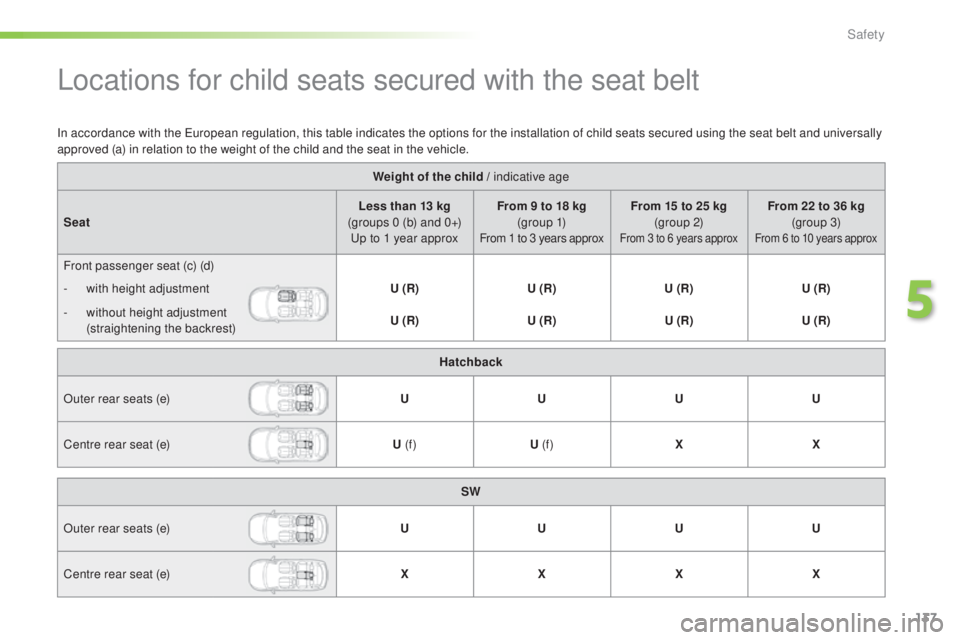
Locations for child seats secured with the seat belt
Weight of the child / indicative age
Seat Less than 13 kg
(groups 0 (b) and 0+)
up to 1 ye
ar approx From 9 to 18 kg
(g r o u p 1)
From 1 to 3 years approx
From 15 to 25 kg (group 2)
From 3 to 6 years approx
From 22 to 36 kg (group 3)
From 6 to 10 years approx
Front passenger seat (c) (d)
-
wi
th height adjustment U (R)U (R)U (R)U (R)
-
wi
thout height adjustment
(straightening the backrest) U (R)
U (R)U (R)U (R)
In accordance with the
eur
opean regulation, this table indicates the options for the installation of child seats secured using the seat belt and universally
approved (a) in relation to the weight of the child and the seat in the vehicle.
Hatchback
Outer rear seats (e) UUUU
Centre rear seat (e) U (f )U (f ) XX
SW
Outer rear seats (e) UUUU
Centre rear seat (e) XXXX
5
Safety